Last updated: September 12, 2026
We may earn a commission when you buy through links on this page, at no extra cost to you. We were not sent samples and no brand paid for placement. How we research and rate.
The short version
A bathrobe is worn directly against clean, damp skin, usually for an hour a day, and it is one of the few garments most people keep for a decade. That combination makes it a sensible place to care about how the cotton was grown and, more to the point, what was done to it afterwards.
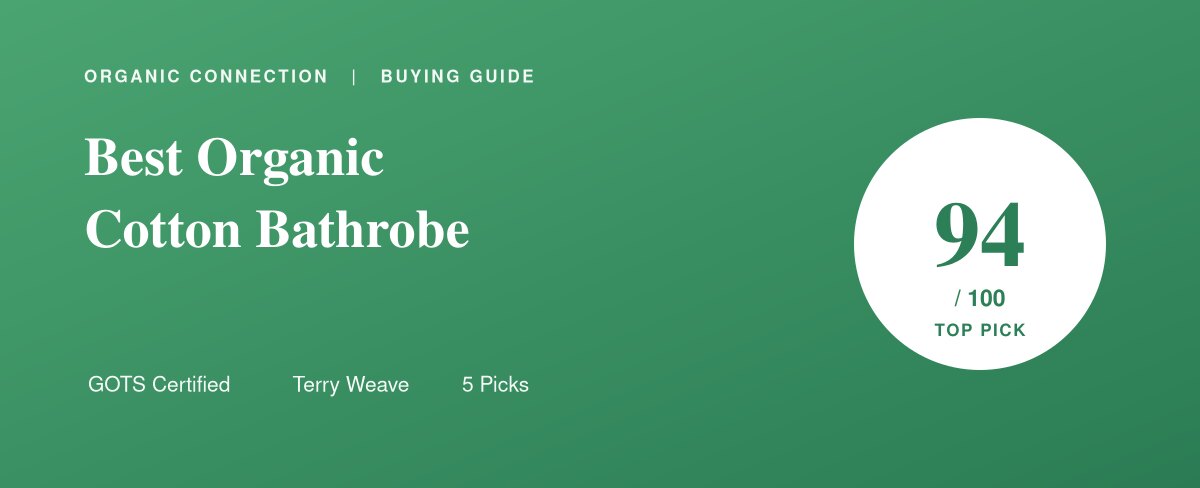
Our top pick is the GOTS Certified Organic Cotton Terry Bathrobe, which carries full certification and the classic heavyweight terry construction that makes a robe feel like a hotel robe. Arus is the pick for Turkish-woven quality with a hood, BAGNO MILANO is the lighter kimono-style option, and U2SKIIN is the cheapest certified robe we could verify.
An honest note on weave: “bathrobe” covers three quite different garments. Terry absorbs water and is what you want after a shower. Waffle and lightweight woven robes are loungewear that dry fast but absorb little. Velour looks plush but has a sheared outer face that absorbs less than it appears to. Most disappointment in this category comes from buying one and expecting another.
Best organic cotton bathrobe compared
Five robes, scored on the same criteria. The Organic Integrity Score is out of 100 and our rating is that score expressed out of five. Prices update automatically.
| Best Choice | Best Value | ||||
 |  |  |  |  | |
| Product | GOTS Terry Bathrobe | Arus Hooded Turkish | BAGNO MILANO Kimono | Burt’s Bees Baby | U2SKIIN Lightweight |
| Organic Integrity Score | 94/ 100 | 91/ 100 | 88/ 100 | 86/ 100 | 82/ 100 |
| Our rating | 4.7 | 4.6 | 4.4 | 4.3 | 4.1 |
| Certification | GOTS, Certified Organic | GOTS, Certified Organic | Certified Organic | GOTS, Organic | — |
| Weave | Heavyweight terry | Turkish terry | Lightweight woven kimono | Knit terry | Lightweight woven kimono |
| Absorbency | Highest here | High | Low, loungewear | Moderate | Low, loungewear |
| Hood | No, shawl collar | Yes | No | Yes | No |
| Best for | Proper post-shower robe | Hooded Turkish terry | Warm weather and summer | Babies and toddlers | Cheapest certified robe |
| Price | $89.00 View on Amazon | $73.95 View on Amazon | $49.95 View on Amazon | $29.95 View on Amazon | $27.99 View on Amazon |
- Organic Household hub
- our organic product database — compare brands across every guide
Price and availability as of October 27, 2026 7:10 am EDT. Product prices and availability are accurate as of the date/time indicated and are subject to change. Any price and availability information displayed on Amazon.com at the time of purchase will apply to the purchase of this product.
The three weaves, and which one you actually want
Get this right and everything else is detail. Get it wrong and no amount of certification will make you like the robe.
Terry: the absorbent one
Terry is woven with uncut loops on the surface, which multiplies the surface area enormously and is why towels are made this way. A terry robe genuinely dries you, and can replace a towel entirely if it is heavy enough.
The costs are weight and drying time. A heavyweight terry robe is substantial to wear and takes a long time to dry on a hook, so it needs a well-ventilated bathroom or a spot outside it. This is the classic hotel robe and the default choice for most people.
Waffle and lightweight woven: the fast one
Waffle weave forms a grid of raised squares, giving some texture and air circulation with far less material. These robes are light, pack small, dry quickly, and feel comfortable in warm weather.
They absorb noticeably less than terry. If you step out of the shower still wet, a waffle robe will feel damp rather than dry you. As loungewear over pajamas or in a hot climate, they are the better garment.
Velour and terry-velour: the plush one
Velour is terry with the outer loops sheared flat, producing a smooth, soft, slightly formal surface. Many hotel robes are terry inside and velour outside, which is a sensible compromise: absorbency against the skin, a smoother appearance outward.
A robe that is velour on both faces looks luxurious and absorbs relatively little. Check which construction you are buying, because listings often say velour without specifying whether the inner face is looped.
What certification does and does not cover here
GOTS is the standard that matters for a cotton robe, and it is worth being specific about its scope.
It requires certified organic fiber content, restricts the dyes and finishing chemicals permitted at every processing stage, bans chlorine bleaching and formaldehyde treatments, mandates wastewater treatment at the facilities, and applies social criteria to the factories. On a garment worn against skin daily, the chemistry restrictions are the substantive part. Our GOTS certification explainer covers the two tiers of the standard and what each one permits.
What it does not tell you is how well the robe is made. Stitch quality, belt loop placement, pocket depth, whether the tie stays tied, and how the garment survives forty washes are all construction questions that no certification addresses. A GOTS-certified robe can be poorly sewn, and a beautifully made robe can carry no certification at all.
It is also worth noting that “organic cotton” without a named certifier is a weaker claim than GOTS, and both appear on this page. We have said which is which rather than treating them as equivalent, and scored accordingly.
How we scored these robes
Every product on this site is scored out of 100 against the same ten criteria. Four carried the most weight here.
Named certification
We checked the certification claim against each product listing rather than the title, because search results in this category are dense with sponsored placements whose seals belong to other products. GOTS scored highest, a general organic cotton claim lower.
Weave stated clearly
A listing that specifies terry, waffle or velour, and ideally the weight, is telling you what the garment will actually do. Vague descriptions score lower, because weave is the single biggest determinant of whether you will be happy with it.
Construction details
Belt loops sewn into the side seams rather than tacked on, pockets deep enough to be useful, a shawl or hooded collar that sits properly, and a tie long enough to knot comfortably. These are what separate a robe you keep from one you replace.
Sizing honesty
Robes run notoriously inconsistent, and Turkish-made robes in particular often run generous. We weighted listings that give real measurements rather than only S/M/L.
Best overall: GOTS Certified Organic Cotton Terry Bathrobe
| Organic Integrity Score | 94 / 100 |
| Certification | GOTS, Certified Organic |
| Weave | Heavyweight terry, looped both faces |
| Collar | Shawl collar, no hood |
| Best for | The classic absorbent robe with full certification |
This is the robe most people picture when they think of a bathrobe: heavyweight terry, shawl collar, full length, and genuinely absorbent enough to replace a towel. It is also the only one here where the listing names GOTS explicitly rather than making a general organic claim.
Terry looped on both faces is what produces the absorbency. It also makes the robe heavy and slow to dry, which is the honest trade. Hang it somewhere with air movement rather than on the back of a bathroom door.
It is the most expensive robe on this page and the one we would still buy. A well-made terry robe lasts many years, and the price per year is trivial compared with replacing a cheap one repeatedly.
Best hooded: Arus Organic Cotton Turkish Bathrobe
| Organic Integrity Score | 91 / 100 |
| Certification | GOTS, Certified Organic |
| Weave | Turkish terry |
| Length | Full length, hooded |
| Best for | Long hair, and anyone who wants a hood |
The hood is the reason to buy this one. If you have long hair, a hooded terry robe removes the need for a second towel wrapped around your head, which is a small daily convenience that adds up.
Arus weave in Turkey, where the long-staple cotton and the terry weaving tradition are both genuinely good. The fabric feels denser than the price suggests and it softens rather than thins over the first several washes.
Sizing runs generous, as Turkish robes usually do. Read the measurements rather than the letter size, particularly if you are between sizes.
Best for warm weather: BAGNO MILANO Organic Cotton Kimono Robe
| Organic Integrity Score | 88 / 100 |
| Certification | Certified Organic |
| Weave | Lightweight woven, kimono cut |
| Absorbency | Low, this is loungewear |
| Best for | Summer, travel, and over pajamas |
A different garment for a different purpose. The kimono cut and lightweight woven fabric make this comfortable in heat, quick to dry, and easy to pack, none of which a heavyweight terry robe manages.
Be clear about what you are getting: it will not dry you after a shower the way terry does. Used over pajamas, in summer, or in a hotel where a bulky robe is impractical, it is the better choice. Used as a towel replacement, it will disappoint.
The organic Turkish cotton is genuinely soft, and it gets softer with washing. For a lot of people this is the robe they end up wearing most, simply because it is the one that is comfortable indoors year round.
Best for children: Burt’s Bees Baby Organic Hooded Robe
| Organic Integrity Score | 86 / 100 |
| Certification | GOTS, Organic |
| Weave | Knit terry, hooded |
| Sizing | Infant and toddler |
| Best for | Babies and small children after a bath |
Included because children are the group for whom the finishing-chemistry argument is strongest: thinner skin, higher surface area relative to body mass, and a garment worn right after a bath when skin is warm and damp.
Burt’s Bees Baby uses organic cotton across the range and the knit terry is soft rather than scratchy, which matters when the wearer will simply refuse to put on something uncomfortable. The hood is genuinely useful on a wet-headed toddler.
It is a small garment and children outgrow it quickly, so buy a size up if you are between. Our organic cotton pajamas guide covers the rest of the wardrobe on the same criteria.
Best value: U2SKIIN Organic Cotton Robe
| Organic Integrity Score | 82 / 100 |
| Certification | — |
| Weave | Lightweight woven, long kimono |
| Best for | Organic cotton loungewear at the lowest price here |
The cheapest robe on this page by some margin, and a reasonable one. It is a lightweight woven kimono rather than terry, so treat it as loungewear rather than a shower robe.
It scores lowest of the adult robes because the listing claims organic cotton without naming a certifying body, which is a materially weaker claim than the GOTS robe at the top. We have not assumed the two are equivalent.
If you want something organic to throw on around the house and do not want to spend seventy or ninety dollars, this does the job. If you want a robe that dries you, spend more and buy terry.
Turkish, Egyptian and ordinary cotton
Robe listings lean heavily on cotton origin, and the terms are worth decoding because two of them mean something and one is often decoration.
Staple length is the real variable. Staple means the length of the individual cotton fiber. Longer fibers can be spun into finer, stronger, smoother yarn with fewer loose ends, which is why long-staple cotton feels better and pills less. Everything else in the naming is a proxy for this.
Turkish cotton is generally long-staple, and Turkey has a genuine terry weaving industry built around it. In robes and towels the description is usually meaningful, which is why two of our picks are Turkish. It tends to start slightly less plush than Egyptian and become more absorbent as it is washed.
Egyptian cotton is extra-long staple when it is genuine, and it is the softest of the three. It is also the term most abused: the label has been applied to blends and to cotton never grown in Egypt often enough that it has been the subject of industry fraud investigations. Treat it as a claim requiring evidence rather than a guarantee.
Upland cotton, the ordinary short-staple variety, accounts for the overwhelming majority of the world crop and most robes that name no origin at all. It is perfectly serviceable. It pills sooner and feels less smooth, and it is what you are getting when a listing simply says “100% cotton”.
None of this is an organic question. Staple length is about fiber quality; certification is about farming and finishing chemistry. A robe can be long-staple and conventionally processed, or short-staple and fully GOTS certified. They are separate axes and it is worth checking both.
Getting the size and the care right
Read measurements, not letters. Robe sizing is among the least consistent in clothing, and Turkish-made robes typically run generous. Chest and length in inches tell you what S/M/L does not.
Wash before first wearing. New terry sheds lint and reaches full absorbency only after two or three washes. A brand new terry robe genuinely does not dry you as well as the same robe a month later.
Never use fabric softener on terry. It coats the loops in a waxy residue and directly reduces absorbency, which defeats the purpose of buying terry. White vinegar in the rinse softens without the coating.
Tumble dry low, or line dry. High heat degrades cotton loops over time and causes more shrinkage than the fabric needs to suffer. Low and slow keeps a robe usable for years longer.
Hang it where air moves. A damp terry robe on a hook behind a closed bathroom door is how robes start to smell musty. A hook outside the bathroom solves it entirely.
For the rest of the linen cupboard, see our guides to organic cotton towels and organic cotton bath mats, and our organic cotton textiles guide for what certification is worth across the category.
Judging construction before you buy
Certification tells you about the fiber and the chemistry. It says nothing about whether the robe survives four years of washing, and the details that decide that are visible in listing photographs if you know what to look at.
The belt loops
This is the single most common failure point in a bathrobe and the easiest to assess. Loops sewn into the side seam, where the fabric is already doubled and reinforced, hold indefinitely. Loops tacked onto the surface with a short line of stitching pull away, taking a patch of towelling with them and leaving a hole that cannot be neatly repaired.
Look for the loop sitting flush in the seam line rather than as an obvious added strap. Some better robes also have a second set of loops at a different height, which is genuinely useful if you are between the heights the pattern was cut for.
Belt length and width
A tie that is too short knots but will not stay knotted, and a robe that keeps falling open is one you stop wearing. As a rough guide the belt should go around you comfortably with enough left for a proper bow rather than a tight single knot. Wider belts hold a knot better than narrow ones and dig in less when sitting.
Pockets and seams
Patch pockets sewn onto the outside are quicker to make and pull away sooner than inset pockets set into the seam. Depth matters more than you would think, since a shallow pocket on a heavy terry robe will not hold a phone without it working loose.
On seams generally, look for double stitching at the shoulders and side seams. Terry is heavy when wet and the shoulder seam carries all of it.
Collar and cuff finishing
A shawl collar should be interlined or doubled so it holds shape; a single layer of towelling flops and looks tired within months. Cuffs that are simply hemmed will fray and stretch, whereas a banded or turned cuff keeps its shape. Neither is expensive to do properly, which makes their absence a reasonable proxy for how the rest of the robe was made.
Common questions about organic cotton bathrobes
What is the difference between terry, waffle and velour?
Terry has uncut loops and is the absorbent one. Waffle is a light grid weave that dries fast but absorbs little. Velour is terry with the outer loops sheared flat, which looks plush but absorbs less than looped terry.
Does GOTS certification mean the robe is well made?
No. GOTS covers fiber content, processing chemistry, wastewater and social criteria. It says nothing about stitching, belt loops, pocket depth or how the garment survives repeated washing.
Is “organic cotton” as good as GOTS certified?
It is a weaker claim. GOTS names an accredited certifier and audits the whole chain, while an unqualified organic cotton claim may refer only to the fiber with no oversight of processing.
Why does my new terry robe not absorb well?
New terry reaches full absorbency only after two or three washes, and fabric softener or residual manufacturing finishes reduce it further. Wash it before first use and skip the softener.
How do I stop a bathrobe smelling musty?
Hang it where air circulates rather than on a hook behind a closed bathroom door, and wash it every week or two. Damp terry in still air is what causes the smell.
What size bathrobe should I buy?
Use the stated chest and length measurements rather than S/M/L, and be aware that Turkish-made robes usually run generous. Size up if you want to wrap it over pajamas.
What is the most common way a bathrobe fails?
Belt loops pulling away. Loops sewn into the side seam, where the fabric is doubled, hold for years; loops tacked onto the surface tear out and take a patch of towelling with them. It is visible in listing photographs and worth checking before buying.
How long should a bathrobe belt be?
Long enough to go around you comfortably and still tie a proper bow rather than a tight single knot. Short belts knot but do not stay knotted. Wider belts hold better and are more comfortable to sit in than narrow ones.
Should I buy a hooded robe or a shawl collar?
A hood is genuinely useful if you have long hair, since it removes the need for a second towel. A shawl collar is more comfortable to sit against and looks less bulky. Check that a shawl collar is doubled or interlined, since a single layer of towelling loses its shape quickly.
Can a terry bathrobe replace a towel?
A heavyweight terry robe genuinely can, provided it has been washed two or three times to reach full absorbency and has never met fabric softener. Waffle and lightweight woven robes cannot, as they absorb far less and are designed as loungewear.
Will an organic cotton bathrobe shrink?
Cotton shrinks most in its first hot wash and tumble dry, typically a few percent, and organic cotton is no different since shrinkage is a property of the fiber rather than the farming. Wash warm rather than hot and tumble on low to limit it. Buying a size up is sensible if you want to wrap the robe over pajamas.
How often should a bathrobe be washed?
Every one to two weeks with normal use, more often in humid conditions. A robe goes on clean skin so it stays fresher than most clothing, but terry holds moisture and a damp robe on a hook behind a closed door is what causes the musty smell people blame on the fabric.
Are Turkish and Egyptian cotton robes actually different?
Both terms refer to long-staple cotton, which spins into smoother, stronger yarn that pills less. Turkish cotton is generally genuine in robes and towels because Turkey has a real terry weaving industry. Egyptian cotton is the more abused label and has been the subject of industry fraud cases, so treat it as a claim needing evidence rather than a guarantee.
What weight of terry should I look for?
Listings that state a GSM figure are telling you something useful. Around 300 to 400 GSM is a light robe suited to warm weather, 400 to 600 is a standard everyday weight, and above 600 is the heavy hotel-style robe that dries you properly and takes a long time to dry itself. Many listings omit it, which is itself informative.
Why does my new robe leave lint everywhere?
New terry sheds loose fibers left from weaving and cutting, and it is normal for the first two or three washes. Wash it separately at first so the lint does not transfer to other laundry, and expect it to stop. Shedding that continues beyond a few washes indicates poor yarn quality rather than a settling-in period.
Is a childrens robe worth buying in organic cotton?
It is the strongest case in the category. Children have thinner skin and a higher surface area relative to body mass, and a robe goes on straight after a bath when skin is warm and damp. The restrictions GOTS places on finishing chemistry matter more in that situation than in adult use.
Looking for other organic products?
We have checked more than 800 products across food, household goods, gardening, personal care and pet, every one against its stated certification. Browse all reviews.
Organic Connection participates in the Amazon Services LLC Associates Program, an affiliate advertising program designed to provide a means for sites to earn advertising fees by advertising and linking to Amazon.com.