Last updated: September 30, 2026
We may earn a commission when you buy through links on this page, at no extra cost to you. How we research and rate.
Safety note: Always do a patch test 48 hours before coloring, even with natural products, since allergic reactions are possible. Avoid so-called “black henna,” which contains PPD and can cause severe reactions. Pure henna and clean plant-based dyes are gentler than conventional color but not risk-free, so follow the directions and check with a professional if you are pregnant or have a sensitive scalp.
The short version
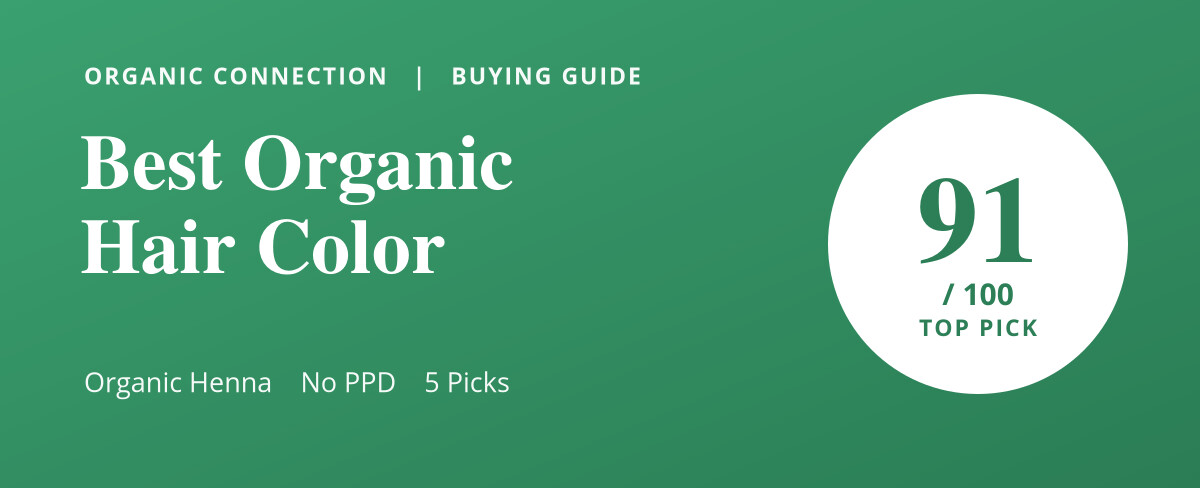
After researching the ingredients and certifications of the most popular organic and natural hair colors, our top pick is Indus Valley Bio Organic Natural Henna Hair Color. It is made from organic henna leaf powder and botanicals with nothing else, free of ammonia, peroxide, PPD, and metallic salts, which is why it earned our highest Organic Integrity Score of 89 out of 100. For a permanent color with strong gray coverage, Naturtint is our pick, and for a ready-to-use semi-permanent cream, Surya Brasil Henna Cream is the best choice.
One honest note up front: the only truly “organic” hair colors are pure henna and plant powders, because permanent color chemistry cannot be certified organic. So this is a guide to organic and natural hair color, and we are clear about which picks are pure organic henna and which are cleaner-than-conventional plant-based dyes.
Best organic hair color compared
| Best Choice | Best Value | ||||
 |  |  |  |  | |
| Product | Indus Valley Henna | Naturtint | Surya Brasil Cream | Indus Valley Henna 16 oz | Surya Brasil Black |
| Organic Integrity Score | 89/ 100 | 79/ 100 | 78/ 100 | 77/ 100 | 76/ 100 |
| Our rating | 4.5 | 4.0 | 3.9 | 3.9 | 3.8 |
| Best for | Most organic | Permanent / gray coverage | Ready-to-use cream | Value henna | Dark & gray |
| Type | Pure henna powder | Ammonia-free permanent | Semi-permanent henna cream | Pure henna powder | Semi-permanent cream |
| Chemistry | No chemicals | No ammonia/resorcinol | No PPD/ammonia | No chemicals | No PPD/ammonia |
| Price | $9.35 $9.95 −6%$2.67 / ounce View on Amazon | $79.99$2.63 / fluid ounce View on Amazon | $16.98 View on Amazon | $29.99 View on Amazon | $17.99$7.59 / fluid ounce View on Amazon |
Price and availability as of October 11, 2026 7:10 pm EDT. Product prices and availability are accurate as of the date/time indicated and are subject to change. Any price and availability information displayed on Amazon.com at the time of purchase will apply to the purchase of this product.
Scores are ours, based on independent research of ingredients, chemical-free formulation, and honest labeling, using the same 10-criteria method we apply to every product. See how we research and rate.
Reading the seals on organic hair color: what each one does and does not cover
A seal is a specific promise about a specific thing. These are the promises behind the marks on this page, in plain terms, along with the question each one leaves unanswered.
| Certification | Covers | Key exclusion |
| USDA Organic | Farming and handling: no synthetic pesticides or fertilizers, no GMOs, no sewage sludge or irradiation, audited yearly by an accredited certifier | Three different tiers share the one seal, and it makes no claim about worker pay, food miles, or nutrition |
| Demeter Biodynamic | Organic practice plus whole-farm ecosystem requirements and biodynamic preparations | Certified separately from USDA Organic; the two are not interchangeable on a label |
| COSMOS Organic | Cosmetics: organic content thresholds, permitted processes and ingredients, and packaging rules | Its sister grade, COSMOS Natural, carries the same name and requires no minimum organic content at all |
| Soil Association | The UK organic standard across food, textiles and beauty, in several places stricter than the legal minimum | A UK and EU scheme; it is not USDA Organic and the two are not interchangeable on a US label |
COSMOS is two standards with one name, and the weaker one is easy to miss. COSMOS Organic requires at least 95% of the plant ingredients to be organic. COSMOS Natural, printed in the same typeface by the same body, requires no minimum organic content whatsoever: it governs which ingredients and processes are permitted, not how much of the product is organic. If the word after COSMOS is “Natural”, the organic question is still open.
Key things to look for in organic and natural hair color
Good natural hair color is about clean ingredients and realistic expectations. Here is what matters.
1. Pure henna or clean plant ingredients
The most organic options are 100% henna leaf powder and botanicals, with no chemical additives.
2. Free of the harsh chemicals
Look for no ammonia, peroxide, PPD, resorcinol, or metallic salts, which are the ingredients most people want to avoid.
3. Permanent vs semi-permanent
Henna and natural creams are semi-permanent and fade gradually; ammonia-free permanent dyes give longer gray coverage with cleaner chemistry than conventional color.
4. Realistic color results
Natural colors work with your existing shade rather than lightening it, so results vary by starting color.
Why “organic” hair color is really henna
Permanent hair dye works through chemical reactions that lighten and deposit color, and that chemistry, ammonia, peroxide, and dye precursors like PPD, simply cannot be certified organic. So when a product is genuinely “organic” hair color, it is almost always pure henna or a blend of plant powders, which stain and coat the hair with natural pigments and condition it at the same time. These are semi-permanent, work with your natural shade rather than bleaching it, and are the cleanest option available.
Beyond pure henna, there are cleaner-than-conventional plant-based dyes, ammonia-free permanent colors and ready-to-use henna creams, that avoid the harshest chemicals while offering easier application and better gray coverage. We are upfront about which picks are pure organic henna and which are natural (but not certified-organic) dyes, and our scoring rewards clean ingredients, the absence of harsh chemicals, and honest labeling.
How to choose an organic or natural hair color
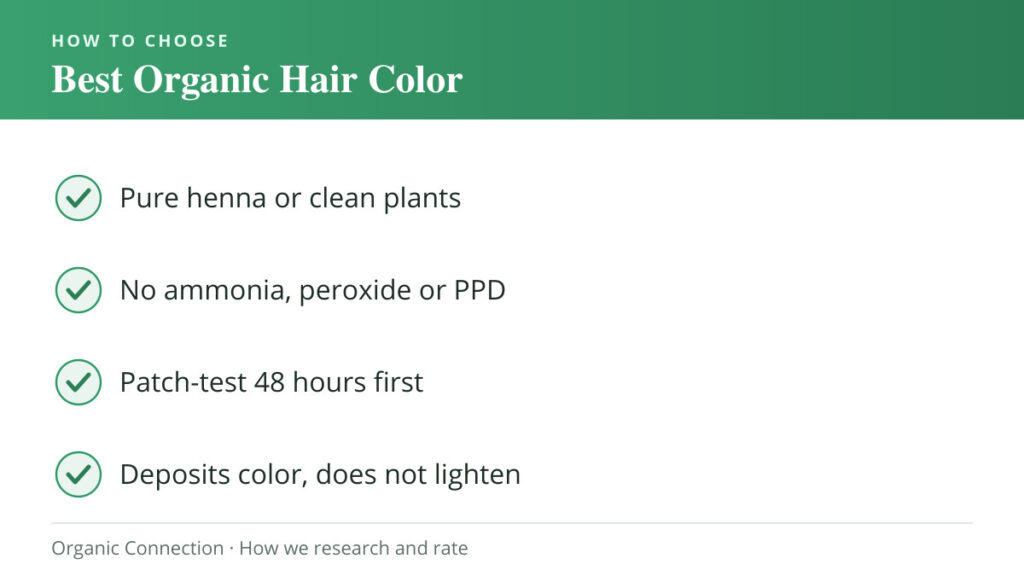
- Decide henna or dye. Pure henna is the most organic; a clean plant-based dye is easier and covers gray better.
- Check the ingredient list. Look for no ammonia, peroxide, PPD, resorcinol, or metallic salts.
- Set realistic expectations. Natural colors deepen and enrich rather than lighten, so results depend on your starting shade.
- Patch-test every time. Even natural dyes can cause reactions; test 48 hours before.
- Avoid “black henna.” It contains PPD and can cause severe reactions; pure henna is reddish, not black.
Who should buy organic hair color
The best color depends on your goals. If you want the most organic, pure-henna option, our top pick fits. If you want a permanent color with strong gray coverage, a ready-to-use semi-permanent cream, the best value henna, or coverage for dark and gray hair, we have a pick for each.
Best overall: Indus Valley Bio Organic Natural Henna Hair Color
| Organic Integrity Score | 89 / 100 |
| Type | Pure organic henna leaf powder and botanicals |
| Chemistry | No ammonia, peroxide, PPD, or metallic salts |
| Best for | The cleanest, most organic color |
Light Mountain is our top pick because it is genuinely organic and chemical-free. It contains organic henna leaf powder and pure botanicals and nothing else, ammonia-free, PPD-free, peroxide-free, and metallic-salt-free, cruelty-free, and vegan, coloring and conditioning your hair with plant pigments across a range of red and brown shades.
The trade-off is that pure henna takes more effort (mix with water, apply, and leave on) and works with your natural shade rather than lightening it. For the cleanest, most organic color, it is our first choice.
What we liked: Pure organic henna and botanicals, no harsh chemicals, cruelty-free and vegan, and conditioning as it colors.
Keep in mind: Henna is more hands-on to apply and deposits rather than lightens, so results depend on your starting color.
What the listing discloses: INDUS VALLEY documents a USDA organic claim and Ecocert as the certifying agent, and leaves where it was grown or made unsaid.
Best permanent: Naturtint Permanent Hair Color
| Organic Integrity Score | 79 / 100 |
| Type | Ammonia-free permanent color, plant-enriched |
| Chemistry | No ammonia or resorcinol |
| Best for | Long-lasting gray coverage |
Naturtint is our pick for permanent color. It was the first permanent colorant without ammonia or resorcinol, enriched with plant ingredients like olive-derived oleic acid, meadowfoam seed oil, and quinoa, delivering up to 100% gray coverage and long-lasting results across 30+ shades, vegan and cruelty-free, with a cleaner formula than conventional permanent dye.
It scores below our henna pick because it is a natural, cleaner permanent dye rather than a certified-organic product, but for the best gray coverage and lasting color with far fewer harsh chemicals, it is excellent.
What we liked: Ammonia- and resorcinol-free, plant-enriched, strong gray coverage, many shades, and vegan and cruelty-free.
Keep in mind: It is a natural, cleaner permanent dye rather than certified organic, and permanent dyes still warrant a patch test.
What the listing discloses: No organic certification appears anywhere on the Naturtint listing.
Best cream: Surya Brasil Henna Cream
| Organic Integrity Score | 78 / 100 |
| Type | Ready-to-use semi-permanent henna cream |
| Chemistry | No ammonia, PPD, peroxide, or parabens |
| Best for | Easy, no-mix natural coloring |
Surya Brasil is our pick for convenience. Its award-winning henna cream is a ready-to-use, no-mixing semi-permanent color made with 94 to 98% natural-origin ingredients, henna, aloe, Brazil nut oil, and botanicals, free of ammonia, PPD, peroxide, resorcinol, and parabens, that colors, conditions, and covers gray while gradually fading over 10 to 12 washes.
It scores in the middle because it is a natural cream rather than pure organic henna, but for an easy, clean, no-mess natural color you can apply straight from the tube, it is a standout.
What we liked: Ready-to-use with no mixing, 94 to 98% natural ingredients, no PPD or ammonia, and conditioning gray coverage.
Keep in mind: It is semi-permanent and fades over 10 to 12 washes, and it is natural rather than certified organic.
What the listing discloses: No organic certification appears anywhere on the Surya Brasil listing.
Best value: Indus Valley Henna (16 oz)
| Organic Integrity Score | 77 / 100 |
| Type | Pure organic henna, 16 oz value size |
| Chemistry | No ammonia, peroxide, PPD, or metallic salts |
| Best for | Long hair and frequent coloring |
The 16-ounce Light Mountain henna is our value pick. It is the same pure, organic, chemical-free henna as our top pick in a larger size, giving a much lower cost per application, ideal for long or thick hair that needs more product, or for anyone who colors regularly and wants to stock up.
It scores in the value range simply because it overlaps with our top pick; the quality and cleanliness are identical. For pure organic henna at the best price per use, it is the smart buy.
What we liked: Identical pure organic henna in a large 16-ounce size, and a low cost per application.
Keep in mind: It is the same hands-on henna process, just in a bigger, better-value size.
What the listing discloses: On the LIGHT MOUNTAIN label: a single-ingredient formula. Not stated: where it was grown or made.
Best for dark & gray: Surya Brasil Henna Cream Black
| Organic Integrity Score | 76 / 100 |
| Type | Semi-permanent henna cream, black |
| Chemistry | 96% natural ingredients, no PPD or ammonia |
| Best for | Covering gray on dark hair |
Surya Brasil Black is our pick for dark hair and gray coverage. This ready-to-use henna cream is 96% natural, free of PPD and ammonia, and delivers a deep, conditioning black to cover gray on dark hair, a genuinely important safe alternative to the “black henna” and harsh black dyes that people should avoid.
It scores at the value end because black is the hardest shade for natural dyes to achieve and it is semi-permanent, but for a clean, PPD-free way to cover gray on dark hair, it is the right choice.
What we liked: A safe, PPD-free black option, 96% natural, ready to use, and conditioning gray coverage on dark hair.
Keep in mind: Black is the toughest natural shade, so it is semi-permanent and may need reapplication for full, lasting coverage.
What the listing discloses: Surya Brasil carries no organic claim, certified or otherwise.
How to color your hair naturally
Always patch-test 48 hours ahead. For pure henna, mix the powder with warm water (some people add lemon juice or tea) to a yogurt-like paste, apply to clean hair with gloves, cover, and leave on for one to several hours before rinsing; the color deepens over a day or two. Ready-to-use creams apply straight from the tube and rinse after the time on the box. Remember that natural colors deposit and enrich rather than lighten, so they work best going darker or richer, not lighter, and results depend on your starting shade. Never use “black henna,” which contains PPD.
The chemicals these products leave out, and what each one does
Every “clean” hair color brand advertises what it is free from, and almost none explain what those ingredients were doing in the first place. That matters, because each omission costs you something — usually longevity, lift or gray coverage — and knowing which trade you are making is how you pick the right product rather than the loudest label.
| Ingredient | What it does | Cost of removing it |
| Ammonia | Raises pH to swell the cuticle so dye can enter the cortex | Replaced by MEA (ethanolamine), which is gentler on smell but not necessarily on hair; color may sit less deeply |
| Hydrogen peroxide | Lifts existing pigment and develops the new color | Without it you cannot go lighter at all. This is the hard ceiling on plant dyes. |
| PPD / PTD | The primary intermediate that forms permanent color, especially dark shades | PPD-free permanent dark shades are harder to achieve and fade faster. PTD is a lower-reactivity substitute, not an absence. |
| Resorcinol | A coupler that shapes tone and helps gray coverage | Tone control narrows; some brands compensate with other couplers rather than removing the class |
| Metallic salts | Cheap progressive darkening in some “natural” dyes | Nothing lost. This one should be removed — see below. |
The honest summary: permanent color that lightens hair requires peroxide, and peroxide is not a plant. A fully certified-organic permanent dye with lift does not exist, and any product claiming it is either not permanent, not lifting, or not certified. What genuinely exists is henna and other plant dyes that deposit color, and conventional dyes reformulated to drop the most reactive ingredients.
PPD: the ingredient worth actually understanding
Para-phenylenediamine is the single most important ingredient in this category, both because it is what makes dark permanent color work and because it is the most common cause of serious reactions to hair dye.
In oxidative hair dye, PPD is regulated to low single-digit percentages and must be mixed with developer immediately before use — once oxidized and bound into the hair, the reactive form is largely gone. It is prohibited for direct application to skin, and the FDA has never approved it for that use.
Keep in mind — “black henna” is not henna. Real henna stains a reddish orange-brown and takes hours to develop. Any paste sold as henna that stains jet black within an hour contains added PPD, often at concentrations far above what hair dye is allowed. Analyses of artisanal black henna mixtures have found PPD ranging from around 2% to over 15%, and unregulated products up to nearly 30% — applied directly to skin and left to soak for hours. Twelve years of FDA adverse-event data catalog the results: allergic contact dermatitis, blistering, chemical burns, permanent scarring, and lifelong sensitization. Pediatric case reports specifically flag toddlers sensitized by holiday tattoos. Once sensitized, a person often cannot use conventional hair dye safely for the rest of their life. If you take one thing from this guide, take that.
Patch test properly, every time. Not just the first time — sensitization can develop after years of uneventful use.
- Mix a small amount exactly as you would for the full application.
- Apply to a coin-sized area behind the ear or inside the elbow.
- Leave uncovered and unwashed for 48 hours.
- Any itching, redness, swelling or burning means do not use the product — and note the brand, because cross-reaction between PPD and PTD is common.
- If you have ever reacted to a black henna tattoo, a dark textile dye or a sulfa drug, treat that as a strong reason to patch test with extra care.
Compound henna and metallic salts: the safety issue nobody mentions
Pure henna (Lawsonia inermis) is inert with respect to other hair chemistry. Nothing in the plant reacts badly with bleach or conventional color applied later.
Compound henna is a different product entirely. To offer henna in shades the plant cannot produce — black, ash, blonde — some manufacturers blend it with metallic salts and organic intermediates such as pyrogallol. These deposit metal in the hair shaft, and metal reacts with peroxide.
The consequences are well documented in salon practice: hair treated with metallic-salt henna and then colored or bleached can heat up, smoke, turn green or gray, become brittle and break off at the root. In severe cases the reaction causes scalp burns. This is why professional colorists ask whether you have used henna and often decline to work on hair that has — they are not being precious about plant dyes, they are avoiding a genuinely dangerous reaction. Damage of this kind cannot be conditioned out; the affected length has to grow out or be cut.
How to stay clear of it:
- Buy henna with a single-ingredient list: Lawsonia inermis, and nothing else. Two-ingredient products adding indigo (Indigofera tinctoria) or cassia are also fine.
- Treat “henna” sold in black, ash, platinum or blonde with suspicion. The plant produces red-orange. Everything else comes from blending with indigo, or from something that is not a plant.
- Avoid products whose ingredient list is vague, proprietary or lists “mineral colorants”.
- Tell any colorist exactly what you have used and when, even if it was a year ago.
- If you are unsure what is on your hair, a colorist can strand-test a cutting in developer before touching your head. Ask for it.
Certifications that actually mean something here
“Organic” on a hair color box is not regulated the way it is on food, and this is the category where that gap is widest. Three marks carry real audit weight:
- Soil Association — the strictest of the three for cosmetics. It’s Pure is generally cited as the only Soil Association certified organic hair color brand in the world, which tells you how narrow the genuinely certified end of this shelf is.
- ECOCERT / COSMOS Organic — sets minimum percentages of organic content and restricts processing. Natulique’s botanicals are ECOCERT-certified, though the finished color system is not therefore a plant dye.
- USDA Organic — appears on single-ingredient plant powders such as henna, cassia and indigo. Straightforward and meaningful for those, and essentially absent from oxidative color.
What you will more often see is an uncertified claim: “made with organic ingredients”, “certified organic botanicals”, “97% naturally derived”. None of these are audited claims about the finished product, and “naturally derived” in particular can describe a heavily processed molecule whose starting material was a plant. Read the ingredient list; it is more informative than the front of the box.
Lower-chemical salon lines, if you want a professional result
Most organic hair color roundups only cover boxes you can buy online, which skips the part of the market where the reformulation work is actually happening. If you would rather have a colorist do it, ask whether your salon carries one of these:
| Line | Position | Worth knowing |
| Natulique | ECOCERT-certified organic botanicals; a low-PPD range and a PPD-free “Sensitive” range | The PPD-free range trades some dark-shade depth and longevity |
| Oway Hcolor | Biodynamic botanicals; ammonia-free, PPD-free, resorcinol-free | Among the gentlest oxidative systems in professional use |
| Organic Color Systems | Low-ammonia oxidative color with a high organic ingredient fraction | Long-established in salons specializing in sensitive scalps |
| Herbatint / Tints of Nature | At-home, ammonia-free, reduced or low PPD | The realistic middle ground between henna and conventional box dye |
None of these are plant dyes. They are conventional oxidative color with the harshest components reduced or removed, which is a real improvement and a different thing from “organic”. If a salon describes any oxidative color as fully organic, that is marketing.
Permanent, demi and semi: what you are actually choosing between
| Type | How it works | Lasts | Can it lighten? |
| Permanent | Alkaliser opens cuticle, peroxide lifts, dye forms inside the cortex | Until it grows out; needs root touch-ups | Yes |
| Demi-permanent | Low-volume peroxide, no ammonia; deposits and tones | 20–28 washes | No |
| Semi-permanent | Pigment coats the cuticle; no developer | 6–12 washes | No |
| Henna / plant dye | Lawsone binds to keratin; builds with repeat use | Effectively permanent, fades in tone not presence | No |
If your goal is the lowest chemical exposure and you are not trying to go lighter, demi-permanent or semi-permanent in one of the cleaner lines is the practical answer. They fade faster, which is the trade, and they are gentler on both scalp and hair. Plant dyes go further still, at the cost of shade range and reversibility.
Dark shades and gray coverage with plant dyes
Henna alone will not give you brown or black — it gives red-orange, and on gray hair the result is bright copper. Darker shades come from a two-step process most beginners get wrong on the first attempt.
- Henna first. Apply pure henna and leave it 2–4 hours. This lays down the red base that indigo needs something to bind over.
- Rinse, do not shampoo. Water only.
- Indigo second. Mix indigo fresh — it has a working life of under an hour — and apply for 1–2 hours. One step gives brown; a longer second step gives near-black.
- Wait 48 hours before washing with shampoo. Indigo oxidizes and settles over roughly two days, and color that looks alarmingly green on day one usually resolves to brown by day three.
Single-step “henna and indigo mixed together” products are more convenient and give a softer, less durable brown, particularly over gray. On resistant gray, two steps is the difference between coverage and a copper halo.
Keep in mind: plant dye is close to irreversible. It cannot be lifted out cleanly, bleach over henna gives unpredictable results, and the only reliable removal is growing it out. Strand-test on hair from a brush before committing, and start with a shorter processing time than the box suggests — you can always repeat, but you cannot undo.
How we researched this guide
We are a research-based review site. We compared each product against its ingredients, absence of harsh chemicals, honest labeling, and the weight of aggregated customer feedback on color and gentleness, then scored each with our 10-criteria Organic Integrity Score. No brand paid to be included or ranked. Read the full method on our How We Research and Rate page.
Common questions about organic hair color
What is the best organic hair color?
Our overall pick is Indus Valley Bio Organic Natural Henna Hair Color, because it is pure organic henna and botanicals with no ammonia, peroxide, PPD, or metallic salts. For a permanent color with strong gray coverage, Naturtint is our pick, and for an easy cream, Surya Brasil Henna Cream.
Is there such a thing as truly organic hair dye?
Genuinely organic hair color is essentially pure henna and plant powders, because permanent dye chemistry cannot be certified organic. Other “natural” dyes are cleaner than conventional color (no ammonia or PPD) but are not certified organic.
Is natural hair color safe?
Natural colors avoid the harshest chemicals, but they are not risk-free, so always patch-test 48 hours ahead. Critically, avoid “black henna,” which contains PPD and can cause severe skin reactions; pure henna is reddish, never black.
Does henna cover gray hair?
Henna coats gray with a reddish or brown tone rather than an exact match, and results vary by starting color. For precise, permanent gray coverage, an ammonia-free dye like Naturtint or a ready-to-use henna cream tends to cover more evenly.
Can natural hair color lighten my hair?
No. Henna and natural dyes deposit color and work with your existing shade, so they enrich or darken rather than lighten. To go lighter you need a lightening (bleaching) process, which natural colors do not provide.
What is PPD in hair dye and is it dangerous?
Para-phenylenediamine is the primary intermediate that makes permanent dark color work. In oxidative hair dye it is regulated to low single-digit percentages and must be mixed with developer immediately before use. It is prohibited for direct application to skin, and it is the most common cause of serious allergic reactions to hair color. Patch test 48 hours before every application, not just the first one — sensitization can develop after years of uneventful use.
Is black henna safe?
No. Real henna stains reddish orange-brown over several hours. Any paste that stains jet black quickly contains added PPD, often far above the concentration allowed in hair dye — analyses have found 2% to over 15% in artisanal mixtures and up to nearly 30% in unregulated products, applied straight to skin. FDA adverse-event data record blistering, chemical burns, permanent scarring and lifelong sensitization, including in young children. Once sensitized, many people can never use conventional hair dye safely again.
Why do salons refuse to color hair that has had henna?
Because of metallic salts, not the henna itself. Pure Lawsonia inermis is inert and reacts with nothing. But compound henna, blended with metallic salts to produce black or ash shades the plant cannot make, deposits metal in the hair shaft. That metal reacts with peroxide — hair can heat up, smoke, turn green, become brittle and break off, and in severe cases the scalp is burned. Buy henna with a single-ingredient list and tell any colorist what you have used.
Can organic hair color lighten my hair?
No. Lightening requires hydrogen peroxide to lift existing pigment, and peroxide is not a plant ingredient. Any product claiming to be fully organic and to lighten hair is either not permanent, not lifting, or not certified. Plant dyes deposit color on top of what is there, which means the result always depends on your starting shade.
Which organic hair color certifications are real?
Three carry audit weight: Soil Association, the strictest for cosmetics and held by very few hair color brands; ECOCERT and COSMOS Organic, which set minimum organic content and restrict processing; and USDA Organic, which appears on single-ingredient plant powders such as henna, cassia and indigo. Uncertified phrasing like “made with organic ingredients” or “97% naturally derived” is not an audited claim about the finished product.
How do I get brown or black with henna?
Two steps. Apply pure henna for 2 to 4 hours, rinse with water only, then apply freshly mixed indigo for 1 to 2 hours — longer for near-black. Wait 48 hours before shampooing while the indigo oxidizes; color that looks green on day one usually settles to brown by day three. Single-step mixes are more convenient but give a softer, less durable result, especially over resistant gray.
Is ammonia-free hair color gentler?
Somewhat, and less than the marketing implies. Ammonia-free formulas usually substitute MEA (ethanolamine), which has far less smell but still raises pH to open the cuticle. It tends to be gentler on the scalp, but because it is less volatile it can linger in the hair. The bigger reduction in exposure comes from choosing demi-permanent or semi-permanent over permanent color.
Can henna be removed?
Not reliably. Plant dye binds to keratin and cannot be lifted out cleanly; bleaching over henna gives unpredictable results and risks damage. Growing it out or cutting is the dependable route. Strand-test on hair from a brush and use a shorter processing time than the box suggests on a first attempt.
- Organic Skincare and Beauty hub
- Best Organic Shampoo
- Best Organic Jojoba Oil
- How we research and rate products
- our organic beauty product database — compare certifications across brands
Price and availability as of October 11, 2026 7:10 pm EDT. Product prices and availability are accurate as of the date/time indicated and are subject to change. Any price and availability information displayed on Amazon.com at the time of purchase will apply to the purchase of this product.
Looking for other organic products?
We have checked more than 800 products across food, household goods, gardening, personal care and pet, every one against its stated certification. Browse all reviews.
Organic Connection is reader-supported. When you buy through links on this page we may earn a commission, at no extra cost to you. As an Amazon Associate we earn from qualifying purchases. We are not paid to feature or rank any product. How we research and rate.