Last updated: September 12, 2026
We may earn a commission when you buy through links on this page, at no extra cost to you. How we research and rate.
The short version
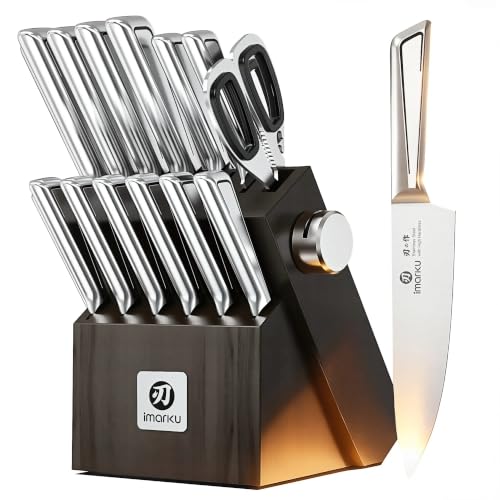
Judged on what each maker will put in writing, our top pick is the imarku 14-Piece Japanese Knife Set with Block. It is the only set here that publishes an edge angle, the only one that explains what that angle means against the alternative, and it is candid about the fact that its own dishwasher-safe claim will cost you sharpness. That earned it our highest Organic Integrity Score of 91 out of 100.
Every set on this page says “high carbon stainless steel”, and that phrase names no steel. It is a family — a large one — in the same way “stainless steel” was a family when we audited tea kettles. The two numbers that actually describe a blade are its steel designation (X50CrMoV15, VG-10, AUS-8 and so on) and its HRC hardness, which tells you how well the edge holds and how easily it re-sharpens.
Reviewers who test knives properly use both figures. Not one of these five listings publishes either.
What the listings leave out
| Best Choice | Best Value | ||||
 |
 |
 |
 |
 |
|
| Product | imarku 14-Piece | Cuisinart 15-Piece | Amazon Basics 14-Piece | Martha Stewart 14-Piece | Farberware 15-Piece |
| Organic Integrity Score | 91/ 100 | 89/ 100 | 84/ 100 | 81/ 100 | 77/ 100 |
| Our rating | 4.6 | 4.5 | 4.2 | 4.1 | 3.9 |
| Best for | Best overall | Lifetime warranty in writing | Cheapest, full tang in the title | Acacia block, hand-wash honesty | The familiar name |
| Edge angle stated | 10–15°, stated | Not stated | Not stated | Not stated | Not stated |
| Steel designation / HRC | Neither | Neither | Neither | Neither | Neither |
| Full tang | Stated | Stated, with steel rivets | Stated in the title | Stated | Not stated |
| Forged | Precision-forged | Forged | Not stated | Forged | Forged |
| Warranty | Not stated | Lifetime, terms given | Not stated | Not stated | Not stated |
| Wash guidance | Dishwasher safe, but hand wash keeps it sharp | Not stated | Hand wash and dry immediately | Hand wash only | Hand wash and dry |
| Price | $169.99$12.14 / count View on Amazon |
$97.99 $129.95 −25% View on Amazon |
$26.24 $29.85 −12%$1.87 / count View on Amazon |
$59.99$4.29 / count View on Amazon |
$35.18 $48.99 −28% View on Amazon |
Scores are ours, based on independent research of specification disclosure, construction, published warranty terms and value, using the same ten-criteria method we apply to every product.
The two numbers that describe a knife, and why you will not find them here
“High carbon stainless steel” tells you the alloy contains enough carbon to take an edge and enough chromium not to rust. That is all. It covers steels that behave completely differently in your hand.
HRC hardness is the Rockwell C figure, and it is the single most useful number about a blade. Harder steel holds an edge longer and is more brittle; softer steel dulls sooner and is more forgiving and easier to bring back.
The useful range for kitchen knives runs roughly 55 to 61. German-style forged knives typically sit around 56 to 58 — tough, shock resistant, and easy to restore with a honing steel. Japanese-style knives usually run harder, around 58 to 61, which holds a finer edge but chips more readily if you hit a bone or twist in a squash.
The steel designation is the second number. X50CrMoV15 is the standard German kitchen steel; VG-10, AUS-8 and SG2 are common Japanese ones. Each has a known composition and a known behavior, and naming it lets you compare one knife against every other knife.
Premium makers print both figures because both are selling points. None of the five sets on this page prints either. That is not a scandal at these prices — it is simply the line between a knife sold on specification and a knife sold on appearance, and it is worth knowing which side you are shopping on.
One set gets closer than the others, and it is worth crediting properly.
The one performance number anybody gives
The imarku listing states an edge angle of 10 to 15 degrees per side, and then does something better: it explains the comparison, noting that softer European knives are typically ground to around 20 degrees.
That is a real, checkable specification and it has consequences you will feel.
A narrower angle is sharper and more delicate. Ten to fifteen degrees slices cleanly through a ripe tomato skin without pressure. It also has less steel behind the cutting edge, so it rolls or chips more easily if you cut on a hard surface, hit a bone, or use it as a lever.
A wider angle is more durable and less keen. Twenty degrees survives more abuse and forgives a heavier hand.
Neither is better in the abstract. What matters is that you know which one you bought, because it determines how you should treat the knife and how you should sharpen it. Sharpening a 15-degree edge on a jig set to 20 degrees removes the edge geometry you paid for.
Four listings here leave you to guess, which means four sets will be sharpened at whatever angle their owner assumes.
Forged, full tang, and triple rivets
These three phrases appear across the page and they are the construction claims that actually predict longevity.
Forged means the blade was hammered or pressed into shape from a bar of hot steel, which compacts the grain structure. Forged blades are typically thicker, heavier and stiffer, and usually have a bolster — the thickened collar between blade and handle. Stamped blades are cut from rolled sheet like a cookie cutter. Stamped is not automatically bad — many excellent Japanese knives are stamped — but at this price forged usually indicates more material and more process.
Four of these five state forged. One does not.
Full tang means the steel runs the entire length of the handle rather than stopping in a short stub. It is the difference between a knife that can be levered and dropped for twenty years and one whose blade eventually works loose from the handle. It also puts weight behind your hand, which is where balance comes from.
Four of these five state full tang. The Farberware set does not, and on a knife that is the omission that matters most.
Triple rivets are three pins through the handle scales into the tang. More rivets means a mechanical joint rather than reliance on adhesive, which is what stops handles loosening after years of washing. Cuisinart specifies stainless steel rivets, which is a detail worth having — plain steel rivets in a wet environment eventually weep rust into the handle.
Cuisinart also names an extra-wide safety bolster, which is a genuine feature: it stops your fingers sliding forward onto the edge, and it adds weight at the balance point.
What each claim on a knife set listing covers
| Claim | Covers | Key exclusion |
| HRC 55–61 | Measured hardness, predicting edge retention and ease of sharpening | The benchmark spec reviewers use; no listing here publishes it |
| X50CrMoV15 / VG-10 | A named steel with a known composition and behavior | Lets you compare across brands; no listing here names one |
| High carbon stainless steel | Enough carbon to hold an edge, enough chromium to resist rust | A family of steels, not a specification |
| 10–15° edge | The grind angle, which sets sharpness against durability | The only performance figure on this page; one listing gives it |
| Full tang | Steel running the full length of the handle | The main predictor of long-term handle integrity; four state it |
| Forged | Shaped from hot bar stock rather than cut from sheet | Usually thicker and heavier; not automatically better than stamped |
| Triple riveted | Three mechanical pins securing the handle scales | Rivet material matters; only one listing says stainless |
| Dishwasher safe | The knives will survive a cycle without failing | Survival is not preservation — it dulls edges and loosens handles |
Best overall: imarku 14-Piece Japanese Knife Set with Block
| Organic Integrity Score | 91 / 100 |
| Edge | Hand-honed to 10–15 degrees, compared against ~20° European grinds |
| Construction | Precision-forged, full tang, patented non-slip handle |
| Block | Hardwood, with an integrated pull-through sharpener |
| Set | 14 pieces: chef, bread, slicing, santoku, utility, paring, 6 steak knives, shears |
| Best for | The only set that tells you how its edge is ground |
This wins on one specification and one piece of honesty.
The specification is the edge angle. Ten to fifteen degrees, hand-honed, with an explanation of what that means relative to the twenty-degree grinds typical of softer European knives. That is the only performance number anywhere on this page, and it tells you both how the knives will cut and how you should sharpen them.
The honesty is about the dishwasher. The listing says the knives are dishwasher safe, and then adds, in the same bullet, that hand-washing extends sharpness. That is a seller undercutting its own convenience claim in order to tell you the truth, and it is rare enough that we weight it heavily. Dishwasher safe means the knife will survive; it does not mean the edge will.
The integrated sharpener in the block is a genuinely sensible piece of design, because the reason most home knives are blunt is that the sharpener lives in a drawer. Putting it in the block is the difference between sharpening occasionally and sharpening never.
Two more things we credit. The handle is described in terms of who it helps — lighter and requiring less grip force, for people with arthritis or reduced hand strength — which is a specific accessibility claim rather than “ergonomic”. And there is a logo change notice, telling buyers they may receive classic or updated branding. Disclosing a running change instead of quietly shipping it is a small mark of good faith.
At around a hundred and seventy dollars it is by far the most expensive set here, the listing is heavy with emoji and gift-guide copy, and it still does not give you an HRC figure or a steel designation.
What we liked: A stated edge angle with a comparison, precision-forged full tang, a sharpener built into the block, a specific accessibility claim, and honesty that hand-washing beats the dishwasher.
Keep in mind: The most expensive set by a wide margin. No HRC or steel designation. A harder, finer edge chips more easily if you cut on hard surfaces. No stated warranty.
Lifetime warranty in writing: Cuisinart 15-Piece Forged Triple Rivet Set
| Organic Integrity Score | 89 / 100 |
| Construction | Forged, full tang secured with stainless steel rivets |
| Bolster | Extra-wide safety bolster, stated for stability and control |
| Warranty | Lifetime against defects in material and workmanship, terms stated |
| Set | 15 pieces, every knife listed individually with its blade length |
| Best for | The strongest written commitment on this page |
The most complete construction description here, and the only real warranty.
The lifetime warranty is stated with terms — free of defects in material and workmanship, under normal home use, from the date of purchase, for the original purchaser. That last clause matters and we would rather it were spelled out than implied: it is not transferable, and it covers manufacturing defects rather than a dull edge or a blade you put through a bone.
The construction detail is genuinely specific. Full tang, secured with stainless steel rivets — naming the rivet material is the kind of thing only a maker thinking about decades of dishwater bothers with. And the extra-wide safety bolster is a real feature that both protects your fingers and moves the balance point back toward your hand.
The set contents are itemized precisely, down to a 2.75-inch bird’s beak paring knife, so you know exactly what fifteen pieces means before you buy.
Two gaps keep it just behind. There is no washing guidance at all — the only set here that says nothing about how to care for the knives, on a page where three competitors say hand wash. And like everything else here, no edge angle, no HRC, no steel name.
What we liked: A lifetime warranty with actual terms, forged full-tang construction, stainless rivets named, an extra-wide bolster, and a fully itemized set list.
Keep in mind: No care or washing guidance whatsoever. No edge angle, hardness or steel designation. Warranty covers the original purchaser only.
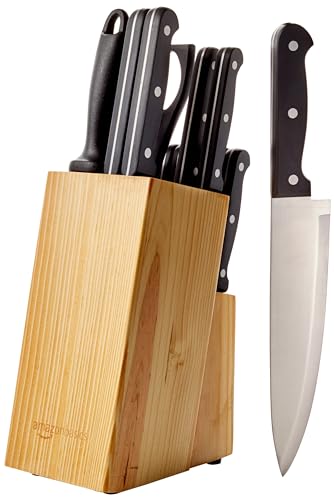
Cheapest, full tang in the title: Amazon Basics 14-Piece Knife Set
| Organic Integrity Score | 84 / 100 |
| Construction | Full tang, triple-riveted — full tang stated in the product title |
| Care | Hand wash and dry immediately; air-dry the block upside down monthly |
| Set | 14 pieces, itemized with blade lengths, including shears |
| Best for | The construction claim that matters, at the lowest price here |
Around twenty-six dollars, and it puts full tang construction in the product title — the one construction fact most worth having, advertised where you cannot miss it. Only one other set does that, and it costs three times as much.
The set is itemized properly with blade lengths, the handles are triple-riveted, and the weight is described as giving balance and control rather than just being “ergonomic”.
The care instruction is the best on this page, and it includes something nobody else mentions: wipe the block with a damp cloth and air-dry it upside down at least once a month. Knife blocks accumulate moisture and crumbs in the slots and go moldy from the inside where you cannot see. That is a real maintenance instruction from someone who knows how blocks fail, and it is on the cheapest product here.
It scores below the two above because the listing never says forged — the only set on this page that omits it — which suggests stamped blades, and because “lasting sharpness” is an adjective rather than a figure. Neither an edge angle nor a hardness appears, and there is no warranty statement.
What we liked: Full tang in the title, triple-riveted handles, a properly itemized set, the lowest price here, and genuinely useful block-care guidance.
Keep in mind: Forging is never claimed, which points to stamped blades. No warranty, no edge angle, no hardness, no steel name.
Acacia block and hand-wash honesty: Martha Stewart Eastwalk 14-Piece Set
| Organic Integrity Score | 81 / 100 |
| Construction | Forged, full tang, ABS triple-riveted handles |
| Block | Acacia wood, named by species |
| Care | Hand wash only, stated plainly |
| Best for | A named-wood block and no pretense about the dishwasher |
Two things this listing does that we want to reward.
It names the block wood. Acacia, not “wood block”. Acacia is dense, closed-grain and holds up well to kitchen moisture, and naming a species is a small commitment that tells you the block is a considered component rather than whatever was cheapest.
And it says hand wash only. No hedging, no dishwasher-safe claim quietly undermined two clauses later. For knives that is simply the correct instruction, and a seller willing to state a restriction rather than advertise a convenience is telling you what the product needs.
The construction claims are solid: forged stainless with full tang for balance and durability, triple-riveted handles. The handle material is identified as ABS — a specific polymer rather than “ergonomic handle”, which is more than most listings here manage, even if ABS is a plastic rather than a premium composite.
It sits fourth because beyond those points the listing is short on substance. No edge angle, no hardness, no steel designation, no warranty, and the descriptions of the knives themselves are a list of lengths.
What we liked: The block wood named as acacia, a plain hand-wash-only instruction, forged full-tang construction stated, and the handle polymer identified.
Keep in mind: ABS handles are plastic. No warranty, edge angle, hardness or steel name. Mid-price with less disclosure than the cheaper Amazon Basics set.
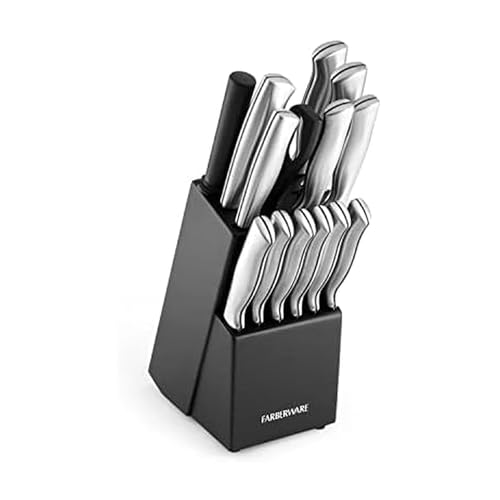
The familiar name: Farberware 15-Piece Knife Set
| Organic Integrity Score | 77 / 100 |
| Construction | Forged from high-carbon stainless; full tang not claimed |
| Block | Black pinewood |
| Included | Sharpening tool and six steak knives |
| Care | Hand wash and dry |
| Best for | A recognizable brand at a low price |
A well-known American brand at a modest price, with fifteen pieces and a sharpening tool included — and the sharpener is worth having, since a set that ships with one is a set you might actually maintain.
The care instruction is correct: hand wash and dry to maintain the integrity of the blades.
Two things pull it to the bottom of the table.
First, full tang is never claimed. Every other set on this page states it, three of them prominently. On a knife, the tang is the structural question, and a listing that describes the handle as ergonomic and satin-finished without saying how far the steel goes into it has left out the part that determines whether the knife survives a decade.
Second, the durability argument is a sales statistic. The listing offers “Farberware is the #1 selling cutlery brand in the U.S. for a reason” as the evidence that the knives are built to last. Popularity is evidence that people buy something; it is not a specification, and on a page where competitors are naming rivet materials and bolster geometry it stands out as a substitute for one.
The block is named as pinewood, which is honest — pine is soft and light, and saying so is better than “wood block”.
What we liked: A sharpening tool in the set, forged blades claimed, correct hand-wash guidance, the block wood named, and a long-established brand at a low price.
Keep in mind: Full tang is never stated. Market share is offered in place of a durability specification. Pine is a soft block wood. No warranty, edge angle, hardness or steel name.
What a “15-piece set” actually contains
Piece counts in this category are mostly steak knives, and it is worth translating before you compare.
A typical fifteen-piece set is: a chef’s knife, a bread knife, a santoku, a slicing knife, a utility knife, one or two paring knives — then six steak knives, a pair of shears, a sharpening steel, and the block itself. The block counts as a piece.
So a fifteen-piece set and a fourteen-piece set usually contain the same five or six knives you will actually cook with. The difference is an extra paring knife or an extra steak knife.
Judge a set by the chef’s knife. You will use it for perhaps eighty percent of everything, and if it is not comfortable the other fourteen pieces do not matter. A bread knife and a paring knife cover most of the rest.
Steak knives are genuinely useful if you eat steak and largely decorative if you do not, and they are how a set reaches an impressive number cheaply.
The dishwasher question
Three of these five listings say hand wash. One says dishwasher safe and then admits hand-washing keeps the knives sharper. One says nothing at all.
Hand wash them. The reasons are specific rather than superstitious.
Detergent is abrasive and alkaline. Dishwasher powder contains mild abrasives and runs at a high pH, which etches the polished surface and dulls the fine edge over repeated cycles.
Heat and moisture attack the handle joint. Prolonged hot wet cycles work at the joint between scales and tang, and on riveted handles that is what eventually causes movement and gaps that trap food.
Blades knock against everything. A knife rattling against a rack or another blade rolls its edge, and a rolled edge feels blunt even though no steel has been lost.
Washing a knife by hand takes about eight seconds. Dry it immediately — even stainless will spot if it air-dries — and put it back in the block edge-up if the slots allow, so the cutting edge is not resting on wood.
Keeping them sharp
Honing and sharpening are different things. A honing steel does not remove metal; it pushes a rolled edge back into alignment. Do it every few uses and the knife stays keen for months. Sharpening removes metal to create a new edge, and it is needed a couple of times a year for a home cook.
Match the angle. This is why the edge angle specification matters. If your knives are ground at 15 degrees and you sharpen at 20, you grind away the fine edge geometry you paid for. If they are ground at 20 and you sharpen at 15, you create a thin edge the steel may be too soft to hold.
Pull-through sharpeners like the one built into the imarku block are convenient and remove more metal than a stone. They are the right tool for keeping ordinary knives usable and the wrong one for a knife you care about.
Cut on wood or plastic, never glass, stone or steel. A single pass on a glass board undoes months of care. Our cutting board guide covers which surfaces are kind to an edge, and why end grain is the gentlest of them.
How we researched this guide
We read all five listings in full, title and description, and recorded every specification and construction claim. Because every set in this category uses the same unspecific phrase for its steel, we scored on what actually differs: whether an edge angle, hardness figure or steel designation appears at all; whether full tang and forged construction are stated; whether rivet material, bolster and block wood are named; whether any warranty terms are published; and whether the listing gives honest care guidance rather than a dishwasher-safe claim. We treated market-share statistics as marketing rather than specification. Sales position was used as a check on whether claims have been tested by use. Scores reflect what each maker states in writing.
Common questions about kitchen knife sets
What does “high carbon stainless steel” actually mean?
That the alloy has enough carbon to take an edge and enough chromium to resist rust. It is a family of steels, not a specification, and it covers blades that behave very differently. All five sets here use the phrase.
What HRC hardness should a kitchen knife be?
Roughly 55 to 61. German-style knives typically sit at 56 to 58, tough and easy to re-sharpen; Japanese-style knives run 58 to 61, holding a finer edge but chipping more easily. No listing here publishes a figure.
Is full tang important?
Yes. It means the steel runs the whole length of the handle, which gives balance and stops the blade working loose over years. Four of these five state it; one does not.
Forged or stamped, which is better?
Forged blades are shaped from hot bar stock and are usually thicker, heavier and stiffer, often with a bolster. Stamped blades are cut from sheet and are lighter. Forged is generally the more substantial build at this price, but excellent stamped knives exist.
What edge angle should my knives be?
Roughly 15 degrees per side for Japanese-style knives and around 20 for European-style. Sharper cuts better; wider survives more abuse. One set here states 10 to 15 degrees; the rest leave you guessing, which matters when you sharpen.
Can I put kitchen knives in the dishwasher?
You can, and you should not. Detergent is abrasive and alkaline, heat and moisture work at the handle joint, and blades knock against racks and roll their edges. Three listings here say hand wash.
What is the difference between honing and sharpening?
Honing realigns a rolled edge without removing metal and should be done every few uses. Sharpening removes metal to create a new edge and is needed once or twice a year for most home cooks.
How many knives do I actually need?
Three: a chef’s knife, a bread knife and a paring knife. Everything beyond that is convenience. A fifteen-piece set is usually those plus a santoku, six steak knives, shears, a steel and the block.
Does the block count as a piece?
Yes, in almost every set. So do the shears and the sharpening steel. Compare the knives listed rather than the headline number.
What wood should a knife block be?
A dense closed-grain hardwood such as acacia resists kitchen moisture better than a soft wood like pine. Two listings here name their species; the others say “wood block”.
How do I clean a knife block?
Wipe it with a damp cloth and air-dry it upside down at least monthly, so moisture and crumbs do not sit in the slots. One listing gives exactly this instruction.
Do steak knives need sharpening?
Serrated ones effectively cannot be sharpened at home and are treated as consumable. Straight-edged steak knives sharpen like any other blade.
Related reading
- Best Wood Cutting Boards
- Best Stainless Steel Cookware
- Best Wooden Cooking Utensils
- Ceramic vs Stainless vs Cast Iron vs Carbon Steel
- Organic Product Database — search all 800+ products we have reviewed