Last updated: September 30, 2026
We may earn a commission when you buy through links on this page, at no extra cost to you. How we research and rate.
The short version
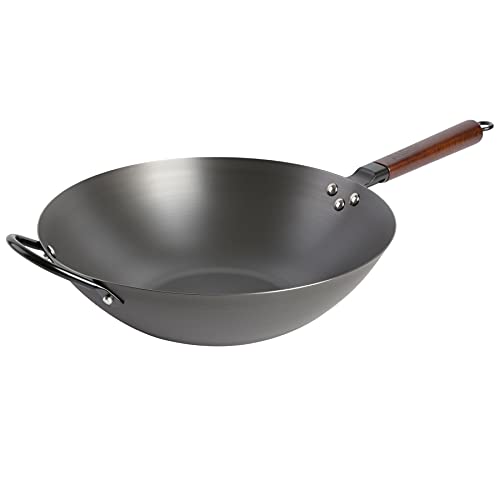
Weighing what each maker states against what it leaves out, our top pick is the YOSUKATA 13.5″ Flat Bottom Black Carbon Steel Wok. It is the only wok here that tells you a number about its seasoning — factory-seasoned at over 600°F — it sits flat on every cooktop including induction, and it is the best-selling wok of the five. That earned it our highest Organic Integrity Score of 91 out of 100.
A carbon steel wok is the rare pan where our usual question does not apply. There is no coating. There is no PTFE, no ceramic sol-gel, no “non-toxic” layer to interrogate, because the cooking surface is bare steel and the slipperiness comes from polymerized oil you build up yourself. So the questions change entirely, and the one that matters most is how thick the steel is — which exactly one of these five listings will tell you.
What the listings leave out
| Best Choice | Best Value | ||||
 |
 |
 |
 |
 |
|
| Product | YOSUKATA 13.5″ | Craft Wok 14″ | Calmabode 11″ | Babish 14″ | Mammafong 14″ |
| Organic Integrity Score | 91/ 100 | 87/ 100 | 84/ 100 | 80/ 100 | 75/ 100 |
| Our rating | 4.6 | 4.4 | 4.2 | 4.0 | 3.8 |
| Best for | Best overall | Gas burners and wok rings | Deep frying, small kitchens | Cheapest here | Hand-hammered surface |
| Steel thickness | Not stated | 15-gauge, 1.8 mm, stated | Not stated | Not stated | Not stated |
| Seasoning | Factory-seasoned above 600°F, stated | Raw, season it yourself | Nitrided and pre-seasoned, uncoated stated | Raw, builds with use | Not stated |
| Bottom | Flat, all cooktops | Round, not for flat electric or induction | Flat, all cooktops | Flat, 6 in, induction safe | Flat, machine pressed |
| Handle | Wooden, ergonomic | Wooden with steel helper handle | Detachable, oven safe | Riveted wooden, stated | Wooden |
| Origin stated | No | No | No | No | Guangdong, China |
| Price | $62.99 View on Amazon |
$65.75 View on Amazon |
$79.99 View on Amazon |
$49.99 View on Amazon |
$75.00 View on Amazon |
Scores are ours, based on independent research of materials disclosure, construction, published specifications and value, using the same ten-criteria method we apply to every product.
What each claim on a wok listing covers
| Claim | Covers | Key exclusion |
| 15-gauge / 1.8 mm | A measured steel thickness you can compare between products | The one number that predicts how a wok behaves; one listing prints it |
| Heavy gauge | The seller’s opinion of its own steel | No number, no units, no way to compare it against anything |
| Pre-seasoned | A factory oil layer, so food releases reasonably from day one | Not a finished surface; you still season it several more times |
| Seasoned above 600°F | A stated process temperature, which implies real polymerization | Specific and checkable in use; only one listing gives a figure |
| Nitrided | A heat treatment that hardens the surface and resists rust | A genuine process, not a coating; one listing names it |
| Uncoated / no synthetic nonstick | An explicit statement that nothing is layered on the steel | The most direct materials claim available here; one listing makes it |
| PFOA-free / PTFE-free | Absence of fluoropolymers | Meaningless on bare carbon steel, which never contained any |
| Riveted handle | The handle is mechanically fixed rather than spot-welded | A construction detail worth knowing; rivets can loosen but can be replaced |
The useful rows are thinly filled and the decorative ones are not. Every listing has an opinion about its steel; one has a measurement.
On a wok, “non-stick” means something completely different
This is the single most useful thing to understand before you buy one, and it inverts the meaning of a word you have read on a hundred other pans.
On a non-stick skillet, non-stick is a coating — PTFE, or a ceramic sol-gel layer — applied at the factory, sitting on top of the metal, and slowly wearing away from the day you start using it. The whole reason our cookware guides interrogate coatings is that they are a material you did not choose, between you and your food, with a finite life.
On a carbon steel wok there is no coating at all. The cooking surface is bare steel. What makes it slippery is seasoning: thin layers of oil heated past their smoke point until they polymerize into a hard, dark, slightly glassy film bonded to the metal. It is not applied, it is grown. And unlike a coating, it gets better with use rather than worse, and when you damage it you simply rebuild it.
Two consequences follow, and both are worth having in mind while you read listings in this category.
First, “PFOA-free” and “PTFE-free” are empty on a carbon steel wok. There was never any there. It is a true statement in the way that “sugar-free” is true of a bag of salt, and where you see it, it is decoration rather than information.
Second, “pre-seasoned” is a head start, not a finished job. A factory-seasoned wok will not stick catastrophically on day one, which is genuinely worth something. But every carbon steel wok, seasoned or raw, needs several rounds of oil-and-heat before it really performs, and the seasoning you build yourself is what lasts.
Gauge is the number that decides how a wok cooks
With no coating to compare, the specification that actually separates these products is the thickness of the steel, and it is measured in gauge or in millimeters.
Thin steel, roughly 1.2 to 1.5 mm, heats blisteringly fast and responds the instant you move it off the flame. That responsiveness is the point of a wok. Too thin and it dents, warps over a powerful burner, and drops temperature the moment cold food hits it.
Thick steel, 1.8 to 2 mm, holds its heat when you add a full load of vegetables, which is exactly when a home cook loses the sear. It is heavier to toss and slower to react.
For home cooking, 1.5 to 1.8 mm is the range worth being in. It is thick enough not to buckle on a home burner and thin enough to still feel like a wok.
Four of these five listings say “heavy gauge” or “heavy-duty” and print no number. One says 15-gauge, 1.8 mm, in both units, in the product basics. That is a seller who measured the thing and expects you to care, and it is the most substantive single line on this page.
Best overall: YOSUKATA 13.5″ Flat Bottom Black Carbon Steel Wok
| Organic Integrity Score | 91 / 100 |
| Size | 13.5 inches, flat bottom |
| Seasoning | Factory pre-seasoned at over 600°F, stated |
| Cooktops | Gas, electric, ceramic, glass and induction, all listed |
| Best for | The wok that works on the cooktop you actually have |
Two things put this first, and neither is the marketing.
It gives a seasoning temperature. Pre-seasoned at over 600°F is the only number anyone on this page attaches to a seasoning claim, and it matters because temperature is what separates real polymerization from a wipe of oil. Above roughly 400°F oil begins to cross-link into the hard film you want; a factory that names 600°F is describing a process rather than a gesture.
And it is flat-bottomed and lists every cooktop. Gas, electric, ceramic, glass, induction. That sounds mundane until you read the round-bottom wok below, which explicitly cannot be used on two of those. For most people buying a first wok, compatibility is not a feature, it is the whole purchase.
It is also by a distance the best-selling wok of the five, which means the pre-seasoning claim is being tested daily in a large number of kitchens rather than sitting on a spec sheet.
What it does not do is name a thickness. “High-grade black carbon steel” is a phrase, not a gauge, and on the specification that matters most in this category the top pick is silent. That is why it scores 91 and not higher.
What we liked: A stated seasoning temperature, a flat bottom with every cooktop listed, a usable 13.5-inch size, light enough to toss, and the strongest sales record here.
Keep in mind: No steel thickness given anywhere. “High-grade” is not a grade. It still needs several rounds of your own seasoning before it is truly slick.
Gas burners and wok rings: Craft Wok 14″ Hand Hammered Pow Wok
| Organic Integrity Score | 87 / 100 |
| Steel | 15-gauge, 1.8 mm, described as commercial grade |
| Bottom | Round — explicitly not for flat electric or flat induction |
| Handles | Wooden main handle plus a steel helper handle |
| Best for | A gas burner, a wok ring, or an outdoor wok burner |
This is the wok for people who already know what they want, and its listing is the most informative on the page in both directions.
It prints the thickness — 15-gauge, 1.8 mm — in gauge and in millimeters, which no one else here does in either. It says commercial grade and gives a date the design has been in production. It has a steel helper handle opposite the wooden one, which is what you want when a 14-inch wok is full and hot.
And then it does something we almost never see: it tells you not to buy it. The listing states plainly that this wok is not suitable for flat electric or flat induction stoves, because the curved bottom cannot make proper contact. That is a seller turning away a large share of American buyers in order to prevent a bad purchase, and on a site that spends most of its time cataloging what listings omit, it deserves saying loudly.
The round bottom is genuinely better if you have the burner for it. Heat concentrates in the base, food slides back to the center, and tossing works the way it is supposed to. On a wok ring over a strong gas flame this outperforms everything else here.
It scores below the YOSUKATA only because most readers do not have that setup. For the ones who do, this is the better wok.
What we liked: The only stated thickness on the page, in two units. A steel helper handle. Real hand hammering. And an honest compatibility warning that costs the seller sales.
Keep in mind: Round bottom, so you need a gas burner and probably a wok ring — unusable on flat electric or induction. It ships raw, so budget a weekend for seasoning.
Deep frying and small kitchens: Calmabode 11″ Nitrided Carbon Steel Wok
| Organic Integrity Score | 84 / 100 |
| Size | 11 inches, deep walls, flat bottom |
| Surface | Nitrided, pre-seasoned, and stated to have no synthetic nonstick coating |
| Handle | Detachable wooden handle, oven safe with it removed |
| Included | Amber glass lid |
| Best for | Deep frying, oven finishing, and kitchens short on storage |
This is the most explicit materials statement in the group, and it is worth reading carefully: nitrided, pre-seasoned and uncoated, with no synthetic nonstick coating. That is a seller naming the surface treatment and then stating outright what is not on the pan. Almost nobody does the second half.
Nitriding is a real process rather than a marketing word. The steel is held in a nitrogen-rich atmosphere at high temperature so nitrogen diffuses into the surface, hardening it and making it substantially more rust-resistant. It is not a layer sitting on top that can chip — it is a change in the steel itself. For a pan that will otherwise flash-rust if you leave it wet for an hour, that is a meaningful advantage.
The practical design is thoughtful too. Deep walls make it a better deep-fryer than a wide shallow wok. The handle comes off, so it goes in the oven and stores flat. And it comes with a glass lid, which the other four do not.
What keeps it mid-table is size and evidence. Eleven inches is small for a wok — fine for two people, cramped for a family stir-fry, and a crowded wok steams instead of searing. And it has by far the least sales history of the products here, so its claims have not been tested by many kitchens yet.
What we liked: Nitriding named, an explicit statement that nothing is coated on it, deep sides for frying, a removable handle for the oven, and a lid included.
Keep in mind: Eleven inches limits how much you can cook at once. No thickness stated. Very little sales record behind the claims.
Cheapest here: Babish 14″ Flat Bottom Carbon Steel Wok
| Organic Integrity Score | 80 / 100 |
| Size | 14 inches, with a 6-inch flat base |
| Handles | Riveted wooden, stated, cool to the touch |
| Surface | Raw steel; builds its own seasoning through oil absorption |
| Cooktops | Grill, gas, electric, ceramic, glass and induction |
| Best for | The largest wok here at the lowest price |
Fourteen inches for around fifty dollars, which is the best surface-per-dollar on this page, and it is a strong seller in its category.
Two details in the listing are better than they look. It says the handles are riveted, which tells you how they are attached — rivets hold under heat and can be tightened or replaced, where a spot weld either holds or does not. And it describes the surface honestly: the steel absorbs oil to build a naturally non-stick capability. That is a correct account of seasoning rather than a claim of a coating, and it quietly sets expectations that this pan needs work before it performs.
The 6-inch flat base is worth noting too. It is a real contact patch for an electric or induction element, which is more than the phrase “flat bottom” guarantees on its own.
It scores where it does because “heavy-gauge” is doing all the work on the specification that matters, there is no seasoning statement of any kind, and no origin is given.
What we liked: The lowest price for the largest wok, riveted handles named, a properly sized flat base, every cooktop plus the grill, and an honest description of how seasoning works.
Keep in mind: “Heavy-gauge” with no number. Ships unseasoned, so plan several rounds before you cook eggs in it. No origin stated.
Hand-hammered surface: Mammafong 14″ Flat Bottom Pow Wok
| Organic Integrity Score | 75 / 100 |
| Size | 14 inches, flat bottom |
| Construction | 100% hand hammered with a machine-pressed flat base, stated |
| Origin | Guangdong, China, stated |
| Best for | A hammered surface with a base that sits flat on a home burner |
The hammered dimples are not decoration. Each one is a shallow depression that gives food somewhere to rest above the hottest part of the pan, which is how a cook pushes cooked pieces up the sides while the next batch sears in the middle. On a smooth machine-pressed wok everything slides back down.
The listing is also candid in a way we want to credit: it says the wok is 100% hand hammered with a machine pressed flat base. That is a precise account of a hybrid product, and it would have been easy to say only “hand hammered” and let you assume the whole thing was. It names its region of manufacture too, Guangdong, which nobody else here does.
It scores lowest because everything else is atmosphere. “Premium carbon steel and heavy gauge body” gives no number. There is no seasoning statement, so you do not know whether it arrives raw or treated. And it is far and away the slowest seller of these five, so there is little accumulated use to weigh against the claims.
What we liked: A genuinely hammered cooking surface, an unusually honest description of how it is made, a stated region of manufacture, and a full 14 inches.
Keep in mind: No thickness, no seasoning information, the most vague materials language here, and very little sales history.
Flat bottom or round bottom
This decides whether the wok you buy is usable, and it is the mistake people most often make.
Round bottom is the traditional shape and it is better in every way that matters — on the right burner. Heat pools at the base, the curve returns food to the center, and tossing is a flick rather than a chore. It needs a gas flame and usually a wok ring to sit in, or a dedicated wok burner.
Flat bottom puts a machined disc of contact on the burner so the wok sits stable on any cooktop, including induction, where a round wok simply will not work. The cost is that the curve starts higher up the wall, so there is less of the deep pooling zone and tossing is a little less natural.
If you have a glass, electric or induction cooktop, this is not a preference — buy flat. One of the woks here states outright that it will not work on yours, and it is doing you a favor by saying so.
If you have gas, either works, and the round bottom on a ring is the better cooking tool.
Seasoning a new wok, and keeping it
Strip it first if it is raw. New unseasoned woks ship with a factory anti-rust film. Scrub it off with hot water and a little dish soap — the one time soap is appropriate on a wok — and dry it immediately.
Heat it until it changes color. Dry, on the highest flame you have, moving it so the blue-gray tint travels over the whole surface. This opens the steel to take oil.
Oil thin, then thinner. A teaspoon of a high smoke point oil — grapeseed, canola, peanut — wiped around and then wiped almost entirely off. The mistake everyone makes is leaving too much, which gives you a sticky varnish instead of a hard film. Heat until it stops smoking, cool, repeat three or four times.
Then cook fatty things in it. Onions, scallions, ginger, bacon. Real cooking builds seasoning better than empty rounds do.
Care afterward is simple. Hot water and a stiff brush, no soap once seasoned, dry it on the burner every single time, and wipe the barest film of oil over the inside while it is still warm. A wok left wet for an hour will show rust, and a wok dried on the flame will not.
If it does rust, it is not ruined. Scour it back to bare metal and season it again. That is the great advantage of having no coating: there is nothing that can be destroyed, only a surface that can be rebuilt. Our cookware materials guide covers how this compares with cast iron, stainless and ceramic.
How we researched this guide
We read all five listings in full, title and description, and recorded every materials, construction and seasoning claim. Because carbon steel woks carry no coating, we scored on the specifications that actually differ: stated steel thickness, whether the seasoning claim carries a temperature or process, how the handle is attached, whether the bottom shape is matched honestly to cooktop compatibility, and whether any origin is given. We noted claims that are technically true but carry no information on bare steel, such as the absence of fluoropolymers. Sales position was used as a check on whether claims have been tested by real use. Scores reflect what each maker states in writing.
Common questions about carbon steel woks
Is a carbon steel wok non-stick?
Eventually, and by a different mechanism than a coated pan. Seasoning is polymerized oil bonded to bare steel, built up through use. It improves with time rather than wearing out, and it can be rebuilt if damaged.
Does a carbon steel wok contain PTFE or PFOA?
No. There is no coating of any kind on bare carbon steel, so claims about the absence of fluoropolymers are true but carry no information in this category.
What thickness should a wok be?
Roughly 1.5 to 1.8 mm for home cooking — thin enough to be responsive, thick enough not to warp or lose heat when you add food. Only one listing here states a thickness at all.
Do I need a flat or round bottom wok?
Flat if you have electric, ceramic, glass or induction. Round only if you have a gas flame, ideally with a wok ring. A round wok on a flat cooktop cannot make proper contact, and one listing here says so directly.
What does pre-seasoned actually mean?
A factory oil layer applied and heated so food releases reasonably from the first use. It is a head start, not a finished surface — every carbon steel wok needs further seasoning from you.
What is a nitrided wok?
One treated in a nitrogen-rich atmosphere at high temperature so nitrogen diffuses into the surface of the steel, hardening it and improving rust resistance. It changes the metal rather than coating it, so nothing can chip off.
What oil should I season a wok with?
A high smoke point neutral oil — grapeseed, canola or peanut. Apply it extremely thinly and wipe most of it back off; excess oil produces a sticky finish instead of a hard one.
Can I use soap on a wok?
Once, on a new raw wok to remove the factory anti-rust coating. After that, hot water and a stiff brush. Soap on a seasoned wok strips the film you spent weeks building.
My wok has rusted. Is it ruined?
No. Scour it back to bright metal and season it again from the start. Having no coating means there is nothing to destroy permanently.
What size wok should I buy?
Fourteen inches for a family, 12 to 13.5 for one or two people. Bigger is not always better on a home burner, because the flame only heats the base and the walls of an oversized wok stay cool.
Why does my food steam instead of sear?
The wok is overcrowded or not hot enough. Cook in batches, get the pan properly hot before anything goes in, and dry your ingredients first.
Is a carbon steel wok better than cast iron?
For stir-frying, yes. Carbon steel is far lighter and responds to heat changes in seconds, where cast iron holds temperature but reacts slowly. Cast iron is better for searing and long cooking.