Last updated: August 28, 2026
We may earn a commission when you buy through links on this page, at no extra cost to you. How we research and rate.
The short version
This guide covers plumbed-in systems that live under the sink. If you rent, or you would rather not drill anything, the no-plumbing options are in our guide to the best countertop water filters, which covers countertop reverse osmosis and gravity systems.
Our top pick is the iSpring RCC7AK-BLK, with an Organic Integrity Score of 96 out of 100, the highest we have given any product. It is certified to NSF/ANSI 58, and its listing publishes the actual tested reduction figures behind that certificate rather than describing them in adjectives.
The reason it wins is a distinction almost nobody explains. NSF/ANSI 58 is the standard that tests whether a reverse osmosis system removes contaminants. NSF/ANSI 372 only certifies that the parts are lead-free. Both get advertised as “NSF certified”.
Of the systems we examined, the most expensive one in the comparison carries 372 and not 58.
The numbers that matter, and what each one certifies
This is the whole guide in one section, so it comes first.
NSF/ANSI standards are numbered, and the number tells you which question was asked. In water treatment the ones you will meet are these.
NSF/ANSI 58 is the reverse osmosis standard. It covers material safety, structural integrity, and crucially the contaminant reduction claims the manufacturer makes. A system certified to 58 has been tested, and the certificate names what it reduces and by how much. This is the one to look for on an RO system.
NSF/ANSI 53 is health effects for other filter types: lead, cysts, VOCs, and similar. You will see it on carbon block filters more than on RO.
NSF/ANSI 42 is aesthetic effects only: chlorine, taste and odor. Genuinely useful, and it says nothing about health contaminants.
NSF/ANSI 401 covers emerging contaminants, the category that includes pharmaceutical residues and some pesticides.
NSF/ANSI 372 is lead-free materials. It certifies that the product’s wetted parts do not leach lead into the water passing through them. It is a plumbing materials standard, and every faucet and fitting sold in the US has to meet the underlying requirement anyway.
So a listing reading “NSF/ANSI 372 Certified” on a $289 reverse osmosis system is telling you the housing is lead-free. It is an accurate claim and it is not a performance claim, and the word “certified” carries the same weight visually as it does on a system certified to 58.
Two other certifiers are legitimate and worth recognizing. WQA, the Water Quality Association, runs a Gold Seal program that tests against the same NSF/ANSI standards. IAPMO R&T does likewise. A WQA certification against Standard 58 is equivalent to an NSF one; what matters is the standard number, not which body issued it.
The practical instruction that falls out of all this is short. Look past the word “certified” and find the number. If a listing gives you a standard number, you know which question was answered. If it gives you only a body name, or only the letters NSF, you have been told that something was certified without being told what.
Full system or components: the second distinction
A subtler point, and one of our picks makes it explicitly in its own listing.
An RO system is an assembly: sediment filter, carbon pre-filters, membrane, post-filter, tank, faucet. Individual components can be certified, and so can the finished system. They are not the same claim.
The iSpring RCC7AK listing states it directly: “Unlike other brands that lack NSF certification or full system certification, our RCC7AK is certified to NSF/ANSI 58 standards for the entire water filtration system.” That is a competitive jab and it is also a genuine distinction. A system built from certified components has not necessarily been tested as an assembled unit, and it is the assembled unit that sits under your sink.
When you read a certification claim on an RO system, the question worth asking is what exactly was certified: the membrane, the faucet, or the system.
Published percentages are the strongest signal available
One listing in this comparison goes further than naming a standard, and it is the reason for our top score.
The iSpring RCC7AK-BLK listing states: “Tested and certified by NSF International for reduction of TDS (97.9%), lead (98.9%), fluoride (97.4%), asbestos (>99.7%), barium (98.4%), cadmium (98.8%), chromium (99.2%), copper (97.8%)”.
Those are the figures from the certificate. They are specific, they are attributed, and they are falsifiable. Compare that with the more common formulation, which is some version of “removes up to 99% of over 1,000 contaminants” — a number with no named standard behind it, where “up to” is doing all the work and “1,000 contaminants” is not a category any test measures.
We are not in a position to verify a laboratory result from a product listing. What we can do is score how far a manufacturer goes toward making its claim checkable, and publishing the tested percentages alongside the standard number is as far as a listing can go.
GPD, drain ratio and the running costs nobody mentions
Three specifications decide what an RO system is like to live with.
GPD is gallons per day, the membrane’s rated production. Most under-sink systems run 50 to 100 GPD; tankless units advertise 400 to 600. Higher GPD means faster refill, and for a tank system it matters less than it sounds, because the tank buffers demand. A 50 GPD system with a full tank pours a glass just as fast as a 600 GPD one.
The drain ratio is the specification to actually care about, and it is the one most listings bury. Reverse osmosis works by pushing water against a membrane and flushing the rejected contaminants away, so every gallon of drinking water produces some wastewater. Traditional tank systems commonly run 3:1 or 4:1, meaning three or four gallons down the drain per gallon produced. Better designs claim 2:1 or 1:1. Over a year that difference is thousands of gallons.
Filter replacement is the real cost of ownership. Sediment and carbon pre-filters typically need replacing every six to twelve months, the membrane every two to three years, and the post-filter annually. Budget for it before buying, because a cheap system with expensive proprietary cartridges costs more over three years than a dearer one with standard sizes.
One more thing worth knowing about how RO water tastes. The membrane removes dissolved minerals along with contaminants, which is why RO water tastes flat to some people and why several systems here add a remineralization stage. That stage is a preference rather than a health requirement, and it is the difference between the 5-stage and 6-stage versions of the same product.
Best reverse osmosis systems compared
| Best Choice | Best Value | ||||
 |  |  |  |  | |
| Product | iSpring RCC7AK-BLK | iSpring RCC7-BN | APEC Water ROES-50X | Waterdrop G2P600 | FS-TFC 5-Stage RO |
| Organic Integrity Score | 96/ 100 | 92/ 100 | 78/ 100 | 72/ 100 | 68/ 100 |
| Our rating | 4.8 | 4.6 | 3.9 | 3.6 | 3.4 |
| Standard certified | NSF/ANSI 58 | NSF/ANSI 58 | — | NSF/ANSI 372 only | Title claim only |
| Percentages published | Yes, eight named | No | No | No | No |
| Stages | 6, remineralizing | 5 | 5 | 7, tankless | 5 |
| Rated output | 75 GPD | 75 GPD | 50 GPD | 600 GPD | 100 GPD |
| Best for | A checkable certificate | Certified at lowest cost | Established brand, no cert | Speed and no tank | Lowest price |
| Price | $249.99 View on Amazon | $219.96 View on Amazon | $212.67 $274.99 −23% View on Amazon | $299.00 $359.00 −17% View on Amazon | $139.99 View on Amazon |
Price and availability as of August 28, 2026 1:29 pm EDT. Product prices and availability are accurate as of the date/time indicated and are subject to change. Any price and availability information displayed on Amazon.com at the time of purchase will apply to the purchase of this product.
Best overall: iSpring RCC7AK-BLK 6-Stage Reverse Osmosis System
| Organic Integrity Score | 96 / 100 |
| Configuration | 6-stage under-sink RO with pH+ remineralization, 75 GPD, tank |
| Certification | NSF/ANSI 58, with tested reduction percentages published in the listing |
| Best for | Anyone who wants the performance claim tested rather than asserted |
The best-documented product we have scored in any category. It names the correct standard for its product type, and then publishes the numbers from the certificate: TDS 97.9 percent, lead 98.9, fluoride 97.4, asbestos over 99.7, barium 98.4, cadmium 98.8, chromium 99.2, copper 97.8.
Read those alongside the more usual claim, which is “removes up to 99% of over 1,000 contaminants” with no standard attached. One of those statements can be checked against a certificate. The other cannot be checked at all.
The system itself is a conventional six-stage design with a tank: sediment, two carbon pre-filters, the RO membrane, a remineralization stage that puts calcium and magnesium back, and a final polishing filter. The remineralization is what separates this from the RCC7 below, and it is a taste decision rather than a health one.
Three honest points. It is a tank system, so it takes cupboard space that a tankless unit does not. Installation involves drilling for a faucet unless you have a spare hole, which is the step most people find daunting and most plumbers charge an hour for. And it is the most expensive of our certified picks.
- NSF/ANSI 58 certified, the standard that actually tests performance.
- Publishes eight tested reduction figures.
- Transparent first-stage housing so you can see when the filter is loaded.
- Tank takes under-sink space.
- Faucet installation usually needs a drilled hole.
- Priciest certified option here.
Best for: Buyers who want the strongest available evidence, not the strongest available adjectives.
Best value: iSpring RCC7-BN 5-Stage Reverse Osmosis System
| Organic Integrity Score | 92 / 100 |
| Configuration | 5-stage under-sink RO, 75 GPD, tank, no remineralization |
| Certification | Certified to NSF/ANSI 58, stated explicitly in the listing body |
| Best for | The certified option at the lowest price |
The same certification as our top pick, on a simpler system, for less money. The listing states “CERTIFIED TO NSF/ANSI 58” in plain terms, which is the claim that matters in this category.
What you give up against the RCC7AK is the remineralization stage. Straight RO water has had its dissolved minerals stripped along with everything else, and some people find it tastes flat. If that does not bother you, or you already use a remineralizing pitcher, this is the sensible buy and saves a meaningful amount.
Otherwise it is the same architecture: sediment, carbon, carbon block, membrane, post-filter, with a tank and a dedicated faucet. iSpring has been selling this model for over a decade, so the replacement cartridges are commodity items rather than proprietary ones, which keeps the running cost down.
Two caveats. It does not publish the tested percentages the way the RCC7AK listing does, so the certification is named rather than itemised. And the same installation and space considerations apply.
- NSF/ANSI 58 certified at the lowest price of any certified system here.
- Long-established model with widely available filters.
- Straightforward five-stage design.
- No remineralization, so the water may taste flat to you.
- Certification named but percentages not published.
- Tank and faucet installation.
Best for: Most households, if you can live without added minerals.
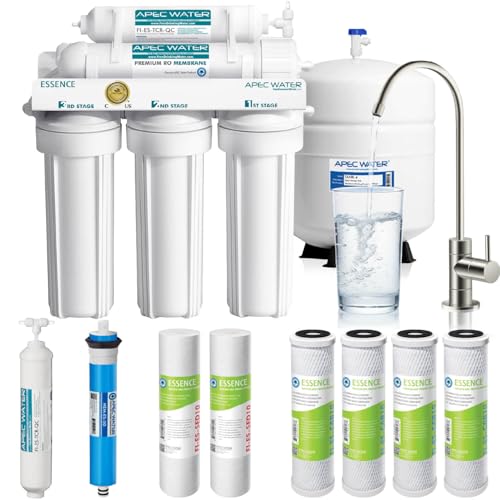
Established brand, uncertified listing: APEC Water ROES-50X
| Organic Integrity Score | 78 / 100 |
| Configuration | 5-stage under-sink RO, 50 GPD, tank, extra filters included |
| Certification | No standard or certifying body named on this listing |
| Best for | Buyers who trust the brand and are not buying on certification |
APEC is a serious manufacturer with a long record in this category, and several of its other systems do carry WQA certification. This particular listing does not name a standard or a certifier anywhere.
What it does instead is claim contaminant removal directly: arsenic, chlorine, lead, fluoride, heavy metals, PFAS and microplastics, “1000+ impurities”. Those are the right contaminants to be talking about, and without a named standard behind them there is nothing to check.
The pattern is one we have found repeatedly across categories: a brand holds certifications on some products and publishes listings on others that never mention them. It is almost always listing copy rather than a different product, and it still leaves you with nothing to verify.
The system is well specified otherwise, ships with spare filters, and at 50 GPD it is the slowest here, which for a tank system matters little in practice.
- Established manufacturer.
- Extra filters in the box.
- Sensible five-stage design at a fair price.
- No standard named on this listing, while competitors name NSF/ANSI 58.
- Lowest rated output of the group.
Best for: Buyers choosing on brand reputation rather than documentation.
Fastest, and the certification to read carefully: Waterdrop G2P600 Tankless
| Organic Integrity Score | 72 / 100 |
| Configuration | 7-stage tankless under-sink RO, 600 GPD, 2:1 drain ratio |
| Certification | NSF/ANSI 372 for lead-free materials; no performance standard named |
| Best for | Speed and cupboard space, if the certificate is not your reason for buying |
The most expensive system in this comparison and the one whose certification needs the most careful reading, which is an uncomfortable combination.
As hardware it is genuinely the most advanced here. Tankless, so it frees the cupboard space a pressure tank occupies and eliminates water standing in a bladder. 600 GPD, so it refills essentially on demand. And a 2:1 drain ratio, which is meaningfully better than the 3:1 or 4:1 typical of tank systems and will save thousands of gallons a year.
The certification is the problem. The listing says “[NSF/ANSI 372 Certified]” and, to its credit, explains what that covers: “The G2P600 system is certified by NSF/ANSI 372 for lead-free materials”. That is honest. It is also a materials standard, not a performance one. Nothing in the listing indicates the system has been tested against NSF/ANSI 58 for what it actually reduces.
So you are paying the highest price in the group for the best engineering and the weakest evidence. If you want tankless and you are buying on design rather than on a certificate, it is a reasonable purchase made with open eyes.
- Tankless, so no pressure tank and no standing water.
- 600 GPD is effectively instant.
- 2:1 drain ratio is among the best here.
- States plainly what its certification covers.
- NSF/ANSI 372 is lead-free materials, not contaminant reduction.
- Most expensive in the comparison.
- Needs a power outlet under the sink.
Best for: Small kitchens and heavy use, where speed and space beat documentation.
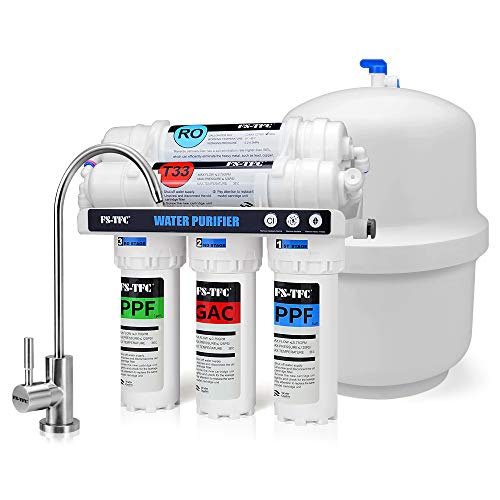
Cheapest, and a title-only claim: FS-TFC 5-Stage RO System
| Organic Integrity Score | 68 / 100 |
| Configuration | 5-stage under-sink RO, 100 GPD, 1:1 drain ratio, four spare filters |
| Certification | “NSF Certified” appears in the title only; no standard named in the body |
| Best for | The cheapest way into reverse osmosis, on the seller’s word |
Substantially cheaper than everything else here, and the certification claim is the thinnest.
The product title reads “NSF Certified 100GPD RO Water Purifier”. Across the listing body, NSF is never mentioned again. There is no standard number, no certifying body, no scope statement. What the body says instead is that each unit is “fully designed, assembled and tested” by the manufacturer, which is a description of internal quality control rather than third-party certification.
The specification is otherwise appealing, and that is worth saying. 100 GPD is faster than either iSpring, the claimed 1:1 drain ratio is the best in this comparison, and four spare filters are included.
Also worth noting the claim of “99.999% ultra-high contaminant reduction”. Five nines is a figure from microbiology, not from NSF/ANSI 58 testing, and it is not a number any RO performance standard produces for chemical contaminants.
If price is the constraint and you accept that the certification is unverifiable, it is a lot of hardware for the money. If certification is why you are here, the RCC7-BN costs more and documents itself properly.
- By far the cheapest.
- 100 GPD and a claimed 1:1 drain ratio.
- Four spare filters included.
- NSF appears in the title and nowhere else.
- No standard number or certifier.
- The 99.999 percent figure is not an RO performance measurement.
Best for: Budget buyers who are not paying for a certificate.
What we left out and why
APEC ROES-PH75 and APEC RO-90. Both genuinely frustrating omissions. Each names WQA certification, which is a legitimate third-party program testing against the same NSF/ANSI standards, and the ROES-PH75 is well priced. We excluded them on availability: at the time of checking, both returned a future availability date rather than in-stock, and a guide that stays online for months should not lead readers toward something they cannot buy. If they are available when you look, both are worth considering.
Countertop reverse osmosis units. Bluevua, Waterdrop C2SL and DREO all sell countertop RO systems that need no plumbing, which is the right answer for renters. They are a different product with a different installation decision, and we will cover them separately rather than mixing them into an under-sink comparison.
A third iSpring model. Two of our five picks are already iSpring, and that is not a preference for the brand. Of the systems in this comparison, iSpring’s were the only listings that state NSF/ANSI 58 certification in the product description rather than only in the title. One entry per model is enough to make that point.
AquaTru and Frizzlife. Both are widely recommended elsewhere, both are sold on Amazon, and both are worth explaining rather than silently omitting.
The Frizzlife 1000 GPD system puts “NSF/ASNI 58&53&42&372 Standard” in its product title, four standard numbers including the two that matter most. Its description then says the system “is certified against NSF/ANSI 372 for lead-free material. It also certified by FCC.” Of the four numbers in the title, the body substantiates one, and it is the materials standard. We are not saying the other three are untrue. We are saying the listing does not stand behind them where it counts, and an FCC certification is about radio emissions from the electronics.
The AquaTru Glass Carafe is the countertop unit that appears at the top of most other roundups, and it is genuinely well regarded. Its Amazon listing headlines “Removes 84 Contaminants” and, across the feature bullets we read, names no certifying standard at all. Other sources report it as IAPMO certified to several NSF/ANSI standards, and we score listings rather than reputations, so it does not appear in a comparison built on what each product documents about itself.
Both cases make the same point from opposite directions. A title is written to win a search; a description is written to describe a product. Where they disagree, the description is the one to read.
The limit of this method is worth restating. Reading listing copy tells you what a manufacturer will claim publicly and how far it will substantiate the claim. It cannot verify a laboratory result, and we have not tested any of these systems. What a named standard with a number provides is accountability, since a certificate is something a third party issued and can withdraw.
How to install an under-sink RO system
Most people can do this. The connections are push-fit, the instructions are usually good, and the only step that genuinely stops people is drilling for the faucet. Budget two to three hours for a first attempt.
- Clear the cabinet and shut off the cold supply. Turn the cold stop valve under the sink, then open the tap to release pressure. Put a towel and a shallow tray underneath, because a small amount of water will come out whatever you do.
- Fit the feed adapter to the cold line. The kit includes an adapter that goes between the cold stop valve and the faucet supply line, with a take-off for the RO system. Hand tight plus a quarter turn; do not overtighten plastic threads.
- Mount the faucet. If your sink has a spare hole for a soap dispenser or sprayer, use it. If not, this is the step to consider paying for: stainless steel needs a step drill and granite or quartz needs a diamond hole saw and a steady hand. A cracked worktop costs more than a plumber.
- Fit the drain saddle. This clamps around the waste pipe above the trap and takes the reject line. Drill the pipe through the saddle’s guide hole, never below the trap, and keep it above the standing water line.
- Mount the manifold and hang the tank. The filter housings need clearance underneath to unscrew, usually around four inches, so check that before fixing anything to the cabinet wall.
- Connect the tubing by color and push it fully home. Push-fit connectors need the tube seated all the way in or they will weep. Tug each one afterwards. Most leaks people report are a tube that went in most of the way.
- Open the supply slowly and check every joint. Do this with the cabinet dry and a piece of kitchen paper under each connection, so a slow weep is visible.
- Flush the first two tanks and discard them. New membranes and carbon filters shed fines. Fill and drain twice before drinking, and expect the first tank to take a few hours.
Tankless systems skip the tank and the drain saddle is often the same, but they need a power socket inside the cabinet, which not every kitchen has.
What it actually costs to run
The purchase price is the smaller number over five years. These are the figures each manufacturer publishes, which is what makes them comparable; where a listing does not state something, we have said so rather than estimating it.
Three costs to add up before buying, because the cheapest system is frequently not the cheapest to own.
Cartridges. A system using standard 10-inch housings takes commodity filters from any supplier. A system using proprietary snap-in cartridges takes whatever the manufacturer charges. Over three years that difference can exceed the price gap between the two systems.
Water. At 4:1, producing two gallons of drinking water a day sends eight gallons to the drain, close to 3,000 gallons a year. At 1:1 the same household wastes a quarter of that. On a metered supply this is a real line item, and in a drought-restricted area it may decide the purchase.
The membrane. The expensive component, and its life depends almost entirely on whether the cheap pre-filters in front of it were changed on time. Neglecting a $20 sediment filter is how a $70 membrane dies early.
Maintenance and living with it
Installation is the step people underestimate. A tank system needs a cold water tap connection, a drain saddle on the waste pipe, and a hole for the dedicated faucet. If your sink has a spare hole for a soap dispenser you are fine; if not, drilling stainless steel or granite is a job worth paying for.
Sanitise at the first filter change. RO systems hold water, and the tank in particular benefits from being drained and sanitised annually. Most manufacturers describe the procedure and most owners skip it.
Flush the first tankful. A new membrane and new carbon filters release fines, so the first tank should go down the drain rather than into a glass.
Check the drain ratio against your water bill. A 4:1 system producing two gallons of drinking water a day sends eight gallons to waste. Over a year that is nearly 3,000 gallons, which in a metered household is a real number and in a drought-restricted area is a reason to prefer a better ratio.
Track filter dates. Pre-filters every six to twelve months protects the membrane, which is the expensive part. A neglected pre-filter shortens membrane life considerably, so the cheap maintenance is what protects the costly component.
Questions about reverse osmosis systems
What is the difference between NSF/ANSI 58 and NSF/ANSI 372?
Standard 58 is the reverse osmosis performance standard: it tests what the system actually reduces and the certificate names the contaminants and percentages. Standard 372 certifies that the wetted parts are lead-free. A system certified only to 372 has never been tested for whether it removes anything.
Does reverse osmosis remove fluoride?
Yes, and it is one of the few household treatments that does. One certified system in this comparison publishes a tested figure of 97.4 percent reduction. Carbon filters generally do not remove fluoride.
Does RO remove healthy minerals too?
Yes. The membrane does not distinguish between calcium and cadmium, so dissolved minerals go with the contaminants. That is why some systems add a remineralization stage, and why RO water can taste flat without one. Dietary minerals come overwhelmingly from food rather than water.
How much water does reverse osmosis waste?
Traditional tank systems commonly run 3:1 or 4:1, meaning three or four gallons to drain per gallon produced. Better designs claim 2:1 or 1:1. Over a year the difference runs to thousands of gallons, so the drain ratio is worth checking before buying.
Is a higher GPD rating better?
Less than it sounds on a tank system, because the tank buffers demand and a 50 GPD system with a full tank pours as fast as a 600 GPD one. GPD matters on tankless systems, where production rate is the flow rate.
Do I need a plumber to install one?
Not necessarily. The connections are push-fit and the instructions are usually good. The step that stops people is drilling a hole for the dedicated faucet if the sink has no spare, which on granite or stainless steel is worth paying someone to do.
What does full system certification mean?
That the assembled unit was tested, rather than individual components. A system built from certified parts has not necessarily been certified as a whole, and the whole is what sits under your sink.
How often do the filters need changing?
Sediment and carbon pre-filters every six to twelve months, the membrane every two to three years, the post-filter annually. Keeping pre-filters fresh is what protects the membrane, which is the expensive component.
Is WQA certification as good as NSF?
Yes, where it is against the same standard. The Water Quality Association runs a Gold Seal program testing to NSF/ANSI standards, as does IAPMO R&T. What matters is the standard number, not which accredited body issued the certificate.
Organic Connection is reader supported. We check every product against its stated certification and say plainly when a claim cannot be verified. How we research and rate.