Last updated: September 30, 2026
We may earn a commission when you buy through links on this page, at no extra cost to you. How we research and rate.
The short version
This guide covers carbon under-sink filters: plumbed in, no tank, no wastewater, no electricity. If you need fluoride or dissolved solids removed, that requires reverse osmosis, which we cover in the best under-sink reverse osmosis systems. If you cannot plumb anything in, see countertop filters.
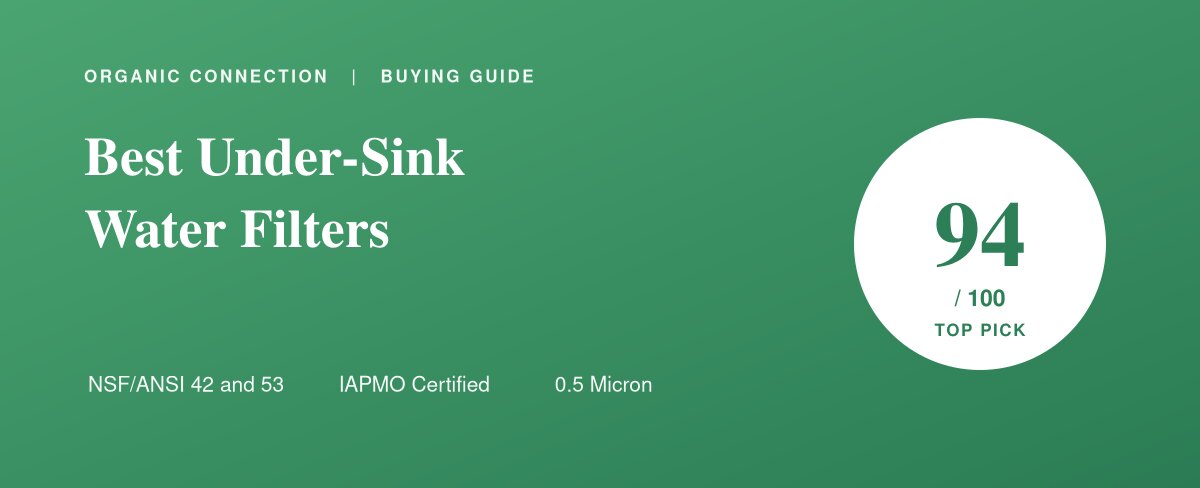
Our top pick is the Frizzlife SK99, with an Organic Integrity Score of 94 out of 100. Its listing names the certifying body, the standards, and what those standards actually tested.
After looking at whole house systems, where none of the Amazon listings we read named a performance standard, and reverse osmosis, where one brand carried the right one, this category is a pleasant surprise. Five of the six systems we examined name a genuine NSF/ANSI performance standard, and two name the accredited body that issued it.
Best under-sink water filters compared
| Best Choice | Best Value | ||||
 |  |  |  |  | |
| Product | Frizzlife SK99 | CuZn UC-200 | ICEPURE Under Sink | Waterdrop TSA 8 Layer | Waterdrop 15UB |
| Organic Integrity Score | 94/ 100 | 88/ 100 | 86/ 100 | 84/ 100 | 82/ 100 |
| Our rating | 4.7 | 4.4 | 4.3 | 4.2 | 4.1 |
| Standards named | 42 and 53 | 42 and 372 | 42 and 372 | 42 | 372 |
| Certifier named | IAPMO | — | — | IAPMO | IAPMO |
| Micron | 0.5 | Not stated | 0.5 | Not stated | Not stated |
| Capacity | Not stated | 5 years | 22,000 gal | Not stated | Not stated |
| Best for | Health-effect certification | Longest life, states limits | Capacity per dollar | Direct connect simplicity | Separate filtered tap |
| Configuration | 8-layer compound cartridge, 0.5 micron, direct connect | Single large cartridge, 5-year rated life, direct connect | Coconut shell carbon, 0.5 micron outer layer, direct connect, 3 years or 22,000 gallons | Three cartridges, 8-stage filtration, standard 1/2 or 3/8 inch connections | Multistage filter with its own lead-free stainless faucet |
| Price | $99.99 $125.99 −21% View on Amazon | $149.95 $163.99 −9% View on Amazon | $49.99 $59.99 −17% View on Amazon | $99.99 $119.99 −17% View on Amazon | $67.99 $78.99 −14% View on Amazon |
- Clean Air and Water hub
- Best Portable Water Filters
- Best Refrigerator Water Filters
- our organic product database — compare brands across every guide
- What water filters actually remove
Price and availability as of October 12, 2026 1:10 am EDT. Product prices and availability are accurate as of the date/time indicated and are subject to change. Any price and availability information displayed on Amazon.com at the time of purchase will apply to the purchase of this product.
The under sink water filters certifications, and the question each one leaves open
Most shoppers read a certification as a general signal of quality. Every one of them is narrower than that, and the gaps between them are where the marketing lives.
| Certification | Covers | Key exclusion |
| NSF/ANSI | Independent testing of a water treatment product against one named standard number | The number is the claim: 42 is taste and odor, 53 is health contaminants, 58 is reverse osmosis, 401 is emerging compounds, and 372 is only lead-free materials |
| WQA Gold Seal | Certifies a water treatment product against the NSF/ANSI standards, as an accredited alternative to NSF itself | A certifying body rather than a standard, so the standard number it certified against still matters |
Check which NSF standard, and then check which contaminants inside it. Certification is granted claim by claim rather than filter by filter, so a unit certified to NSF/ANSI 53 is certified for the specific contaminants it was tested against, not for everything the standard covers. Manufacturers publish those claims and so do the certifying bodies, and the two should agree. “Tested to NSF standards” in a listing, with no number and no certifier, is not a certification at all.
Why this category documents itself so well
Worth understanding, because the contrast with the neighboring categories is stark and it is not an accident.
A carbon under-sink filter is the easiest water product to certify. It runs at half a gallon a minute rather than ten, its cartridge life is measured in thousands of gallons rather than hundreds of thousands, and the contaminants it targets are exactly the ones NSF/ANSI 42 and 53 were written around. The test is affordable and the result is a clean marketing asset, so manufacturers get it done.
Compare that with whole house systems, where the same test at household flow rates over a filter life of hundreds of thousands of gallons is expensive enough that none of the seven Amazon-listed systems we read carried a performance certificate.
The practical consequence for you is unusually good. In this category you can simply refuse to buy anything that does not name a standard number, and still have five options. That is not true anywhere else in water treatment, and it is not true in most of the organic categories we cover either.
What carbon filtration does and does not do
Being precise about this saves buying the wrong technology.
Activated carbon works by adsorption: contaminants stick to an enormous internal surface area as water passes through. It is very good at chlorine, chloramine, taste, odor, volatile organic compounds and many pesticides and industrial chemicals. A dense carbon block, as opposed to loose granular carbon, also filters mechanically, which is how these systems handle lead particulates and cysts.
What carbon does not do is remove dissolved inorganic salts. Fluoride, nitrates, sodium and most dissolved minerals pass straight through. If any of those is your reason for filtering, carbon is the wrong tool and reverse osmosis is the right one.
That distinction is also why these filters do not lower TDS, and two manufacturers here say so in their own listings. One adds a genuinely useful correction: dissolved solids include the calcium, magnesium and potassium you probably want to keep, so a TDS meter measures how much is dissolved rather than how much is harmful.
The upside of carbon is everything RO gives up. No wastewater at all, no electricity, no tank, no remineralization stage needed because the minerals were never removed, and a much smaller cabinet footprint.
Micron rating, capacity and flow
Three specifications separate these systems, and all three are usually published.
Micron rating is the size of particle the block will stop. Most quality carbon blocks here are 0.5 micron, which is fine enough to catch cysts like Giardia and Cryptosporidium as well as lead particulates. A 5 micron block flows faster and catches far less. Where a listing publishes 0.5 micron, that is a meaningful specification rather than a marketing number.
Capacity is rated in gallons, and it varies enormously here: from a few thousand to 22,000 gallons on one system, and five years on another. Capacity is what determines running cost, and a filter costing twice as much with four times the capacity is the cheaper filter.
Flow rate is the trade-off nobody mentions until they own one. A 0.5 micron block passing water through eight layers is doing real work, and the water comes out of the tap noticeably slower than unfiltered. One manufacturer here addresses this directly in its listing, which we counted in its favor: filling a kettle takes longer than you expect.
Two practical notes. Direct-connect systems plumb into the existing cold line and filter everything from the main kitchen tap, which means no extra hole and no second faucet. Dedicated-faucet systems run a separate small tap for filtered water, which needs a hole but keeps unfiltered water available for washing up and preserves cartridge life.
How to know whether carbon is enough for your water
Ten minutes of reading before you buy will tell you whether this whole category solves your problem, and it costs nothing.
Start with your supplier’s water quality report. Municipal suppliers in the US publish an annual Consumer Confidence Report, usually on the utility’s website or available on request. It lists what was detected, at what level, against the regulatory limit. That single document turns the question from “what should I be worried about” into “here is what is actually in my water”.
Read it looking for which of two groups your concerns fall into.
Carbon handles these. Chlorine and chloramine, the taste and smell that come with them, volatile organic compounds, many pesticides and industrial solvents, disinfection byproducts such as trihalomethanes, and lead where it arrives as particulates from old plumbing rather than dissolved.
Carbon does not handle these. Fluoride, nitrates and nitrites, sodium, arsenic in its dissolved form, hardness minerals, and total dissolved solids generally. Those need reverse osmosis, or in some cases a specific medium such as activated alumina for fluoride.
If everything on your list is in the first group, a carbon filter is the right purchase and the cheapest one that solves it. If anything important is in the second group, buying carbon will not fix it however many stages the box advertises.
On a private well, the report does not exist and the rules change. Wells are not regulated the way municipal supply is, and the common problems are different: bacteria, iron, manganese, sulfur and sediment. A carbon filter addresses almost none of those. Testing first is not optional there, and we cover the sequence separately.
One more thing the report will not tell you, because it is measured at the treatment plant rather than at your tap: lead from your own plumbing. If the house predates the mid-1980s, that is worth a separate test, and it is the one case where certification to Standard 53 rather than 42 genuinely matters.
The trade-offs of an under-sink carbon filter
This is the cheapest water treatment there is to run, and the reason is that it does less. Worth being clear about both halves before you buy.
| In its favor | Against it | |
| Running cost | No electricity, no wastewater, and capacities measured in thousands of gallons. Cartridge intervals run from six months to five years | Nothing — this is the category’s strongest argument |
| What it removes | Chlorine, taste, odor, sediment, VOCs, and on certified models lead and cysts | No dissolved solids. Fluoride, nitrate, sodium and most arsenic pass straight through carbon at any micron rating |
| Certification | One of the few categories where NSF/ANSI certification is normal rather than exceptional | Certification is per contaminant, so “certified” alone tells you nothing about which one |
| Installation | Inline models connect to the existing cold line with no drilling | Dedicated-faucet models need a hole in the sink or worktop |
| Space and flow | Compact enough for a crowded cabinet | Multi-stage designs slow the flow noticeably, and the honest listings say so |
If your water report shows a dissolved contaminant, this is the wrong category and reverse osmosis is the right one. If it does not, an under-sink carbon filter does the same job for a fraction of the running cost.
What actually separates these five
All five are carbon under-sink filters at broadly similar prices, so the differences are in what each one documents and what format it takes.
| Pick | What only this one does |
| Frizzlife SK99 | The only one certified by IAPMO against the NSF/ANSI standards, and it states 0.5 micron filtration accuracy |
| CuZn UC-200 | A five-year cartridge, by far the longest here, using KDF-55 alongside coconut carbon. It also names PFAS, PFOA/PFOS and lead as independently tested |
| ICEPURE | A 22,000 gallon capacity tested under NSF/ANSI 42 — the largest figure on the page — at the lowest purchase price |
| Waterdrop TSA | Eight filtration stages, and the only listing that volunteers a drawback: it warns in writing that flow slows after full filtration |
| Waterdrop 15UB | A dedicated lead-free stainless faucet, plus the cheapest replacement cartridges here at around $36 |
Best overall: Frizzlife SK99 Under Sink Water Filter
| Organic Integrity Score | 94 / 100 |
| Configuration | 8-layer compound cartridge, 0.5 micron, direct connect |
| Certification | NSF |
| Best for | Health-effect certification, not just taste and odor |
This listing does something we have seen only a handful of times across every category on this site: it names the certifying body, the standards, and what those standards actually evaluated.
The sentence reads: “rigorously tested and certified by IAPMO against NSF/ANSI 42&53 for Material Safety, Structure Integrity, Flow rate, and Filtration”. IAPMO R&T is an accredited certification body, equivalent to NSF International for this purpose. Naming the four tested attributes is a level of detail almost nobody publishes.
Certification to 53 is what separates this from most of the category. Standard 42 is chlorine, taste and odor. Standard 53 is health effects: lead, cysts, VOCs. Plenty of filters carry 42. Far fewer carry 53, and it is the one that covers the contaminants people are actually worried about.
The cartridge is an eight layer compound block at 0.5 micron, which is fine enough for cysts and lead particulates. Direct connect, so no second faucet and no drilling.
Two honest points. No capacity figure is published, which is the one specification we would want and cannot find. And a 0.5 micron eight layer block is inherently slower than an unfiltered tap.
- Names IAPMO, both standards, and the four attributes tested.
- Certified to 53, not just 42.
- 0.5 micron block.
- Direct connect with no drilling.
- No capacity figure published.
- Noticeably slower flow than an unfiltered tap.
- Compound cartridge means replacing all layers together.
What we liked: The only pick certified by IAPMO against the NSF/ANSI standards, with a stated 0.5 micron accuracy and strong flow.
Keep in mind: Shorter cartridge life than the long-life options here, so the running cost is higher than the sticker suggests.
Best for: Anyone who wants health-effect certification rather than taste certification.
Longest life, and it states its limits: CuZn UC-200
| Organic Integrity Score | 88 / 100 |
| Configuration | Single large cartridge, 5-year rated life, direct connect |
| Certification | NSF |
| Best for | Set and forget, with the longest replacement interval here |
A five year filter life is the headline, and in a category where most cartridges are annual it changes the ownership maths entirely. One cartridge change in five years is close to no maintenance at all.
The listing also does the thing we keep rewarding: it states a limitation. “NOTE: does not reduce TDS, which can only…” — a manufacturer telling you what its product will not do, in the same breath as what it will. That is the second time we have seen it in water filtration, and both times from a company that seems to know its own product well.
On certification, read the wording carefully. It says NSF/ANSI 42 certified components and materials, alongside separate independent testing for PFAS, PFOA, lead and chlorine. That is component certification rather than whole system certification, which is a real distinction and one step below the Frizzlife.
The trade-off for the long life is size. This is a large cartridge and it needs the cabinet space to match, plus room below to swap it.
- Five year rated life, by far the longest here.
- States plainly that it does not reduce TDS.
- Independent testing named for PFAS and lead specifically.
- Certification is on components and materials rather than the whole system.
- Large cartridge needs cabinet space.
- No micron rating published.
What we liked: A five-year cartridge, by far the longest here, using KDF-55 alongside coconut carbon, and it names PFAS, PFOA/PFOS and lead as independently tested.
Keep in mind: “Independently tested” is not the same as certified to a named standard, and the highest purchase price in this field.
Best for: People who would rather not think about filters for five years.
Best value: ICEPURE Under Sink Water Filter
| Organic Integrity Score | 86 / 100 |
| Configuration | Coconut shell carbon, 0.5 micron outer layer, direct connect, 3 years or 22,000 gallons |
| Certification | NSF |
| Best for | Capacity per dollar, by a wide margin |
The cheapest system here and the one publishing the most useful capacity figure: 22,000 gallons, or three years, and it specifies that the capacity was tested under NSF/ANSI 42 rather than estimated.
Tying a capacity claim to a standard is unusual and it matters. Most published capacities are the manufacturer’s own estimate under favorable conditions; a figure tested to a standard is one somebody checked.
Run the arithmetic and the value case is emphatic. Twenty-two thousand gallons at this price works out at a fraction of a cent per gallon, before considering that many competitors want an annual cartridge.
Certification is 42 and 372: aesthetic effects plus lead-free materials. That is one step below the Frizzlife’s 53, so it is tested for chlorine, taste and odor rather than for health contaminants. The listing separately claims heavy metal reduction, which is a manufacturer statement rather than part of the certificate.
Coconut shell carbon at 0.5 micron on the outer layer, BPA free housings, direct connect.
- 22,000 gallon capacity tested to a standard, not estimated.
- Cheapest here by a distance.
- 0.5 micron.
- Names both standards it carries.
- Certified to 42, not 53, so it is a taste and odor certificate.
- Heavy metal claims sit outside the certification.
- Housing is plastic.
What we liked: A 22,000 gallon capacity tested under NSF/ANSI 42, the largest figure on the page, at the lowest purchase price.
Keep in mind: NSF/ANSI 42 covers taste and chlorine rather than health contaminants, so the big number is a capacity claim rather than a lead claim.
Best for: Chlorine and taste on municipal water, at the lowest running cost here.
Simplest install: Waterdrop TSA 8 Layer
| Organic Integrity Score | 84 / 100 |
| Configuration | Three cartridges, 8-stage filtration, standard 1/2 or 3/8 inch connections |
| Certification | NSF |
| Best for | A straightforward fit to existing connections |
The most explicit listing here about fitting. It names the connection sizes it expects, half inch or three eighths female NPT, and says it is designed for standard under-sink cold water connections on municipal supply. That is the information that decides whether an afternoon goes smoothly.
It also does something we counted in its favor and most manufacturers would rather not print: it warns that flow slows after eight stages of filtration, and explains the 2026 revision to the PP filter intended to help. Telling a buyer their tap will run slower is not a selling point, and it is true of every fine filter in this category.
Certification is NSF/ANSI 42, with IAPMO named in the listing. Coconut shell carbon block, three cartridges, mineral retention.
Its wider contaminant claims, covering PFAS, PFOA, fluoride and cysts, go beyond what a Standard 42 certificate covers, so treat those as manufacturer statements. Fluoride in particular is not something a carbon block meaningfully removes.
- Publishes the exact connection sizes.
- Warns honestly about reduced flow.
- NSF/ANSI 42 with IAPMO named.
- Three cartridges rather than one compound block.
- Certified to 42 only.
- Claims fluoride reduction, which carbon does not meaningfully do.
- Three cartridges means three replacements.
What we liked: Eight filtration stages and the only listing here that volunteers a drawback: it warns in writing that flow slows after full filtration.
Keep in mind: That flow reduction is real, and three cartridges means three replacements on a schedule.
Best for: A clean fit to standard connections without surprises.
Separate filtered tap: Waterdrop 15UB
| Organic Integrity Score | 82 / 100 |
| Configuration | Multistage filter with its own lead-free stainless faucet |
| Certification | NSF |
| Best for | Keeping filtered water separate from washing-up water |
The only system here shipping with its own faucet, which is a genuine design choice rather than an upsell. A dedicated tap means the cartridge only filters what you drink, so its life stretches considerably compared with a direct-connect system filtering everything including the washing up.
The cost is a hole in the worktop, or a spare one if you are lucky.
The listing includes the most useful piece of consumer education we have found in the category, and it argues against a number the industry usually leans on: “TDS is not a professional way to measure the water quality. Essential Minerals, Calcium, Potassium, Sodium, Magnesium… These essential minerals are dissolved solids, PPM will not be dropping if you test with a TDS meter.”
That is a manufacturer telling buyers not to judge its product by the meter they probably own, and explaining why. It is correct, and it is the opposite of what a company optimising for reviews would write.
The certification itself is the weakest of our picks: IAPMO against NSF/ANSI 372, which is lead-free materials rather than filtration performance. The contaminant claims are manufacturer statements.
- Includes a dedicated lead-free faucet, which extends cartridge life.
- Names IAPMO as certifier.
- Corrects the TDS misconception honestly and clearly.
- NSF/ANSI 372 is materials only, the weakest certification among our picks.
- Needs a faucet hole.
- Contaminant claims sit outside the certificate.
What we liked: A dedicated lead-free stainless faucet, IAPMO certified materials, and the cheapest replacement cartridges here at around $36.
Keep in mind: The separate tap needs a hole in the sink or worktop, which rules it out for many rented kitchens.
Best for: Kitchens with a spare tap hole, where cartridge life matters.
What we left out and why
Aquasana Claryum. The best-selling system in the category by sales rank, and a genuine omission worth explaining rather than hiding. Its listing states “WQA tested & certified to reduce up to 99.99% of 78 contaminants”, names the Water Quality Association as certifier, and adds that the system will not reduce TDS. What it does not do, on Amazon, is name the standard numbers behind that certificate. Other sources report the Claryum line as certified to NSF/ANSI 42, 53 and 401, which if accurate would be the broadest certification in this guide, including the emerging contaminants standard that none of our picks carries.
We score listings rather than reputations, and a certifier without a standard number sits below a listing naming both, which is why it is here rather than in the table. If you are choosing on brand and track record rather than on documentation, it is a strong option and its sales rank suggests most buyers agree.
Frizzlife FK99. A second Frizzlife carrying NSF/ANSI 42 and 53, at a lower price than the SK99, and notable for stating it passed 100,000 cycles of a 600 psi water hammer test. We left it out on brand concentration rather than quality, and if the SK99 is above your budget it is the obvious alternative.
Replacement cartridges. Search results for this category are full of cartridges rather than systems, including Pentair Pentek blocks that many housings accept. Worth knowing when you are replacing rather than buying.
Reverse osmosis systems. They also fit under the sink and they solve a different problem, at the cost of wastewater, a tank and electricity. Covered separately in the best under-sink reverse osmosis systems.
The limit of this method, as always. We read what each listing claims and how far it substantiates the claim. We have not tested these filters, and a certificate number is a claim someone can be held to rather than proof of performance in your kitchen.
How to install an under-sink carbon filter
This is the easiest plumbed installation in water treatment. No drain connection, no tank, no power. Most people manage it in under an hour.
- Check your connection size first. Look under the sink at the cold supply: most are 3/8 inch compression or 1/2 inch NPT. Buying a system that matches saves a trip for adapters.
- Turn off the cold stop valve and open the tap. Releases pressure. Put a bowl underneath, since the riser holds water.
- Disconnect the cold riser from the stop valve. One spanner, quarter turn, expect a splash.
- Fit the tee or inline adapter. Direct-connect systems go inline on the cold feed. Dedicated-faucet systems take a tee off the cold and run separately to their own tap.
- Mount the bracket, leaving swap clearance. Cartridges come out downward, so leave the manufacturer’s stated clearance beneath. Getting this wrong makes every future change miserable.
- Push tubing fully home and tug each fitting. Push-fit connectors leak when the tube is not seated all the way. A firm tug is the test.
- Open the valve slowly and check for weeps. Kitchen paper under each joint makes a slow leak visible before it becomes a puddle.
- Flush for five to ten minutes. New carbon sheds fines and the first water runs gray. Do not drink it.
What it costs to run
This is the cheapest technology in water treatment to run. No electricity, nothing to drain, and cartridge intervals measured in years rather than months.
Compare it with reverse osmosis, where you add electricity on tankless units, three or four gallons to waste per gallon produced on tank systems, and a membrane every two to three years on top of the pre-filters. If carbon does what you need, it does it for a fraction of the running cost.
Judge cartridges on gallons, not on price. A cartridge at twice the price with four times the capacity is the cheaper filter, and capacity is published often enough here to compare properly.
Questions about under-sink water filters
What is the difference between NSF/ANSI 42 and 53?
Standard 42 covers aesthetic effects: chlorine, taste and odor. Standard 53 covers health effects: lead, cysts, VOCs and similar. Most filters carry 42. Fewer carry 53, and 53 is the one covering the contaminants people usually mean.
Do carbon filters remove fluoride?
No, not meaningfully. Fluoride is a dissolved inorganic ion and passes through carbon. Removing it requires reverse osmosis or a specific fluoride medium, whatever a listing claims.
Will an under-sink filter lower my TDS reading?
No, and that is not a fault. Carbon does not remove dissolved solids, and dissolved solids include calcium, magnesium and potassium that you want to keep. One manufacturer here makes exactly this point in its own listing.
Carbon or reverse osmosis?
Carbon for chlorine, taste, odor, VOCs and lead particulates, with no wastewater, no power and no tank. Reverse osmosis if you need fluoride, nitrates or dissolved solids removed, accepting wastewater and a tank.
Direct connect or a dedicated faucet?
Direct connect filters everything from the main tap and needs no drilling, but the cartridge also filters your washing-up water. A dedicated faucet needs a hole and only filters what you drink, so cartridges last considerably longer.
Why does my tap run slower after fitting one?
Because a 0.5 micron block passing water through several layers is doing real work. Every fine filter reduces flow, and one manufacturer here says so in its listing. It is the normal trade for finer filtration.
How long do the cartridges last?
Anywhere from a year to five, and capacity is often published in gallons, which is the better comparison. One system here is rated at 22,000 gallons, another at five years. Sediment-heavy water shortens both.
Do I need a plumber?
Usually not. There is no drain connection, no tank and no power, and connections are push-fit or compression. The only job that might need help is drilling a faucet hole if you choose a dedicated-tap system.
Organic Connection is reader supported. We check every product against its stated certification and say plainly when a claim cannot be verified. How we research and rate.