
Last updated: September 23, 2026
We may earn a commission when you buy through links on this page, at no extra cost to you. How we research and rate.
The short version
Judged on the evidence each listing gives you, our top pick is iSpring WGB21BM 2-Stage Iron and Manganese System, with our highest Organic Integrity Score of 90 out of 100. iSpring WGB32BM 3-Stage is the runner-up at 86.
Our top pick is the iSpring WGB21BM, with an Organic Integrity Score of 90 out of 100. It publishes the one thing almost nothing else in water treatment publishes: an input figure and an output figure, in parts per million, for the contaminant it targets.
Before any of that, the thing that matters more than which filter you buy. You cannot choose a well water system without a water test, and nothing on this page changes that. Municipal customers get an annual report. Well owners get nothing unless they order it.
Best well water filters compared
| Best Choice | Best Value | |||
 |  |  |  | |
| Product | iSpring WGB21BM | iSpring WGB32BM | HQUA-TWS-12 UV | DuraWater Fleck 5600 SXT |
| Organic Integrity Score | 90/ 100 | 86/ 100 | 66/ 100 | 64/ 100 |
| Our rating | 4.5 | 4.3 | 3.3 | 3.2 |
| Publishes figures | Yes, ppm in and out | Yes, ppm in and out | No | No |
| Stage it covers | Iron, manganese, carbon | Sediment, carbon, iron | Disinfection only | Heavy iron, oxidising |
| Iron ceiling | 3.0 ppm | 3.0 ppm | Not applicable | High, air injection |
| Best for | Moderate iron, most wells | Dirtier wells needing | Bacteria, as a final stage | Iron beyond cartridge range |
| Configuration | 2-stage 10 x 4.5 inch: CTO carbon block, then FM15B iron and manganese media | 3-stage: 5 micron polypropylene sediment, coconut carbon block, FM25B iron media | 12 GPM whole house UV, 120V, spare lamp and quartz sleeve included | Air injection oxidising filter, 1.5 cubic feet media, Fleck 5600 SXT control valve |
| Price | $192.99 $230.99 −16% View on Amazon | $473.68 $535.99 −12% View on Amazon | $259.99 View on Amazon | $945.00 View on Amazon |
- Clean Air and Water hub
- our organic product database — compare brands across every guide
- Best Portable Water Filters
- What water filters actually remove
Price and availability as of October 13, 2026 1:10 am EDT. Product prices and availability are accurate as of the date/time indicated and are subject to change. Any price and availability information displayed on Amazon.com at the time of purchase will apply to the purchase of this product.
Test the water before you buy anything
This is the whole guide compressed into one instruction, and skipping it is how people buy the wrong system twice.
A private well has no utility behind it. Nobody samples it, nobody publishes a report, and nothing about the water is guaranteed by anyone. The US Centers for Disease Control recommends testing a private well at least once a year for bacteria and nitrates, plus anything of local concern.
What to test for, and why each one changes the purchase:
Bacteria, specifically coliform and E. coli. If this comes back positive, filtration does not solve it. You need disinfection, which means UV or chlorination, and that is a different product from everything else on this page.
Iron, in ppm. This decides your entire system. Below about 3 ppm, a cartridge filter with iron-reducing media handles it. Above that, you are into oxidising systems with a backwashing tank, which cost several times as much.
Manganese. Travels with iron, causes the black specks, and is handled by the same media.
Hydrogen sulfide, the rotten egg smell. Low levels come out with carbon and iron media. Higher levels need air injection or chlorination.
pH and hardness. Acidic water corrodes plumbing and shortens filter life; hardness needs a softener, which is a different appliance again.
Nitrates. Common near agriculture, and important because carbon does not touch them. Nitrate removal means reverse osmosis at the tap or anion exchange for the house.
A laboratory test costs less than the cheapest system here, and it is the difference between buying a solution and buying a guess.
Well water is a sequence, not a product
This is the second thing that separates well treatment from municipal, and it is why a single “best filter” answer does not exist.
Treated town water arrives having already had its sediment removed and its bacteria killed. A filter is adding polish. Well water arrives raw, and the stages have to run in the right order because each one protects the next.
Sediment first. Sand, silt and rust, usually caught at 5 micron. Its job is protecting everything downstream, and on a well it loads far faster than most people expect.
Iron and manganese second. Specialised media, either a cartridge for moderate levels or an oxidising tank for high ones. This has to come before carbon, because iron fouls carbon quickly.
Carbon third. Sulfur smell, tannins, taste, any organic chemistry. Carbon is also where pesticide and solvent contamination is addressed, which matters near agricultural land.
UV last, if bacteria are present. Ultraviolet light must be the final stage, because it needs clear water to work. Sediment and iron shadow organisms from the lamp, so UV in front of filtration is close to useless.
Reverse osmosis at the kitchen tap, separately, if nitrates or dissolved contaminants are the problem. Whole-house RO on a well is almost always the wrong purchase, covered in our under-sink RO guide.
Most households do not need all five. The test tells you which.
Iron, manganese and the rotten egg smell
The three complaints that bring people to this category, and they are related.
Iron shows as orange or brown staining on baths, sinks and laundry, and a metallic taste. It arrives dissolved and invisible, then oxidises on contact with air, which is why water can look clear at the tap and stain the bath an hour later.
The practical threshold is around 0.3 ppm for staining. Cartridge systems with iron-reducing media handle up to roughly 3 ppm. Above that you need oxidation: air injection, which draws a bubble of air into the tank to convert dissolved iron into particles the media can catch, followed by a periodic backwash.
Manganese causes the black specks and dark staining, and behaves similarly at lower concentrations, typically becoming a problem above 0.05 ppm.
Hydrogen sulfide is the rotten egg smell, and it is worth understanding because the smell is diagnostic. If it comes only from the hot tap, the problem is usually the water heater’s anode rod rather than the well, and replacing that rod is far cheaper than any filter. If it comes from both hot and cold, it is in the water.
One thing worth knowing about all three: they are aesthetic and plumbing problems more than health ones at typical well concentrations. The health issues on a well are bacteria, nitrates and arsenic, and none of those announces itself with a smell or a stain. That asymmetry is exactly why the test matters more than the symptom.
UV is disinfection, and it is not filtration
Worth its own section because the two get conflated constantly.
A UV system passes water alongside an ultraviolet lamp inside a quartz sleeve. The light disrupts the DNA of bacteria, viruses and protozoa so they cannot reproduce. It is effective, it needs no chemicals, and it changes nothing about the water’s taste or content.
It removes nothing. Everything that entered the system leaves it, including the dead organisms. UV is a treatment stage, not a filter, and it complements filtration rather than replacing it.
Three requirements decide whether it works.
Clarity. UV needs to reach the organism. Sediment and dissolved iron shadow them, so UV goes last in the sequence and needs filtration in front of it. Most manufacturers specify a maximum turbidity and iron level for this reason.
Flow rate. Rated in gallons per minute, and it is a dose rather than a capacity. Push water through faster than the rating and each drop spends less time under the lamp, which lowers the dose below what is effective. Size it to your peak household demand, not your average.
Annual lamp replacement. A UV lamp keeps lighting long after its output has fallen below the germicidal threshold, so it is replaced on a calendar rather than when it fails. That is the single most-neglected maintenance item in well treatment, and a lamp that looks fine can be doing nothing.
The serious systems are not sold on Amazon
The same pattern we found in whole house filtration, and it is more pronounced here.
Search for well water treatment and the systems that come back at the top of the results are largely direct-sale: brands selling through their own site or a dealer, sized to your water test, frequently installed by the dealer, and priced accordingly. Systems capable of very high iron loads or heavy sulfur generally live in that channel.
There are good reasons. Well treatment is genuinely consultative, because the right system depends on numbers only your test can supply. A single marketplace listing cannot do that, and a system sold blind to the water it will treat is a gamble on both sides.
So the honest scope of this guide is narrower than “the best well water filters”. It is: here is what Amazon sells, what it is genuinely good for, and where the ceiling is. For moderate iron, sulfur odor and bacteria, the products below do the job at a fraction of the price of a dealer system. For heavy iron, high sulfur or a complicated test result, buying direct is the better answer and we would rather say so.
The trade-offs of well water treatment
Well water is the one category where buying before testing is close to pointless. A private well is not treated or monitored, there is no annual report to read, and what is in the water is a local question about geology, agriculture and the well itself.
| In its favor | Against it | |
| Control | You can treat exactly what your water has, rather than a generic municipal profile | You have to find out what that is first. A laboratory test is the real first purchase |
| Capability | Staged systems handle problems municipal supply does not have: iron, manganese, hardness, sediment, bacteria | One unit rarely does it. Well treatment is normally a chain, and the cost is the chain rather than the box |
| Iron and staining | Air injection and catalytic media handle heavy iron that cartridge filters cannot | Those systems are the most expensive and the most involved to install |
| Bacteria | UV certified to NSF/ANSI 55 Class A is effective and adds nothing to the water | UV removes nothing. It inactivates organisms, needs clear water to work, must sit last in the chain, and needs continuous power |
| Nitrate | Nothing in this guide addresses it | Nitrate is common in agricultural areas and matters most for infants. That is a reverse osmosis job at the kitchen tap |
The usual order is sediment, then iron and manganese, then softening for hardness, then carbon, then UV last. Skipping a stage tends to destroy the stage after it — grit shortens everything downstream, and iron fouls carbon quickly.
What actually separates these four
These are not four competing answers to one question. They are different stages, and a difficult well may need more than one of them.
| Pick | What only this one does |
| iSpring WGB21BM | A two-stage system with a filter specifically designed for iron and manganese, arriving pre-assembled on its bracket — the simplest genuine well setup here |
| iSpring WGB32BM | The three-stage version for dirtier wells, adding 5 micron sediment capture ahead of the iron and carbon stages |
| HQUA-TWS-12 UV | The only pick that addresses bacteria at all: 12 GPM at 55 W with a 9,000 hour bulb, and the only one that changes nothing about taste, odor, pH or water chemistry |
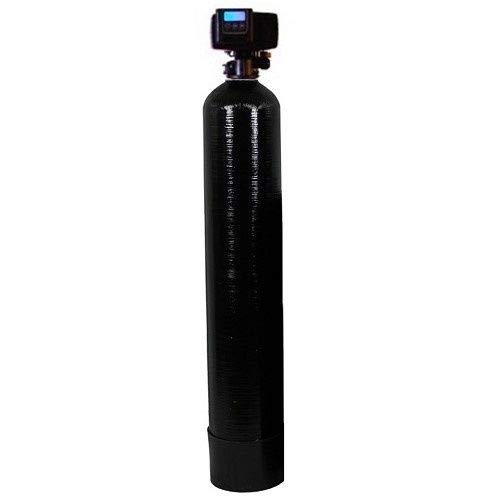
| DuraWater Fleck 5600 SXT | The heavy-iron answer, using air injection to oxidize iron before 1.5 cubic feet of catalytic carbon, with a digital control head and a bypass. Also the most expensive and the most involved to install |
Best overall: iSpring WGB21BM 2-Stage Iron and Manganese System
| Organic Integrity Score | 90 / 100 |
| Configuration | 2-stage 10 x 4.5 inch: CTO carbon block, then FM15B iron and manganese media |
| Published performance | Iron 3.0 ppm to 0.01 ppm; manganese 1.0 ppm to 0.01 ppm |
| Best for | Wells with moderate iron, which is most of them |
The best-documented product we have found in well treatment, and it is also the cheapest system here.
The reason is the figures. Rather than a percentage, the listing publishes what goes in and what comes out: iron from a maximum of 3.0 ppm down to 0.01, manganese from 1.0 down to 0.01. Set that against your test result and you know immediately whether this filter is the right size for your water. A percentage cannot do that, because 99 percent of a very large number is still a large number.
It goes further and states the ceiling explicitly: “For well/pond water with very high iron/manganese please contact us for customized solutions.” That is a manufacturer telling you when to buy something else, which is the second time we have seen iSpring do this and the reason it scores as it does across our water guides.
The carbon stage is coconut shell CTO, and the listing notes it is tested by an independent third party against NSF/ANSI standards, though it stops short of naming which number.
Two honest points. There is no sediment stage, so on a well with visible grit you want the three-stage version below or a separate pre-filter. And like every cartridge system it will not reduce TDS, which the listing also says.
- Publishes input and output in ppm rather than a percentage.
- States plainly when your water is beyond its range.
- Cheapest system here.
- Large 4.5 inch housings.
- No sediment stage, so gritty wells need a pre-filter.
- Iron ceiling of 3.0 ppm.
- Third-party testing mentioned without naming the standard number.
What we liked: A second stage designed specifically for iron and manganese, arriving pre-assembled on its bracket, which makes it the simplest genuine well setup here.
Keep in mind: Two stages only, so a sediment-heavy well will need more, and nothing here addresses bacteria or nitrate.
Best for: Wells testing under 3 ppm iron, which covers most private wells.
Best for dirtier wells: iSpring WGB32BM 3-Stage
| Organic Integrity Score | 86 / 100 |
| Configuration | 3-stage: 5 micron polypropylene sediment, coconut carbon block, FM25B iron media |
| Published performance | Iron and manganese reduction stated in ppm; states it will not reduce TDS |
| Best for | Wells producing visible sediment alongside iron |
The same iron media in a three-stage arrangement, with a 5 micron sediment cartridge in front. On a well that produces visible grit, that first stage is not optional: it is what stops sand scouring the carbon and shortening the life of the expensive media behind it.
The sequence is correct, which is worth saying because it is not always. Sediment, then carbon, then iron media, each protecting the next.
Documentation is the same standard as its two-stage sibling: iron and manganese reduction stated in parts per million, NSF/ANSI referenced for the carbon stage without a number attached, and a clear statement that the system does not reduce TDS and is not a reverse osmosis substitute.
It costs substantially more than the WGB21BM for one extra cartridge, which is the honest objection. If your well runs clear, the two-stage does the same work on iron for considerably less. If it does not, this is the right buy and the sediment stage will pay for itself in media life.
- Correct three-stage sequence with sediment first.
- Same well-documented iron media.
- States its TDS limit.
- Large housings for real flow.
- Considerably dearer than the two-stage for one cartridge.
- Same 3.0 ppm iron ceiling.
- Three cartridges to replace rather than two.
What we liked: The three-stage version for dirtier wells, adding 5 micron sediment capture ahead of the iron and carbon stages.
Keep in mind: Roughly double the price of the two-stage system, and three large cartridges to buy on a schedule.
Best for: Wells with sediment as well as iron.
For bacteria: HQUA-TWS-12 Ultraviolet Purifier
| Organic Integrity Score | 66 / 100 |
| Configuration | 12 GPM whole house UV, 120V, spare lamp and quartz sleeve included |
| Certification | Not stated on the listing |
| Best for | Wells that have tested positive for bacteria, as the final stage |
Included because a well that tests positive for coliform needs disinfection and no filter on this page provides it. This is the stage that does, and it is the most widely bought UV unit in the category.
At 12 GPM it suits most households, and the inclusion of a spare lamp and spare quartz sleeve is more thoughtful than it sounds. The lamp is an annual replacement and the sleeve eventually clouds, so shipping both means the first two years are covered without hunting for parts.
The score is low and the reason is documentation. The listing makes no claim at all: no log reduction figure, no dose rating in millijoules per square centimeter, no certification, no statement of the water clarity it requires. UV performance is entirely a function of dose, and dose is the specification this listing does not publish.
Two things to get right regardless of which UV unit you buy. It goes last, after filtration, because sediment and iron shadow organisms from the lamp. And the lamp is replaced annually on the calendar, not when it stops lighting, because output falls below the germicidal threshold long before the lamp goes dark.
- Provides the one thing filtration cannot.
- 12 GPM suits most homes.
- Spare lamp and quartz sleeve included.
- No dose rating, log reduction figure or certification published.
- Needs clear water in front of it.
- Annual lamp replacement is mandatory, not optional.
What we liked: The only pick that addresses bacteria at all, at 12 GPM and 55 W with a 9,000 hour bulb, and it changes nothing about taste, odor, pH or chemistry.
Keep in mind: UV inactivates organisms and removes nothing, so it needs clear water ahead of it, must sit last in the chain, and needs continuous power.
Best for: Wells with a positive bacteria test, installed after filtration.
For heavy iron: DuraWater Fleck 5600 SXT Air Injection
| Organic Integrity Score | 64 / 100 |
| Configuration | Air injection oxidising filter, 1.5 cubic feet media, Fleck 5600 SXT control valve |
| Certification | Not stated on the listing |
| Best for | Iron beyond what a cartridge system can handle |
A different machine solving the same problem at a scale cartridges cannot reach, and the only product here that addresses iron above the 3 ppm ceiling.
The mechanism is worth understanding because it explains the price. Rather than trapping dissolved iron in media, it draws a pocket of air into the top of the tank and passes water through it, oxidising dissolved iron into solid particles the media bed then catches. Periodically the valve reverses flow, flushes the accumulated iron to drain and re-draws its air pocket. That is why it needs a drain connection and why it never needs a cartridge.
The Fleck 5600 SXT valve is the industry standard for this job, widely serviced, with parts available almost anywhere. On a system expected to run for a decade that matters more than any feature.
The documentation is the problem and the reason for the score. No iron capacity figure, no flow rating, no certification, nothing quantified anywhere in the listing. On a system at this price, being told nothing about the load it handles is a real gap, and it is precisely the information the direct-sale brands lead with.
It is also the most demanding installation here: a drain line, a bypass, and enough clearance for a tall tank.
- Handles iron levels no cartridge system can.
- No cartridges to buy, ever.
- Industry-standard Fleck valve with parts everywhere.
- No capacity or flow figures published at all.
- Most expensive and most involved installation here.
- Needs a drain connection.
What we liked: The heavy-iron answer, oxidizing iron by air injection before 1.5 cubic feet of catalytic carbon, with a digital control head and a bypass included.
Keep in mind: By far the most expensive and most involved installation here, and it regenerates on a schedule, which means a drain line.
Best for: Wells testing well above 3 ppm iron, where cartridges would clog constantly.
What we left out and why
H&G Lifestyles iron filters. Two systems at attractive prices, excluded on availability: at the time of checking they returned as scarce rather than in stock, and a guide that sits online for months should not lead readers toward something that may not be buyable.
The VEVOR 3-stage. A capable iron and manganese system, and it is already our well-water pick in the whole house guide. Recommending the same product twice across two guides would make those guides compete with each other rather than complement each other.
Whole-house reverse osmosis. It appears in well water searches and it is almost always wrong. Treating the water to your toilet and garden tap to drinking standard wastes enormous volumes, and on a well with iron the membrane fouls quickly. Put RO at the kitchen sink, after iron removal.
Softeners. Hardness is a separate problem needing a separate appliance. Some softeners claim modest iron removal, and using one as your iron filter shortens the resin’s life considerably.
The limit of this method deserves particular emphasis here. We read what each listing claims and how far it substantiates it. On a well, the listing is only half the question; the other half is your water test, and no guide can supply that.
How to install a well water system
Cartridge systems are within reach for a confident DIYer. Backwashing tanks and UV are more involved, and the order below is not optional.
- Get the test back first. Everything below depends on knowing your iron, manganese, pH and bacteria numbers. Do not size a system from symptoms.
- Install after the pressure tank. Well systems have a pump and a pressure tank; filtration goes downstream of both, never between pump and tank.
- Fit a bypass loop. Three valves, so the system can be isolated for cartridge changes without shutting off water to the house. On a well this matters more than on town water, because you cannot simply run a tap while you work.
- Respect the sequence. Sediment, then iron media, then carbon, then UV. Carbon before iron fouls quickly; UV before filtration barely works.
- Support the weight and leave clearance. Big Blue housings full of water are heavy and cartridges come out downward. Mount into studs or masonry with the manufacturer’s clearance beneath.
- Run the drain line for a backwashing tank. It needs an air gap at the drain and a run with no uphill sections. This is the step that most often needs a plumber.
- Open slowly and check every joint. Kitchen paper under each connection makes a slow weep visible before it becomes a flood.
- Flush thoroughly, then retest. Run to drain for at least ten minutes, then send a second sample to the lab. Confirming the system did what you bought it for is the step almost everybody skips.
What it costs to run
Three running costs, and they behave very differently.
Cartridges are the main cost on a filter system, and on a well they load faster than any manufacturer’s estimate assumes. Judge them on pressure, not on the calendar: when the shower weakens, the sediment stage is done.
UV lamps are an annual fixed cost regardless of use, plus a quartz sleeve every few years. This is the one item where skipping the replacement leaves you with a system that appears to work and does nothing.
Backwashing tanks have almost no consumable cost and instead use water and a little electricity on every regeneration cycle. Over a decade that generally works out cheaper than cartridges, which is the argument for the higher purchase price.
Add the annual water test. It is the cheapest line item and the only one that tells you whether the rest is working.
Questions about well water filtration
How often should I test my well?
At least once a year for bacteria and nitrates, which is the CDC recommendation, plus anything of local concern such as arsenic or agricultural runoff. Test again after any flooding, after work on the well, and after installing treatment.
Does a filter remove bacteria from well water?
No. Sediment, carbon and iron media are filtration, not disinfection. A well testing positive for coliform needs UV or chlorination, installed as the final stage after filtration.
How much iron can a cartridge filter handle?
Around 3 ppm on the systems here, which their listings state directly. Above that you need an oxidising system with a backwashing tank, because cartridges clog too quickly to be practical.
Why does my water smell of rotten eggs?
Hydrogen sulfide. If the smell is only on the hot tap, the likely cause is the water heater’s anode rod rather than the well, and replacing it is far cheaper than any filter. From both hot and cold, it is in the water.
What order do the stages go in?
Sediment, then iron and manganese, then carbon, then UV last. Carbon placed before iron removal fouls quickly, and UV placed before filtration cannot reach organisms shadowed by sediment.
Do I need to replace the UV lamp if it still lights?
Yes, annually. Output falls below the germicidal threshold long before the lamp goes dark, so a lit lamp is not evidence the system is working.
Will a water softener remove iron?
Some remove modest amounts, and using one as your iron filter shortens the resin’s life considerably. Hardness and iron are separate problems best handled by separate equipment.
Is whole-house reverse osmosis a good idea on a well?
Almost never. It wastes large volumes treating water destined for toilets and gardens, and iron fouls the membrane quickly. Put reverse osmosis at the kitchen tap, downstream of iron removal.
Organic Connection is reader supported. We check every product against its stated certification and say plainly when a claim cannot be verified. How we research and rate.