Last updated: September 23, 2026
We may earn a commission when you buy through links on this page, at no extra cost to you. How we research and rate.
The short version
Our top pick is the Aquabliss SF100, with an Organic Integrity Score of 84 out of 100. It is the best-selling shower filter in the category, and it earns the top spot partly for what it does not claim.
Because the thing most people are searching for is not what this product does. A shower filter reduces chlorine. It does not soften hard water. Independent lab testing of these units has found no meaningful reduction in hardness, and several products still put “hard water softener” in the title.
That is not a reason to skip the category. Chlorine is a genuine cause of dry skin and dull hair, and removing it is worth doing. It is a reason to buy for the right reason.
Best shower filters compared
| Best Choice | Best Value | ||||
 |  |  |  |  | |
| Product | Aquabliss SF100 | SR SUN RISE 20 Stage | FEELSO Filtered Head | MyHalos Filtered Head | weAQUA Heavy Duty |
| Organic Integrity Score | 84/ 100 | 74/ 100 | 70/ 100 | 68/ 100 | 62/ 100 |
| Our rating | 4.2 | 3.7 | 3.5 | 3.4 | 3.1 |
| Claims to soften | No | No | No | No | Yes, 99% |
| Names its media | Partly | Yes, four named | No | No | Partly |
| Form | Inline cartridge | Inline, 3 cartridges | Filtered head | Filtered head | Inline cartridge |
| Best for | Keeping your own head | Media you can check | Cheapest replacement head | Premium finish | Read the claim first |
| Configuration | Inline cartridge filter, fits between shower arm and existing head | Inline filter with three cartridges: KDF 55, activated carbon, calcium sulfite, ceramic | Filtered shower head, media inside the head body | Filtered shower head, chrome finish | Inline cartridge with sediment, carbon, KDF and calcium sulfite media |
| Stated scope | Chlorine, sediment and impurities; states TDS testing is not supported | Chlorine and general purification; media individually named | Chlorine plus lead, mercury, nickel and chromium named specifically | Chlorine and harsh chemicals; NSF referenced without a standard number | Claims 99% removal of hard water, chlorine, heavy metals, fluoride and more |
| Price | $37.99 View on Amazon | $27.96 View on Amazon | $19.78 $29.99 −34% View on Amazon | $67.49 $74.99 −10% View on Amazon | $24.95 View on Amazon |
- Clean Air and Water hub
- Best Countertop Water Filters
- Best Portable Water Filters
- our organic product database — compare brands across every guide
Price and availability as of October 11, 2026 7:10 pm EDT. Product prices and availability are accurate as of the date/time indicated and are subject to change. Any price and availability information displayed on Amazon.com at the time of purchase will apply to the purchase of this product.
What hard water is, and why a shower filter cannot fix it
Worth being precise, because the confusion here is doing a lot of work in this category’s marketing.
Hard water is dissolved calcium and magnesium. They are in solution, invisible, and chemically stable. They are what leaves limescale on a shower screen and what stops soap lathering properly.
Removing them means ion exchange: passing water through a resin bed that swaps calcium and magnesium for sodium, then periodically flushing the resin with brine to recharge it. That process needs a resin tank, a brine tank and a drain. It is an appliance in a utility room, not a cartridge in a shower arm.
A shower filter has seconds of contact time and a few cubic inches of media. It can adsorb chlorine, catch sediment and drive some chemical reduction. It cannot perform ion exchange at any meaningful capacity, and even if the media could, it would exhaust within days.
So when a listing promises softened water from a device that screws onto a shower arm, the physics are against it. Independent testing of these products has consistently found hardness unchanged.
What people are usually reacting to is chlorine, not hardness. Chlorine strips sebum from skin and hair, which produces exactly the tight, dry, itchy feeling that gets blamed on hard water. Remove the chlorine and the symptom often improves markedly while the water remains just as hard. That is why these filters have genuinely satisfied customers and why the category is not a scam.
What the media actually does
Four materials turn up in almost every cartridge, and knowing what each is for makes the specification sheets readable.
KDF-55 is a copper and zinc alloy that removes chlorine by electrochemical reaction rather than adsorption. It works well in hot water, where carbon struggles, and it inhibits bacterial growth inside a cartridge that sits wet between showers. In a shower filter it is doing most of the real work.
Calcium sulfite is the other chlorine reducer, and it works better than KDF at high flow and high temperature. Good cartridges use both. Its name causes some of the confusion in this category, because calcium sulfite adds a small amount of calcium rather than removing any.
Activated carbon handles taste, odor and some organic compounds. In a shower filter its contribution is limited by contact time, which is why carbon-only cartridges underperform.
Vitamin C, or ascorbic acid, neutralises both chlorine and chloramine and is genuinely effective. It also depletes quickly, so vitamin C cartridges have short lives.
Two things the media list does not tell you. Stage counts are marketing. A “20-stage” cartridge is layers of the four materials above plus ceramic balls and mineral stones, and more layers in a fixed volume means less of each. And chloramine is harder than chlorine. Many US utilities have switched to chloramine, which most carbon and KDF cartridges handle poorly. If your supplier uses chloramine, check that the product addresses it specifically.
Inline cartridge or filtered shower head?
Two form factors, and the choice is mostly about your existing shower.
Inline filters screw between the shower arm and your existing head. You keep the head you have, which matters if it was expensive or if you like it. They add a few inches of length, so a low ceiling or a fixed rail can make them awkward.
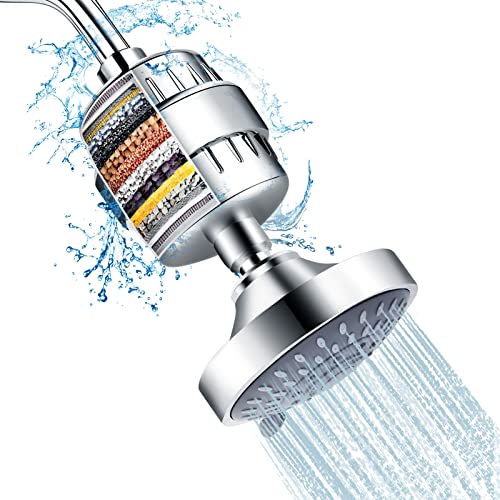
Filtered shower heads replace the head entirely, with the media inside the body. Neater, no extra length, and you are accepting whatever spray pattern the manufacturer chose. Media volume is usually smaller because it has to fit inside the head.
Neither needs tools beyond a spanner, and both fit the standard half inch thread used across US showers.
One practical note that decides satisfaction more than either choice: replacement cadence. Most cartridges are rated at six months or around 10,000 gallons, and vitamin C cartridges considerably less. A shower filter past its life is an inert lump of media that still looks fine, and the honest signal is the return of the chlorine smell rather than any indicator.
How to tell whether chlorine is actually your problem
Since chlorine is what these filters address, it is worth five minutes establishing whether it is what is bothering you. Two households can have identical hardness and completely different chlorine levels.
Check your utility’s annual report. Municipal suppliers publish a Consumer Confidence Report listing the disinfectant used and the residual level at the tap. The two you will see are free chlorine and chloramine, and which one you have changes what to buy: standard KDF and carbon handle chlorine well and chloramine poorly.
The hot shower test. Run a hot shower with the door closed for a few minutes and stand in the steam. Chlorine is volatile, so it comes out of solution and concentrates in the air far more than it does at a cold tap. If you can smell a pool changing room, chlorine is present at a level worth treating. This is also the test that tells you when a cartridge is spent.
Separate the symptoms. Tight, squeaky, itchy skin after showering and hair that feels stripped point to chlorine. Soap that will not lather, limescale on the screen and spotting on glass point to hardness. Many people have both, and only one of them is fixable at the shower arm.
Check the hot tap alone. If a metallic or eggy smell appears only in hot water, the water heater is the more likely source than the supply, and no shower filter addresses that.
One more consideration that rarely gets mentioned. Water temperature matters to filter performance. Activated carbon adsorbs less efficiently as temperature rises, which is precisely the condition a shower filter works in. That is the practical reason the better cartridges lead with KDF and calcium sulfite, both of which hold up in hot water, rather than relying on carbon alone.
The trade-offs of a shower filter
A shower filter is the only water filter on this site that treats water you are not going to drink, and that changes what counts as success.
| In its favor | Against it | |
| What it addresses | Chlorine on skin and hair, and chlorine vapor in a hot enclosed room — exposure no drinking-water filter touches | Chlorine is essentially the whole deliverable, whatever else the box says |
| Certification | NSF/ANSI 177 exists specifically for shower filtration | It covers free available chlorine reduction and nothing else, so claims about lead or fluoride have no shower-specific standard behind them |
| Contact time | Fine for chlorine, which reacts quickly with KDF media | The category’s real limit. Adsorption needs water held against media, and a showerhead gives it a fraction of a second at full flow |
| Cost and install | Cheap, and fits between the arm and the head in two minutes with no tools | Cartridges need replacing every three to six months, and a spent one is a warm wet surface biofilm likes |
| Pressure | Most modern designs cost you little or no flow | Some combination units restrict flow noticeably, especially in low-pressure homes |
Buy one to reduce chlorine, and judge it on that. If your concern is lead or fluoride, the filter that solves it goes at the tap you drink from, not the shower.
What actually separates these five
Something unusual happens in this field: two of these listings disagree with each other in print. One sells alkaline ceramic balls as filtration media; another says in its own bullets that ceramic balls are clay with no function. They cannot both be right, and it is the clearest illustration we have found of how unregulated shower filter media claims are.
| Pick | What only this one does |
| Aquabliss SF100 | The most widely bought filter here, and the one that argues its case on longevity rather than on stage count |
| SR SUN RISE 20 Stage | Names its media explicitly — KDF 55, activated carbon, calcium sulfite — and ships three cartridges rated 12,000 gallons each. It also includes the alkaline ceramic balls the weAQUA listing dismisses |
| FEELSO | The cheapest way into the category, as a complete filtered showerhead with five spray modes rather than an inline cartridge |
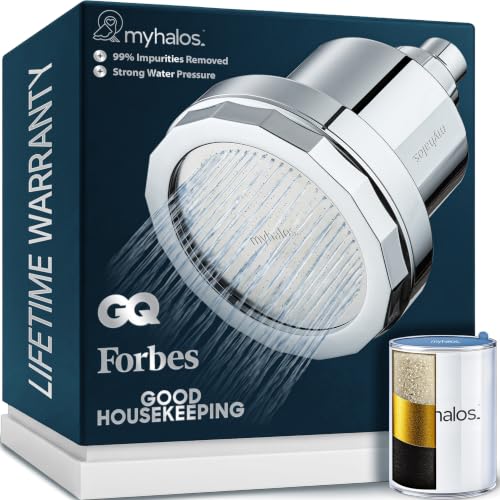
| MyHalos | The premium finish, and the listing leaning hardest on hair and skin outcomes rather than on filtration specifics |
| weAQUA | The only listing that attacks a competing media claim by name, calling energy and ceramic balls functionless clay, and states 99% removal from laboratory-tested media |
One caution that applies to all five: several of these listings claim heavy metal removal — lead, mercury, nickel, chromium. No shower-specific standard tests for those, and the contact time argument above applies. Treat chlorine as the claim you can rely on.
Best overall: Aquabliss SF100 Revitalize Shower Filter
| Organic Integrity Score | 84 / 100 |
| Configuration | Inline cartridge filter, fits between shower arm and existing head |
| Stated scope | Chlorine, sediment and impurities; states TDS testing is not supported |
| Best for | Keeping a shower head you already like |
The best-selling shower filter on Amazon by a wide margin, and it takes our top score for a reason that has nothing to do with popularity.
It does not claim to soften water. In a category where “hard water softener” appears in competitors’ titles, this listing describes itself as reducing chlorine, sediments and impurities and leaves it there. Given the search term that brings people here is usually about hard water, declining to make the claim costs the seller traffic and is the strongest signal of integrity available.
It goes further. The listing states plainly that “TDS testing is not supported by this product” — heading off buyers who will point a TDS meter at it and conclude it is broken. That is a manufacturer managing expectations against its own short-term interest.
It also compares its own two models against each other and explains which suits which buyer, rather than pushing the dearer one.
Two honest limits. The media is described in general terms rather than named and weighed, so you cannot tell how much KDF or calcium sulfite you are getting. And as an inline unit it adds a few inches between arm and head, which is worth measuring in a low shower.
What we liked: Declines to claim softening in a category full of that claim. States its own TDS limitation. Helps you choose between its models. Tool-free fit.
Keep in mind: Media not individually named or weighed. Adds length between arm and head. Dearer than most inline filters here.
Best for: Anyone keeping their existing shower head and buying for chlorine.
Best specified media: SR SUN RISE 20 Stage Shower Filter
| Organic Integrity Score | 74 / 100 |
| Configuration | Inline filter with three cartridges: KDF 55, activated carbon, calcium sulfite, ceramic |
| Stated scope | Chlorine and general purification; media individually named |
| Best for | Knowing what is actually inside the cartridge |
The only listing here that names its media individually: KDF 55, alkaline ceramic balls, activated carbon and calcium sulfite. That matters more than the stage count printed on the front.
KDF 55 and calcium sulfite together is the correct pairing for a shower. KDF works electrochemically and performs well in hot water; calcium sulfite handles high flow and high temperature better than carbon alone. Seeing both named is a genuine specification rather than an adjective.
The 20-stage framing is marketing, and it is worth saying so. A cartridge has a fixed internal volume, so twenty layers means less of each material than four layers would. The layer count is not the reason to buy this; the named media is.
Three cartridges in the box covers eighteen months at the usual six month interval, which is unusually good value and removes the most common failure in this category, which is never replacing the cartridge at all.
No certification is named and no reduction figures are published, which is the norm here and is what holds the score in the seventies.
What we liked: Names all four media rather than a stage count. KDF 55 plus calcium sulfite is the right pairing. Three cartridges included. Does not claim softening.
Keep in mind: The 20-stage number is marketing rather than specification. No reduction figures or certification. Inline, so it adds length.
Best for: Buyers who want to see the media list before spending.
Best value: FEELSO Filtered Shower Head
| Organic Integrity Score | 70 / 100 |
| Configuration | Filtered shower head, media inside the head body |
| Stated scope | Chlorine plus lead, mercury, nickel and chromium named specifically |
| Best for | Replacing head and filter together at the lowest cost |
The cheapest way into the category and one of its best sellers, and it does something the premium options do not: it names the specific metals it targets rather than saying “heavy metals”.
Lead, mercury, nickel and chromium is a checkable list. It is the difference between a claim you could in principle test and a category noun that means nothing.
As an all-in-one head it adds no length and needs no separate cartridge housing, which suits a low shower or a rail where an inline unit would sit awkwardly. Media volume is necessarily smaller than an inline cartridge, so expect a shorter effective life.
Worth noting the title includes “for Hard Water” while the description makes no softening claim. That is the pattern across this category: the title chases the search term, the body describes the product. Reading the body is the whole trick.
No certification, no reduction percentages, and the media itself is not named.
What we liked: Names four specific metals rather than a category. Cheapest option here. All-in-one, so no added length. Strong sales rank.
Keep in mind: Media not named. Smaller media volume than inline cartridges. Title says hard water while the body does not claim it.
Best for: Low ceilings, tight rails and small budgets.
Premium finish: MyHalos Filtered Shower Head
| Organic Integrity Score | 68 / 100 |
| Configuration | Filtered shower head, chrome finish |
| Stated scope | Chlorine and harsh chemicals; NSF referenced without a standard number |
| Best for | A bathroom where the head has to look right |
The most expensive product here and the best looking, which is a legitimate reason to buy a fixture you look at every day.
The build quality is where the money goes, and a chrome filtered head that matches the rest of a bathroom is genuinely hard to find, since most of this category is white plastic.
Two things hold the score down. The listing references NSF without naming a standard number, so you are told something was certified without being told what. As we set out in our under-sink guide, the number is the part that carries meaning.
And it leans on hair loss language, describing itself as the best shower head filter for hair loss. Chlorine removal can plausibly improve hair condition and reduce the dryness and breakage that follow from stripped sebum. Hair loss is a different claim with a different evidence bar, and we would not buy a shower filter to treat it.
On chlorine, which is what these products do, it is a reasonable performer in a nicer package.
What we liked: Genuinely good-looking chrome finish, rare in this category. Solid build. All-in-one with no added length.
Keep in mind: References NSF without naming a standard number. Hair loss framing goes beyond what chlorine reduction supports. Most expensive here.
Best for: Bathrooms where a white plastic filter would look wrong.
Read the claim first: weAQUA Heavy Duty Shower Filter
| Organic Integrity Score | 62 / 100 |
| Configuration | Inline cartridge with sediment, carbon, KDF and calcium sulfite media |
| Stated scope | Claims 99% removal of hard water, chlorine, heavy metals, fluoride and more |
| Best for | Buyers who want the media stack and can discount the headline |
Included because it is well bought and because its listing is the clearest example of the problem this guide exists to explain.
The claim reads: “laboratory tested and certified filtration media with 99% removal of Hard Water, Chlorine, Heavy Metals, Fluoride, Micro-life, Toxic Chemicals, Organics & much more!”
Three things are wrong with that sentence and one is a physics problem. Hardness is not removable by a shower cartridge, and independent testing of these products has found hardness unchanged. Fluoride is a dissolved ion that carbon and KDF do not meaningfully remove. And “Organics & much more” at 99 percent is not a testable statement, because it does not name what was measured.
“Laboratory tested and certified” names neither the laboratory nor the standard, which is the weakest form a certification claim can take while still being made.
The underlying product is not bad. The media stack it describes, sediment plus carbon plus KDF plus calcium sulfite, is the correct combination and matches our better-scoring picks. On chlorine it will do a reasonable job. Our score reflects the gap between what the hardware does and what the listing promises.
What we liked: Sensible media combination. Inexpensive. Fits any standard shower without tools.
Keep in mind: Claims 99% hard water removal, which independent testing does not support. Fluoride claim is not plausible for this media. Names neither lab nor standard.
Best for: Buyers who want the media and are ignoring the headline.
What we left out and why
MakeFit and similar “softener” heads. Several filtered heads put “hard water softener” directly in the product title. We have covered the reason that is not achievable above, and one worked example is enough.
Whole-house softeners. If hardness genuinely is your problem, this is the appliance that solves it: a resin tank, a brine tank and a drain connection. It is a different purchase at a different price, and no shower filter substitutes for it.
Vitamin C cartridges. Genuinely effective against both chlorine and chloramine, and they deplete fast enough that the running cost becomes the story. Worth considering specifically if your utility uses chloramine.
The limit of this method, as always. We read what each listing claims and how far it substantiates it. We have not tested these filters. Where we say a claim is not supported, that rests on the published testing of others and on what the media can physically do, not on our own measurements.
How to fit a shower filter
The easiest installation in water treatment. Ten minutes, one tool, no plumbing.
- Unscrew the existing head anticlockwise from the shower arm. An adjustable spanner with a cloth around the jaws protects the finish. Decades-old joints may need penetrating oil and patience.
- Clean the arm threads. Scrape off old tape and scale with a cloth and an old toothbrush. Most leaks come from sealing over debris.
- Wrap PTFE tape clockwise, three or four turns, in the direction the fitting will tighten so it does not unwind as you screw on.
- Fit the filter to the arm, hand tight plus a quarter turn with the spanner. Plastic threads strip easily, so stop there.
- Fit your shower head to the filter, with tape on that joint too if it is not a captive washer connection.
- Flush for five minutes before showering. New KDF and carbon media shed fines and the first water often runs gray or black. This is normal and is why you flush.
- Write the date on the cartridge with a marker, or put a note in your phone. Six months arrives without any signal from the product.
What it costs to run
The cheapest category in water treatment to own. No power, no wastewater, no plumbing, and the only consumable is a cartridge two to three times a year.
The real cost is forgetting. A spent cartridge looks exactly like a new one and the shower still works, so the filter quietly becomes an ornament. Multi-cartridge packs help, and so does writing the date on the housing.
The honest signal that a cartridge is done is the chlorine smell coming back, particularly in a hot shower with the door closed.
Questions about shower filters
Do shower filters soften hard water?
No. Hardness is dissolved calcium and magnesium, and removing it requires ion exchange with a resin bed and a brine tank. Independent testing of shower filters has found hardness unchanged, despite several products claiming otherwise.
So what does a shower filter actually do?
Reduces chlorine, and with it the dryness, itching and dull hair that chlorine causes by stripping sebum. That is a real benefit and it is frequently mistaken for a hardness problem.
Will it help my skin and hair?
Often, if chlorine is what is bothering them. It will not change how the water feels in terms of hardness, and it is not a treatment for hair loss.
What media should I look for?
KDF 55 and calcium sulfite together. KDF works electrochemically and performs well in hot water; calcium sulfite handles high flow and temperature better than carbon alone. Stage counts are marketing.
Does it remove chloramine?
Poorly, in most cases. Many utilities have switched from chlorine to chloramine, which standard KDF and carbon handle badly. Vitamin C cartridges are the usual answer, at the cost of a much shorter life.
How often do I replace the cartridge?
Around six months or 10,000 gallons for most, less for vitamin C. Nothing tells you when, so write the date on the housing. The chlorine smell returning is the practical signal.
Inline filter or filtered shower head?
Inline keeps the head you have and adds a few inches of length. A filtered head replaces it entirely with no added length but usually less media inside. Both fit the standard half inch thread.
Why is the first water black?
New KDF and carbon media shed fines. Flush for five minutes before the first shower and it clears.
Organic Connection is reader supported. We check every product against its stated certification and say plainly when a claim cannot be verified. How we research and rate.