Last updated: August 28, 2026
We may earn a commission when you buy through links on this page, at no extra cost to you. How we research and rate.
The short version
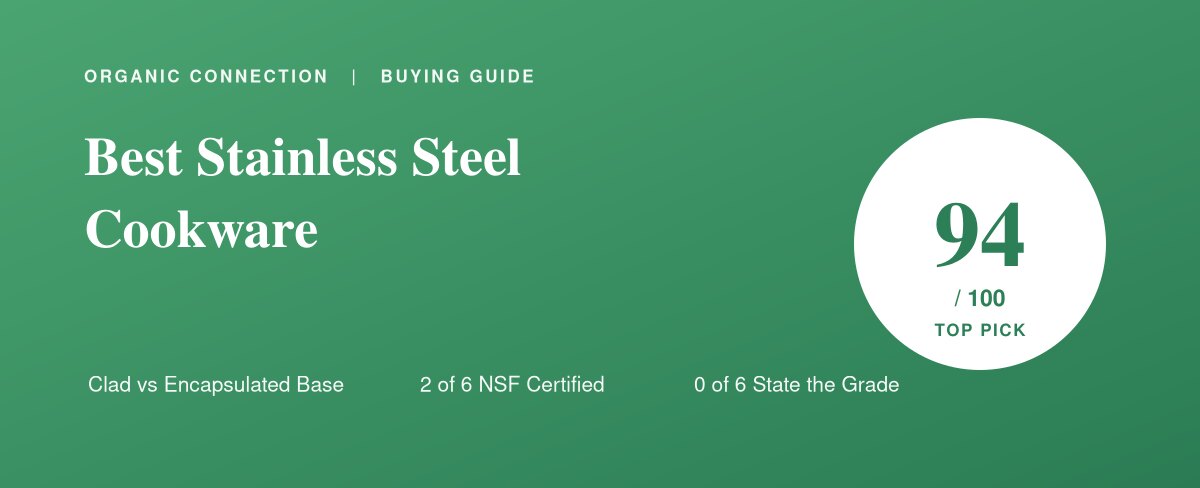
Our top pick is the Tramontina Signature Tri-Ply Clad set, with an Organic Integrity Score of 94 out of 100. It is fully clad rather than disc-bottomed, it is oven safe to 500°F, it carries a lifetime warranty, and it is one of only two sets in this comparison carrying a certification that means anything.
Stainless steel cookware is the category where the marketing vocabulary has drifted furthest from the engineering, and one phrase does most of the damage.
“Clad” and “encapsulated base” describe two fundamentally different pans, and they are used almost interchangeably in listing copy. A clad pan is a metal sandwich pressed through the entire body, so the aluminum layer runs up the walls to the rim. An encapsulated base pan is a single sheet of steel with an aluminum disc welded to the bottom. The base heats well. The walls are bare steel and heat only by conduction from below.
Both are legitimate constructions. Only one of them justifies the phrase “aluminum core”, and here is what we found in a bestselling listing:
Clad, disc base, and why it changes how you cook
Take a saucepan and heat it with something acidic in it, a tomato sauce or a reduction, and the difference shows up within minutes.
In a fully clad pan, the aluminum layer continues up the sides. Heat spreads laterally through the whole vessel, the walls reach a similar temperature to the base, and the sauce heats from every surface it touches. That is why clad pans are the standard in professional kitchens for anything that reduces or simmers.
In an encapsulated base pan, the disc stops at the bottom edge, often a few millimetres short of it. Above that line you have a single layer of stainless steel, which is a poor conductor. The base runs hot, the walls run cool, and food at the bottom scorches while the sauce a centimetre up the side has barely moved.
For boiling water, neither matters. For a stockpot, the disc is arguably the better buy since you are heating from below anyway and paying for wall cladding you will never use. For a frying pan, a sauté pan or a saucepan doing anything more delicate than boiling, cladding is the whole point of buying stainless.
The reason this matters commercially is that disc-base sets are considerably cheaper to manufacture and are frequently sold at clad prices. The phrase to look for in the bullets is “encapsulated”, and if a listing uses it, the pan is disc-bottomed regardless of what the title says about cores.
Nobody tells you what steel it is
Here is the finding that surprised us most, and it held across every listing we opened.
Stainless steel for cookware is described by grade. 18/10 means 18% chromium and 10% nickel, which is the same alloy as grade 304, and it is what you want touching food: corrosion resistant, non-reactive, and durable. 18/0, or grade 430, contains no nickel, is magnetic, and is what manufacturers use for the outer layer of an induction-compatible pan because it responds to a magnetic field.
A well-built clad pan is typically 18/10 on the cooking surface, aluminum in the middle, and 430 on the exterior. That arrangement is completely standard and entirely sensible.
Not one of the six listings we read stated a grade anywhere. Not the $140 set, not the $180 set, not the $800 All-Clad. No 18/10, no 304, no 430, on either the interior or the exterior. “18/10 stainless” is the single most quoted specification in cookware marketing and it was absent from every Amazon product listing in this comparison.
We are not suggesting anything is wrong with the steel in these pans. All-Clad in particular has a fifty-year reputation and would have a great deal to lose. The point is narrower and it is about disclosure: the specification buyers are told to shop on is not published where they are shopping. If you want the grade, you generally have to leave Amazon and find the manufacturer’s own specification sheet.
NSF certification exists for cookware, and almost nobody has it
Every category we audit has one certification that separates a checkable claim from an adjective. In water filters it is a named NSF/ANSI standard number. In air purifiers it is AHAM Verifide. In cookware it is NSF certification, and it is far rarer than it should be.
NSF certification on food equipment covers materials, construction and cleanability: whether the alloy is suitable for food contact, whether crevices around rivets and handle joints can actually be cleaned, and whether the surfaces resist corrosion in commercial use. It is why NSF marks are common on restaurant supply and rare on consumer cookware.
Of the six sets we read, two carried NSF certification, and both were Tramontina. The All-Clad set at nearly $800 does not mention it. Neither does the Cuisinart, the CAROTE or the Mueller.
It is worth being precise about what this does and does not tell you. NSF certification is not a performance test: it does not measure how evenly a pan heats, and an NSF-certified pan is not automatically better to cook in than one without. What it establishes is that an accredited third party examined the materials and the construction and issued a certificate that can be withdrawn. In a category where the steel grade goes unpublished, that independent check is the closest thing to a verifiable fact on offer, and we score it accordingly.
All-Clad does say its cookware is “third-party tested for safety”, which is a step above silence, and it names neither the party nor the standard nor the result.
Oven-safe temperature is the spec that actually varies
Most stainless sets look interchangeable on a specification table. The one number that genuinely separates them is the oven rating, and the spread is much wider than people expect.
Across this comparison it runs from 350°F to 600°F, which is the difference between a pan that can finish a steak under the broiler and one that cannot go near it.
All-Clad states 600°F, oven and broiler. Both Tramontina sets state 500°F. The Cuisinart states 500°F with lids rated separately to 450°F. The Mueller set states 350°F. CAROTE says “oven safe” and gives no temperature at all.
The lids are the trap. Glass lids are almost always rated lower than the pans they sit on, and the better listings say so: Tramontina’s Boston set specifies 500°F without the lid and 350°F with the glass lid, and Cuisinart separates its 500°F pans from its 450°F lids. A listing quoting one temperature for a set that includes glass lids is quoting the pan.
If you roast, sear and finish in the oven, treat anything below 450°F as a real constraint rather than a footnote.
“Non-toxic” on a material that has no coating
Two sets in this comparison lead with toxicity claims, and one leads with a plastics claim, and all three are describing properties inherent to bare stainless steel.
The Mueller listing says “100% Non-Toxic Stainless Steel – no coatings, no PFOA, no PTFE”. CAROTE puts “Non Toxic” in its product title. Cuisinart’s warranty bullet notes “this product is BPA free”.
All three statements are true, and none of them distinguishes the product from any other bare stainless pan. PFOA and PTFE are non-stick coating chemistry, and an uncoated steel pan has no coating to contain them. BPA is a plastics compound, and there is no plastic in the food contact area of a steel pot. Saying bare stainless is PTFE-free is like advertising water as gluten-free.
We flag this not because the claims are false but because of what they crowd out. The Mueller listing has room for a paragraph about the absence of coatings and no room for a steel grade. The genuinely useful facts about a stainless pan are its construction, its grade and its oven rating, and toxicity language tends to appear where those are missing.
Where “non-toxic” does carry meaning in cookware is in coated pans, ceramic and non-stick, where there is a coating whose chemistry is a real question. On bare steel it is filler.
What we looked for
We read every feature bullet on every listing in full and scored on what each manufacturer put in writing.
Whether it is clad or disc-based, stated plainly. The single most consequential fact about a stainless pan, and the one most often blurred between title and bullets.
A named certification. NSF is the one that exists in this category. A brand reputation is not a certification.
A stated oven temperature, with lids rated separately where the set includes glass lids.
A real warranty, distinguishing a lifetime warranty from language about lasting a lifetime, which is a description rather than a commitment.
Construction detail: riveted versus welded handles, rim finish, and whether the aluminum is described as a core, a base, or a disc.
Best stainless steel cookware compared
 |  |  |  |  | |
| Set | Tramontina Signature 12-pc | Tramontina Boston 10-pc | All-Clad D3 10-pc | Cuisinart Chef’s Classic 11-pc | CAROTE 21-pc |
| Organic Integrity Score | 94 / 100 | 92 / 100 | 88 / 100 | 72 / 100 | 70 / 100 |
| Construction | Tri-ply clad | Tri-ply clad | Fully bonded tri-ply | Encapsulated base | Tri-ply, “fully clad” |
| NSF certified | Yes | Yes | No | No | No |
| Steel grade stated | No | No | No | No | No |
| Oven safe | 500°F | 500°F, 350°F with lid | 600°F, broiler | 500°F, lids 450°F | Not stated |
| Warranty | Lifetime | Lifetime | Limited lifetime | Limited lifetime | None stated |
| Made in | Not stated | Not stated | USA, global components | Not stated | Not stated |
| Price | $315.00 $399.95 −21% View on Amazon | $199.95 $274.95 −27% View on Amazon | $799.95 View on Amazon | $129.95 $179.95 −28% View on Amazon | $139.99 $189.99 −26% View on Amazon |
Price and availability as of September 1, 2026 2:12 am EDT. Product prices and availability are accurate as of the date/time indicated and are subject to change. Any price and availability information displayed on Amazon.com at the time of purchase will apply to the purchase of this product.
Best overall: Tramontina Signature Tri-Ply Clad 12-Piece
| Organic Integrity Score | 94 / 100 |
| Construction | Tri-ply clad with aluminum core, stated as clad in both title and bullets |
| Certification | NSF certified |
| Oven safe | 500°F |
| Best for | A first serious set, where you want construction and certification stated plainly |
This wins on the two things that are checkable, and it wins them together.
It is genuinely clad, and the listing says so consistently: “Tri-Ply Clad Construction: Features an aluminum core for even heat distribution”. The title and the bullets agree, which sounds like a low bar until you read the Cuisinart listing below.
And it is NSF certified, which puts it in a minority of two across everything we read, including cookware at nearly three times the price. NSF is not a heat-distribution test, and we would not claim this pan cooks better than an All-Clad. It does mean an accredited body examined the materials and the construction and issued a certificate that can be withdrawn, which in a category this short on published specification is worth a great deal.
The rest is solid rather than remarkable. Oven safe to 500°F covers roasting and finishing. Riveted stainless handles and a stainless lid, so the whole vessel goes in the oven without a separate lid rating to remember. Dishwasher safe. A lifetime warranty stated as a lifetime warranty rather than as a claim about lasting a lifetime.
What it does not tell you is the steel grade, which no set here does, and where it is made. The 12-piece configuration is also worth checking against your own cooking: piece counts in this category are inflated by counting lids separately, so a 12-piece set is typically seven or eight vessels.
- NSF certified, one of only two sets here that carries any third-party certification.
- Genuinely tri-ply clad, stated consistently in title and bullets.
- Oven safe to 500°F with a stainless lid, so no separate lid rating.
- Lifetime warranty, stated as a warranty rather than as a description.
- Substantially cheaper than the All-Clad while sharing its construction type.
- No steel grade published, like every set in this comparison.
- Country of manufacture not stated.
- Piece count includes lids, so fewer vessels than the number suggests.
- No stated broiler rating.
Best for: Most kitchens. The construction is right, the certification is real, and the price is sane.
Best value: Tramontina Boston Tri-Ply Clad 10-Piece
| Organic Integrity Score | 92 / 100 |
| Construction | Tri-ply clad with aluminum core |
| Certification | NSF certified |
| Oven safe | 500°F without the lid, 350°F with the glass lid |
| Best for | The same construction and certification for less, if you want glass lids |
Structurally the same proposition as our top pick, with glass lids instead of stainless and a smaller piece count, at a lower price.
It earns its score for a detail most listings skip. It rates the pans and the lids separately: 500°F without the lid and 350°F with the glass lid. That is the single most useful sentence in this entire comparison, because glass lids are always the weak link and almost nobody says so. A buyer who reads a bare “oven safe to 500°F” on a set with glass lids and puts the lid in a 500°F oven finds out the hard way.
Same NSF certification as the Signature, same clad construction, same lifetime warranty, and the same silence on steel grade.
The trade-off is the glass. Glass lids let you watch without lifting, which is genuinely useful for simmering, and they cap your oven work at 350°F whenever the lid is on. If you braise with a lid in the oven, the Signature set with its stainless lid is the better buy despite costing more.
The 10-piece configuration is the more honest of the two, with fewer pieces and less lid-counting inflation, and for a small kitchen it is probably the right size.
- NSF certified, like the Signature set.
- Rates pans and glass lids separately, which almost no listing does.
- Tri-ply clad construction at a lower price than our top pick.
- Lifetime warranty and dishwasher safe.
- Glass lids let you monitor without lifting.
- 350°F ceiling whenever the glass lid is on, which rules out covered oven braising.
- No steel grade published.
- Fewer pieces than the Signature set.
- Country of manufacture not stated.
Best for: Stovetop cooks who want the same certified construction for less and rarely braise with a lid in the oven.
Best performance: All-Clad D3 10-Piece
| Organic Integrity Score | 88 / 100 |
| Construction | D3 fully bonded tri-ply, aluminum core |
| Oven safe | 600°F, oven and broiler |
| Made in | USA with global components, Pennsylvania, since 1971 |
| Best for | Cooks who finish in the oven or under the broiler, and are keeping it for decades |
The best cookware here and not the best listing, which is why it sits third.
What it does better than anything else: 600°F oven and broiler safe, which is 100°F above both Tramontina sets and the only rating in this comparison that genuinely covers broiler work. If you sear a steak on the hob and finish it under the broiler, this is the set on this page that can do it.
It is also the only one that tells you where it is made, and it is specific about it: “Made in the USA with global components in our Pennsylvania Factory since 1971”. Naming the factory and the year, and being explicit that components are sourced globally, is more precise than most country-of-origin claims and does not overstate itself.
The construction language is the clearest here too. “D3 Stainless is the original fully bonded tri-ply cookware”, with the aluminum core described as running through the body rather than sitting in the base. No ambiguity between title and bullets.
So why 88. Two reasons, both about what is not in the listing.
No NSF certification is mentioned, on a set costing roughly three times our NSF-certified top pick. And the safety claim it does make is unusually vague for a company of this standing: “third-party tested for safety” names no party, no standard and no result. That is the cookware equivalent of “lab tested” on a water filter, and we score it the same way wherever we find it.
It also does not publish a steel grade, and it recommends handwashing, which for an $800 set of pans people buy partly for convenience is worth knowing before you order.
- 600°F oven and broiler safe, the highest rating here by 100°F.
- Only set to state where it is made, with factory and year.
- Clearest construction language: fully bonded tri-ply, no title-to-bullet drift.
- Limited lifetime warranty from a manufacturer with a five-decade record.
- No NSF certification mentioned at roughly three times the price of a certified set.
- “Third-party tested for safety” names no party, standard or result.
- No steel grade published.
- Handwashing recommended.
- By far the most expensive set here.
Best for: Broiler and oven cooks buying once, who value the 600°F rating and the stated origin over a certification.
The bestseller with two different construction claims: Cuisinart Chef’s Classic
| Organic Integrity Score | 72 / 100 |
| Construction | Aluminum encapsulated base; title says “Aluminum Core” |
| Oven safe | 500°F, lids to 450°F, broiler safe |
| Certification | None named |
| Best for | Boiling, stock and everyday use, at a price that reflects disc construction |
This is one of the best selling stainless sets on Amazon and was the top recommendation on several of the pages we read while researching this guide. It is also the reason this guide leads with a vocabulary lesson.
The product title includes the phrase “Aluminum Core”. The first feature bullet says “aluminum encapsulated base”. The bullet is the accurate description, and it means this is a disc-bottom pan, not a clad one. The aluminum is in the base. The walls are single-layer stainless.
We want to be careful about the accusation here. Cuisinart has not hidden anything: the accurate phrase is in the first line of the first bullet, where anyone who reads the listing will find it. But “core” and “encapsulated base” mean different things to anyone who knows the category, and it is the title that appears in search results, in comparison tables, and in the recommendation lists that cite this set as clad cookware.
Judged as what it is, it is decent. 500°F with lids separately rated to 450°F is a good rating for a disc-base set and it is broiler safe. Riveted handles, dishwasher safe, limited lifetime warranty, and a price that is roughly half our clad top pick, which is about the right discount for the construction.
For boiling pasta, making stock, or heating anything where you only care about the bottom of the pan, disc construction is fine and arguably the sensible purchase. For a saucepan reducing a sauce or a sauté pan cooking something delicate, you will meet the cool walls.
The listing also notes the product is “BPA free”, which is true of every bare steel pot and tells you nothing. No NSF, no steel grade, no country of origin.
- 500°F and broiler safe, with lids rated separately at 450°F.
- Roughly half the price of a comparably sized clad set.
- Riveted handles, dishwasher safe, limited lifetime warranty.
- Fine for boiling, stock and high-volume everyday cooking.
- Title says “Aluminum Core”; the bullets say “encapsulated base”, which is a disc, not a core.
- Walls are single-layer steel, so they run much cooler than the base.
- No NSF certification and no steel grade.
- “BPA free” on a bare steel pot is filler.
Best for: Boiling and stock work, bought knowingly as a disc-base set rather than as clad cookware.
Budget clad, with nothing stated: CAROTE 21-Piece
| Organic Integrity Score | 70 / 100 |
| Construction | “Tri-ply fully clad construction… from base to rim” |
| Oven safe | Stated as oven safe; no temperature given |
| Certification | None named |
| Best for | A cheap clad set, accepting that nothing in the listing can be checked |
The cheapest set here by a wide margin, and the construction claim it makes is the right one, stated in the right words.
“Tri-ply fully clad construction delivers fast, even heating from base to rim” is exactly how a clad pan should be described, and the phrase “base to rim” is the specific detail that distinguishes cladding from a disc. If accurate, this is a fully clad set at roughly half the price of our top pick.
We also credit the honesty of the cooking advice. The listing tells you to preheat the pan, add oil, and flip only when food releases naturally. That is correct technique for bare stainless and it addresses the single most common complaint about it, which is sticking. Most listings sell the pan and leave you to work that out.
What holds it at 70 is that nothing here can be verified and several basics are simply absent. No oven temperature at all, only “oven safe”, which is the one specification that genuinely varies in this category. No warranty stated, in a comparison where three competitors offer lifetime coverage. No certification. No steel grade. No country of origin.
The title also carries “Non Toxic”, which on uncoated steel describes the material rather than the product, and the 21-piece count is heavily inflated by lids and utensils.
Our position is not that this is a bad set. It is that at this price the clad claim is the only thing you are buying, and it is the one thing the listing gives you no way to confirm.
- Describes cladding correctly, “from base to rim”, rather than blurring it with disc language.
- Cheapest set in this comparison by a wide margin.
- Uncoated cooking surface, correctly explained.
- Gives genuinely useful technique advice for cooking on bare stainless.
- No oven temperature stated, only “oven safe”.
- No warranty stated at all.
- No certification, no steel grade, no country of origin.
- 21-piece count inflated by lids and utensils.
- “Non Toxic” in the title describes bare steel generally, not this product.
Best for: A first apartment kitchen on a tight budget, bought understanding that the clad claim is unverified.
What we left out and why
We left out the Mueller 17-piece Ultra-Clad Pro set, which is genuinely 3-ply and reasonably priced, for two reasons. Its oven rating is 350°F, the lowest in the category by 150°F, which rules out most roasting and all broiler work and is easy to miss in a listing otherwise full of professional-grade language. And the brand field on the listing reads JANSKA while the title and copy read Mueller, which is the kind of inconsistency that makes warranty claims harder than they need to be.
We left out sets whose only construction claim was “stainless steel” with no mention of ply, disc or core, since there is nothing to evaluate.
We left out non-stick and ceramic-coated sets entirely. Those are a different purchase with a different lifespan and a genuinely different safety conversation, since a coated pan has a coating whose chemistry is a real question, where bare steel does not. We audit those claims in our guide to the best ceramic cookware. Our guide to cookware materials compared sets the four side by side.
We also left out sets sold only as open stock or single pans, because the search that brings people here is for a set, and piece-by-piece buying is a different budget exercise.
How to set up and season a stainless pan
Stainless steel is the material people most often decide they hate, almost always because of sticking, and almost always for a fixable reason.
- Wash everything in hot soapy water and dry it. New pans carry manufacturing residue that will smell and smoke on first heating.
- Check the oven rating for the pans and, separately, for the lids. Write it somewhere, because they usually differ and nobody remembers.
- Identify which pieces are clad and which are disc-based if your set mixes them, which large stockpots often are. Use the disc pieces for boiling.
- Preheat the empty pan on medium for two to three minutes. This is the step people skip and it is the one that matters.
- Test with a bead of water. If it skitters across the surface as a ball rather than boiling away, the pan is at temperature. This is the Leidenfrost point and it is the single most useful trick in stainless cooking.
- Add the oil now, not before. Oil added to a cold pan polymerizes into a sticky film as the pan heats.
- Add the food and leave it alone. Protein sticks on contact and then releases as a crust forms underneath.
- Flip only when it releases without force. If you have to pull, it is not ready.
- Deglaze while the pan is still warm. Water or stock into a hot pan lifts the fond in seconds and turns the worst cleaning job into the best sauce.
- For burnt-on residue, simmer water with a spoonful of baking soda rather than attacking it with an abrasive.
- Rainbow discoloration is harmless chromium oxide, not damage. A little acid, vinegar or lemon, removes it.
- White chalky spots are mineral deposits from hard water, not pitting. Same fix.
- Avoid salting cold water in the pan. Undissolved salt sitting on a cold surface is the main cause of the small pits people mistake for defects.
What it costs to own
Stainless is the cheapest cookware to own over time and among the more expensive to buy, because there is no coating to wear out and nothing to replace on a schedule.
Two consequences worth planning for. The first is that a set is usually the wrong unit of purchase for an experienced cook: most people use three vessels constantly and the rest occasionally, and buying a 10-inch frying pan, a 3-quart saucepan and a stockpot separately often costs less than a set and gets better pieces.
The second is that mixing constructions deliberately is the cheapest sensible strategy. Buy clad where it matters, in the frying and sauté pans and the saucepans, and buy a disc-base stockpot for boiling, where wall cladding does nothing and you would only be paying for it.
Living with stainless steel
It is a skill, briefly. Almost everyone who says stainless sticks is adding food to a pan that is not up to temperature. Two weeks of preheating properly and the complaint disappears.
Discoloration is not damage. Rainbow tinting and chalky spots are cosmetic and both come off with a mild acid. Stainless is one of the few materials where the pan genuinely does not degrade.
Handles get hot in the oven. All-metal handles are why these pans go to 500°F and above, and they will burn you every time you forget. A folded towel over the handle after it comes out of the oven is a habit worth building.
Check the lid rating separately. Glass lids are consistently rated below the pans they cover, and they are the component people break.
Buy pieces, not counts. A 21-piece set and a 10-piece set can contain the same number of pans. Count the vessels, not the boxes on the label.
Questions about stainless steel cookware
What is the difference between clad and encapsulated base cookware?
A clad pan is a metal sandwich pressed through the whole body, so the aluminum layer runs up the walls to the rim and the sides heat like the base. An encapsulated base pan is single-layer steel with an aluminum disc welded to the bottom, so only the base conducts well. Clad matters for frying, sauteing and reducing; a disc base is fine for boiling and stock.
Does “aluminum core” always mean clad?
No, and this is the trap. At least one bestselling set uses “Aluminum Core” in its title while its own feature bullets describe an “aluminum encapsulated base”. If the bullets say encapsulated, the pan is disc-bottomed whatever the title says. Read the bullets, not the title.
What does 18/10 stainless steel mean?
18% chromium and 10% nickel, the same alloy as grade 304. It is corrosion resistant and non-reactive, which is what you want on a cooking surface. 18/0, or grade 430, has no nickel and is magnetic, which is why it is used for the outer layer of induction-compatible pans. Notably, none of the six listings we read published a grade at all.
Is NSF certification worth looking for on cookware?
Yes, because it is rare and it is checkable. NSF certification covers materials, construction and cleanability, and it means an accredited body examined the pan and issued a certificate that can be withdrawn. It is not a heat-distribution test, so it does not tell you the pan cooks well. In a category where the steel grade goes unpublished, it is the strongest verifiable claim available.
Why does food stick to my stainless steel pan?
Almost always because the pan was not hot enough when the food went in. Preheat the empty pan for two to three minutes, then flick in a bead of water: if it skitters across as a ball rather than boiling away, the pan is ready. Add oil at that point, then the food, then leave it alone until it releases on its own.
What oven temperature can stainless steel cookware handle?
It varies far more than people expect, from 350°F to 600°F across the sets in this comparison. Check the pan rating and the lid rating separately, because glass lids are consistently rated lower, often 350°F or 450°F on a pan rated to 500°F.
Is stainless steel cookware non-toxic?
Bare stainless has no coating, so there is no PTFE, PFOA or PFAS to be concerned about, and no plastic in the food contact area. That is true of all uncoated stainless, which is why “non-toxic” and “BPA free” on a bare steel pan describe the material rather than distinguishing the product. Where the term carries real meaning is on coated pans, where there is a coating whose chemistry is a genuine question.
Is a more expensive stainless set better?
Not reliably. Our top pick costs a fraction of the most expensive set here and carries a certification the expensive one does not. What price does buy at the top end is a higher oven rating, a stated country of origin and a long manufacturing record. What it does not buy is more published specification.
How many pieces do I actually need?
Fewer than any set contains. Most cooks use a 10-inch frying pan, a 3-quart saucepan and a stockpot constantly and the rest rarely. Piece counts include lids and sometimes utensils, so a 21-piece set may hold seven or eight vessels. Buying the three pieces you use separately is often cheaper and better.
Can I put stainless steel cookware in the dishwasher?
Most sets here say yes, and one, the All-Clad, recommends handwashing. Dishwashing is hard on the exterior finish over time and will not damage the steel. If a listing recommends handwashing on an expensive set, factor that into the purchase.
Do I need induction-compatible cookware?
Only if you have or might get an induction hob, in which case the pan needs a magnetic exterior layer, usually grade 430. Every set in this comparison states induction compatibility. A quick test on cookware you already own: if a fridge magnet sticks firmly to the base, it will work on induction.
Organic Connection is reader supported. We read every product listing in full and say plainly when a claim cannot be verified. How we research and rate.