Last updated: September 30, 2026
We may earn a commission when you buy through links on this page, at no extra cost to you. How we research and rate.
The short version
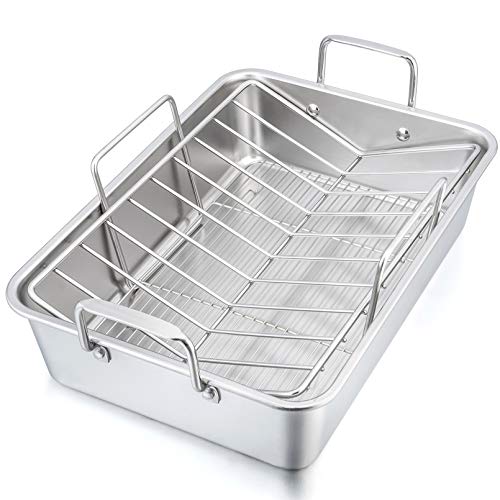
Judged on what each maker will put in writing, our top pick is the All-Clad Specialty Stainless Steel Roaster. It is the only pan here that states a temperature — oven and broiler safe to 600°F — and the only one that tells you exactly which stovetops it works on, including the one it does not. That earned it our highest Organic Integrity Score of 92 out of 100.
A roasting pan has two jobs and most listings only describe the first. It roasts, and then — while the meat rests — it goes on a burner so you can deglaze the fond and make gravy. That second job is where a roasting pan earns its place over a sheet pan, and it is the job most of these listings never mention.
Two of the five say whether you can put the pan on a stovetop. None of them says whether it is fully clad tri-ply or single-layer stainless — which is what determines whether it heats evenly on a burner or buckles.
What the listings leave out
| Best Choice | Best Value | ||||
 |
 |
 |
 |
 |
|
| Product | All-Clad Specialty | Cuisinart 16-Inch | Amazon Basics | P&P CHEF 16″ | Tifanso |
| Organic Integrity Score | 92/ 100 | 88/ 100 | 86/ 100 | 83/ 100 | 80/ 100 |
| Our rating | 4.6 | 4.4 | 4.3 | 4.2 | 4.0 |
| Best for | Best overall | Induction kitchens | Cheapest with a temperature | Two racks included | Cheapest overall |
| Temperature stated | 600°F, oven and broiler | Not stated | 500°F, oven only | Not stated | Not stated |
| Stovetop use | Any stovetop except induction, stated | Induction compatible, stated | Not stated | Not stated | Not stated |
| Construction | Not stated | Not stated | Not stated | Not stated | Not stated |
| Dimensions | 14 x 18 in | Pan and rack both, to 0.1 in | Pan and rack both, separately | 16 in | 3 in deep sides |
| Warranty | Limited lifetime | Lifetime | Not stated | Not stated | Not stated |
| Price | Currently unavailable See buying options |
$53.95 $79.95 −33% View on Amazon |
$53.95 View on Amazon |
$45.99 View on Amazon |
$20.51 $23.99 −15% View on Amazon |
Scores are ours, based on independent research of materials disclosure, construction, published specifications and value, using the same ten-criteria method we apply to every product.
What each claim on a roasting pan listing covers
| Claim | Covers | Key exclusion |
| Tri-ply / fully clad | Aluminum core through the whole pan, even stovetop heating | The spec that predicts gravy-making and warping; none states it |
| Oven and broiler safe to 600°F | A stated ceiling including radiant broiler heat | The only broiler claim here; one listing makes it |
| Induction compatible | A magnetic base layer, so it works on any stovetop | Implies construction the listing does not otherwise describe |
| Any stovetop except induction | Gas and electric burner use, honestly bounded | An unusually precise negative; one listing gives it |
| Heavy gauge | The seller’s description of thickness | No number, so nothing to compare |
| Riveted handles | Mechanically fixed rather than spot welded | What holds under the weight of a loaded turkey |
| V-rack | Cradles a bird, lifts it clear of the drippings | Better for poultry; a flat rack suits everything else |
| No chemical coatings | Bare steel, nothing applied to the cooking surface | True of all stainless roasters; one listing states it anyway |
The gravy question, which is really a construction question
Here is the sequence every roast follows. The bird comes out, it rests, and you are left with a pan of browned drippings — the fond — welded to the bottom. You put the pan across a burner, add stock or wine, and scrape it up into gravy.
That single step is why you own a roasting pan rather than a sheet pan and a disposable foil tray. And it depends entirely on something none of these listings states.
Fully clad tri-ply construction sandwiches an aluminum core between two layers of stainless steel across the whole pan. Aluminum conducts heat about fifteen times better than stainless, so a burner under one corner spreads across the base instead of concentrating. Tri-ply pans deglaze evenly and resist warping.
Single-layer stainless is one sheet of steel. It roasts perfectly well in an oven, where heat surrounds it. On a burner it develops a hot spot directly over the flame — your gravy scorches in one place while the far end stays cool — and the uneven expansion is what makes a pan buckle.
Not one listing here says which it is. They all say stainless steel, which as we have found in kettles, mixing bowls and knives, is a family rather than a specification.
What you can do is read the stovetop claim, because it implies the construction. Two listings here make one.
All-Clad states the pan works on any stovetop excluding induction. That exclusion is informative: induction needs a magnetic layer, and a pan that works on gas and electric but not induction is telling you its base is non-magnetic stainless or aluminum-cored without a magnetic outer.
Cuisinart states induction compatible, which requires a magnetic stainless exterior — typically the outer layer of a clad or disc-based build.
The other three say nothing about stovetops at all, and the safe assumption with an unspecified stainless roaster is oven only.
The temperature nobody prints
Two listings give an oven rating and three do not, which matters more in this category than in most.
Roasting runs hot. A turkey starts at 425°F or higher, potatoes want 425 to 450, and the last few minutes under a broiler to crisp skin push considerably past that. A pan without a stated ceiling is a pan you are guessing about at exactly the moment it is under the most stress.
All-Clad states 600°F, oven and broiler. Broiler-safe is the meaningful half — radiant heat from a few inches away is far harsher than convected oven heat, and it is where handles discolor and lower-grade steel warps.
Amazon Basics states 500°F, oven. Ample for any roast, and honest in not claiming broiler use.
The other three make no temperature claim of any kind. All-stainless pans with riveted stainless handles are generally tolerant of high heat, so this is unlikely to be a safety problem — but it is a specification the buyer is entitled to, and its absence is the difference between knowing and assuming.
Best overall: All-Clad Specialty Stainless Steel Roaster with Rack
| Organic Integrity Score | 92 / 100 |
| Size | 14 x 18 inches, fits two chickens |
| Heat | Oven and broiler safe to 600°F |
| Stovetop | Any stovetop excluding induction, stated |
| Origin | Designed in Canonsburg PA, made in China, stated |
| Warranty | Limited lifetime |
| Best for | The only pan that tells you its temperature and its burners |
This wins on three disclosures, and the third is the one we did not expect.
600°F, oven and broiler. The only temperature on this page that includes broiler use, which is the harshest thing you will do to a roasting pan and the step that crisps skin.
Any stovetop, excluding induction. A precise, bounded claim. It tells induction owners not to buy it, which costs the seller sales, and it tells everyone else they can make gravy in it. Compare that with three competitors who leave the question open entirely.
And it states where it is made. “Designed in Canonsburg, PA — USA, Made in China.” All-Clad is an American brand with a strong domestic manufacturing reputation, and this specialty line is not made in that plant. Saying so plainly, in the listing, rather than letting the brand’s reputation imply otherwise, is the kind of disclosure this site exists to reward — and it is rarer than it should be.
The rest is well specified: 14 by 18 inches with a capacity described in birds rather than abstractly, large upright handles sized for gloved hands, a V-rack with grab points, and a limited lifetime warranty.
The obvious problem is price. At around a hundred and ninety dollars it is three and a half times the Amazon Basics pan and eight times the Tifanso. And even here, the construction is never stated — on a pan at this price, “stainless steel with a polished finish” should be “tri-ply” or it should not be implied.
What we liked: A 600°F broiler rating, an exact stovetop compatibility statement including what it excludes, honest origin disclosure, gloved-hand handles, a V-rack with grab points, and a lifetime warranty.
Keep in mind: By far the most expensive here, and not induction compatible. Construction is never described despite the price. Made in China under an American brand.
Induction kitchens: Cuisinart 16-Inch Roasting Pan
| Organic Integrity Score | 88 / 100 |
| Stovetop | Induction compatible, stated |
| Pan | 16.8 x 12.8 x 3.4 in |
| With handles and rack | 21.1 x 12.8 x 5.8 in |
| Handles | Riveted stainless steel |
| Warranty | Lifetime |
| Best for | Making gravy on an induction hob, and knowing it fits |
The right answer for a modern kitchen, and the most dimensionally precise listing here.
Induction compatible is the more useful stovetop claim of the two on this page, because induction is where new kitchens are going and because a pan that works on induction works on everything else too. If you have an induction hob, the pan above simply will not function on it and this one will.
The measurements are exemplary. Pan alone: 16.8 by 12.8 by 3.4 inches. With handles and rack: 21.1 by 12.8 by 5.8. Giving both is genuinely thoughtful — the first tells you whether it fits your oven shelf, the second tells you whether it fits your cupboard and whether the handles will foul the oven walls. Roasting pans are among the most awkward objects in a kitchen and almost nobody publishes both numbers.
Riveted stainless handles and a rack with its own handles, so you can lift the bird clear without burning your knuckles on the pan. A lifetime warranty, stated plainly.
It sits second because there is no temperature rating at all — unexpected on a pan at this price — and because the construction is described only as “high-performance stainless steel exterior”, which hints at layers without naming them.
What we liked: Induction compatibility stated, pan and overall dimensions both given to a tenth of an inch, riveted handles, a rack with its own handles, and a lifetime warranty.
Keep in mind: No oven temperature rating. Construction hinted at but never named. Twice the price of the Amazon Basics pan.
Cheapest with a temperature: Amazon Basics Roasting Pan with Rack
| Organic Integrity Score | 86 / 100 |
| Heat | Oven safe to 500°F, stated |
| Pan | 19.9 x 13.8 x 5.8 in |
| Rack | V-shaped, 16 x 13.2 x 3.5 in, heavy-gauge food-grade steel |
| Handles | Riveted stainless steel side handles |
| Best for | The most specification per dollar on this page |
The best value here by a comfortable margin, and a listing that does the boring things right.
It states 500°F, which covers every roast you will ever cook, and it does not claim broiler use it cannot support. It dimensions the pan and the rack separately, which matters because a V-rack that is too tall stops the oven door closing and one too small lets a bird sit in its own fat.
The rack is described as heavy-gauge food-grade stainless, the handles are riveted, and it is dishwasher safe — genuinely useful on a pan that comes out of the oven coated in baked-on fat.
The listing is also honest about what the pan is for, mentioning collecting drippings for gravy in the first line. That makes the absence of a stovetop claim slightly frustrating: it tells you to make gravy and does not tell you whether you can do it in the pan or must transfer to a saucepan.
It scores third rather than higher because of that gap and because no stovetop, construction or warranty statement appears anywhere.
What we liked: A stated 500°F oven rating, pan and rack dimensioned separately, heavy-gauge food-grade steel on the rack, riveted handles, dishwasher safe, and a very fair price.
Keep in mind: No stovetop claim despite mentioning gravy. No construction detail and no warranty. “Heavy-gauge” carries no number.
Two racks included: P&P CHEF 16″ Roasting Pan
| Organic Integrity Score | 83 / 100 |
| Set | 3 pieces — pan, V-rack and flat baking rack |
| Size | 16 inches |
| Finish | Brushed pan, mirror-polished racks |
| Handles | Riveted, wide grip |
| Best for | Getting a second rack you will genuinely use |
The most useful set on the page for the money, because of a genuinely good decision: it includes both rack types.
A V-rack cradles a bird, holding it stable and lifting it clear of the fat so the underside roasts instead of stewing. It is the right tool for turkey and chicken and awkward for anything else.
A flat rack sits level and takes ribs, a joint, roasted vegetables, or bacon. It also works outside the pan as a cooling rack for baking. Most sets give you one or the other and you end up buying the second separately.
The finish choice is also considered: brushed on the pan for abrasion resistance, mirror-polished on the racks so food releases more easily. The listing explains that reasoning rather than just listing finishes, and mentions rounded edges without rough spots — a real detail on a pan you will be scrubbing.
Riveted handles described as wide for grip, and the V-rack is removable so the pan works as a straightforward bake dish for lasagne or brownies.
It scores fourth because the specification stops at the hardware. “Premium stainless steel” with no grade, no temperature rating, no stovetop claim, no overall dimensions beyond 16 inches, and no warranty.
What we liked: Both a V-rack and a flat rack included, a reasoned choice of finishes, riveted wide handles, rounded edges, dishwasher safe, and genuine versatility as a bake dish.
Keep in mind: No steel grade, no temperature, no stovetop claim, no full dimensions and no warranty. “No toxic material leeching” is loose phrasing on plain stainless.
Cheapest overall: Tifanso Heavy Duty Roasting Pan
| Organic Integrity Score | 80 / 100 |
| Surface | No chemical coatings, stated |
| Sides | 3 inches deep, stated |
| Rack | Flat cooling rack with standing feet |
| Care | Soft sponge or non-abrasive scrubber; dishwasher safe |
| Best for | A working roasting pan for the price of a takeaway |
Around twenty-three dollars, the strongest seller in its category, and a pan that does the job without pretending to be more.
It states there are no chemical coatings. On a stainless roaster that is true of every competitor and none of them says it — and after auditing non-stick bakeware and coated pans across this site, we are not going to penalize a seller for stating plainly that its cooking surface is bare metal.
Three-inch sides is a real specification and the right one to give. Depth is what keeps rendered fat in the pan rather than smoking on the oven floor, and it is what lets you build enough liquid for gravy. Shallow roasting pans are a common and irritating mistake.
The flat rack with standing feet suits joints and vegetables, and the care advice — soft sponge, non-abrasive scrubber — is correct for keeping a brushed stainless surface unscratched.
It scores lowest because “high-quality, non-toxic stainless steel” carries no grade, and there is no temperature rating, no stovetop claim, no dimensions beyond depth, and no warranty. It also comes with a flat rack only, so poultry sits less securely than on a V-rack.
What we liked: The lowest price here by a distance, an explicit no-coatings statement, a stated 3-inch depth, sensible care guidance, dishwasher safe, and the best sales record on the page.
Keep in mind: No steel grade, temperature, stovetop claim, dimensions or warranty. Flat rack only, so no V-cradle for a bird.
Sizing a roasting pan properly
This is where most people buy wrong, in both directions.
Measure your oven first, not the turkey. A 16-inch pan with handles can be 21 inches across, and standard ovens are around 22 to 24 inches of usable width. You need clearance on both sides for air to circulate, or the roast browns unevenly and the pan is a nightmare to lift out. Only two listings here give the with-handles dimension.
Match pan to bird. A 16-inch pan handles a turkey up to roughly 20 pounds. For a chicken or a small joint, a 16-inch pan is too big — drippings spread thin across the base and burn instead of forming fond, which ruins the gravy before you start.
Depth of about 3 inches is the sweet spot. Deeper traps steam against the sides and hinders browning; shallower and fat spits out. Two listings here give a depth.
If you roast a turkey once a year and chickens monthly, buy for the chicken. Borrow or buy a disposable tray for the turkey. A pan that is right eleven months of the year beats one that is right once.
Making the gravy, since that is the point
Assuming your pan is stovetop safe — and check, because three of these do not say — the method is short.
Lift the meat out and let it rest. Tip the pan and spoon off most of the fat, leaving the dark browned juices and the crust stuck to the base.
Put the pan across a burner on medium. If it spans two rings, use both on low rather than one on high, which is exactly where a single-layer pan scorches.
Deglaze with wine, stock or water. Add liquid while the pan is hot and scrape hard with a wooden spoon. Every brown speck is flavor, and it lifts more easily than people expect.
Thicken if you want to. A spoon of flour cooked into the reserved fat first, or a cornstarch slurry at the end. Strain it, season it, and add the resting juices from the meat.
If your pan is oven-only, scrape everything into a saucepan with a little liquid and do the same thing there. It works nearly as well and it is the reason not to overpay for stovetop capability you will not use.
Cleaning a roasting pan
Deglazing is most of the cleaning. If you made gravy in the pan, the hard part is already done.
Otherwise, soak while it is still warm. Hot water and a squirt of dish soap into a pan straight from the oven will lift almost anything by the time you have eaten.
For burnt-on patches, simmer water in it. A shallow layer of water brought to a simmer on the hob, or left with a spoonful of baking soda, softens carbonized fat far better than scrubbing. Our baking soda guide covers which grades are food-safe.
Avoid steel wool on a brushed finish. Two listings here specify a non-abrasive scrubber, and they are right — scratches give future residue somewhere to grip.
Rainbow heat tint is cosmetic. The iridescent patches stainless develops at roasting temperatures wipe off with vinegar. They are not damage.
Dry it before storing. Stainless is rust resistant, not rust proof, and a large pan holds water in the seams around riveted handles.
How we researched this guide
We read all five listings in full, title and description, and recorded every construction and performance claim. Because a roasting pan’s second job is deglazing on a burner, we weighted stovetop compatibility and any stated oven or broiler temperature most heavily, followed by whether the construction — fully clad tri-ply or single layer — is described at all, since that is what determines even heating and warp resistance. We then scored dimensional disclosure for both pan and rack, handle attachment, rack type, and published warranty terms. We treated an explicit statement of what a pan cannot do, such as excluding induction, as disclosure rather than a shortcoming. Sales position was used as a check on whether claims have been tested by use.
Common questions about roasting pans
Can I put a roasting pan on the stovetop?
Only if the listing says so. Two of these five state stovetop use — one for any hob except induction, one as induction compatible. The other three say nothing, and the safe assumption is oven only.
What is tri-ply and why does it matter?
An aluminum core bonded between stainless layers through the whole pan. Aluminum spreads heat far better than steel, so a tri-ply pan deglazes evenly on a burner and resists warping. No listing here states its construction.
Why did my roasting pan warp?
Usually a single-layer pan on a burner, where one spot gets far hotter than the rest and the metal expands unevenly. Putting a hot pan into cold water does the same thing.
What size roasting pan do I need?
Sixteen inches handles a turkey up to around 20 pounds. Measure your oven’s usable width first, and remember handles can add five inches. For chickens and small joints a smaller pan concentrates the drippings better.
How deep should a roasting pan be?
About 3 inches. Deeper traps steam and hinders browning; shallower lets fat spit into the oven and gives you too little liquid for gravy.
V-rack or flat rack?
A V-rack cradles poultry and holds it stable above the fat. A flat rack suits joints, ribs and vegetables and doubles as a cooling rack. One set here includes both.
What temperature can a roasting pan take?
Stainless roasters generally tolerate high heat, but only two listings here give a figure — 600°F including broiler, and 500°F oven only. Broiler use is the harsher test.
Do I need a roasting pan or will a sheet pan do?
A sheet pan roasts vegetables and a chicken perfectly well. A roasting pan earns its place with deep sides for drippings, a rack, and handles you can lift a heavy bird with.
How do I clean burnt-on fat?
Simmer a shallow layer of water in the pan, or soak it warm with dish soap and a spoonful of baking soda. Avoid steel wool on brushed finishes.
Is the rainbow discoloration a problem?
No. It is heat tint, a harmless oxide layer that forms on stainless at roasting temperatures, and vinegar removes it.
Are riveted handles better than welded?
For a pan carrying twenty pounds of turkey, yes. Rivets are a mechanical joint that can be inspected and will not fail suddenly the way a bad spot weld can.
Can roasting pans go in the dishwasher?
Most stainless ones can, and three listings here say so. Hand washing is gentler on a brushed finish, but a pan coated in baked fat is a fair use of a dishwasher.
- Best Cast Iron Skillets
- Best Non-Toxic Bakeware
- Best Oven Mitts
- Best Stainless Steel Cookware
- Organic Product Database — search all 800+ products we have reviewed