Last updated: September 30, 2026
We may earn a commission when you buy through links on this page, at no extra cost to you. How we research and rate.
The short version
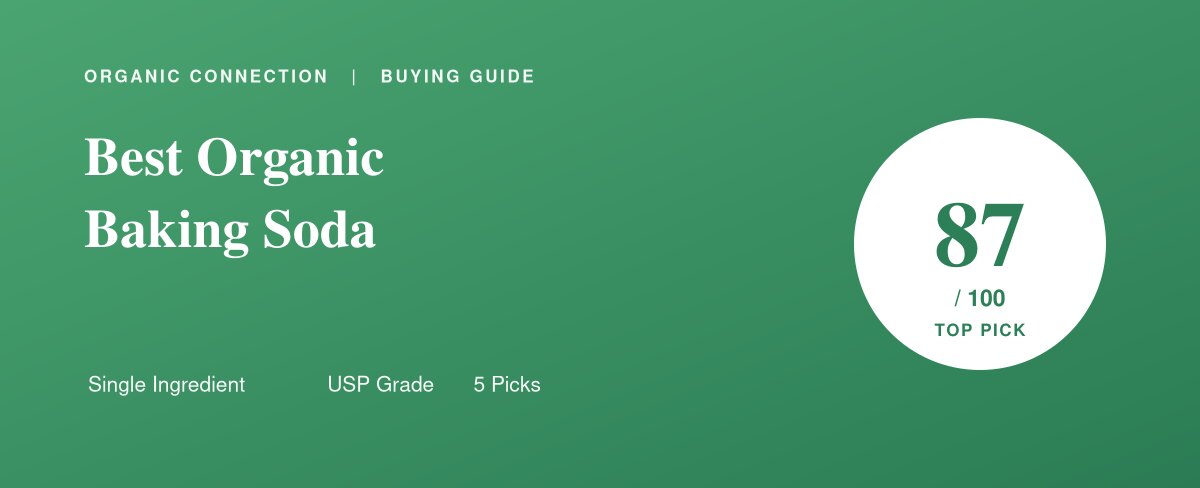
After working through the certification rules and the labeling around this product, our top pick is Bob’s Red Mill Pure Baking Soda. It is a single-ingredient sodium bicarbonate with no anti-caking agents, from a brand with an unusually strong disclosure record, which is why it earned our highest Organic Integrity Score of 87 out of 100.
This guide has to start by dismantling two things on the packaging, because both are misleading and one of them is the phrase you probably searched for.
Best organic baking soda compared
| Best Choice | Best Value | ||||
 |  |  |  |  | |
| Product | Bob’s Red Mill Pure Baking | It’s Just Baking Soda | Milliard Pure Baking Soda | Naturally Mined USP | Earthborn Elements 10 lb |
| Organic Integrity Score | 87/ 100 | 86/ 100 | 85/ 100 | 82/ 100 | 76/ 100 |
| Our rating | 4.4 | 4.3 | 4.3 | 4.1 | 3.8 |
| Ingredients | Sodium bicarbonate only | Sodium bicarbonate only | Sodium bicarbonate only | Sodium bicarbonate only | — |
| Third-party tested | Not stated | Yes, each batch | Not stated | Not stated | Not stated |
| Grade | Food grade | Food grade | USP | USP | — |
| Size | 2 lb total | 1.25 lb | 19 lb | 5 lb | — |
| Best for | Everyday baking | Verified purity | Cleaning and bulk | Mined route | — |
| Price | Currently unavailable See buying options | $9.99$0.50 / ounce View on Amazon | Currently unavailable See buying options | $19.99$0.25 / ounce View on Amazon | $24.99$0.16 / ounce View on Amazon |
Scores are ours, based on independent research of purity, ingredient disclosure, sourcing transparency, packaging and value, using the same 10-criteria method we apply to every product.
Reading the seals on organic baking soda: what each one does and does not cover
Most shoppers read a certification as a general signal of quality. Every one of them is narrower than that, and the gaps between them are where the marketing lives.
| Certification | Covers | Key exclusion |
| USDA Organic | Farming and handling: no synthetic pesticides or fertilizers, no GMOs, no sewage sludge or irradiation, audited yearly by an accredited certifier | Three different tiers share the one seal, and it makes no claim about worker pay, food miles, or nutrition |
| Kosher | Ingredients and production comply with Jewish dietary law, verified by a rabbinic agency that inspects the facility | A dietary-law standard: it makes no claim about pesticides, GMOs or farming practice |
Kosher and organic answer entirely different questions. A kosher mark, OU, OK, Star-K and others, confirms that ingredients and production follow Jewish dietary law, verified by an agency that inspects the facility. It is a rigorous supply-chain audit and it says nothing about pesticides, GMOs or farming. The two seals appear together often precisely because neither substitutes for the other.
Why baking soda cannot be USDA Organic
Sodium bicarbonate is a chemical compound, NaHCO₃. It is either mined as trona ore or manufactured, and in neither case is it grown. USDA organic certification applies to agricultural production, so there is no pathway for it, exactly as there is none for magnesium or for the surfactants in dish soap.
Baking soda does appear on the National List as a substance permitted for use in certified organic food production. That is a different thing entirely. It means an organic bakery may use it as an ingredient, not that the box on your shelf is certified. If you see a box marketed as organic baking soda, the word is doing no verified work.
This is not a reason to give up on quality. It means the things worth checking are purity and process rather than a seal.
“Aluminum-free” is true and useless
This claim appears on a great many baking soda packages and it is technically accurate in the way “gluten-free water” is accurate.
Baking soda has never contained aluminum. It is a single compound. The aluminum concern is real but belongs to baking powder, some formulations of which contain sodium aluminum sulfate as a slow-acting acid. Double-acting baking powders are where you should look for an aluminum-free claim, because there the label distinguishes between two genuinely different products.
On baking soda, printing “aluminum-free” is marketing a property every competitor also has. It is worth knowing so the phrase stops steering your purchase, and so you check the right box when you buy baking powder.
Mined versus manufactured, which is the real difference
Here is the distinction that actually separates products, and almost nobody explains it.
Most baking soda in the United States comes from trona ore, a naturally occurring mineral mined principally in Wyoming, then purified and processed into sodium bicarbonate. Elsewhere, much is made industrially by the Solvay process, a chemical route using salt, limestone and ammonia.
The finished sodium bicarbonate is chemically identical either way, and both are food safe. The difference is environmental and philosophical rather than nutritional: mining versus chemical synthesis, with different energy and waste profiles. If you buy natural products for provenance reasons, mined trona is generally the one you want, and brands that source it usually say so. Nobody’s cake can tell.
Grades, and what “USP” means on a bag
You will see USP on some packaging, particularly bulk bags. It means the product meets United States Pharmacopeia standards for purity, which is a higher and more precisely defined bar than food grade. It is a genuine quality marker and it costs the manufacturer something to claim.
For baking, food grade is entirely sufficient. USP matters if you are using bicarbonate for anything closer to medical or laboratory use, and it is a reasonable tiebreaker on a bulk purchase where you want confidence in what you are buying by the sack.
Key things to look for in a baking soda
1. One ingredient
Sodium bicarbonate, alone. Some products add anti-caking agents; there is no need for them in a well-packaged product, and their absence is the clearest quality signal available.
2. Stated sourcing
Mined trona versus Solvay process. Brands doing the former usually say so, and it is the only meaningful production difference in the category.
3. Food grade or USP
Food grade is fine for baking. USP is a higher purity standard and a sensible tiebreaker on bulk.
4. Resealable packaging
Baking soda absorbs moisture and odors, which is the same property that makes it work in a fridge. A cardboard box left open loses potency, so a resealable bag or a transferred airtight jar is better.
5. A size you will use
Baking soda does lose activity over time once opened. A 19 pound sack is superb value for cleaning and pointless for someone who bakes occasionally.
Who should buy a premium baking soda
Buy a single-ingredient, clearly sourced product if you want to know what you are eating and prefer brands that disclose. Buy bulk if you use bicarbonate for cleaning, laundry, deodorizing or pool chemistry, where the quantities dwarf baking use. Buy USP grade if you want the higher purity standard for non-food uses.
Do not pay a premium for the word organic on this product, because it certifies nothing here, and do not pay one for “aluminum-free” either. If you want to spend money usefully in this corner of the pantry, spend it on an aluminum-free baking powder, where the distinction is real.
How to choose a baking soda
Check the ingredient list is one line. Prefer a brand that states its sourcing. Decide food grade or USP based on what you are using it for. Then buy the size that matches your actual consumption, remembering that baking and cleaning uses differ by an order of magnitude. Ignore organic and aluminum-free claims entirely; neither tells you anything about this product.
Best overall: Bob’s Red Mill Pure Baking Soda, 16 oz (Pack of 2)
| Organic Integrity Score | 87 / 100 |
| Size | 16 oz x 2 |
| Certification | Kosher, Gluten-free |
| Best for | Everyday baking with a clean single-ingredient product |
Only a few things can be done well in this category, and this does them: one ingredient, no anti-caking agents, and a company with a long record of disclosing what is in the box. Two one-pound bags is a sensible quantity for a household that bakes regularly without becoming stale in the cupboard.
There is nothing exotic to say about the sodium bicarbonate itself, and that is rather the point. In a category full of claims that mean nothing, a plain product from a transparent brand at a fair price is the correct answer, and paying more buys you no better chemistry.
What we liked: Genuinely single ingredient. Strong brand disclosure record. Sensible two-bag quantity. No misleading organic or aluminum-free claims on the front.
Keep in mind: Bags are not resealable, so decant into an airtight jar or the powder will absorb moisture and odors. Costs more than supermarket own-label for chemically identical bicarbonate.
What the listing discloses: Bob’s Red Mill carries no organic claim, certified or otherwise.
Best documented purity: It’s Just Baking Soda, 1.25 lb
| Organic Integrity Score | 86 / 100 |
| Size | 1.25 lb |
| Composition | 100% sodium bicarbonate, stated as no additives and no fillers |
| Testing | Each batch third-party lab tested for purity, stated in the listing |
| Origin | Made and packaged in the USA |
| Best for | Anyone who wants the purity claim actually checked |
This is the only listing in the comparison that says its purity is verified rather than asserted. The description states that each batch is third-party lab tested, and that the product is both made and packaged in the USA.
That matters more here than it would in most categories. Baking soda has one ingredient, so there is no recipe to judge and no certification to check — sodium bicarbonate cannot be USDA Organic. Purity is the entire specification, which makes batch testing the only meaningful differentiator anybody in this aisle can offer.
It sits a point below our top pick only on practicality. At 1.25 lb it is the smallest quantity here, and the price per pound is correspondingly high. If you use bicarbonate for cleaning as well as baking, one of the bulk options is better value.
What we liked: Third-party batch testing named in the listing, a one-line composition with additives and fillers explicitly ruled out, and a stated country of manufacture and packaging rather than a vague origin.
Keep in mind: The smallest pack here, so the cost per pound is the highest of the five. The listing names food grade in the title but does not claim USP, so for non-food uses the Milliard bag is the stronger paper.
Best bulk and highest grade: Milliard Pure Baking Soda USP, 19 lb
| Organic Integrity Score | 85 / 100 |
| Size | 19 lb resealable bag |
| Certification | Not stated on the listing |
| Best for | Cleaning, laundry, deodorizing and pool use |
USP grade is a higher purity standard than food grade, and at 19 pounds in a resealable bag this transforms the economics if you use bicarbonate for anything beyond baking. Cleaning, laundry boosting, deodorizing, scrubbing and pool alkalinity all consume it far faster than cakes do.
The resealable bag is a meaningful advantage in this category, since it is the one product here that ships in packaging designed for a product that absorbs moisture. Store it somewhere dry and it will stay usable a long time.
What we liked: USP purity standard, which is above food grade. Vastly better cost per pound. Genuinely resealable. No additives or anti-caking agents.
Keep in mind: Nineteen pounds needs storage space and is absurd for baking alone. Buy it for household use, not for cakes.
What the listing discloses: The word organic does not appear on the Milliard listing at all.
Best mined option: Naturally Mined Baking Soda USP, 5 lb
| Organic Integrity Score | 82 / 100 |
| Size | 5 lb |
| Grade | USP food grade, stated |
| Process | Described as water-extracted, without harsh chemicals |
| Best for | Buyers who want the mined route and a stated grade |
This is the listing that engages with the distinction the section above describes. It states USP food grade and describes the product as “carefully water-extracted”, recovered “using a simple water process, without harsh chemicals”.
That phrasing describes solution mining: water is pumped into the trona bed, the dissolved bicarbonate is brought up, and the solid is recovered. It is not a purity claim in itself, and it is not organic certification, which does not exist for a mineral. What it is, is a manufacturer telling you which of the two routes their product took — and almost nobody in this aisle does.
Five pounds at a USP grade also sits in a useful gap. It is enough for a household that cleans with bicarbonate as well as bakes with it, without committing to the 19 lb sack.
What we liked: A stated grade and a stated process, in a category where most listings give neither. The size is the practical middle of this comparison.
Keep in mind: No third-party testing is mentioned, so the purity claim rests on the grade alone. The brand is far less established than Bob’s Red Mill or Milliard, and “the way nature intended” in the copy is marketing rather than specification.
Best bulk value: Earthborn Elements Baking Soda, 10 lb
| Organic Integrity Score | 76 / 100 |
| Size | 10 lb |
| Organic claim | None, and correctly so |
| Listing claims | None in the title or body |
| Best for | Cleaning and baking in quantity at the lowest cost per pound |
This pick exists to make a point the rest of the category dances around. Baking soda cannot be certified organic.
Sodium bicarbonate is a mineral, either mined as nahcolite or manufactured from soda ash. It is not an agricultural product, so it falls outside what the National Organic Program certifies — exactly as we found with organic salt. Any box of baking soda you see is the same compound; the differences are purity grade, packaging and price.
This listing makes no organic claim at all, which is the honest position, and it is the cheapest per pound on the page by a wide margin.
It also makes no other claims. Our scanner found nothing in the title or body beyond the product name and weight — no USP grade, no aluminum-free statement, no origin. Worth noting that “aluminum-free” on baking soda is meaningless anyway: sodium bicarbonate never contains aluminum. That claim belongs on baking powder, which sometimes does.
What we liked: Cheapest per pound here, and it correctly declines to make an organic claim that cannot exist.
Keep in mind: No purity grade stated, no claims of any kind, and 10 lb is a lot unless you clean with it as well as bake.
What the listing discloses: Earthborn Elements carries no organic claim, certified or otherwise.
Storage, potency, and the test that takes ten seconds
Baking soda does not spoil in the way food spoils. What it does is slowly react with moisture and with carbon dioxide in the air, converting to sodium carbonate, which does not leaven. A box that has been open in a humid kitchen for two years will still be sodium bicarbonate on the label and noticeably weaker in a cake.
The test. Put a teaspoon of bicarbonate in a small bowl and pour on a splash of vinegar or lemon juice. Fresh bicarbonate erupts immediately and vigorously. Tired bicarbonate fizzes weakly, or slowly, or briefly. There is no ambiguity in the result and it takes ten seconds, which makes it worth doing before you commit it to a batter you have spent an hour on.
Why packaging format matters more than the date. This is the practical argument for buying several sealed units rather than one large container if you bake occasionally. An unopened bag holds its potency far longer than an opened one, whatever the printed date says. It is also the argument against the biggest sack for a household that only bakes: 19 lb of bicarbonate is excellent value per pound and poor value if half of it goes flat before you reach it.
Keep the baking supply and the cleaning supply separate. A box that has been sitting open in a refrigerator absorbing odors is doing exactly the job it was put there to do, and it is no longer the box you want in a cake. The same applies to a tub kept under the sink. Bicarbonate is cheap enough that keeping two is not a real cost.
Store it airtight and away from the stove. Heat and humidity are what convert it. An airtight container in a cupboard beats the original box with a folded top, and the original box beats a jar left open next to the kettle.
How much do you actually need? This is worth working out before the price per pound tempts you into the sack. A household that bakes most weekends will get through roughly a pound a year in recipes. Add cleaning, deodorizing and the occasional laundry use and it might reach three or four pounds. On that basis the 19 lb bag is a five-year supply, and bicarbonate that has been open for five years is not the same product it was on day one.
The bulk sizes make sense for a genuinely different use case: pool chemistry, large-scale cleaning, livestock, or a household that has switched most of its cleaning products to bicarbonate and vinegar. If that is you, the price per pound is a real saving. If it is not, the smaller sealed formats are cheaper in the only way that counts, which is cost per pound you actually use.
Common questions about organic baking soda
Is there such a thing as organic baking soda?
No. Sodium bicarbonate is a mineral compound, either mined from trona ore or manufactured, and USDA organic certification applies to agricultural production. There is no certification pathway. Baking soda is permitted for use in certified organic food production, which is a different thing from the box itself being certified.
Does baking soda contain aluminum?
No, and it never has. Baking soda is a single compound, sodium bicarbonate. The aluminum concern belongs to baking powder, some formulations of which contain sodium aluminum sulfate. An “aluminum-free” claim on baking soda is technically true and tells you nothing, because every baking soda qualifies.
Then where should I look for aluminum-free?
On baking powder, where the distinction is real and the label separates two genuinely different formulations. If avoiding aluminum in baking matters to you, that is the product to check.
What is the difference between baking soda and baking powder?
Baking soda is pure sodium bicarbonate and needs an acid in the recipe, such as buttermilk, yogurt or lemon juice, to react and produce lift. Baking powder is baking soda with a powdered acid already included, so it works without one. They are not interchangeable without adjusting the rest of the recipe.
Is mined baking soda better than manufactured?
Chemically they are identical and both are food safe. The difference is environmental and philosophical: mined trona ore versus the Solvay chemical process, with different energy and waste profiles. If provenance matters to you, mined trona is generally the preference, and brands sourcing it usually say so.
What does USP grade mean?
That the product meets United States Pharmacopeia purity standards, which is a higher and more precisely defined bar than food grade. Food grade is entirely sufficient for baking. USP is worth having for non-food uses or when buying in bulk.
Does baking soda expire?
It loses potency rather than spoiling. To test it, drop a spoonful into vinegar: vigorous fizzing means it is still active, a weak reaction means replace it. Store it airtight and dry, because the moisture and odor absorption that makes it useful in a fridge also degrades it in a cupboard.
Should I pay more for a premium baking soda?
Only for purity and packaging, not for the chemistry. All food-grade sodium bicarbonate is the same compound. What you can reasonably pay for is a single-ingredient product with no anti-caking agents, clear sourcing, and packaging that keeps it dry. Paying extra for “organic” or “aluminum-free” on this product buys nothing at all.
- Organic Food and Pantry hub
- Best Organic Bread Flour
- How to read an ingredient list
- browse all our reviewed products — scores and certifications for 800+ products
- Best Glass Food Storage Containers
Price and availability as of October 15, 2026 1:10 pm EDT. Product prices and availability are accurate as of the date/time indicated and are subject to change. Any price and availability information displayed on Amazon.com at the time of purchase will apply to the purchase of this product.
Looking for other organic products?
We have checked more than 800 products across food, household goods, gardening, personal care and pet, every one against its stated certification. Browse all reviews.
Organic Connection is reader-supported. When you buy through links on this page we may earn a commission, at no extra cost to you. As an Amazon Associate we earn from qualifying purchases. We are not paid to feature or rank any product. How we research and rate.
How do I know if my baking soda is still good?
Add a splash of vinegar or lemon juice to a teaspoon of it. Fresh bicarbonate fizzes immediately and vigorously. A weak, slow or short reaction means it has partly converted to sodium carbonate and will not leaven properly. The test takes ten seconds and is more reliable than the printed date.
Can I use baking soda for cleaning and for baking from the same box?
You can, but it is better not to. A box kept open to absorb odors, in a refrigerator or under a sink, has been doing exactly that, and those odors end up in whatever you bake. Bicarbonate is inexpensive enough that keeping a sealed baking supply separate costs very little.
Is there a difference between food grade and USP baking soda?
USP is the stricter of the two. It means the product meets United States Pharmacopeia standards for purity, which is the specification used for pharmaceutical and medical applications. Food grade is sufficient for cooking. If you are using bicarbonate for personal care or anything medical, USP is the paper you want.
Why is baking soda sold in such different sizes and prices?
Because it serves two markets from the same bin. A one pound box is a baking ingredient and is priced like one. A nineteen pound sack is a cleaning and pool chemical, and the price per pound falls sharply. The product inside can be identical, so the right size depends entirely on how fast you will use it before it goes flat.
Does any brand test its baking soda for purity?
Very few say so. Of the five listings we read for this guide, one states that each batch is third-party lab tested. In a product with a single ingredient and no available organic certification, that is the only meaningful quality claim anybody can make, which makes its absence from most listings notable.