Last updated: September 30, 2026
We may earn a commission when you buy through links on this page, at no extra cost to you. How we research and rate.
The short version
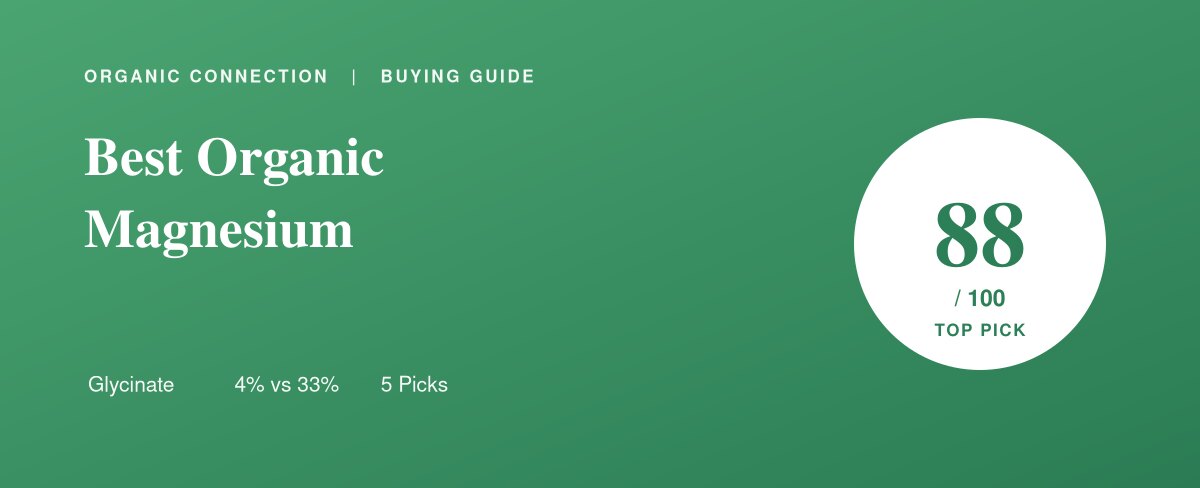
After working through the absorption literature, our top pick is Doctor’s Best High Absorption Magnesium Glycinate Lysinate. It uses a chelated glycinate form with strong bioavailability, it is gentle on the stomach, and the dose is stated clearly per serving, which is why it earned our highest Organic Integrity Score of 88 out of 100.
Before the picks, two corrections, because the phrase “organic magnesium” means something quite different from what most people searching it expect. Neither correction costs you anything, and one of them will save you money.
Best organic magnesium compared
| Best Choice | Best Value | ||||
 |  |  |  |  | |
| Product | Doctor’s Best High | Thorne Magnesium Glycinate | Doctor’s Best 100% | Pure Encapsulations | Doctor’s Best High |
| Organic Integrity Score | 88/ 100 | 87/ 100 | 84/ 100 | 83/ 100 | 82/ 100 |
| Our rating | 4.4 | 4.4 | 4.2 | 4.2 | 4.1 |
| Form | Glycinate lysinate chelate | Glycinate chelate | 100% chelated | Capsules, 90 count | Chelated powder |
| Per serving | 105 mg elemental | Stated on pack | 200 mg elemental | — | Adjustable |
| Testing | Non-GMO, vegan | NSF Contents Certified | Not buffered | — | Non-GMO, vegan |
| Best for | Everyday use | Verified purity | Higher doses | Fewest added ingredients | Flexible dosing |
| Certification | Non-GMO, Gluten-free, Vegan | Not stated on the listing | Non-GMO, Gluten-free, Vegan | — | Non-GMO, Gluten-free, Vegan |
| Price | $14.99$0.12 / count View on Amazon | $26.00$0.29 / count View on Amazon | $23.99$0.10 / count View on Amazon | $27.00$0.30 / count View on Amazon | $19.99$2.82 / ounce View on Amazon |
Scores are ours, based on independent research of form and bioavailability, dose transparency, third-party testing and value, using the same 10-criteria method we apply to every product.
What each certification on an organic magnesium label actually covers
Each certification below appears on at least one product on this page. They are not ranked against each other, because they measure different things, but knowing which is which changes what you buy.
| Certification | Covers | Key exclusion |
| USDA Organic | Farming and handling: no synthetic pesticides or fertilizers, no GMOs, no sewage sludge or irradiation, audited yearly by an accredited certifier | Three different tiers share the one seal, and it makes no claim about worker pay, food miles, or nutrition |
| NSF/ANSI | Independent testing of a water treatment product against one named standard number | The number is the claim: 42 is taste and odor, 53 is health contaminants, 58 is reverse osmosis, 401 is emerging compounds, and 372 is only lead-free materials |
Check which NSF standard, and then check which contaminants inside it. Certification is granted claim by claim rather than filter by filter, so a unit certified to NSF/ANSI 53 is certified for the specific contaminants it was tested against, not for everything the standard covers. Manufacturers publish those claims and so do the certifying bodies, and the two should agree. “Tested to NSF standards” in a listing, with no number and no certifier, is not a certification at all.
No magnesium supplement is USDA Organic
This is the first correction, and it is absolute rather than a matter of degree.
Magnesium is a mineral, an element. It is not grown, and USDA organic certification applies to agricultural production. There is no organic farm producing magnesium, and there is no certification pathway for a mineral supplement, so no magnesium supplement can carry the USDA Organic seal for its magnesium.
What you may occasionally see is a product where other ingredients, such as a plant blend or a flavoring, are certified organic, sitting alongside the mineral. That is a legitimate claim about those ingredients and it tells you nothing about the magnesium. This is the same arithmetic that makes certified organic toothpaste and dish soap essentially impossible: the functional ingredient is not agricultural.
What “organic magnesium” actually means
Here is the second correction, and it is the genuinely useful one.
In chemistry, “organic” means carbon-containing. Magnesium supplements divide into inorganic salts, such as magnesium oxide, and organic salts, where the magnesium is bound to a carbon-based molecule, such as citrate, glycinate or malate. When a supplement brand refers to organic magnesium, this is what the term means, and it has nothing to do with farming.
The distinction matters enormously, because organic forms are absorbed several-fold more efficiently than inorganic ones. So the phrase people search for by mistake happens to point at exactly the right thing: you should be buying organic magnesium, in the chemical sense. That is a genuinely lucky accident, and it is the practical answer this page is built around.
Which form should you buy?
Magnesium glycinate is bound to the amino acid glycine, which helps carry it across the intestinal wall. It has the best absorption of the common forms and is the gentlest on the stomach, and glycine itself has a mild calming effect. This is the default recommendation for most people, particularly for evening use.
Magnesium citrate is well absorbed and highly soluble, and it is a reasonable middle ground on price. Its notable property is a laxative effect at higher doses, which is either a drawback or the entire point depending on why you are buying it.
Magnesium malate is bound to malic acid and is also well absorbed, often chosen by people who find glycinate too sedating for daytime use.
Magnesium oxide is the one to avoid for supplementation, and it is the most common form on shelves because it is cheap and contains a lot of magnesium by weight. At roughly 4 percent absorption, most of what you swallow passes through, which is also why it works as a laxative. A cheap high-milligram oxide product is usually worse value than a smaller dose of glycinate.
Key things to look for in a magnesium supplement
1. The form, named specifically
Glycinate, citrate or malate. If the label says only “magnesium” or “magnesium complex” without naming the salt, assume oxide, because a brand using a better form says so.
2. Elemental magnesium per serving
The number that matters. A tablet may say 1000 mg of magnesium glycinate while delivering perhaps 100 mg of elemental magnesium. Good labels state elemental content; less good ones state compound weight, which looks bigger.
3. Servings per dose
Chelated magnesium is bulky, so hitting a useful dose often takes two to four tablets. Compare cost per dose rather than per bottle, and check how many pills a day you are signing up for.
4. Third-party testing
Since organic certification cannot apply here, third-party verification is the quality signal available to you. NSF, USP or an equivalent means something checked what is in the bottle. See our guide to supplement third-party testing.
5. Buffered or not
Some products blend cheap magnesium oxide into a chelated formula to raise the milligram count at low cost, described as “buffered”. A product stating it is not buffered is telling you the whole dose is the better form.
Who should buy a magnesium supplement
Consider one if your diet is low in leafy greens, nuts, seeds and wholegrains, which are the main dietary sources, or if you have discussed magnesium with your doctor for a specific reason. Glycinate is the sensible default, and evening is the usual timing because of glycine’s calming effect.
Be careful if you have reduced kidney function, since impaired kidneys cannot clear excess magnesium and supplementation can be genuinely dangerous. That is a conversation with your doctor, not a shelf decision. Magnesium also interacts with several medications, including some antibiotics and bisphosphonates, usually by impairing their absorption when taken together. And if you eat plenty of magnesium-rich food already, the incremental benefit is modest.
How to choose a magnesium supplement
Pick the form first, since it matters more than everything else combined: glycinate for general use and sleep, citrate if you also want the laxative effect, malate for daytime. Then find elemental magnesium per serving and work out cost per dose rather than per bottle. Then check for third-party testing, and whether the formula is buffered with oxide. Ignore organic claims entirely, since as above they cannot apply to the mineral.
Best overall: Doctor’s Best High Absorption Magnesium Glycinate Lysinate, 120 Veg Caps
| Organic Integrity Score | 88 / 100 |
| Form | Magnesium glycinate lysinate chelate, 120 veg capsules |
| Certification | Non-GMO, Gluten-free, Vegan |
| Best for | Everyday magnesium, particularly in the evening |
Only one thing really matters here, and this gets it right: a genuine chelated glycinate, rather than oxide dressed up with a large milligram number. Elemental magnesium is stated at 105 mg per serving, which is the honest way to label it, and the glycinate form is both the best absorbed of the common options and the least likely to upset your stomach.
The trade-off is bulk. Chelated magnesium is a physically large molecule, so reaching a meaningful daily intake means several capsules rather than one, and the bottle empties faster than the count suggests. That is inherent to the form rather than a fault of this product, and it is the price of the sevenfold absorption difference over oxide.
What we liked: Real glycinate lysinate chelate, elemental magnesium stated plainly, gentle on the stomach, vegan and non-GMO. The evening calming effect from glycine is a genuine bonus rather than a marketing line.
Keep in mind: Multiple capsules per dose. Not certified organic, and as explained above no magnesium supplement can be.
What the listing discloses: Doctor’s BEST makes no organic claim anywhere, so the case rests on the other claims it does make.
Best tested: Thorne Magnesium Glycinate, 90 Capsules
| Organic Integrity Score | 87 / 100 |
| Form | Magnesium glycinate chelate, 90 capsules |
| Certification | Not stated on the listing |
| Best for | Buyers who want independent verification of contents |
Thorne carry NSF Contents Certified status, which means an independent body verified that what is on the label is what is in the capsule. In a category where organic certification is unavailable, that is the most meaningful third-party assurance you can get, and Thorne’s testing record is among the better ones in supplements.
You pay for that. Thorne is consistently more expensive than mainstream brands for the same form and a similar dose. Whether the verification is worth the premium depends on how much weight you place on independent testing, which after the label-accuracy problems documented across the supplement industry is a reasonable thing to value.
What we liked: NSF Contents Certified, which is genuine independent verification rather than self-attestation. Glycinate form. Clean formulation with minimal excipients.
Keep in mind: Noticeably more expensive per dose. Ninety capsules does not last long at multi-capsule dosing.
What the listing discloses: The word organic does not appear on the THORNE listing at all.
Best higher dose: Doctor’s Best 100% Chelated Magnesium, 240 Tablets
| Organic Integrity Score | 84 / 100 |
| Form | 100% chelated magnesium, 200 mg elemental per serving, 240 tablets |
| Certification | Non-GMO, Gluten-free, Vegan |
| Best for | Higher daily intakes and better cost per dose |
Two hundred milligrams of elemental magnesium per serving from a fully chelated source, and the phrase to notice is not buffered. Buffering means blending cheap magnesium oxide into a chelated product to lift the milligram figure at low cost, and a brand stating it does not do this is making a claim worth having.
At 240 tablets this is also the best cost per dose among our picks. The tablets are large, which some people struggle with, and it is worth building up gradually rather than starting at the full dose.
What we liked: Explicitly not buffered with oxide. Higher elemental dose per serving. Best value here per dose. Large count lasts.
Keep in mind: Large tablets. Higher doses of any magnesium can loosen stools, so increase gradually.
What the listing discloses: The word organic does not appear on the Doctor’s BEST listing at all.
Fewest added ingredients: Pure Encapsulations Magnesium (Glycinate), 90 Capsules
| Organic Integrity Score | 83 / 100 |
| Form | Magnesium glycinate capsules, 90 count |
| Per serving | — |
| Testing | — |
| Certification | — |
| Best for | Anyone reacting to fillers rather than to magnesium |
This is the pick for people who have worked out that the problem was never the magnesium. Pure Encapsulations sells on subtraction: the listing’s own summary is “what we leave out matters, too”, and it states the product is free from common allergens, artificial and unnecessary ingredients, and GMOs. For anyone who has reacted badly to a supplement and never established which ingredient did it, that is a more useful claim than another chelate name.
It is the most expensive per capsule on this page and the smallest count, at 90. That is the trade: you are paying for a short ingredient list rather than for volume, and if fillers have never bothered you there is no reason to pay it.
Worth being precise about what is not here. The listing names no certifying body, publishes no third-party test, and does not state elemental magnesium per capsule in its bullets, which is why three cells above are dashes. Its claims about heart, bone and sleep support all carry the asterisk that marks a structure-function claim, meaning the FDA has not evaluated them. The reason to buy this one is the exclusions, and those are the only part of the listing that is specific.
What we liked: The one pick here whose selling point is what is absent, stated plainly: free from common allergens, artificial ingredients and GMOs. A different proposition from the chelate variants around it.
Keep in mind: The highest price per capsule on the page and the smallest bottle. No certifier named, no test published, and no elemental magnesium figure in the listing bullets.
What the listing discloses: Pure Encapsulations states the product is free from common allergens, artificial or unnecessary ingredients and GMOs. It names no certifying body, no third-party testing and no elemental magnesium per capsule. The word organic does not appear.
Best powder: Doctor’s Best High Absorption Magnesium Powder, 200 g
| Organic Integrity Score | 82 / 100 |
| Form | Chelated magnesium powder, 200 g |
| Certification | Non-GMO, Gluten-free, Vegan |
| Best for | People who cannot swallow multiple large tablets |
Powder solves the real practical problem with chelated magnesium, which is that a useful dose means several large pills. You can scale a powder precisely, start low and increase, and mix it into a drink rather than counting tablets.
The trade-offs are taste and convenience. Chelated magnesium powder is not pleasant on its own and needs mixing into something with flavor, and it is less portable than a bottle of capsules. Worth it if swallowing pills is the barrier that would otherwise stop you.
What we liked: Fully adjustable dosing, which suits building up gradually. No pills to swallow. Same chelated quality as the tablets.
Keep in mind: Needs mixing into a flavored drink. Less convenient away from home.
What the listing discloses: The word organic does not appear on the Doctor’s BEST listing at all.
Sleep, cramps, and an indirect argument
Magnesium is one of the more genuinely useful supplements for the reason that shortfall is common, and its connection to weight is indirect and worth stating carefully.
Magnesium is involved in hundreds of enzymatic reactions including glucose metabolism, and observational data links lower magnesium status with insulin resistance and metabolic syndrome. Trials of supplementation have found modest improvements in insulin sensitivity in people with low magnesium or existing metabolic disturbance, and little in those who are replete.
Direct evidence for weight loss is absent. What exists is a plausible relationship between magnesium status and metabolic health, which is not the same thing.
The indirect route runs through sleep, and it is the more practical one. Magnesium has modest evidence for improving sleep quality, particularly in older adults and people with low intake. Sleep is robustly linked to appetite regulation, with controlled sleep restriction increasing hunger and shifting food choices. If magnesium improves your sleep, that chain is real, and the first link is the uncertain one.
The form matters more here than in most supplements. Magnesium oxide is cheap and poorly absorbed, and is effectively a laxative at meaningful doses. Glycinate, citrate and malate are better absorbed and better tolerated, which is covered above.
That laxative effect is worth naming in this context, because a supplement causing loose stools will move the scale temporarily and that is water and stool, not fat.
Honest summary: genuinely useful where intake is low, a plausible indirect route through sleep, no direct weight effect, and a form choice that determines whether you absorb it or simply pass it.
Common questions about organic magnesium
Is there such a thing as USDA Organic magnesium?
No. Magnesium is a mineral, not an agricultural product, and USDA organic certification applies to farming. No magnesium supplement can carry the seal for its magnesium. Occasionally other ingredients in a formula are certified organic, which is a claim about those ingredients only.
What does “organic magnesium” actually mean?
In chemistry, organic means carbon-containing. Organic magnesium salts are those bound to a carbon-based molecule, such as citrate, glycinate or malate, as opposed to inorganic salts like magnesium oxide. Usefully, organic forms in this chemical sense are also the better absorbed ones, so the phrase points at the right products by accident.
Which form of magnesium is best absorbed?
Glycinate leads, with citrate and malate also well absorbed. Magnesium oxide is the outlier: absorption studies put it at roughly 4 percent against approximately 28 to 33 percent for other forms, close to a sevenfold difference. Oxide is nonetheless the most commonly sold form because it is cheap.
Why is magnesium oxide so widely sold if it absorbs poorly?
Because it is inexpensive and contains a high proportion of magnesium by weight, so a label can show a large milligram figure cheaply. Most of it passes through unabsorbed, which is also why it functions as a laxative. A smaller dose of glycinate is usually better value than a large dose of oxide.
What is the difference between glycinate and citrate?
Both are well absorbed. Glycinate is bound to glycine, is gentler on the digestive system, and carries a mild calming effect that suits evening use. Citrate is highly soluble and somewhat cheaper, with a laxative effect at higher doses that is either a drawback or the reason you are buying it.
How much magnesium should I take?
That depends on your diet and your reasons, and it is worth checking elemental magnesium rather than compound weight when comparing products. If you are taking it for a specific health reason, or you have any kidney impairment, ask your doctor rather than working from a label.
Should I take magnesium at night?
Many people prefer to, particularly glycinate, because glycine itself has a mild calming effect. There is no absorption reason it must be evening. If you find glycinate makes you drowsy during the day, malate is the usual alternative.
Can magnesium interact with medication?
Yes. Magnesium can impair the absorption of several medications, including certain antibiotics and bisphosphonates, when taken at the same time, and it is genuinely risky in reduced kidney function because impaired kidneys cannot clear the excess. Check with your doctor or pharmacist if you take regular medication.
- Organic Supplements and Wellness hub
- Supplement third-party testing explained
- Best Organic Multivitamin
- every organic supplement we have reviewed — searchable by certification and testing
Price and availability as of October 15, 2026 1:10 pm EDT. Product prices and availability are accurate as of the date/time indicated and are subject to change. Any price and availability information displayed on Amazon.com at the time of purchase will apply to the purchase of this product.
Looking for other organic products?
We have checked more than 800 products across food, household goods, gardening, personal care and pet, every one against its stated certification. Browse all reviews.
Organic Connection is reader-supported. When you buy through links on this page we may earn a commission, at no extra cost to you. As an Amazon Associate we earn from qualifying purchases. We are not paid to feature or rank any product. How we research and rate.