Last updated: September 30, 2026
We may earn a commission when you buy through links on this page, at no extra cost to you. How we research and rate.
Health note: This guide is general information, not medical advice. Supplements are not intended to diagnose, treat, cure, or prevent any disease. A varied whole-food diet is the best foundation; a multivitamin fills gaps. Talk to your doctor before starting any supplement, especially if you are pregnant, nursing, taking medication, or managing a health condition, and to confirm the right nutrients and doses for you.
The short version
After researching the certifications, sourcing, and formulas of the most popular organic multivitamins, our top pick is Llama Naturals Organic Whole Fruit Multivitamin. Its vitamins come from real organic fruit rather than synthetic USP isolates, with no added cane sugar or syrups, which is why it earned our highest Organic Integrity Score of 90 out of 100. For women, Garden of Life Organics Women’s Once Daily states both USDA Organic and Non-GMO Project verification and is the cheapest here; for men, the matching Men’s Once Daily is our pick. If you specifically need iron or a methylated B12, Mama Natural names both on the label. This guide lists four picks rather than five for the reason set out below: genuinely certified organic multivitamins are rare.
Genuinely USDA-organic multivitamins are rare, because most multis use synthetic (USP) vitamins that cannot be certified organic. The ones that qualify are made from real, organic whole foods. We flag each pick’s certification and who it is for.
Best organic multivitamin compared
| Best Choice | Best Value | |||
 |  |  |  | |
| Product | Llama Naturals Gummy | Garden of Life Women's | Garden of Life Men's | Mama Natural Women's |
| Organic Integrity Score | 90/ 100 | 80/ 100 | 79/ 100 | 77/ 100 |
| Our rating | 4.5 | 4.0 | 4.0 | 3.9 |
| Best for | Best overall | Best for women | Best for men | Iron and methyl B12 |
| Form | Real-fruit gummy | One tablet daily | One tablet daily | One vegan tablet daily |
| Certification | Organic, Non-GMO, Vegan | USDA Organic, Non-GMO Project Verified | Certified organic | USDA Organic |
| Nutrients named on listing | 13 vitamins from whole fruit | Not itemized | Selenium, B vitamins | 19 nutrients incl. iron, methyl B12 |
| Price | $34.99$0.29 / count View on Amazon | $23.79 $26.07 −9%$0.79 / count View on Amazon | $35.07 $56.99 −38%$0.58 / count View on Amazon | $31.98 View on Amazon |
Price and availability as of October 11, 2026 7:10 pm EDT. Product prices and availability are accurate as of the date/time indicated and are subject to change. Any price and availability information displayed on Amazon.com at the time of purchase will apply to the purchase of this product.
Scores are ours, based on independent research of certification, whole-food sourcing, testing, and formula fit, using the same 10-criteria method we apply to every product. See how we research and rate.
The certification map for organic multivitamins, and what each one actually excludes
The labels on these products are not interchangeable, and several of them cover things that have nothing to do with each other. Here is what each one actually buys you.
| Certification | Covers | Key exclusion |
| USDA Organic | Farming and handling: no synthetic pesticides or fertilizers, no GMOs, no sewage sludge or irradiation, audited yearly by an accredited certifier | Three different tiers share the one seal, and it makes no claim about worker pay, food miles, or nutrition |
| Non-GMO Project | Testing and supply-chain traceability showing the ingredients are not genetically engineered | Sets no limit on synthetic pesticides or fertilizers, so it is not an organic claim |
| NSF/ANSI | Independent testing of a water treatment product against one named standard number | The number is the claim: 42 is taste and odor, 53 is health contaminants, 58 is reverse osmosis, 401 is emerging compounds, and 372 is only lead-free materials |
| USP Verified | Supplement identity, potency, purity and dissolution against United States Pharmacopeia monographs | Confirms the label is accurate; it does not claim the ingredient does anything |
Check which NSF standard, and then check which contaminants inside it. Certification is granted claim by claim rather than filter by filter, so a unit certified to NSF/ANSI 53 is certified for the specific contaminants it was tested against, not for everything the standard covers. Manufacturers publish those claims and so do the certifying bodies, and the two should agree. “Tested to NSF standards” in a listing, with no number and no certifier, is not a certification at all.
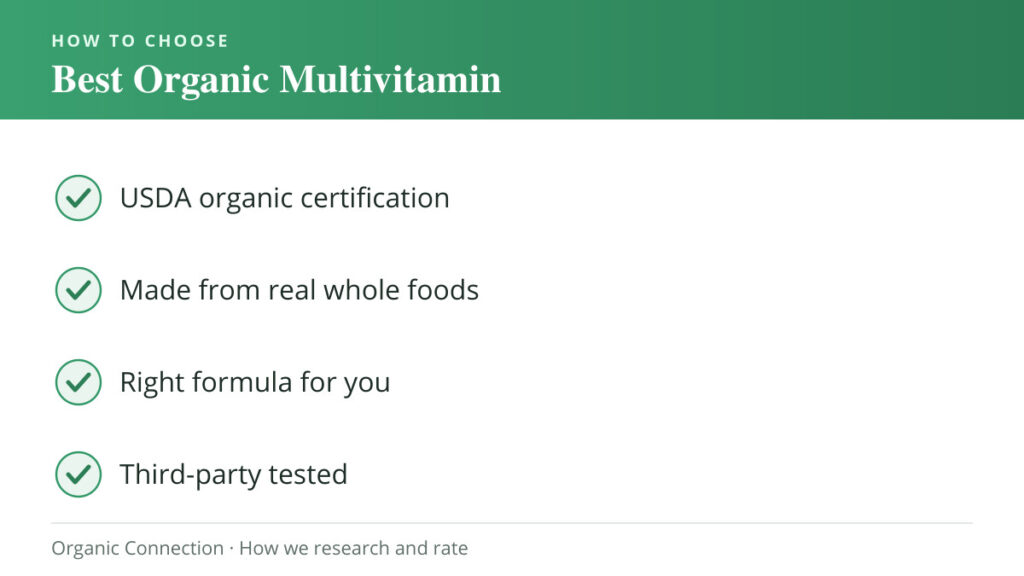
Key things to look for in an organic multivitamin
Good organic multivitamins are about real-food sourcing and honest formulas. Here is what matters.
1. USDA organic certification
It confirms the vitamins come from certified-organic foods, not synthetic lab-made USP vitamins.
2. Whole-food based
Look for nutrients from real fruits, vegetables, and herbs, ideally with third-party testing.
3. The right formula for you
Men’s, women’s, and age-specific (40-plus, 55-plus) formulas target different needs like iron, prostate, or bone support.
4. Form and dose
Once-daily tablets are convenient; gummies are easier to take; check whether it is one or two per day.
Why true organic multivitamins are rare
Here is the honest reality of this category: the vast majority of multivitamins, even ones with clean-sounding labels, are built from synthetic USP vitamins manufactured in a lab. Those cannot carry a USDA organic seal, because they are not made from organic food. The handful of multivitamins that are genuinely USDA organic get their nutrients from real, certified-organic foods instead, which is a fundamentally different (and more expensive) approach. Garden of Life’s mykind Organics line is the leading example, made exclusively from organic whole foods and dual-certified organic and Non-GMO, with Llama Naturals offering a whole-fruit gummy alternative.
Our scoring rewards genuine USDA organic certification, real whole-food sourcing, third-party testing, and formulas matched to real needs, and we are upfront that this is a small category dominated by a few brands, because that is the truth of what is actually certified organic.
Whole food versus synthetic: an honest assessment
“Whole food” is the central selling proposition of organic multivitamins and it carries a large price premium. The evidence supports it less than the marketing implies, and we would rather say so.
For most nutrients, the source does not matter much. A vitamin molecule is a vitamin molecule. Ascorbic acid synthesized in a factory is chemically identical to ascorbic acid in an orange, and absorption studies find no measurable difference. Across folate, iron, and iodine, the bioavailability gap between whole-food and synthetic forms is small and not clinically meaningful when the doses match. If a whole-food multivitamin and a synthetic one both deliver the same amount of the same form, expect the same result.
Where form genuinely does matter, and it is not about “natural”. The real distinctions are chemical, not agricultural:
| Nutrient | Better form | Weaker form |
| Folate | Methylfolate (5-MTHF), already bioactive | Folic acid, needs enzymatic conversion |
| B12 | Methylcobalamin or adenosylcobalamin | Cyanocobalamin, though it works fine for most |
| Vitamin D | D3 (cholecalciferol) | D2 (ergocalciferol), less effective at raising levels |
| Vitamin E | d-alpha-tocopherol, natural form | dl-alpha-tocopherol, synthetic, roughly half as active |
| Magnesium | Glycinate, citrate, malate | Oxide, poorly absorbed |
The folate point is the significant one. Folic acid must be converted by the MTHFR enzyme into the active form, and a substantial share of people, commonly cited around 40%, carry a genetic variant that slows that conversion. Methylfolate is already in the bioactive form and bypasses the step entirely. Notably, methylfolate is fully bioactive whether it came from a fermentation process or a food matrix, so this is an argument for the right form rather than for a whole-food product specifically.
The genuine advantages of whole-food formulas are real but narrower than claimed: they typically come with cofactors and phytonutrients from the food matrix, they are often gentler on an empty stomach, and they tend to use better forms across the board because the brands making them care about that. Those are decent reasons. “Your body cannot recognize synthetic vitamins” is not, and it is the claim these products are usually sold on.
What USDA Organic does and does not tell you here
This matters more in supplements than almost anywhere else on this site.
USDA Organic is a sourcing claim, not a potency or purity claim. It verifies how the agricultural inputs were grown. It does not verify that the pill contains the amount stated on the label, that it dissolves and is absorbed, or that it is free of contaminants. Those are entirely separate questions, and they are the ones that determine whether a supplement does anything.
The certifications that answer those questions are USP Verified and NSF Certified, which test identity, potency, dissolution, and contaminants, and audit the manufacturing facility. As covered in our guide to supplement third-party testing, participation is voluntary and relatively few products carry them, so their absence is weak evidence either way while their presence is a strong signal.
The ideal is both: organic certification for the inputs and USP or NSF for what actually ends up in the capsule. Where you have to choose, third-party potency testing tells you more about whether the product works.
One practical note on dosing. More is not better in a multivitamin. Fat-soluble vitamins A, D, E, and K accumulate, and high-dose formulas offering several hundred percent of daily values across the board are not more effective, just harder on your liver and your wallet. A multivitamin is intended to fill gaps in a diet, not to megadose. If you are treating a diagnosed deficiency, a targeted single supplement at a proper dose does that job far better than a multivitamin.
How to choose an organic multivitamin
- Look for the USDA Organic seal. It is what separates a true organic multi from a synthetic one.
- Favor whole-food based and tested. Nutrients from real foods, with third-party testing.
- Match the formula to you. Men’s, women’s, or 40-plus and 55-plus for age-specific needs.
- Check the dose and form. Once-daily tablets are convenient; gummies are easier to take but check the sugar.
- Talk to your doctor. Confirm the nutrients and doses that make sense for you, especially iron.
Who should buy an organic multivitamin
Age and sex change the formulation you need. Our top picks cover organic multivitamins for men and for women. If you want a whole-fruit gummy, or a formula tailored for women over 40 or men over 55, we have a pick for each. Always clear a new supplement with your healthcare provider.
Best overall: Llama Naturals Organic Whole Fruit Multivitamin
| Organic Integrity Score | 90 / 100 |
| Certification | Non-GMO, Vegan, Organic |
| Form | Real-fruit gummy, no added sugar cane |
| Best for | An easy, whole-fruit gummy multi |
Llama Naturals is our pick for a gummy. Uniquely, its gummies are made from real organic fruit with no added sugar cane, syrups, synthetic vitamins, gelatin, or artificial ingredients, delivering 13 vitamins and phytonutrients from pounds of organic fruit and vegetables, third-party tested, and suitable for adults (with kids’ versions too), a genuinely clean alternative to sugary synthetic gummies.
What we liked: Made from real organic fruit, no added sugar or synthetic vitamins, third-party tested, and easy and pleasant to take.
Keep in mind: As a whole-fruit gummy it provides food-based nutrient levels rather than high-dose amounts.
What the listing discloses: Llama Naturals is thin on detail, and does not say where it was grown or made.
Best for women: Garden of Life Organics Women’s Once Daily
| Organic Integrity Score | 80 / 100 |
| Certification | USDA Organic and Non-GMO Project Verified, both stated on the listing |
| Form | One whole-food tablet daily, 30 tablets |
| Best for | Women who want certification they can check, at the lowest price here |
This is the pick that best answers the question the whole guide is built around. Most multivitamins cannot be certified organic, because the vitamins in them are synthetic isolates manufactured in a laboratory rather than agricultural products. This one states USDA Organic and Non-GMO Project Verified plainly on the listing, and it is a whole-food formula built from real foods rather than USP isolates.
It is also the cheapest multivitamin on this page, at around $20 for a 30-tablet month. That combination — the deepest stated certification and the lowest price — is why it takes the value badge as well as the women’s slot.
The honest caveat is disclosure of a different kind: the listing is sparse. It confirms the certifications and the whole-food basis but does not itemize the nutrients or their levels, so if you are choosing a multivitamin for a specific nutrient at a specific dose, you will need the supplement facts panel rather than the listing.
What we liked: USDA Organic plus independent Non-GMO Project verification stated outright, a genuine whole-food formula, one tablet a day, and the lowest price on the page.
Keep in mind: A sparse listing that does not itemize nutrient levels, and a 30-tablet bottle is a single month.
What the listing discloses: Garden of Life states a USDA organic claim and Non-GMO Project Verified, and does not say where it was grown or made.
Best for men: Garden of Life Organics Men’s Once Daily
| Organic Integrity Score | 79 / 100 |
| Certification | Certified organic, whole-food formula |
| Form | One whole-food tablet daily, 60 tablets |
| Best for | Men who want an organic whole-food multi in a two-month bottle |
The men’s counterpart to the pick above, crafted from real foods rather than synthetic isolates, with selenium included for prostate support and B vitamins for energy and heart health. It comes as 60 tablets rather than 30, so a bottle lasts two months.
One tablet a day is worth more than it sounds. A large share of whole-food multivitamins ask for two to four tablets daily to hit their label claims, which quietly doubles or quadruples the real cost per month and is the single most common reason people stop taking a multivitamin at all.
It scores just below the women’s version for one reason: its listing describes the formula as certified organic but does not carry the explicit Non-GMO Project verification the women’s listing states, and it costs more per tablet.
What we liked: A certified organic whole-food formula in a genuine one-a-day tablet, with selenium and B vitamins, in a two-month bottle.
Keep in mind: The listing does not state Non-GMO Project verification as the women’s does, and it costs more per tablet.
What the listing discloses: Garden of Life leaves the basics open, including where it was grown or made.
Best for iron and methylated B12: Mama Natural Organic Women’s Multivitamin
| Organic Integrity Score | 77 / 100 |
| Certification | USDA Organic, whole-food based |
| Form | One vegan tablet daily |
| Nutrients | 19 essential nutrients including iron, methylated B12 and biotin |
| Best for | Women who specifically need iron or a methylated B12 |
This is the alternative to the women’s pick above, and the reason to choose it is specificity. Where that listing confirms its certifications but not its contents, Mama Natural names what is in the tablet: 19 essential nutrients, with iron, methylated B12 and biotin called out explicitly, in a USDA Organic whole-food formula that is vegan and taken once a day.
Both of those named nutrients matter to real people for real reasons. Iron is the nutrient women of reproductive age are most commonly short of, and many multivitamins leave it out entirely to avoid over-supplying men. Methylated B12 (methylcobalamin) is the already-active form, which is the one usually recommended for people who convert the cheaper cyanocobalamin poorly. If either of those is why you are buying a multivitamin, a label that names them beats one that does not.
It scores below the picks above on price rather than formula — it costs about half again as much per month as the women’s pick — and it is a smaller company without the certification depth stated on the Garden of Life listing.
What we liked: A USDA Organic whole-food formula that actually names its nutrients, including iron and methylated B12, in one vegan tablet a day.
Keep in mind: Around 50% more per month than the women’s pick, and the listing states organic certification without independent non-GMO verification.
What the listing discloses: Mama Natural lists USDA organic certification. The gap is where it was grown or made.
How to get the most from a multivitamin
A multivitamin is meant to fill gaps in an already varied, whole-food diet, not replace it. Take it with food and water, ideally at the same time each day, and follow the label for whether it is one tablet or two. Whole-food organic multivitamins deliver food-based nutrient levels rather than mega-doses, which many people prefer. Be careful about doubling up on single nutrients (especially iron and fat-soluble vitamins A, D, E, and K) across different supplements, and talk to your doctor about the nutrients and doses that make sense for you, particularly if you are pregnant, take medication, or have a health condition.
How we researched this guide
We are a research-based review site. We did not lab-test these supplements ourselves, and we do not make medical claims. We compared each against its certification, whole-food sourcing, testing, and formula fit, then scored each with our 10-criteria Organic Integrity Score. No brand paid to be included or ranked. Read the full method on our How We Research and Rate page.
Deficiency correction is not weight loss
Multivitamins are occasionally marketed with metabolic language, and the reasoning behind it is worth examining because it contains a true statement used misleadingly.
The true statement is that several micronutrients are involved in energy metabolism. B vitamins are cofactors in the pathways that release energy from food, iron is required for oxygen transport, and iodine for thyroid hormone synthesis. All of that is textbook biochemistry.
The misleading inference is that supplementing these speeds metabolism. Cofactors are required, not rate-limiting, in someone who has enough. Correcting a genuine deficiency restores normal function, which can meaningfully improve energy and capacity for activity in someone who was deficient. Adding more to someone already sufficient does nothing, because the pathway was never short of them.
Where this genuinely matters is the subset who are deficient. Iron deficiency causes fatigue and reduced exercise capacity, and correcting it can transform how much activity someone manages. The same is true of B12 in people who are low. That is a real effect and it belongs to deficiency correction, not to supplementation in general.
The evidence that multivitamins improve outcomes in well-nourished people is generally weak, and large trials have mostly failed to show benefit on hard endpoints.
There is no evidence that any multivitamin causes weight loss, and no proposed mechanism that survives the cofactor argument above.
Honest summary: genuinely valuable for correcting identified deficiencies, with real effects on energy and activity in that group, and no weight effect in anyone who is already sufficient. A blood test is worth more than a guess here.
Common questions about organic multivitamin
What is the best organic multivitamin?
Our overall pick is Llama Naturals Organic Whole Fruit Multivitamin, which scores highest here at 90, because its vitamins come from real organic fruit rather than synthetic isolates, with no added sugar. For women, Garden of Life Organics Women’s Once Daily states USDA Organic and Non-GMO Project verification at the lowest price here, and the Men’s Once Daily is our pick for men. Always check with your doctor first.
Are most multivitamins organic?
No. The vast majority are made from synthetic USP vitamins that cannot be certified organic. Only a few multivitamins, like mykind Organics and Llama Naturals, are made from real organic foods and carry genuine organic certification.
Is a whole-food multivitamin better than a synthetic one?
Whole-food organic multis deliver nutrients from real foods with their natural matrix, which many people prefer and find gentle on the stomach, though doses are food-based rather than mega-doses. Both can be effective; the organic, food-based approach is about cleaner sourcing.
Do I need a multivitamin?
A varied whole-food diet is the best foundation, and a multivitamin fills gaps rather than replacing food. Whether you need one depends on your diet, life stage, and health. Talk to your doctor about which nutrients you may be missing.
Should men and women take different multivitamins?
Often yes. Women’s formulas typically include iron and skin-supporting nutrients, while men’s often add selenium for prostate support and skip added iron. Age-specific formulas (40+, 55+) target further needs. Choose the one that matches you, and confirm with your doctor.
- Organic Supplements and Wellness hub
- Best Organic Prenatal Vitamins
- Best Organic Turmeric Supplements
- Best Organic Fish Oil
- How we research and rate products
- our searchable product database — compare all 800+ picks side by side
Price and availability as of October 11, 2026 7:10 pm EDT. Product prices and availability are accurate as of the date/time indicated and are subject to change. Any price and availability information displayed on Amazon.com at the time of purchase will apply to the purchase of this product.
Looking for other organic products?
We have checked more than 800 products across food, household goods, gardening, personal care and pet, every one against its stated certification. Browse all reviews.
Organic Connection is reader-supported. When you buy through links on this page we may earn a commission, at no extra cost to you. As an Amazon Associate we earn from qualifying purchases. We are not paid to feature or rank any product. How we research and rate.