Last updated: September 30, 2026
We may earn a commission when you buy through links on this page, at no extra cost to you. How we research and rate.
Health note: This guide is general information, not medical advice. Supplements are not intended to diagnose, treat, cure, or prevent any disease. Talk to your doctor or pharmacist before starting any supplement, especially if you are pregnant, nursing, taking medication (turmeric can interact with blood thinners), or managing a health condition.
The short version
Reading what each listing will actually stand behind, our top pick is NatureWize Curcumin. Its listing names CCOF, which earned it our highest Organic Integrity Score of 93 out of 100. Terrasoul Organic Turmeric is our pick for powder, and Sports Research Turmeric Curcumin for extract.
Two things separate a good turmeric supplement from a weak one: genuine organic sourcing, and an absorption aid, because curcumin (turmeric’s active compound) is famously hard for the body to absorb on its own. We flag which products are USDA organic and which include black pepper (piperine) or another absorption enhancer.
Best organic turmeric compared
| Best Choice | Best Value | ||||
 |  |  |  |  | |
| Product | NatureWize | Terrasoul Powder | Sports Research | Gaia Herbs | Organic India |
| Organic Integrity Score | 93/ 100 | 91/ 100 | 81/ 100 | 80/ 100 | 77/ 100 |
| Our rating | 4.7 | 4.6 | 4.1 | 4.0 | 3.9 |
| Best for | Best overall | Culinary powder | Standardized extract | Trusted organic turmeric | Whole herb |
| Certification | CCOF, Organic | Certified Organic, Non-GMO, Kosher | Non-GMO, Gluten-free, Organic | Gluten-free, Vegan, Organic | — |
| Absorption aid | BioPerine | Add pepper & fat | BioPerine + coconut oil | Black pepper | Whole-herb matrix |
| Form | Standardized 95% curcuminoids | Ground turmeric powder | Standardized curcumin C3 Complex | — | Whole-herb turmeric, often with supportive herbs |
| Price | $21.49$0.12 / count View on Amazon | $14.99$1.25 / ounce View on Amazon | $32.95$0.27 / count View on Amazon | $29.69$0.49 / count View on Amazon | $27.80$0.31 / count View on Amazon |
Price and availability as of October 16, 2026 7:10 pm EDT. Product prices and availability are accurate as of the date/time indicated and are subject to change. Any price and availability information displayed on Amazon.com at the time of purchase will apply to the purchase of this product.
Scores are ours, based on independent research of certification, testing transparency, absorption support, and value, using the same 10-criteria method we apply to every product.
What each certification on an organic turmeric label actually covers
Each certification below appears on at least one product on this page. They are not ranked against each other, because they measure different things, but knowing which is which changes what you buy.
| Certification | Covers | Key exclusion |
| USDA Organic | Farming and handling: no synthetic pesticides or fertilizers, no GMOs, no sewage sludge or irradiation, audited yearly by an accredited certifier | Three different tiers share the one seal, and it makes no claim about worker pay, food miles, or nutrition |
| Kosher | Ingredients and production comply with Jewish dietary law, verified by a rabbinic agency that inspects the facility | A dietary-law standard: it makes no claim about pesticides, GMOs or farming practice |
Kosher and organic answer entirely different questions. A kosher mark, OU, OK, Star-K and others, confirms that ingredients and production follow Jewish dietary law, verified by an agency that inspects the facility. It is a rigorous supply-chain audit and it says nothing about pesticides, GMOs or farming. The two seals appear together often precisely because neither substitutes for the other.
Key benefits of organic turmeric
Turmeric is one of the most studied culinary herbs, valued for the curcumin compounds in its root. Choosing an organic, well-formulated supplement matters for both purity and effect. Here is what people typically look for.
1. Curcumin, the active compound
Turmeric’s benefits are largely attributed to curcuminoids, which research has studied for their antioxidant properties. A good supplement concentrates or standardizes them.
2. Clean, organic sourcing
Turmeric is a root crop, and some conventional supplies have been flagged for contaminants, so USDA-organic, tested sourcing matters.
3. Absorption support
Because curcumin absorbs poorly alone, the best products add black pepper (piperine) or a fat or liposomal delivery to help your body use it.
4. Third-party testing
Since supplements are not pre-approved by the FDA, independent testing for potency and contaminants is a key quality signal.
Organic vs conventional turmeric supplements: does it matter?
Turmeric is a root, and roots can concentrate what is in the soil, so contaminant testing and organic growing genuinely matter here. Some conventional turmeric powders and supplements have historically been flagged for adulteration or heavy metals, which is exactly what USDA-organic certification plus third-party testing is designed to guard against.
Because the FDA does not review supplements for safety or effectiveness before they are sold, that independent verification is the consumer’s main protection. On top of purity, formulation decides whether the curcumin actually reaches your bloodstream, which is why the black pepper research above is so central. Our scoring weights certification and testing alongside real absorption support, not just how many milligrams are on the label.
The bioavailability problem, and whether piperine really solves it
This is the whole game with turmeric, and it is where most buying guides repeat a claim that the recent evidence complicates.
The problem. Curcumin, the main active curcuminoid, has poor oral bioavailability. It is poorly soluble, rapidly metabolized by glucuronidation, and quickly eliminated, so a large oral dose produces very little circulating free curcumin. This is not a marginal issue; it is the central obstacle to turmeric doing anything measurable.
The standard fix. Piperine, an alkaloid from black pepper, inhibits glucuronidation and certain efflux transporters, and the widely quoted figure is that it raises curcumin plasma concentrations by up to 2,000%. That figure comes from a small early study and it is the basis for nearly every “with black pepper extract” label on the market.
The complication worth knowing. More recent pharmacokinetic work is less flattering. An independent crossover study in healthy males tested several formulations, including a high dose with and without piperine, and found plasma levels of unconjugated curcumin remained below 2 nM in most cases, with piperine providing no benefit in that comparison. Other work suggests only a high piperine content, around 10% rather than the typical 1%, meaningfully matches the pharmacokinetic profile of purpose-built bioavailable formulations. So piperine is not the settled answer the labels imply, and the amount matters.
Where the clinical outcomes still favor the combination. Despite the pharmacokinetic muddle, outcome data is more encouraging. A meta-analysis of lipid effects in adults with cardiometabolic risk found greater LDL reduction with turmeric plus piperine, around 29.6 mg/dL, than with turmeric alone at about 16.2 mg/dL. Separately, curcumin or turmeric at doses above 1,000 mg daily for eight weeks significantly reduced ALT and AST liver enzymes.
| What to look for | Why |
| Standardized to 95% curcuminoids | The benchmark extract concentration; raw turmeric powder is only 2 to 5% curcuminoids |
| A stated piperine percentage | 1% is typical, higher performs better; “black pepper extract” with no figure tells you little |
| Or a purpose-built delivery system | Phytosome, liposomal, and micellar formulations address solubility directly rather than via piperine |
| Taken with fat | Curcumin is fat-soluble; a meal with fat helps regardless of formulation |
| Doses used in trials | Commonly 500 to 1,000 mg curcuminoids daily, with liver-enzyme effects seen above 1,000 mg |
One caution about piperine. The same mechanism that boosts curcumin absorption, inhibiting drug-metabolizing enzymes, can raise blood levels of other medications. If you take prescription medicine, a high-piperine turmeric supplement is worth mentioning to your doctor or pharmacist rather than assuming a spice extract is inert.
How to choose an organic turmeric supplement
- Look for USDA organic. It confirms the turmeric was grown without synthetic pesticides, which matters for a root crop.
- Check for an absorption aid. Black pepper (piperine or BioPerine), a fat base, or a liposomal or phytosome form all help curcumin absorb.
- Whole herb vs standardized extract. Whole-herb products keep turmeric’s full profile; standardized extracts (often 95% curcuminoids) deliver a concentrated dose.
- Third-party testing. Favor brands that publish testing for potency and contaminants.
- Check interactions. Turmeric can thin blood and interact with some medications, so confirm with your doctor first.
Who should buy organic turmeric
Start from what you want it to do. For organic turmeric with trusted third-party testing, our top pick leads. If you want a pure whole-herb USDA-organic product, a high-potency standardized extract, a value curcumin, or an organic culinary powder, we have a pick for each. Always clear a new supplement with your healthcare provider.
Best overall: NatureWize Curcumin
| Organic Integrity Score | 93 / 100 |
| Form | Standardized 95% curcuminoids |
| Absorption aid | BioPerine black pepper |
| Best for | An affordable high-potency curcumin |
NatureWize is our top pick for a high-potency extract. It delivers a standardized 95% curcuminoid extract with BioPerine for absorption, third-party tested, at a lower price per dose than most premium brands, which makes it an accessible way to get a strong curcumin supplement.
It takes first place on documentation: its listing names CCOF, where most of this category asks to be taken on trust.
What we liked: High 95% curcuminoid potency, BioPerine for absorption, third-party tested, and an affordable price per dose.
Keep in mind: It is a standardized extract rather than a USDA-organic whole herb, so choose it for potency and value rather than organic sourcing.
What the listing discloses: NatureWise lists CCOF as the certifying agent. The gap is whether the USDA seal applies and where it was grown or made.
Best culinary powder: Terrasoul Organic Turmeric
| Organic Integrity Score | 91 / 100 |
| Certification | Certified Organic, Non-GMO, Kosher |
| Form | Ground turmeric powder |
| Best for | Cooking, golden milk, and DIY dosing |
Terrasoul is our pick for those who prefer food over capsules. This USDA Organic ground turmeric powder is great for cooking, golden milk, and smoothies, letting you add turmeric to your diet the traditional way, with black pepper and a little fat to aid absorption, at a low cost per serving.
It scores at the value end because a culinary powder delivers less concentrated curcumin than a supplement and dosing is up to you, but for an organic, whole-food way to use turmeric daily, it is excellent value.
What we liked: USDA Organic, versatile in cooking and golden milk, whole-food form, and very affordable per serving.
Keep in mind: As a culinary powder it is far less concentrated than a supplement, so pair it with black pepper and fat, and dosing is up to you.
What the listing discloses: You are told kosher certification for Terrasoul Superfoods; you are not told whether the USDA seal applies and where it was grown or made.
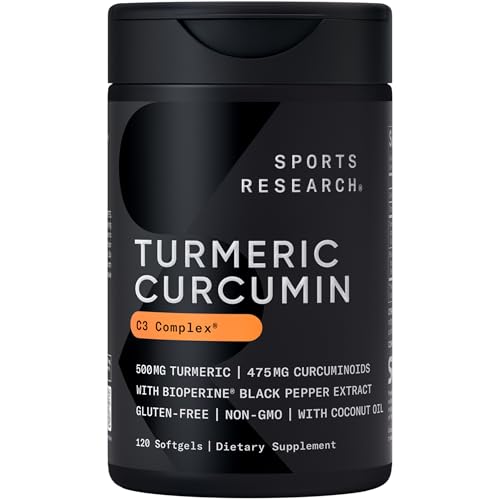
Best standardized extract: Sports Research Turmeric Curcumin
| Organic Integrity Score | 81 / 100 |
| Form | Standardized curcumin C3 Complex |
| Absorption aid | BioPerine black pepper + organic coconut oil |
| Best for | A high, well-absorbed curcumin dose |
Sports Research is our pick for a potent, well-absorbed dose. It uses the clinically studied Curcumin C3 Complex standardized extract, paired with BioPerine black pepper and an organic coconut oil base to boost absorption, in a non-GMO, third-party tested softgel.
It scores in the middle on our organic metric because the curcumin is a standardized extract rather than a whole certified-organic herb (though it includes organic coconut oil and is well tested), but for absorption and potency it is a standout.
What we liked: Clinically studied C3 Complex, BioPerine plus organic coconut oil for strong absorption, non-GMO, and third-party tested.
Keep in mind: The curcumin is a standardized extract rather than a whole USDA-organic herb, so it is a potency-first pick.
What the listing discloses: Sports Research leaves the basics open, including whether the USDA seal applies and where it was grown or made.
Trusted organic turmeric: Gaia Herbs Turmeric Supreme Extra Strength
| Organic Integrity Score | 80 / 100 |
| Certification | Gluten-free, Vegan, Organic |
| Absorption aid | Black pepper, plus supportive herbs |
| Best for | An all-around trusted organic turmeric |
Gaia Herbs earns its place here because it combines organic sourcing, a smart formula, and unusual transparency. The turmeric is certified organic, the formula adds black pepper to aid absorption, and Gaia’s “Meet Your Herbs” program lets you look up the testing for your specific bottle by lot number, a level of traceability few supplement brands offer.
The trade-off is that it is priced as a premium herbal product rather than a bulk curcumin extract. For a trustworthy, well-formulated organic turmeric you can verify, it is a dependable option.
What we liked: Certified organic, black pepper for absorption, and lot-level testing transparency through the Meet Your Herbs program.
Keep in mind: It is premium-priced, and as a whole-herb formula the curcumin dose is lower than a concentrated 95% extract.
What the listing discloses: Gaia Herbs is thin on detail, and does not say whether the USDA seal applies and where it was grown or made.
Best whole herb: Organic India Turmeric
| Organic Integrity Score | 77 / 100 |
| Certification | — |
| Form | Whole-herb turmeric, often with supportive herbs |
| Best for | A pure, traceable whole-herb option |
Organic India is our pick for a clean whole-herb product. Its turmeric is USDA Organic and non-GMO, grown through the company’s regenerative farming partnerships in India, with a focus on the whole herb rather than an isolated extract, and often blended with supportive herbs.
It scores just below our top pick mainly on published lot-level testing detail, but on organic sourcing and a transparent farm-to-bottle story, it is one of the most trustworthy whole-herb options.
What we liked: USDA Organic, non-GMO, whole-herb approach, and a strong regenerative-farming and sourcing story.
Keep in mind: As a whole-herb product the curcumin concentration is lower than a standardized extract, and you may want to add black pepper.
What the listing discloses: On the ORGANIC INDIA label: an origin of India. Not stated: whether the USDA seal applies.
How to take turmeric well
Curcumin absorbs best with black pepper and a source of fat, which is why traditional golden milk pairs turmeric with pepper and whole milk or coconut milk. Take supplements with a meal that contains some fat. Follow the dose on the label rather than assuming more is better. Importantly, turmeric can have a blood-thinning effect and may interact with anticoagulants, diabetes medication, and others, and high doses are not recommended in pregnancy, so talk to your doctor or pharmacist before starting, especially if you take medication or have gallbladder issues.
Liver injury: the risk the bioavailability boosters created
Our section above covers why curcumin is poorly absorbed and how piperine addresses it. There is a consequence to that solution which has become clearer in recent years and which belongs on any honest turmeric page.
Keep in mind: piperine inhibits hepatic and intestinal glucuronidation — the process by which the liver packages curcumin for excretion — and can raise curcumin bioavailability by up to 2,000%, roughly a twenty-fold increase. That is the whole point of adding it. It is also the mechanism by which turmeric supplements can become hepatotoxic, because far more curcumin reaches the liver and stays there longer. The US Drug-Induced Liver Injury Network reported ten cases of turmeric-associated liver injury, all enrolled since 2011 and six of them since 2017, and piperine was implicated in several. Further individual case reports of turmeric-plus-piperine liver injury have been published since.
Proportion matters here. Turmeric has been eaten as a spice for millennia with no such signal, and ten cases in a national registry is not an epidemic. What has changed is the product: high-dose, high-bioavailability extracts are a modern invention, and they are pharmacologically different from turmeric in a curry. The rising case count since 2017 tracks the rise of those formulations.
Practical implications:
- Culinary turmeric is not the concern. Cooking with it is fine.
- Be cautious with enhanced-absorption supplements — anything advertising piperine, BioPerine, phytosome, liposomal or “20x absorption” — particularly at high doses over long periods.
- Do not take them if you have liver disease, or alongside other hepatotoxic medication, without medical advice.
- Stop and seek medical attention for jaundice, dark urine, pale stools, unexplained fatigue, nausea or right upper abdominal pain. Turmeric-associated injury is usually reversible on stopping, and it is not always mild.
- More absorption is not automatically better. This is the rare case where the marketing claim and the risk are the same property.
Lead chromate: a real problem, and a genuinely improving one
Turmeric has been subject to deliberate adulteration with lead chromate, a bright yellow industrial pigment used to make dull roots look vividly golden. It is not a trace contaminant; it is added.
An extensive survey in Bangladesh — a major source of turmeric reaching the US — found lead concentrations as high as 1,150 mg/kg. Lead is a potent neurotoxin with no safe exposure level, and this route has been linked to elevated blood lead in affected populations.
The encouraging part deserves equal billing, because public health work actually succeeded here. Following interventions in Bangladesh, the incidence of adulterated spice at markets fell from 47% in September 2019, to 5% in the first quarter of 2020, to no detectable lead in 2021. That is a real and rapid improvement.
What still helps as a buyer:
- Buy from brands that publish heavy metal testing. Organic certification does not cover lead — it governs what was applied to the crop, not adulteration after harvest or metals in soil.
- Be wary of unusually vivid, uniform color in loose or market-bought powder, and of very cheap product with no stated origin.
- Whole roots you grind yourself are harder to adulterate than powder.
- Third-party marks such as NSF or USP carry contaminant screening and mean more here than an organic seal.
Root, powder and extract are three different doses
| Form | Curcuminoid content | What it is for |
| Fresh or dried root, culinary powder | 2–8% curcuminoids | Cooking. A teaspoon supplies a small fraction of any studied dose. |
| Standardized extract | Concentrated to 95% curcuminoids | Supplementation at research-relevant doses |
| “Whole herb” capsules | Same as the root, 2–8% | Gentler; a capsule of powder, not a concentrated dose |
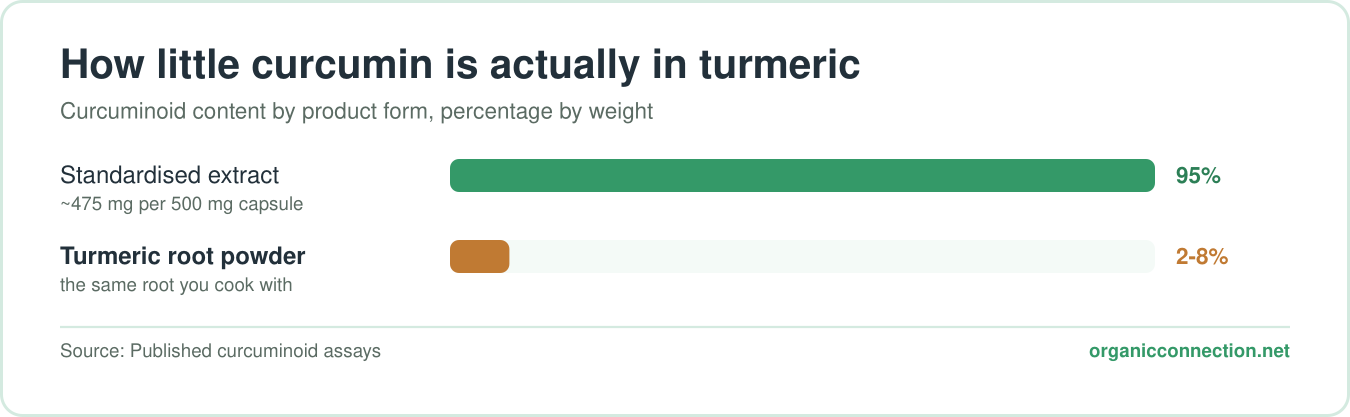
This is the number most turmeric marketing obscures. “Curcumin” and “turmeric” are used interchangeably on labels, and they are not the same: curcumin is the dominant curcuminoid, supplying around 75% of total curcuminoids, with demethoxycurcumin at 10–20% and bisdemethoxycurcumin under 5%. A 500 mg capsule of turmeric root powder contains perhaps 10–40 mg of curcuminoids. A 500 mg capsule of 95% standardized extract contains around 475 mg. Those are different products at a factor of more than ten, sold on adjacent shelves.
If a label says only “turmeric 500 mg” with no standardization figure, assume the low end.
Who should be careful
- Liver disease, or medication metabolized by the liver — as above, and the most important entry on this list.
- Anticoagulants and antiplatelets. Curcumin may affect platelet aggregation, so warfarin, clopidogrel and similar warrant a conversation. Culinary amounts are not the concern.
- Before surgery — most surgical teams ask you to stop concentrated botanical supplements one to two weeks ahead.
- Gallstones or bile duct obstruction. Turmeric stimulates bile flow, which can worsen symptoms where flow is blocked.
- Iron deficiency. Curcumin can chelate iron and reduce absorption, which matters for anyone already low.
- Kidney stones — turmeric is moderately high in oxalate at supplemental doses.
- Pregnancy — culinary use is fine; concentrated supplements lack safety data.
- Reflux and stomach irritation are the most common minor side effects, usually resolved by taking it with food.
Getting the most from culinary turmeric
- Cook it in fat. Curcuminoids are fat-soluble, so turmeric bloomed in oil or ghee at the start of a dish delivers far more than the same amount stirred into water. This is why traditional preparations do exactly that.
- Black pepper alongside is the traditional pairing and the reason it works — but note the dose difference: a pinch of pepper in a curry is not the concentrated piperine of a supplement, and carries none of the same concern.
- Add it early for depth, and expect raw turmeric stirred in at the end to taste dusty and bitter.
- Fresh root is brighter and more citrusy than dried, and grates like ginger. Freeze it whole and grate from frozen.
- It stains everything — worktops, plastic, nails, grouting. Oil lifts fresh stains better than water; sunlight fades set ones on plastic.
- Storage: airtight, dark, cool. Ground turmeric holds color longer than flavor — replace it annually, and judge by smell rather than by how yellow it still looks.
How we researched this guide
We are a research-based review site. We did not lab-test these supplements ourselves, and we do not make medical claims. We compared each against its certification, testing transparency, formulation and absorption support, and the weight of aggregated customer feedback, then scored each with our 10-criteria Organic Integrity Score. No brand paid to be included or ranked. Read the full method on our How We Research and Rate page.
Curcumin, inflammation and the absorption problem
Turmeric appears in weight-loss formulations regularly, and the honest answer involves two separate difficulties: the evidence is limited, and the compound barely gets into you.
The active constituent is curcumin, which has genuine anti-inflammatory activity in laboratory work and a large research literature behind it. Some meta-analyses of curcumin supplementation report small reductions in BMI and waist circumference, generally in populations with metabolic syndrome or obesity, with the proposed mechanism running through inflammation and insulin sensitivity rather than energy expenditure. The effects are small and the trials vary widely in dose and formulation.
The absorption issue is the more important practical point. Curcumin is poorly soluble in water, rapidly metabolised, and quickly cleared, so oral bioavailability is famously low. Most research uses formulations designed to overcome this: piperine from black pepper, phospholipid complexes, or nanoparticle preparations. Culinary turmeric in food, or a plain powder capsule, delivers a fraction of what those trials administered.
Turmeric powder is also only around 2 to 5% curcuminoids by weight, so the gap between a teaspoon of spice and a standardised extract used in a trial is very large indeed.
None of this argues against cooking with turmeric, which is a good ingredient with a long culinary history and a plausible if modest contribution to a diet.
Honest summary: small effects in specific populations using formulations built for absorption, and very little reason to expect the same from a spice jar. If the research is why you are buying, the extract question above matters more than the organic certification does.
Common questions about organic turmeric
What is the best organic turmeric supplement?
Our overall pick is Gaia Herbs Turmeric Supreme Extra Strength, because it is certified organic, includes black pepper to aid absorption, and offers lot-level testing transparency. For a whole-herb USDA-organic option, Organic India is our pick. Always check with your doctor first.
Why does turmeric need black pepper?
Curcumin, turmeric’s active compound, is poorly absorbed on its own. Research found that piperine from black pepper can increase its bioavailability by up to 2,000%, so the best supplements include black pepper extract or a fat-based delivery.
Is turmeric safe to take every day?
Many people take turmeric daily at label doses, but it can thin the blood and interact with medications like anticoagulants and diabetes drugs, and it is not advised in high doses during pregnancy. Talk to your doctor or pharmacist before daily use, especially if you take medication.
What is the difference between turmeric and curcumin?
Turmeric is the whole root; curcumin (and other curcuminoids) is the active compound within it. Whole-herb supplements use the full root, while standardized extracts concentrate curcumin, often to 95% curcuminoids.
Does organic turmeric matter?
Yes, because turmeric is a root that can concentrate soil contaminants, and some conventional supplies have been flagged for adulteration or heavy metals. USDA-organic certification plus third-party testing helps ensure purity.
Can turmeric supplements damage your liver?
High-bioavailability ones carry a documented risk. The US Drug-Induced Liver Injury Network reported ten cases of turmeric-associated liver injury, all since 2011 and six since 2017, with piperine implicated in several. The mechanism is the same property that is marketed as a benefit: piperine inhibits liver and intestinal glucuronidation and can raise curcumin bioavailability by up to 2,000%, so far more reaches the liver and stays longer. Culinary turmeric is not the concern — high-dose enhanced-absorption extracts are.
Should you avoid turmeric supplements with black pepper?
Be cautious with them, especially at high doses over long periods, and avoid them entirely if you have liver disease or take hepatotoxic medication without medical advice. Watch for jaundice, dark urine, pale stools, unexplained fatigue or right upper abdominal pain, and stop and seek attention if they appear. A pinch of pepper in a curry is a completely different dose and carries none of this concern.
Is there lead in turmeric?
There has been, through deliberate adulteration with lead chromate — a bright yellow industrial pigment added to make dull roots look golden. A Bangladesh survey found lead as high as 1,150 mg/kg. The encouraging part is that public health intervention worked: adulteration incidence at markets fell from 47% in September 2019 to 5% in early 2020 to no detectable lead in 2021. Organic certification does not cover this, since it governs farming rather than post-harvest adulteration.
How much curcumin is actually in turmeric?
Only 2 to 8% of the root by weight. Standardized extracts concentrate that to 95%. So a 500 mg capsule of turmeric root powder contains perhaps 10 to 40 mg of curcuminoids, while a 500 mg capsule of standardized extract contains around 475 mg — a difference of more than ten times, sold on adjacent shelves. If a label says only “turmeric 500 mg” with no standardization figure, assume the low end.
Is turmeric the same as curcumin?
No, though labels use them interchangeably. Turmeric is the root; curcumin is its dominant active compound, supplying around 75% of total curcuminoids, with demethoxycurcumin at 10 to 20% and bisdemethoxycurcumin under 5%. Buying “turmeric” gets you the whole root at 2 to 8% curcuminoids; buying “curcumin” or a standardized extract gets you the concentrate.
Who should not take turmeric supplements?
Anyone with liver disease or on medication metabolized by the liver, without medical advice. Also people on anticoagulants or antiplatelets, since curcumin may affect platelet aggregation; anyone with gallstones or bile duct obstruction, since turmeric stimulates bile flow; people with iron deficiency, since curcumin chelates iron; and anyone within one to two weeks of surgery. Culinary amounts are fine in all these cases.
How do you cook with turmeric to get the most from it?
Bloom it in fat at the start of a dish. Curcuminoids are fat-soluble, so turmeric cooked in oil or ghee delivers far more than the same amount stirred into water — which is exactly what traditional preparations do. Black pepper alongside is the traditional pairing and the reason it works. Added raw at the end, turmeric tastes dusty and bitter.
How long does ground turmeric keep?
About a year for flavor, though it holds color far longer — which is why people keep it too long. Judge by smell rather than by how yellow it still looks. Store airtight, dark and cool. Fresh root is brighter and more citrusy, grates like ginger, and freezes well whole for grating from frozen.
- Organic Supplements and Wellness hub
- Best Organic Spirulina
- Best Organic Sea Moss
- our organic supplement database — compare third-party testing across brands
- Heavy metals in organic food, explained
- Lead in cinnamon and ground spices
Price and availability as of October 16, 2026 7:10 pm EDT. Product prices and availability are accurate as of the date/time indicated and are subject to change. Any price and availability information displayed on Amazon.com at the time of purchase will apply to the purchase of this product.
Looking for other organic products?
We have checked more than 800 products across food, household goods, gardening, personal care and pet, every one against its stated certification. Browse all reviews.
Organic Connection is reader-supported. When you buy through links on this page we may earn a commission, at no extra cost to you. As an Amazon Associate we earn from qualifying purchases. We are not paid to feature or rank any product. How we research and rate.