Last updated: September 30, 2026
We may earn a commission when you buy through links on this page, at no extra cost to you. How we research and rate.
The short version
After researching the certifications, weave, and quality of the most popular organic cotton blankets, our top pick is the Bedsure PureWoven GOTS Certified Organic Cotton Waffle Blanket. It is GOTS and Fairtrade certified, made from breathable organic cotton in a soft single-knit weave, and it gets softer with every wash, which is why it earned our highest Organic Integrity Score of 93 out of 100. For a cozy knit throw, Makemake Organics is our pick, and for a lightweight waffle weave, Salt Earth is the best choice.
The single most important thing to check with an “organic” cotton blanket is the GOTS certification, the Global Organic Textile Standard, which verifies the cotton is genuinely organic and processed without harmful chemicals or dyes. We flag which blankets are GOTS certified and their weave.
Best organic cotton blanket compared
| Best Choice | Best Value | ||||
 |  |  |  |  | |
| Product | Bedsure PureWoven | Salt Earth | Whisper Knit Coverlet | Organic Cotton Mart | Makemake Organics |
| Organic Integrity Score | 93/ 100 | 92/ 100 | 88/ 100 | 86/ 100 | 85/ 100 |
| Our rating | 4.7 | 4.6 | 4.4 | 4.3 | 4.3 |
| Best for | Best overall | Waffle weave | Bed coverlet | Lightweight | Cozy knit throw |
| Weave | Single-knit woven | Waffle | Single-knit | Waffle | Knit throw |
| Certification | GOTS, OEKO-TEX, Certified Organic | GOTS, Organic | GOTS, Fair Trade, Certified Organic | Certified Organic | GOTS, Certified Organic |
| Price | $74.99 $81.99 −9% View on Amazon | $36.99 View on Amazon | $129.99 View on Amazon | $69.99 $74.99 −7% View on Amazon | $98.00 View on Amazon |
Price and availability as of October 11, 2026 7:10 pm EDT. Product prices and availability are accurate as of the date/time indicated and are subject to change. Any price and availability information displayed on Amazon.com at the time of purchase will apply to the purchase of this product.
Scores are ours, based on independent research of certification, weave, breathability, and durability, using the same 10-criteria method we apply to every product. See how we research and rate.
The organic cotton blanket certifications, and the question each one leaves open
Seals accumulate on a package faster than meaning does. This is what each of the marks you will see here certifies, and what it leaves out.
| Certification | Covers | Key exclusion |
| GOTS | Organic fiber from farm to finished textile, plus dyeing, finishing, wastewater and labor criteria | Has a weaker second tier, “made with organic”, that needs only 70% organic fiber and carries the same name |
| OEKO-TEX Standard 100 | Laboratory testing of the finished textile against limits for more than 1,000 harmful substances | Says nothing at all about whether the fiber was organically grown |
| Fair Trade Certified | A price floor for producers, a community premium, and labor standards on the farms and in the facilities | An economic and labor standard; it is not an organic or pesticide claim |
Standard 100 answers “what is in this fabric”, not “how was it grown”. That is a useful question and the testing behind it is rigorous, covering formaldehyde, heavy metals, azo dyes and a long list besides. But a product can pass it while having been grown with every pesticide the organic standards prohibit, because those residues do not survive to the finished textile. Treat it as a floor for chemical safety and look elsewhere for the farming claim.
GOTS versus OEKO-TEX: you want both, and they do different jobs
| GOTS | OEKO-TEX Standard 100 | |
| Covers the farming | Yes, organic fiber required | No |
| Covers processing chemicals | Yes, bans toxic azo dyes, formaldehyde, chlorine bleach, heavy metals | Tests the finished product for over 1,000 harmful substances |
| Covers labor conditions | Yes, social criteria audited | No |
| Tests the final item | Audits the chain | Yes, tests the item itself |
| What it does not cover | Softness, durability, weave quality, thread count accuracy | Whether the fiber was organically grown |
The short version: GOTS certifies how it was made, OEKO-TEX tests what is left in it. They are complementary rather than competing, and the strongest products carry both. A garment described as “organic cotton” with no named certifier is an unverified marketing claim, since there is no legal protection on that phrase for textiles the way there is for food.
One nuance worth knowing: GOTS comes in two grades. “Organic” requires at least 95% certified organic fiber. “Made with organic” requires at least 70%. Both are legitimate, and the first is the stronger claim, and elastane in stretch garments is why many perfectly good items sit in the second category.
Key things to look for in an organic cotton blanket
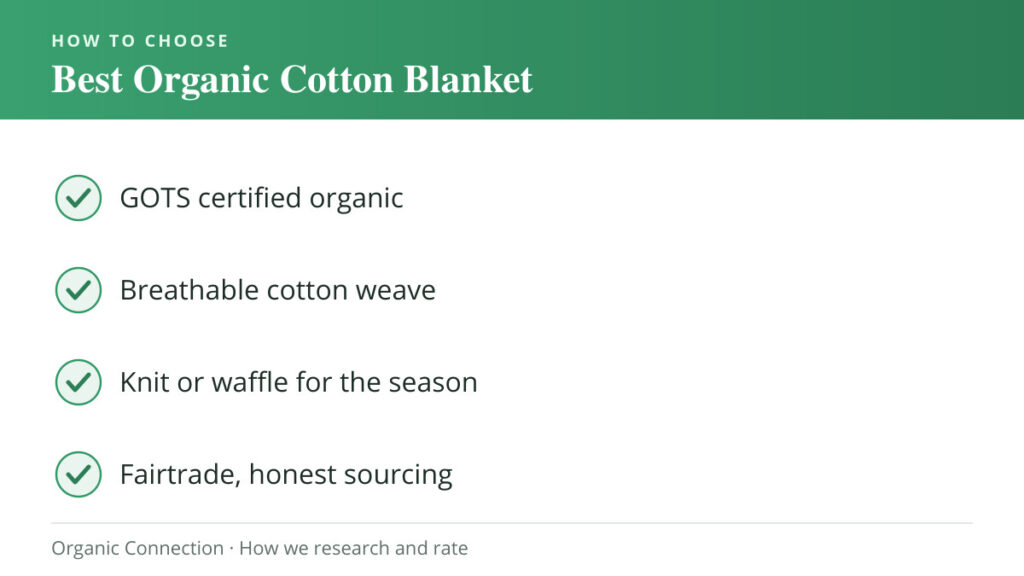
A genuine organic cotton blanket is about certification and weave as much as softness. Here is what matters.
1. GOTS certification
GOTS verifies the cotton is organically grown and processed without harmful chemicals or dyes, from field to finished blanket. It is the key proof of an organic textile.
2. The weave
Single-knit and woven blankets are soft, breathable all-rounders; waffle weave is light and airy for warmer months; heavier weaves add cozy warmth.
3. Breathability and year-round use
Cotton is naturally breathable, keeping you cool in summer and cozy in winter, which makes a good cotton blanket a true all-season layer.
4. Honest sourcing and fair labor
Fairtrade certification and transparent sourcing add ethical assurance on top of the organic fiber.
Why GOTS matters for an “organic” blanket
Unlike food, the word “organic” on a blanket is not automatically regulated, so plenty of blankets are marketed as “natural” or “cotton” without any verification. GOTS closes that gap: it certifies the cotton was organically grown and, just as importantly, that the spinning, weaving, dyeing, and finishing avoided the harsh chemicals and dyes used in conventional textile processing. For something you sleep under and press against your skin for hours, that end-to-end assurance is what separates a genuinely organic blanket from a greenwashed one.
Our scoring rewards GOTS (and where present, Fairtrade) certification, weave quality, breathability, and durability, so you get a blanket that is both verifiably organic and genuinely nice to live with, not just an organic-sounding label.
Why conventional cotton is the crop this matters most for
Cotton is unusual among crops in how chemically intensive it is, and the numbers are worth having.
In the field. Cotton occupies roughly 2.4% of the world’s cultivated land and accounts for around 6% of global pesticide use, a higher share relative to acreage than any other crop. In the United States alone, at least 98 different pesticides were applied to conventional cotton in 2021. It is also a crop where the fiber is grown, harvested, and processed into something you then wear against skin for hours a day.
After the field, which is the part most guides skip. The chemistry does not stop at harvest. Conventional textile processing commonly involves azo dyes for color and a finishing stage that can include formaldehyde resins for wrinkle resistance, along with NPEs, phthalates, and other auxiliaries. Formaldehyde in finishing is associated with skin irritation, allergic reactions, and contact dermatitis. Certain azo dyes are water soluble and can release aromatic amines on contact with skin, some of which are classed as carcinogenic and are restricted in the EU for that reason.
This is why buying “100% cotton” is not the same as buying organic cotton. Organic addresses the growing; the processing is a separate question, and it is the one certification actually answers.
How to choose an organic cotton blanket
- Insist on GOTS certification. It verifies the organic fiber and clean processing to the finished product.
- Pick the weave for the season. Waffle for light and airy, single-knit or woven for all-season softness.
- Match the size. Throw for the couch, twin/full/queen/king for the bed.
- Consider color and dyes. Undyed natural shades avoid dye entirely; GOTS-certified dyes are low-impact.
- Expect it to soften. Quality organic cotton gets softer with each wash, so a slightly crisp feel at first is normal.
Who should buy organic cotton blanket
Weight and use decide it. Our top pick is the GOTS-certified blanket for year-round use. If you want a cozy knit throw, a light waffle weave, a lightweight summer layer, or a colored coverlet for the bed, we have a pick for each.
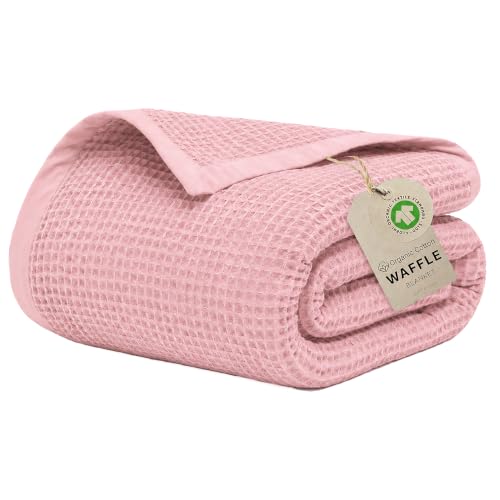
Best overall: Bedsure PureWoven GOTS Certified Organic Cotton Waffle Blanket
| Organic Integrity Score | 93 / 100 |
| Certification | GOTS, OEKO-TEX, Certified Organic |
| Weave | Soft single-knit woven, breathable |
| Best for | An all-around certified organic blanket |
Bedsure PureWoven is our top pick because it nails the certifications and the feel. It is both GOTS and Fairtrade certified, made from organic cotton sourced from farms in India in a soft, breathable single-knit weave, comes in multiple sizes and natural colors, and buyers report it gets softer with every wash.
The trade-off is that a genuinely certified organic blanket costs more than a generic cotton throw. For a verifiably organic, ethically made, all-season cotton blanket, it is our first choice.
What we liked: GOTS and Fairtrade certified, breathable single-knit weave, multiple sizes and natural colors, and it softens with washing.
Keep in mind: It is priced above uncertified cotton blankets, and the knit weave may feel slightly crisp until the first wash or two.
What the listing discloses: Bedsure commits to GOTS and OEKO-TEX but stops short of whether the USDA seal applies and where it was grown or made.
Best waffle weave: Salt Earth Organic Cotton Waffle Blanket
| Organic Integrity Score | 92 / 100 |
| Certification | GOTS, Organic |
| Weave | Waffle weave, breathable |
| Best for | A light, textured all-season blanket |
Salt Earth is our pick for a waffle weave. This GOTS-certified 100% organic cotton waffle blanket has an airy, textured weave that is light and breathable yet cozy, comes in modern colors, and works well as a summer-weight bed blanket or a stylish, comfy layer year-round.
It scores in the middle because the waffle weave is lighter than a dense knit, so it is more of a cooling layer than a heavy winter blanket, but for warm nights and modern style, it is a standout.
What we liked: GOTS certified, airy waffle texture, modern colors, and a light, breathable all-season feel.
Keep in mind: The waffle weave is lightweight, so in deep winter you may want to layer it with a heavier blanket.
What the listing discloses: Salt Earth is explicit about GOTS, and silent on whether the USDA seal applies and where it was grown or made.
Best bed coverlet: Whisper Organics Single-Knit Cotton Blanket
| Organic Integrity Score | 88 / 100 |
| Certification | GOTS, Fair Trade, Certified Organic |
| Weave | Soft single-knit, colored |
| Best for | A colored bedspread or coverlet |
This colored single-knit blanket from Whisper Organics is our pick for a bed coverlet. It brings the same GOTS and Fairtrade certification and soft, breathable single-knit weave as our top pick, in richer colors like burgundy and gray, ideal as a bedspread or coverlet that layers over sheets and softens with washing.
It scores at the value end here only because it overlaps with our top pick; on quality and certification it is identical. For a colored, certified organic coverlet for the bed, it is a great choice.
What we liked: GOTS and Fairtrade certified, soft single-knit weave, richer color options, and the same softening-with-washing quality.
Keep in mind: It overlaps closely with our top pick, so choose based on the color and size you want.
What the listing discloses: Whisper Organics documents GOTS and Fair Trade, and leaves whether the USDA seal applies and where it was grown or made unsaid.
Best lightweight: Organic Cotton Mart Waffle Blanket
| Organic Integrity Score | 86 / 100 |
| Certification | Certified Organic |
| Weave | Lightweight waffle weave |
| Best for | A breathable summer layer |
Organic Cotton Mart is our lightweight pick. This GOTS-certified, all-natural 100% cotton waffle blanket is soft, luxurious, and lightweight, made for warm-weather comfort, and it comes in soft neutral shades suitable for toddlers, teens, and adults alike.
It scores in the value range because it is a lighter, simpler waffle blanket rather than a premium bed piece, but for a breathable, certified organic summer layer at a friendly price, it does the job well.
What we liked: GOTS certified, soft and lightweight waffle weave, neutral shades, and a friendly price.
Keep in mind: It is a light summer-weight blanket, so it is not the pick for cold winter warmth on its own.
What the listing discloses: Organic Cotton Mart leaves the basics open, including whether the USDA seal applies and where it was grown or made.
Best knit throw: Makemake Organics Organic Cotton Throw
| Organic Integrity Score | 85 / 100 |
| Certification | GOTS, Certified Organic |
| Weave | Soft knit throw |
| Best for | A cozy couch or accent throw |
Makemake Organics is our pick for a throw. This GOTS-certified organic cotton knit throw comes in soft, neutral fall colors and a couch-friendly size, hypoallergenic and gentle enough that the brand also makes it for toddlers, ideal for layering on a sofa, reading chair, or the end of a bed.
It scores just below our top pick mainly because it is throw-sized rather than a full bed blanket, but as a cozy, certified organic accent throw, it is excellent.
What we liked: GOTS certified, soft knit texture, attractive neutral colors, and a hypoallergenic, family-friendly make.
Keep in mind: It is throw-sized, so for full bed coverage you will want a larger blanket.
What the listing discloses: MakeMake Organics documents GOTS, and leaves whether the USDA seal applies and where it was grown or made unsaid.
How to care for an organic cotton blanket
Most organic cotton blankets are easy to live with: machine wash on a gentle cycle in cold water and tumble dry on low, which protects the fibers and the finish. Skip fabric softeners and bleach, which can coat or degrade the cotton; the blanket will naturally get softer with each wash. Wash colored blankets with like colors the first few times. Because organic cotton is breathable, it works year-round, and a light waffle weave doubles as a cooling summer layer while a denser knit adds cozy warmth in winter.
Weave decides warmth more than fiber does
Every blanket in this guide is cotton, so the thing that actually separates a cool summer coverlet from a genuinely warm winter layer is how the yarn was constructed. This is the specification that competing roundups skip entirely, and it is the one that determines whether you like the blanket.
| Weave | How it behaves | Best for |
| Waffle | Cellular pockets trap a layer of air while the open structure still breathes | Year-round. The most versatile choice, and why it dominates the organic shelf. |
| Thermal / cellular | Open honeycomb; warmth comes from trapped air, adjustable by layering | Hospital-style versatility; hot sleepers who still want cover |
| Herringbone / twill | Denser, flatter, heavier drape | Winter, and beds where you want the blanket to stay put |
| Muslin / gauze (multi-layer) | Very light, gets softer with every wash | Summer, babies and toddlers, warm climates |
| Knit / jersey | Stretchy, drapes closely, cosy rather than crisp | Sofa throws. Stretches over time. |
| Chenille | Plush pile, warmest cotton option | Winter throws. Sheds initially and pills more. |
GSM is the second number to look for and is stated more often than you might expect. Roughly: under 200 gsm is a summer coverlet; 250–350 gsm covers most year-round use — a typical quality waffle blanket sits around 320 gsm; above 400 gsm is a genuine winter blanket with real heft. If a listing gives dimensions but no weight, it is usually at the lighter end.
Cotton against the alternatives
| Organic cotton | Wool | Fleece / synthetic | |
| Warmth for weight | Moderate | Highest | High |
| Breathability | Excellent | Excellent, regulates actively | Poor — traps moisture |
| Washing | Machine, easy | Delicate, often hand or dry clean | Machine, easy |
| Allergy | Rarely an issue | Lanolin and prickle affect some | Rarely an issue |
| Microplastic shedding | None | None | Sheds fibers every wash |
| Lifespan | 5–10 years | Decades if cared for | 2–5 years before matting |
Cotton’s case is washability plus breathability plus no shedding. Wool is warmer and lasts longer but is harder to launder and irritates some people. Fleece is cheap and warm and sheds plastic microfibers into the water system on every wash — for a blanket washed frequently, that is a meaningful ongoing difference rather than a one-off.
Flame retardants and blanket regulations
This gets raised often and is more nuanced than the forums suggest. In the US, federal flammability standards for bedding apply to mattresses and to children’s sleepwear, not to ordinary adult blankets and throws — so most blankets, organic or not, are not required to be treated, and the majority are not.
Where GOTS adds real assurance is by prohibiting the chemistry outright, along with the other finishes commonly applied to textiles:
- Flame retardant treatments — prohibited under GOTS.
- Formaldehyde-releasing wrinkle-resistant resins — prohibited.
- Restricted azo dyes that can release aromatic amines — excluded by both GOTS and OEKO-TEX.
- Optical brighteners — prohibited, which is why genuinely organic undyed cotton reads cream rather than blue-white.
- Chlorine bleaching — prohibited; GOTS permits oxygen-based bleaching instead.
Keep in mind: “organic cotton” on a label describes the fiber only. It is GOTS that covers the dyeing, finishing, wastewater treatment and social criteria of everything done to that fiber afterwards — which for a blanket, where the whole surface sits against your skin for hours, is the part that matters. OEKO-TEX Standard 100 tests the finished product for harmful substances but says nothing about how the cotton was farmed. Neither replaces the other.
Safe use with babies and children
Blankets are frequently bought as baby gifts, so this belongs in any honest guide.
Pediatric safe-sleep guidance is consistent: no loose blankets, pillows, bumpers or soft objects in a sleep space for infants under 12 months, because of the risk of suffocation and sudden unexpected infant death. An infant should sleep on a firm flat surface on their back, with nothing loose in the cot. A wearable sleep sack is the recommended alternative for warmth.
That does not make a cotton baby blanket useless — it is genuinely good for pram covering while supervised, tummy time, floor play, swaddling in the newborn weeks if done correctly, and as a nursing cover. It simply should not be left in the cot with a sleeping baby under one. Lightweight organic muslin is the best fabric for those uses: breathable, quick to wash, and softer with every cycle.
Care, shrinkage and pilling
- Expect 3–5% shrinkage on the first wash unless the blanket is pre-shrunk, mostly in length. Buy one size up if your bed is between sizes.
- Wash cool, 30°C. Hot water shrinks cotton and accelerates fiber wear without cleaning better.
- No fabric softener. It coats fibers, reduces absorbency and breathability, and flattens the texture of waffle and thermal weaves — which is precisely what you paid for.
- Wash alone or with like colors for the first two or three washes. Cotton blankets shed loose fiber initially, and undyed organic cotton can release a little natural color.
- Tumble low and remove slightly damp, then air finish. High heat is the main cause of a blanket going stiff and losing loft.
- Pilling comes from short-staple fiber and friction. A knit or chenille blanket will pill more than a woven waffle one; a fabric shaver deals with it and does no harm.
- Shake it out periodically rather than washing constantly. Over-washing is the most common way people wear out a good cotton blanket.
- Store folded and breathable — a cotton bag or shelf, never sealed plastic, which traps moisture and can cause mildew and yellowing.
How we researched this guide
We are a research-based review site. We compared each blanket against its certification (GOTS, Fairtrade), weave and breathability, size options, and the weight of aggregated customer feedback on softness and durability, then scored each with our 10-criteria Organic Integrity Score. No brand paid to be included or ranked. Read the full method on our How We Research and Rate page.
Common questions about organic cotton blanket
What is the best organic cotton blanket?
Our overall pick is the Bedsure PureWoven GOTS Certified Organic Cotton Waffle Blanket, because it is GOTS and Fairtrade certified, breathable, and softens with washing. For a cozy knit throw, Makemake Organics is our pick, and for a waffle weave, Salt Earth.
What does GOTS certified mean?
GOTS, the Global Organic Textile Standard, certifies that a textile’s cotton is organically grown and that the entire manufacturing process, spinning, weaving, dyeing, and finishing, avoids harmful chemicals. It is the strongest assurance that a blanket is genuinely organic.
Is an organic cotton blanket worth it?
If you want to avoid the pesticides used on conventional cotton and the harsh chemicals in conventional textile processing, especially for something you sleep under, yes. A GOTS-certified blanket verifies both, and quality organic cotton is breathable and gets softer over time.
Are organic cotton blankets good for sensitive skin?
Generally yes. Because GOTS limits harsh dyes and finishing chemicals, organic cotton blankets are often a good choice for sensitive skin and allergies, and undyed natural versions avoid dyes entirely.
How do I wash an organic cotton blanket?
Machine wash on a gentle cycle in cold water and tumble dry on low, avoiding bleach and fabric softener. Organic cotton naturally softens with each wash, so a slightly crisp new blanket will become cozier over time.
Which cotton blanket weave is warmest?
Chenille, then herringbone or twill, then waffle and thermal, then muslin gauze at the lightest end. Waffle is the most versatile because its cellular pockets trap a layer of air while the open structure still breathes, which is why it dominates the organic shelf. Weave matters more than fiber for warmth, since all these blankets are the same material.
What GSM should a cotton blanket be?
Under 200 gsm is a summer coverlet, 250 to 350 gsm suits year-round use — a typical quality waffle blanket sits around 320 gsm — and above 400 gsm is a genuine winter weight with real heft. If a listing gives dimensions but no weight, it is usually at the lighter end.
Do cotton blankets contain flame retardants?
Usually not. US federal flammability standards apply to mattresses and children’s sleepwear, not ordinary adult blankets and throws, so most are untreated whether organic or not. What GOTS adds is prohibiting the chemistry outright, along with formaldehyde-releasing resins, restricted azo dyes, optical brighteners and chlorine bleaching.
Is “organic cotton” the same as GOTS certified?
No. “Organic cotton” describes the fiber only. GOTS covers the dyeing, finishing, wastewater treatment and social criteria applied to that fiber afterwards — which for a blanket, where the whole surface sits against skin for hours, is the part that matters. OEKO-TEX Standard 100 tests the finished product for harmful substances but says nothing about farming. Neither certification replaces the other.
Can babies sleep with a cotton blanket?
Not under 12 months. Pediatric safe-sleep guidance is consistent that no loose blankets, pillows, bumpers or soft objects belong in an infant’s sleep space, because of suffocation and sudden unexpected infant death risk — a firm flat surface, on the back, nothing loose. A wearable sleep sack is the recommended way to keep a baby warm. A cotton blanket is still genuinely useful for supervised pram covering, tummy time, floor play and nursing, and lightweight organic muslin is the best fabric for all of those.
Cotton, wool or fleece blanket?
Cotton for washability, breathability and no shedding. Wool is warmer for its weight and lasts decades but needs delicate laundering and irritates some people. Fleece is cheap and warm but traps moisture and sheds plastic microfibers into the water system with every wash — for a blanket washed often, that is an ongoing difference rather than a one-off.
Do organic cotton blankets shrink?
By about 3 to 5% on the first wash unless pre-shrunk, mostly in length. Buy a size up if your bed sits between sizes. Wash at 30°C, since hot water shrinks cotton and accelerates wear without cleaning better, and skip fabric softener entirely — it coats fibers and flattens the texture of waffle and thermal weaves, which is exactly what you paid for.
Why is my cotton blanket pilling?
Short-staple fiber plus friction. Knit and chenille blankets pill considerably more than woven waffle ones. A fabric shaver removes it without damaging the blanket. Reducing wash frequency helps too — over-washing is the most common way people wear out a good cotton blanket, and shaking it out between washes is usually enough.
- Organic Household hub
- Best Organic Cotton Sheets
- Best Organic Cotton Pajamas
- How we research and rate products
- our searchable product database — compare all 800+ picks side by side
- Best Organic Cotton Fabric
Price and availability as of October 11, 2026 7:10 pm EDT. Product prices and availability are accurate as of the date/time indicated and are subject to change. Any price and availability information displayed on Amazon.com at the time of purchase will apply to the purchase of this product.
Looking for other organic products?
We have checked more than 800 products across food, household goods, gardening, personal care and pet, every one against its stated certification. Browse all reviews.
Organic Connection is reader-supported. When you buy through links on this page we may earn a commission, at no extra cost to you. As an Amazon Associate we earn from qualifying purchases. We are not paid to feature or rank any product. How we research and rate.