Last updated: September 30, 2026
Some links in this guide point to our product reviews, which may earn us a commission at no extra cost to you. How we research and rate.
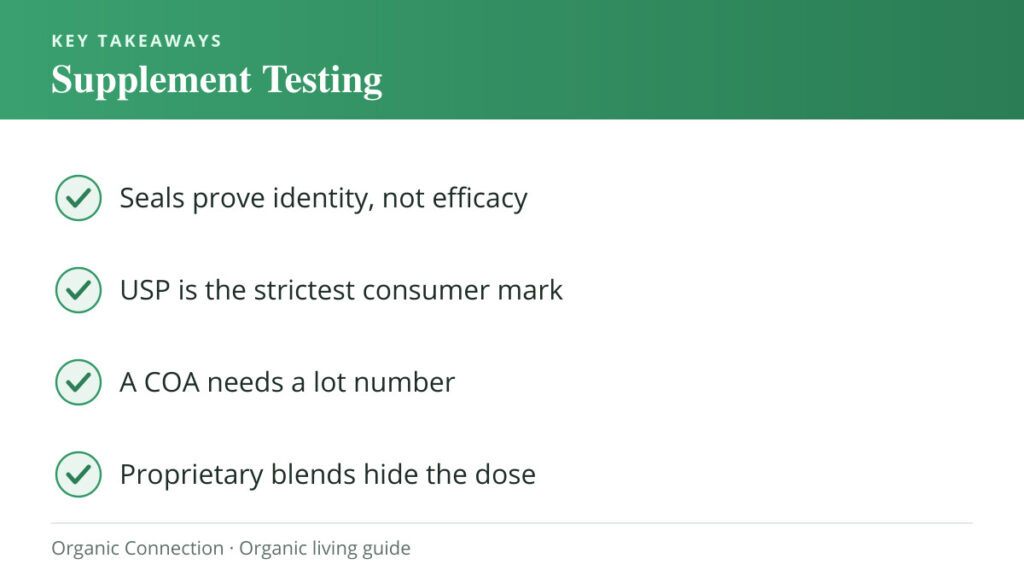
Supplements in the United States are regulated as food, not as drugs, which means nobody checks that what is in the bottle matches what is on the label before it goes on sale. Third-party testing exists to fill that gap, and the seals are genuinely useful once you know what each one certifies and, just as importantly, what none of them certify. This guide explains USP, NSF, Informed Choice, ConsumerLab, and the certificate of analysis, and gives you a practical way to judge a supplement you are about to buy.
Why this matters more for supplements than for food
Under the Dietary Supplement Health and Education Act of 1994, supplements sit in a category of their own. Manufacturers do not need to prove safety or efficacy before selling, and the FDA acts mainly after problems emerge rather than before. Good Manufacturing Practice regulations do apply, and FDA inspections have repeatedly found significant violation rates.
The consequences show up regularly in independent testing. Investigations have found herbal supplements containing little or none of the labeled botanical, products bulked with undeclared rice or wheat starch, protein powders and greens blends with heavy metal levels above state thresholds, and sports supplements containing undeclared stimulants and, in some cases, prohibited substances. In our own category work this comes up constantly: a UC Davis analysis of leading moringa brands found several products sold as organic failing to meet USDA organic standards on pesticide residues, and in the mushroom supplement category a large share of products are grown on grain and milled together with it, so the powder is substantially starch.
None of this means supplements are a scam. It means the variance between products is enormous and invisible from the outside, which is precisely the problem third-party testing addresses.
What the law already requires, before any seal is involved
The gap third-party testing fills is narrower than most articles suggest, because manufacturers are not operating in a vacuum. They are bound by a federal rule, enforced by the FDA after a product reaches the market rather than before it. The FDA is explicit that it does not approve supplements in advance: firms “are responsible for evaluating the safety and labeling of their products before marketing,” and the agency’s power is to act against a product that is already adulterated or misbranded on sale.
The rule itself is 21 CFR Part 111, the current good manufacturing practice regulation for dietary supplements. Three of its requirements are worth knowing by number, because they are exactly what a seal is verifying compliance with.
| Requirement | What it obliges the manufacturer to do | Why it matters to you |
| 21 CFR 111.70 Specifications | Set written specifications for the identity, purity, strength and composition of each component and of the finished batch, and set “limits on those types of contamination that may adulterate, or that may lead to adulteration of, the finished batch.” | A contamination limit is not optional. A company that cannot tell you its lead limit has not met a requirement it is already under. |
| 21 CFR 111.75 Testing | Run “at least one appropriate test or examination to verify the identity of any component that is a dietary ingredient.” A supplier’s certificate of analysis may stand in for that test only after the manufacturer has qualified the supplier by confirming its results, documented that qualification, and periodically re-confirms it. | This is why “we rely on our supplier’s COA” is only an answer if the company also tested that supplier’s work itself, at least once. |
| 21 CFR 111.320 Methods | “Identify and use an appropriate scientifically valid method for each established specification for which testing or examination is required,” and verify the method suits its purpose. | A number is only as good as the method behind it, which is why a COA that names no method tells you very little. |
So the honest framing is not that supplements are unregulated. It is that compliance is self-declared and checked afterwards, by an agency that inspects a fraction of firms each year. Third-party testing is a company volunteering to be checked in advance, by someone with no stake in the result.
The certifications, and what each actually covers
USP Verified
Run by the United States Pharmacopeia, a non-profit that also sets the official quality standards used in US pharmaceutical manufacturing. The USP Verified mark is the most rigorous consumer-facing supplement certification available. It confirms the product contains the declared ingredients at declared potency, does not contain harmful levels of specified contaminants including heavy metals and microbes, will break down and release into the body within a specified time, and is made according to good manufacturing practices, with audits of the manufacturing facility.
Its limitation is coverage. Participation is voluntary and expensive, so relatively few products carry it, and the absence of a USP mark tells you almost nothing about a product’s quality. It is a strong positive signal and a weak negative one.
NSF Certified for Sport
NSF International certifies against contamination and label accuracy, and its “Certified for Sport” program additionally screens for more than 280 substances banned by major athletic organizations. This is the standard that matters if you are a competing athlete subject to drug testing, because supplement contamination is a well-documented route to a failed test and the consequences fall on the athlete regardless of intent.
NSF also runs a broader dietary supplement certification that verifies contents and screens contaminants without the banned-substance element. Both involve facility audits and ongoing retesting rather than a one-off check.
Informed Choice and Informed Sport
Operated by LGC, these programs focus specifically on banned-substance screening for athletes, with batch-level testing. Informed Sport tests every batch, which is a stronger claim than periodic testing. Like NSF Certified for Sport, this is about competition safety rather than general quality.
ConsumerLab
A subscription service that independently buys products off the shelf and tests them, then publishes results. This is different in kind from the certifications above: brands do not opt in and pay, so the testing is genuinely independent and includes products that would rather not be tested. The trade-off is that results sit behind a paywall and are a snapshot rather than ongoing certification.
Non-GMO Project Verified and USDA Organic
Worth mentioning because they are frequently confused with quality testing. USDA Organic verifies farming practices and prohibited substances in production. Non-GMO Project Verified involves testing for genetically modified material. Neither confirms that the supplement contains the labeled dose of the active ingredient, and neither is a heavy metal or potency test. They answer a different and also useful question.
The certificate of analysis, and how to read one
A certificate of analysis, or COA, is a laboratory report for a specific batch. Good supplement companies publish them, often searchable by the lot number printed on your bottle. This is the single most useful transparency signal in the industry, and it is worth learning to read.
What a useful COA contains: the product name and a specific lot or batch number, the testing date, the name of the laboratory, the methods used, and results for identity, potency of the active compound, heavy metals (typically lead, arsenic, cadmium, mercury), microbial contamination, and residual solvents or pesticides where relevant.
The warning signs: a COA with no lot number, which means it cannot be matched to the product in your hand; one produced by an in-house laboratory rather than an independent one; a document that shows only a subset of tests; one that is years old; or a “COA” that is really a specification sheet stating what the product is supposed to contain rather than test results showing what it does.
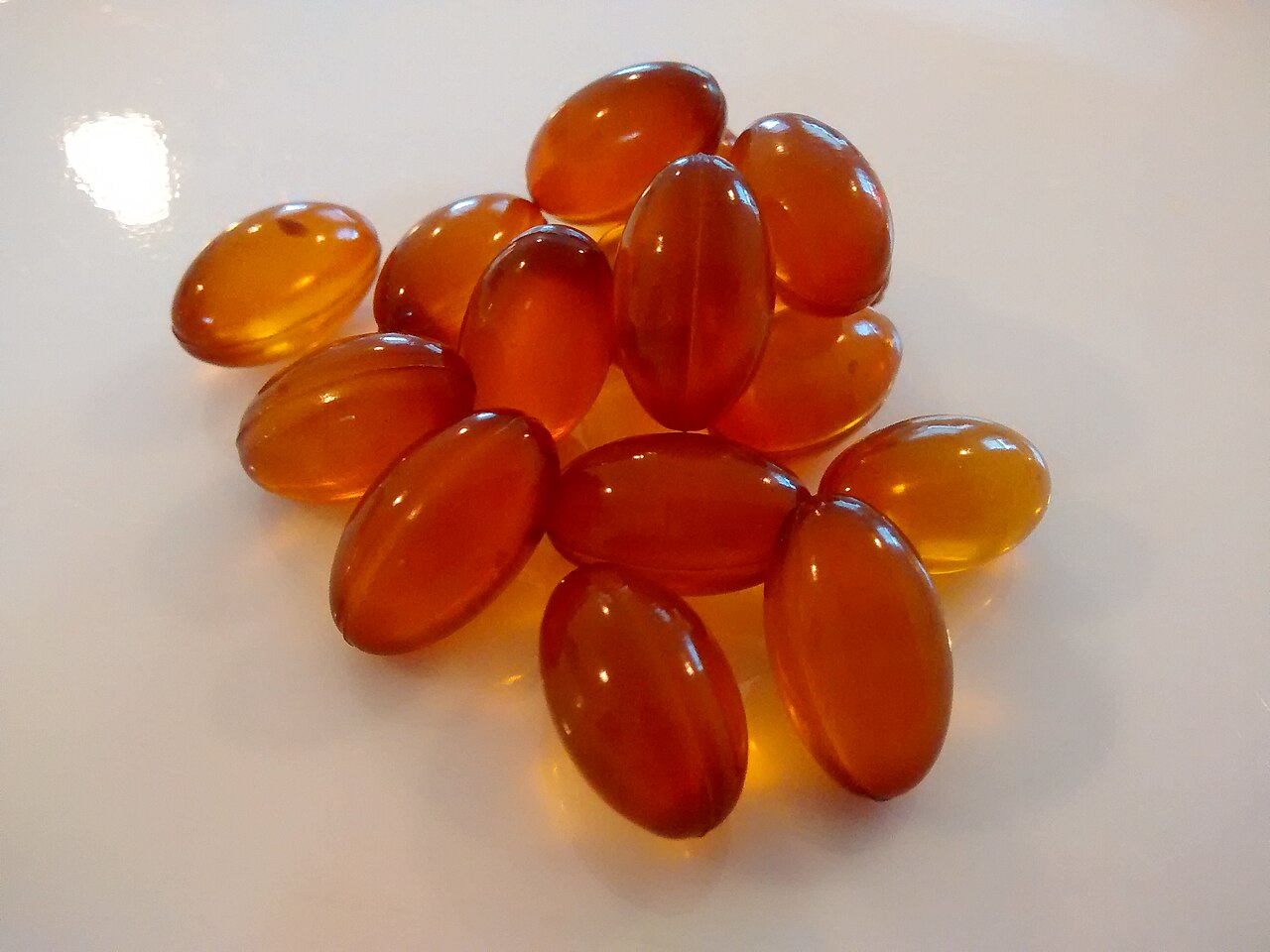
The specific number to look for depends on the category. For mushroom supplements it is beta-glucan content, because that distinguishes real mushroom extract from grain-grown mycelium, and a polysaccharide figure can include starch. For herbal extracts it is the marker compound and the extract ratio. For greens powders it is heavy metals, since plants concentrate them from soil. For fish and algal oils it is the oxidation value, which tells you whether the oil is already rancid.
The regulation itself defines the minimum. Where a manufacturer relies on a supplier’s certificate of analysis, 21 CFR 111.75 requires that the certificate include “a description of the test or examination method(s) used, limits of the test or examinations, and actual results of the tests or examinations.” That is a usefully concrete three-part test you can apply to any document a brand sends you: method, limit, result. A PDF missing any of the three is not doing the job the law expects of it, whatever it is titled.
Then ask who ran the test. The document that answers this is the laboratory’s accreditation to ISO/IEC 17025, the international standard for the competence of testing laboratories. Accreditation is described by ILAC, the body that coordinates it worldwide, as “the independent evaluation of conformity assessment bodies against recognized standards to carry out specific activities to ensure their impartiality and competence” — in plain terms, somebody audited the lab itself. ILAC maintains a signatory search and a database of accredited bodies, so a lab named on a COA can be checked in a couple of minutes. A lab that cannot be found in one is a fair reason to discount the certificate.
Proprietary blends: the labeling trick that defeats all of this
A proprietary blend lets a manufacturer list a group of ingredients under a single total weight without disclosing how much of each is present. The ingredients must be listed in descending order by weight, which is the only useful information you get.
The practical consequence is that a “2,400 mg Focus Blend” can be 2,350 mg of a cheap filler and 50 mg spread across the six impressive-sounding botanicals underneath, and that is entirely legal. This is called fairy dusting: including a token amount of an ingredient so it can appear on the label. It is common in greens powders, nootropic blends, and pre-workouts.
Since you cannot see the doses, you cannot compare a proprietary blend against the doses used in research, which makes evaluating it impossible in principle. Our position is straightforward: prefer products that disclose every dose. When a company withholds them, the most likely reason is that the numbers are not flattering, since a brand using research-backed doses has every commercial reason to say so loudly.
A practical checklist before you buy
- Does the label disclose every ingredient dose? If it hides behind a proprietary blend, that is usually reason enough to move on.
- Is there a third-party seal? USP Verified or NSF is a strong positive. Its absence is weak evidence either way.
- Can you find a batch-specific COA? Ideally searchable by the lot number on your bottle.
- Does the dose match the research? Look up what trials actually used. Many products contain a fraction of it.
- What form is the active ingredient in? Fruiting body versus mycelium, extract versus raw powder, and which mineral salt, all change what you are getting.
- Is the company transparent about sourcing? Named origin and named certifier beat vague claims.
- Are the claims plausible? Anything promising to cure, treat, or prevent a disease is making an illegal claim, which tells you what kind of company you are dealing with.
How much this matters was shown in October 2025, when Consumer Reports tested 23 protein powders and shakes and found that more than two-thirds contained more lead in a single serving than its experts consider safe for a whole day, with plant-based powders averaging about nine times the lead of the dairy-based ones tested. That distinction runs straight through our organic protein powder and organic whey protein guides, where the plant options score well on certification and publish the least testing. There is no federal limit for lead in protein powder, so a published batch test is the only number a buyer can actually check. Consumer Reports’ findings are worth reading alongside our explainer on heavy metals in organic food, which covers where the metals come from in the first place.
Where organic certification fits in
Organic certification and quality testing answer different questions, and the strongest products carry both. USDA organic tells you the raw material was grown without synthetic pesticides and, for extracts, that hexane and similar solvents were not used. That matters most for supplements made from whole dried plant material you consume directly, herbal powders, greens, and algae among them, since there is no washing or cooking step between field and bottle.
What organic certification does not do is verify potency, screen for heavy metals, or confirm that the labeled amount of an active compound is present. Heavy metals in particular are a soil and plant-uptake issue rather than a pesticide issue, so an organic greens powder can still test high for lead. This is exactly why the combination of a real organic certification and published batch testing is the standard worth holding out for, and why relatively few products meet it.
Checking a supplement claim yourself in five minutes
Everything above is only useful if it turns into something you can do while standing in a shop or looking at a product page. This is the whole routine, in the order that fails fastest.
- Find the lot number on the bottle, usually stamped near the expiry date. Everything that follows hangs on this: a test result that cannot be tied to the batch in your hand is marketing, not evidence. If there is no lot number at all, stop here.
- Look for a batch lookup on the brand’s site. The better companies let you type the lot number and get that batch’s report. A single undated PDF covering “our products” is a much weaker signal, because it cannot tell you about the jar you own.
- Apply the three-part test to whatever you get back: does it name the method, state the limit it was measured against, and give the actual result? Those three are what 21 CFR 111.75 requires of a certificate a manufacturer relies on, so it is a fair standard to hold a published one to.
- Read the results, not the summary. “Passes heavy metals” is a conclusion. The number, its units and the limit are the evidence. Parts per billion and micrograms per serving are different measures, and a result expressed per kilogram of powder will look reassuring next to a limit expressed per daily serving.
- Check the laboratory. Search the lab’s name in ILAC’s directory of accredited bodies or the national accreditation body it names. An accredited lab has been audited for impartiality and competence against ISO/IEC 17025; an unfindable one has not been audited by anybody you can confirm.
- Check the seal against the certifier’s own list, not the product page. Every certification program publishes the products it currently certifies. A seal printed on a label is a claim; the certifier’s listing is the record.
If a product clears all six, you are in a small minority of the supplement aisle. In the 236 listings we read across our food and supplement guides for a separate piece of work, eight mentioned heavy metals at all and none published a number.
What none of these seals cover
It is as important to know the boundary of a certification as its content, because the marketing around seals routinely implies more than any of them claim.
- They do not say the supplement works. Verification is about identity, potency and contamination — whether the bottle contains what the label says, cleanly. Whether that ingredient does anything for you is a clinical question none of these programs addresses.
- They do not say the dose is right. A product can be verified to contain exactly the 50 mg it claims while 50 mg is far below the amount used in any trial. It is why our multivitamin and magnesium guides read the amount per serving rather than the badge on the front.
- They do not cover every batch unless the program says so. Certification schemes vary in how often they retest and whether they test every lot. That frequency is the thing to ask about, and it is rarely on the front of the label. It matters most where the active material is fragile or variable: probiotics, where the count is guaranteed to a date rather than forever, fish oil, which oxidises, and botanicals such as ashwagandha and elderberry syrup, where extract strength varies batch to batch.
- They are not a safety review. The FDA does not approve supplements before sale at all, as the agency states plainly; a private certification does not fill that role either, and does not evaluate whether an ingredient is safe for you specifically, or alongside a medication.
- They say nothing about farming. Organic certification and contaminant testing answer different questions entirely, which is why a certified organic powder can still test high for lead: metals come from soil and water, not from a prohibited pesticide.
Read that way, the seals are worth real money in a category where the alternative is taking a brand’s word for it. They are evidence about a narrow question, honestly scoped — which is exactly how we treat certification everywhere else on this site.
Common questions about third-party testing
Are supplements regulated by the FDA?
They are regulated as food rather than as drugs. Manufacturers do not have to prove safety or efficacy before selling, and the FDA generally acts after problems emerge rather than before. Good Manufacturing Practice rules do apply and inspections have found significant violation rates, which is why independent third-party testing matters so much in this category.
What does USP Verified actually mean?
That the product contains the declared ingredients at declared potency, contains no harmful levels of specified contaminants including heavy metals and microbes, breaks down and releases within a specified time, and is made under audited good manufacturing practices. It does not mean the ingredient works or that the dose is effective, which are separate questions you have to answer from the evidence.
What is a certificate of analysis?
A laboratory report for a specific batch, showing test results for identity, potency, heavy metals, and microbial contamination. A useful COA names the lot number, the testing date, and an independent laboratory. Be wary of documents with no lot number, in-house testing only, or specification sheets that state what a product should contain rather than what testing found.
Why should I avoid proprietary blends?
Because they disclose only the combined weight of a group of ingredients, not the amount of each, so you cannot tell whether an ingredient is present at a research-backed dose or as a token amount. Ingredients are listed in descending order by weight, which is the only clue you get. A company using effective doses has every reason to publish them.
Does USDA organic certification mean a supplement is tested for heavy metals?
No. Organic certification covers farming practices and prohibited substances in production, and for extracts it rules out solvents like hexane. Heavy metals are a soil and plant-uptake issue rather than a pesticide issue, so a certified organic greens or herb powder can still test high for lead. Look for organic certification and published batch testing together.
Keep reading
- A Beginner’s Guide to Organic Supplements
- Best Organic Lion’s Mane
- Best Organic Moringa Powder
- Greenwashing: 12 Label Tricks
- Organic Product Database — search every product we have reviewed, by certification
- Organic Supplements and Wellness hub
- Understanding organic certifications
- How to read an ingredient list
- Heavy metals in organic food, explained
Organic Connection is reader-supported. When you buy through links in our reviews we may earn a commission, at no extra cost to you. As an Amazon Associate we earn from qualifying purchases. We are not paid to feature or rank any product. This page is informational and is not medical advice; speak to a clinician before starting any supplement, particularly if you take medication. How we research and rate.