
Last updated: September 30, 2026
Some links in this guide point to our product reviews, which may earn us a commission at no extra cost to you. How we research and rate.
Cold-pressed, expeller-pressed, unrefined, virgin, first press, CO2-extracted, solvent-extracted. Oil labels use a dozen terms, only some of which are legally defined, and the differences between them explain most of the price gap between a $6 bottle and a $40 one. This guide sets out what each term actually means, which ones are regulated and which are marketing, and how to tell whether the oil in front of you, whether it is for cooking or for your face, is worth what it costs.
The extraction methods, in plain terms
Cold-pressed
The seed, nut, or fruit is mechanically crushed without added heat, and the temperature is kept below a defined threshold, usually around 120°F (49°C), though this varies by country and by oil. Because pressing itself generates friction and therefore heat, “cold” means temperature-controlled rather than genuinely cold. It preserves the most heat-sensitive compounds and gives the highest antioxidant retention.
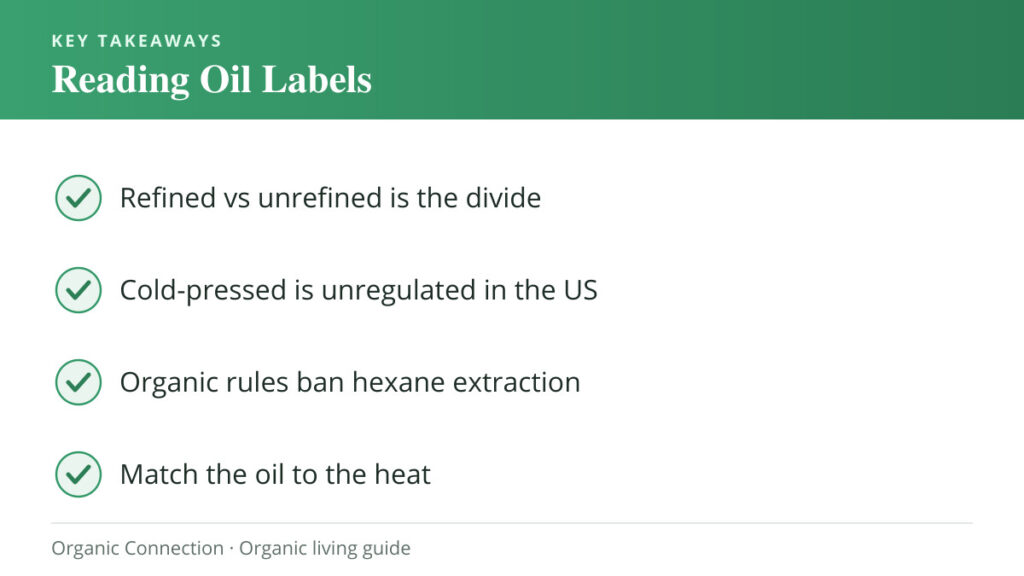
The important caveat: in the United States, “cold-pressed” is not legally defined or enforced for most oils. In the EU it is regulated for olive oil specifically. This means a US bottle can say cold-pressed with no external verification, which is why brand reputation and third-party certification carry more weight than the phrase itself.
Expeller-pressed
The same mechanical screw press, but without temperature control. Friction can push temperatures to 200°F or higher, which reduces some heat-sensitive nutrients and produces a slightly darker, more cooked-tasting oil. Crucially, expeller-pressed still means no chemical solvent, which is the more significant point for most buyers. Expeller-pressed sits between cold-pressed and solvent-extracted, and for high-heat cooking oils the nutrient loss matters much less than it does for a facial oil.
Solvent-extracted
The default for industrial commodity oils. The material is heated and washed with hexane, a petroleum-derived solvent, which dissolves out far more oil than pressing can, typically recovering over 95% versus around 70% for pressing. The solvent is then evaporated off. This is why refined vegetable oil is cheap: yield is much higher.
Two things are worth separating here. Residual hexane in the finished oil is measured at very low levels, well below established safety thresholds, so the dietary risk argument is weak. The stronger objections are occupational exposure for workers and environmental emissions from processing plants. USDA organic certification prohibits hexane extraction entirely, which is one of the more concrete practical benefits of buying certified organic oil.
CO2 extraction
Pressurized carbon dioxide is used as a solvent at low temperature, then simply evaporates away leaving no residue at all. It is expensive and mostly used for high-value botanical oils and extracts rather than cooking oils. It typically captures a broader range of compounds than pressing, which is why some premium skincare oils, including certain rosehip oils, use it and charge accordingly.
Refining, bleaching, deodorizing
Known in the trade as RBD. After extraction, oil destined for commodity use is treated with alkali to remove free fatty acids, filtered through bleaching clay to strip pigment, and steam-deodorized at high temperature to remove smell and flavor. The result is a pale, neutral, shelf-stable oil. It is not dangerous, and it is nutritionally hollow compared with the unrefined version of the same oil, and this is where most of the substantive criticism of industrial oils actually lands.
The terms that are legally defined, and the ones that are not
This distinction is worth internalizing, because it tells you which words on a bottle you can rely on.
Regulated and meaningful: “Extra virgin olive oil” has a legal definition with chemical parameters, free acidity limits, and sensory requirements, though enforcement and fraud remain real issues in the category. “USDA Organic” is a certification with audits and an accredited certifier behind it. “Non-GMO Project Verified” involves third-party testing. “Certified organic” from a named body such as the Soil Association or COSMOS carries an auditable standard.
Not regulated in the US, and often just marketing: “Cold-pressed” for most oils other than olive. “Pure.” “Natural.” “First press” or “first cold press”, which is largely a historical term from stone-mill pressing and means very little with modern centrifuge equipment. “Chemical-free,” which is meaningless. “Unrefined,” which is descriptive and generally honest but not independently verified. “Extra virgin” applied to anything other than olive oil, such as extra virgin coconut oil, where the term has no legal standing at all.
The practical implication is not that unregulated terms are lies. It is that they are unverified claims, so they are worth something when the brand has a track record and a certification behind it, and worth very little on an anonymous bottle.
The two numbers that actually define oil quality
Every term on the front of the bottle is descriptive. The grade on the back, where one exists, rests on laboratory measurements — and for olive oil there are two that matter.
| Measurement | What it detects | Extra virgin limit |
| Free acidity as oleic acid | Breakdown of the oil’s fats before and during pressing: bruised or fermenting fruit, delays between harvest and mill, poor handling. | 0.8% maximum |
| Peroxide value mEq O₂/kg | Oxidation — the reaction with oxygen that eventually produces the stale, crayon-like smell of rancid oil. | 20 mEq O₂/kg maximum |
Those limits come from the International Olive Council trade standard, the reference the industry works to worldwide. An oil meeting both, with no sensory defects, may be sold as extra virgin; an oil failing either may not, whatever the grove looked like.
This is the useful thing to take from the numbers: “extra virgin” is a description of the oil at the moment it was graded. It is not a permanent property of the bottle. Which brings us to the part almost no guide covers.
What the shelf does to those numbers
Two peer-reviewed studies published in 2025 followed bottled extra virgin olive oil through storage and measured what changed. Both are worth knowing about before you buy a large tin.
Light is the fastest way to ruin oil. In a study in Foods on Umbrian extra virgin oil stored for 24 months at room temperature, peroxide values in light-exposed samples rose from 5.19 to 24.30 mEq O₂/kg. Read that against the table above: the oil finished the experiment above the 20 mEq limit for extra virgin. It began as extra virgin and ended as something that could no longer be sold under the name — without anything being wrong with the oil at bottling.
The same study found the compounds people actually pay a premium for degraded fastest: oleocanthal fell by roughly 60% and oleacein by roughly 75%.
Heat does the same thing more slowly. A study in Antioxidants followed 21 Coratina oils for 18 months and compared room temperature with 4°C. At room temperature, peroxide values climbed from about 4.6–5.9 to 11.5–16.6 mEq O₂/kg. Kept cold, the same oils reached only 10–13.7. Free acidity barely moved in either condition, which tells you something precise: acidity is set at the mill, oxidation happens in your kitchen.
The practical conclusions follow directly, and they are more useful than any label term:
- Buy dark glass or tin, never clear bottles. This is the single highest-value decision, and it costs nothing.
- Buy a size you will finish in a few months, not the catering tin that looks better value. The unit price is lower; the oil you pour in month ten is not the oil you bought.
- Store away from the stove. The convenient spot beside the hob is the worst place in the kitchen.
- Look for a harvest date, not just a best-before. A bottling date tells you when it was packed; a harvest date tells you how old the oil actually is.
- Close it properly. Oxygen in the headspace of a half-empty bottle keeps working on the oil between uses.
What this means for cooking oils
For the kitchen, the decision comes down to matching the oil to the heat, and there is a persistent myth worth correcting.
Smoke point is not the whole story. Unrefined oils have lower smoke points because the compounds that give them flavor and antioxidant content also burn. That is real. But research has repeatedly found that oxidative stability under heat depends more on fatty acid composition and antioxidant content than on smoke point alone, and extra virgin olive oil, which is high in monounsaturated fat and rich in polyphenols, performs better under domestic cooking heat than its modest smoke point suggests. Ordinary sautéing, roasting, and shallow frying with extra virgin olive oil is fine, contrary to a very widespread belief.
For genuinely high heat, searing, wok work, or deep frying, use something built for it: ghee, refined coconut oil, or avocado oil. This is the one clear case where a refined oil is the better technical choice, and there is no reason to feel bad about it.
For dressings and finishing, unrefined every time. This is where you actually taste what you paid for, and where the polyphenols survive to be eaten.
Do not reuse frying oil repeatedly. Of all the concerns about oils, this one has the best evidence. Repeatedly reheated oil accumulates aldehydes and other oxidation products, and that is a genuine reason to avoid heavy deep frying at home and to be wary of it commercially.
What this means for skincare oils
The calculus shifts for oils you put on your skin rather than in a pan, because you are not applying heat and because the fragile compounds are the entire point.
For facial oils, unrefined and cold-pressed genuinely matters. A refined rosehip oil is pale, odorless, and has lost most of the carotenoids that give it a reputation; an unrefined one is deep orange and smells earthy and faintly fishy, which is not a defect but the smell of the actual product. The same logic applies to argan, where cosmetic argan should be cold-pressed from unroasted kernels, and to jojoba, where golden unrefined oil retains more than the clear refined version.
Three practical signals for skincare oils. Color: unrefined oils have color, and pale usually means refined. Smell: unrefined oils smell of their source, and odorless usually means deodorized. Packaging: unrefined oils oxidize faster, so a producer who cares will use dark glass, and clear plastic signals a product not expected to hold up.
The trade-off is shelf life. An unrefined facial oil high in polyunsaturated fat, rosehip above all, has roughly six months once opened. Buy small bottles, store them cool and dark, and replace them when the smell turns sharp or waxy rather than earthy.
How to read an oil label in thirty seconds
- Look for a real certification first. USDA Organic, Soil Association, COSMOS, Non-GMO Project. These are auditable; adjectives are not.
- Find the extraction method. Cold-pressed or expeller-pressed means no solvent. Silence usually means solvent-extracted and refined.
- Check refined or unrefined. If it does not say, look at the color and smell.
- Read the ingredient list. A good oil has one ingredient, sometimes with vitamin E as a natural antioxidant.
- Look at the bottle. Dark glass for delicate oils. Clear plastic for a large jug of neutral cooking oil is fine; clear plastic for a premium facial oil is a bad sign.
- Check the size against your usage. The single most common mistake is buying a large bottle of a delicate oil that will oxidize before it is finished.
The same logic runs through every oil we review. In the kitchen, that means organic olive oil, avocado oil, coconut oil, ghee and MCT oil, where smoke point and refinement decide what a fat is for. On skin it means jojoba, argan, rosehip, castor oil, black seed oil and shea butter, where cold-pressed and unrefined carry real meaning for the compounds that survive processing — and where the same dark-glass rule applies for the same reason.
Where paying more is and is not worth it
Worth paying for: unrefined finishing oils you taste directly; cold-pressed skincare oils where the fragile compounds are the product; certified organic versions of soy, corn, and canola, since those crops are overwhelmingly GM and glyphosate-associated in the US and organic rules also exclude hexane; and single-origin oils where the producer names the source, which is usually a sign of someone who chose the material deliberately.
Not worth paying for: “first cold press” as a phrase, which adds nothing over cold-pressed; extra virgin claims on oils where the term has no legal meaning; large bottles of delicate oil that will go rancid; and refined high-heat cooking oil marketed as premium, since the whole point of a refined oil is that it is neutral and interchangeable.
The honest summary is that oil is one of the few categories where the price difference usually reflects a real difference in the product rather than in the branding. What you have to do is work out which difference you are actually buying, and whether it survives the use you are putting it to. Paying a premium for cold-pressed unrefined oil and then deep frying with it wastes the premium entirely.
The part of the grade that is not a number
Free acidity and peroxide value are laboratory measurements, and an oil can pass both while tasting wrong. That is why the extra virgin definition also requires no sensory defects, assessed by a trained tasting panel rather than an instrument.
Panels look for a short list of named faults, and once you know them you can run the same check at home for nothing:
- Fusty — olives left in heaps too long before milling, fermenting rather than fresh. Sweaty, vaguely like old socks.
- Musty — damp cardboard or cellar, from mold on the fruit.
- Winey or vinegary — a sharp, acetic note from fermentation.
- Rancid — the one most people meet: stale nuts, old crayons, putty. This is oxidation, the process the peroxide value measures.
What good oil tastes like is the opposite of bland. Fresh extra virgin olive oil is usually grassy or green, faintly bitter, and produces a distinct peppery catch at the back of the throat when you swallow. That catch comes from oleocanthal — one of the compounds the storage study above found falling by around 60% over two years in light. Bitterness and pepperiness are not flaws to tolerate; they are the taste of the phenolic compounds still being there.
A practical consequence: an oil that tastes of almost nothing is not “mild” in a good sense. It is refined, blended, or old. None of those is a scandal — refined oil has real uses, particularly for high-heat cooking — but it should not carry an extra virgin price.
This is also the cheapest quality check available to anyone. Pour a little into a small glass, warm it in your palm, cover it, then smell it before tasting. You are not trying to score it like a panel; you are asking one question, which is whether it smells fresh and green or stale and waxy. Once you have tasted a genuinely fresh oil beside an old one, the difference stops being subtle.
“First cold press” and other phrases left over from an older industry
Some terms on oil bottles describe machinery that has largely been replaced, and they persist because they sound reassuring.
“First cold press” comes from the era of stacked fiber mats and hydraulic presses, when a second, hotter pressing could squeeze more oil from the same paste. Most modern mills do not press at all: they crush the fruit and separate the oil in a centrifuge, in one continuous run. There is no second pressing for the first to be distinguished from. The phrase is not a lie so much as an anachronism, and it tells you less than “cold extracted” or an actual temperature statement would.
“Pure” and “light” are the two to read most carefully on olive oil, because neither describes quality and neither describes calories. Both conventionally indicate refined oil, sometimes with a little virgin oil blended back for flavor. “Light” refers to color and taste. The fat content is identical across every grade of olive oil, which is worth saying plainly, since the word is doing its best to imply otherwise.
“Unfiltered” means the oil still holds fine particles of olive flesh and water. It looks appealing as sediment in a bottle and it shortens shelf life, because that material gives oxidation and microbes something to work on. It is a style preference with a genuine trade-off, not a quality mark.
“Expeller pressed” appears on seed and nut oils rather than olive oil, and it means the oil was squeezed out mechanically rather than extracted with a solvent such as hexane. That is a real and meaningful distinction, and on seed oils it is the term worth looking for, because solvent extraction is the industry default rather than the exception.
“Refined” is not an insult. Refining strips out free fatty acids, pigments and volatile compounds, which removes flavor and most of the phenolics — and in exchange produces an oil that tolerates higher heat and keeps far longer. For deep frying or a neutral-tasting cake, that is the right tool. The mistake is paying unrefined prices for it, or using a delicate unrefined oil where its qualities are destroyed by the pan.
Common questions about cooking oil labels
What is the difference between cold-pressed and expeller-pressed?
Both are mechanical pressing with no chemical solvent. Cold-pressed is temperature-controlled, usually kept below about 120°F, which preserves more heat-sensitive nutrients and flavor. Expeller-pressed is uncontrolled, and friction can push it above 200°F, giving a darker, more cooked-tasting oil. For delicate skincare and finishing oils the difference matters; for high-heat cooking oils it matters much less.
Is cold-pressed a regulated term?
Not in the United States for most oils. It is legally defined for olive oil in the EU, but elsewhere a bottle can say cold-pressed without any external verification. That does not make it a lie, but it does mean it is an unverified claim, so it carries weight only alongside a real certification or a brand with a track record.
Is hexane-extracted oil dangerous?
Measured residual hexane in refined oils is very low and well below established safety thresholds, so the dietary risk argument is weak. The stronger objections are occupational exposure for processing workers and environmental emissions. USDA organic certification prohibits hexane extraction, so certified organic oils are mechanically pressed.
Can you cook with extra virgin olive oil?
Yes, including sautéing, roasting, and shallow frying, despite a persistent belief otherwise. Oxidative stability under heat depends more on fatty acid composition and antioxidant content than on smoke point alone, and extra virgin olive oil performs better than its modest smoke point suggests. For genuinely high-heat searing or deep frying, ghee, avocado oil, or refined coconut oil are better technical choices.
Why is my unrefined oil darker and smellier than the one I usually buy?
Because it has not been bleached and deodorized. Color and aroma come from the pigments, polyphenols, and volatile compounds that refining strips out, so an unrefined oil looks and smells like its source material. Pale and odorless generally indicates refining. The exception to watch for is a sharp, waxy, crayon-like smell, which indicates the oil has oxidized and should be replaced.
Keep reading
- Best Organic Olive Oil
- Best Organic Rosehip Oil
- Are Seed Oils Bad? What the Evidence Says
- How to Read an Ingredient List
- browse all our reviewed products — scores and certifications for 800+ products
- Organic Food and Pantry hub
- our organic product database — compare brands across every guide
Organic Connection is reader-supported. When you buy through links in our reviews we may earn a commission, at no extra cost to you. As an Amazon Associate we earn from qualifying purchases. We are not paid to feature or rank any product. This page is informational and is not medical advice. How we research and rate.