Last updated: September 11, 2026
Some links in this guide point to our product reviews, which may earn us a commission at no extra cost to you. How we research and rate.
Most organic pest control advice fails for one of two reasons: it recommends products that do not work, or it recommends products that work and does not explain the timing and technique that make the difference between success and a wasted afternoon. Organic pest control is genuinely effective, and it demands more from you than opening a bottle of synthetic spray. This guide covers what actually works in a home garden, in the order you should try it, and is honest about the cases where nothing organic will save the plant.
The hierarchy: work down it in order
Professional organic growers follow an escalation sequence, and home gardeners who adopt it spray far less than those who do not. The order matters because each step is cheaper, safer, and more durable than the one after it.
1. Prevention through soil and plant health
Stressed plants attract pests. This sounds like gardening folklore and it is well established: plants under drought stress, nutrient stress, or root stress produce different volatile compounds and different sap chemistry, and sap-sucking insects like aphids are measurably drawn to them. A plant in good compost-rich soil, watered consistently and not over-fertilized with nitrogen, is a harder target than the same variety struggling in compacted ground. Over-feeding with high-nitrogen fertilizer is a particularly common own goal, because the lush soft growth it produces is exactly what aphids prefer.
2. Physical barriers and removal
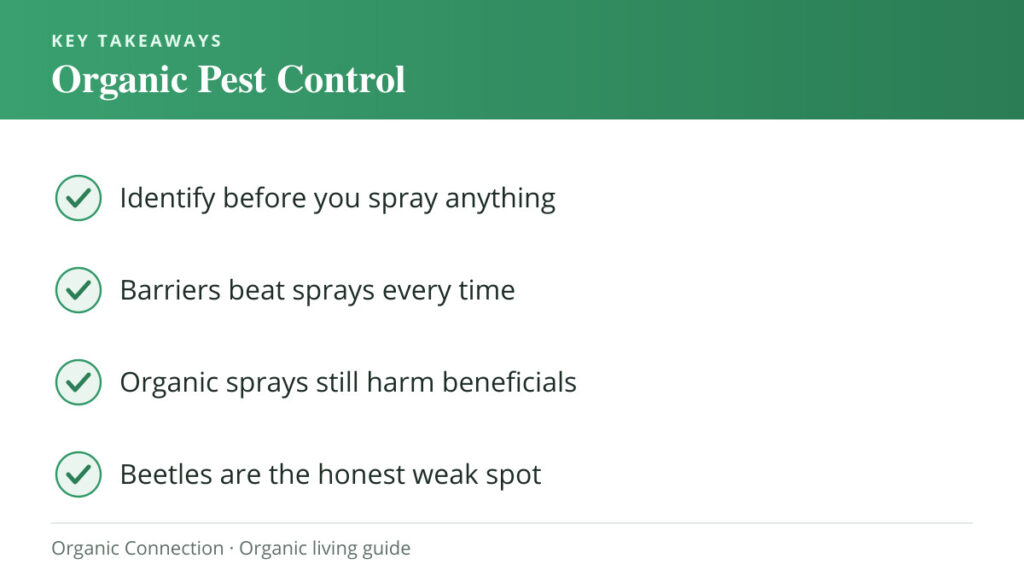
The least glamorous methods are the most reliable. Fine insect mesh over brassicas stops cabbage white butterflies laying, which prevents the caterpillar problem entirely rather than treating it. Copper tape and beer traps handle slugs. Cardboard collars around seedlings stop cutworms. A hard jet of water from a hose knocks aphid colonies off roses and takes days for them to re-establish, and repeating it every few days for a week will often break the infestation with no product at all. Squashing pests by hand, unpleasant as it is, is the fastest way to deal with a small colony of anything.
3. Encourage the predators
An established garden with flowering plants, some undisturbed corners, and no broad-spectrum spraying will develop a population of ladybirds, lacewings, hoverflies, parasitic wasps, ground beetles, and birds that does most of your pest control invisibly. Hoverfly larvae in particular eat aphids in enormous numbers. The way to get them is to plant things they feed on as adults, which means umbellifers like dill, fennel, and coriander allowed to flower, plus yarrow, alyssum, and marigolds. The catch is that this takes a season or two, and every broad spray you apply resets it, because predator populations recover more slowly than pest populations.
4. Targeted biological controls
These are living organisms or their by-products, and they are highly specific. Bacillus thuringiensis var. kurstaki is a soil bacterium that kills caterpillars when they eat treated leaves and affects nothing else; it is the single most effective organic answer to cabbage worms, tomato hornworms, and similar. Nematodes watered into soil deal with vine weevil larvae and fungus gnats. Predatory mites handle spider mites in greenhouses. Because they are specific, they only work if you have correctly identified the pest, which brings us back to the first principle.
5. Sprays, as a last resort
Only when the steps above have failed or the infestation is beyond them. This is where neem oil, insecticidal soap, horticultural oil, and pyrethrin sit. They are useful and they are not free of consequence, which is the part organic gardening content routinely glosses over.
The sprays, honestly assessed
Neem oil
The most useful and most misunderstood organic spray. Cold-pressed neem contains azadirachtin, which disrupts insect moulting and feeding, and it works on aphids, whitefly, spider mites, thrips, mealybugs, and scale crawlers, plus a genuine fungicidal effect on powdery mildew and black spot. The critical detail most people miss is that much of the neem sold in garden centers is clarified hydrophobic extract, which has had most of the azadirachtin stripped out and works mainly by smothering. Both are useful; they are not the same product. Neem takes three to seven days and two or three applications to show results, and people who expect a knockdown effect conclude it does not work.
Insecticidal soap
Potassium salts of fatty acids, which dissolve the outer cuticle of soft-bodied insects. It is cheap, effective on aphids, whitefly, and mites, and has essentially no residual activity, meaning it kills what it touches and then does nothing. That is both its strength, since it leaves no persistent residue for beneficials to encounter later, and its weakness, since coverage has to be thorough and repeated. It will burn foliage on some plants in sun or heat.
Horticultural and dormant oils
Fine mineral or plant oils that smother eggs and overwintering scale. Applied to dormant fruit trees in late winter, these are one of the highest-return interventions in organic growing, dealing with the next season’s problem before it starts.
Pyrethrin
Extracted from chrysanthemum flowers and permitted in organic growing, this is the one to treat with genuine caution. It is a broad-spectrum nerve agent that kills on contact and does not distinguish between a pest and a ladybird. It is also highly toxic to fish and to bees. “Organic” here does not mean gentle, and pyrethrin should be a targeted last resort on a specific serious infestation, never a routine spray. Note also that pyrethroids, the synthetic analogues with similar names, are not permitted in organic growing and are considerably more persistent.
Diatomaceous earth
Fossilized algae that abrades insect cuticles. It works on crawling insects, slugs, and ants, and only while completely dry, so rain or dew renders it useless until reapplied. It is also indiscriminate, killing beneficial ground beetles alongside pests, and the dust is a respiratory irritant, so wear a mask when applying it.
The part most guides skip: organic sprays still harm beneficials
This deserves stating plainly because the organic label creates a false sense of safety. Neem can harm bees that are directly sprayed and affects larvae through treated pollen. Insecticidal soap kills any soft-bodied insect it contacts, including ladybird larvae, which look nothing like adult ladybirds and are frequently sprayed by gardeners who do not recognize them. Pyrethrin is acutely toxic to bees and aquatic life. Diatomaceous earth kills beneficial ground beetles.
The practical rules that follow are simple and worth actually observing. Spray at dusk or very early morning, when pollinators are not flying. Never spray a plant in open bloom. Never spray in bright sun or above about 85°F, which causes leaf burn as well as harming insects. Spot-treat the affected plant rather than blanket-spraying a bed. And learn what ladybird and lacewing larvae look like, because they are the most commonly killed beneficials in home gardens, purely through misidentification.
Common pests and what actually works on each
Aphids. Water jet first, repeated every few days. Then insecticidal soap or neem on the undersides of leaves. Ladybirds and hoverfly larvae will usually take over within a fortnight if you stop spraying. Check for ants farming them, since ants protect aphids from predators, and a sticky band on the stem breaks that relationship.
Cabbage caterpillars. Fine mesh netting from the day you plant, which prevents the problem entirely. If they are already there, Bacillus thuringiensis is close to a complete solution. Hand-picking works on small plantings.
Slugs and snails. Beer traps, copper tape, hand-collecting at night with a torch, and encouraging frogs, hedgehogs, and ground beetles. Iron phosphate pellets are permitted in organic growing and are effective, though they are not harmless to other soil organisms.
Spider mites. They thrive in hot dry conditions, so raising humidity is a genuine control. Neem and insecticidal soap both work, but coverage of leaf undersides must be thorough, and repeat applications are essential because eggs are not affected.
Squash vine borer, cucumber beetle, Japanese beetle. This is where honesty matters: organic control of hard-bodied adult beetles is difficult. Row covers until flowering, hand-picking into soapy water, and accepting some damage are the realistic strategies. Anyone promising an easy organic spray solution for Japanese beetles is overselling.
Fungus gnats. A soil problem rather than a leaf problem. Let the surface dry between waterings, use yellow sticky traps for adults, and drench with cold-pressed neem or apply beneficial nematodes for the larvae.
Powdery mildew. Airflow and spacing prevent it. Neem oil, potassium bicarbonate, and milk sprays all have reasonable evidence. Remove and bin affected leaves rather than composting them.
What to do about weeds
Weeds are a pest problem in everything but name, and the organic answer is overwhelmingly mechanical rather than chemical. Mulch is the single most effective tool: a thick layer of organic mulch suppresses germination, holds moisture, and feeds the soil as it breaks down. Hoeing seedlings on a dry day kills them before they establish. Hand-weeding perennials with taproots is unavoidable.
Organic weed killers, mostly high-strength vinegar, are worth understanding correctly. They are contact herbicides that burn off top growth and do not kill roots, which means perennial weeds regrow. They are useful on paths and patios and largely ineffective on established dandelions and bindweed. Twenty percent acetic acid is also genuinely caustic and will damage skin, eyes, and any plant it drifts onto, so “organic” again does not mean handle carelessly.
Building a garden that needs less of this
The gardens that need the least intervention share a few characteristics. They have diverse planting rather than large blocks of one crop, because a monoculture is an easy target and a mixed bed is a harder one. They include flowering plants throughout the season to feed predators. They rotate crops so soil-borne pests do not build up. They have healthy, biologically active soil built with compost rather than fed with soluble fertilizer. And they tolerate a background level of damage rather than pursuing perfection, because a garden with zero pests also has zero predators, and is one aphid arrival away from an explosion.
That last point is the mental shift that makes organic pest control work. The goal is not elimination; it is keeping populations below the level where they cause real damage, using the cheapest and least disruptive method that achieves it. A few holes in the leaves are the price of a system that mostly regulates itself, and it is a considerably better deal than a spray schedule.
Common questions about organic pest control
What is the most effective organic pest control?
Prevention and physical barriers, by a wide margin. Fine mesh netting over brassicas prevents caterpillars entirely, and healthy soil with consistent watering makes plants less attractive to sap-sucking insects. Among sprays, cold-pressed neem oil is the most broadly useful, and Bacillus thuringiensis is close to a complete solution for caterpillars specifically.
Is organic pest control safe for bees?
Safer than synthetic insecticides, but not harmless. Neem can harm directly sprayed bees and affect larvae through treated pollen, and pyrethrin is acutely toxic to bees despite being permitted in organic growing. Spray at dusk or very early morning, never treat plants in open bloom, and spot-treat rather than blanket-spraying.
Why is my neem oil not working?
Usually one of three reasons. You may have bought clarified hydrophobic extract rather than cold-pressed neem, which has most of the azadirachtin removed. You may be expecting results too quickly, since neem takes three to seven days and two or three applications. Or you may not be covering the undersides of leaves, which is where aphids, mites, and whitefly actually live.
Does organic mean the spray is harmless?
No. Pyrethrin is a broad-spectrum nerve agent highly toxic to bees and fish, twenty percent vinegar weed killer is genuinely caustic, and diatomaceous earth is a respiratory irritant that kills beneficial ground beetles. Organic certification limits which substances are permitted; it does not mean those substances are without effect or risk.
How do I get rid of Japanese beetles organically?
With difficulty, and honestly. Hard-bodied adult beetles are the weakest area for organic control. Row covers until flowering, hand-picking into soapy water in the early morning when they are sluggish, and milky spore for grubs in lawns are the realistic options. Pheromone traps often attract more beetles than they catch and are usually counterproductive.
Keep reading
- Best Organic Neem Oil
- Organic Gardening for Beginners
- Best Natural Weed Killer
- Best Organic Compost
- our searchable product database — compare all 800+ picks side by side
- Organic Gardening hub
- our organic product database — compare brands across every guide
Organic Connection is reader-supported. When you buy through links in our reviews we may earn a commission, at no extra cost to you. As an Amazon Associate we earn from qualifying purchases. We are not paid to feature or rank any product. Always read and follow the product label. How we research and rate.