
Last updated: September 11, 2026
Some links in this guide point to our product reviews, which may earn us a commission at no extra cost to you. How we research and rate.
“Seed oils are toxic” has gone from a fringe claim to a mainstream shopping heuristic in about five years, and it is now printed on packaging as a selling point. The underlying science is genuinely more complicated and considerably less alarming than the internet version, but it is also not nothing, and the strongest argument against most seed oils has almost nothing to do with the reasons people usually give. This guide separates the claims that hold up from the ones that do not, and gives a practical framework for which cooking oils to buy.
What “seed oils” actually means
The term as used online usually refers to eight industrially refined oils: soybean, corn, canola (rapeseed), cottonseed, sunflower, safflower, grapeseed, and rice bran. Sometimes peanut is included. These are high in the omega-6 fatty acid linoleic acid, they are cheap, and they dominate processed and restaurant food.
The category is botanically incoherent, which is worth noting because it makes the discussion confusing. Olive oil and avocado oil are pressed from fruit, not seeds, and are excluded, though they are still plant oils. Coconut oil comes from a seed and is not usually included. Sesame oil is a seed oil and rarely attracts criticism, probably because it is used in small quantities and usually sold unrefined. What actually unites the criticized list is not seed origin but industrial refining and high linoleic acid content, which is why “seed oil” is a poor label for the thing people are objecting to.
The claims, assessed one at a time
“Omega-6 causes inflammation”
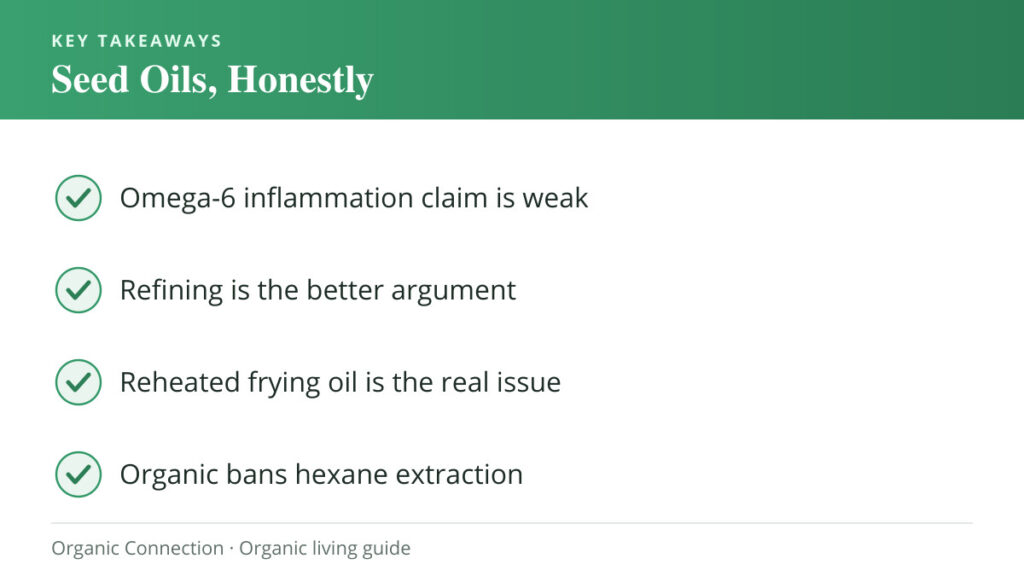
This is the central claim and it is the weakest. The theory is that linoleic acid converts to arachidonic acid, which produces inflammatory signalling molecules. The problem is that human trials do not show this happening: controlled studies increasing linoleic acid intake generally find no meaningful increase in inflammatory markers, because the conversion rate to arachidonic acid in humans is low and tightly regulated. Meta-analyses of linoleic acid intake and cardiovascular outcomes generally find neutral or modestly favorable associations, and major health bodies continue to recommend replacing saturated fat with polyunsaturated fat. The inflammation mechanism sounds plausible and has not held up well when tested.
“The omega-6 to omega-3 ratio is dangerously skewed”
The ratio in Western diets has genuinely shifted, and omega-3 intake is genuinely low for most people. But the evidence that the ratio itself is the problem, rather than simply insufficient omega-3, is weaker than usually presented. The practical implication points the same way either way: eat more omega-3, from oily fish, walnuts, chia, and flax. Cutting omega-6 to improve a ratio is a less well-supported strategy than raising omega-3.
“Hexane residue is dangerous”
Hexane is used as an extraction solvent and trace residues can remain, which sounds alarming. Measured residual levels in refined oils are very low and far below established safety thresholds. The stronger objection to hexane is occupational and environmental, exposure for workers and emissions from processing plants, rather than dietary. This is a legitimate reason to prefer expeller-pressed or cold-pressed oil, just not primarily a personal-health one.
“Heating them creates toxic compounds”
This one has real substance. Heating any polyunsaturated oil past its smoke point, and especially reusing it repeatedly as commercial fryers do, produces aldehydes and other oxidation products that are genuinely undesirable. Polyunsaturated oils are more vulnerable to this than monounsaturated or saturated fats because their double bonds are more reactive. The problem is largest in deep frying, repeated reuse, and old oil stored badly, and much smaller in a domestic pan used once. This is the part of the seed oil argument that deserves attention.
“They are in all ultra-processed food”
Entirely true, and probably the most important point in the whole debate, though it is a correlation argument rather than a mechanism. Refined seed oils are cheap, neutral, and shelf-stable, so they are in almost every packaged snack, fried food, sauce, and restaurant fryer. Diets high in these foods are associated with worse health outcomes. Whether the oil is a cause or simply a marker for ultra-processed food is genuinely unresolved, and the honest answer is that we do not know. Either way, reducing ultra-processed food reduces seed oil intake automatically, and that is a well-supported dietary change regardless of what you think about linoleic acid.
What actually follows from this
Putting it together, the defensible position is narrower than either camp claims. Industrially refined, hexane-extracted, deodorized oils are nutritionally empty and are the fat of ultra-processed food, and reheated frying oil produces compounds nobody wants to eat. That is a good enough reason to build your cooking around better oils. It is not a good enough reason for the “seed oils are poison” framing, which outruns the evidence considerably and leads people to strange places, like avoiding a salad dressing while eating plenty of processed meat.
The practical framework we would suggest is simple and does not depend on resolving the linoleic acid debate:
- Cook mostly with unrefined, minimally processed fats. Extra virgin olive oil for most things, coconut oil or ghee for higher heat, and butter where it suits the dish.
- Match the oil to the heat. Extra virgin olive oil is fine for normal sautéing despite persistent myths, but for genuinely high-heat searing use ghee, avocado oil, or refined coconut oil, which handle it better.
- Do not deep fry at home often, and never reuse frying oil repeatedly. This is where oxidation genuinely matters.
- Cut ultra-processed food, which does more for your seed oil intake than any label-reading, and is well supported for other reasons.
- Raise omega-3 rather than obsessing over cutting omega-6.
- Buy organic and cold-pressed where you can. Organic certification rules out GMO soy, corn, and canola and the pesticides used on them; cold-pressing avoids the solvent and high-heat refining entirely.
Where organic certification fits
This is the part most seed oil discussions skip, and it is the part most relevant to how you actually shop. Soy, corn, and canola are overwhelmingly genetically modified in the US and are among the crops most associated with glyphosate use, as covered in our glyphosate guide. USDA organic certification rules out both the GMO seed and the synthetic pesticide use, which is a concrete, verifiable difference regardless of where you land on linoleic acid.
Organic certification also constrains processing. Hexane is prohibited as an extraction solvent under USDA organic rules, so certified organic oils are mechanically pressed rather than solvent-extracted. That single fact addresses one of the more substantive objections in the whole debate, and it means the choice between “seed oil” and “not seed oil” is less useful than the choice between certified organic cold-pressed oil and industrial refined oil. An organic cold-pressed sunflower oil is a very different product from the refined sunflower oil in a fryer, even though both would be lumped together under “seed oil.”
Look for “cold-pressed,” “expeller-pressed,” or “unrefined” alongside the organic seal, buy oil in dark glass rather than clear plastic since light accelerates oxidation, buy sizes you will finish within a few months, and store bottles away from the stove. Rancid oil smells sharp and crayon-like; if a bottle smells like that, it belongs in the bin regardless of what crop it came from. That is the same logic we apply to argan and other cold-pressed oils across the site.
A note on how this debate is being used
“Seed oil free” is now a marketing claim, and like every marketing claim it is being attached to things that do not deserve it. A snack fried in beef tallow is still a fried snack. A “seed oil free” cookie made with palm oil and sugar is a cookie, and palm oil carries deforestation problems that refined sunflower oil does not. Several brands have discovered that the phrase sells and are using it exactly the way “fat free” was used in the 1990s and “low carb” in the 2000s: as a halo that distracts from the rest of the label.
The reliable defense is the one we recommend everywhere: turn the package over and read the ingredient list, as set out in our guide to reading labels. A front-of-pack claim about what a product does not contain tells you nothing about what it does. And treat any single-nutrient explanation of health with caution, whether it is fat, carbs, gluten, or linoleic acid. Dietary patterns do the work; individual villains rarely survive contact with the evidence.
What the seed oil evidence actually shows
The strong claim that seed oils are toxic is not well supported: the omega-6 inflammation mechanism has largely failed in human trials, and hexane residues are far below safety thresholds. The weaker, more defensible claims are that industrially refined oils are nutritionally stripped, that repeatedly heated frying oil produces genuinely undesirable oxidation products, and that these oils are the signature fat of ultra-processed food. All three point to the same practical conclusion, which happens to be good advice regardless: cook with unrefined organic cold-pressed oils, match the oil to the heat, avoid repeatedly reheated frying oil, eat less ultra-processed food, and get more omega-3. You do not need to resolve the science to act well on it.
Common questions about seed oils
Are seed oils actually bad for you?
The strong version of the claim is not well supported. Human trials increasing linoleic acid generally do not show increased inflammatory markers, and meta-analyses find neutral or modestly favorable cardiovascular associations. The better-founded concerns are that industrially refined oils are nutritionally stripped, that repeatedly reheated frying oil produces oxidation products, and that these oils dominate ultra-processed food.
What counts as a seed oil?
The term usually refers to eight industrially refined oils: soybean, corn, canola, cottonseed, sunflower, safflower, grapeseed, and rice bran. The category is botanically inconsistent, since olive and avocado oils come from fruit and are excluded while sesame is a seed oil that rarely attracts criticism. What actually unites the list is industrial refining and high linoleic acid content.
Is hexane in cooking oil dangerous?
Measured residual hexane in refined oils is very low and well below established safety thresholds, so the dietary risk is minimal. The stronger objections are occupational exposure for processing workers and environmental emissions. USDA organic rules prohibit hexane extraction, so certified organic oils are mechanically pressed, which sidesteps the question entirely.
Which cooking oils should I use instead?
Extra virgin olive oil for most cooking including normal sautéing, and ghee, avocado oil, or refined coconut oil for genuinely high-heat searing. The more useful distinction is unrefined versus industrially refined rather than seed versus fruit: an organic cold-pressed sunflower oil is a very different product from refined sunflower oil.
Does organic certification matter for cooking oils?
Yes, and more than the seed-oil framing suggests. Soy, corn, and canola are overwhelmingly genetically modified in the US and associated with glyphosate use, both of which organic certification rules out. Organic rules also prohibit hexane extraction, so certified oils are mechanically pressed rather than solvent-extracted.
Keep reading
- Glyphosate in Food: Where It Shows Up and How to Reduce It
- How to Read an Ingredient List
- Best Organic Olive Oil
- Greenwashing: 12 Label Tricks
- all our reviewed products in one place — sortable by Organic Integrity Score
- Organic Food and Pantry hub
- our organic product database — compare brands across every guide
Organic Connection is reader-supported. When you buy through links in our reviews we may earn a commission, at no extra cost to you. As an Amazon Associate we earn from qualifying purchases. We are not paid to feature or rank any product. This page is informational and is not medical advice. How we research and rate.