
Last updated: September 21, 2026
Some links in this guide point to our product reviews, which may earn us a commission at no extra cost to you. How we research and rate.
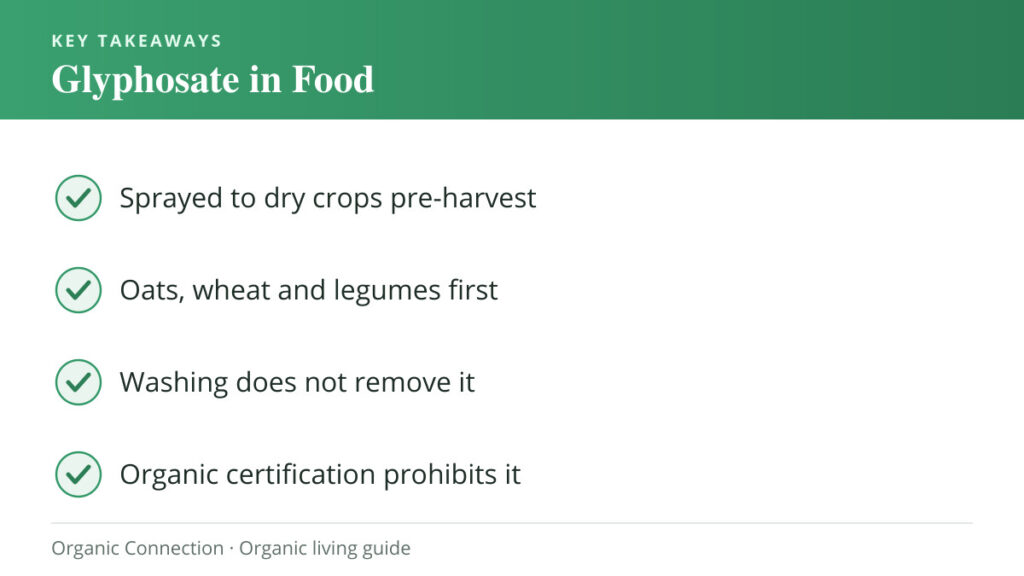
Glyphosate is the most widely used herbicide in the world, and it turns up in food testing more often than most people expect, including in foods nobody associates with weedkiller. The reason is a practice most shoppers have never heard of: pre-harvest desiccation, spraying a crop shortly before harvest to dry it evenly. This guide explains where glyphosate actually shows up, what the science does and does not say about the risk, why organic certification is the most reliable way to reduce your exposure, and which specific foods are worth switching first.
What glyphosate is and why it is everywhere
Glyphosate is a broad-spectrum systemic herbicide, meaning it is absorbed into the plant rather than sitting on the surface, and it kills essentially any plant it touches. It was introduced commercially in the 1970s, and its use expanded enormously from the mid-1990s onward with the introduction of genetically engineered crops bred to tolerate it, which allowed farmers to spray entire fields and kill only the weeds. It is now applied at a scale that has no real precedent in agricultural chemistry.
Two features make it particularly relevant to what ends up in your kitchen. First, being systemic, it moves inside the plant, so washing produce does not remove it the way rinsing removes a surface residue. Second, the desiccation practice described above puts it on crops very shortly before they are harvested. Together these mean that residue detected in grain products is genuinely inside the grain, and that the foods most affected are frequently not the GMO crops people assume.
Where glyphosate actually shows up
Independent testing programs and government residue monitoring have repeatedly found glyphosate in the following categories. Note how many are ordinary pantry staples rather than fresh produce.
Oats and oat products
Oats are among the most consistently flagged foods in glyphosate testing, because desiccation before harvest is common in oat production in North America. That includes rolled oats, instant oatmeal, granola, oat-based cereals, and oat milk. This is the single strongest argument for buying organic oatmeal and oat milk, since these are foods many people eat daily.
Wheat and wheat products
The same desiccation practice is used on wheat, particularly in cooler and wetter growing regions where uneven ripening is a problem. That carries through into flour, bread, pasta, crackers, and baked goods. Organic bread flour and pasta remove this entirely.
Legumes and pulses
Chickpeas, lentils, dried peas, and beans are commonly desiccated before harvest for the same reason. This has implications for hummus, canned beans, and pulse-based flours and pastas.
Corn and soy products
These are the glyphosate-tolerant GMO crops, so they are sprayed during the growing season. The residue implications run through corn syrup, corn starch, soy lecithin, soybean oil, and the vast range of processed foods built on them. Certified organic popcorn and corn products avoid GMO corn by definition.
Honey and animal products
Bees forage across treated fields, so glyphosate has been detected in conventional honey. It also enters the food chain through livestock feed, which is one reason some people prioritize organic dairy and meat. Certified organic honey comes from hives managed under organic rules.
Wine, beer, and processed foods
Testing has found glyphosate in wine, beer, and a wide range of packaged foods, generally at low levels, reflecting how widely the inputs are used across the food system.
What the science says, and where it is genuinely contested
This is a topic where both alarmism and dismissal are easy to find, so it is worth laying out the actual state of the evidence.
In 2015 the International Agency for Research on Cancer (IARC), part of the World Health Organization, classified glyphosate as “probably carcinogenic to humans,” their Group 2A category. That classification is about hazard, meaning whether something can cause cancer under some circumstances, not about risk at real-world exposure levels, a distinction that is routinely lost in coverage. Group 2A also contains red meat, very hot beverages, and shift work, which gives a sense of the category’s breadth.
Other major regulatory bodies reached different conclusions. The US Environmental Protection Agency and the European Food Safety Authority have both concluded that glyphosate is unlikely to pose a carcinogenic risk to humans at expected dietary exposure levels, and the EU renewed its approval on that basis. The disagreement is partly methodological: IARC weighted certain epidemiological studies and animal data differently, and reviewed published literature only, while regulators also considered unpublished industry studies. Both approaches have defenders and critics.
Meanwhile, US courts have awarded very large damages in cases brought by people who developed non-Hodgkin lymphoma after heavy occupational exposure, and manufacturers have paid substantial settlements. It is important to note that those cases concern people who handled and sprayed concentrated product regularly, an exposure level orders of magnitude above eating food with trace residue. Litigation outcomes reflect legal standards of evidence, not scientific consensus.
The honest summary: dietary glyphosate exposure at levels typically detected in food is below regulatory limits, and the strong evidence for harm comes from occupational exposure, not from eating bread. At the same time, the disagreement between IARC and regulators is real, research on long-term low-dose effects and on the surfactants in commercial formulations is ongoing, and “within legal limits” is a regulatory judgement rather than a guarantee. That is exactly the situation where reducing avoidable exposure is a reasonable personal choice without requiring anyone to believe the sky is falling.
What the regulators have actually concluded, and where they disagree
The glyphosate argument is unusually confusing for a shopper because two respected bodies reached different-sounding conclusions, and both are quoted selectively by people with something to sell. It is worth setting out precisely what each one said, because they were answering different questions.
The EPA’s position is stated plainly on its glyphosate page: its 2017 human health assessment “found no dietary risks of concern”, and the agency concluded that glyphosate “is not likely to be carcinogenic to humans” when used as directed. EPA assesses risk under expected real-world exposure conditions.
The IARC classification, which is where “probably carcinogenic” comes from, is a hazard classification. A hazard assessment asks whether a substance can cause harm under any circumstances; a risk assessment asks whether it is likely to at the doses people actually encounter. Both can be honestly stated and they are not the contradiction they appear to be.
That distinction is the single most useful thing to carry away from the entire debate, and it applies well beyond glyphosate.
The status is not settled, and we should say so. EPA’s registration review of glyphosate began in 2009; its interim decision was withdrawn in September 2022 after court challenges, and the agency is updating its human health risk assessment, with completion expected in late 2026, alongside formal Endangered Species Act consultation. A page that tells you the science is closed, in either direction, is overstating what is on the record.
Tolerances: the number that governs what is legally on your food
The mechanism people rarely hear about is the tolerance, and it explains why “glyphosate was detected” headlines are less informative than they sound.
A tolerance is a legally established maximum residue level for a specific pesticide on a specific commodity. EPA sets them, and they are enforceable: residues above the tolerance make a commodity subject to seizure. The agency sets them with sensitive populations, including infants and children, taken into account.
So a detection is not a violation. Modern laboratory methods can find residues at parts per billion, far below any tolerance. A report that glyphosate was “found in” a food is consistent with a result thousands of times under the legal limit, and the only way to know is to read the number against the tolerance for that commodity. Where a testing program reports findings, the useful questions are: what was the level, what is the tolerance, and how much of that food would you have to eat.
None of this makes residue testing pointless. It makes the units matter, which is the same argument we make about heavy metals in food and about supplement testing: a number with a limit beside it is information, and a number alone is noise.
What organic certification does here, precisely
This is the part of the glyphosate question where certification genuinely answers something, and it is worth being exact about the mechanism.
Under the National Organic Program rule at 7 CFR 205.105, organic production may not use synthetic substances unless the specific substance is on the National List. Glyphosate is not on it. So an organic crop was not sprayed with it, and that is an auditable fact about the farm rather than a claim about the finished food.
What certification does not promise is a zero residue result. Drift from neighboring fields, shared equipment and shared storage all exist, which is why organic standards focus on practices and audits rather than guaranteeing an outcome nobody can control. If you want both — the practice and the result — the combination to look for is organic certification plus published residue testing, which a small number of brands now provide.
Where this matters most is the crops where glyphosate is most used, particularly those where it may be applied shortly before harvest to even out ripening. Our guides to organic oats, quinoa, rice, breakfast cereal, granola and pasta cover the categories where the question comes up most, and our explainer on the Dirty Dozen and Clean Fifteen covers the produce side.
Why organic certification is the reliable lever
If you decide to reduce your exposure, USDA organic certification is by a wide margin the most effective and most verifiable tool available, and it is worth understanding why.
Glyphosate is a prohibited synthetic under the USDA organic standard. It cannot be applied to organic crops, cannot be used on the land during the three-year transition period before certification, and cannot be used in organic livestock feed production. This is not a labeling claim: it is enforced through annual inspection, records review, and residue testing by accredited certifiers, with decertification as the consequence. Studies of people switching to organic diets have measured substantial drops in glyphosate metabolites in urine within days.
What organic certification does not promise is zero detection. Glyphosate drifts on the wind from neighboring fields, persists in soil and water, and can appear in shared processing and transport equipment, so trace amounts occasionally turn up in organic products. The standard addresses what was applied, not what the environment contributes. That is a limitation worth knowing, but it does not change the basic arithmetic: organic products consistently test dramatically lower than conventional equivalents in the categories where desiccation is routine.
Two other labels are worth distinguishing. “Non-GMO Project Verified” addresses genetic modification only, so a non-GMO oat product tells you nothing about glyphosate, since oats are not genetically modified and the residue comes from desiccation. “Glyphosate Residue Free” is a third-party certification that tests specifically for glyphosate below a detection threshold, which is genuinely useful and narrower than organic: it verifies one chemical rather than a whole farming system. If you see both, organic is the broader assurance. We cover how to tell real certifications from marketing in our guide to spotting greenwashing.
A practical priority list
You do not need to convert your whole kitchen. Because glyphosate exposure concentrates in specific categories, a targeted approach captures most of the reduction for a fraction of the cost. In rough order of return:
- Oats first. Oatmeal, granola, oat-based cereal, and oat milk. Consistently among the most flagged foods, and often eaten daily by the same person.
- Wheat products second. Flour, bread, pasta, and crackers. High frequency, and desiccation is common.
- Legumes third. Chickpeas, lentils, and dried beans, including hummus and pulse pastas.
- Corn and soy-derived ingredients. Harder to control because they are embedded in processed foods; cooking from ingredients does more here than label reading.
- Honey and, if budget allows, dairy and meat. These enter through foraging and feed rather than direct application.
- Everything else, when convenient. Fresh produce is a lower priority for glyphosate specifically, though it matters for other residues, as covered in the Dirty Dozen and Clean Fifteen.
The useful feature of this list is that grains and legumes are among the cheapest organic categories to switch, often only 10 to 25 percent more than conventional, because they are shelf-stable commodity crops with mature organic supply chains. The highest-exposure foods are also the cheapest to fix, which is an unusually favorable arrangement. We break down the wider economics in Is Organic Worth It?
Things that do not help much
A few widely repeated tips are worth correcting, because they give false confidence.
Washing does not remove it. Glyphosate is systemic and moves inside the plant, so rinsing, scrubbing, and vinegar soaks do very little. Washing is still worth doing for surface pesticides, dirt, and microbes, but it is not a glyphosate strategy.
Peeling does not help with grains. There is nothing to peel on a rolled oat or a lentil, and the residue is not concentrated in a removable outer layer.
“Natural” and “non-GMO” labels do not address it. “Natural” is unregulated and means nothing here. Non-GMO verification covers genetic modification only, which is irrelevant for wheat, oats, and pulses, none of which are genetically modified. A non-GMO oat product can be desiccated with glyphosate.
Detox products do not do anything useful. Supplements marketed to “flush glyphosate” are not supported by meaningful evidence. Glyphosate is water-soluble and excreted relatively quickly on its own; the effective intervention is reducing intake, not buying a product to remove it afterwards.
Keeping this in proportion
It is worth ending where the evidence actually sits, because scale matters. Detected dietary levels are generally well below the regulatory reference doses set by both US and European authorities, and the strongest human evidence of harm involves occupational exposure among people applying concentrated herbicide, not people eating bread. Nobody should stop eating whole grains, legumes, or fresh produce out of glyphosate concern; the dietary benefit of those foods is large, well established, and far outweighs a trace residue question that remains genuinely contested.
The reasonable position is the same one we take across this site: where a cheap, verifiable option exists that removes an avoidable exposure, take it, and do not agonize about the rest. Organic oats and flour cost very little more than conventional, they eliminate the single most consistently flagged source, and they require no lifestyle change whatsoever. That is a good trade. Buying organic avocados because of glyphosate is not, since avocados are neither desiccated nor glyphosate-tolerant crops. Precision beats anxiety here, and it is also considerably cheaper.
What the glyphosate evidence adds up to
Glyphosate reaches food mainly through pre-harvest desiccation of oats, wheat, and legumes, and through glyphosate-tolerant corn and soy. Washing does not remove it, non-GMO labels do not address it, and the scientific disagreement about low-dose dietary risk is real but unresolved. USDA organic certification prohibits it outright and is enforced by inspection, which makes it the one reliable lever available to a shopper. Start with oats, then wheat, then legumes, three of the cheapest organic categories there are, and you will have addressed most of your dietary exposure without meaningfully changing your grocery bill or your diet.
Common questions about glyphosate in food
What foods contain the most glyphosate?
Oats and oat products, wheat products, and legumes such as chickpeas and lentils are the most consistently flagged, because these crops are commonly sprayed shortly before harvest to dry them evenly, a practice called desiccation. Corn and soy products also carry residue because those crops are engineered to tolerate glyphosate and are sprayed during growing.
Does washing food remove glyphosate?
No, not meaningfully. Glyphosate is a systemic herbicide, meaning it is absorbed into the plant rather than sitting on the surface, so rinsing, scrubbing, and vinegar soaks do very little. Washing produce is still worthwhile for surface pesticides, dirt, and microbes, but it is not an effective glyphosate strategy.
Does organic food contain glyphosate?
Glyphosate is prohibited under USDA organic rules and cannot be applied to organic crops, land in transition, or organic livestock feed, enforced through annual inspection and residue testing. Trace amounts occasionally appear from spray drift, soil persistence, or shared equipment, but organic products consistently test dramatically lower than conventional equivalents.
Is glyphosate actually dangerous?
It is genuinely contested. The WHO’s IARC classified it as “probably carcinogenic to humans” in 2015, a hazard classification, while the US EPA and the European Food Safety Authority concluded it is unlikely to pose a carcinogenic risk at expected dietary levels. The strongest human evidence of harm involves heavy occupational exposure among applicators, not dietary trace residue.
Does a non-GMO label mean no glyphosate?
No. Non-GMO Project Verification addresses genetic modification only. Wheat, oats, and pulses are not genetically modified, yet they are among the most glyphosate-flagged foods because the residue comes from pre-harvest desiccation rather than from GMO cultivation. A non-GMO oat product can still have been desiccated with glyphosate.
Keep reading
- The Dirty Dozen and Clean Fifteen: Where Buying Organic Matters Most
- Is Organic Worth It? An Honest Cost Breakdown
- What “Organic” Really Means: A Complete Guide to Certifications
- How to Build an Organic Pantry Without Overspending
- Organic Product Database — search every product we have reviewed, by certification
Organic Connection is reader-supported. When you buy through links in our reviews we may earn a commission, at no extra cost to you. As an Amazon Associate we earn from qualifying purchases. We are not paid to feature or rank any product. This page is informational and is not medical advice. How we research and rate.