Last updated: September 30, 2026
We may earn a commission when you buy through links on this page, at no extra cost to you. How we research and rate.
The short version
After researching the certifications, sugar content, and ingredient lists of the most popular organic breakfast cereals, our top pick is Nature’s Path Organic Heritage Flakes. It is USDA certified organic, built on six ancient grains rather than a single refined flour, and delivers 23 g of whole grain per serving in the largest box here, which is why it earned our highest Organic Integrity Score of 93 out of 100. For the highest fiber, Nature’s Path Smart Bran is our pick; for children and anyone cutting added sugar, Cascadian Farm Organic Cinnamon Apple is the best choice; and for the lowest price on a classic O-shaped cereal, 365 by Whole Foods Market Organic Morning Os is the one to buy.
With cereal, the organic seal only tells you how the grain was grown. The sugar per serving and whether the first ingredient is a whole grain matter just as much. We flag each product’s certification and sugar.
Best organic cereal compared
| Best Choice | Best Value | ||||
 |  |  |  |  | |
| Product | Nature’s Path Heritage Flakes | Nature’s Path Smart Bran | Cascadian Farm Cinnamon Apple | 365 Morning Os | Cascadian Farm Honey Oat Crunch |
| Organic Integrity Score | 93/ 100 | 87/ 100 | 83/ 100 | 80/ 100 | 74/ 100 |
| Our rating | 4.7 | 4.4 | 4.2 | 4.0 | 3.7 |
| Sugar | Low | Low | None added | Low | Moderate |
| Best for | Best overall | Highest fiber | Kids, no added sugar | Best value | Sweet crunch |
| Certification | USDA Organic, Non-GMO | — | USDA Organic, Non-GMO Project Verified | USDA Organic | USDA Organic, Non-GMO Project Verified |
| Grain | Six ancient grains, 23 g whole grain | Wheat bran with psyllium and oat bran | Whole grain oats, 25 g whole grain | Whole grain oat and rice flours | Wheat, oats, corn and rice, 19 g whole grain |
| Price | $7.64 $8.86 −14%$0.23 / ounce View on Amazon | $5.03$0.47 / ounce View on Amazon | $4.99$0.42 / ounce View on Amazon | $3.68 $4.13 −11%$0.26 / ounce View on Amazon | $5.49$0.41 / ounce View on Amazon |
Price and availability as of October 11, 2026 7:10 pm EDT. Product prices and availability are accurate as of the date/time indicated and are subject to change. Any price and availability information displayed on Amazon.com at the time of purchase will apply to the purchase of this product.
Scores are ours, based on independent research of certification, grain quality, sugar and fiber content, ingredient purity, and value, using the same 10-criteria method we apply to every product. See how we research and rate.
What each claim on a cereal box covers
Cereal packaging carries more unregulated language than almost any aisle in the store, and the claims that sound most reassuring are often the ones that promise least. Here is what each one on this page actually commits the manufacturer to.
| Claim | Covers | Key exclusion |
| USDA Organic | Every agricultural ingredient, plus the farming and handling behind them | Says nothing about sugar, sodium, or how heavily processed the cereal is |
| Non-GMO Project Verified | Independent testing that ingredients trace back to non-GMO sources | Largely duplicates organic certification, which already bars GMOs |
| “Organic” with no USDA seal shown | Usually the same certified standard, just stated loosely in the listing | Only the seal is enforceable; wording alone gives you nothing to verify |
| “No added sugar” | No sugars were added during processing | Fruit and date sugars still land in total sugars; it is not a low-sugar claim |
| “Made with whole grain” | Some whole grain is present somewhere in the recipe | No minimum at all; the grams-per-serving figure is the only checkable number |
| “23 g whole grain per serving” | A stated weight you can compare across boxes | Measured against that box’s serving size, which varies; 48 g a day is the target |
| “Ancient grains” | Grains outside modern commodity wheat — spelt, khorasan, quinoa, millet | A marketing term with no legal definition or nutritional guarantee |
| “At least 1% Kernza” | A minimum inclusion of a perennial grain with genuine soil and water benefits | 1% is a floor, not a proportion; the rest is ordinary annual grain |
| “No artificial sweeteners”, “no bleached flour” | Those specific additives are absent | Organic certification already prohibits both, so the claim adds nothing |
| Kosher | Ritual production standards, verified by a certifying agency | Unrelated to pesticides, nutrition, or sugar content |
| Gluten free | Tested below 20 ppm gluten | Not implied by organic; oats usually pick up wheat in shared milling unless certified |
| “Fortified with iron and vitamins” | Nutrients added back after processing strips them | Organic cereals are fortified less often than conventional ones — read the panel |
Key things to look for in organic cereal
Great organic cereal is about certification, grain quality, sugar, and fiber. Here is what matters.
1. USDA organic certification
It rules out GMO corn, synthetic pesticides, and the pre-harvest glyphosate commonly used on conventional wheat and oats.
2. A whole grain first
The first ingredient should be a whole grain, whole oat flour, whole wheat, brown rice, not a refined flour or a starch.
3. Low sugar per serving
Under 6 grams per serving is a good target. Organic cane sugar, honey, and fruit juice concentrate all count the same as sugar.
4. Fiber and a short ingredient list
Look for 3 grams of fiber or more, and an ingredient list you can read without a pause. Skip added colors and flavorings.
Where the sugar hides
Cereal is one of the categories where organic branding does the most work on shoppers and the least work on the actual product. Because a box can be certified organic, whole grain, non-GMO, and still be a third sugar by weight, the front of the pack is close to useless as a guide. The tell is on the nutrition panel: compare grams of sugar to the serving size in grams. A 30 gram serving with 12 grams of sugar is 40 percent sugar, whatever the box says about wholesomeness.
Watch for sweeteners that read as ingredients rather than as sugar. Organic cane sugar is obvious. Less obvious are organic brown rice syrup, organic evaporated cane juice, organic fruit juice concentrate, organic honey, and organic molasses, all of which are sugar with a better reputation. A cereal can carry four of these at once, none appearing in the top three ingredients, and still be heavily sweetened. Meanwhile “made with whole grain” on the front is not the same as whole grain being first on the list; a cereal can contain a token amount of whole grain and be built on refined flour. Reading two lines of the panel, first ingredient and sugars per serving, tells you more than the entire front of the box.
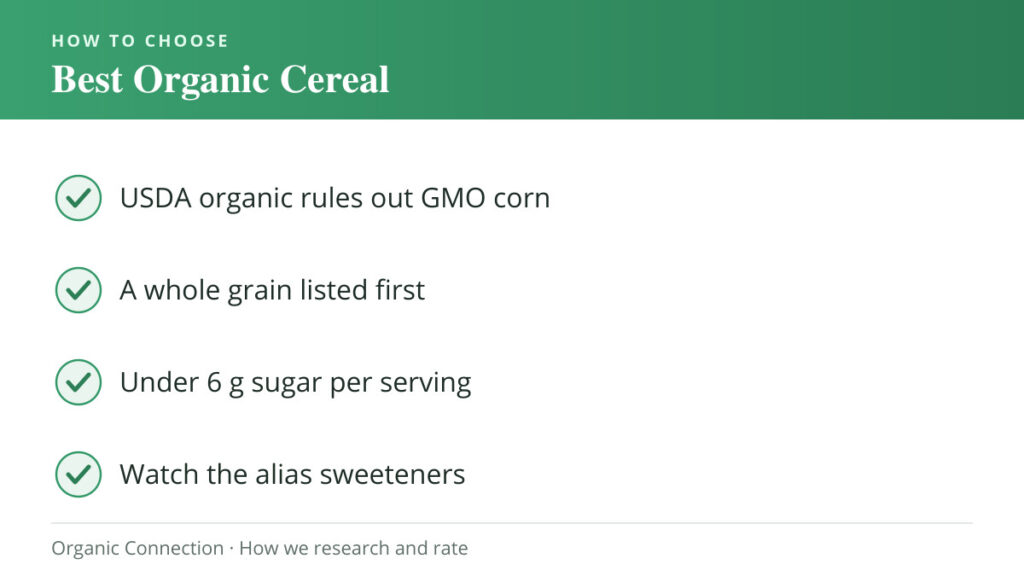
How to choose organic cereal
- Confirm USDA organic. On grain, this rules out GMO corn and pre-harvest glyphosate.
- Check the first ingredient. A whole grain, not a refined flour or starch.
- Read sugar per serving. Under 6 grams is a reasonable target; compare it against the serving weight.
- Spot the alias sweeteners. Cane juice, brown rice syrup, and fruit juice concentrate are all sugar.
- Look for fiber. Three grams or more per serving is what makes a cereal actually filling.
Who should buy organic cereal
The right cereal depends on who is eating it. If you want the cleanest low-sugar organic cereal for everyday breakfast, our top pick fits. If you want maximum fiber, a cereal with no added sugar for children, the lowest-priced classic O, or a sweeter flake that is still certified organic, we have a pick for each.
Best overall: Nature’s Path Organic Heritage Flakes
| Organic Integrity Score | 93 / 100 |
| Grain | Six ancient grains, 23 g whole grain per serving |
| Certification | USDA Organic, Non-GMO |
| Best for | An everyday whole-grain staple in a box big enough to last |
Heritage Flakes is our top pick because it does the thing this category keeps promising and rarely delivers: a genuine whole-grain base, in a box you can actually live on, at a price that does not punish you for it. Nature’s Path builds it on six ancient grains rather than a single refined flour, and the label states 23 g of whole grain and 5 g of protein per serving. It is USDA certified organic and made with non-GMO ingredients, with no artificial colors, flavors, or preservatives.
The economics are the quiet argument. At 33.5 oz this is the largest box here, and it works out within half a cent an ounce of our value pick, so the everyday staple and the cheap option cost effectively the same. That is unusual: organic cereal normally makes you choose between the two.
Two honest caveats. It is sweetened, lightly, with organic sweetener and honey, so it is not a no-sugar cereal, and the sea salt and honey give it a definite flavor rather than a neutral one. It is also built on wheat, barley and other gluten grains, so it is not gluten free. Nor is anything else on this page certified gluten free, which is a real gap if that is your constraint: even the oat-based picks carry no certification, because oats are routinely cross-contaminated with wheat during milling unless a producer segregates them deliberately.
What we liked: Six ancient grains with 23 g whole grain and 5 g protein per serving, USDA organic and non-GMO, no artificial additives, and by far the best cost per ounce of any everyday box here.
Keep in mind: Contains wheat and barley, so it is not gluten free, and it is lightly sweetened rather than unsweetened.
What the listing discloses: Nature’s Path lists USDA organic certification. The gap is where it was grown or made.
Highest fiber: Nature’s Path Organic Smart Bran
| Organic Integrity Score | 87 / 100 |
| Grain | Wheat bran with psyllium and oat bran |
| Certification | — |
| Best for | Digestive regularity and staying full until lunch |
Smart Bran is the fiber specialist, and it does that job better than anything else in this guide. It combines wheat bran, oat bran, and psyllium husk to deliver a fiber load per serving that most cereals cannot approach, while staying USDA certified organic and keeping sugar modest. For anyone whose reason for eating cereal is digestive regularity or staying full through the morning, this is the practical answer.
The trade-off is texture and adjustment. Bran cereal is firm and tastes distinctly of bran, which is an acquired preference, and jumping straight to a high-fiber cereal after a low-fiber diet reliably produces bloating for a week or so. Start with a half portion mixed into another cereal and drink plenty of water.
What we liked: Exceptional fiber content from three sources, USDA organic, modest sugar, and genuinely filling.
Keep in mind: Firm bran texture, an acquired taste, and it needs a gradual introduction to avoid bloating.
What the listing discloses: Nature’s Path leaves the basics open, including whether the USDA seal applies and where it was grown or made.
Best for kids: Cascadian Farm Organic Cinnamon Apple
| Organic Integrity Score | 83 / 100 |
| Grain | Whole grain oats, 25 g whole grain per serving |
| Certification | USDA Organic, Non-GMO Project Verified |
| Best for | Children, and anyone cutting added sugar without cutting flavor |
This is the pick that makes the fewest compromises for the audience that usually gets the worst of them. It is Certified USDA Organic and Non-GMO Project Verified, the most complete certification pairing on this page; it carries 25 g of whole grain per serving, the highest stated figure of our five; and it has no added sugar at all. The sweetness comes from date powder and apple puree, with cinnamon doing the rest.
That “no added sugar” flag deserves the same scrutiny we give any other claim, because it is a labeling term with a specific meaning, not a health verdict. It tells you no sugars were added during processing. It does not tell you the cereal is low in sugar: the sugars in date powder and apple puree are naturally occurring, so they count toward total sugars on the panel while leaving the added-sugar line at zero, and dates are roughly two-thirds sugar by weight. What you are buying is a cereal sweetened from fruit instead of from cane, which is a real ingredient improvement and for most shoppers a genuine reduction. Read the total sugars line rather than letting the front of the box settle it.
Set against the two picks above it, the limits are size and price. A 12 oz box is the smallest here and among the most expensive per ounce, so this is a cereal you buy for the ingredient list rather than for the shelf economics.
What we liked: The strongest certification pairing on the page, the highest stated whole grain per serving, no added sugar, and a flavor children actually choose.
Keep in mind: “No added sugar” is not the same as low sugar, since the date powder still contributes sugars, and the 12 oz box is the smallest here.
What the listing discloses: Cascadian Farm states USDA organic certification and Non-GMO Project Verified, and does not say where it was grown or made.
Best value: 365 by Whole Foods Market Organic Morning Os
| Organic Integrity Score | 80 / 100 |
| Grain | Organic whole grain oat and rice flours |
| Certification | USDA Organic |
| Best for | The cheapest certified organic O-shaped cereal here |
Morning Os is the straight organic swap for the O-shaped cereal most American households grew up on, and it is the cheapest box on this page by both measures that matter: lowest sticker price and lowest cost per ounce. For a 14 oz box that is hard to argue with. It is organic, built on whole grain oat flour, and the listing is explicit that there are no artificial sweeteners and no bleached flours.
Two things keep it out of the top three rather than in them. The grain bill is “organic whole grain oat and rice flours”, and only the oat flour is described as whole grain, so this is not a wholly whole-grain cereal in the way the picks above it are. And the certification detail is thinner: organic is stated clearly, but there is no Non-GMO Project verification alongside it, where two of our picks carry both.
Neither point is a reason to avoid it. If the choice in front of you is this or a conventional supermarket O, this is the better box and it costs about the same.
What we liked: The lowest price here on both sticker and cost per ounce, organic certification, whole grain oat flour, and a familiar plain flavor that takes fruit well.
Keep in mind: The rice flour is not stated as whole grain, and the listing claims organic certification without Non-GMO Project verification.
What the listing discloses: 365 by Whole Foods Market is thin on detail, and does not say whether the USDA seal applies and where it was grown or made.
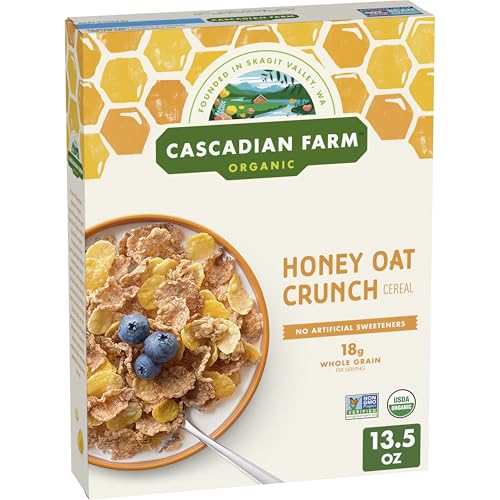
Best crunchy flake: Cascadian Farm Organic Honey Oat Crunch
| Organic Integrity Score | 74 / 100 |
| Grain | Whole grain wheat and oats with corn and rice, 19 g whole grain per serving |
| Certification | USDA Organic, Non-GMO Project Verified |
| Best for | A sweeter, crunchier bowl that stays inside organic |
Honey Oat Crunch is the box for the person who finds the picks above it worthy but joyless. It is a sweetened, crunchy flake built on whole grain wheat and oats with corn and rice, certified USDA organic and Non-GMO Project Verified, and it is the most straightforwardly enjoyable cereal here.
It also carries this page’s most interesting marketing claim, and the claim needs unpacking. Cascadian Farm promotes it as containing “at least 1% Kernza grain”, a perennial wheatgrass whose roots run several feet deep and which genuinely does reduce erosion, hold soil carbon, and cut nitrogen leaching in ways annual wheat cannot. The agronomy is real, and the company deserves some credit for buying Kernza at all, since it is barely commercialized. But 1% is a floor, not a proportion to be proud of: the other 99% of the box is ordinary organic grain. Read it as a signal that a large brand is helping fund an early supply chain, which is worth something, rather than as a climate feature of your breakfast.
It scores lowest here for the plainest reason. It is the sweetest cereal on the page, honey included, and at 19 g per serving it has the lowest stated whole grain of the picks that state one, because the corn and rice dilute what the wheat and oats bring.
What we liked: USDA organic and Non-GMO Project Verified in a cereal people actually crave, with a real if small perennial-grain commitment behind it.
Keep in mind: The sweetest and lowest whole grain of our picks, and the Kernza content is a stated minimum of 1%.
What the listing discloses: Cascadian Farm commits to USDA organic certification and Non-GMO Project Verified but stops short of where it was grown or made.
Building a better bowl
What you add matters as much as which box you buy. A plain low-sugar cereal plus fresh or frozen fruit gives you sweetness with fiber attached, which behaves very differently from the same grams of added sugar in the box. A spoonful of chia seeds, ground flax, or chopped nuts adds protein and fat, which is what actually keeps you full to lunch; cereal alone is mostly carbohydrate and tends to leave you hungry by mid-morning. Check the serving size on the panel against what you actually pour, since the listed serving is often around 30 grams and a real bowl is frequently double that, doubling the sugar and calories with it. If you are switching a household off sweetened cereal, mixing the sweet cereal and the plain one at a 3:1 ratio and shifting it over a few weeks works better than a cold swap. Store opened boxes with the liner rolled tightly closed or decant into an airtight container; cereal goes stale from humidity faster than most people expect.
The fortification gap: where organic cereal is often weaker
This is the trade-off organic cereal guides consistently skip, and it runs against the usual direction of a recommendation, so it deserves stating plainly.
Conventional breakfast cereal is one of the most heavily fortified categories in the food supply. A cup of cereal made from standard wheat supplies roughly 10% of daily iron; the same cup made with fortified grain can supply close to 100%. The same applies to folic acid, B12, riboflavin, niacin and often vitamin D and zinc. For many households — particularly children, teenagers and menstruating women — cereal is a meaningful share of total intake of several nutrients, whether or not anyone planned it that way.
Many organic cereals are not fortified at all, because minimal ingredient lists are the category’s whole positioning and synthetic vitamin additions sit awkwardly with that. That is a defensible philosophy and a real nutritional difference.
| Nutrient | Typical fortified cereal | Typical unfortified organic cereal |
| Iron | Often 45–100% DV per serving | Whatever the grain naturally contains, roughly 6–10% |
| Folic acid | Commonly 25–100% DV | Usually none added |
| Vitamin B12 | Commonly added | None — grains contain no B12 |
| Vitamin D | Often added | Usually none |
Keep in mind: if cereal is an occasional breakfast, this does not matter. If it is a daily staple for a growing child, a teenager, someone vegetarian or vegan, or anyone whose iron runs low, an unfortified organic cereal is a step down from the fortified box beside it, and a cleaner ingredient list does not make up for it. Either choose a fortified organic cereal — they exist, and several major organic brands do fortify — or make sure those nutrients are coming from elsewhere deliberately. Worth knowing: US rules require ready-to-eat cereals listing a whole grain first to be fortified unless the cereal is 100% whole grain, which is why some minimally processed organic cereals are exempt.
Serving sizes, and the arithmetic nobody does
Nutrition panels are calculated on serving sizes that bear little relation to how anyone actually pours cereal, which makes every number on the box optimistic.
- Typical label serving: 30–40 g, or around ¾ to 1 cup for a flake cereal.
- Typical real bowl: 60–80 g. Dense cereals like granola are worse — the label serving is often ¼ cup, and a realistic portion is three to four times that.
- The consequence: a cereal listing 8 g of sugar per serving delivers 16–20 g in a real bowl, and a granola at 12 g per quarter-cup can approach 40 g.
- Weigh your bowl once. It takes thirty seconds and permanently recalibrates how you read these panels. Most people are shocked.
- Milk is not in the numbers unless the panel says “with ½ cup milk”, which adds its own sugars, protein and calories.
A practical benchmark: aim for 6 g of added sugar or less per label serving, and at least 3 g of fiber. That combination filters out most of the aisle very quickly.
Reading the ingredient list
- “Whole grain oats” first is what you want. “Made with whole grain” on the front tells you nothing about how much.
- Count the sweeteners. Manufacturers split sugar across several names — cane sugar, cane syrup, honey, molasses, fruit juice concentrate, brown rice syrup, malt extract — so that no single one appears near the top. Add them together mentally.
- “No added sugar” sweetened with fruit juice concentrate is still sugar, and metabolically almost identical. It is a labeling route, not a nutritional one.
- Brown rice syrup carries an arsenic caveat: rice takes up arsenic from soil, organic certification does not change that, and products using it as a primary sweetener have tested higher for inorganic arsenic. Relevant if a cereal is a daily fixture for a small child.
- “Made with organic ingredients” means at least 70% organic and cannot carry the USDA seal. The seal itself means 95% or more.
- Watch for added “natural flavor” in cereals marketed as simple — it is permitted in organic products and is frequently doing more work than the fruit pictured on the box.
Where organic genuinely earns its premium here
Two specific things, rather than a general claim.
Glyphosate on oats. Oats are commonly desiccated with glyphosate shortly before harvest, and residues survive into finished products. EWG-commissioned testing in 2018 detected glyphosate in all 28 oat-based cereal and breakfast products it sampled, with the highest at almost 18 times EWG’s own 160 ppb benchmark; follow-up testing in 2023 found levels had dropped. Worth being fair about: EWG’s benchmark is far stricter than the EPA tolerance of 30 ppm, so most flagged products were within federal limits. Organic certification prohibits glyphosate outright, which removes the question rather than asking you to weigh parts per billion. For an oat-based cereal eaten daily, this is the strongest argument in the category.
Synthetic colors and preservatives. Organic rules prohibit synthetic dyes — Red 40, Yellow 5, Yellow 6, Blue 1 — along with BHT and BHA, which are still used as preservatives in some conventional cereals and packaging. Brightly colored children’s cereals are where this matters most, and organic versions color with fruit and vegetable concentrates instead. Expect duller colors; that is the point.
The iron in cereal is literally iron
A small but genuinely useful piece of knowledge: the iron added to fortified cereal is usually elemental iron — finely ground metallic iron powder, not a dissolved compound. You can drag a strong magnet through crushed fortified cereal in water and physically collect the filings. It is a well-known school science demonstration and it surprises people every time.
It is not a scandal. Stomach acid converts elemental iron to an absorbable form, and it is a recognized, permitted fortificant used precisely because it is stable and does not affect taste or shelf life. Absorption is somewhat lower than from ferrous sulfate, which is one reason fortification levels are set high. Vitamin C alongside improves uptake substantially, so fruit with cereal is doing more than adding flavor — while tea or coffee with the meal reduces it.
Storage
- Airtight is everything. Cereal goes stale by absorbing humidity, not by spoiling. Roll the inner bag down tightly or decant into a sealed container.
- Unopened boxes keep 6–12 months; once opened, expect 1–3 months before texture noticeably declines.
- Cereals with nuts, seeds or added oil go rancid rather than merely stale — granola especially. Smell it: sharp or paint-like means discard. Organic granolas without synthetic antioxidants sit at the shorter end.
- Do not refrigerate. Condensation makes cereal soggy far faster than a cupboard does.
- Freeze granola and nut-heavy cereals if you buy large bags — it stops the oils oxidizing and does not affect texture.
- Pantry moths are more common with organic cereals, which receive no fumigant treatment. The eggs arrive in the packaging; a sealed container contains the problem rather than letting it spread through a cupboard.
How we researched this guide
We are a research-based review site. We compared each product against its certification (USDA organic), grain quality and whether a whole grain leads the ingredient list, sugar and fiber per serving, ingredient purity, and the weight of aggregated customer feedback on taste and value, then scored each with our 10-criteria Organic Integrity Score. No brand paid to be included or ranked. Read the full method on our How We Research and Rate page.
Sugar per serving, and the serving nobody uses
Breakfast cereal is worth examining closely because it is a category where the nutrition panel and the way the product is eaten diverge more than almost anywhere else.
Start with the stated serving, which is typically 30 to 40 grams. Poured to a normal depth in a normal bowl, most people serve 60 to 90 grams, so every figure on the panel should be read as roughly double what you will actually eat. This is not a trick; it is simply that the reference serving and the human serving differ.
Sugar is the second issue. Cereals marketed as healthy frequently carry 20 to 30% sugar by weight, and the presence of whole grain, added fiber or a heart symbol on the front does not constrain it. A bowl can supply more added sugar than a chocolate bar while reading as a virtuous breakfast.
The variable that actually predicts fullness is fiber and protein per serving. A cereal with 8 grams of fiber and a decent protein content behaves quite differently from a puffed or flaked product with 2, regardless of how either is marketed. Milk contributes protein, which is a large part of why cereal is more satiating with dairy or soy than with almond milk.
A useful rule for the aisle: check sugar per 100 grams rather than per serving, since serving sizes vary between brands and 100 grams does not. Under 10 grams is good, over 20 is a dessert.
Honest summary: a food category where the label understates the portion and the front of the box says little about the panel, and where fiber and protein per serving are the numbers worth comparing.
Common questions about organic cereal
What is the best organic cereal?
Our overall pick is Nature’s Path Organic Heritage Flakes, which scores highest here at 93, because it is USDA certified organic, built on six ancient grains, and delivers 23 g of whole grain per serving in the biggest box on the page. For the highest fiber, Nature’s Path Smart Bran is our pick. For children or anyone cutting added sugar, Cascadian Farm Organic Cinnamon Apple has no added sugar and the highest stated whole grain per serving. For the lowest price, 365 by Whole Foods Market Organic Morning Os.
Is organic cereal healthier than regular cereal?
It is cleaner, not automatically healthier. USDA organic certification rules out GMO corn, synthetic pesticides, and the pre-harvest glyphosate commonly applied to conventional wheat and oats, which is a real difference. It places no limit on sugar, so an organic cereal can be just as sweet as a conventional one. Read the sugar per serving separately from the seal.
How much sugar should organic cereal have?
Under 6 grams per serving is a reasonable target for an everyday cereal. Compare that figure against the serving weight on the panel: a 30 gram serving with 12 grams of sugar is 40 percent sugar regardless of what the front of the box says.
What are the hidden sugars in organic cereal?
Organic cane sugar is the obvious one. Less obvious are organic evaporated cane juice, organic brown rice syrup, organic fruit juice concentrate, organic honey, and organic molasses. All are sugar, and a cereal can use several at once so that none appears high in the ingredient list while the total remains substantial.
Does “made with whole grain” mean the cereal is whole grain?
No. That phrase only means some whole grain is present, potentially a token amount, and the cereal may still be built mainly on refined flour. The reliable check is whether a whole grain is the first ingredient on the list.
Is organic cereal fortified with vitamins and iron?
Often not, and this is where organic can be nutritionally weaker. Conventional cereal is heavily fortified — a cup made with fortified grain can supply close to 100% of daily iron against roughly 10% from the grain alone, plus folic acid, B12, riboflavin and often vitamin D. Many organic cereals add nothing, because minimal ingredient lists are their positioning. If cereal is a daily staple for a child, a teenager or anyone whose iron runs low, choose a fortified organic cereal — several major organic brands do fortify — or get those nutrients elsewhere deliberately.
How much cereal is a real serving?
Roughly double the label serving. Panels are calculated on 30 to 40 g, while a typical poured bowl is 60 to 80 g — and granola is worse, where a label serving is often a quarter cup against a realistic three to four times that. So a cereal listing 8 g of sugar per serving delivers 16 to 20 g in practice. Weigh your usual bowl once; it permanently recalibrates how you read these panels.
How much sugar should breakfast cereal have?
Aim for 6 g of added sugar or less per label serving, with at least 3 g of fiber. That filters out most of the aisle quickly. Watch for sweeteners split across several names — cane sugar, cane syrup, honey, molasses, fruit juice concentrate, brown rice syrup, malt extract — so no single one appears near the top of the list.
Is “no added sugar” cereal sweetened with fruit juice better?
No. Fruit juice concentrate is sugar, and metabolically almost identical to what it replaced. It is a labeling route rather than a nutritional improvement. Brown rice syrup carries an additional caveat, since rice takes up arsenic from soil and products using it as a primary sweetener have tested higher for inorganic arsenic — worth knowing if a cereal is a daily fixture for a small child.
Does organic cereal have less glyphosate?
It should have none, since organic certification prohibits it. Oats are commonly desiccated with glyphosate shortly before harvest and residues survive into finished products — EWG-commissioned testing in 2018 found it in all 28 oat-based breakfast products sampled, the highest at almost 18 times EWG’s 160 ppb benchmark, though follow-up testing in 2023 found levels had fallen. Fairness point: EWG’s benchmark is far stricter than the EPA’s 30 ppm tolerance, so most flagged products were within federal limits.
Why is the iron in cereal magnetic?
Because it literally is iron. The fortificant used is usually elemental iron — finely ground metallic iron powder — which you can collect with a strong magnet from crushed cereal in water. It is not a scandal: stomach acid converts it to an absorbable form, and it is used because it is stable and does not affect taste or shelf life. Absorption is lower than from ferrous sulfate, which is partly why fortification levels are set high. Vitamin C improves uptake, while tea or coffee with the meal reduces it.
What does organic certification remove from cereal?
Synthetic dyes — Red 40, Yellow 5, Yellow 6, Blue 1 — plus BHT and BHA preservatives, synthetic pesticide residues including glyphosate, and artificial flavors. Brightly colored children’s cereals are where this matters most; organic versions color with fruit and vegetable concentrates instead, so expect duller colors.
How long does cereal last once opened?
1 to 3 months before texture noticeably declines, against 6 to 12 months for an unopened box. Cereal goes stale by absorbing humidity rather than spoiling, so airtight storage matters more than the date. Cereals with nuts, seeds or added oil go rancid rather than merely stale — granola especially — and a sharp or paint-like smell means discard. Do not refrigerate; condensation makes cereal soggy faster than a cupboard does.
- Organic Food & Pantry hub
- Best Organic Oatmeal
- Best Organic Oat Milk
- How we research and rate products
- all our reviewed products in one place — sortable by Organic Integrity Score
- Glyphosate in food, explained
Price and availability as of October 11, 2026 7:10 pm EDT. Product prices and availability are accurate as of the date/time indicated and are subject to change. Any price and availability information displayed on Amazon.com at the time of purchase will apply to the purchase of this product.
Looking for other organic products?
We have checked more than 800 products across food, household goods, gardening, personal care and pet, every one against its stated certification. Browse all reviews.
Organic Connection is reader-supported. When you buy through links on this page we may earn a commission, at no extra cost to you. As an Amazon Associate we earn from qualifying purchases. We are not paid to feature or rank any product. How we research and rate.