Last updated: September 30, 2026
We may earn a commission when you buy through links on this page, at no extra cost to you. How we research and rate.
The short version
After researching the sourcing, processing, and certifications of the most popular organic nuts, our top pick is Terrasoul Superfoods Organic Almonds. They are USDA organic, truly raw (never steam-pasteurized), lab-tested, and imported from Spain, which is why they earned our highest Organic Integrity Score of 93 out of 100. For creamy raw cashews, Food to Live Organic Cashews are our pick, and for omega-3-rich walnuts, Terrasoul Organic Walnuts are the best choice.
With nuts, the main things that matter are clean organic sourcing, whether they are truly raw or heat-treated, and freshness, since the healthy fats can go rancid. We flag each pick’s nut, form, and certification.
Best organic nuts compared
| Best Choice | Best Value | ||||
 |  |  |  |  | |
| Product | Terrasoul Walnuts | Terrasoul Pecans | Terrasoul Almonds | Food to Live Cashews | Food to Live Mixed |
| Organic Integrity Score | 93/ 100 | 90/ 100 | 89/ 100 | 86/ 100 | 80/ 100 |
| Our rating | 4.7 | 4.5 | 4.5 | 4.3 | 4.0 |
| Nut | Walnuts | Pecans | Almonds | Cashews | Mixed nuts |
| Form | Raw halves | Raw halves | Raw, unsalted | Raw, unsalted | Raw mix |
| Certification | Certified Organic, Non-GMO, Gluten-free | Non-GMO Project Verified, Certified Organic, Kosher | USDA Organic, Non-GMO, Kosher | Certified Organic, Non-GMO, Kosher | Non-GMO, Kosher, Vegan |
| Best for | Omega-3-rich snacking | Baking, snacking | Versatile organic nut | Snacking and creamy cashew | Variety, trail mix |
| Price | $17.99$1.12 / ounce View on Amazon | $18.99$1.73 / ounce View on Amazon | $29.99$0.94 / ounce View on Amazon | $13.34 $14.82 −10%$0.83 / ounce View on Amazon | $21.82$1.36 / ounce View on Amazon |
Price and availability as of October 11, 2026 7:10 pm EDT. Product prices and availability are accurate as of the date/time indicated and are subject to change. Any price and availability information displayed on Amazon.com at the time of purchase will apply to the purchase of this product.
Scores are ours, based on independent research of certification, sourcing and testing, processing, and freshness, using the same 10-criteria method we apply to every product. See how we research and rate.
What each certification on an organic nuts label actually covers
A seal is a specific promise about a specific thing. These are the promises behind the marks on this page, in plain terms, along with the question each one leaves unanswered.
| Certification | Covers | Key exclusion |
| USDA Organic | Farming and handling: no synthetic pesticides or fertilizers, no GMOs, no sewage sludge or irradiation, audited yearly by an accredited certifier | Three different tiers share the one seal, and it makes no claim about worker pay, food miles, or nutrition |
| Kosher | Ingredients and production comply with Jewish dietary law, verified by a rabbinic agency that inspects the facility | A dietary-law standard: it makes no claim about pesticides, GMOs or farming practice |
Kosher and organic answer entirely different questions. A kosher mark, OU, OK, Star-K and others, confirms that ingredients and production follow Jewish dietary law, verified by an agency that inspects the facility. It is a rigorous supply-chain audit and it says nothing about pesticides, GMOs or farming. The two seals appear together often precisely because neither substitutes for the other.
Key things to look for in organic nuts
Good organic nuts are about clean sourcing, form, and freshness. Here is what matters.
1. USDA organic and lab-tested
Organic confirms no synthetic pesticides, and the best brands lab-test for pesticide residue and aflatoxins.
2. Truly raw vs heat-treated
Raw nuts keep the most nutrients; note that US-grown almonds are required to be pasteurized, so “raw” almonds are usually imported.
3. Salted vs unsalted
Raw, unsalted nuts let you control salt and roast or season them yourself.
4. Freshness and storage
Nuts’ healthy fats go rancid over time, so favor lab-tested brands with resealable bags and store nuts cool or frozen.
What buying organic actually changes for nuts
Nuts are a nutrient-dense whole food you often eat raw and by the handful, so choosing organic to avoid synthetic pesticides makes sense for a regular snack. Sourcing and processing matter too: truly raw nuts keep more of their nutrients, and because US-grown almonds must be pasteurized (sometimes with heat or a chemical called PPO), genuinely raw almonds are typically imported from regions like Spain. Freshness is the other key factor, since the healthy fats in nuts can go rancid, so lab-tested brands with good packaging and turnover are ideal.
Our scoring rewards genuine USDA certification, clean lab-tested sourcing, truly raw processing where it matters, and freshness and value, so you get nuts that are both certified organic and genuinely fresh.
Rancidity is the real quality problem, not pesticides
Most guides in this category focus entirely on certification. The thing far more likely to actually affect what you eat is oxidation, and almost nobody checks for it.
Why it happens. Nuts and seeds are high in unsaturated fat, and unsaturated bonds react with oxygen. Once that starts, the fats break down into hydroperoxides which decompose further into volatile compounds, chiefly hexanal, pentanal, and 2,4-decadienal, that produce the sharp, waxy, paint-like or old-crayon smell people recognize as rancid. It is a chemical cascade rather than a spoilage organism, so there is no mold to see and no obvious visual warning.
What it costs you. Beyond taste, oxidation destroys the things you bought the food for. In chia specifically, tocopherol content can fall by up to 91% within six months of poor storage. Rancid nuts and seeds deliver oxidized fats instead of intact ones, which is the opposite of the intended result.
| Factor | Effect on shelf life |
| Whole and unopened, cool and dark | Longest, often a year or more |
| Opened at room temperature | Cut sharply, often to a few months |
| Ground, milled, or chopped | Degrades roughly 3 to 5 times faster, since surface area rises enormously |
| Refrigerated after opening | Substantially extends life |
| Frozen | Best option for anything you will not finish in a couple of months |
| Clear jar in daylight, warm cupboard | Worst case; light and heat both accelerate oxidation |
The test is your nose, every time. Fresh nuts and seeds smell faintly sweet, buttery, or grassy. If it smells sharp, bitter, waxy, or like old paint, it has oxidized and should be thrown out rather than masked in a smoothie. This is more reliable than any date on the packet, because the date does not know how the product was stored between the factory and your kitchen.
Two things commonly claimed that do not hold up
Soaking to remove phytic acid. The popular advice is to soak nuts and seeds to neutralize phytates and “unlock” minerals. Research is unflattering: soaking whole nuts was not effective at reducing phytate concentration at all. Soaking chopped nuts did reduce phytic acid, and it also reduced the mineral content along with it, which rather defeats the purpose. Soaking has legitimate uses, it makes nuts softer and some people find them easier to digest, and the phytate-and-minerals argument for it is weak.
Aflatoxins, in proportion. Aflatoxins are carcinogenic compounds produced by Aspergillus molds, and nuts, peanuts, pistachios, and dried fruit are all susceptible during growing and storage. This is a genuine food safety category with real regulatory limits, and commercial products in developed markets are tested against them. The practical protections are ordinary: buy from suppliers with high turnover, store cool and dry, and discard any nut that tastes bitter or looks shrivelled or discolored rather than eating around it. Organic certification does not address aflatoxin, which is a storage and handling issue rather than a spraying one.
How to choose organic nuts
- Look for USDA organic and lab testing. Clean growing plus testing for residues and aflatoxins.
- Decide raw or roasted. Raw keeps the most nutrients; you can roast and season them yourself.
- Choose unsalted to control salt. Raw, unsalted nuts are the most versatile.
- Buy sizes you will use. Bulk is cheaper per pound, but store it cool or frozen to keep it fresh.
- Mix it up. Different nuts offer different nutrients, so variety is a plus.
Who should buy organic nuts
Every nut suits a different job. For organic almonds, our top pick is the bag to buy. If you want creamy cashews, omega-3-rich walnuts, buttery pecans, or a versatile mixed-nut blend, we have a pick for each.
Best overall: Terrasoul Organic Walnuts
| Organic Integrity Score | 93 / 100 |
| Nut | Walnuts, raw halves and pieces |
| Certification | Certified Organic, Non-GMO, Gluten-free |
| Best for | Omega-3-rich snacking and baking |
Terrasoul walnuts are our pick for omega-3s. These USDA-organic, non-GMO raw walnuts are the Chandler variety, prized for their light color and mild, sweet flavor, and walnuts are one of the best plant sources of omega-3 (ALA), making them great over oatmeal and salads, in baking, or by the handful.
What puts it first is simply that its listing names certified organic. That is a lower bar than it sounds, and most rivals here do not clear it.
What we liked: USDA organic and non-GMO, light-colored Chandler walnuts, rich in omega-3, and mild and sweet in flavor.
Keep in mind: Walnuts are high in oil and go rancid faster, so buy sizes you will use and store them cool or frozen.
What the listing discloses: Terrasoul Superfoods is thin on detail, and does not say whether the USDA seal applies and where it was grown or made.
Best pecans: Terrasoul Organic Pecans
| Organic Integrity Score | 90 / 100 |
| Nut | Pecans, raw mammoth halves |
| Certification | Non-GMO Project Verified, Certified Organic, Kosher |
| Best for | Baking, snacking, and pecan pie |
Terrasoul pecans are our pick for baking and buttery snacking. These USDA-organic, non-GMO raw mammoth pecan halves are grown in the USA, fresh and lab-tested, with a rich, buttery flavor perfect for pecan pie, granola, salads, or snacking straight from the resealable pouch.
It scores in the value range because pecans are a pricier, more special-occasion nut and, like walnuts, are oil-rich and best used fresh, but for clean, fresh organic pecans, they are excellent.
What we liked: USDA organic and non-GMO, large mammoth halves, rich buttery flavor, and USA-grown and lab-tested.
Keep in mind: Pecans are pricier and oil-rich, so they are best bought fresh and stored cool.
What the listing discloses: Terrasoul Superfoods documents Non-GMO Project Verified, kosher certification and an origin of the USA, and leaves whether the USDA seal applies unsaid.
Versatile organic nut: Terrasoul Superfoods Organic Almonds
| Organic Integrity Score | 89 / 100 |
| Nut | Almonds, raw, unsalted |
| Certification | USDA Organic, Non-GMO, Kosher |
| Best for | An all-around versatile organic nut |
Terrasoul almonds are our top pick because they are genuinely raw, clean, and versatile. These USDA-organic, non-GMO almonds are imported from Spain, where they are never treated with steam, irradiation, high heat, or chemical sterilization, so they stay truly raw and sproutable, and each batch is lab-tested for aflatoxins and pesticide residues, ideal for snacking, almond milk, and baking.
The trade-off is that truly raw imported almonds cost a bit more than mass-market ones. For clean, genuinely raw, versatile organic almonds, they hold up well.
What we liked: USDA organic and non-GMO, truly raw (never heat-pasteurized), lab-tested, and versatile for snacking and almond milk.
Keep in mind: Genuinely raw imported almonds cost more than pasteurized US almonds, and should be stored cool for freshness.
What the listing discloses: Terrasoul Superfoods is explicit about USDA organic certification and kosher certification, and silent on where it was grown or made.
Best cashews: Food to Live Organic Cashews
| Organic Integrity Score | 86 / 100 |
| Nut | Cashews, raw, whole, unsalted |
| Certification | Certified Organic, Non-GMO, Kosher |
| Best for | Snacking and creamy cashew recipes |
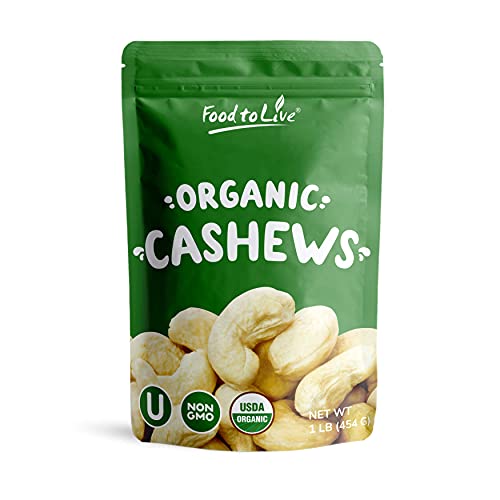
Food to Live cashews are our pick for creamy cashews. These USDA-organic, non-GMO whole raw cashews are unsalted with no additives, rich in copper, magnesium, and zinc, and perfect eaten as a snack, roasted at home, or blended into creamy dairy-free sauces, cheeses, and desserts, in a resealable bag.
What we liked: USDA organic and non-GMO, whole raw unsalted cashews, versatile for snacking and creamy recipes, and a resealable bag.
Keep in mind: All “raw” cashews are lightly steam-processed to remove the shell, which is normal for the nut.
What the listing discloses: Food to Live is explicit about kosher certification, and silent on whether the USDA seal applies and where it was grown or made.
Best mixed: Food to Live Organic Mixed Raw Nuts
| Organic Integrity Score | 80 / 100 |
| Nut | Cashews, Brazil nuts, walnuts, almonds |
| Certification | Non-GMO, Kosher, Vegan |
| Best for | Variety, trail mix, and snacking |
Food to Live Mixed is our pick for variety. This USDA-organic, non-GMO mix combines raw cashews, Brazil nuts, walnuts, and almonds, unsalted and low in sodium, delivering a range of nutrients (including selenium from the Brazil nuts) in one bag, ideal as a snack, trail mix base, or salad and oatmeal topper.
It scores at the value end because a mix gives you less of any single nut and can vary batch to batch, but for easy variety and balanced nutrition in one organic bag, it is a smart, convenient choice.
What we liked: USDA organic and non-GMO, four nuts in one bag for variety and nutrients, raw and unsalted, and versatile.
Keep in mind: A mix means less of any single nut, and Brazil nuts are high in selenium, so eat them in moderation.
What the listing discloses: Food to Live lists kosher certification. The gap is whether the USDA seal applies and where it was grown or made.
How to enjoy and store organic nuts
Raw organic nuts are ready to snack, or you can roast them at home: spread on a tray and bake at around 300 to 350°F for 10 to 15 minutes, tossing occasionally, and add sea salt or spices to taste. Sprinkle them over oatmeal, yogurt, and salads, blend cashews into creamy sauces, or fold them into baking and trail mix. Because the healthy fats in nuts can go rancid, store them sealed in a cool, dark place, or in the fridge or freezer for longer freshness, especially oil-rich walnuts and pecans. A small handful is a filling, nutrient-dense snack.
“Raw” almonds in the US are not raw
This is the single most useful thing to know about buying nuts in America, and almost nobody selling them explains it.
Following salmonella outbreaks traced to almond processing in 2001 and 2004, the USDA introduced a rule effective 1 September 2007 requiring that all almonds grown in California — which is the overwhelming majority of the US crop — be pasteurized before sale, including almonds still labeled and sold as “raw”. The permitted treatments are steam or steam-vacuum, blanching, dry roasting, oil roasting, radio frequency treatment (approved in 2016), or fumigation with propylene oxide.
Keep in mind: propylene oxide is a fumigant classified as a possible human carcinogen, and it is prohibited for organic almonds. That means every raw organic almond grown in the US has been steam pasteurized rather than chemically fumigated — while a conventional almond labeled “raw” may have been treated with PPO, and nothing on the packet will tell you which. Imported almonds are not covered by the rule at all, so genuinely untreated raw almonds are generally Spanish or Italian.
This is one of the clearest and most specific arguments for buying organic anywhere on this site, and it is unusual in that it concerns post-harvest processing rather than farming. It applies to almonds specifically — the pasteurization mandate does not extend to walnuts, pecans, cashews or pistachios.
One related point worth knowing: cashews are never truly raw either. The shell contains urushiol, the same caustic compound as poison ivy, so all commercial cashews are steamed or roasted to remove it safely. “Raw cashews” means unroasted after that step, not untreated.
Brazil nuts: the one nut with a genuine upper limit
Brazil nuts are an extraordinary selenium source — so concentrated that portion size stops being a matter of calories and becomes a matter of dose.
A single Brazil nut typically supplies somewhere around 68–91 micrograms of selenium, against an adult RDA of 55 mcg and a tolerable upper intake level of 400 mcg per day. Two nuts can therefore meet or exceed daily requirements; a small handful eaten daily can push toward the upper limit, and the content varies enormously depending on soil selenium where the tree grew, so you cannot predict it from the packet.
Chronic excess produces selenosis — the classic signs are brittle hair and nails, hair loss, a garlic odor on the breath, a metallic taste, skin rash and gastrointestinal upset. It is uncommon, and it is one of the few nutrient toxicities a person can plausibly reach from whole food alone.
Practically: one to two Brazil nuts a day is a reasonable ceiling, and there is no reason to eat them by the handful the way you would almonds. If you also take a multivitamin or selenium supplement, count that in — this is where people quietly stack the dose.
Which nuts go rancid fastest, and how to store each
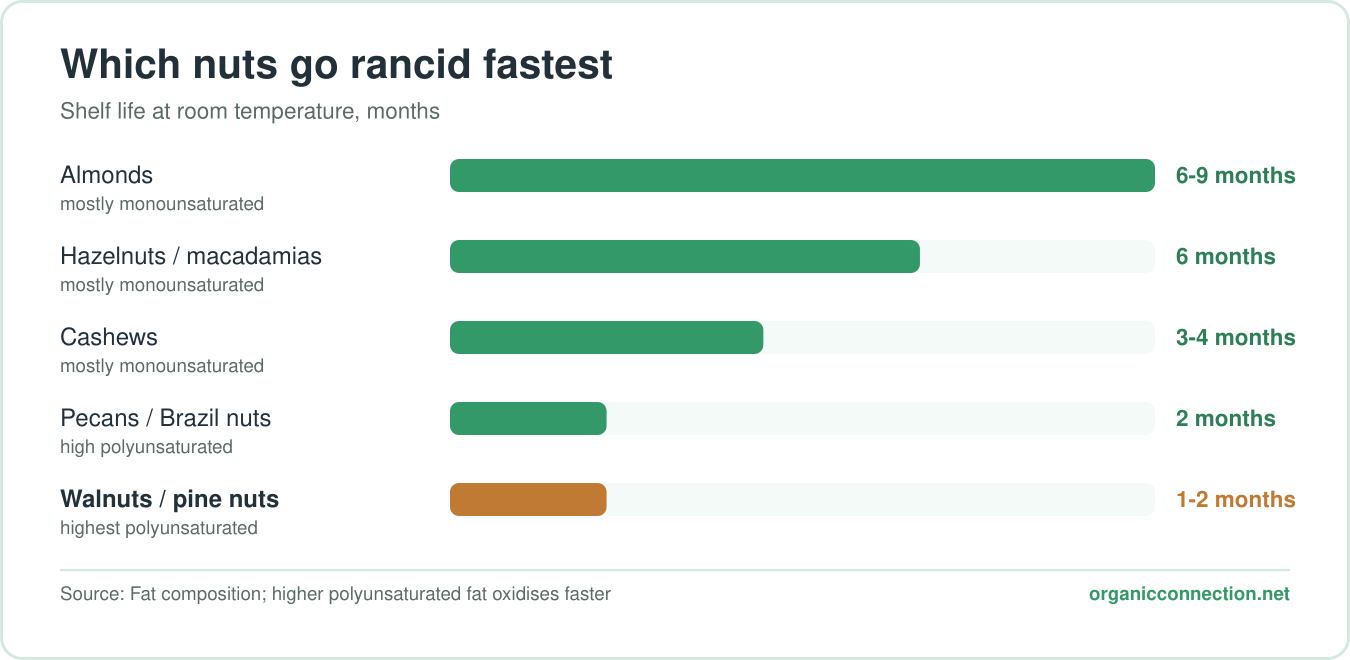
Fat composition determines shelf life almost entirely: the more polyunsaturated the fat, the faster it oxidizes.
| Nut | Fat profile | Pantry | Fridge | Freezer |
| Walnuts | Highest PUFA — goes off fastest | 1–2 months | 6 months | 1 year |
| Pecans | High PUFA | 2 months | 6–9 months | 1–2 years |
| Pine nuts | High PUFA, expensive to waste | 1–2 months | 6 months | 1 year |
| Brazil nuts | High PUFA | 2 months | 6 months | 1 year |
| Cashews | Mostly monounsaturated | 3–4 months | 6–9 months | 1–2 years |
| Almonds | Mostly monounsaturated — very stable | 6–9 months | 1 year | 2 years |
| Hazelnuts | Mostly monounsaturated | 6 months | 1 year | 2 years |
| Macadamias | Mostly monounsaturated, highest fat overall | 6 months | 1 year | 2 years |
- Shelled nuts spoil far faster than in-shell. The shell is a light and oxygen barrier; in-shell nuts keep roughly twice as long.
- Roasted nuts spoil faster than raw. Roasting cracks cell structure and exposes oils, so buy raw in bulk and roast in small batches.
- Chopped and ground nuts spoil fastest of all — surface area again. Grind nut flour as you need it.
- The tell is taste, not smell. Rancid nuts taste sharply bitter and paint-like. One bitter nut in a handful means the batch is going; it is not “just that one”.
- Freezing is genuinely effective and nuts need no thawing before use. It is the right default for anything bought in bulk.
Peanuts are not nuts, and it matters
Peanuts are legumes that grow underground, botanically closer to peas and lentils than to almonds. That distinction has three practical consequences most nut guides skip:
- Allergy is separate. Peanut allergy and tree nut allergy are distinct conditions with distinct proteins. Many people with one do not have the other, though cross-contamination in processing means shared-facility warnings matter for both.
- Growing underground changes the mold risk profile, which is why peanuts are among the crops most closely monitored for aflatoxin alongside pistachios and Brazil nuts.
- Nutritionally they behave more like a nut than a legume — high fat, high protein — which is why dietary advice generally groups them with nuts despite the botany.
Nutritionally the tree nuts differ more than people assume, which is a good argument for variety rather than loyalty to one:
| Per 28 g | Notable for |
| Almonds | Vitamin E and calcium; highest fiber of the common nuts |
| Walnuts | The only common nut high in ALA omega-3 |
| Brazil nuts | Selenium, in quantities requiring restraint |
| Cashews | Iron, magnesium, copper; lower fat than most |
| Pistachios | Highest protein per calorie; potassium and lutein |
| Hazelnuts | Vitamin E, folate, manganese |
| Macadamias | Highest fat, lowest carbohydrate |
| Pecans | Among the highest in antioxidants |
Roasting nuts properly
- 150–160°C (300–325°F) for 10–15 minutes, stirring once. Most recipes call for hotter and faster, which browns the outside before the inside develops flavor and damages the fats.
- Watch the last three minutes. Nuts go from perfect to burnt very quickly, and they continue cooking on a hot tray after they come out.
- Cool completely before storing. Warm nuts sealed in a jar create condensation, which turns them soft and shortens shelf life dramatically.
- Dry roast rather than oil roast where you can. Nuts contain plenty of their own fat, and commercial oil-roasted nuts are usually fried in inexpensive refined oils that add nothing.
- Salt after roasting, with a tiny amount of water or oil to help it adhere. Salt before and the surface steams instead of toasting.
- Check what “roasted and salted” contains — many commercial versions add sugar, maltodextrin, MSG and anti-caking agents alongside the oil.
How we researched this guide
We are a research-based review site. We compared each nut against its certification, sourcing and lab testing, processing, and the weight of aggregated customer feedback on freshness and flavor, then scored each with our 10-criteria Organic Integrity Score. No brand paid to be included or ranked. Read the full method on our How We Research and Rate page.
Why nut eaters weigh slightly less, against expectation
Nuts are calorie-dense by any measure, running between 160 and 200 calories an ounce depending on type. The epidemiology consistently fails to punish people for eating them, and that discrepancy has been studied enough to be worth explaining.
Across large cohort studies and a number of controlled trials, regular nut consumption is associated with slightly lower body weight and smaller waist circumference over time, not higher. Adding nuts to a diet in intervention trials generally produces less weight gain than the added calories predict, sometimes none at all.
Three explanations carry most of the weight. Nuts are satiating out of proportion to their volume, so they displace other eating. Their cell structure resists complete digestion, so measured metabolisable energy runs meaningfully below the label figure, particularly for whole nuts. And there is modest evidence of a small rise in resting energy expenditure after eating them.
Which nut matters less than the form it comes in. Raw or dry-roasted, unsalted, whole nuts show the effect most clearly. Honey-roasted, heavily salted, chocolate-coated or ground into flour, the structural protection disappears and the salt makes overeating easier. This is a strong argument for the plainest version of the product.
Portion is the remaining variable and the one people get wrong. An ounce is a small handful, roughly 23 almonds or 14 walnut halves. From a large bag while distracted, four ounces is effortless, and at that point the arithmetic reasserts itself.
Honest summary: one of the few calorie-dense foods the evidence actively supports including, provided they are plain and portioned rather than snacked from the bag.
Common questions about organic nuts
What are the best organic nuts?
Our overall pick is Terrasoul Superfoods Organic Almonds, because they are USDA organic, truly raw, and lab-tested. For creamy cashews, Food to Live Organic Cashews are our pick, and for omega-3-rich walnuts, Terrasoul Organic Walnuts.
Are organic nuts worth it?
Since you often eat nuts raw and by the handful, choosing organic avoids synthetic pesticide residues on a regular snack. Organic, lab-tested nuts also tend to come from brands that test for aflatoxins and residues, adding assurance.
Why are US almonds not truly raw?
US-grown almonds are required to be pasteurized (sometimes with heat or the fumigant PPO), so almonds labeled truly raw are usually imported from regions like Spain, where pasteurization is not mandated. Terrasoul’s almonds are imported and genuinely raw.
How should I store nuts to keep them fresh?
Keep nuts sealed in a cool, dark place, or refrigerate or freeze them for longer freshness. Oil-rich nuts like walnuts and pecans go rancid faster, so cold storage helps them most.
Are nuts healthy?
Yes, in moderation. Nuts provide plant protein, healthy fats, fiber, and minerals, and a one-ounce handful is a satisfying snack. They are calorie-dense, so portion size matters, and unsalted versions let you control sodium.
Are raw almonds actually raw?
Not if they were grown in California. A USDA rule effective 1 September 2007 requires all Californian almonds to be pasteurized before sale, including those labeled “raw”, after salmonella outbreaks in 2001 and 2004. Permitted treatments include steam, blanching, roasting, radio frequency, or fumigation with propylene oxide. Imported almonds are exempt, so genuinely untreated raw almonds are usually Spanish or Italian.
Why buy organic almonds specifically?
Because of the pasteurization method. Propylene oxide is a fumigant classified as a possible human carcinogen, and it is prohibited for organic almonds — so every raw organic almond grown in the US has been steam pasteurized instead. A conventional almond labeled “raw” may have been PPO-fumigated, and nothing on the packet tells you which. It is one of the most specific arguments for organic anywhere, and it concerns processing rather than farming.
Are raw cashews really raw?
No, and for good reason. Cashew shells contain urushiol, the same caustic compound as poison ivy, so all commercial cashews are steamed or roasted to remove it safely. “Raw cashews” means unroasted after that step, not untreated.
How many Brazil nuts can you eat a day?
One to two is a sensible ceiling. A single Brazil nut supplies roughly 68 to 91 micrograms of selenium against an adult RDA of 55 mcg and a tolerable upper limit of 400 mcg per day, and content varies enormously with soil selenium so you cannot predict it from the packet. Chronic excess causes selenosis — brittle hair and nails, hair loss, garlic breath odor, metallic taste and skin rash. Count any selenium in a multivitamin too.
Which nuts go rancid fastest?
Walnuts, then pecans, pine nuts and Brazil nuts — all high in polyunsaturated fat, which oxidizes quickest. Walnuts last only 1 to 2 months in a pantry against 6 to 9 months for almonds. Shelled nuts spoil roughly twice as fast as in-shell, roasted faster than raw, and chopped or ground fastest of all. The tell is taste rather than smell: rancid nuts taste sharply bitter and paint-like, and one bitter nut means the batch is going.
Should you freeze nuts?
Yes, for anything bought in bulk. Freezing roughly doubles or triples shelf life and nuts need no thawing before use. Walnuts keep about a year frozen against 1 to 2 months in a cupboard. Buy raw rather than roasted for storage, since roasting cracks cell structure and exposes the oils.
Are peanuts nuts?
No — they are legumes that grow underground, botanically closer to peas and lentils. That matters in three ways: peanut allergy and tree nut allergy are distinct conditions with distinct proteins; growing underground changes the mold risk profile, which is why peanuts are monitored closely for aflatoxin alongside pistachios and Brazil nuts; and nutritionally they behave like nuts anyway, which is why dietary advice groups them together.
What temperature should you roast nuts at?
150 to 160°C (300 to 325°F) for 10 to 15 minutes, stirring once. Most recipes call for hotter and faster, which browns the outside before flavor develops and damages the fats. Watch the last three minutes closely and remember they keep cooking on a hot tray. Cool completely before storing, since warm nuts sealed in a jar create condensation. Dry roast rather than oil roast, and salt afterwards rather than before.
- Organic Food and Pantry hub
- Best Organic Peanut Butter
- Best Organic Chia Seeds
- How we research and rate products
- our organic food product database — compare brands across every pantry guide
Price and availability as of October 11, 2026 7:10 pm EDT. Product prices and availability are accurate as of the date/time indicated and are subject to change. Any price and availability information displayed on Amazon.com at the time of purchase will apply to the purchase of this product.
Looking for other organic products?
We have checked more than 800 products across food, household goods, gardening, personal care and pet, every one against its stated certification. Browse all reviews.
Organic Connection is reader-supported. When you buy through links on this page we may earn a commission, at no extra cost to you. As an Amazon Associate we earn from qualifying purchases. We are not paid to feature or rank any product. How we research and rate.