Last updated: September 30, 2026
We may earn a commission when you buy through links on this page, at no extra cost to you. How we research and rate.
The short version
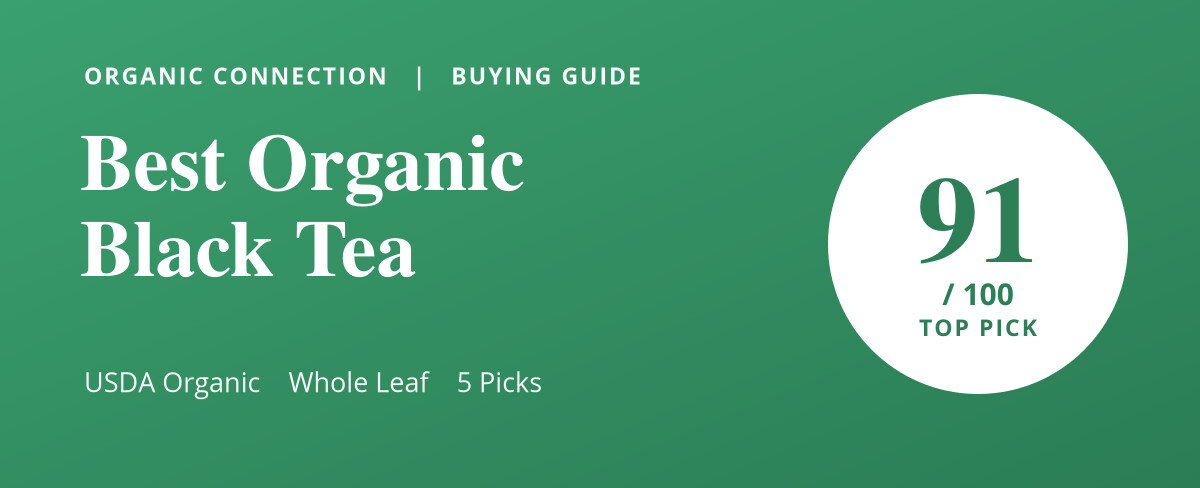
After researching the certifications, sourcing, and quality of the most popular organic black teas, our top pick is Rishi Tea English Breakfast Organic Loose Leaf. It is USDA certified organic, Non-GMO, whole-leaf pure black tea with a bold, balanced flavor, which is why it earned our highest Organic Integrity Score of 93 out of 100. For everyday tea bags, Numi Organic Breakfast Blend is our pick, and for a pure single-origin Chinese black, Rishi China Breakfast is the best choice.
With tea, “organic” genuinely matters because tea leaves are not washed before drying, so any pesticide applied to the plant can end up in your cup. We flag which teas are USDA certified organic and their form and origin.
Best organic black tea compared
| Best Choice | Best Value | ||||
 |  |  |  |  | |
| Product | Rishi English Breakfast | Numi Variety Pack | Numi Breakfast Blend | Rishi Earl Grey | Rishi China Breakfast |
| Organic Integrity Score | 93/ 100 | 92/ 100 | 90/ 100 | 88/ 100 | 86/ 100 |
| Our rating | 4.7 | 4.6 | 4.5 | 4.4 | 4.3 |
| Form | Loose leaf | Tea bags | Tea bags | Loose leaf | Loose leaf |
| Style | English Breakfast blend | Breakfast, Earl Grey, Chai | Assam/Ceylon/Darjeeling | Earl Grey (bergamot) | Pure Chinese black |
| Certification | USDA Organic, Non-GMO, Gluten-free | USDA Organic | USDA Organic, Fair Trade | USDA Organic, Non-GMO, Gluten-free | USDA Organic, Non-GMO, Kosher |
| Best for | Bold, clean daily black | Trying several styles | Convenient, ethical | Classic, aromatic Earl | Smooth, pure Chinese black |
| Price | $50.00$3.13 / ounce View on Amazon | $16.00 $17.53 −9%$0.30 / count View on Amazon | Currently unavailable See buying options | $58.00$3.63 / ounce View on Amazon | Currently unavailable See buying options |
Price and availability as of October 11, 2026 7:10 pm EDT. Product prices and availability are accurate as of the date/time indicated and are subject to change. Any price and availability information displayed on Amazon.com at the time of purchase will apply to the purchase of this product.
Scores are ours, based on independent research of certification, leaf quality, origin, and value, using the same 10-criteria method we apply to every product. See how we research and rate.
The certification map for organic black tea, and what each one actually excludes
The labels on these products are not interchangeable, and several of them cover things that have nothing to do with each other. Here is what each one actually buys you.
| Certification | Covers | Key exclusion |
| USDA Organic | Farming and handling: no synthetic pesticides or fertilizers, no GMOs, no sewage sludge or irradiation, audited yearly by an accredited certifier | Three different tiers share the one seal, and it makes no claim about worker pay, food miles, or nutrition |
| Fair Trade Certified | A price floor for producers, a community premium, and labor standards on the farms and in the facilities | An economic and labor standard; it is not an organic or pesticide claim |
| Kosher | Ingredients and production comply with Jewish dietary law, verified by a rabbinic agency that inspects the facility | A dietary-law standard: it makes no claim about pesticides, GMOs or farming practice |
Kosher and organic answer entirely different questions. A kosher mark, OU, OK, Star-K and others, confirms that ingredients and production follow Jewish dietary law, verified by an agency that inspects the facility. It is a rigorous supply-chain audit and it says nothing about pesticides, GMOs or farming. The two seals appear together often precisely because neither substitutes for the other.
Key things to look for in organic black tea
Great organic black tea is about certification, leaf quality, and origin. Here is what matters.
1. USDA organic certification
Because tea is unwashed and steeped directly, organic certification keeps synthetic pesticide residues out of your cup.
2. Whole leaf quality
Whole loose leaf or full-leaf sachets give more flavor and aroma than the broken dust in many cheap tea bags.
3. Origin and style
Assam is malty and strong, Ceylon is bright, Chinese black is smooth; blends like English Breakfast balance them.
4. Ethical sourcing
Fair Trade and direct-trade sourcing support the growers and often signals higher quality and care.
Loose leaf vs tea bags: what to know
The organic standard is the same either way; the difference is leaf quality and convenience. Loose leaf tea is usually whole or large-piece leaf, which unfurls fully in the water to release more flavor, aroma, and nuance, and it lets you control the strength; it needs an infuser or teapot and a moment more effort. Tea bags are convenient and consistent, but many mass-market bags contain “fannings” and “dust,” the broken bits that brew fast but flat. The best organic tea-bag brands use whole-leaf or full-leaf pyramid sachets and plastic-free, biodegradable bags, closing much of the quality gap.
So the honest advice is: choose loose leaf for the best flavor and value per cup, and choose a quality organic tea-bag brand for convenience without sacrificing purity. Our scoring rewards USDA organic certification, whole-leaf quality, honest origin labeling, and ethical sourcing across both forms, so whichever you prefer, you get a clean, flavorful cup rather than dusty filler.
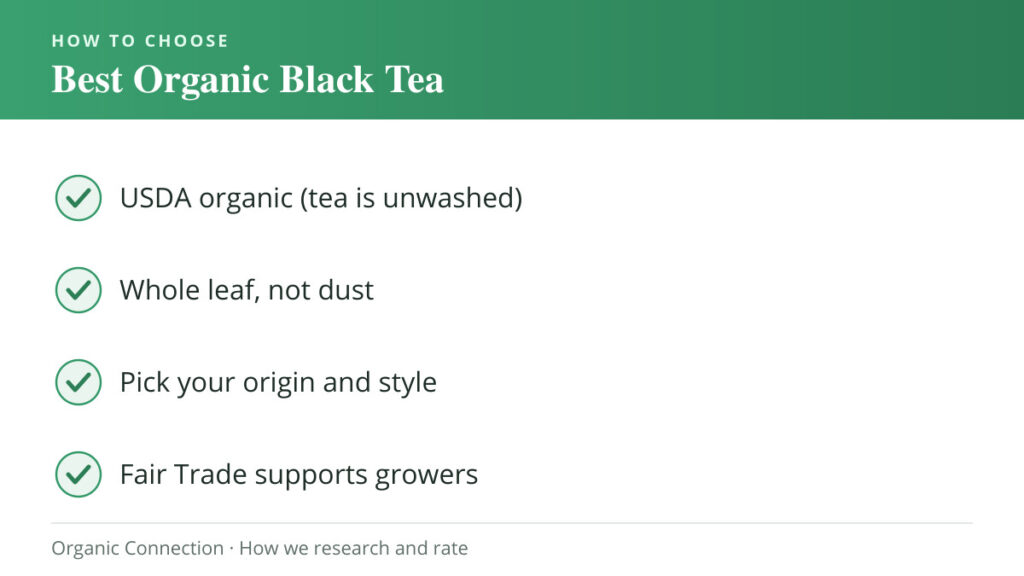
How to choose organic black tea
- Confirm USDA organic. It keeps synthetic pesticide residues out of your unwashed, steeped leaf.
- Favor whole leaf. Loose leaf or full-leaf sachets over broken dust for real flavor.
- Pick a style. English Breakfast for balanced and bold, Assam for malty, Chinese black for smooth, Earl Grey for citrus.
- Look for Fair Trade. It supports growers and often signals quality and care.
- Choose your form. Loose leaf for best value and flavor, quality sachets for convenience.
Who should buy organic black tea
Taste and routine settle it. Loose-leaf is where to start, and our top pick leads it. If you want convenient tea bags, a pure single-origin Chinese black, a classic Earl Grey, or a variety pack, we have a pick for each.
Best overall: Rishi Tea English Breakfast Organic Loose Leaf
| Organic Integrity Score | 93 / 100 |
| Form | Whole loose leaf, 16 oz (45+ servings) |
| Certification | USDA Organic, Non-GMO, Gluten-free |
| Best for | An all-around bold, clean daily black tea |
Rishi English Breakfast is our top pick because it pairs certification with real leaf quality. It is USDA certified organic, Kosher, and Non-GMO, grown without harmful chemicals, and it is whole loose-leaf pure black tea blended for a bold, smooth, balanced English Breakfast character that takes milk well and brews cup after cup, from a respected direct-trade tea company, in a resealable bulk pouch that is great value per cup.
The trade-off is that loose leaf needs an infuser or teapot. For a genuinely certified organic, whole-leaf, everyday black tea with excellent flavor and value, it is our first choice.
What we liked: USDA organic, whole loose leaf, Non-GMO and Kosher, bold balanced flavor, and great value per cup.
Keep in mind: Loose leaf requires an infuser or teapot, so it takes a little more effort than a tea bag.
What the listing discloses: Rishi Tea states a USDA organic claim, and does not say where it was grown or made.
Best variety: Numi Organic Black Tea Variety Pack
| Organic Integrity Score | 92 / 100 |
| Form | Tea bags, 54 count (three blends) |
| Certification | USDA Organic |
| Best for | Trying several styles, or serving guests |
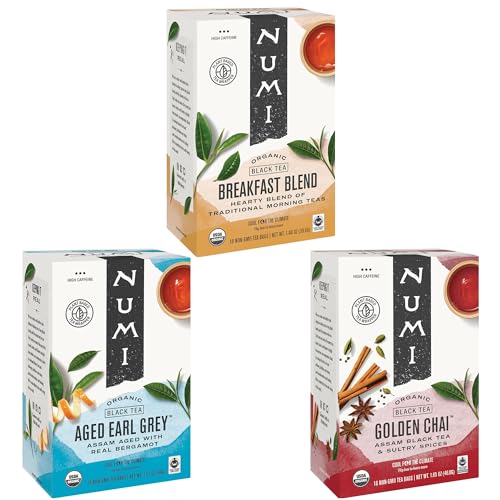
The Numi variety pack is our sampler pick. It is USDA organic and Fair Trade Certified, combining three black tea blends, Breakfast Blend, Earl Grey, and Golden Chai, in plant-based, plastic-free bags, so you can explore different styles or offer guests a choice without buying three boxes, all caffeinated and from the same ethical, certified organic brand.
It scores at the value end here because a variety pack is about breadth rather than depth in any single tea, but for sampling or a household with different tastes, it is a convenient, certified organic choice.
What we liked: USDA organic and Fair Trade, three black blends in one box, plant-based bags, and a great way to explore styles.
Keep in mind: A variety pack gives you less of any one blend, so dedicated drinkers may prefer a single style in bulk.
What the listing discloses: On the Numi label: USDA organic certification. Not stated: where it was grown or made.
Best tea bags: Numi Organic Breakfast Blend
| Organic Integrity Score | 90 / 100 |
| Form | Tea bags, 100 count |
| Certification | USDA Organic, Fair Trade |
| Best for | Convenient, ethical everyday cups |
Numi Breakfast Blend is our tea-bag pick. It is USDA organic and Fair Trade Certified, a bold, robust blend of Assam, Ceylon, and Darjeeling black teas from ethical gardens in India and Sri Lanka, packaged in plant-based, plastic-free biodegradable tea bags, giving you a rich, full-bodied morning cup with the convenience of a bag and none of the plastic that many brands use, at 100 bags for good value.
It scores just below our loose-leaf pick because even a good tea bag has slightly less room for the leaf to unfurl than loose tea, but as a convenient, certified organic, Fair Trade, plastic-free everyday tea, it is excellent.
What we liked: USDA organic and Fair Trade, bold Assam/Ceylon/Darjeeling blend, plant-based plastic-free bags, and 100-count value.
Keep in mind: Tea bags give the leaf a little less room to unfurl than loose leaf, so flavor is slightly less nuanced.
What the listing discloses: Everything we check for is on the Numi listing: USDA organic certification, Fair Trade, a B Corp certification and an origin of India and Sri Lanka.
Best Earl Grey: Rishi Tea Earl Grey Organic Loose Leaf
| Organic Integrity Score | 88 / 100 |
| Form | Whole loose leaf, 16 oz (50+ servings) |
| Certification | USDA Organic, Non-GMO, Gluten-free |
| Best for | A classic, aromatic Earl Grey |
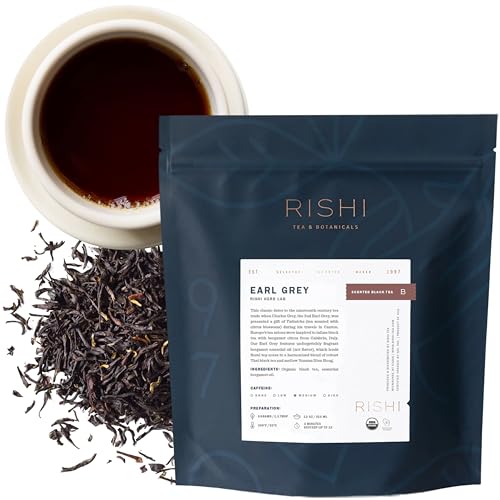
Rishi Earl Grey is our pick for a flavored classic. It is USDA certified organic, whole loose-leaf pure black tea scented with real bergamot oil (not artificial flavor), giving a bright, fragrant citrus aroma over a smooth black base, energizing and caffeinated, great on its own or with a little milk, from the same organic maker, in a resealable bulk pouch.
It scores in the value range here only because Earl Grey is a specific flavor preference rather than an everyday plain black, but for a genuinely organic, real-bergamot Earl Grey, it is excellent.
What we liked: USDA organic, whole loose leaf, scented with real bergamot oil, bright and aromatic over a smooth base.
Keep in mind: Earl Grey is a flavored style, so it is a preference rather than a plain everyday black tea.
What the listing discloses: On the Rishi Tea label: a USDA organic claim. Not stated: where it was grown or made.
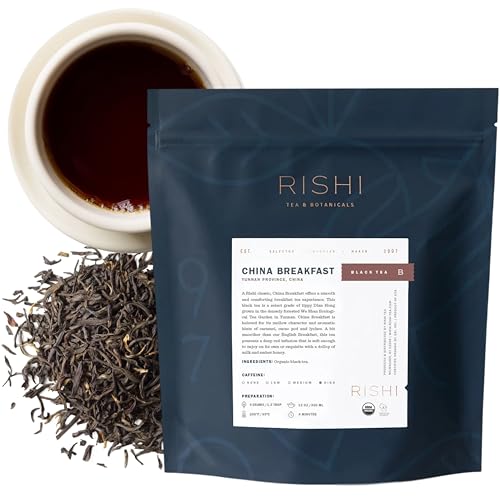
Best single-origin: Rishi China Breakfast Organic Loose Leaf
| Organic Integrity Score | 86 / 100 |
| Form | Whole loose leaf, 16 oz (50+ servings) |
| Certification | USDA Organic, Non-GMO, Kosher |
| Best for | A smooth, pure Chinese black tea |
Rishi China Breakfast is our single-origin pick. It is USDA certified organic, whole loose-leaf pure Chinese black tea (a Yunnan-style black) that is robust yet smooth and naturally a little sweet, with a clean finish and lower astringency than some blends, enjoyable hot or iced and gentle enough to drink without milk, from the same respected organic tea maker, in a resealable bulk pouch.
It scores in the middle only because a single-origin style is a matter of preference versus a breakfast blend, not a quality gap. For a smooth, pure, certified organic Chinese black tea, it is a lovely choice.
What we liked: USDA organic, whole loose leaf, smooth pure Chinese black, naturally a touch sweet, great hot or iced.
Keep in mind: A single-origin smooth style is a preference; those wanting a bolder, maltier cup may prefer a breakfast blend.
What the listing discloses: Rishi Tea commits to USDA organic certification and kosher certification but stops short of where it was grown or made.
Brewing better black tea
Black tea likes hot water, around 200 to 212 F (just off the boil), and a steep of 3 to 5 minutes; longer makes it more astringent, so steep to your taste. Use about a teaspoon of loose leaf or one bag per 8 oz cup, and add milk or a slice of lemon if you like. Loose leaf can often be resteeped for a second cup. Store tea in an airtight container away from light, heat, moisture, and strong odors, since tea readily absorbs smells, and it keeps its flavor best within a year or so. For iced tea, brew a stronger batch and pour over ice.
Origins and styles: what each one actually tastes like
Nearly all black tea comes from one plant, Camellia sinensis. What separates a Darjeeling from an Assam is where it grew, when it was picked and how it was processed — and those differences are far larger than the difference between two brands of the same style.
| Origin | Character | Best for |
| Assam (India) | Malty, brisk, deep red-brown. High body. | Breakfast blends and anything taken with milk |
| Darjeeling (India) | Light, floral, muscatel. First flush is greener and brighter; second flush is rounder and fruitier. | Drinking plain. Milk destroys it. |
| Ceylon (Sri Lanka) | Citrusy and crisp. High-grown is delicate, low-grown is strong and dark. | Iced tea, afternoon drinking, blending |
| Yunnan / Dianhong (China) | Peppery, cocoa-like, gold-tipped, low bitterness | Those who find Assam harsh |
| Keemun (China) | Wine-like, faintly smoky, orchid notes | English Breakfast blends; drinking plain |
| Nilgiri (India) | Fragrant, smooth, doesn’t cloud when iced | Iced tea specifically |
| Kenyan | Bold, brisk, coppery. Almost all CTC. | Strong builder’s-style tea and bagged blends |
Ceylon is usually sold by elevation rather than region, and it matters: high-grown (above roughly 1,200 m) is light and aromatic, mid-grown is balanced, low-grown is dark and robust. A label saying only “Ceylon” is telling you less than it could.
Tea grades, decoded
Those acronyms on loose leaf packaging are not marketing invention — they describe leaf size and the presence of tips, and they are genuinely informative once you know the code.
| Grade | Means | In the cup |
| OP — Orange Pekoe | Whole leaf, no tips. “Orange” refers to the House of Orange, not flavor. | Clean, moderate strength, slow to brew |
| FOP / TGFOP / SFTGFOP | Successively more golden tips included. SFTGFOP is the top orthodox grade. | More aroma, sweetness and complexity; higher price |
| BOP — Broken Orange Pekoe | Deliberately broken leaf | Faster, stronger infusion; good with milk |
| Fannings | Small fragments | Standard teabag filling. Quick, strong, less nuanced. |
| Dust | The finest particles | Cheap bags and vending machines. Brews in seconds and turns bitter as fast. |
The other split is orthodox versus CTC. Orthodox processing rolls leaves relatively intact, preserving aromatic complexity. CTC — crush, tear, curl — puts leaf through toothed rollers to produce uniform granules that brew fast and strong, which is what mass-market bagged tea needs. CTC is not inferior for its purpose; a builder’s tea wants CTC. But it is made largely from more mature leaf, which matters for reasons covered below.
Brewing black tea properly
| Tea | Water | Time | Leaf per 250 ml |
| Assam, Ceylon, breakfast blends | 95–100°C, full boil | 3–5 min | 2–3 g |
| Darjeeling first flush | 85–90°C | 2–3 min | 2–3 g |
| Chinese black (Keemun, Yunnan) | 90–95°C | 3–4 min | 2–3 g |
| CTC / bagged | Full boil | 2–3 min | 1 bag |
- Bitterness is over-extraction, not strength. If your tea is harsh, brew shorter with more leaf rather than longer with less.
- Cover the pot or cup. Aromatics leave with the steam, exactly as with herbal infusions.
- Water matters. Very hard water flattens black tea and produces the film on the surface; filtered water noticeably improves it.
- Milk after, not before — despite the long argument about it. Adding tea to cold milk cools the brew before extraction finishes.
- Never squeeze the bag. It forces out concentrated tannins from the fragments and is the main reason bagged tea tastes astringent.
The teabag problem: plastic in your cup
Keep in mind: many “silken” pyramid teabags are made of nylon or PET rather than silk, and a 2019 McGill University study published in Environmental Science & Technology found that steeping a single plastic teabag at brewing temperature (95°C) releases roughly 11.6 billion microplastic and 3.1 billion nanoplastic particles into one cup. The health consequences of ingesting them are not currently established — that is genuinely unknown rather than known to be safe — but it is a large number for a cup of tea.
Paper bags are not automatically clear either: many are heat-sealed with polypropylene, which is why an ordinary teabag does not fully compost. The alternatives, in rough order of confidence:
- Loose leaf with a stainless steel infuser — no bag at all, and better tea, since whole leaf needs room to unfurl.
- Unbleached string-and-tag paper bags with no plastic seal — several organic brands now state this explicitly on the box.
- PLA (cornstarch) mesh — plant-based, industrially compostable. Better than nylon, though still a polymer at brewing temperature.
- If a box says nothing about the bag material, and the bag is a shiny pyramid, assume plastic.
This is one of the clearest cases where the organic seal does not cover what people assume it covers: certification governs the leaf, not the bag it is packed in.
Fluoride and heavy metals: what organic does not address
Tea plants are unusually efficient accumulators. In acidic soils, aluminum is liberated from clays and forms complexes with fluoride that the plant takes up and concentrates in its leaves — and the concentration rises steadily with leaf maturity.
The measured differences are large. Studies of black tea have reported around 0.95–1.41 mg/L of fluoride from tea sticks, 0.70–2.44 mg/L from granules, and 1.15–6.01 mg/L from teabags — the highest of the three, because bags are typically filled with cheaper, older leaf. Fluoride content correlates negatively with the quality markers of young leaf, total polyphenols and amino acids, so the same choice improves both flavor and fluoride load.
At the extreme, compressed brick tea runs 590–780 mg/kg, and infusions can reach 7.3 mg/L. In Tibet, where brick tea is consumed heavily and continuously, epidemiological survey has found dental fluorosis in 51.2% of children and skeletal fluorosis in 32.83% of adults. That is not a risk faced by someone drinking three cups of loose-leaf Assam a day, but it establishes that the mechanism is real rather than theoretical.
Heavy metals follow a similar pattern. Tea leaves accumulate lead, cadmium, arsenic, copper and chromium depending on soil contamination, pH and geography, and some contamination is introduced during processing. Organic certification governs what was applied to the crop and does nothing about metals already in the soil, which is the same limitation we flag on rice, cocoa and supplement powders.
What actually reduces exposure:
- Buy whole leaf rather than dust or fannings. Younger leaf, less fluoride, better tea. The interests align neatly here.
- Avoid brick and compressed teas as a daily staple.
- Brew for minutes, not hours. Extended steeping pulls out substantially more fluoride.
- Prefer brands that publish third-party contaminant testing. That is a separate assurance from the organic seal, and only a minority of tea companies do it.
Caffeine, and what tea does differently
A cup of black tea contains roughly 40–70 mg of caffeine, against 95–165 mg for drip coffee — but the experience differs by more than the number suggests, because tea also contains L-theanine, an amino acid that promotes alpha brain wave activity. The combination is widely described as calm alertness rather than the sharper edge of coffee.
- Caffeine extracts fast: most of it is out in the first 2–3 minutes, so a longer brew adds tannin and bitterness more than stimulation.
- The old advice to “rinse” tea for 30 seconds to decaffeinate it does not work — you lose flavor and only a fraction of the caffeine.
- Broken leaf and CTC release caffeine faster than whole leaf, which is part of why bagged tea feels sharper.
- Genuinely decaffeinated tea is decaffeinated industrially, most often with CO2 or ethyl acetate. CO2 processing preserves flavor better and is the one to look for.
Storing black tea
- Black tea is the most stable of the tea types and keeps well for about 2 years, but it fades gradually rather than spoiling — a tin opened 18 months ago is not bad, just flat.
- Store airtight, opaque and at room temperature. Light and heat are the enemies.
- Keep it away from odors. Tea absorbs aromas readily; a bag stored next to coffee or spices will taste of them within weeks.
- Do not refrigerate or freeze loose tea. Condensation on removal does more damage than the cold prevents.
- Flavored teas, Earl Grey in particular, lose their scenting faster than plain tea. Buy those in smaller quantities.
How we researched this guide
We are a research-based review site. We compared each tea against its certification (USDA organic, and where present Fair Trade), leaf quality, origin and style, and the weight of aggregated customer feedback on flavor and value, then scored each with our 10-criteria Organic Integrity Score. No brand paid to be included or ranked. Read the full method on our How We Research and Rate page.
Theaflavins, and the gut bacteria explanation
Black tea gets much less attention than green in this context, and the research that exists points at a different mechanism, which makes it worth covering separately.
Black tea is fully oxidised, which converts most of its catechins into larger molecules called theaflavins and thearubigins. Those are what give black tea its color and briskness. Because they are larger, they are poorly absorbed in the small intestine, and much of what you drink reaches the colon intact.
That has led to a distinct line of research: rather than acting on metabolism directly, black tea polyphenols may act on gut bacteria, altering the balance of the microbiome and the short-chain fatty acids it produces. Animal work has shown changes in gut bacterial populations and in energy metabolism, and small human studies have found shifts in microbial composition.
This remains an interesting hypothesis rather than a demonstrated weight effect. Human trials specifically measuring black tea and body weight are few and inconsistent, and the microbiome literature is at an early stage where mechanism is far ahead of outcome.
Caffeine content is the more predictable variable: around 40 to 70 mg a cup, higher than green tea and roughly half a coffee, with the same small acute thermogenic effect and the same tolerance caveat.
And as everywhere in this category, milk and sugar dominate the arithmetic. Two teas a day with a sugar each is around 30 grams of sugar a week that nobody records.
Honest summary: a genuinely different and interesting mechanism at an early stage of evidence, a predictable caffeine contribution, and a drink whose additions matter more than its polyphenols.
Common questions about organic black tea
What is the best organic black tea?
Our overall pick is Rishi Tea English Breakfast Organic Loose Leaf, because it is USDA certified organic, whole loose leaf, Non-GMO, and bold and balanced. For tea bags, Numi Organic Breakfast Blend is our pick, and for a pure Chinese black, Rishi China Breakfast.
Does black tea really need to be organic?
It is worth it, because tea leaves are not washed before drying and you steep the whole leaf directly in your cup, so any pesticide residue passes into the tea. USDA organic tea is grown without synthetic pesticides, which many drinkers prefer for a daily beverage.
Is loose leaf better than tea bags?
Loose leaf is usually whole leaf that unfurls fully for more flavor and better value per cup, while tea bags are more convenient. The best organic tea-bag brands use whole-leaf, plastic-free bags to close much of the gap, so choose based on flavor versus convenience.
What is the difference between Assam, Ceylon, and Chinese black tea?
Assam (from India) is malty, strong, and takes milk well; Ceylon (from Sri Lanka) is bright and brisk; Chinese black is typically smoother and a touch sweet. English Breakfast blends often combine these for a balanced, robust cup.
Do tea bags contain plastic?
Many do. “Silken” pyramid bags are usually nylon or PET, and a 2019 McGill University study found that steeping one plastic teabag at 95°C releases roughly 11.6 billion microplastic and 3.1 billion nanoplastic particles into a single cup. The health effects are not established — genuinely unknown rather than known to be safe. Paper bags are not automatically clear either, since many are heat-sealed with polypropylene. Loose leaf with a steel infuser avoids the question entirely, and some organic brands now state “no plastic” on the box.
What do tea grades like OP and SFTGFOP mean?
They describe leaf size and tip content, not quality claims made up by marketers. OP (Orange Pekoe) is whole leaf without tips — “orange” refers to the House of Orange, not flavor. FOP through SFTGFOP add successively more golden tips, giving more aroma and sweetness. BOP is deliberately broken leaf that brews faster and stronger. Fannings fill standard teabags, and Dust is the finest grade used in cheap bags and vending machines.
What is the difference between CTC and orthodox tea?
Orthodox processing rolls leaves relatively intact and preserves aromatic complexity. CTC — crush, tear, curl — passes leaf through toothed rollers to make uniform granules that brew fast and strong, which is what mass-market bagged tea needs. CTC is not inferior for its purpose, but it uses largely more mature leaf, which carries more fluoride than young leaf does.
Does black tea contain fluoride?
Yes, and the amount varies a lot by leaf quality. Tea plants take up aluminum-fluoride complexes from acidic soils and concentrate them in the leaves, with content rising as leaves mature. Studies report roughly 0.95 to 1.41 mg/L from tea sticks, 0.70 to 2.44 mg/L from granules, and 1.15 to 6.01 mg/L from teabags, which are filled with older leaf. Compressed brick tea runs far higher — 590 to 780 mg/kg — and in Tibet, where it is consumed heavily, surveys have found dental fluorosis in 51.2% of children. Buying whole leaf and brewing for minutes rather than hours reduces it.
Does organic certification cover heavy metals in tea?
No. Tea leaves accumulate lead, cadmium, arsenic, copper and chromium depending on soil contamination, pH and geography, and some is introduced during processing. Organic rules govern what was applied to the crop, not metals already in the soil. If this matters to you, look for brands publishing third-party contaminant testing, which only a minority do.
How much caffeine is in black tea?
Roughly 40 to 70 mg per cup, against 95 to 165 mg for drip coffee. Tea also contains L-theanine, an amino acid promoting alpha brain wave activity, which is why the effect is often described as calm alertness rather than coffee’s sharper edge. Most caffeine extracts in the first two to three minutes, so longer brewing adds bitterness more than stimulation — and the popular trick of rinsing tea for 30 seconds to decaffeinate it does not work.
What water temperature is right for black tea?
95 to 100°C for Assam, Ceylon and breakfast blends, brewed 3 to 5 minutes. Darjeeling first flush is the exception and wants 85 to 90°C for 2 to 3 minutes, since boiling water scorches it. Chinese blacks such as Keemun and Yunnan sit at 90 to 95°C. If tea tastes harsh, brew shorter with more leaf rather than longer with less — bitterness is over-extraction, not strength.
How should you store black tea?
Airtight, opaque, at room temperature, and away from odors — tea absorbs aromas readily, so a packet next to coffee or spices will taste of them within weeks. Black tea is the most stable type and keeps about two years, fading gradually rather than spoiling. Do not refrigerate or freeze loose tea; condensation on removal does more damage than the cold prevents. Flavored teas such as Earl Grey lose their scenting faster, so buy those in smaller amounts.
- Organic Food & Pantry hub
- Best Organic Green Tea
- Best Organic Loose Leaf Tea
- Best Organic Coffee
- How we research and rate products
- every organic food product we have reviewed — searchable by brand and certification
- Organic coffee and tea, explained
Price and availability as of October 11, 2026 7:10 pm EDT. Product prices and availability are accurate as of the date/time indicated and are subject to change. Any price and availability information displayed on Amazon.com at the time of purchase will apply to the purchase of this product.
Looking for other organic products?
We have checked more than 800 products across food, household goods, gardening, personal care and pet, every one against its stated certification. Browse all reviews.
Organic Connection is reader-supported. When you buy through links on this page we may earn a commission, at no extra cost to you. As an Amazon Associate we earn from qualifying purchases. We are not paid to feature or rank any product. How we research and rate.