Last updated: September 30, 2026
We may earn a commission when you buy through links on this page, at no extra cost to you. How we research and rate.
The short version
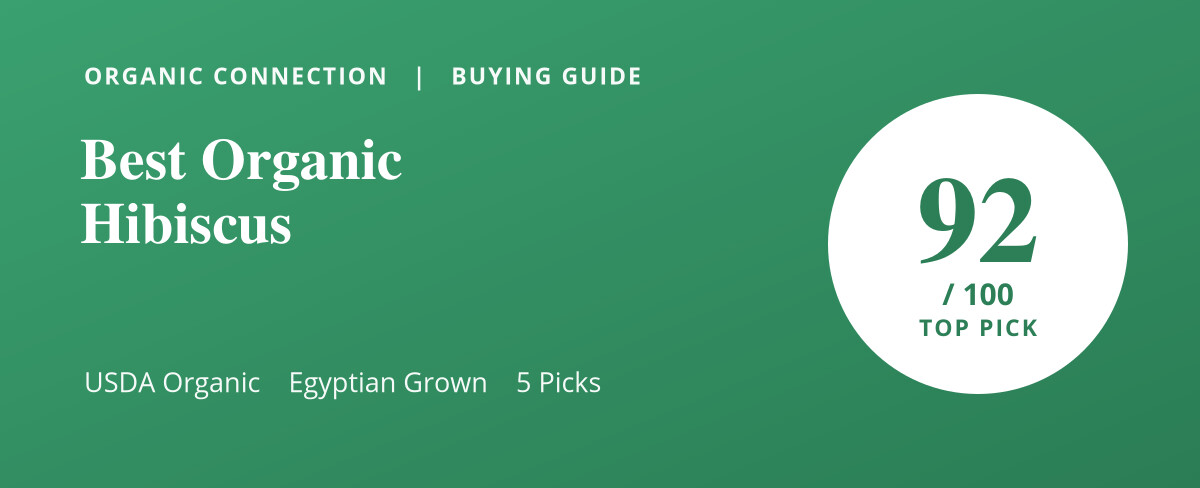
After researching the certifications, sourcing, and petal quality of the most popular organic hibiscus teas, our top pick is Traditional Medicinals Organic Hibiscus. It is USDA certified organic and Non-GMO Project Verified, sourced from organic farms in Egypt with pharmacopoeial-grade herb testing, which is why it earned our highest Organic Integrity Score of 92 out of 100. For loose petals, Frontier Co-op Organic Hibiscus Flowers is our pick, and for the best value, the Traditional Medicinals 96-bag pack is the best choice.
Hibiscus is the rare herbal tea with genuinely good clinical evidence behind one of its claims, and also one where cheap product is obvious the moment you brew it. We flag each product’s certification, format, and cut.
Best organic hibiscus tea compared
| Best Choice | Best Value | ||||
 |  |  |  |  | |
| Product | Traditional Medicinals 16 ct | Frontier Co-op C/S 16 oz | Traditional Medicinals 96 ct | Davidson’s Loose Leaf 16 oz | Frontier Whole Petals 1 lb |
| Organic Integrity Score | 92/ 100 | 90/ 100 | 87/ 100 | 84/ 100 | 81/ 100 |
| Our rating | 4.6 | 4.5 | 4.4 | 4.2 | 4.1 |
| Format | Tea bags | Cut and sifted | Tea bags | Cut and sifted | Whole petals |
| Best for | Best overall | Best loose leaf | Best value | Grower direct | Cooking and syrups |
| Certification | USDA Organic, Non-GMO, Kosher | Certified Organic, Kosher | USDA Organic, Non-GMO, Kosher | USDA Organic, Non-GMO | Certified Organic, Kosher |
| Ingredients | Organic hibiscus flower, blackberry leaf, lemongrass | Organic hibiscus flowers, cut and sifted | Organic hibiscus flower, blackberry leaf, lemongrass | Organic hibiscus flowers, cut and sifted | Organic hibiscus petals, whole |
| Price | $5.88$0.37 / count View on Amazon | $15.39$0.96 / fluid ounce View on Amazon | $38.99$0.41 / count View on Amazon | $18.00$1.13 / ounce View on Amazon | Currently unavailable See buying options |
Price and availability as of October 11, 2026 7:10 pm EDT. Product prices and availability are accurate as of the date/time indicated and are subject to change. Any price and availability information displayed on Amazon.com at the time of purchase will apply to the purchase of this product.
Scores are ours, based on independent research of certification, ingredient purity, calyx grade and sourcing, packaging, format, and value, using the same 10-criteria method we apply to every product. See how we research and rate.
The certification map for organic hibiscus tea, and what each one actually excludes
A seal is a specific promise about a specific thing. These are the promises behind the marks on this page, in plain terms, along with the question each one leaves unanswered.
| Certification | Covers | Key exclusion |
| USDA Organic | Farming and handling: no synthetic pesticides or fertilizers, no GMOs, no sewage sludge or irradiation, audited yearly by an accredited certifier | Three different tiers share the one seal, and it makes no claim about worker pay, food miles, or nutrition |
| Non-GMO Project | Testing and supply-chain traceability showing the ingredients are not genetically engineered | Sets no limit on synthetic pesticides or fertilizers, so it is not an organic claim |
| Kosher | Ingredients and production comply with Jewish dietary law, verified by a rabbinic agency that inspects the facility | A dietary-law standard: it makes no claim about pesticides, GMOs or farming practice |
Non-GMO and organic are not two grades of the same thing. The butterfly certifies an absence of genetic engineering and stops there; the USDA seal prohibits genetic engineering as one clause among many, alongside synthetic pesticides, synthetic fertilizers, sewage sludge and irradiation. That makes organic the broader claim by some distance. Where both appear together, the butterfly is adding batch testing on top of a standard that had already banned GMOs.
Key things to look for in organic hibiscus tea
Great hibiscus is about certification, cut, color, and format. Here is what matters.
1. USDA organic certification
You steep the calyx directly and drink it, so pesticide certification carries more weight here than on a washed crop.
2. Color and cut
Good hibiscus is deep burgundy and mostly whole or lightly cut calyces. Fine dust and pale pieces brew weak and sour without depth.
3. One ingredient, unless you want a blend
Many hibiscus teas are padded with rosehip, apple pieces, or lemongrass. That is fine if chosen, and dilution if not.
4. Loose versus bags
Loose petals give more control and better value. Bags are convenient, and quality varies more between brands.
The blood pressure evidence, and the one real caution
Hibiscus is unusual among herbal teas in having a claim that stands up reasonably well, and one genuine caution that most guides skip.
Blood pressure, with the actual numbers. This is among the best-evidenced claims any herbal tea can make. Meta-analyses have found reductions of roughly 7.6 mmHg systolic and 3.5 mmHg diastolic, with a separate pooled analysis putting the systolic effect at about 7.1 mmHg. One dose-response meta-analysis drew on 26 randomized controlled trials covering 1,797 participants and found hibiscus reduced both systolic and diastolic pressure in a dose-dependent way against placebo and against other teas.
| What the trials used | Detail |
| Daily amount | About 720 ml, or three 8 oz cups |
| Duration | Four to six weeks |
| Systolic reduction | Around 7 mmHg |
| Diastolic reduction | Around 3 mmHg |
| Population | Mostly prehypertension and mild hypertension |
Is that clinically meaningful? Worth putting in context rather than overselling. A 10 mmHg systolic or 5 mmHg diastolic reduction is associated in the wider literature with roughly a 22% lower rate of heart attack and about 41% fewer strokes. Hibiscus lands somewhat below that threshold, so it sits in the territory of a genuinely useful lifestyle input rather than a treatment. It does not replace medication, the trials were mostly in people with mildly raised rather than severe hypertension, and the effect appears dose-dependent, which is why three cups is the figure that keeps recurring.
Antioxidants and lipids. Hibiscus is rich in anthocyanins, the same class of pigment that colors blackcurrants and red cabbage, and some trials have found small improvements in lipid profiles. The evidence here is weaker and less consistent than the blood pressure work.
The caution. Because it does lower blood pressure, hibiscus can compound the effect of antihypertensive medication, and there is evidence it can interact with hydrochlorothiazide and may affect how the body handles some other drugs. If you take blood pressure medication, this is worth an actual conversation with your doctor rather than an assumption that a tea cannot matter. Hibiscus is also generally avoided in pregnancy, and its acidity can be hard on sensitive stomachs and, over time, on tooth enamel. Nothing here is medical advice.
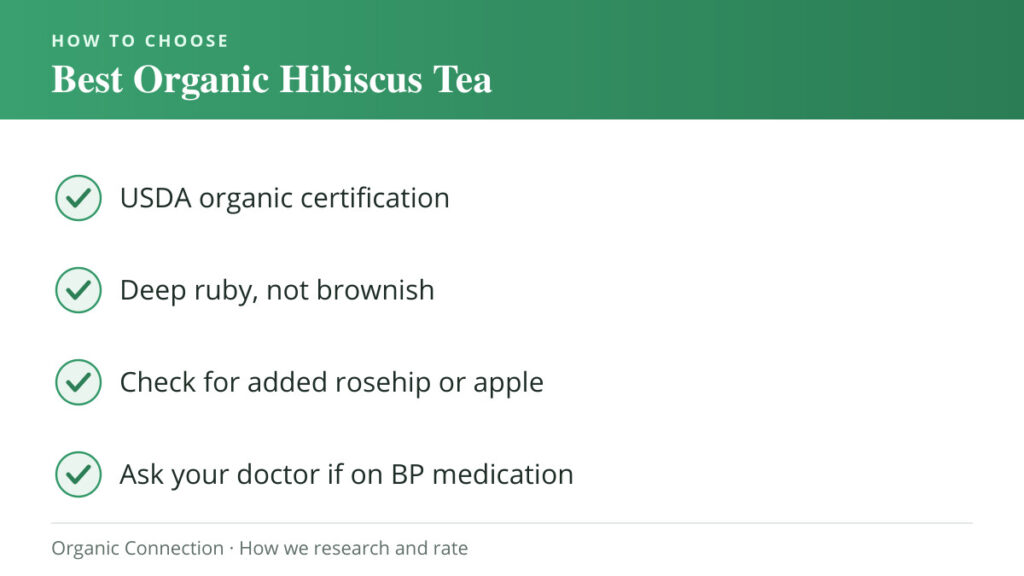
How to choose organic hibiscus tea
- Confirm USDA organic. You are drinking an unwashed steeped calyx.
- Look at the cut. Deep burgundy whole or lightly cut calyces beat fine reddish dust.
- Check the ingredient list for added rosehip, apple, or lemongrass if you want pure hibiscus.
- Buy loose if you drink it often, since the value is far better and you control the strength.
- Store it airtight and dark. Anthocyanins fade with light, and faded hibiscus brews brown.
Who should buy organic hibiscus tea
The right hibiscus depends on how you drink it. If you want the best-sourced bagged tea for a daily cup, our top pick fits. If you want loose petals for iced tea by the jug, the best value in bags, an alternative grower, or whole petals for cooking and syrups, we have a pick for each.
Best overall: Traditional Medicinals Organic Hibiscus, 16 Bags
| Organic Integrity Score | 92 / 100 |
| Ingredients | Organic hibiscus flower, blackberry leaf, lemongrass |
| Certification | USDA Organic, Non-GMO, Kosher |
| Best for | A daily cup with dependable herb quality |
Traditional Medicinals is our top pick because of sourcing discipline. The hibiscus comes from organic farms in Egypt, which is the origin most associated with deep color and high acidity, and the company tests its botanicals to pharmacopoeial-grade standards rather than buying on the open market. It is USDA organic, Non-GMO Project Verified, and the bags are compostable. In the cup it delivers the dense ruby color and clean sharp tartness that mark good hibiscus.
The trade-off is that this is a blend rather than pure hibiscus: blackberry leaf and lemongrass are included, which rounds the sharpness and adds a faint citrus lift. Many people prefer that, but if you want unadulterated hibiscus you should buy loose. The box is also small at 16 bags and priced above supermarket herbals.
What we liked: USDA organic and Non-GMO verified, Egyptian-sourced hibiscus with pharmacopoeial-grade testing, compostable bags, and excellent color.
Keep in mind: It is a blend rather than pure hibiscus, only 16 bags, and priced above grocery-store options.
What the listing discloses: On the Traditional Medicinals label: USDA organic certification and kosher certification. Not stated: where it was grown or made.
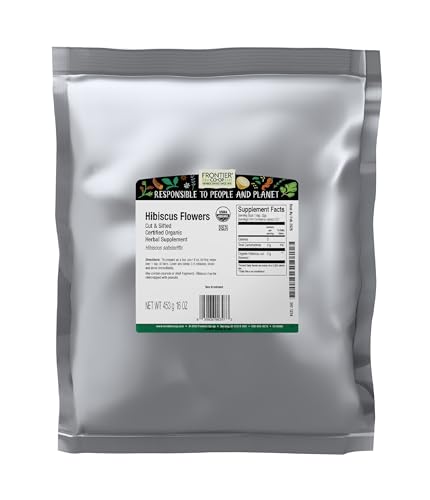
Best loose leaf: Frontier Co-op Organic Hibiscus Flowers, Cut and Sifted, 16 oz
| Organic Integrity Score | 90 / 100 |
| Ingredients | Organic hibiscus flowers, cut and sifted |
| Certification | Certified Organic, Kosher |
| Best for | Iced tea by the jug and home blending |
This is the format that makes hibiscus a habit rather than a treat. A pound of sun-dried, cut-and-sifted organic calyces from Frontier’s Burkina Faso and Egypt sourcing costs a fraction of the equivalent in tea bags, and the cut size is ideal: small enough to extract fast, large enough to strain easily. Frontier is a co-operative with genuinely good sourcing transparency, and the material is non-irradiated and kosher certified. For making agua de jamaica by the jug in summer, nothing else here comes close on value.
The trade-off is that a pound is a serious quantity, roughly a hundred generous pots, and hibiscus anthocyanins fade with time and light. You need an infuser or a strainer, and the deep red liquor stains cloth, wood, and some plastics permanently, which is worth knowing before you brew a jug over a light worktop.
What we liked: Pure single-ingredient organic calyces, excellent color and tartness, outstanding value per cup, and non-irradiated.
Keep in mind: A pound is a lot to get through before color fades, and it stains almost everything it touches.
What the listing discloses: Frontier Co-op documents kosher certification, and leaves whether the USDA seal applies and where it was grown or made unsaid.
Best value in bags: Traditional Medicinals Organic Hibiscus, 96 Tea Bags
| Organic Integrity Score | 87 / 100 |
| Ingredients | Organic hibiscus flower, blackberry leaf, lemongrass |
| Certification | USDA Organic, Non-GMO, Kosher |
| Best for | Anyone drinking two or three cups a day |
The blood pressure trials that found an effect used two to three cups daily for four to six weeks, and at that rate a 16-bag box lasts under a week. Ninety-six bags is the format that matches how hibiscus is actually studied and actually drunk. It is the identical tea to our top pick, at a substantially better rate per cup, with each box staying sealed until opened so the color and aroma hold.
The trade-off is commitment and, again, that it is a blend. If you have not established that you like this particular tea, buy the small box first. Hibiscus is also acidic enough that three cups a day is noticeable if you have a sensitive stomach or reflux, so build up rather than starting at full volume.
What we liked: The best cost per cup for pharmacopoeial-grade organic hibiscus, in sealed boxes that preserve color.
Keep in mind: A multi-month commitment to a blend, and heavy daily use can bother sensitive stomachs.
What the listing discloses: Traditional Medicinals commits to USDA organic certification, kosher certification and a B Corp certification but stops short of where it was grown or made.
Grower direct: Davidson’s Organics Hibiscus Flowers, 16 oz
| Organic Integrity Score | 84 / 100 |
| Ingredients | Organic hibiscus flowers, cut and sifted |
| Certification | USDA Organic, Non-GMO |
| Best for | Buyers who prefer a single-source tea company |
Davidson’s is a third-generation organic tea company that grows, imports, blends, and packs its own product, which is unusual in a category run largely through brokers. The hibiscus is USDA organic, cut and sifted, and has the characteristically tart, rosy character good calyces should. As an alternative loose supplier to Frontier at a comparable price, it is the obvious second choice, and some buyers prefer its slightly finer cut for faster extraction.
The trade-off is that the finer cut also means more dust in the bag, which can slip through a coarse strainer and leave sediment in the cup. Davidson’s publishes less detail about origin than Frontier does, so you know less about where any given batch came from, even though the certification is sound.
What we liked: USDA organic from a vertically integrated grower, good tart flavor, fast extraction, and strong value.
Keep in mind: Finer cut means more dust and sediment, and less published origin detail.
What the listing discloses: On the Davidson’s label: USDA organic certification. Not stated: where it was grown or made.
Best for cooking: Frontier Co-op Organic Whole Hibiscus Petals, 1 lb
| Organic Integrity Score | 81 / 100 |
| Ingredients | Organic hibiscus petals, whole |
| Certification | Certified Organic, Kosher |
| Best for | Syrups, cordials, kombucha, and garnishes |
Whole calyces are the format to buy if you are doing anything beyond making tea. They strain out cleanly with no dust, they rehydrate into recognizable flower shapes for garnishing, and they are the right material for hibiscus syrup, cordial, sorrel, kombucha second ferments, and cocktail work. The color extraction from whole material is spectacular, and Frontier’s is USDA organic and kosher certified.
It scores lowest here on practicality for tea drinkers specifically. Whole calyces take longer to extract than a cut grade, so a quick five-minute steep gives you less than you would expect, and they occupy far more volume in the jar for the same weight. A pound of whole petals is a genuinely large amount of storage. Buy this for the kitchen rather than the teapot.
What we liked: Beautiful whole organic calyces, no dust, exceptional color, and the right format for syrups and infusions.
Keep in mind: Slower to extract than a cut grade, and bulky to store in pound quantities.
What the listing discloses: Frontier Co-op lists QAI as the certifying agent and kosher certification. The gap is whether the USDA seal applies and where it was grown or made.
How to brew hibiscus, hot and iced
Hibiscus is forgiving to brew and easy to over-brew. Use water just off the boil and steep five to seven minutes for a cut grade, or eight to ten for whole calyces. You will see the color develop almost immediately, which is a useful guide: when the liquor is dense and opaque red rather than translucent pink, it is ready. Steeping much longer mainly adds astringency rather than flavor. Roughly a heaped teaspoon per cup of loose material is right, and hibiscus takes a second steep reasonably well, though the second cup is noticeably paler.
Iced is where hibiscus is at its best. Brew it double strength, let it cool, and pour over ice, or make a cold brew by leaving loose calyces in cold water in the fridge overnight, which produces a smoother, less astringent drink. Agua de jamaica is simply this with sugar and lime, and it is genuinely one of the best soft drinks there is. Hibiscus also pairs well with ginger, mint, cinnamon, and orange peel.
Two practical warnings. The color stains: wooden spoons, worktops, light-colored cloth, and some plastic jugs will take on a permanent pink cast, so use glass or stainless steel. And because hibiscus is genuinely acidic, drinking several cups a day is worth rinsing your mouth with water afterwards to protect tooth enamel, and worth moderating if you have reflux. Store loose petals airtight, cool, and dark, since anthocyanins are light-sensitive and faded hibiscus brews brown rather than red.
How we researched this guide
We are a research-based review site. We compared each product against its certification (USDA organic and, where present, Non-GMO Project Verified), ingredient purity, calyx grade and origin, sourcing transparency, packaging, format suitability, and the weight of aggregated customer feedback on color and tartness, then scored each with our 10-criteria Organic Integrity Score. No brand paid to be included or ranked. Nothing here is medical advice; hibiscus can lower blood pressure and interact with antihypertensive medication, and should be discussed with a clinician if that applies to you. Read the full method on our How We Research and Rate page.
Blood pressure evidence, and a smaller weight literature
Hibiscus is one of the better-evidenced herbal teas, and as with beet juice the strong evidence concerns something other than weight.
The blood pressure research is genuinely good. Multiple randomised trials and meta-analyses have found hibiscus consumption produces modest reductions in systolic and diastolic blood pressure, on the order of a few millimeters of mercury, with effects most visible in people with elevated readings to begin with. That is a real, replicated finding.
The weight literature is smaller and more tentative. A handful of trials, several using hibiscus extract rather than brewed tea, have reported reductions in body weight or waist circumference, with proposed mechanisms involving amylase inhibition and effects on fat metabolism. The samples are small, the preparations vary, and the findings have not been established at the level the blood pressure work has.
The amylase point is worth understanding because it recurs across this category. Amylase inhibition means slowing starch digestion, which is a plausible route to a smaller glucose response. It does not remove the calories; it changes the rate at which they arrive. Products marketed on enzyme inhibition frequently blur that distinction.
Brewed hibiscus is essentially calorie-free, tart, and pleasant hot or cold, which makes it a genuinely good replacement for sweetened drinks. That substitution is worth more in practical terms than anything in the extract literature.
One caution: hibiscus may interact with antihypertensive medication and has been studied for effects on some drug metabolism, so it is worth mentioning to a pharmacist if you take regular medication.
Honest summary: strong blood pressure evidence, a small and uncertain weight literature mostly on extracts, and a good zero-calorie drink to swap in.
Common questions about organic hibiscus tea
What is the best organic hibiscus tea?
Our overall pick is Traditional Medicinals Organic Hibiscus, because it is USDA certified organic and Non-GMO Project Verified, sourced from organic farms in Egypt, and tested to pharmacopoeial-grade standards. For pure loose calyces, Frontier Co-op Organic Hibiscus Flowers is our pick, and for the best value in bags, the Traditional Medicinals 96-bag pack.
Does hibiscus tea really lower blood pressure?
Modestly, and this is one of the better-evidenced herbal tea claims. Multiple randomized trials and meta-analyses have found small but statistically significant reductions in systolic and diastolic pressure in people with mild hypertension, typically with two to three cups a day for four to six weeks. The effect is comparable to a lifestyle change, not to medication, and it does not replace treatment.
Can you drink hibiscus tea if you take blood pressure medication?
Ask your doctor first. Because hibiscus genuinely lowers blood pressure, it can compound the effect of antihypertensive drugs, and there is evidence of interaction with hydrochlorothiazide in particular. This is one of the few herbal teas where the interaction question is real rather than theoretical.
Why is my hibiscus tea brown instead of red?
Usually age or light exposure. The red color comes from anthocyanins, which degrade with time, heat, and light, so old or badly stored hibiscus brews brownish and tastes flatter. A low-grade cut padded with stem also brews paler. Store loose petals airtight in a dark cupboard rather than a clear jar on the counter.
Is hibiscus tea safe in pregnancy?
It is generally avoided. Hibiscus has traditional associations with uterine stimulation and emmenagogue effects, and safety data in pregnancy is limited, so most guidance recommends steering clear. As with any herbal tea in pregnancy, this is a question for your midwife or doctor rather than a buying guide.
How many cups of hibiscus tea should you drink for blood pressure?
The trials that found an effect used around 720 ml a day, which is three 8 oz cups, for four to six weeks. The effect appears dose-dependent, so one cup occasionally is unlikely to do much. Build up gradually if you have a sensitive stomach, since hibiscus is genuinely acidic, and treat it as an addition to rather than a replacement for whatever your doctor has prescribed.
How long does hibiscus take to lower blood pressure?
Four to six weeks of consistent daily drinking in most trials. There is no meaningful acute effect from a single cup, so measuring your blood pressure an hour after drinking it will tell you nothing. If you are tracking it, take readings at the same time of day over several weeks rather than looking for an immediate change.
Does hibiscus tea help with weight loss or cholesterol?
The evidence is much weaker than for blood pressure. Some trials have reported small improvements in lipid profiles and body weight measures alongside the blood pressure effect, but results are inconsistent and effect sizes are small. Hibiscus is a pleasant zero-calorie drink that can displace sugary ones, which is a real if unglamorous benefit, and it is not a weight loss intervention.
Does hibiscus tea stain your teeth?
It can, and it is more acidic than most teas, which is the bigger concern. The deep anthocyanin pigment stains cups and cloth readily and can contribute to surface staining on teeth with heavy daily use. Rinse your mouth with water after drinking it, avoid brushing immediately afterwards since enamel is softened by acid, and consider a straw for iced hibiscus.
- Organic Food & Pantry hub
- Best Organic Loose Leaf Tea
- Best Organic Black Tea
- Organic Coffee and Tea: A Cleaner Daily Cup
- every organic coffee and tea we have reviewed — filter by Fair Trade and USDA Organic
Price and availability as of October 11, 2026 7:10 pm EDT. Product prices and availability are accurate as of the date/time indicated and are subject to change. Any price and availability information displayed on Amazon.com at the time of purchase will apply to the purchase of this product.
Looking for other organic products?
We have checked more than 800 products across food, household goods, gardening, personal care and pet, every one against its stated certification. Browse all reviews.
Organic Connection is reader-supported. When you buy through links on this page we may earn a commission, at no extra cost to you. As an Amazon Associate we earn from qualifying purchases. We are not paid to feature or rank any product. This page is informational and is not medical advice. How we research and rate.