Last updated: September 30, 2026
We may earn a commission when you buy through links on this page, at no extra cost to you. One product below, nutriEffect, is part of a paid Amazon Creator Connections campaign that pays us a higher commission rate. It was scored by the same method as everything else and placed where that score put it, which is last. We were not sent samples of any tea on this page. How we research and rate.
The short version
Start with the part most pages in this category will not tell you: no tea causes meaningful weight loss. The research on green tea catechins shows an effect measured in fractions of a kilogram over months, often not distinguishable from noise, and the herbal blends sold as detox or slimming teas have no weight loss evidence behind them at all. Some of them work by making you go to the toilet, which is not the same thing.
What tea can genuinely do is replace higher calorie drinks, give you a warm ritual at the hours when snacking usually happens, and keep you hydrated. Those are real, if unglamorous, contributions. Judged on that basis, our top pick is FGO Organic Japanese Matcha and Green Tea, which is USDA Organic, uses unbleached bags, and is the only tea here whose main ingredient has published research attached to it. For the lowest cost per cup, Traditional Medicinals Organic Dandelion Leaf and Root is certified organic and among the cheapest per serving on the page. If caffeine is the problem, Numi Organic Dandelion Detox is the caffeine-free choice.
An honest note on this category: “weight loss tea” and “detox tea” are marketing categories, not product categories. The Federal Trade Commission has brought enforcement actions against companies in this space over unsupported claims. We have scored these teas on certification, ingredient quality, safety, and value. We have not scored them on weight loss, because there is nothing credible to score.
Best organic weight loss tea compared
Five teas, scored on the same criteria. The Organic Integrity Score is out of 100, and our rating is that score expressed out of five. Prices update automatically.
| Best Choice | Best Value | ||||
 |  |  |  | ||
| Product | FGO Matcha and Green | Traditional Medicinals Dandelion | Numi Dandelion Detox | Herbaly Glucose | nutriEffect 7-Herb |
| Organic Integrity Score | 92/ 100 | 90/ 100 | 88/ 100 | 82/ 100 | 61/ 100 |
| Our rating | 4.6 | 4.5 | 4.4 | 4.1 | 3.1 |
| Certification | USDA Organic, CCOF | Non-GMO, Kosher, Organic | USDA Organic | Non-GMO, Organic | Not stated on the listing |
| Caffeine | Yes, roughly 30 to 50 mg | Caffeine free | Caffeine free | Caffeine free | Yes, green tea and yerba mate |
| Licorice root | No | No | No | No | Yes |
| Format | 100 bags | 16 bags | 48 bags | 28 bags | 250 g loose leaf |
| Best for | One ingredient | Lowest cost per cup | Caffeine-free evening cup | Sweet cravings without sugar | Pleasant multi-herb ritual |
| Ingredients | Japanese matcha and green tea | Dandelion leaf and dandelion root | Organic dandelion with supporting botanicals | — | Green tea, rooibos, yerba mate, nettle leaf, lemongrass, pau d’arco, licorice root |
| Price | $21.99 $24.99 −12%$0.22 / count View on Amazon | $5.88$0.37 / count View on Amazon | $16.13$0.34 / count View on Amazon | View on Amazon | $39.90$4.53 / ounce View on Amazon |
- Organic Food and Pantry hub
- Best Organic Chamomile Tea
- Best Organic Hibiscus Tea
- our organic product database — compare brands across every guide
Price and availability as of October 27, 2026 1:10 am EDT. Product prices and availability are accurate as of the date/time indicated and are subject to change. Any price and availability information displayed on Amazon.com at the time of purchase will apply to the purchase of this product.
The organic weight loss tea certifications, and the question each one leaves open
A seal is a specific promise about a specific thing. These are the promises behind the marks on this page, in plain terms, along with the question each one leaves unanswered.
| Certification | Covers | Key exclusion |
| USDA Organic | Farming and handling: no synthetic pesticides or fertilizers, no GMOs, no sewage sludge or irradiation, audited yearly by an accredited certifier | Three different tiers share the one seal, and it makes no claim about worker pay, food miles, or nutrition |
| Non-GMO Project | Testing and supply-chain traceability showing the ingredients are not genetically engineered | Sets no limit on synthetic pesticides or fertilizers, so it is not an organic claim |
| Kosher | Ingredients and production comply with Jewish dietary law, verified by a rabbinic agency that inspects the facility | A dietary-law standard: it makes no claim about pesticides, GMOs or farming practice |
Non-GMO and organic are not two grades of the same thing. The butterfly certifies an absence of genetic engineering and stops there; the USDA seal prohibits genetic engineering as one clause among many, alongside synthetic pesticides, synthetic fertilizers, sewage sludge and irradiation. That makes organic the broader claim by some distance. Where both appear together, the butterfly is adding batch testing on top of a standard that had already banned GMOs.
What the research actually says about tea and body weight
This section exists because the honest answer changes what you should buy. If you are expecting a tea to do the work, the most expensive blend on this page is a waste of money. If you want a good daily drink that supports habits you are already building, the cheapest certified one is excellent.
Green tea catechins: a small, real, frequently overstated effect
Green tea contains catechins, of which EGCG is the most studied, alongside caffeine. The proposed mechanism is a modest increase in energy expenditure and fat oxidation, driven mostly by the combination of catechins and caffeine rather than either one alone.
The trial evidence exists but is underwhelming. Pooled analyses tend to land on average weight differences of roughly a kilogram or less across twelve weeks, with substantial heterogeneity between studies and results that shrink or disappear entirely in people already habituated to caffeine. Crucially, most of those trials used concentrated extracts delivering several hundred milligrams of EGCG per day. A brewed cup of green tea contains a small fraction of that, and you would need to drink a great deal of it to approach the doses studied.
So the effect is real in the narrow sense that it has been measured, and close to irrelevant in the practical sense: a kilogram over three months, under ideal trial conditions, at doses you are not actually consuming, is not a weight loss strategy. It is a rounding error that got a marketing department.
Why “detox” is a marketing word rather than a mechanism
Detox has no accepted clinical definition in the context of food and drink. The body already has organs dedicated to clearing metabolic waste and foreign compounds, principally the liver and kidneys, and no tea has been shown to make them work better than they already do.
When a product promises to remove unspecified toxins, notice the structure of the claim. The toxins are never named. No measurement is offered before or after. No threshold is given for what success would look like. A claim built that way cannot be tested, and that is precisely why it is built that way. This is the same pattern we describe in our guide to spotting greenwashing, applied to health language instead of environmental language.
This is also why you will not find a detox score in our comparison table. There is nothing there to measure.
The laxative problem, which is the one that genuinely matters
A meaningful share of teas marketed for slimming contain senna, cascara sagrada, or a similar stimulant laxative. Senna is a legitimate short-term treatment for constipation and is regulated as an over-the-counter laxative. It is not a weight loss agent, and it has never been approved as one.
What it produces is a rapid, visible change on the scale, because you have emptied your bowel and lost water along with it. None of that is fat, and it returns as soon as you rehydrate. Regular use carries real risks: electrolyte disturbance, particularly potassium loss, abdominal cramping, dependency in which normal bowel function becomes harder to maintain without it, and interactions with medications including diuretics and certain heart medicines.
The practical takeaway is a label check that takes ten seconds. If a tea sold for weight loss lists senna, cascara sagrada, rhubarb root, or buckthorn bark, understand that its mechanism is a laxative one, whatever the front of the box says. None of the teas recommended below contain senna or any other stimulant laxative. That was a hard filter applied before anything else was considered.
How we scored these teas
Every product on this site is scored out of 100 against the same ten criteria. For this category, four of them carried most of the weight.
A named certifying body
The word “organic” printed on a box means very little on its own. USDA Organic is the American baseline, and it requires a named accredited certifier standing behind it. Herbal tea is a category where uncertified use of the word is common, partly because blends contain many botanicals from many sources and certifying every one of them is expensive.
We verified certification against each product listing itself rather than inferring it from the product name. That distinction matters more than it sounds. Search results for these terms are dense with sponsored placements and comparison widgets, and the organic seal sitting on a page will frequently belong to a completely different product being advertised alongside the one you are looking at. Our guide to organic label tiers explains what each level of claim actually permits.
Ingredient transparency
A blend that names seven herbs is more useful than one hiding behind a proprietary formula. We favored teas that name every botanical and, where it matters, the part of the plant used. Dandelion leaf and dandelion root are different ingredients with different traditional uses and different tastes, and a label that does not distinguish them is telling you less than it appears to.
Safety flags
Stimulant laxatives excluded a product outright. Licorice root was recorded rather than excluded, for reasons covered further down. Caffeine content was noted so you can match the tea to the hour you actually drink it, which is a more practical consideration than most buying guides admit. Our explainer on whether herbal teas are caffeine free covers the common misconceptions there.
Cost per cup
Box prices mislead badly in tea, because counts range from sixteen bags to a hundred, and loose leaf is sold by weight. We converted everything to cost per cup. The spread across this page is roughly fourfold for products that all ultimately deliver hot water and plant matter, which is worth knowing before you spend forty dollars.
Best overall: FGO Organic Japanese Matcha and Green Tea
| Organic Integrity Score | 92 / 100 |
| Certification | USDA Organic, CCOF |
| Ingredients | Japanese matcha and green tea |
| Format | 100 eco-conscious tea bags |
| Caffeine | Yes, roughly 30 to 50 mg per cup |
| Best for | The only tea here whose active ingredient has real research behind it |
If you are going to drink a tea because of a possible effect on body weight, green tea is the only sensible choice, because it is the only ingredient in this category with published human trials attached to it. FGO is our pick within that group on certification and construction rather than on any health claim.
It carries USDA Organic certification, and the bags are unbleached with no glue, staples, or chlorine. That last point sounds like a detail until you consider what steeping actually is: hot water extracting compounds from whatever it touches, which includes the bag. Paying a premium for organically grown leaf and then brewing it through bleached paper sealed with adhesive undoes part of the point.
The matcha and green tea combination is also more interesting in the cup than plain green tea bags usually manage. Matcha is whole ground leaf rather than an infusion, so the blend brews darker and rounder, with less of the thin grassy quality that puts people off cheap green tea. At a hundred bags it also works out cheaper per cup than most sixteen-bag boxes of herbal blend.
The trade-off is caffeine. This is not an evening tea for most people, and if you already drink coffee, adding several cups of green tea on top is where the jitters start. If you want more depth on this ingredient specifically, our organic green tea guide and organic matcha guide go further.
Best value: Traditional Medicinals Organic Dandelion Leaf and Root
| Organic Integrity Score | 90 / 100 |
| Certification | Non-GMO, Kosher, Organic |
| Ingredients | Dandelion leaf and dandelion root |
| Format | 16 tea bags |
| Caffeine | None |
| Best for | The cheapest genuinely certified option on the page |
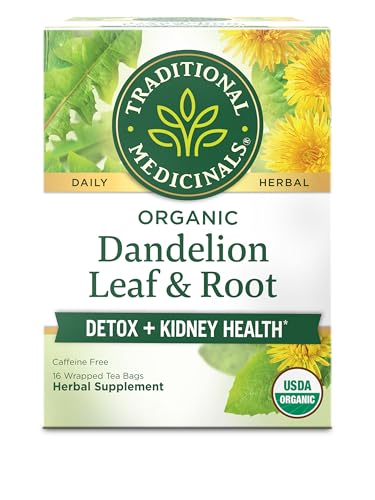
Dandelion appears in almost every tea marketed for bloating, and Traditional Medicinals is the version we would actually buy. It is USDA Organic, Non-GMO Project Verified, and kosher certified, which is three named bodies against a product that costs a few dollars.
What we like most is the labeling. The box specifies leaf and root, not just “dandelion”, which tells you what you are drinking. Dandelion leaf is traditionally used as a mild diuretic and root is more bitter and earthy, closer to coffee when roasted. Getting both is the honest way to sell a dandelion tea.
Worth being clear about the diuretic point, because it is where this category misleads. A mild diuretic makes you pass more water. That will register on a scale, and it is water, not fat. If you feel less bloated after a cup, that is a genuine comfort benefit and worth having on its own terms. It is not weight loss, and any product presenting it as such is misleading you.
The limitation is the sixteen-bag box, which goes quickly if this becomes a daily habit. Our organic dandelion root tea guide covers larger formats and roasted versions.
Best caffeine-free: Numi Organic Dandelion Detox
| Organic Integrity Score | 88 / 100 |
| Certification | USDA Organic |
| Ingredients | Organic dandelion with supporting botanicals |
| Format | 48 tea bags |
| Caffeine | None |
| Best for | An evening cup that will not affect sleep |
Numi is the pick if the tea is going to be an evening habit, which for a lot of people is exactly when it is most useful. The hours between dinner and bed are where unplanned eating tends to happen, and a hot drink occupies that window without adding meaningful calories.
It is USDA Organic and completely caffeine free, and at forty-eight bags it lasts long enough to become an actual routine rather than a novelty box that runs out in a fortnight. Numi has also been consistent about ingredient sourcing and packaging in a category where a lot of brands are not.
The word “detox” is on the box, and we would be inconsistent if we did not say what we said earlier: that word describes nothing measurable. Read it as a flavor category, the same way “breakfast tea” does not describe a mechanism. Judged as a caffeine-free organic dandelion blend that tastes good and is certified, it is genuinely one of the better options available.
Best for sweet cravings: Herbaly Glucose Organic Herbal Tea
| Organic Integrity Score | 82 / 100 |
| Certification | Non-GMO, Organic |
| Format | 28 tea bags |
| Caffeine | None |
| Cost per cup | The highest of the certified options here |
| Best for | Replacing an afternoon sweet snack with something warm |
Herbaly is certified organic and caffeine free, and it is naturally sweet enough to stand in for a sugary drink without any sweetener added. That is the honest case for it, and it is a reasonable one.
We have scored it lower than the three above on two counts. It is the most expensive certified tea per cup on this page by a wide margin, and it is marketed with heavy emphasis on blood sugar and cravings, which pushes toward implied health claims we cannot support with evidence. The certification is genuine and the product is good; the positioning runs ahead of what the research shows.
Buy it if you like the taste and the price does not bother you, and specifically if swapping an afternoon biscuit for a naturally sweet hot drink is a habit change you are trying to make. Do not buy it expecting it to act on blood sugar.
Best herbal blend, though not certified organic: nutriEffect 7-Herb
| Organic Integrity Score | 61 / 100 |
| Certification | Not stated on the listing |
| Ingredients | Green tea, rooibos, yerba mate, nettle leaf, lemongrass, pau d’arco, licorice root |
| Format | 250 g loose leaf, roughly 100 cups |
| Caffeine | Yes, from green tea and yerba mate |
| Best for | A complex loose-leaf ritual, if certification is not your priority |
This is the product that pays us the most, and it finishes last. We think that is worth stating plainly rather than burying, because the alternative is a page you cannot trust.
The reason for the score is certification. nutriEffect makes no organic claim anywhere on the listing, and the manufacturer does not claim one. On a site where the central promise is verified organic certification, a tea with none cannot score alongside four that have it. That is not a criticism of the tea; it is the criterion this site exists to apply.
On its own terms it is a good product. Seven named botanicals, no proprietary blend hiding behind a trademark, no added sugar or artificial ingredients, and a genuinely interesting flavor profile: rooibos gives it a naturally sweet, floral base that most herbal blends of this type lack, and the yerba mate adds body. At 250 grams of loose leaf making around a hundred cups, the cost per cup is competitive despite the higher box price. If you prefer loose leaf and a strainer to bags, there is little else in this category offering this many herbs at this price.
Two things to know before buying. It contains caffeine from green tea and yerba mate, so it is not an evening drink. And it contains licorice root, which is covered in the safety section below and matters if you have high blood pressure.
What organic certification does and does not guarantee here
Worth being precise, because in herbal tea the gap between what people assume and what the seal covers is unusually wide.
USDA Organic certification tells you how the plants were farmed: no prohibited synthetic pesticides or fertilizers for three years before harvest, no genetic engineering, and an audited paper trail from an accredited certifier. In a product that is essentially dried plant matter steeped in water, that is meaningful. Tea is a crop where residues are a legitimate concern, and certification is the most reliable protection available to a shopper.
It tells you nothing at all about whether the tea does anything. Certification is an agricultural standard, not an efficacy standard. An organic tea and a conventional tea marketed for weight loss are equally unsupported on the weight loss question. The seal raises your confidence in how the leaf was grown, and should not raise your confidence in the claim on the front of the box by even a little.
It also does not verify safety of the botanicals themselves. Licorice root can be certified organic and still raise blood pressure. Senna can be certified organic and still be a stimulant laxative. Organic senna is exactly as strong as conventional senna.
Safety: licorice, caffeine, and who should be careful
Herbal does not mean inert, and this category contains a few genuinely active plants.
Licorice root
Licorice contains glycyrrhizin, which in regular or high intake can cause potassium loss and raised blood pressure through an effect on mineralocorticoid activity. This is well documented rather than theoretical, and cases of significant effects from heavy licorice consumption appear in the medical literature.
Occasional cups are not a concern for most healthy adults. Daily use over long periods is worth thinking about, particularly if you have hypertension, kidney disease, heart failure, or take diuretics or corticosteroids. Of the teas here, nutriEffect contains licorice root. If you are in one of those groups, one of the four certified options without it is the safer daily habit.
Caffeine
Green tea, matcha and yerba mate all contain caffeine. That is not a problem in itself, but it stacks with coffee, and the teas here that market themselves around energy and metabolism are typically the caffeinated ones. If you are sensitive, or drinking in the evening, choose a caffeine-free option.
Pregnancy, medication and existing conditions
Several botanicals common in this category, including dandelion and licorice, interact with medications or are advised against during pregnancy. If you are pregnant, breastfeeding, managing a chronic condition, or taking prescription medicine, ask a pharmacist or doctor before making any herbal tea a daily habit. That is genuinely worth doing, and a pharmacist will answer it in two minutes.
How to use tea sensibly in a weight management routine
None of this makes tea useless. It makes it a habit tool rather than a mechanism, and habit tools work if you use them as such.
Use it as a substitute, not an addition. The single largest measurable effect tea can have on your intake is replacing something else. Swapping a sweetened coffee drink or a fizzy drink for tea removes real calories. Adding tea to an unchanged diet removes nothing.
Put it where the snacking is. Most people know their own weak window, usually mid-afternoon or the hours after dinner. Making tea occupies hands and attention for a few minutes and gives the impulse time to pass. This is not profound, and it works more often than any ingredient in the box will.
Do not weigh yourself after a diuretic or laxative tea and believe the number. Water weight moves by a kilogram or more in a day. If a tea makes the scale drop overnight, you have lost fluid, and it will come back.
Judge the tea on whether you enjoy it. A tea you like is one you will drink daily, and the daily habit is the entire benefit. An expensive blend you find unpleasant will sit in the cupboard, which is worth nothing at any price.
Be suspicious of anything promising a timeframe. Fourteen-day teatox programs, in particular, combine the laxative mechanism with a deadline, which is the least useful version of this product. For broader context on the category, our organic coffee and tea guide covers what is worth paying for across the whole aisle.
Common questions about organic weight loss tea
Does any tea actually cause weight loss?
Not to a degree that matters. Green tea catechins show a small effect in pooled analyses, typically around a kilogram or less over twelve weeks, using concentrated extracts at doses far above a brewed cup, with results that shrink in habitual caffeine drinkers. No herbal blend has credible weight loss evidence behind it.
What is the difference between detox tea and laxative tea?
Frequently nothing. Many teas sold as detox contain senna or a similar stimulant laxative, which produces rapid apparent weight change through fluid and stool loss rather than fat loss. Check the ingredient list for senna, cascara sagrada, rhubarb root, or buckthorn bark.
Is organic weight loss tea safer than conventional?
Safer in terms of pesticide residues, yes, since certification governs how the plants were farmed. Not safer in terms of what the herbs do. Organic senna is still a laxative and organic licorice still affects blood pressure.
Can I drink these teas every day?
The four certified teas here are fine as daily drinks for most healthy adults. Take more care with anything containing licorice root over long periods, and avoid daily use of any tea containing a stimulant laxative.
Which tea is best for bloating rather than weight?
Dandelion and peppermint are the usual choices, and bloating comfort is a more realistic thing to expect than weight change. Both dandelion options here are certified organic and caffeine free.
Why is the highest-paying product ranked last on this page?
Because it is not certified organic, and certification is the primary criterion on this site. nutriEffect is part of a paid campaign that pays us a higher rate than anything else here, and it still finished last, because the score is calculated before the commission is considered.
Looking for other organic products?
We have checked more than 800 products across food, household goods, gardening, personal care and pet, every one against its stated certification. Browse all reviews.
Organic Connection participates in the Amazon Services LLC Associates Program, an affiliate advertising program designed to provide a means for sites to earn advertising fees by advertising and linking to Amazon.com. nutriEffect is featured as part of a paid Amazon Creator Connections campaign. This article is general information, not medical advice. If you are managing your weight or a health condition, speak to a doctor or registered dietitian.