Last updated: September 30, 2026
We may earn a commission when you buy through links on this page, at no extra cost to you. One product below, Fusion Select, is part of a paid Amazon Creator Connections campaign that pays us a higher commission rate; it was scored by the same method as everything else and placed where that score put it. We were not sent samples of any tea on this page. How we research and rate.
The short version
After comparing organic certification, leaf grade, bag construction, stated origin, and price per cup across the organic white teas you can actually buy, our top pick is FGO Organic White Tea. It carries both the USDA Organic seal and Non-GMO Project verification, and its bags are unbleached abacá hemp fiber with no glue, staples, or chlorine, which matters more than it sounds when the whole product is steeped in hot water. For loose leaf, Davidson’s Organics Himalayan White is the pick, and for the lowest cost per cup, Prince of Peace Organic White Tea comes in at under nine cents a bag.
An honest note on this category: white tea is the least processed of the true teas, which makes it the easiest to sell on romance and the hardest to verify. Plenty of boxes say “organic” without naming a certifying body, and plenty of what is sold as white tea is a blend. Every tea below is a genuine white tea, and where a certifier is named we have said which one. Where none is named, we have said that too.
Best organic white tea compared
| Best Choice | Best Value | ||||
 |  |  |  |  | |
| Product | FGO Organic | Davidson’s Himalayan | Prince of Peace | Nepal Tea White Prakash | Fusion Select |
| Organic Integrity Score | 93/ 100 | 90/ 100 | 88/ 100 | 86/ 100 | 83/ 100 |
| Our rating | 4.7 | 4.5 | 4.4 | 4.3 | 4.2 |
| Best for | Best overall | Loose leaf | Lowest cost per cup | Single-origin leaf | Mild everyday cup |
| Format | 100 bags | 1 lb loose leaf | 100 bags | 3.5 oz loose leaf | Tea bags |
| Certification | USDA Organic, Non-GMO | USDA Organic, Non-GMO | USDA Organic, Ecocert | USDA Organic | — |
| Origin | Packed in USA | Own farms, India | Not stated | Himalayas, 4,500-6,000 ft | Not stated |
| Price | $21.99$0.22 / count View on Amazon | $30.76$1.92 / ounce View on Amazon | $9.04$0.09 / count View on Amazon | $25.00$7.14 / ounce View on Amazon | $9.99$0.10 / count View on Amazon |
- Organic Food and Pantry hub
- Best Organic Chamomile Tea
- Best Organic Dandelion Root Tea
- our organic product database — compare brands across every guide
- White tea vs green tea, explained
Price and availability as of October 27, 2026 7:10 am EDT. Product prices and availability are accurate as of the date/time indicated and are subject to change. Any price and availability information displayed on Amazon.com at the time of purchase will apply to the purchase of this product.
Scores are ours, based on independent research of certification, bag and packaging materials, stated origin, leaf grade, and cost per cup, using the same 10-criteria method we apply to every product. See how we research and rate.
What each certification on an organic white tea label actually covers
The labels on these products are not interchangeable, and several of them cover things that have nothing to do with each other. Here is what each one actually buys you.
| Certification | Covers | Key exclusion |
| USDA Organic | Farming and handling: no synthetic pesticides or fertilizers, no GMOs, no sewage sludge or irradiation, audited yearly by an accredited certifier | Three different tiers share the one seal, and it makes no claim about worker pay, food miles, or nutrition |
| Non-GMO Project | Testing and supply-chain traceability showing the ingredients are not genetically engineered | Sets no limit on synthetic pesticides or fertilizers, so it is not an organic claim |
| COSMOS Organic | Cosmetics: organic content thresholds, permitted processes and ingredients, and packaging rules | Its sister grade, COSMOS Natural, carries the same name and requires no minimum organic content at all |
COSMOS is two standards with one name, and the weaker one is easy to miss. COSMOS Organic requires at least 95% of the plant ingredients to be organic. COSMOS Natural, printed in the same typeface by the same body, requires no minimum organic content whatsoever: it governs which ingredients and processes are permitted, not how much of the product is organic. If the word after COSMOS is “Natural”, the organic question is still open.
What separates a genuinely organic white tea from a marketing claim
White tea is picked young, withered, and dried, with no rolling and no deliberate oxidation. Less processing means fewer steps where something can be added, which is good, but it also means the raw leaf quality carries the entire cup. Here is what we weighted.
1. A named certifying body
“Organic” on the front of a box means little without a certifier behind it. USDA Organic is the baseline in the United States; ECOCERT and other accredited bodies certify to equivalent standards. Two teas here name one, two carry the USDA seal, and one names neither. That difference is reflected in the scores.
2. Bag material, not just leaf
Most guides skip this. A tea bag steeps in near-boiling water for minutes, so the bag is part of the recipe. Some bags are chlorine-bleached, sealed with adhesive, or closed with metal staples. If you are paying a premium for organically grown leaf, steeping it through bleached paper sealed with glue undoes part of the point.
3. Bud content and leaf grade
The best white teas are made largely from unopened buds, which is where the delicate, slightly sweet character comes from. Cheaper white tea uses more mature leaf and broken pieces, which brews faster and flatter. Loose leaf makes this visible; a bag hides it entirely.
4. Cost per cup, not cost per box
Box prices are not comparable when a loose-leaf pound sits next to a 100-bag box. We converted everything to cost per cup, which is the only figure that makes them comparable. The spread here runs from under nine cents to well over a dollar.
Best overall: FGO Organic White Tea, 100 Count
| Organic Integrity Score | 93 / 100 |
| Certification | USDA Organic, Non-GMO |
| Format | 100 tea bags, foil-lined kraft pouch |
| Bag material | Abacá hemp fiber, no dye, glue, staples, or chlorine bleach |
| Best for | The cleanest certified organic white tea in bag form |
FGO takes the top spot for the same reason its oolong does: it is the only white tea in this group carrying both the USDA Organic seal and Non-GMO Project verification, and the only one that treats the bag as part of the product. The bags are abacá hemp fiber, unbleached, with no adhesive, no staples, and no string, and the tea ships in a foil-lined pouch that keeps the leaf from staling once opened.
It is also by a wide margin the best-selling certified organic white tea on Amazon, which matters less than the certification but is worth knowing. The trade-off is price: at roughly twenty-two cents a bag it costs about two and a half times what the Prince of Peace box does. You are paying for the second certification and the bag construction, and whether that is worth it depends on how much either matters to you.
What we liked: Dual certification, genuinely clean bag construction, a resealable foil-lined pouch, and a 100-count box that keeps the per-cup price sane despite the premium.
Keep in mind: The most expensive bagged option here per cup, and the listing states only that it is packed in the United States rather than naming a growing region.
What the listing discloses: FGO states USDA organic certification and Non-GMO Project Verified, and does not say where it was grown or made.
Best loose leaf: Davidson’s Organics Himalayan White
| Organic Integrity Score | 90 / 100 |
| Certification | USDA Organic, Non-GMO |
| Format | 1 lb loose leaf |
| Sourcing | Grown on the company’s own farms in India |
| Best for | Anyone who wants whole leaf and control over the steep |
Davidson’s is a third-generation organic tea grower that owns its supply chain from cutting to packaging, which is unusual in a category where most brands buy finished tea from a broker. Himalayan White is crisp and clean rather than heavy, and because it is loose you can actually see what you are buying: bud content, leaf size, and color are all visible before the water goes in.
A pound is a serious quantity, enough for well over a hundred cups depending on how heavily you dose it, which makes the per-cup cost competitive despite the box price. The obvious trade-off is that you need an infuser and you have to watch the clock, because white tea turns papery if it is over-steeped.
What we liked: Vertically integrated grower, certified organic, genuinely whole leaf, and enough of it that the cost per cup undercuts most bagged options.
Keep in mind: Requires an infuser, and a one-pound bag is a big commitment if you are still deciding whether you like white tea.
What the listing discloses: Davidson’s documents USDA organic certification, and leaves where it was grown or made unsaid.
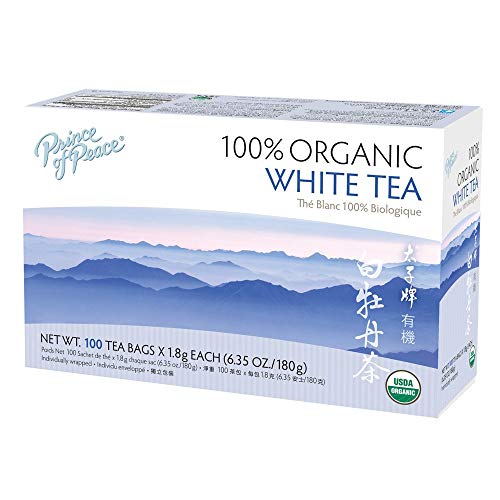
Best value: Prince of Peace Organic White Tea, 100 Bags
| Organic Integrity Score | 88 / 100 |
| Certification | USDA Organic, Ecocert |
| Format | 100 tea bags |
| Leaf | 100% organic white tea leaves, no blend |
| Best for | Daily drinking at the lowest cost per cup |
At under nine cents a bag this is the cheapest certified organic white tea per cup we found, and the certification is held with ECOCERT ICO rather than being an unbacked front-of-box claim. The listing is also refreshingly plain about what is in the box: 100% organic white tea leaves, not a blend dressed up with flavoring.
The cup is lighter and less complex than the loose-leaf options, which is what you would expect at this price, but it is a genuine white tea rather than a green tea sold as one. If you drink white tea daily and work through a box every couple of months, the difference against our top pick adds up to real money over a year.
What we liked: The lowest cost per cup here by a wide margin, a named certifier, and a straightforward single-ingredient tea with no blending.
Keep in mind: The listing does not describe the bag material or name a growing region, and the cup is simpler than the loose-leaf picks.
What the listing discloses: Prince Of Peace is explicit about Ecocert as the certifying agent, and silent on whether the USDA seal applies and where it was grown or made.
Best single-origin: Nepal Tea White Prakash Loose Leaf
| Organic Integrity Score | 86 / 100 |
| Certification | USDA Organic |
| Format | 3.5 oz loose leaf |
| Origin | Himalayas, grown at 4,500 to 6,000 feet |
| Best for | Trying a named single-origin without buying a pound |
This is the most specific listing in the group about where the tea actually comes from: a named estate tea grown in the Himalayas between 4,500 and 6,000 feet. High-altitude growing slows leaf development, which is the usual explanation for the more concentrated character you get in teas like this, and the difference is noticeable against the bagged options.
At 3.5 ounces it is also the sensible way into loose-leaf white tea, because you are not committing to a pound of something you may not like. The cost per cup is higher than Davidson’s precisely because the pack is small, so it is a tasting purchase rather than an everyday one. It also cold-brews well, which is worth knowing in summer.
What we liked: A genuinely stated origin and altitude, USDA certified, small enough to try without commitment, and good cold-brewed.
Keep in mind: The highest cost per cup of the five, and 3.5 ounces will not last long if white tea becomes your daily drink.
What the listing discloses: Nepal Tea states USDA organic certification, and does not say where it was grown or made.
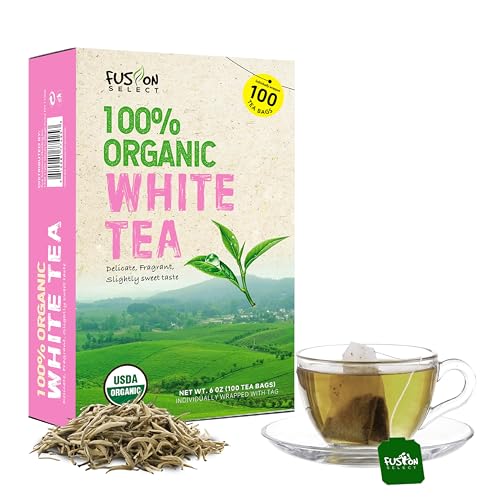
Best mild everyday cup: Fusion Select Organic White Tea
| Organic Integrity Score | 83 / 100 |
| Certification | — |
| Format | Tea bags |
| Processing | Buds gently air-dried to preserve color and aroma |
| Best for | A soft, low-commitment introduction to white tea |
Fusion Select leans on the gentlest end of the white tea range: buds air-dried rather than heat-dried, producing a fragrant, slightly sweet cup with very little astringency. If you have tried white tea and found it thin or papery, this is the style most likely to change your mind, and at ten cents a bag it is an inexpensive way to test that.
Two things hold the score at 83. The listing says the tea is “sourced from organically grown tea plants” but does not name a certifying body, which is a materially weaker claim than the USDA seal on FGO or the ECOCERT certification on Prince of Peace. It also ships through a reseller rather than the brand, so there is less chain of custody to inspect. Neither is disqualifying, but on a site that weights verifiable certification, both cost points.
What we liked: A genuinely delicate, approachable cup, air-dried bud processing, and a low price per bag that makes it easy to try.
Keep in mind: No certifying body named on the listing, no stated origin, and sold through a reseller rather than the brand.
What the listing discloses: Little to verify on the Fusion Select listing: no word on whether the USDA seal applies and where it was grown or made.
White tea versus green tea: what the processing changes
Both come from Camellia sinensis, and both are minimally oxidised, which is why they are often confused. The difference is what happens straight after picking. Green tea is heated quickly, by steaming or pan-firing, to stop oxidation. White tea is simply withered and dried, with no heat-fixing step and no rolling at all.
That absence of processing is the whole character of white tea. It is lighter, softer, and sweeter than green tea, with none of the grassy or marine notes pan-firing produces. It is also more forgiving of a slightly long steep than green tea, though not infinitely so.
White tea is generally the lowest-caffeine true tea, though the gap is smaller than commonly claimed and depends far more on leaf quantity and steeping time than on the category. If caffeine is your reason for choosing it, brew it lightly and briefly rather than assuming the label does the work.
How to brew white tea without flattening it
The single most common mistake is boiling water. White tea is delicate, and water straight off the boil strips the subtlety it is bought for, leaving a flat, faintly papery cup. Around 175 to 185°F is the usual guidance, which in practice means boiling the kettle and letting it stand for two or three minutes.
Steep for three to five minutes for a bag, and shorter for loose leaf, which you can then re-steep. Good loose white tea will give you two or three infusions, and the second is often the best one, because the leaf has opened fully by then.
If the cup tastes of nothing, add leaf rather than time. If it tastes dry or papery, your water was too hot or the steep too long. Those two adjustments fix nearly every problem without any equipment.
Bags or loose leaf: which is right for you
White tea makes the bag-versus-loose question sharper than most categories, because bud content is the main quality signal and a bag hides it completely. Loose leaf lets you see what you paid for: silvery unopened buds rather than broken mature leaf.
That said, a good bagged white tea brewed carefully beats a good loose tea brewed carelessly. Our honest read is that bags are the right choice if you drink white tea occasionally or at work, and loose leaf is worth it once you are drinking it regularly and already own an infuser. Starting with a small loose-leaf pack, like the Nepal Tea above, is the low-risk way to find out which camp you are in.
How we scored these organic white teas
Every product on this site is scored out of 100 against the same ten criteria, weighted for the category. For tea, the heaviest weights sit on certification and traceability, because those are the claims a buyer cannot verify from a photograph.
A tea with a named certifying body scores higher than one that says only “organic”. A stated growing region scores higher than an unstated one. Disclosed bag material scores higher than silence. Price per cup is weighted, but it is not the largest factor, which is why the cheapest tea here is not the top pick and the most expensive bagged one is.
One product here, Fusion Select, is part of a paid Amazon campaign that pays this site a higher commission than the others. It was scored before that was taken into account and it placed fifth, behind four teas that pay us the standard rate. We mention it because you should be able to check our reasoning against our incentives.
Least processed, least studied
White tea is often described as the highest in antioxidants because it is the least processed, and it is worth checking whether that translates into anything measurable.
The processing claim is broadly accurate. White tea is withered and dried with minimal oxidation, so it retains catechins in a form closer to the fresh leaf than green tea does, and considerably closer than black. Analytical comparisons generally find catechin levels comparable to or slightly above green tea, depending heavily on the specific leaf and grade.
What does not follow is a body of evidence. Human research on white tea and body weight is very sparse. There is some laboratory work on white tea extract and fat cell metabolism, showing effects on adipocyte differentiation in cell culture, which is a long way from a person and a scale. Extrapolating the green tea trial literature to white tea is a reasonable assumption and not a finding.
The brewing variable matters more here than in other teas. White tea is brewed at lower temperatures and for shorter times than green or black, typically 75 to 80 degrees, which extracts less of everything including catechins. So the leaf may be richer while the cup is not.
Caffeine is lower than green tea in most white teas, generally 15 to 30 mg a cup, which makes it a reasonable evening option and removes most of the caffeine contribution to the thermogenic argument.
Honest summary: a genuinely minimally processed tea with a catechin profile close to the fresh leaf, almost no direct human evidence on weight, and a gentle brewing method that extracts less than the leaf contains. Buy it for the delicacy of the flavor.
Common questions about organic white tea
Is white tea actually lower in caffeine?
Usually, yes, but less dramatically than often claimed. A cup sits around 15 to 30 mg against 95 to 165 mg for drip coffee. Steeping time and leaf quantity move the figure more than the category does.
Why is white tea more expensive per gram?
Because the best of it is made from unopened buds picked in a narrow window, and it takes far more picking labour per finished ounce than a mature-leaf black tea does.
Can I re-steep white tea?
Loose leaf, yes, and the second infusion is often better than the first. Bagged white tea will give a serviceable second cup but rarely a better one.
Does white tea go stale?
It does, and faster than black tea, because there is no oxidation to stabilize it. Buy in quantities you will finish within a year, and keep it sealed away from light and heat.
Is organic white tea worth the extra cost?
Tea is consumed as an infusion of dried, unwashed leaf, which is a reasonable argument for caring about what was sprayed on it. Certified organic production prohibits most synthetic pesticides, and at under nine cents a cup for the value pick, the premium here is small in absolute terms.
Looking for other organic products?
We have checked more than 800 products across food, household goods, gardening, personal care and pet, every one against its stated certification. Browse all reviews.
Organic Connection participates in the Amazon Services LLC Associates Program, an affiliate advertising program designed to provide a means for sites to earn advertising fees by advertising and linking to Amazon.com. One product on this page is part of a paid Amazon Creator Connections campaign that pays a higher commission rate; it was scored by the same criteria as every other product and placed accordingly. We were not provided with samples of any product on this page. Product prices and availability are accurate as of the date and time indicated and are subject to change.