Last updated: September 30, 2026
We may earn a commission when you buy through links on this page, at no extra cost to you. How we research and rate.
The short version
After researching the certifications, roasting, and sourcing of the most popular organic dandelion root teas, our top pick is Traditional Medicinals Organic Roasted Dandelion Root. It is USDA certified organic and Non-GMO Project Verified, made from roasted root rather than leaf, and the company tests its botanicals to pharmacopoeial-grade standards, which is why it earned our highest Organic Integrity Score of 92 out of 100. For the best value per bag, FGO Organic Roasted Dandelion Root, 100 Count is our pick, and for a nuttier flavor, Alvita Organic Dandelion Root is the best choice.
With dandelion tea, the two things that determine what you get are whether it is root or leaf and whether the root was roasted. We flag each product’s certification and part used.
Best organic dandelion root tea compared
| Best Choice | Best Value | ||||
 |  |  |  |  | |
| Product | Traditional Medicinals 96 ct | FGO 100 ct | GLDNT 100 ct | Alvita 72 ct | Trad. Medicinals Leaf & Root |
| Organic Integrity Score | 92/ 100 | 88/ 100 | 86/ 100 | 85/ 100 | 84/ 100 |
| Our rating | 4.6 | 4.4 | 4.3 | 4.3 | 4.2 |
| Best for | Best overall | Best value | Trying it first | Nuttier roast | Small Alvita box |
| Certification | USDA Organic, Non-GMO, Kosher | USDA Organic, Non-GMO | Certified Organic, Non-GMO, Gluten-free | Gluten-free, Vegan, Organic | USDA organic |
| Price | $39.90 $41.94 −5%$0.42 / count View on Amazon | $24.99$0.25 / count View on Amazon | $19.99$0.20 / count View on Amazon | Currently unavailable See buying options | $5.88$0.37 / count View on Amazon |
Price and availability as of October 11, 2026 7:10 pm EDT. Product prices and availability are accurate as of the date/time indicated and are subject to change. Any price and availability information displayed on Amazon.com at the time of purchase will apply to the purchase of this product.
Scores are ours, based on independent research of certification, part used and roasting, ingredient purity, packaging, and value, using the same 10-criteria method we apply to every product. See how we research and rate.
Reading the seals on organic dandelion root tea: what each one does and does not cover
A seal is a specific promise about a specific thing. These are the promises behind the marks on this page, in plain terms, along with the question each one leaves unanswered.
| Certification | Covers | Key exclusion |
| USDA Organic | Farming and handling: no synthetic pesticides or fertilizers, no GMOs, no sewage sludge or irradiation, audited yearly by an accredited certifier | Three different tiers share the one seal, and it makes no claim about worker pay, food miles, or nutrition |
| GOTS | Organic fiber from farm to finished textile, plus dyeing, finishing, wastewater and labor criteria | Has a weaker second tier, “made with organic”, that needs only 70% organic fiber and carries the same name |
| Non-GMO Project | Testing and supply-chain traceability showing the ingredients are not genetically engineered | Sets no limit on synthetic pesticides or fertilizers, so it is not an organic claim |
| Kosher | Ingredients and production comply with Jewish dietary law, verified by a rabbinic agency that inspects the facility | A dietary-law standard: it makes no claim about pesticides, GMOs or farming practice |
The mark most often mistaken for an organic claim is Non-GMO Project Verified. It is a real standard with real testing, and it verifies exactly one thing: that the ingredients are not genetically engineered. It sets no limit on synthetic pesticides, synthetic fertilizers, or anything else about how the crop was grown. USDA Organic already prohibits GMOs outright, so on a certified organic product the butterfly adds independent verification rather than a new promise. On a product carrying only the butterfly, the pesticide question has not been asked.
Key things to look for in organic dandelion root tea
Great dandelion root tea is about certification, the part used, roasting, and purity. Here is what matters.
1. USDA organic certification
Dandelion is a low-growing root crop and you steep it directly, so pesticide certification genuinely matters.
2. Root, and specifically roasted
Roasted root gives the dark, coffee-like character most people are after. Leaf is a different, greener, more bitter product.
3. A single ingredient
Organic roasted dandelion root and nothing else. Many “detox” blends pad the box with chicory, liquorice, and cheaper botanicals.
4. Sensible packaging
Compostable or unbleached bags avoid steeping plastic in near-boiling water. Resealable bulk bags keep the roast aromatic.
As a coffee substitute, and what the evidence supports
Roasted dandelion root is the best of the caffeine-free coffee alternatives, and it is worth understanding why it works. Roasting the root caramelizes its carbohydrates and develops the same broad family of roasted, bitter, slightly nutty compounds that make coffee taste like coffee. The result is genuinely dark in the cup with a real bitterness behind it, so it satisfies the ritual and the flavor profile in a way that a herbal infusion like chamomile never will. It is not a perfect impersonation, there is no crema, no caffeine, and a distinctly earthy note coffee does not have, but for an evening drink or for someone cutting caffeine it is the closest thing available. Brewing it strong and adding a splash of oat milk gets you remarkably close to a latte.
On the health claims, some honesty is due. Dandelion root has a long traditional use in digestion and liver support, and it does contain inulin, a prebiotic fiber, plus various bitter compounds that stimulate digestive secretions in the way bitters generally do. What it is not is a “detox” or a “liver cleanse,” despite that being the dominant marketing angle. Your liver and kidneys perform detoxification continuously and do not need a tea to do it, and the human clinical evidence for dandelion specifically is thin, mostly limited to small studies and traditional use. Treat it as a pleasant, caffeine-free, low-risk drink that many people find settles digestion, not as a therapy. Two genuine cautions: dandelion is in the daisy family, so people allergic to ragweed, marigolds, or chrysanthemums may react, and because it has a mild diuretic effect and may interact with lithium and some diuretic medications, check with your doctor if you take those.
How to choose organic dandelion root tea
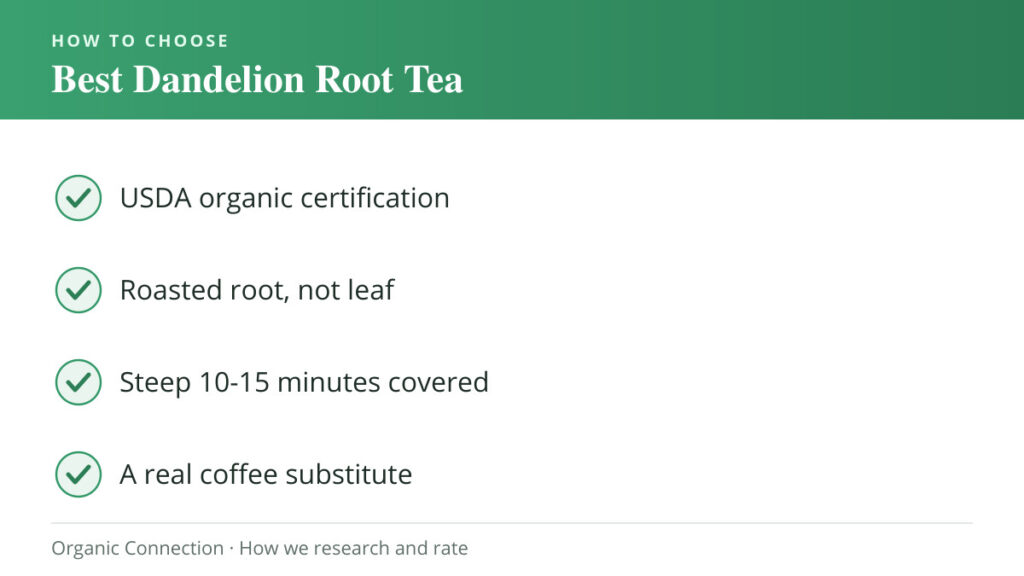
- Confirm USDA organic. A low-growing root you steep unwashed is a sensible place to want certification.
- Check it says root, and roasted. Leaf is a different product with a greener, more bitter profile.
- Read the ingredient list. One ingredient beats a “detox blend” padded with chicory and liquorice.
- Brew it long. Root needs ten to fifteen minutes covered, not the three you would give a black tea.
- Ignore “cleanse” marketing. It is a pleasant digestive bitter, not a therapy.
Who should buy organic dandelion root tea
The right box depends on how you drink it. If you want the best-sourced single-ingredient roasted root, our top pick fits. If you want the lowest cost per cup, a nuttier Alvita roast, a large multipack, or a small box to try first, we have a pick for each.
Best overall: Traditional Medicinals Organic Roasted Dandelion Root, 96 Bags
| Organic Integrity Score | 92 / 100 |
| Part used | Roasted dandelion root |
| Certification | USDA Organic, Non-GMO, Kosher |
| Best for | A daily caffeine-free coffee substitute |
Traditional Medicinals is our top pick because the herb quality is a step above the category. It is USDA certified organic and Non-GMO Project Verified, made from roasted root rather than leaf, tested to pharmacopoeial-grade standards, and packed in compostable bags with unbleached wrappers. The roast is deep enough to genuinely read as coffee-adjacent, with a rounded bitterness and no thin, weedy edge. Buying the six-box, ninety-six-bag format brings the cost per cup to a sensible place for daily use while each box stays sealed until opened.
The trade-off is price relative to commodity herbal tea, and the fact that ninety-six bags is a commitment if you have never tried roasted dandelion. It is also a genuinely bitter drink, which is the point but not to everyone’s taste.
What we liked: USDA organic and Non-GMO verified, pharmacopoeial-grade herb testing, compostable bags, a deep satisfying roast, and good value in the six-box format.
Keep in mind: Priced above commodity herbals, and ninety-six bags is a lot if you are new to the flavor.
What the listing discloses: You are told USDA organic certification and kosher certification for Traditional Medicinals; you are not told where it was grown or made.
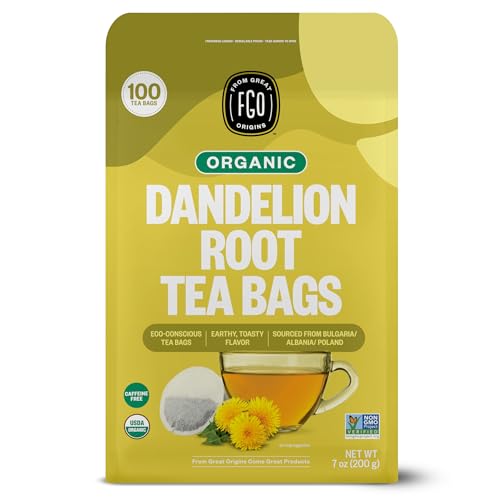
Best value: FGO Organic Roasted Dandelion Root Tea, 100 Count
| Organic Integrity Score | 88 / 100 |
| Part used | Roasted dandelion root |
| Certification | USDA Organic, Non-GMO |
| Best for | Daily drinkers who want the lowest cost per cup |
FGO delivers a hundred bags of USDA certified organic roasted dandelion root in a resealable bag at the lowest cost per cup in this guide by a clear margin. The bags are eco-conscious rather than plastic-sealed, the resealable pouch keeps the roast aromatic better than a cardboard box does once opened, and the roast itself is solid: dark, bitter, and unfussy.
The trade-off is thinner certification depth and sourcing transparency. It carries the USDA organic seal but not Non-GMO Project verification, and FGO publishes less about herb testing and origin than Traditional Medicinals does. The roast is also slightly lighter, so the cup is a touch less coffee-like.
What we liked: USDA organic at the lowest cost per cup here, resealable pouch that preserves aroma, and a straightforwardly good roast.
Keep in mind: Less sourcing and testing transparency, and a slightly lighter roast than the top pick.
What the listing discloses: FGO commits to USDA organic certification and Non-GMO Project Verified but stops short of where it was grown or made.
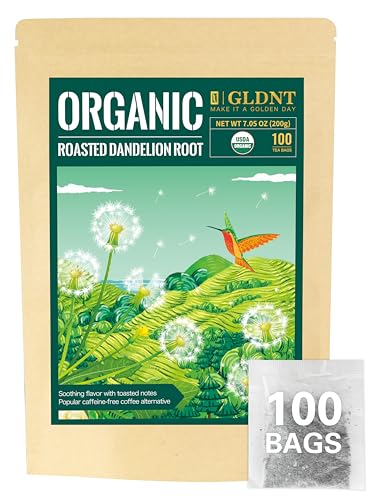
Best unbleached bags: GLDNT Organic Roasted Dandelion Root Tea, 100 Count
| Organic Integrity Score | 86 / 100 |
| Size | 100 tea bags |
| Bags | Non-GMO plant fiber, unbleached, no strings or tags |
| Certification | Certified Organic, Non-GMO, Gluten-free |
| Excludes | Caffeine, additives, gluten, sugar |
| Best for | Buyers who care what the teabag is made of |
Two details here are about the bag rather than the tea, and both are worth having. The bags are non-GMO plant fiber and unbleached, which matters because chlorine bleaching of teabag paper is the thing most people assume has already been dealt with and often has not.
They are also made without strings or tags. That is a small waste reduction and a genuine trade-off: no string means fishing the bag out with a spoon.
The flavor description is unusually specific for a herbal tea — “subtle coffee-like notes… a mild bitterness that quickly gives way to a naturally sweet aftertaste” — which is an accurate account of what roasted dandelion root actually tastes like, and the reason people drink it as a coffee substitute.
The company also says it runs its own processing facilities and manages each step from ingredient selection to packaging, which is a supply chain claim rather than a slogan.
What we liked: Unbleached plant-fiber bags with no strings, an honest flavor description, and in-house processing.
Keep in mind: No certifying agency named, and no strings means you will need a spoon.
What the listing discloses: GLDNT lists a single-ingredient formula. The gap is whether the USDA seal applies and where it was grown or made.
Best nuttier roast: Alvita Organic Dandelion Root Herbal Tea, 72 Bags
| Organic Integrity Score | 85 / 100 |
| Part used | Roasted dandelion root |
| Certification | Gluten-free, Vegan, Organic |
| Best for | People who find dark roasts too bitter |
Alvita is a long-established single-herb tea brand, and their roasted dandelion root leans nuttier and rounder than the darker, more bitter roasts. If you have tried roasted dandelion and found it harsh, this is the version worth trying next: the same USDA certified organic root, roasted to a warmer, less aggressive profile, in a three-box, seventy-two-bag pack that prices sensibly.
The trade-off is exactly that softness. A nuttier roast is less convincing as a coffee substitute, so if the dark bitter cup is what you are after, the top pick serves better. Alvita also publishes less detail on herb testing than Traditional Medicinals.
What we liked: USDA organic single-herb root with a warmer, nuttier roast that suits people who find dark roasts harsh.
Keep in mind: Less coffee-like than a darker roast, and thinner published testing detail.
What the listing discloses: Beyond the organic claim itself, ALVITA does not say whether the USDA seal applies and where it was grown or made.
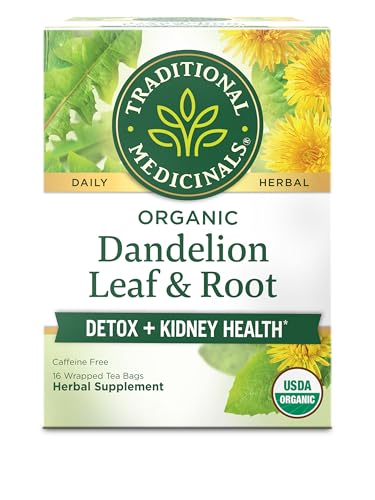
Best leaf and root blend: Traditional Medicinals Organic Dandelion Leaf and Root, 16 Bags
| Organic Integrity Score | 84 / 100 |
| Part used | Dandelion leaf and unroasted root — the only blend here |
| Certification | USDA Organic, Kosher, Non-GMO |
| Bags | Compostable, stated on the listing |
| Best for | Anyone who wants the leaf as well as the root |
This is the one box on the page that is not simply roasted root. It blends dandelion leaf with unroasted root, and that is a genuinely different drink: lighter, greener and more bitter, without the dark coffee-substitute character that roasting produces. If you have tried roasted dandelion and found it too close to coffee, this is the one to try instead.
The disclosure is the fullest here for the price. USDA organic, Kosher, Non-GMO, caffeine-free, and compostable tea bags — the bag material being a detail most herbal tea listings never mention at all, even though it is the part you throw away.
Two honest limits. Sixteen bags is the smallest box on this page, so the cost per bag is the highest. And the leaf and root blend is traditionally used for a different purpose than roasted root, so it is a substitution rather than a like-for-like alternative to the picks above.
What we liked: The only leaf-and-root blend here, and the only unroasted one. USDA organic, Kosher and Non-GMO, with compostable bags named on the listing. Cheapest box to try.
Keep in mind: Sixteen bags is the smallest box, so cost per bag is the highest. Lighter and more bitter than roasted root, which is a different drink rather than a cheaper one.
What the listing discloses: Traditional Medicinals lists kosher certification. The gap is whether the USDA seal applies and where it was grown or made.
How to brew it properly
Root needs far more extraction than leaf, and this is where most people go wrong. Use water just off the boil, cover the cup, and steep for ten to fifteen minutes; a three-minute steep gives you a thin brownish drink and the impression that dandelion tea is weak. Covering keeps the aromatic compounds in the cup. Press the bag firmly before removing it, since a lot of the extract sits in the saturated root.
For the coffee-substitute effect, use two bags in a mug, steep fifteen minutes covered, then add a splash of oat milk; the result is genuinely close to a dark, milky coffee. A pinch of cinnamon works well, and a little maple syrup takes the edge off the bitterness if you want it sweeter. It is also very good cold-brewed overnight, which mellows the bitterness considerably. Drink it after meals if you are using it as a digestive bitter, since that is when the traditional use makes most sense. Store boxes sealed, cool, and dark, and finish an opened box within a year while the roast is still aromatic.
Root, leaf and roasted root are three different products
Packaging often says only “dandelion tea”, and the three forms have genuinely different compositions and traditional uses. Buying the wrong one is the most common reason people find it does nothing.
| Part | Character | Traditionally used for |
| Raw root | Bitter, earthy, pale liquor. High in inulin, sesquiterpene lactones (taraxacin), triterpenes and phenolic acids. | Digestive bitter; bile stimulation |
| Roasted root | Dark, nutty, coffee-like. Roasting caramelizes the inulin and drives off much of the bitterness. | Caffeine-free coffee substitute — the most popular form and what most of our picks are |
| Leaf | Green, sharply bitter, high in potassium | The diuretic traditionally — and the part used in the diuretic research |
Keep in mind: if you bought dandelion tea expecting a diuretic effect and bought roasted root, you bought the wrong part. The small pilot study that found increased urine output used tea made from the leaves. Roasted root is a pleasant coffee alternative with a prebiotic fiber content; it is not the traditional diuretic.
What the evidence actually supports
Dandelion is one of the most heavily marketed “liver detox” botanicals, and the honest position is narrower than the packaging suggests.
- Bile secretion: animal studies have found dandelion root extracts increase bile flow. That is a real, repeatedly observed effect in animals, and it is the basis of the traditional digestive-bitter use.
- Diuresis: one small pilot study using dandelion leaf tea found increased urine output after two cups. It is a mild effect from a very small study, not an established one.
- Liver disease: there are no robust human clinical trials showing dandelion root tea benefits fatty liver disease or any other liver condition. The supportive work is animal and cell-based. Anyone selling it as a liver treatment is going well beyond the evidence.
- Digestion: early human work suggests improved subjective digestion, which is consistent with how bitters have been used for centuries — bitter compounds on the tongue stimulate digestive secretions.
Our reading: dandelion root tea is a genuinely good caffeine-free coffee substitute with a plausible traditional role as a digestive bitter, and a reasonable source of prebiotic fiber. It is not a detox, it does not treat liver disease, and “supports liver function” is a marketing phrase rather than a clinical claim. If you have a liver condition, that needs a doctor.
The inulin issue nobody warns you about
Dandelion root is rich in inulin — a prebiotic fiber that can make up a large share of the root’s dry weight, particularly in autumn-harvested roots. That has two consequences.
The good one: inulin is a genuine prebiotic that feeds beneficial gut bacteria, and it is part of why the roasted root tastes faintly sweet.
The awkward one: inulin is a FODMAP and it is heavily fermented. For people with IBS, SIBO or general sensitivity to fermentable fiber, several cups a day of dandelion root tea can cause exactly the bloating, gas and cramping they may have been trying to relieve. This is the most common reason people quietly abandon it, and almost no product mentions it.
If that sounds like you: start with one cup, brew it shorter, and note that roasted root delivers less intact inulin than raw root because roasting breaks some of it down. Dandelion leaf tea contains far less inulin than the root.
Brewing root properly: decoction, not infusion
Roots are woody, and steeping them like a leaf tea extracts very little — which is why homemade dandelion root tea often tastes like faintly brown water.
- Loose root: simmer, do not steep. Use about a tablespoon of cut root per cup, bring to the boil and simmer covered for 15–20 minutes. That is a decoction, and it is the correct method for any root or bark.
- Teabags: use freshly boiled water and steep 8–10 minutes covered, considerably longer than a black tea bag. Most people under-steep them.
- Cover the cup or pan. Volatile aromatics leave with the steam.
- Roasted root takes milk well and is the closest thing in the herbal aisle to a coffee replacement — add a little oat or dairy milk and it becomes noticeably more coffee-like.
- Re-simmer the root. Loose root gives a decent second decoction; teabags do not.
- A pinch of cinnamon or chicory alongside deepens it. Many commercial “dandelion coffee” blends are dandelion plus roasted chicory root for exactly this reason.
Who should avoid it
Dandelion is a food plant and broadly safe, but it has several specific contraindications that are more concrete than most herbal cautions.
- Gallstones or bile duct obstruction. Dandelion stimulates bile production, which can worsen symptoms where flow is obstructed. This is the clearest contraindication in the category.
- Ragweed, mugwort, marigold, chrysanthemum or daisy allergy. Dandelion is in the Asteraceae family and cross-reactivity is well documented — in one study of 52 patients sensitized to dandelion pollen, nearly all showed cross-reactivity with mugwort and ragweed. If you have hay fever driven by ragweed, introduce it cautiously.
- Prescription diuretics such as furosemide or hydrochlorothiazide — combining them risks dehydration and electrolyte imbalance.
- Lithium. A diuretic effect could theoretically reduce lithium excretion and raise blood levels toward toxicity. The interaction is not well established, but lithium has a narrow therapeutic window, so caution is warranted.
- Potassium-sparing diuretics — dandelion leaf is high in potassium, which compounds the effect.
- Medications generally. Laboratory and pharmacokinetic work suggests dandelion compounds can affect cytochrome P450 enzymes, which metabolize a large share of prescription drugs. The research is incomplete; if you take regular medication, mention it.
- Pregnancy and breastfeeding — insufficient safety data for medicinal quantities.
Foraging, sourcing and storage
- If you dig your own, avoid roadsides, dog-walking routes and any lawn that may have been treated — dandelions grow exactly where herbicide gets sprayed, and the root concentrates what is in the soil. This is a strong practical argument for buying certified organic rather than foraging in an unknown location.
- Autumn roots are highest in inulin; spring roots are more bitter and lower in it. Good producers state harvest season.
- Look for cut root rather than powder. Powdered root has more surface area and stales faster, and it is harder to see what you have bought.
- Storage: airtight, opaque, cool and dry. Cut root keeps 1–2 years; roasted root is best within a year, since the roast aromatics fade much as coffee does.
- Keep it away from odors. Roasted root absorbs neighboring smells readily.
- If it smells musty rather than nutty or earthy, it has taken on moisture. Discard it.
How we researched this guide
We are a research-based review site. We compared each product against its certification (USDA organic, and where present Non-GMO Project Verified), the plant part used and roasting, ingredient purity, packaging materials, and the weight of aggregated customer feedback on flavor and strength, then scored each with our 10-criteria Organic Integrity Score. No brand paid to be included or ranked. Nothing here is medical advice. Read the full method on our How We Research and Rate page.
A diuretic is not a weight loss agent
Dandelion appears in almost every tea marketed for bloating and slimming, and the distinction between what it does and what that is sold as is worth making precisely.
Dandelion leaf has a traditional reputation as a diuretic, and a small human study found increased urinary frequency after dandelion leaf extract. Dandelion root is used differently, traditionally for digestion and bile flow, and is the more bitter, coffee-like preparation.
A diuretic increases water excretion. That reduces body weight on a scale, sometimes by a noticeable amount, and every gram of it is water. It returns as soon as you rehydrate, which you will, because thirst is not optional. No fat is affected at any point in this process.
This is the single most common misdirection in the slimming tea category, and it works because the number on the scale does move. A product can produce a visible result within a day, entirely honestly in mechanical terms, while doing nothing whatsoever to body composition. Our guide to weight loss teas and what the evidence supports covers the related laxative version of the same trick.
Feeling less bloated is nonetheless a genuine comfort benefit, and if dandelion tea delivers that for you it is doing something worth having. It simply is not what it is usually sold as.
One caution: dandelion is in the daisy family and can cause reactions in people sensitive to ragweed, and its diuretic action is worth mentioning to a doctor if you take diuretic or blood pressure medication.
Honest summary: a mild diuretic with a long traditional history, a real effect on water weight, no effect on fat, and a comfort benefit that deserves to be described accurately.
Common questions about organic dandelion root tea
What is the best organic dandelion root tea?
Our overall pick is Traditional Medicinals Organic Roasted Dandelion Root, because it is USDA certified organic and Non-GMO Project Verified, made from roasted root rather than leaf, tested to pharmacopoeial-grade standards, and packed in compostable bags. For the lowest cost per cup, FGO’s 100-count is our pick, and for a nuttier roast, Alvita.
What is the difference between dandelion root and dandelion leaf tea?
They are different parts of the plant with different uses and flavors. The root, especially roasted, is dark, bitter, and coffee-like, traditionally used for digestion. The leaf is green and bitter and traditionally used as a diuretic. If a box says only “dandelion tea,” check which part it actually contains.
Does dandelion tea detox your liver?
No, and that framing is marketing rather than physiology. Your liver and kidneys perform detoxification continuously without help from a tea. Dandelion root does contain inulin, a prebiotic fiber, and bitter compounds that stimulate digestive secretions, and it has a long traditional use for digestion, but human clinical evidence is thin.
Is dandelion root tea a good coffee substitute?
It is the best of the caffeine-free options. Roasting caramelizes the root and develops dark, bitter, roasted notes that genuinely read as coffee-adjacent, unlike a floral herbal infusion. Brew two bags for fifteen minutes covered and add oat milk to get closest. It lacks caffeine and crema and has an earthy note coffee does not.
Who should avoid dandelion tea?
Dandelion is in the daisy family, so anyone allergic to ragweed, marigolds, or chrysanthemums may react to it. It also has a mild diuretic effect and may interact with lithium and certain diuretic medications, so check with your doctor if you take those or have gallbladder or kidney problems.
Is dandelion root tea a diuretic?
The diuretic tradition belongs to the leaf, not the root. The small pilot study that found increased urine output used tea made from dandelion leaves after two cups, and it was a mild effect from a very small study. Roasted dandelion root, which is what most tea bags contain, is a caffeine-free coffee substitute with prebiotic fiber — not the traditional diuretic. If you bought root expecting that effect, you bought the wrong part of the plant.
Does dandelion root tea detox your liver?
No. There are no robust human clinical trials showing dandelion root tea benefits fatty liver disease or any other liver condition — the supportive work is animal and cell-based. Animal studies have found root extracts increase bile secretion, which is real and is the basis of the traditional digestive-bitter use, but “supports liver function” is a marketing phrase rather than a clinical claim. A liver condition needs a doctor.
Why does dandelion root tea make me bloated?
Inulin. Dandelion root is rich in it — a large share of dry weight, especially in autumn-harvested roots — and inulin is a heavily fermented FODMAP. For anyone with IBS, SIBO or sensitivity to fermentable fiber, several cups a day can cause exactly the bloating and cramping they were trying to relieve. Start with one cup, brew shorter, and note that roasted root carries less intact inulin than raw, while the leaf carries far less than either.
How do you brew dandelion root tea properly?
Simmer it, do not steep it. Roots are woody, so a decoction is required: about a tablespoon of cut root per cup, brought to the boil and simmered covered for 15 to 20 minutes. Tea bags need freshly boiled water and 8 to 10 minutes covered, considerably longer than black tea — most people under-steep them, which is why homemade dandelion tea often tastes like brown water.
Who should not drink dandelion root tea?
Anyone with gallstones or bile duct obstruction, since dandelion stimulates bile production and can worsen symptoms where flow is blocked. Also people allergic to ragweed, mugwort, marigold, chrysanthemum or daisies, as dandelion is in the same Asteraceae family and cross-reactivity is well documented. Anyone on prescription diuretics, potassium-sparing diuretics or lithium should check first, and there is insufficient safety data for pregnancy and breastfeeding.
Does dandelion interact with medications?
Possibly, and the research is incomplete. Laboratory and pharmacokinetic work suggests dandelion compounds can affect cytochrome P450 enzymes, which metabolize a large share of prescription drugs. The clearest concerns are prescription diuretics, where combining risks dehydration and electrolyte imbalance, and lithium, where a diuretic effect could theoretically reduce excretion and raise blood levels in a drug with a narrow therapeutic window.
Is roasted dandelion root a good coffee substitute?
It is among the better ones. Roasting caramelizes the inulin and drives off much of the raw root’s bitterness, leaving something dark and nutty that takes milk well — add oat or dairy milk and it becomes noticeably more coffee-like. Many commercial “dandelion coffee” blends add roasted chicory root, which deepens it further. It contains no caffeine at all.
Should you forage your own dandelion root?
Be careful where. Dandelions grow exactly where herbicide gets sprayed, and the root concentrates what is in the soil — so avoid roadsides, dog-walking routes and any treated lawn. That is a strong practical argument for buying certified organic. If you do dig your own, autumn roots are highest in inulin while spring roots are more bitter and lower in it.
- Organic Food & Pantry hub
- Best Organic Instant Coffee
- Best Organic Loose Leaf Tea
- Organic Coffee and Tea: A Cleaner Daily Cup
- every product we have reviewed — filter by USDA Organic, GOTS, Fair Trade and more
Price and availability as of October 11, 2026 7:10 pm EDT. Product prices and availability are accurate as of the date/time indicated and are subject to change. Any price and availability information displayed on Amazon.com at the time of purchase will apply to the purchase of this product.
Looking for other organic products?
We have checked more than 800 products across food, household goods, gardening, personal care and pet, every one against its stated certification. Browse all reviews.
Organic Connection is reader-supported. When you buy through links on this page we may earn a commission, at no extra cost to you. As an Amazon Associate we earn from qualifying purchases. We are not paid to feature or rank any product. This page is informational and is not medical advice. How we research and rate.