
Last updated: September 30, 2026
We may earn a commission when you buy through links on this page, at no extra cost to you. How we research and rate.
The short version
After researching the certifications, species, and processing of the most popular organic cinnamons, our top pick is Simply Organic Ground Ceylon Cinnamon. It is USDA certified organic, genuine Cinnamomum verum rather than cassia, and it is non-irradiated and non-ETO, which is why it earned our highest Organic Integrity Score of 92 out of 100. For bulk value, Anthony’s Organic Ceylon Cinnamon Powder, 1 lb is our pick, and for the best price per ounce, Frontier Co-op Organic Ceylon Cinnamon, 16 oz is the best choice.
With cinnamon, the single most important thing on the label is the species, because true Ceylon cinnamon and the common cassia sold as “cinnamon” differ enormously in coumarin content. We flag each product’s certification and species.
Best organic ceylon cinnamon compared
| Best Choice | Best Value | ||||
 |  |  |  |  | |
| Product | Simply Organic Ceylon | One Farm Single Estate | Anthony’s Ceylon 1 lb | True Organic 1 lb | Frontier Co-op Ceylon 16 oz |
| Organic Integrity Score | 92/ 100 | 90/ 100 | 88/ 100 | 87/ 100 | 85/ 100 |
| Our rating | 4.6 | 4.5 | 4.4 | 4.4 | 4.3 |
| Species | Ceylon (C. verum) | Ceylon | Ceylon | Ceylon | Ceylon |
| Best for | Best overall | Trying Ceylon first | Daily supplement use | Busy kitchens | Best price per ounce |
| Certification | Kosher, Organic | USDA Organic, Fair Trade, Non-GMO | USDA Organic, Non-GMO, Gluten-free | USDA Organic, Non-GMO, Kosher | Fair Trade, Certified Organic, Kosher |
| Price | $7.29$3.50 / ounce View on Amazon | $12.99$4.10 / ounce View on Amazon | $17.19$1.07 / ounce View on Amazon | $14.95$0.93 / ounce View on Amazon | Currently unavailable See buying options |
Price and availability as of October 11, 2026 7:10 pm EDT. Product prices and availability are accurate as of the date/time indicated and are subject to change. Any price and availability information displayed on Amazon.com at the time of purchase will apply to the purchase of this product.
Scores are ours, based on independent research of species verification, certification, processing, freshness, and value, using the same 10-criteria method we apply to every product. See how we research and rate.
The certification map for organic ceylon cinnamon, and what each one actually excludes
Certification names are easy to confuse and easy to trade on. Below is what each of these marks covers, and the part of the picture it says nothing about.
| Certification | Covers | Key exclusion |
| USDA Organic | Farming and handling: no synthetic pesticides or fertilizers, no GMOs, no sewage sludge or irradiation, audited yearly by an accredited certifier | Three different tiers share the one seal, and it makes no claim about worker pay, food miles, or nutrition |
| Fair Trade Certified | A price floor for producers, a community premium, and labor standards on the farms and in the facilities | An economic and labor standard; it is not an organic or pesticide claim |
| Kosher | Ingredients and production comply with Jewish dietary law, verified by a rabbinic agency that inspects the facility | A dietary-law standard: it makes no claim about pesticides, GMOs or farming practice |
Kosher and organic answer entirely different questions. A kosher mark, OU, OK, Star-K and others, confirms that ingredients and production follow Jewish dietary law, verified by an agency that inspects the facility. It is a rigorous supply-chain audit and it says nothing about pesticides, GMOs or farming. The two seals appear together often precisely because neither substitutes for the other.
Key things to look for in organic cinnamon
Great organic cinnamon is about species, certification, processing, and freshness. Here is what matters.
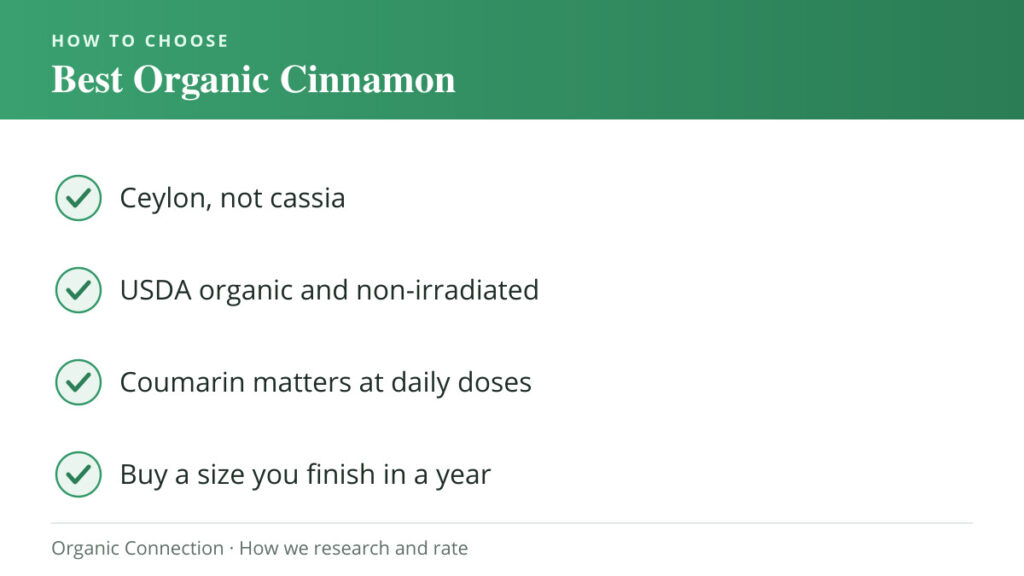
1. True Ceylon (Cinnamomum verum)
The label should name Ceylon or Cinnamomum verum. If it just says “cinnamon,” assume cassia and its much higher coumarin.
2. USDA organic certification
It rules out synthetic pesticides and, importantly for spices, prohibits irradiation and ethylene oxide fumigation.
3. Non-irradiated and non-ETO
Sterilizing treatments degrade the volatile oils that carry cinnamon’s aroma. Organic spices are steam-treated instead.
4. A size you will finish
Ground spices lose aroma within about a year. A pound of cinnamon is only good value if you actually use it.
Ceylon versus cassia, in practice
The two are easy to tell apart if you know what to look for. Ceylon cinnamon sticks are made of many thin, papery layers rolled together like a cigar, they crumble easily, and the color is a light tan. Cassia sticks are a single thick, hard curl of bark, dark reddish brown, and nearly impossible to break by hand. In powder form, Ceylon is lighter in color and noticeably milder, more floral and citrusy, while cassia is darker, sweeter, and considerably more aggressive. That flavor difference matters in cooking: cassia is what most American baked goods are calibrated to, so a cinnamon roll made with Ceylon can taste underpowered to someone expecting the supermarket punch. Ceylon shines in delicate applications, custards, rice pudding, fruit, tea, and in Sri Lankan and southern Indian savory cooking where cassia would bully everything else.
On the coumarin question, keep it in proportion. Cassia is not dangerous in normal culinary amounts; European food safety authorities set a tolerable daily intake for coumarin that a sprinkle on oatmeal does not approach. The concern arises with sustained high intake, and the people most likely to reach it are exactly those taking cinnamon deliberately as a supplement for blood sugar or cholesterol. If you use half a teaspoon on your morning porridge and nothing else, either species is fine. If you are taking a teaspoon or more daily as a supplement, Ceylon is the sensible choice, and it is worth saying plainly that the evidence for cinnamon meaningfully improving blood sugar in humans is mixed and modest, so it is not a substitute for medical treatment.
How to choose organic cinnamon
- Check the species on the label. Ceylon or Cinnamomum verum. Unlabeled “cinnamon” is almost always cassia.
- Confirm USDA organic. On spices this also rules out irradiation and ethylene oxide fumigation.
- Choose Ceylon if you take it daily. Cassia’s coumarin content matters at supplement-level intake, not at sprinkle level.
- Adjust for flavor. Ceylon is milder, so recipes calibrated to cassia may need a little more.
- Buy for a year, not five. Ground cinnamon fades; store it airtight, cool, and dark.
Who should buy organic ceylon cinnamon
How much cinnamon you get through decides this. For a kitchen jar of certified organic Ceylon, start with our top pick. If you want a pound for daily use, the lowest price per ounce, a multipack for a busy kitchen, or a small jar to try Ceylon first, we have a pick for each.
Best overall: Simply Organic Ground Ceylon Cinnamon
| Organic Integrity Score | 92 / 100 |
| Species | Cinnamomum verum (true Ceylon) |
| Certification | Kosher, Organic |
| Best for | Everyday cooking, baking, and daily use |
Simply Organic is our top pick because it names the species on the label, which most cinnamon does not. It is explicitly Cinnamomum verum, USDA certified organic, and non-irradiated, so the volatile oils that carry cinnamon’s aroma survive intact rather than being degraded by sterilizing treatment. The flavor is the genuine Ceylon profile: delicate, faintly floral and citrusy, with none of the harsh edge cassia brings. The 2.08 oz glass jar is the right size for a kitchen, since ground cinnamon fades within a year and most households will finish this in that window.
The trade-off is price per ounce, which is high compared with bulk bags, and the mildness itself. If you bake American recipes calibrated to supermarket cassia, you will want to increase the quantity by roughly a quarter to get a comparable cinnamon presence.
What we liked: Species named explicitly on the label, USDA organic, non-irradiated, genuine delicate Ceylon flavor, and a jar size that stays fresh.
Keep in mind: Expensive per ounce, and milder than cassia, so baking recipes may need adjusting.
What the listing discloses: Simply Organic states kosher certification, and does not say whether the USDA seal applies and where it was grown or made.
Best single estate: One Farm Organic Ceylon Cinnamon, Sri Lanka
| Organic Integrity Score | 90 / 100 |
| Origin | Single estate, Sri Lanka |
| Certification | USDA Organic, Fair Trade, Non-GMO |
| Supply chain | Vertically integrated farm; planting, harvesting and processing in one place |
| Packaging | Resealable jar |
| Best for | Buyers who want traceability to one farm |
The most traceable cinnamon in the comparison. Single estate means the spice comes from one farm rather than being blended from whatever the market offered, and it is a claim almost never made about a spice.
The company backs it with structure rather than sentiment: the cinnamon comes from a vertically integrated farm that oversees planting, harvesting and processing, and is sourced directly from the growers. That is the mechanism that makes single-estate sourcing possible.
Fair Trade Certified is named as a program alongside USDA Certified Organic, which is two named certifications on a jar of spice.
It also says freshly ground and ships in a resealable jar, both of which matter for a spice whose volatile oils fade after grinding.
The listing is careful about the variety too, calling it “true” Ceylon cinnamon — the distinction from cassia that gives this whole category its reason to exist.
What we liked: Single-estate sourcing with the supply chain described, Fair Trade and USDA Organic both named, freshly ground, resealable.
Keep in mind: No weight stated in the listing body, and no certifying agency named for either mark.
What the listing discloses: You are told USDA organic certification and Fair Trade for One Farm by WAAYB; you are not told where it was grown or made.
Best for daily use: Anthony’s Organic Ceylon Cinnamon Powder, 1 lb
| Organic Integrity Score | 88 / 100 |
| Species | Ceylon |
| Certification | USDA Organic, Non-GMO, Gluten-free |
| Best for | People taking a teaspoon or more of cinnamon daily |
Anthony’s is the pick for the specific group most likely to be reading this guide: people taking cinnamon daily for blood sugar support, who need Ceylon rather than cassia and go through it fast enough that a spice jar is impractical. It is USDA certified organic Ceylon, explicitly non-irradiated and non-GMO, in a resealable 1 lb bag at a fraction of the per-ounce cost of jarred spice. Anthony’s is a reliable bulk ingredient brand with consistent quality across batches.
The trade-off is quantity versus freshness. A pound of ground cinnamon is a lot, and if you only use it for baking it will fade before you finish it. Decant a working amount into a small airtight jar and keep the rest sealed, cool, and dark.
What we liked: USDA organic Ceylon, explicitly non-irradiated, resealable bulk bag, and a large drop in cost per ounce versus jars.
Keep in mind: A pound will lose aroma before an occasional baker gets through it.
What the listing discloses: Anthony’s documents itself unusually well, stating USDA organic certification and an origin of India and California.
Best bulk: True Organic Pure Ceylon Cinnamon Powder, 1 lb
| Organic Integrity Score | 87 / 100 |
| Size | 1 lb |
| Origin | USDA certified organic farm in Sri Lanka |
| Certification | USDA Organic, Non-GMO, Kosher |
| Allergens | No contact with gluten, soy, peanuts, tree nuts or GMOs |
| Best for | Buying Ceylon cinnamon in quantity |
The only listing on this page to name a food safety certification. FSSC 22000 is a GFSI-recognized food safety management scheme covering the facility rather than the crop, and it sits alongside the organic claim rather than duplicating it.
The allergen statement is a facility statement rather than a recipe one: no contact with gluten, soy, peanuts, tree nuts or GMOs. That is about the production line, which is where cross-contact actually happens, and it is far more useful than an ingredient list on a single-ingredient spice.
Origin is specific — a USDA certified organic farm in Sri Lanka — and the listing notes the cinnamon is nurtured, harvested and packed by hand.
One pound is a lot of cinnamon. Ground spice fades within about six months, so decant it into smaller sealed jars rather than opening the bag repeatedly.
What we liked: FSSC 22000 named, a facility-level allergen statement, kosher certification, and a named country of origin.
Keep in mind: A pound of ground cinnamon will lose aroma before most kitchens finish it. No certifying agency named for the organic claim.
What the listing discloses: True Organic is explicit about USDA organic certification and kosher certification, and silent on where it was grown or made.
Best price per ounce: Frontier Co-op Organic Ceylon Cinnamon Powder, 16 oz
| Organic Integrity Score | 85 / 100 |
| Species | Cinnamomum verum J. Presl |
| Certification | Fair Trade, Certified Organic, Kosher |
| Best for | Large households and heavy bakers |
Frontier Co-op is a member-owned cooperative with a long record in the organic spice trade, and their bulk Ceylon cinnamon names the botanical species on the label, is USDA certified organic and non-irradiated, and comes from sustainably grown sources. The 16 oz bulk bag is the cheapest way to buy genuine organic Ceylon here, and the quality is consistent with their jarred line rather than being a lesser bulk grade.
The trade-off is packaging. Bulk bags are less convenient than jars and need decanting into something airtight, and as with any bulk spice, sixteen ounces is only good value if you will use it within a year. The co-op structure and sourcing transparency are genuine positives worth weighing.
What we liked: USDA organic, non-irradiated, botanical species named, co-op sourcing, and the lowest price per ounce here.
Keep in mind: Bulk bag needs decanting, and sixteen ounces will fade if you use cinnamon only occasionally.
What the listing discloses: Frontier Co-op is explicit about Fair Trade and kosher certification, and silent on whether the USDA seal applies and where it was grown or made.
Getting the most out of cinnamon
Ground cinnamon loses its aroma faster than most people realize, typically within about a year, because the volatile oils responsible evaporate steadily once the spice is milled. Buying whole Ceylon quills and grinding small amounts extends that considerably, and Ceylon quills are soft enough to break up in a spice grinder, which cassia sticks are not. Whatever form you buy, store it airtight in a cool dark cupboard rather than the shelf above the stove, where heat and steam accelerate the loss. To check whether an old jar is still worth using, rub a pinch between your fingers and smell it: if it smells faintly of dust rather than cinnamon, it will do nothing for your food.
In cooking, remember Ceylon is the milder species, so recipes written for supermarket cassia often need about a quarter more. Cinnamon’s flavor compounds are fat-soluble and heat-responsive, so blooming it briefly in warm butter or oil before adding other ingredients releases far more than stirring it into a cold mixture. It pairs naturally with oatmeal, apples, cocoa, and coffee, and works in savory cooking with lamb, chickpeas, and rice, where a single Ceylon quill added whole to the pot perfumes a dish without dominating it.
Coumarin: the numbers behind the Ceylon recommendation
Our section above explains the Ceylon–cassia distinction. Here is the arithmetic, because it is more striking than the general advice suggests and it changes what a “healthy daily cinnamon habit” actually looks like.
Coumarin is a naturally occurring compound in cassia that is hepatotoxic at sufficient dose. Cassia contains roughly 1% coumarin by mass; Ceylon contains roughly 0.004% — around a 250-fold difference. Testing across cassia brands has found mean coumarin between about 2,650 and 7,017 mg/kg, with maxima approaching 9,900 mg/kg in pure cassia samples.
The European Food Safety Authority sets a tolerable daily intake of 0.1 mg of coumarin per kg of body weight. For a 70 kg adult that is 7 mg per day.
| Scenario | Coumarin | Against a 7 mg TDI |
| ½–1 tsp cassia daily | Can exceed 7 mg | At or over the ceiling from a single teaspoon |
| 6 g cassia daily for 4 weeks | Well above | Sustained exceedance |
| 6 g Ceylon daily for 4 weeks | Comfortably below | Does not exceed the TDI |
Keep in mind: the TDI is a lifetime-exposure guideline with safety margins, not a threshold at which harm begins — one cinnamon bun will not damage your liver. But it does mean that a daily teaspoon of supermarket cassia, which is exactly what blood-sugar advice tends to recommend, sits at or beyond the intended ceiling. Anyone taking cinnamon deliberately every day, and anyone with liver disease or taking hepatotoxic medication, should be using Ceylon. Children reach the limit at far smaller amounts, since the TDI scales with body weight — a 20 kg child’s ceiling is 2 mg.
The irony worth naming: most of the blood-sugar research was done using cassia, not Ceylon, because cassia is what is cheap and available. So the evidence base and the safety recommendation point at different species, and the honest position is that Ceylon is the safer choice while being the less-studied one.
Telling them apart, and the four types of cassia
You can identify these by eye in seconds once you know what to look for, which matters because labeling is frequently vague — US law does not require the species to be distinguished, so “cinnamon” on a jar almost always means cassia.
| Ceylon (Cinnamomum verum) | Cassia | |
| Stick structure | Many thin layers rolled like a cigar | One or two thick layers, hollow curl |
| Texture | Fragile, crumbles by hand | Hard, needs a grinder |
| Color | Light tan | Dark reddish-brown |
| Flavor | Delicate, citrusy, floral | Bold, hot, the “cinnamon” of baked goods |
| Price | Several times higher | Cheap |
Cassia is not one thing either, and the type matters for coumarin:
- Indonesian (korintje) — the most common in US supermarkets and in commercial baking.
- Chinese cassia — Cinnamomum cassia proper, common in Asian cooking and traditional medicine.
- Vietnamese / Saigon cassia — the strongest flavor and the highest coumarin of the group. Prized by bakers, and the one to be most careful about consuming daily.
Ceylon grades, if you buy sticks: Alba is the finest and thinnest, then C5 Special, C5, and M5 as quills get coarser. For grinding into daily use the grade matters far less than the species does.
The lead problem in ground cinnamon
Separately from coumarin, ground cinnamon has been the subject of an ongoing US safety issue that is worth knowing about.
Following the 2023 incident in which elevated lead and chromium were found in cinnamon applesauce pouches, the FDA began testing ground cinnamon more broadly. A public health alert issued in 2024 has been expanded several times, covering multiple brands. Testing by state programs and confirmed by the FDA found lead ranging from slightly over 2 ppm to about 7 ppm in most of the affected spices, with one brand — El Servidor — at 20 ppm.
The relevant point for this guide: organic certification does not address lead. Lead is a soil and processing contaminant, not something sprayed on a crop, so an organic seal tells you nothing about it — the same limitation we flag on cocoa, rice, tea and supplement powders. What helps is buying from established brands with published contaminant testing, avoiding unusually cheap ground spice from unfamiliar importers, and preferring whole sticks you grind yourself, since adulteration and contamination are both easier in ground product.
Using cinnamon well
- Ceylon and cassia are not interchangeable by volume in baking. Ceylon is milder, so a recipe developed for cassia will taste flat — use around 1½ times as much Ceylon, and accept a more delicate, less “hot” result.
- Ceylon suits custards, rice pudding, fruit and drinks, where its citrus and floral notes come through. Cassia suits cinnamon rolls, spice cakes and anything wanting punch.
- Bloom it in fat. Cinnamaldehyde, the main flavor compound, is fat-soluble, so cinnamon stirred into melted butter or warm oil tastes markedly stronger than the same amount added dry.
- Add it late to long-cooked dishes. Extended heat drives off the volatile aromatics and leaves the bitter tannic notes behind.
- Sticks over powder for infusions — mulled drinks, poaching liquids, stews — because powder clouds the liquid and turns gritty.
- Grinding Ceylon is easy; it crumbles by hand and a coffee grinder finishes it. Cassia sticks are genuinely hard and will damage a cheap grinder.
Storage
- Whole sticks keep 3–4 years; ground cinnamon holds usable flavor for about 6 months to a year, though it remains safe far longer.
- Airtight, cool, dark and dry. Never above the hob — heat is what strips volatile oils fastest, and the spice rack next to the cooker is the worst place in most kitchens.
- Judge by smell. Rub a pinch between your fingers; if it does not smell strongly sweet-warm, it will not taste of much either. Color is a poor guide.
- Buy small quantities of ground and larger quantities of sticks, since sticks keep several times longer.
- Keep it away from moisture. Never shake a jar directly over a steaming pan; measure into a spoon first, or the steam will clump the jar permanently.
How we researched this guide
We are a research-based review site. We compared each product against its species labeling (Ceylon versus cassia), certification (USDA organic), processing (non-irradiated, non-ETO), packaging and freshness, and the weight of aggregated customer feedback on aroma and flavor, then scored each with our 10-criteria Organic Integrity Score. No brand paid to be included or ranked. Nothing here is medical advice. Read the full method on our How We Research and Rate page.
The blood sugar research, and the coumarin reason to choose Ceylon
Cinnamon appears in blood sugar and weight formulations constantly, and there are two separate things worth getting right: what the research shows, and why the variety matters for safety.
The blood glucose literature is genuine but inconsistent. Meta-analyses of cinnamon supplementation in people with type 2 diabetes have found modest reductions in fasting glucose, with considerable heterogeneity between trials and uncertainty about clinical significance. Effects on HbA1c are smaller and less consistent. The proposed mechanism involves improved insulin sensitivity.
On body weight specifically, evidence is weaker still. Some meta-analyses report small reductions in BMI or waist circumference, generally in people with metabolic conditions, and the certainty is low. Cinnamon is not a weight intervention on this evidence.
The variety question is more clear-cut and matters more. Cassia cinnamon, which is what most supermarket cinnamon is, contains substantial coumarin, a compound associated with liver toxicity at sustained high intake. European food safety authorities have set a tolerable daily intake, and a couple of teaspoons of cassia daily can approach or exceed it for a smaller adult. Ceylon cinnamon contains only trace coumarin.
That is the practical consequence of the research: if someone is taking cinnamon daily in therapeutic quantities because of the glucose findings, the coumarin content of cassia becomes a genuine concern, and Ceylon is the variety that makes daily use sensible.
Honest summary: modest and inconsistent glucose effects, very weak weight evidence, and a strong safety argument for Ceylon if you intend to take it daily rather than sprinkle it occasionally.
Common questions about organic ceylon cinnamon
What is the best organic cinnamon?
Our overall pick is Simply Organic Ground Ceylon Cinnamon, because it names the true species Cinnamomum verum on the label, is USDA certified organic, and is non-irradiated so the aromatic oils survive. For daily supplement-level use, Anthony’s Organic Ceylon 1 lb is our pick, and for the lowest price per ounce, Frontier Co-op Organic Ceylon 16 oz.
What is the difference between Ceylon and cassia cinnamon?
They are different species. Ceylon (Cinnamomum verum) is lighter, milder, and faintly citrusy, with only trace coumarin. Cassia, which is what most supermarket cinnamon is, is darker, sweeter, more aggressive, and contains coumarin at roughly a thousand times the level. Ceylon sticks are thin papery layers; cassia sticks are a single thick hard curl.
Is cassia cinnamon dangerous?
Not in normal culinary amounts. Coumarin is hepatotoxic in sufficient quantity, but a sprinkle on oatmeal does not approach the tolerable daily intake European authorities have set. The concern applies to sustained high intake, typically among people taking a teaspoon or more daily as a supplement, and those people should use Ceylon.
Does cinnamon lower blood sugar?
The human evidence is mixed and the effects reported are modest, so cinnamon is not a treatment and should not replace medical care or prescribed medication. If you are taking it daily for this reason, use Ceylon rather than cassia to keep coumarin intake low, and discuss it with your doctor.
How long does ground cinnamon last?
About a year before the aroma noticeably fades, since the volatile oils evaporate steadily once the spice is milled. Store it airtight in a cool dark cupboard, not above the stove. Whole Ceylon quills keep considerably longer and can be ground as needed, since they are soft enough for a spice grinder.
How much coumarin is in cassia versus Ceylon cinnamon?
Cassia contains roughly 1% coumarin by mass and Ceylon roughly 0.004% — around a 250-fold difference. Testing across cassia brands has found mean coumarin between about 2,650 and 7,017 mg/kg, with maxima approaching 9,900 mg/kg. EFSA’s tolerable daily intake is 0.1 mg per kg of body weight, which is 7 mg daily for a 70 kg adult, and just half to one teaspoon of cassia can reach that.
Is it safe to eat cinnamon every day?
Ceylon, yes. Daily cassia is where the problem sits — at 6 g a day for four weeks, cassia exceeds the EFSA tolerable daily intake for coumarin while Ceylon at the same dose does not. The TDI is a lifetime-exposure guideline with safety margins rather than a harm threshold, so one cinnamon bun is not a concern. But anyone taking cinnamon deliberately every day, and anyone with liver disease or on hepatotoxic medication, should use Ceylon. Children reach the limit at much smaller amounts, since the TDI scales with body weight.
Was the blood sugar research done on Ceylon or cassia?
Mostly cassia, because it is what is cheap and available — which is an awkward irony. The evidence base and the safety recommendation point at different species, so the honest position is that Ceylon is the safer choice while being the less-studied one.
How do you tell Ceylon from cassia?
By eye, in seconds. Ceylon sticks are many thin layers rolled like a cigar, light tan, fragile enough to crumble by hand. Cassia is one or two thick layers in a hollow curl, dark reddish-brown and hard enough to need a grinder. Flavor differs too — Ceylon is delicate, citrusy and floral; cassia is bold and hot. US labeling does not require the species to be distinguished, so a jar marked simply “cinnamon” is almost always cassia.
Which cassia has the most coumarin?
Vietnamese or Saigon cassia, which also has the strongest flavor and is prized by bakers. Indonesian korintje is the most common in US supermarkets and commercial baking, and Chinese cassia is common in Asian cooking. If you eat cinnamon daily, Saigon is the one to be most careful about.
Is there lead in ground cinnamon?
In some products, yes. After the 2023 cinnamon applesauce incident, the FDA began broader testing and issued a public health alert in 2024 that has since been expanded several times. Lead was found ranging from slightly over 2 ppm to about 7 ppm in most affected spices, with one brand at 20 ppm. Organic certification does not address this — lead is a soil and processing contaminant, not a spray. Buy from established brands with published testing, and prefer whole sticks you grind yourself.
Can you substitute Ceylon for cassia in baking?
Not one for one. Ceylon is milder, so a recipe developed for cassia will taste flat — use about 1½ times as much and expect a more delicate, less hot result. Ceylon suits custards, rice pudding, fruit and drinks where its citrus notes come through; cassia suits cinnamon rolls and spice cakes that want punch.
How long does cinnamon keep?
Whole sticks 3 to 4 years, ground cinnamon about 6 months to a year for usable flavor, though it stays safe far longer. Store airtight, cool, dark and dry, and never above the hob — heat strips volatile oils faster than anything. Judge by smell rather than color: rub a pinch between your fingers, and if it does not smell strongly sweet-warm it will not taste of much.
- Organic Food & Pantry hub
- Best Organic Ginger
- Best Organic Cayenne Pepper
- Best Organic Turmeric
- Organic Product Database — search every product we have reviewed, by certification
- Best Organic Cloves
- Lead in cinnamon and ground spices
Price and availability as of October 11, 2026 7:10 pm EDT. Product prices and availability are accurate as of the date/time indicated and are subject to change. Any price and availability information displayed on Amazon.com at the time of purchase will apply to the purchase of this product.
Looking for other organic products?
We have checked more than 800 products across food, household goods, gardening, personal care and pet, every one against its stated certification. Browse all reviews.
Organic Connection is reader-supported. When you buy through links on this page we may earn a commission, at no extra cost to you. As an Amazon Associate we earn from qualifying purchases. We are not paid to feature or rank any product. This page is informational and is not medical advice. How we research and rate.