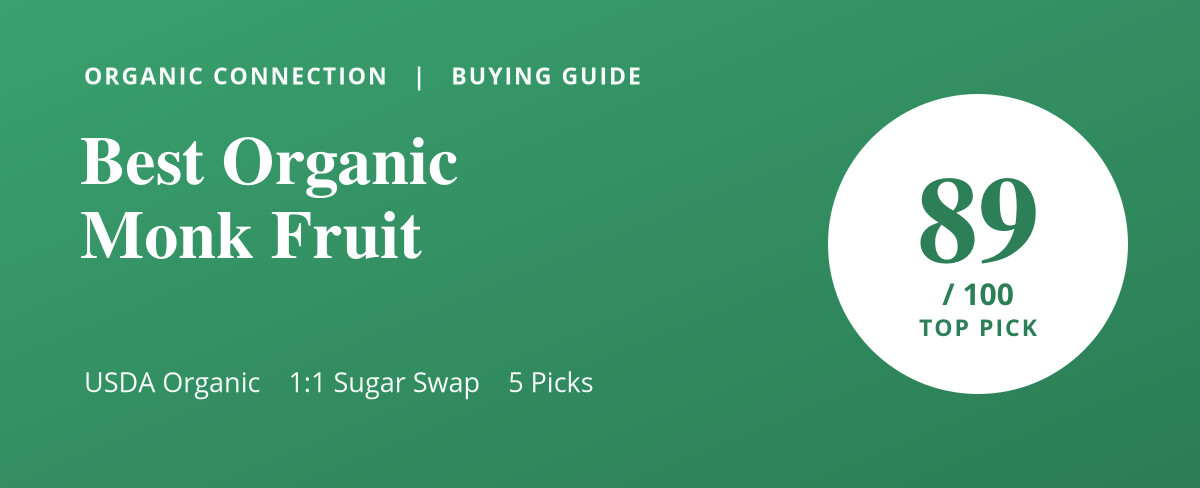
Last updated: September 30, 2026
We may earn a commission when you buy through links on this page, at no extra cost to you. How we research and rate.
The short version
After researching the certifications, blends, and formats of the monk fruit sweeteners available in the US, our top pick is DureLife Organic 100% Pure Monk Fruit Sweetener, No Erythritol. It is USDA certified organic, blended with organic erythritol at a 1:1 sugar replacement ratio, and it is the only widely available monk fruit product carrying a genuine organic seal, which is why it earned our highest Organic Integrity Score of 92 out of 100. For baking, Lakanto Powdered is our pick, and for a caramel note, Lakanto Golden is the best choice.
The most important thing to understand before buying is that nearly every “monk fruit sweetener” is mostly erythritol, not monk fruit. We flag each product’s certification and blend.
Best organic monk fruit sweetener compared
| Best Choice | Best Value | ||||
 |  |  |  |  | |
| Product | DureLife No Erythritol | Lakanto Organic 8.29 oz 10pk | Lakanto Powdered | Lakanto Golden | Whole Earth Monk Fruit |
| Organic Integrity Score | 92/ 100 | 85/ 100 | 80/ 100 | 76/ 100 | 68/ 100 |
| Our rating | 4.6 | 4.3 | 4.0 | 3.8 | 3.4 |
| Blend | Organic erythritol + monk fruit | Organic erythritol + monk fruit | Erythritol + monk fruit | Erythritol + monk fruit | Erythritol + monk fruit |
| Best for | Best overall | Organic multipack | Icings and drinks | Baking depth | Lowest price |
| Certification | USDA Organic, Non-GMO, Kosher | Non-GMO, Organic | Not stated on the listing | Non-GMO, Gluten-free | Non-GMO |
| Price | $29.99$6.00 / ounce View on Amazon | $64.68$8.09 / ounce View on Amazon | Currently unavailable See buying options | Currently unavailable See buying options | Currently unavailable See buying options |
Price and availability as of October 11, 2026 7:10 pm EDT. Product prices and availability are accurate as of the date/time indicated and are subject to change. Any price and availability information displayed on Amazon.com at the time of purchase will apply to the purchase of this product.
Scores are ours, based on independent research of certification, blend composition, ingredient purity, format suitability, and value, using the same 10-criteria method we apply to every product. See how we research and rate.
The certification map for organic monk fruit sweetener, and what each one actually excludes
Most shoppers read a certification as a general signal of quality. Every one of them is narrower than that, and the gaps between them are where the marketing lives.
| Certification | Covers | Key exclusion |
| USDA Organic | Farming and handling: no synthetic pesticides or fertilizers, no GMOs, no sewage sludge or irradiation, audited yearly by an accredited certifier | Three different tiers share the one seal, and it makes no claim about worker pay, food miles, or nutrition |
| Kosher | Ingredients and production comply with Jewish dietary law, verified by a rabbinic agency that inspects the facility | A dietary-law standard: it makes no claim about pesticides, GMOs or farming practice |
Kosher and organic answer entirely different questions. A kosher mark, OU, OK, Star-K and others, confirms that ingredients and production follow Jewish dietary law, verified by an agency that inspects the facility. It is a rigorous supply-chain audit and it says nothing about pesticides, GMOs or farming. The two seals appear together often precisely because neither substitutes for the other.
Key things to look for in organic monk fruit sweetener
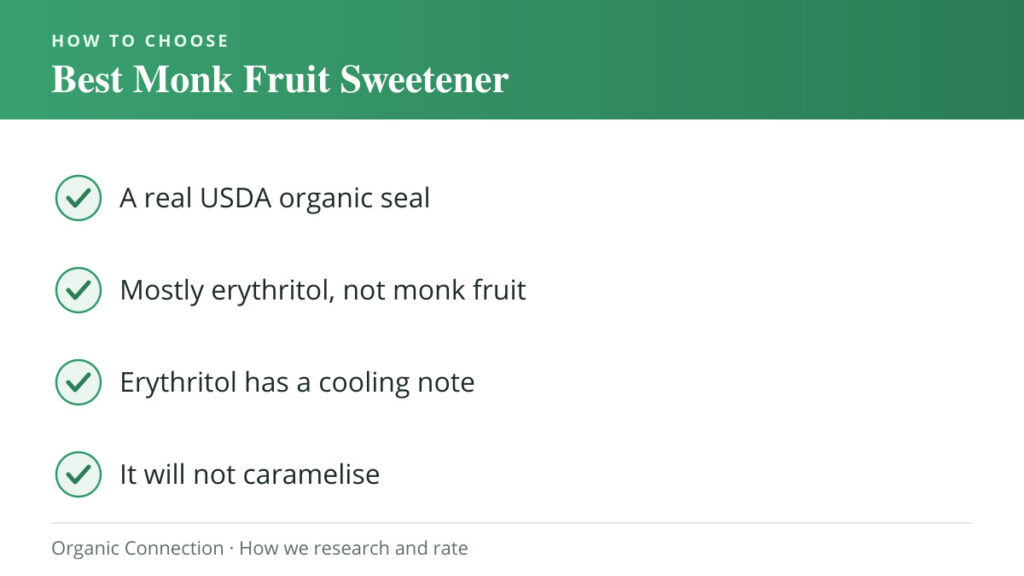
Great monk fruit sweetener is about certification, the blend, the format, and honest expectations. Here is what matters.
1. A genuine USDA organic seal
Organic monk fruit blends are uncommon because organic erythritol is harder to source. The seal is the differentiator.
2. Read what the bulking agent is
Erythritol in most cases. Some blends use maltodextrin or dextrose, which carry a glycemic load and defeat the purpose entirely.
3. A short ingredient list
Organic erythritol and organic monk fruit extract. Nothing else needed. No fillers, anti-caking agents, or artificial flavors.
4. The right format for the job
Granulated for general use, powdered for icings and no-grit drinks, golden for a caramel note in baking.
Erythritol, the elephant in the bag
Since erythritol is most of what you are buying, it deserves a straight assessment rather than being skipped over.
Erythritol is a sugar alcohol that is roughly 70 percent as sweet as sugar, contributes almost no calories, and has essentially no effect on blood glucose or insulin, which is why it dominates keto and diabetic-friendly products. Unlike most sugar alcohols it is largely absorbed in the small intestine and excreted unchanged in urine, which is why it causes far less digestive upset than sorbitol or maltitol. A minority of people still get bloating or a laxative effect at higher doses, and it is worth building up rather than replacing all your sugar at once.
Two honest caveats. First, in 2023 a study reported an association between higher circulating erythritol levels and cardiovascular events, which received substantial press. The research was observational, could not establish causation, and the human body also produces erythritol endogenously, which complicates interpretation considerably; regulatory bodies have not changed their position and erythritol remains generally recognized as safe. It is not settled science in either direction, and if you find that genuinely uncertain, using less sweetener of any kind is the safe response rather than switching to a different one. Second, erythritol has a distinct cooling sensation on the tongue, like a very faint mint, which is more noticeable in cold or uncooked applications. Some people never notice it, others cannot get past it, and no brand fully eliminates it.
How to choose organic monk fruit sweetener
- Look for the USDA organic seal. It is uncommon in this category, which makes it a real differentiator.
- Check the bulking agent. Erythritol is standard; maltodextrin or dextrose defeats the purpose.
- Match the format to the use. Granulated everyday, powdered for icing and drinks, golden for baking depth.
- Expect the cooling effect. It is erythritol’s signature and is strongest in cold, uncooked applications.
- Introduce it gradually if you are sensitive to sugar alcohols.
Who should buy organic monk fruit sweetener
The right bag depends on what you cook. If you want a certified organic 1:1 sugar replacement, our top pick fits. If you want a smaller organic format, a powdered version for icings, a golden version for baking, or a widely stocked budget option, we have a pick for each.
Best overall: DureLife Organic 100% Pure Monk Fruit Sweetener, No Erythritol, 5 oz
| Organic Integrity Score | 92 / 100 |
| Size | 5 oz |
| Composition | 100% pure monk fruit extract, no erythritol |
| Certification | USDA Organic, Non-GMO, Kosher |
| Excludes | Artificial colors, flavors and preservatives |
| Best for | Anyone who wants monk fruit without the sugar alcohol |
The single most useful thing on this page is three words: no erythritol.
Most products sold as monk fruit sweetener are overwhelmingly erythritol, a sugar alcohol, with a small amount of monk fruit extract for sweetness. That is not a scandal — pure monk fruit extract is intensely sweet and needs bulking to be spoonable — but it does mean a bag labeled monk fruit is usually mostly something else, and erythritol is the ingredient that causes digestive upset for some people.
This is 100% pure monk fruit extract, which is why 5 oz costs what a pound of the blended kind does. It is also why you cannot substitute it spoon for spoon in a recipe: pure extract is many times sweeter than sugar, so a bag this size goes a very long way.
The certifications are named properly, including the agency: USDA Certified Organic, non-GMO, Keto Certified and OU Kosher. Naming OU rather than writing kosher is the kind of precision we credit throughout this site.
The low glycemic claim is reasonable for monk fruit, and framed as helping avoid a blood sugar spike rather than as a treatment.
What we liked: Genuinely erythritol-free, four certifications with the kosher agency named, and no artificial additives.
Keep in mind: Pure extract does not measure like sugar, so recipes need adjusting. Far more expensive per ounce than blended sweeteners, though it goes much further.
What the listing discloses: On the DureLife label: USDA organic certification, kosher certification and a single-ingredient formula. Not stated: where it was grown or made.
Best organic multipack: Lakanto Organic Classic Monk Fruit Sweetener, 8.29 oz, 10-Pack
| Organic Integrity Score | 85 / 100 |
| Blend | Organic erythritol with organic monk fruit extract |
| Certification | Non-GMO, Organic |
| Best for | Stocking up, or splitting across households |
Ten sealed 8.29 oz bags of the same certified organic blend. Erythritol is hygroscopic and clumps once a bag has been open in a humid kitchen for a while, so individually sealed bags genuinely help: you open one at a time and the rest stay dry and free-flowing. It is also a sensible format if you bake in bursts rather than continuously.
The trade-off is that multipack pricing fluctuates and does not always beat the single large bag on a per-ounce basis, plus ten small bags is more packaging than one large one. Compare unit prices at the time you buy.
What we liked: Same USDA organic blend with sealed bags that stay free-flowing, useful given erythritol’s tendency to clump.
Keep in mind: Per-ounce pricing does not always beat the 1 lb bag, and it is more packaging.
What the listing discloses: Beyond the organic claim itself, Lakanto does not say whether the USDA seal applies and where it was grown or made.
Best for icings and drinks: Lakanto Powdered Monk Fruit Sweetener, 1 lb
| Organic Integrity Score | 80 / 100 |
| Blend | Erythritol with monk fruit extract, powdered |
| Certification | Not stated on the listing |
| Best for | Icing, frosting, whipped cream, and cold drinks |
Granulated erythritol does not dissolve well in cold liquid and leaves a gritty texture in icings, which is a real and annoying limitation. The powdered version solves both: it replaces confectioner’s sugar one for one, dissolves almost instantly, and produces smooth frostings, whipped cream, and iced drinks. If you bake anything that needs icing, this is the format you actually need.
It scores below the top picks because this particular product is Non-GMO but not USDA certified organic, which is the bar this guide is built on. The cooling effect is also most noticeable in exactly these cold, uncooked applications, so it is more apparent here than in baked goods.
What we liked: Solves the grittiness problem in icings and cold drinks, dissolves fast, and replaces powdered sugar 1:1.
Keep in mind: Not USDA certified organic, and the cooling sensation is most noticeable in cold uncooked uses.
What the listing discloses: No organic certification appears anywhere on the Lakanto listing.
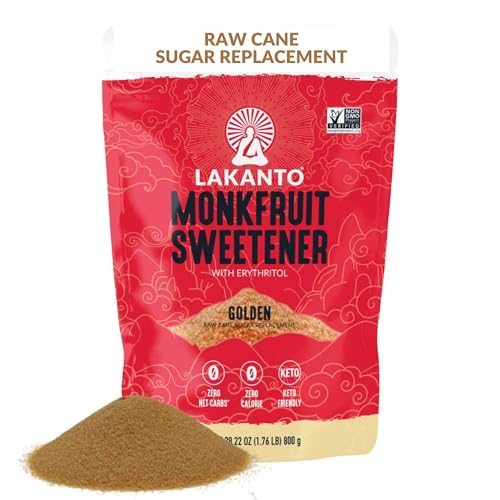
Best for baking depth: Lakanto Golden Monk Fruit Sweetener, 1.76 lb
| Organic Integrity Score | 76 / 100 |
| Blend | Erythritol with monk fruit extract, golden |
| Certification | Non-GMO, Gluten-free |
| Best for | Cookies, brownies, and anything that wants a brown sugar note |
Golden is formulated to mimic raw cane sugar, with a warmer, faintly caramel character that works far better than the white version in cookies, brownies, gingerbread, and anything where brown sugar would normally go. In those applications the white version tastes flat by comparison, so this is a genuinely useful second bag to keep rather than a gimmick.
It scores lower here for the same reason as the powdered version: Non-GMO but not USDA certified organic. The 1.76 lb bag is also a lot if you only bake occasionally, and like all erythritol blends it will not caramelize the way real sugar does, so it approximates brown sugar’s flavor without its browning behavior.
What we liked: A genuinely warmer caramel note that suits cookies and brownies far better than white sweetener.
Keep in mind: Not USDA certified organic, a large bag for occasional bakers, and it still will not caramelize.
What the listing discloses: No organic certification appears anywhere on the Lakanto listing.
Best budget option: Whole Earth Monk Fruit Sweetener, 12 oz
| Organic Integrity Score | 68 / 100 |
| Blend | Erythritol with monk fruit extract |
| Certification | Non-GMO |
| Best for | The lowest price on a monk fruit and erythritol blend |
Whole Earth is the supermarket-accessible option, widely stocked, considerably cheaper than Lakanto, and functionally similar: an erythritol and monk fruit blend that replaces sugar without a glycemic impact. If cost is the deciding factor and organic certification is not, it does the job.
We are being explicit about why it scores lowest: it is not USDA certified organic, which is the criterion this guide weights most heavily, and Whole Earth’s sourcing disclosure is thinner than Lakanto’s. It is a perfectly reasonable sweetener; it simply does not meet the standard the rest of this list is built around.
What we liked: The lowest price here on a functional monk fruit and erythritol blend, and easy to find in ordinary supermarkets.
Keep in mind: Not USDA certified organic and thinner sourcing disclosure, which is why it ranks last.
What the listing discloses: The word organic does not appear on the Whole Earth listing at all.
Baking and cooking with it
Monk fruit blends replace sugar one for one by volume, which makes substitution easy, but three behaviors differ from sugar and cause most of the disappointing results. First, erythritol does not caramelize or brown, so cookies stay pale and will not spread or crisp at the edges the way sugar cookies do; adding a tablespoon of maple syrup or using the golden version helps both color and flavor. Second, sugar is hygroscopic and holds moisture, so baked goods made entirely with erythritol dry out faster; they are best eaten within a day or two. Third, erythritol recrystallizes as things cool, which can make a ganache or caramel grainy, so it is a poor choice for confectionery.
Practical fixes: use the powdered form anywhere grittiness would show, split the sweetener with a small amount of real sugar or honey if you are not strictly avoiding it, and add a pinch of salt, which suppresses the cooling sensation noticeably. Store bags airtight, because erythritol draws moisture and clumps in a humid kitchen; a rice-free desiccant sachet in the container helps. And keep expectations sensible: an organic sweetener is still a sweetener, and a keto brownie made with it is a treat rather than a health food, which is the same point we make about organic candy.
What the erythritol research actually found
Our section above explains that most monk fruit sweetener is largely erythritol. Since 2023 there has been genuine research attached to that, and it has been reported badly in both directions — so here is what the work says and what it does not.
In February 2023, Cleveland Clinic researchers published a study in Nature Medicine tracking over 4,000 patients. People with the highest circulating erythritol levels were roughly twice as likely to experience a major cardiovascular event — heart attack, stroke or death — over three years, compared with those in the lowest group. In laboratory work the team showed erythritol increased platelet aggregation and thrombus formation, and adding erythritol to blood products in vitro at concentrations seen in patients increased platelet aggregation and adhesion. A follow-up from the same group in 2024 added to the picture.
Keep in mind — the caveats matter as much as the finding. The patient cohort was people already undergoing cardiac risk assessment, not the general population. Plasma erythritol is not only dietary: the body makes erythritol endogenously through the pentose phosphate pathway, so high circulating levels may partly reflect an underlying metabolic state rather than what someone ate — which is a genuine confounder the authors acknowledge. And the intervention that produced platelet effects used 30 g of erythritol, whereas a normal serving of a blended sweetener is a few grams. This is an association plus a plausible mechanism, not a demonstrated causal chain from your coffee to a heart attack.
Our reading: erythritol is not established as dangerous at ordinary use, and it is no longer something to wave away either. If you have existing cardiovascular disease or significant risk factors, or if you are stacking several erythritol-sweetened products a day — the sweetener plus protein bars plus “keto” snacks plus a drink — reducing total intake is a reasonable, low-cost precaution. For someone using a teaspoon in coffee, the evidence does not currently justify alarm.
Mogrosides: what actually makes monk fruit sweet
The sweetness in Siraitia grosvenorii comes from mogrosides, principally mogroside V, which is roughly 150 to 250 times sweeter than sugar and contributes no calories.
That extreme potency is the whole reason blends exist. A teaspoon of pure mogroside extract would be inedibly sweet and impossible to measure, so manufacturers bulk it out to sugar-like volume — and erythritol is the usual filler because it is granular, low-calorie and mildly sweet itself.
| Product | What it is | Use |
| “Monk fruit sweetener”, 1:1 | Mostly erythritol with a small percentage of monk fruit extract | Cup-for-cup sugar replacement. Read the ingredient order. |
| Pure monk fruit extract | Mogroside concentrate, sometimes standardized (e.g. 50% mogroside V) | Drinks and anywhere volume does not matter. Tiny amounts. |
| Liquid monk fruit drops | Extract in water or glycerine | Coffee, tea, smoothies. No erythritol at all. |
| Golden / brown blends | Erythritol plus monk fruit plus molasses or similar | Baking where you want brown sugar character |
| Monk fruit + allulose | Allulose as the bulking agent instead | The main erythritol-free 1:1 option. Browns better; more expensive. |
Reading the label: ingredients run by weight, so whatever is listed first is what you are mostly buying. A bag whose first ingredient is erythritol is an erythritol product with monk fruit flavoring the sweetness — which is not dishonest, but it is not what the front of the pack implies.
Why it behaves differently in baking
Sugar does four jobs in baking, and monk fruit blends only do one of them.
| Sugar’s job | Monk fruit blend |
| Sweetness | Yes — this part works |
| Browning (Maillard and caramelization) | No. Baked goods stay pale and taste less complex. |
| Moisture retention | No. Results are drier and stale faster. |
| Structure and tenderness | Partially. Texture is often denser or more crumbly. |
- It does not caramelize, so it cannot make caramel, toffee or a proper crème brûlée crust.
- Erythritol recrystallizes on cooling, which is why sugar-free baked goods can turn gritty the next day and why frostings can go grainy. Using a powdered blend helps considerably.
- Add moisture back — an extra egg yolk, a spoon of yogurt or apple sauce — to compensate for what sugar would have held.
- Expect no spread in cookies. Sugar melting is what makes cookies spread; without it they hold their shape. Flatten them before baking.
- Golden blends help with flavor depth but still do not brown.
- Yeast cannot ferment it, so it will not work in bread that relies on sugar to feed the yeast.
The cooling effect, and tolerance
- That cool, minty sensation is erythritol dissolving — it has a negative heat of solution, absorbing energy as it dissolves and physically cooling your mouth. It is most noticeable in cold or powdered applications and in anything undissolved. Blending with allulose or using it in warm food reduces it.
- Erythritol is the best tolerated sugar alcohol — around 90% is absorbed in the small intestine and excreted unchanged in urine, so far less reaches the colon to be fermented than with maltitol, sorbitol or xylitol.
- It can still cause trouble at volume. Above roughly 30–50 g in a sitting, nausea and loose stools are common. Sugar-free confectionery is where people typically overshoot.
- Pure monk fruit extract has no GI effect, since the dose is milligrams.
- Xylitol warning, since these products sit together: xylitol is extremely toxic to dogs, causing rapid hypoglycaemia and liver failure. Erythritol and monk fruit are not considered toxic in the same way, but if you keep sugar-free products in a house with a dog, check which alcohol is in each and store them out of reach.
Buying and storing
- “Organic” on a monk fruit blend usually refers to the fruit extract and, where applicable, organic erythritol. It is a legitimate claim; it does not change any of the above.
- Check for added dextrose, maltodextrin or “natural flavors” in cheaper blends — dextrose and maltodextrin are sugars with a high glycaemic index, which defeats the purpose entirely.
- Standardized extracts stating mogroside V percentage are the more informative products, though most retail bags do not.
- Storage: airtight and dry. These blends are hygroscopic and clump hard once damp — a rice grain or two in the container helps.
- Shelf life is effectively indefinite if kept dry. Erythritol does not spoil and mogrosides are stable.
- Clumping is not spoilage. Break it up or blitz it briefly; it performs the same.
How we researched this guide
We are a research-based review site. We compared each product against its certification (USDA organic), blend composition and bulking agent, ingredient purity, format suitability, and the weight of aggregated customer feedback on taste, cooling effect, and baking performance, then scored each with our 10-criteria Organic Integrity Score. No brand paid to be included or ranked. Nothing here is medical advice. Read the full method on our How We Research and Rate page.
Sugar substitution as a calorie lever, and the argument against it
Monk fruit is a zero-calorie sweetener, so the arithmetic case looks simple. It is worth setting out that case honestly and then the substantial counterargument, because the evidence here is genuinely contested rather than settled.
The straightforward version: sugar supplies roughly four calories per gram and monk fruit extract supplies effectively none. Replacing sugar in tea, coffee, baking or yogurt removes those calories outright, and for anyone consuming a significant amount of sugar in drinks that is a real and immediate reduction. Monk fruit also has negligible effect on blood glucose, which is why it is used by people managing diabetes.
Trials in which sugar-sweetened drinks are swapped for non-nutritive alternatives generally show modest weight reductions against continuing with sugar. As a straight substitution, the arithmetic holds up.
The counterargument is worth taking seriously. In 2023 the World Health Organization issued a guideline advising against the use of non-sugar sweeteners for weight control, on the basis that long-term observational evidence does not show sustained benefit and may be associated with adverse outcomes. That guidance is contested by other bodies and observational data on sweeteners is notoriously confounded, since people already trying to lose weight are the ones most likely to use them. But it is a serious position from a serious body and it should not be omitted from a page recommending the product.
There is also a behavioral argument that intense sweetness maintains a preference for sweet food, so substitution manages the calories without shifting the habit underneath. The evidence for this is mixed and mostly short-term.
The position we would take: as a direct swap for sugar in drinks, monk fruit removes real calories and is a reasonable tool. As a strategy on its own, the evidence that it produces lasting weight change is weak, and the WHO guidance is a fair reason to treat it as a small lever rather than a plan.
Common questions about organic monk fruit sweetener
What is the best organic monk fruit sweetener?
Our overall pick is DureLife Organic 100% Pure Monk Fruit Sweetener, which scores highest here at 92, because its listing names USDA organic certification, kosher certification and a single-ingredient formula. For icings and cold drinks, Lakanto Powdered is our pick, and for baking depth, Lakanto Golden.
Is monk fruit sweetener actually mostly erythritol?
Yes. Monk fruit extract is 150 to 250 times sweeter than sugar, so it must be blended into a bulking agent to measure like sugar, and that agent is almost always erythritol. By weight these products are typically 95 percent or more erythritol, which means erythritol is doing most of the work and determines how the product behaves.
Why does monk fruit sweetener taste cooling?
That is erythritol, which produces a distinct cooling sensation on the tongue as it dissolves. It is most noticeable in cold and uncooked applications like iced drinks and frostings, and least noticeable in baked goods. No brand eliminates it entirely, though a pinch of salt suppresses it noticeably.
Is erythritol safe?
Regulatory bodies consider it safe, and it has far less digestive impact than most sugar alcohols because it is absorbed in the small intestine and excreted unchanged. A 2023 observational study reported an association between higher circulating erythritol and cardiovascular events, but it could not establish causation and the body also produces erythritol naturally. If the uncertainty concerns you, using less sweetener overall is the sensible response.
Can you bake with monk fruit sweetener?
Yes, at a 1:1 volume swap, but expect three differences: it does not caramelize or brown, so baked goods stay pale; it does not hold moisture like sugar, so they dry out faster; and it recrystallizes on cooling, making it poor for caramel and ganache. The golden version and a spoonful of real syrup both help with color and flavor.
Is erythritol in monk fruit sweetener bad for your heart?
The evidence is real but narrower than headlines suggested. A 2023 Nature Medicine study from Cleveland Clinic tracked over 4,000 patients and found those with the highest circulating erythritol levels were roughly twice as likely to have a major cardiovascular event over three years, with laboratory work showing increased platelet aggregation. The caveats matter: the cohort was people already undergoing cardiac risk assessment, the body also produces erythritol endogenously so blood levels are not purely dietary, and the intervention that produced platelet effects used 30 g against a typical serving of a few grams. If you have cardiovascular risk or stack several erythritol products daily, reducing intake is a reasonable precaution.
Is monk fruit sweetener mostly erythritol?
Usually, yes. Mogroside V, the sweet compound in monk fruit, is 150 to 250 times sweeter than sugar, so a pure extract would be impossible to measure by the spoonful. Manufacturers bulk it to sugar-like volume, and erythritol is the standard filler. Ingredients run by weight, so a bag listing erythritol first is an erythritol product with monk fruit providing the sweetness.
Can you get monk fruit without erythritol?
Yes. Liquid monk fruit drops contain extract in water or glycerine with no erythritol at all, and pure powdered extract is available for anywhere volume does not matter. For cup-for-cup baking, monk fruit blended with allulose is the main erythritol-free option — it browns better than erythritol blends and costs more.
Why does monk fruit sweetener taste cool in your mouth?
That is erythritol dissolving. It has a negative heat of solution, absorbing energy as it dissolves and physically cooling your mouth. It is most noticeable in cold or powdered applications and in anything undissolved. Blending with allulose or using it in warm food reduces the effect.
Why don’t my sugar-free cookies spread?
Because sugar melting is what makes cookies spread, and monk fruit blends do not melt the same way. Flatten them before baking. More broadly, sugar does four jobs — sweetness, browning, moisture retention and structure — and these blends only do the first. Expect paler results, drier texture and faster staling, and add moisture back with an extra yolk, yogurt or apple sauce.
Can you make caramel with monk fruit sweetener?
No. It does not caramelize, so caramel, toffee and a proper crème brûlée crust are all out. Erythritol also recrystallizes on cooling, which is why sugar-free baked goods can turn gritty overnight and frostings go grainy — using a powdered blend helps considerably.
How much erythritol causes digestive problems?
Roughly 30 to 50 g in a sitting for most people, which is high — erythritol is the best tolerated sugar alcohol because around 90% is absorbed in the small intestine and excreted unchanged, so far less reaches the colon than with maltitol, sorbitol or xylitol. Sugar-free confectionery is where people typically overshoot. Pure monk fruit extract has no GI effect at all, since the dose is milligrams.
Is monk fruit sweetener safe for dogs?
Erythritol and monk fruit are not considered toxic to dogs in the way xylitol is — xylitol causes rapid hypoglycaemia and liver failure and is a genuine emergency. Since sugar-free products sit together in the cupboard, check which sugar alcohol is in each and store them out of reach.
- Organic Food & Pantry hub
- Best Organic Maple Syrup
- Best Organic Honey
- How to Read an Ingredient List
- Organic Product Database — search every product we have reviewed, by certification
Price and availability as of October 11, 2026 7:10 pm EDT. Product prices and availability are accurate as of the date/time indicated and are subject to change. Any price and availability information displayed on Amazon.com at the time of purchase will apply to the purchase of this product.
Looking for other organic products?
We have checked more than 800 products across food, household goods, gardening, personal care and pet, every one against its stated certification. Browse all reviews.
Organic Connection is reader-supported. When you buy through links on this page we may earn a commission, at no extra cost to you. As an Amazon Associate we earn from qualifying purchases. We are not paid to feature or rank any product. This page is informational and is not medical advice. How we research and rate.