Last updated: September 30, 2026
We may earn a commission when you buy through links on this page, at no extra cost to you. How we research and rate.
The short version
Reading what each listing will actually stand behind, our top pick is Wholesome Organic. Its listing names Non-GMO Project Verified and USDA Organic, which earned it our highest Organic Integrity Score of 92 out of 100. Nature Nate's Organic is our pick for flavor, and Heavenly Organics for ethics.
Every honey below is USDA Certified Organic and raw or minimally processed. The scores show how they compare on our 10 criteria, from our 93-point top pick to the 73-point everyday option. Because honey fraud is common, certification and traceable sourcing matter more here than almost any other pantry item.
Best organic honey compared
| Best Choice | Best Value | ||||
 |  |  |  |  | |
| Product | Wholesome | Nature Nate’s | Heavenly Organics | GloryBee | Y.S. Eco Bee Farms |
| Organic Integrity Score | 92/ 100 | 89/ 100 | 88/ 100 | 84/ 100 | 77/ 100 |
| Our rating | 4.6 | 4.5 | 4.4 | 4.2 | 3.9 |
| Best for | Best overall | Flavor | Ethics | Everyday | Trustworthy certified raw |
| Certification | USDA Organic, Non-GMO Project Verified, Fair Trade | USDA Organic | USDA Organic, Non-GMO Project Verified, Fair Trade | Certified Organic, Non-GMO | Not stated on the listing |
| Style | Smooth, squeeze bottle | Raw, unfiltered, squeeze | Raw, wild forage | Smooth, all-purpose | Raw, unfiltered |
| Price | $12.48$0.78 / ounce View on Amazon | $19.98$0.62 / ounce View on Amazon | $13.45$1.12 / ounce View on Amazon | $17.75$0.99 / ounce View on Amazon | $14.84$0.67 / ounce View on Amazon |
Price and availability as of October 15, 2026 7:10 pm EDT. Product prices and availability are accurate as of the date/time indicated and are subject to change. Any price and availability information displayed on Amazon.com at the time of purchase will apply to the purchase of this product.
Nutrition facts side by side
| Per 100 g | Y.S. Eco Bee Farms | Heavenly Organics | Wholesome Organic |
| Calories | 286 kcal | 286 kcal | 286 kcal |
| Carbs | 81 g | 81 g | 81 g |
| Sugars | 76.2 g | 76.2 g | 81 g |
| Fiber | — | — | 0 g |
| Protein | 0 g | 0 g | 0 g |
| Fat | 0 g | 0 g | 0 g |
| Sodium | 0 mg | — | 0 mg |
Source: USDA FoodData Central, matched by UPC. Figures are per 100 g, not per serving, and reflect the panel USDA published for each product.
Scores are ours, based on independent research of certification, sourcing, processing, and traceability, using the same 10-criteria method we apply to every product.
What each certification on an organic honey label actually covers
The labels on these products are not interchangeable, and several of them cover things that have nothing to do with each other. Here is what each one actually buys you.
| Certification | Covers | Key exclusion |
| USDA Organic | Farming and handling: no synthetic pesticides or fertilizers, no GMOs, no sewage sludge or irradiation, audited yearly by an accredited certifier | Three different tiers share the one seal, and it makes no claim about worker pay, food miles, or nutrition |
| Non-GMO Project | Testing and supply-chain traceability showing the ingredients are not genetically engineered | Sets no limit on synthetic pesticides or fertilizers, so it is not an organic claim |
| Kosher | Ingredients and production comply with Jewish dietary law, verified by a rabbinic agency that inspects the facility | A dietary-law standard: it makes no claim about pesticides, GMOs or farming practice |
Non-GMO and organic are not two grades of the same thing. The butterfly certifies an absence of genetic engineering and stops there; the USDA seal prohibits genetic engineering as one clause among many, alongside synthetic pesticides, synthetic fertilizers, sewage sludge and irradiation. That makes organic the broader claim by some distance. Where both appear together, the butterfly is adding batch testing on top of a standard that had already banned GMOs.
Key benefits of organic honey
Honey should be one simple thing: honey. Choosing USDA Organic, raw honey from a traceable source is how you make sure that is what you are getting. Here is what that gets you.
1. Real, unadulterated honey
Honey is one of the most commonly faked foods, often cut with rice or corn syrup. USDA Organic certification and a clear source give you real confidence you are buying honey, not a syrup blend.
2. Raw and unfiltered goodness
Raw, unfiltered honey is not pasteurized or heavily strained, so it keeps more of its natural pollen, enzymes, and flavor. It is honey closer to how it comes out of the hive.
3. Cleaner hives and forage
Organic certification covers how the bees are kept and what they forage on, prohibiting synthetic treatments and requiring organic forage areas, so the whole system is cleaner.
4. A versatile natural sweetener
Real organic honey is a genuine pantry workhorse, for tea, baking, dressings, and eating straight, with a depth of flavor that mass-produced honey lacks.
Organic vs conventional honey: does it matter?
With honey, the biggest issue is not pesticides on a crop, it is fraud. A 2023 EU investigation found 46% of imported honey samples suspected of adulteration with cheaper syrups. USDA Organic certification verifies organic beekeeping and forage and, combined with a traceable source, is the most reliable way to know you are buying real honey rather than a diluted or mislabeled product.
Organic certification also prohibits synthetic treatments in the hive. Groups like the EU’s Joint Research Center track honey fraud precisely because so much of it is fake. You are paying a small premium for real, cleanly-produced, traceable honey, which is the trade-off we weight in our scoring.
Honey is the third most adulterated food in the world
Unlike the olive oil story, the honey fraud problem is genuine and substantial, and it is the main reason to care where your honey comes from.
The scale. Honey ranks as the third most adulterated food globally, with estimates that up to a third of honey products contain adulterants. The usual method is cutting honey with cheap sugar syrups, historically corn or rice syrup and increasingly barley malt syrup, chosen specifically because they are harder to detect with older testing methods.
Why it is so hard to catch. Sugar syrups can be engineered to mimic honey’s sugar profile, so basic sugar-ratio testing misses them. Modern authentication uses NMR spectroscopy, which produces a chemical fingerprint of the whole sample rather than checking a handful of markers, and can identify both adulteration and floral origin. Specific markers help too: mannose is characteristic of syrup rather than blossom honey, which makes it a useful flag.
What protects you at the shelf. Certification and traceability, mostly. Single-origin honey from a named producer or region is much harder to adulterate through a long anonymous supply chain than a blend labeled with vague multi-country wording. Buying from beekeepers, co-operatives, or brands that publish testing gives you far more assurance than a price-competitive blend. Organic certification adds an audited chain of custody on top, which is its main value here, since the pesticide argument for honey is weaker than for a field crop.
Raw versus pasteurized, and the infant safety point that surprises people
What pasteurization does. Heating honey delays crystallization and makes it easier to filter and bottle. It does not meaningfully improve safety, and it degrades some of the enzymes, pollen, and heat-sensitive compounds that make raw honey distinctive. Research indicates raw honey is at least as safe as pasteurized.
The critical point about babies. Honey should not be given to infants under 12 months, and the reason is Clostridium botulinum spores, which an immature gut cannot handle and which can produce toxin causing infant botulism. Here is what most people get wrong: pasteurization does not deactivate those spores. The spores survive the heat treatment the honey industry uses, so pasteurized honey is not safer for a baby than raw honey. Neither is safe under 12 months, and choosing a processed supermarket honey provides no protection whatsoever.
Worth adding for context rather than alarm: most infant botulism cases have no identified source, and recent research indicates the majority arise from infants inhaling or swallowing microscopic dust carrying the spores, with honey a known but secondary route. That does not change the advice, which is unambiguous: no honey at all before a child’s first birthday, in any form, including baked into food.
On crystallization. Raw honey crystallizes, and that is a sign of authenticity rather than a fault. Honey that stays perfectly clear and runny for years has usually been heavily heated and filtered, or is not entirely honey. To reliquefy crystallized honey, stand the jar in warm water rather than microwaving it.
How to choose organic honey
- USDA Certified Organic. Honey fraud is common, so certification and a traceable source matter. The USDA seal verifies organic beekeeping and forage.
- Raw and unfiltered. Raw honey is not heated or heavily filtered, so it keeps more of its natural pollen, enzymes, and flavor.
- Fair Trade and Non-GMO. Meaningful extra certifications that support ethical sourcing.
- Traceable origin. Single-source or clearly-sourced honey is more trustworthy than vague “blend of origins” labels.
- Crystallization is good. Real raw honey crystallizes over time; that is a quality sign, not spoilage.
Who should buy organic honey
The best jar depends on what you want. If you want trustworthy, certified raw honey at a fair everyday price, our top pick fits. If flavor is everything, the strongest ethics matter most, or you want the best value squeeze bottle, we have a pick for each.
Best overall: Wholesome Organic
| Organic Integrity Score | 92 / 100 |
| Certification | USDA Organic, Non-GMO Project Verified, Fair Trade |
| Style | Smooth, easy-squeeze bottle |
| Best for | Everyday sweetening and baking |
Wholesome Organic is the value pick. It is USDA Organic and Fair Trade, comes in convenient squeeze bottles, and has a smooth, mild flavor that suits everyday sweetening and baking without a premium price.
It takes first place on documentation: its listing names Non-GMO Project Verified and USDA Organic, where most of this category asks to be taken on trust.
What we liked: USDA Organic and Fair Trade at an everyday price, in an easy-pour squeeze bottle. A practical, certified choice for baking and tea.
Keep in mind: It is a milder, everyday honey rather than a distinctive raw varietal, so flavor enthusiasts may want something bolder to eat straight.
What the listing discloses: On the Wholesome label: a USDA organic claim, Non-GMO Project Verified, Fair Trade and kosher certification. Not stated: where it was grown or made.
Best flavor: Nature Nate’s Organic
| Organic Integrity Score | 89 / 100 |
| Certification | USDA Organic |
| Style | Raw, unfiltered, easy-squeeze bottle |
| Best for | Rich, complex honey flavor for everyday use |
Nature Nate’s USDA Organic honey is the flavor pick. Tasters consistently praise its complex, floral character, and it is raw, unfiltered, and produced by bees in hives surrounded by organic forage. The easy-squeeze bottle is a genuine everyday convenience.
What we liked: USDA Organic, raw and unfiltered, with a notably rich, floral flavor that stands out from typical grocery honey. The squeeze bottle is convenient for daily use.
Keep in mind: The organic version costs more than the brand’s standard raw honey, so budget shoppers sometimes choose the non-organic jar. Like all raw honey, it will crystallize over time.
What the listing discloses: Nate’s Honey states USDA organic certification and a single-ingredient formula, and does not say where it was grown or made.
Best ethics: Heavenly Organics
| Organic Integrity Score | 88 / 100 |
| Certification | USDA Organic, Non-GMO Project Verified, Fair Trade |
| Sourcing | Wild-forest raw honey |
| Best for | Buyers who prioritize ethical sourcing |
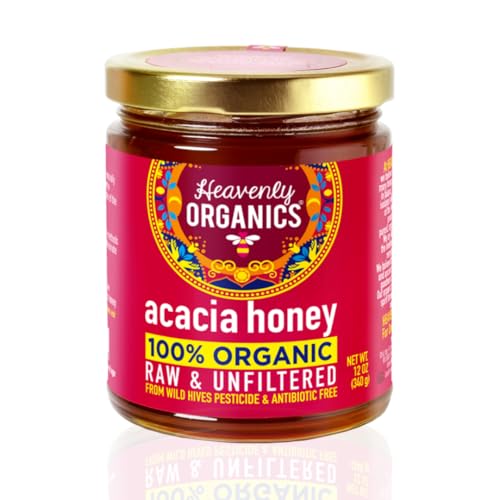
Heavenly Organics is the pick if sourcing ethics matter most. Its multi-floral raw honey carries USDA Organic, Fair Trade, and Non-GMO certifications, is harvested from wild forests, and has a strong social-impact story behind it.
It scores a little lower here purely on value, the multiple certifications and wild sourcing put it at the premium end, but on ethics and transparency it is the leader of this list.
What we liked: USDA Organic plus Fair Trade and Non-GMO, wild-forage sourcing, and a meaningful social-impact mission. A genuinely well-documented, ethical honey.
Keep in mind: The stacked certifications and wild sourcing make it one of the pricier options, so it is more of a values purchase than an everyday budget jar.
What the listing discloses: Heavenly Organics lists a USDA organic claim, Non-GMO Project Verified, Fair Trade and kosher certification. The gap is where it was grown or made.
Best everyday versatile: GloryBee Organic
| Organic Integrity Score | 84 / 100 |
| Certification | Certified Organic, Non-GMO |
| Flavor | Smooth, mild, all-purpose |
| Best for | Tea, baking, and cooking |
GloryBee Organic is a dependable, versatile everyday honey. It is USDA Organic with a smooth, mild flavor that works in tea, baking, and cooking, from a long-established honey company. It is the reliable all-purpose jar.
It scores at the value end because a mild, smooth honey is versatile but less characterful than a raw varietal, but for everyday kitchen use it does the job at a fair price.
What we liked: USDA Organic with a smooth, all-purpose flavor and a trusted, long-established brand. Reliable for tea, baking, and cooking.
Keep in mind: The mild flavor is versatile but less distinctive than a raw varietal honey you might eat straight.
What the listing discloses: GloryBee commits to Non-GMO Project Verified and a single-ingredient formula but stops short of where it was grown or made.
Trustworthy certified raw honey: Y.S. Eco Bee Farms Organic Raw Honey
| Organic Integrity Score | 77 / 100 |
| Certification | Not stated on the listing |
| Style | Raw, unfiltered |
| Track record | Decades of organic beekeeping, thousands of reviews |
| Best for | Trustworthy certified raw honey at a fair price |
Y.S. Eco Bee Farms earns its place here because it combines USDA Organic certification with raw, unfiltered honey and a long, trusted track record. It has thousands of high-rated reviews and reasonable pricing for regular use, and the family has decades of certified-organic beekeeping behind it, exactly the kind of real-world consistency and traceability our method rewards.
Because it is raw, it naturally crystallizes over time, which is a sign of quality, not spoilage. For a jar you can trust to be real, certified, and raw without paying a specialty premium, it is the standout.
What we liked: USDA Organic, raw and unfiltered, with a genuinely long track record and thousands of consistent reviews. The pricing is fair for a certified raw honey you use regularly.
Keep in mind: Raw honey crystallizes over time, which surprises some first-time buyers even though it is a quality sign, easily reversed with gentle warming. The flavor is a classic honey profile rather than a bold single-flower varietal.
What the listing discloses: The word organic does not appear on the YS Royal Jelly/Honey Bee listing at all.
How to store and use organic honey
Keep honey in a sealed jar at room temperature; it does not need refrigeration and effectively never spoils. If it crystallizes, place the jar in warm (not boiling) water and stir until smooth, or leave it crystallized to spread. Do not microwave repeatedly, which can degrade raw honey. Note: never give honey to infants under 12 months, due to the risk of infant botulism.
How adulterated honey is actually detected
Our section above covers the scale of the problem. What is worth adding is that detection is genuinely difficult, which is why the fraud persists.
The older test looked for C4 sugars — cane and corn syrup — by carbon isotope ratio. Adulterators responded by switching to C3 syrups from rice and beet, which the standard test does not catch. The current toolkit includes NMR profiling, LC-HRMS, isotope ratio mass spectrometry in several forms, LC-MS/MS and ICP-MS, and no single method is definitive: one comparison found EIM-IRMS agreeing with the reference method 85% of the time while NMR agreed 53%. NMR combined with multivariate statistics has reported around 95% predictive capacity for syrup adulteration, which is good and not perfect.
Keep in mind: what this means for you as a buyer is that you cannot test honey at home, and the folk tests circulating online — dropping honey in water to see if it dissolves, burning it with a match, the thumb test — have no diagnostic value whatsoever. What you can do is buy from sources with traceability: a named single origin, a beekeeper or cooperative, or a brand that publishes testing. Very cheap honey of unstated origin is where the risk concentrates, and “product of more than one country” on a label tells you the supply chain is long enough to hide things in.
Raw versus pasteurized — and the safety point that surprises people
Honey pasteurization means heating to roughly 145–160°F briefly. Its purpose is commercial rather than microbiological: it kills yeast cells that could ferment the honey, and it dissolves glucose crystals so the jar stays clear and pourable on a shelf.
The cost is that heat destroys the heat-sensitive enzymes — glucose oxidase, diastase, invertase — reduces antimicrobial activity, and degrades some vitamins and antioxidants. That is a real difference, and it is the honest case for raw honey.
Keep in mind: pasteurization affords no protection against infant botulism. The temperatures used destroy yeast cells but have no effect on bacterial spores, which is what causes the problem. So raw and pasteurized honey are equally unsafe for infants, and the rule is absolute: no honey of any kind before 12 months of age. An infant’s immature gut allows Clostridium botulinum spores to colonize and produce toxin; older children and adults are unaffected because established gut flora prevent it. This applies to honey cooked into food as well as honey off a spoon.
Crystallization is evidence your honey is real
People discard crystallized honey thinking it has spoiled. It is the opposite signal.
Honey is roughly 80% glucose and fructose, and glucose comes out of solution over time. Raw and unpasteurized honey crystallizes sooner precisely because pasteurization dissolves the seed crystals that start the process. Adulterated honey cut with syrup often stays liquid indefinitely.
- Crystallization does not affect quality at all — it is a physical change, not spoilage.
- To reliquefy: stand the jar in warm water below 40°C and stir occasionally. Do not microwave, and do not use boiling water — you will simply pasteurize it yourself and destroy what you paid extra for.
- Rate varies by floral source. Clover and rapeseed crystallize fast; acacia and tupelo stay liquid for a long time. Neither indicates quality.
- Fine, smooth crystallization is prized in some markets — creamed or set honey is deliberately crystallized under controlled conditions.
Manuka grading: UMF and MGO decoded
Manuka is the one honey sold on a numbered potency scale, and the two systems confuse people because they measure related but different things.
| UMF grade | Equivalent MGO | Use |
| UMF 5+ | ≥83 mg/kg | Everyday eating |
| UMF 10+ | ≥263 mg/kg | General wellness use |
| UMF 15+ | ≥514 mg/kg | Higher potency; substantially more expensive |
- MGO measures methylglyoxal, the compound responsible for manuka’s antibacterial activity, in mg/kg. It is a single number.
- UMF is the broader certification, verifying four markers: MGO for potency, leptosperin for authenticity, and DHA and HMF for freshness and how well the honey will hold quality. Leptosperin is the important addition, because it is difficult to fake and confirms the honey is genuinely manuka.
- Prefer UMF where available, since MGO alone tells you potency but not authenticity.
- “Active” with no number means nothing. All honey has some antibacterial activity from hydrogen peroxide; the manuka claim rests on MGO specifically.
- Manuka cannot be certified organic in most cases — hives forage over wide areas of wild scrubland that cannot be certified — so its absence is not a red flag here.
Local honey does not treat hay fever
This is the most widely believed claim about honey and it does not hold up, so we would rather say so than repeat it.
A 2020 review found no scientific evidence that local honey helps hay fever, and the American Academy of Allergy, Asthma and Immunology addresses it directly. The mechanism fails on its own terms: the pollens that cause allergic rhinitis are windborne — grass, birch, ragweed — and bees do not collect them in meaningful quantity. Bees gather from insect-pollinated flowers, whose heavy sticky pollen is not what makes you sneeze. So local honey contains largely the wrong pollen, in trace and highly variable amounts, taken orally rather than by any route resembling immunotherapy.
Buy local honey because it is fresher, supports local beekeeping and often tastes far better than supermarket blends. Those are good reasons. Allergy relief is not one of them, and anyone with hay fever bad enough to want treating should see a doctor about actual immunotherapy.
Storage and use
- Honey does not spoil. Its low water activity and acidity make it inhospitable to microbes — edible honey has been recovered from ancient tombs. A “best before” date is about quality, not safety.
- Store at room temperature in a sealed jar. Do not refrigerate, which accelerates crystallization.
- Keep water out. A wet spoon adds moisture and is the one way to make honey ferment.
- Darkening over time is normal oxidation and does not indicate spoilage.
- Heating destroys the enzymes, so add raw honey to warm rather than hot drinks and off the heat in cooking if the enzymes are why you bought it. For baking it makes no difference; the heat gets it either way.
- Honey is sugar. Around 17 g of sugar and 64 calories per tablespoon, with a glycaemic index broadly comparable to table sugar. It brings trace enzymes and antioxidants that refined sugar does not, and it is not a low-sugar alternative.
How we researched this guide
We are a research-based review site. We did not lab-test these honeys ourselves. We compared each against its certification records, sourcing and processing disclosures, and the weight of aggregated buyer and expert feedback, then scored each with our 10-criteria Organic Integrity Score. No brand paid to be included or ranked. Read the full method on our How We Research and Rate page.
Honey against sugar: what actually changes
Honey is routinely positioned as the better choice for anyone watching their weight, and the comparison is worth making properly rather than assuming either direction.
By calories, honey loses. It carries roughly 64 calories per tablespoon against about 49 for granulated sugar, because honey is denser and a tablespoon holds more of it. On a gram-for-gram basis the two are close, with honey marginally lower, but nobody measures honey by weight in a cup of tea.
The glycaemic argument is more genuinely in honey’s favor and smaller than usually claimed. Honey’s fructose-to-glucose ratio is a little higher than table sugar’s, which produces a slightly gentler blood glucose response. The difference is real, modest, and easily swamped by how much you use.
Where honey does have an edge is sweetness intensity. Most people find it sweeter than sugar, so a smaller quantity satisfies the same craving. That is a behavioral advantage rather than a metabolic one, and it only counts if you actually use less rather than the same spoonful out of habit.
What honey does not do is act as a metabolic aid. The trace enzymes, pollen and antioxidants raw honey carries are genuine and nutritionally negligible at the quantities anyone eats. You would need to consume an absurd amount to get a meaningful dose of anything but sugar, and by then the sugar is the dominant fact.
The honest position: raw honey is a better product than refined sugar for flavor, complexity and the things covered elsewhere on this page. For body weight specifically, treat it as sugar with better provenance, and measure it the same way.
Common questions about organic honey
What is the best organic honey?
Our overall pick is Y.S. Eco Bee Farms Organic Raw Honey, because it is USDA Certified Organic, raw and unfiltered, fairly priced, and backed by decades of organic beekeeping and thousands of strong reviews.
Is organic honey really different from regular honey?
Honey adulteration is common, so USDA Organic certification and traceable sourcing give you more confidence that you are buying real, cleanly-produced honey rather than a diluted or mislabeled product.
What does raw and unfiltered mean?
Raw honey is not pasteurized or heavily filtered, so it retains more of its natural pollen, enzymes, and flavor. It tends to crystallize over time, which is a quality sign.
Why did my organic honey crystallize?
Crystallization is natural for raw honey and does not mean it has gone bad. Warm the jar gently in hot water and stir to return it to liquid, or spread it as-is.
Can babies eat organic honey?
No. Never give any honey, organic or not, to infants under 12 months, because of the risk of infant botulism.
Can you test honey at home for adulteration?
No. The folk tests — dropping honey in water, burning it with a match, the thumb test — have no diagnostic value. Real detection needs NMR profiling, isotope ratio mass spectrometry or LC-MS, and even those disagree: one comparison found EIM-IRMS matching the reference method 85% of the time against 53% for NMR. Adulterators also switched from C4 syrups like cane and corn, which the classic isotope test catches, to C3 syrups from rice and beet, which it does not. Buy traceability instead — named origin, a beekeeper, or published testing.
Is pasteurized honey safe for babies?
No — and this is the point that surprises people. Pasteurization heats honey to about 145 to 160°F, which kills yeast cells but has no effect on bacterial spores, which is what causes infant botulism. Raw and pasteurized honey are equally unsafe for infants. No honey of any kind before 12 months, including honey cooked into food. An infant’s immature gut lets Clostridium botulinum spores colonize and produce toxin; older children and adults are unaffected.
What is the difference between raw and pasteurized honey?
Pasteurization is done for commercial reasons — killing yeast that could ferment the honey and dissolving glucose crystals so the jar stays clear on a shelf. The cost is that heat destroys the enzymes glucose oxidase, diastase and invertase, reduces antimicrobial activity and degrades some antioxidants. That is the genuine case for raw honey. It confers no safety advantage for infants either way.
Why has my honey crystallized?
Because it is real. Honey is roughly 80% glucose and fructose, and glucose comes out of solution over time — raw honey crystallizes sooner precisely because pasteurization dissolves the seed crystals that start it. Adulterated honey cut with syrup often stays liquid indefinitely. To reliquefy, stand the jar in warm water below 40°C; do not microwave or use boiling water, or you will pasteurize it yourself.
What is the difference between UMF and MGO on manuka honey?
MGO measures methylglyoxal, the compound behind manuka’s antibacterial activity, in mg/kg — a single potency number. UMF is the broader certification, verifying four markers: MGO for potency, leptosperin for authenticity, and DHA and HMF for freshness. Leptosperin is the key addition since it is hard to fake. UMF 5+ corresponds to at least 83 mg/kg MGO, UMF 10+ to 263, UMF 15+ to 514. Prefer UMF where available.
Does local honey help with hay fever?
No. A 2020 review found no scientific evidence for it, and the mechanism fails on its own terms — the pollens causing allergic rhinitis are windborne grass, birch and ragweed, which bees do not collect in meaningful quantity. Bees gather from insect-pollinated flowers whose heavy sticky pollen is not what makes you sneeze. Buy local honey because it is fresher and tastes better; for hay fever bad enough to want treating, see a doctor about immunotherapy.
Does honey go off?
Not really. Its low water activity and acidity make it inhospitable to microbes, and edible honey has been recovered from ancient tombs — a best-before date is about quality rather than safety. Store at room temperature in a sealed jar, do not refrigerate since that accelerates crystallization, and keep water out, since a wet spoon is the one reliable way to make honey ferment.
Is honey healthier than sugar?
Marginally, and not in the way it is usually sold. Honey carries around 17 g of sugar and 64 calories per tablespoon with a glycaemic index broadly comparable to table sugar. It brings trace enzymes and antioxidants refined sugar lacks, and it is not a low-sugar alternative. Note too that heating destroys the enzymes, so add raw honey to warm rather than hot drinks if that is why you bought it.
- Organic Food and Pantry hub
- Best Organic Peanut Butter
- our full product index — search by brand, product or certification
Price and availability as of October 15, 2026 7:10 pm EDT. Product prices and availability are accurate as of the date/time indicated and are subject to change. Any price and availability information displayed on Amazon.com at the time of purchase will apply to the purchase of this product.
Looking for other organic products?
We have checked more than 800 products across food, household goods, gardening, personal care and pet, every one against its stated certification. Browse all reviews.
Organic Connection is reader-supported. When you buy through links on this page we may earn a commission, at no extra cost to you. As an Amazon Associate we earn from qualifying purchases. We are not paid to feature or rank any product. How we research and rate.