
Last updated: September 30, 2026
We may earn a commission when you buy through links on this page, at no extra cost to you. How we research and rate.
The short version
After working through cocoa labor certification, why chips are engineered not to melt, soy lecithin and the heavy metals question in dark chocolate, our top pick is Pascha Organic 55% Cacao Semi-Sweet Chocolate Chips. They are certified organic, made from three ingredients with no soy lecithin, produced in a dedicated allergen-free facility, and they behave properly in a cookie. They earned our highest Organic Integrity Score of 86 out of 100.
Before comparing bags, one distinction is worth getting straight: organic certification says nothing whatsoever about who picked the cocoa. In this category, that is the ethical question that actually matters.
Best organic chocolate chips compared
| Best Choice | Best Value | ||||
 |  |  |  |  | |
| Product | Pascha Organic 55% Cacao | Guittard Organic 66% | Equal Exchange Organic | Pascha Bulk Organic | Equal Exchange Organic |
| Organic Integrity Score | 86/ 100 | 82/ 100 | 81/ 100 | 80/ 100 | 79/ 100 |
| Our rating | 4.3 | 4.1 | 4.1 | 4.0 | 4.0 |
| Cacao | 55% | 66% | Bittersweet | — | 55% |
| Soy lecithin | None | Contains | Contains | — | Contains |
| Fair Trade | Rainforest Alliance | Fair Trade cocoa | Fair Trade | — | Fair Trade |
| Best for | Allergen-free baking | Melting and dark bakes | Less sweet results | — | Everyday cookies |
| Certification | Rainforest Alliance, Non-GMO, Kosher | Non-GMO, Organic | Kosher, Organic | Fair Trade, Rainforest Alliance, Non-GMO | — |
| Contents | Organic cane sugar, cocoa liquor, cocoa butter, 55% cacao, 6 bags | Organic semisweet chocolate baking wafers, 66% cacao, 12 oz | Organic bittersweet chocolate chips, 10 oz | Organic semi-sweet chocolate chips, 55% cacao, 10 lb | Organic semi-sweet chocolate chips, 55% cacao, 10 oz |
| Price | $69.95$1.32 / ounce View on Amazon | $20.98$1.75 / ounce View on Amazon | Currently unavailable See buying options | $144.95$0.91 / ounce View on Amazon | $9.90 $19.83 −50%$0.99 / ounce View on Amazon |
Scores are ours, based on independent research of certification, labor standards, ingredient simplicity, cacao content, allergen handling and value, using the same 10-criteria method we apply to every product.
The organic chocolate chips certifications, and the question each one leaves open
Seals accumulate on a package faster than meaning does. This is what each of the marks you will see here certifies, and what it leaves out.
| Certification | Covers | Key exclusion |
| USDA Organic | Farming and handling: no synthetic pesticides or fertilizers, no GMOs, no sewage sludge or irradiation, audited yearly by an accredited certifier | Three different tiers share the one seal, and it makes no claim about worker pay, food miles, or nutrition |
| Fair Trade Certified | A price floor for producers, a community premium, and labor standards on the farms and in the facilities | An economic and labor standard; it is not an organic or pesticide claim |
| Rainforest Alliance | Farm-level criteria for deforestation, biodiversity, water and working conditions | Permits a defined list of synthetic pesticides that organic certification prohibits outright |
Rainforest Alliance is not an organic label, and the frog is regularly read as one. Its criteria are genuinely strong on deforestation, biodiversity and farm working conditions, and it permits a defined list of synthetic pesticides that organic certification prohibits outright. The two standards overlap and plenty of good farms hold both. But a frog on its own has not answered the pesticide question.
Chocolate chips are engineered not to melt
This surprises people who have tried to make ganache from chips and ended up with something grainy, so it is worth explaining.
A chocolate chip is designed to hold its shape through baking. That is its entire purpose: you want distinct pockets of chocolate in a cookie, not a marbled brown dough. Manufacturers achieve this by reducing the proportion of cocoa butter relative to a bar, and often by adding stabilizers, so the chip softens without collapsing at oven temperatures.
The consequence is that chips are the wrong product for anything requiring chocolate to actually melt and flow. Ganache, tempering, dipping, glazing and mousse all want a bar or wafers, where the cocoa butter content is higher and the chocolate behaves fluidly. Chips melted for these purposes tend to seize or set thick and dull.
So buy chips for cookies, muffins, scones and anything where you want them to stay chips. Buy bars or wafers for melting. It is not a quality distinction — it is two different products doing two different jobs, and using the wrong one is the most common chocolate mistake in home baking.
Cacao percentage, and what it actually tells you
The number on the bag is useful once you know what it measures.
Cacao percentage is the proportion of the product derived from the cocoa bean — cocoa solids and cocoa butter together. The remainder is mostly sugar. So a 55 percent chip is roughly 45 percent sugar, and a 70 percent chip is roughly 30 percent.
In practice, 55 percent semi-sweet is the standard baking chip and what most recipes assume. It is sweet enough for cookies without dominating. 60 to 66 percent bittersweet is noticeably less sweet and more intense, and works well in recipes that are already sweet, where a sweeter chip makes the result cloying. Above 70 percent is quite bitter in a cookie and better suited to eating or to specific recipes built around it.
Higher percentage also means less sugar and slightly more cocoa butter, so darker chips melt somewhat more readily than semi-sweet ones. If you find standard chocolate chip cookies too sweet, switching to bittersweet chips is a more effective fix than reducing the sugar in the dough.
Soy lecithin, and whether it matters
It appears in the great majority of chocolate chips and generates more concern than it warrants.
Soy lecithin is an emulsifier, used in tiny quantities to control viscosity and help the chocolate flow during manufacturing. It is a genuinely useful processing aid and it has no meaningful nutritional effect at the amounts present.
Two situations make it worth avoiding. The first is soy allergy, where even trace amounts are a real consideration, though highly refined lecithin contains very little soy protein. The second is preference for the shortest possible ingredient list, which is a legitimate reason even without an allergy.
A handful of brands make chips without it, using extra cocoa butter to achieve the same flow. Those chips are genuinely three ingredients — cocoa liquor, cocoa butter and sugar — which is about as simple as chocolate gets. They also tend to cost more, because cocoa butter is expensive and lecithin is cheap. That is the trade, and it is a reasonable one to make if the ingredient list matters to you.
The heavy metals question in dark chocolate
This has circulated widely since consumer testing reported lead and cadmium in dark chocolate, and it deserves an accurate answer rather than either dismissal or alarm.
The finding is real. Cocoa takes up cadmium from soil, particularly in some South American growing regions where it occurs naturally at higher levels, and lead appears to enter largely during post-harvest drying, when beans are laid out and exposed to dust and soil.
Three things follow. Darker chocolate contains more cocoa solids, so it generally carries more of both — the higher percentage that makes it nutritionally preferable also concentrates this. Organic certification does not help, because cadmium comes from the soil and is not something farming practice removes. And the exposure is dose-dependent: a few chips in a cookie is a very different proposition from eating a bar of very dark chocolate every day.
The proportionate response is to vary your sources rather than eating one brand exclusively, and to be more attentive if chocolate is a daily habit or if you are buying for young children, who are more vulnerable to lead. It is not a reason to stop baking with chocolate chips.
Key things to look for in organic chocolate chips
1. Fair Trade certification alongside organic
Organic covers farming inputs; Fair Trade covers labor and pays a premium to producer cooperatives. In cocoa, the labor question is the more serious one.
2. Cacao percentage
55 percent is the standard baking chip most recipes assume. 60 to 66 percent is less sweet and better in already-sweet recipes. Higher than 70 becomes bitter in a cookie.
3. Ingredient count
Cocoa liquor, cocoa butter and sugar is the minimum. Soy lecithin is common and harmless for most people; brands that omit it use more cocoa butter instead.
4. Allergen facility statements
Chocolate production commonly runs milk and nuts on shared lines. If you are baking for an allergy, a dedicated facility is worth seeking out specifically.
5. Bag size against how you bake
Chocolate keeps well if stored properly, so bulk is reasonable here — unlike flour or nuts. Store cool and sealed, away from strong smells.
Who should buy organic chocolate chips
Buy them if you want cocoa grown without synthetic pesticides, and buy Fair Trade certified alongside if the labor conditions behind chocolate matter to you, which they reasonably might. Buy soy-free chips if you have a soy allergy or want the shortest ingredient list.
Buy bittersweet rather than semi-sweet if you find standard chocolate chip cookies too sweet, since that is a more effective adjustment than changing the dough. And buy bars or wafers instead if you are melting the chocolate rather than baking it into something, because chips are built to resist exactly that.
How to choose organic chocolate chips
Start by deciding whether you are baking with them or melting them, since that determines whether you want chips at all. Then choose a cacao percentage: 55 for standard cookies, 60 to 66 if you prefer less sweetness.
Look for Fair Trade certification alongside organic, check the ingredient list if soy lecithin matters to you, and check the facility statement if you are baking for an allergy. Then buy a size you will use within a few months, and store it sealed in a cool cupboard rather than the fridge, where chocolate picks up odors and develops a dull bloom.
Best overall: Pascha Organic 55% Cacao Semi-Sweet Chocolate Chips (Pack of 6)
| Organic Integrity Score | 86 / 100 |
| Contents | Organic cane sugar, cocoa liquor, cocoa butter, 55% cacao, 6 bags |
| Certification | Rainforest Alliance, Non-GMO, Kosher |
| Best for | Allergy-conscious baking and the shortest ingredient list |
No other chip here is this simple while still being genuinely good, and that is what puts it first. Three ingredients — organic cane sugar, cocoa liquor and cocoa butter — with no soy lecithin, no emulsifiers and no artificial anything. Achieving proper flow without lecithin means using more cocoa butter, which costs more and tastes better.
The dedicated allergen-free facility is the other substantial point, and it is genuinely uncommon. Chocolate production almost always runs milk and nuts on shared lines, so for anyone baking for a dairy or nut allergy this solves a real problem rather than hedging it with a may-contain warning.
At 55 percent cacao these behave exactly as a standard baking chip should, holding shape in cookies while softening properly. Two honest points: six bags is a substantial commitment, and while Rainforest Alliance certification covers environmental and some social criteria, it is a different and generally less stringent standard on labor than Fair Trade.
What we liked: Three ingredients and no soy lecithin. Dedicated allergen-free facility. Higher cocoa butter content gives better flavor. Standard 55% behaves properly in cookies.
Keep in mind: Six bags is a lot to commit to. Rainforest Alliance is not the same as Fair Trade on labor. More expensive than lecithin-containing chips.
What the listing discloses: Pascha commits to Rainforest Alliance and kosher certification but stops short of whether the USDA seal applies and where it was grown or made.
Best for melting: Guittard Organic 66% Chocolate Baking Wafers, 12 oz
| Organic Integrity Score | 82 / 100 |
| Contents | Organic semisweet chocolate baking wafers, 66% cacao, 12 oz |
| Certification | Non-GMO, Organic |
| Best for | Ganache, dipping, tempering and dark baking |
Wafers are the right product for everything chips are wrong for. Because they are made to the same standard as a bar rather than engineered to resist heat, they melt smoothly and flow properly — which is what ganache, dipping, glazing and tempering all require. The flat shape also melts more evenly than a chip, with less risk of scorching.
At 66 percent cacao this is genuinely dark, so it works well in recipes that are already sweet and gives depth where a semi-sweet chip would disappear. Guittard have been making chocolate in California since the 1860s and the quality reflects it, with Fair Trade certified cocoa and organic certification.
The obvious caveat is that these are not chips and will not behave like them. In a cookie they melt into pools and streaks rather than holding as distinct pieces, which some people prefer and which is not what a chocolate chip cookie recipe expects. Buy them for melting and for bakes where you want the chocolate to spread.
What we liked: Melts smoothly and evenly, unlike chips. Genuinely dark at 66%. Fair Trade cocoa and organic. Long-established quality producer.
Keep in mind: Will not hold shape in cookies the way chips do. 66% is too dark for some recipes. Costs more per ounce than chips.
What the listing discloses: Guittard is thin on detail, and does not say whether the USDA seal applies and where it was grown or made.
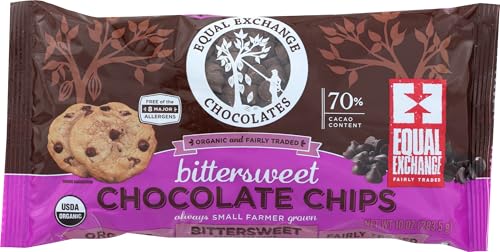
Best less sweet: Equal Exchange Organic Bittersweet Chocolate Chips, 10 oz
| Organic Integrity Score | 81 / 100 |
| Contents | Organic bittersweet chocolate chips, 10 oz |
| Certification | Kosher, Organic |
| Best for | Cookies and brownies that are already sweet enough |
If you have ever found chocolate chip cookies cloying, this is the fix, and it is a better one than reducing the sugar in the dough — which changes texture and spread as well as sweetness. Swapping semi-sweet chips for bittersweet cuts the sweetness precisely where it is concentrated while leaving everything else alone.
Same Fair Trade cooperative sourcing and organic certification as the semi-sweet version, with a more intense, less sugary chocolate character that stands up in brownies and rich doughs.
Two things to know. Bittersweet is genuinely less sweet, and in a recipe that was not already sweet enough it can read as harsh rather than sophisticated — it suits rich bakes, not restrained ones. And it is the same 10 oz bag rather than the 12 oz standard, so check recipe quantities.
What we liked: Effective way to cut sweetness without altering the dough. Same Fair Trade and organic credentials. More intense chocolate character.
Keep in mind: Can read as harsh in less sweet recipes. 10 oz rather than the standard 12 oz. Contains soy lecithin.
What the listing discloses: Equal Exchange states kosher certification, and does not say whether the USDA seal applies and where it was grown or made.
Best bulk: Pascha Bulk Organic Semi-Sweet Chocolate Chips, 10 lb
| Organic Integrity Score | 80 / 100 |
| Contents | Organic semi-sweet chocolate chips, 55% cacao, 10 lb |
| Certification | Fair Trade, Rainforest Alliance, Non-GMO |
| Best for | Heavy bakers, small businesses and holiday baking |
Chocolate is one of the few pantry items where buying in bulk genuinely makes sense, because it keeps well — properly stored, chocolate chips remain good for a year or more, unlike the flours and nuts elsewhere in our guides that turn rancid. For anyone baking at volume, a holiday season, a bake sale or a small food business, ten pounds at this price per pound is a substantial saving.
It is the same allergen-free, soy-free formulation as our top pick, so nothing is compromised on quality to get the bulk price.
Two practical considerations. Ten pounds needs proper storage: a cool, dry place away from strong smells, decanted into sealed containers. Not the fridge, where chocolate absorbs odors and develops a dull white bloom on the surface. And it is a genuinely large quantity — be honest about whether you bake enough to justify it before the appeal of the unit price takes over.
What we liked: Best price per pound, and chocolate genuinely keeps well in bulk. Same allergen-free, soy-free formulation as our top pick. Fair Trade and organic.
Keep in mind: Ten pounds needs real storage space and airtight containers. Never store chocolate in the fridge. Only sensible for high-volume bakers.
What the listing discloses: Pascha states Fair Trade, Rainforest Alliance and kosher certification, and does not say whether the USDA seal applies and where it was grown or made.
Best Fair Trade: Equal Exchange Organic Semi-Sweet Chocolate Chips, 10 oz
| Organic Integrity Score | 79 / 100 |
| Contents | Organic semi-sweet chocolate chips, 55% cacao, 10 oz |
| Certification | — |
| Best for | Anyone who cares how the cocoa farmers were treated |
Equal Exchange is a worker-owned cooperative that has built its entire business around buying from small farmer cooperatives, and in a category where labor is the central ethical problem, that structure is doing more than a certification mark alone would. The cacao comes from small-scale farmers in Peru and the sugar from Paraguay, with a premium paid back to the cooperatives.
The chocolate itself is a proper 55 percent semi-sweet chip that performs exactly as it should in cookies, and it is soy free despite not making a great deal of noise about it.
Two practical points. A 10 oz bag is smaller than the standard 12 oz American baking bag, which matters when recipes call for a full bag — check quantities. And it costs more than supermarket chips, which is the direct consequence of the sourcing model rather than a premium for the label.
What we liked: Genuine Fair Trade sourcing from a worker-owned cooperative. Organic and soy free. Proper 55% baking chip behavior. Transparent about origin.
Keep in mind: 10 oz bag is smaller than the standard 12 oz recipes assume. Costs more than supermarket chips. Not made in an allergen-free facility.
What the listing discloses: Sparse documentation from Equal Exchange — nothing on whether the USDA seal applies and where it was grown or made.
Cocoa percentage, and what baking chocolate is actually for
Chocolate chips are worth treating separately from a chocolate bar, because they are a baking ingredient and the way they are consumed changes the arithmetic.
By composition, chocolate chips are cocoa solids, cocoa butter and sugar, with the proportions varying widely. A quarter cup runs around 200 calories, and semi-sweet chips are typically 40 to 50% sugar by weight. Dark versions at 60 to 70% cocoa carry correspondingly less sugar and more fat, so the calorie difference between them is smaller than people expect; the sugar difference is the real one.
Higher cocoa percentage has a practical consequence beyond composition. Darker chocolate is more bitter and more intensely flavored, and most people eat less of it. That is a behavioral effect rather than a metabolic one, and it is the most reliable benefit of buying a higher percentage.
The flavanol research that gives dark chocolate its reputation applies weakly here. Flavanols are largely destroyed by alkalisation, and many chips are made with Dutch-processed cocoa specifically for color and flavor stability. If the antioxidant argument is why you are buying, a bar of minimally processed high-percentage dark chocolate is a better vehicle than chips.
The honest thing about chips specifically is that a substantial proportion never reaches the recipe. A bag open on the counter is one of the easier ways to eat 400 calories without registering a meal, and the small size of each chip is precisely what makes it easy.
Honest summary: a calorie-dense baking ingredient, meaningfully improved by choosing a higher cocoa percentage, with the main risk being consumption straight from the bag rather than anything nutritional.
Common questions about organic chocolate chips
Does organic certification cover child labor in cocoa?
No. Organic standards govern agricultural inputs and processing, not who works the farm or under what conditions. Documented child and forced labor in West African cocoa production is the most serious ethical issue in chocolate, and Fair Trade certification is the standard that addresses labor practices and pays a premium to producer cooperatives. Look for both marks, not one.
Why do chocolate chips not melt properly?
Because they are designed not to. Chips contain less cocoa butter than a bar and often include stabilizers, so they hold their shape through baking and give you distinct pockets of chocolate rather than marbled dough. For ganache, dipping or tempering, use a bar or baking wafers, where the higher cocoa butter content lets the chocolate flow.
What does the cacao percentage mean?
The proportion of the product coming from the cocoa bean, both solids and cocoa butter, with the remainder mostly sugar. A 55 percent chip is roughly 45 percent sugar. 55 percent is the standard baking chip; 60 to 66 percent is less sweet and suits already-sweet recipes; above 70 percent becomes bitter in a cookie.
Is soy lecithin in chocolate a problem?
Not for most people. It is an emulsifier used in tiny quantities to control viscosity, with no meaningful nutritional effect. It matters if you have a soy allergy, though highly refined lecithin contains very little soy protein, or if you simply want the shortest ingredient list. Brands that omit it use more cocoa butter instead, which costs more.
Is there really cadmium in dark chocolate?
Yes, and the finding is real. Cocoa takes up cadmium from soil, particularly in some South American regions, and lead appears to enter mainly during post-harvest drying. Darker chocolate carries more of both because it contains more cocoa solids, and organic certification does not help, since cadmium comes from the soil. Vary your sources rather than eating one brand exclusively.
How should I store chocolate chips?
Sealed, in a cool dry cupboard away from strong smells. Not the refrigerator: chocolate absorbs odors readily and condensation causes sugar bloom, the dull white film that appears on chilled chocolate. Properly stored, chips keep well for a year or more, which makes bulk buying reasonable here.
Can I substitute bittersweet for semi-sweet chips?
Yes, and it is often an improvement. Swapping to bittersweet cuts sweetness exactly where it is concentrated without altering the dough’s texture or spread, which is what happens if you reduce the sugar in the recipe instead. It suits rich bakes; in a restrained recipe it can read as harsh.
Why are organic chocolate chips more expensive?
Organic cocoa costs more to produce and is grown at smaller scale, and Fair Trade sourcing pays a premium back to producer cooperatives by design. Brands omitting soy lecithin also use more cocoa butter, which is one of the more expensive ingredients in chocolate. The premium reflects real cost rather than positioning alone.
- Organic Food and Pantry hub
- Best Organic Dark Chocolate
- Fair Trade versus organic, explained
- every organic food product we have reviewed — searchable by brand and certification
- Best Organic Vanilla Extract
Price and availability as of October 15, 2026 1:10 pm EDT. Product prices and availability are accurate as of the date/time indicated and are subject to change. Any price and availability information displayed on Amazon.com at the time of purchase will apply to the purchase of this product.
Nutrition facts side by side
| Per 100 g | Equal Exchange Organic | Equal Exchange Organic |
| Calories | 600 kcal | 600 kcal |
| Carbs | 53.3 g | 46.7 g |
| Sugars | 46.7 g | 33.3 g |
| Fiber | 6.7 g | 6.7 g |
| Protein | 6.7 g | 6.7 g |
| Fat | 40 g | 40 g |
| Sodium | 0 mg | 0 mg |
Source: USDA FoodData Central, matched by UPC. Figures are per 100 g, not per serving, and reflect the panel USDA published for each product.
Looking for other organic products?
We have checked more than 800 products across food, household goods, gardening, personal care and pet, every one against its stated certification. Browse all reviews.
Organic Connection is reader-supported. When you buy through links on this page we may earn a commission, at no extra cost to you. As an Amazon Associate we earn from qualifying purchases. We are not paid to feature or rank any product. How we research and rate.