Last updated: September 30, 2026
We may earn a commission when you buy through links on this page, at no extra cost to you. How we research and rate.
The short version
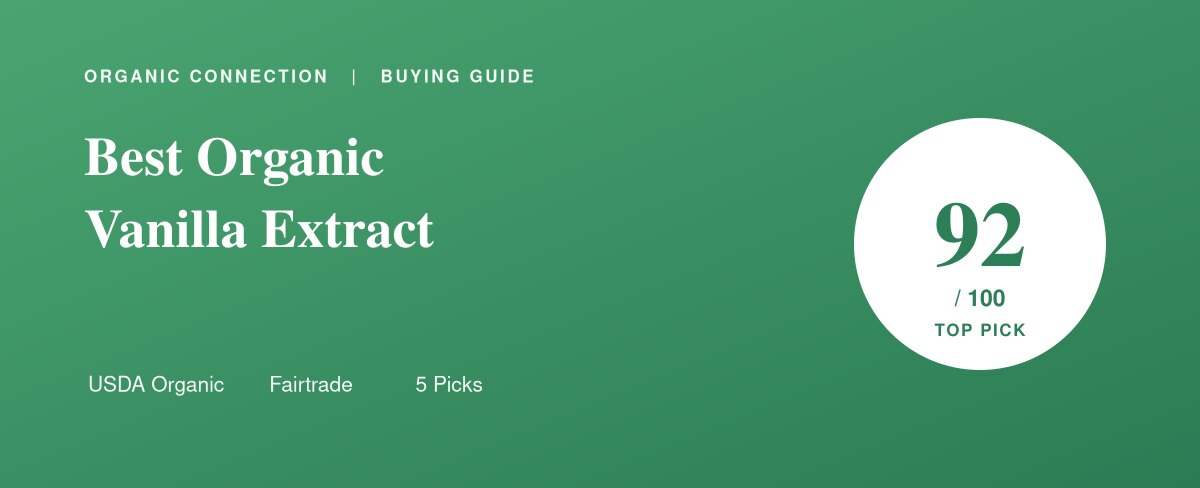
After working through the federal standard of identity and the certification landscape, our top pick is Fairtrade Organic Madagascar Bourbon Pure Vanilla Extract. It meets the legal definition of pure extract, it is USDA organic, and it is Fairtrade certified in a crop where grower economics are a genuine issue, which is why it earned our highest Organic Integrity Score of 92 out of 100.
This is one of the rare categories where the law is on your side. Unlike avocado oil or “natural” skincare, pure vanilla extract has a legal standard of identity, so the words on the front of the bottle carry real weight once you know what they mean.
Best organic vanilla extract compared
| Best Choice | Best Value | ||||
 |  |  |  |  | |
| Product | Nielsen-Massey 8 oz | Nielsen-Massey 4 oz | Simply Organic 2 x 4 oz | Doctor Vanilla 16 oz | Vanilla Bean Kings 4 oz |
| Organic Integrity Score | 92/ 100 | 90/ 100 | 85/ 100 | 84/ 100 | 82/ 100 |
| Our rating | 4.6 | 4.5 | 4.3 | 4.2 | 4.1 |
| Type | Pure extract | Pure extract | — | Pure extract | Pure extract |
| Origin | Madagascar Bourbon | Madagascar Bourbon | — | Madagascar Bourbon | Madagascar |
| Certification | USDA Organic, Non-GMO Project Verified, Fair Trade | USDA Organic, Non-GMO Project Verified, Fair Trade | USDA Organic, Kosher, Gluten-free | — | — |
| Best for | Regular bakers | Occasional baking | — | Trying it first | Everyday value |
| Size | 8 fl oz | 4 fl oz | 2 x 4 fl oz | 16 fl oz | 4 fl oz |
| Price | $42.95$5.37 / fluid ounce View on Amazon | $22.70 $24.81 −9%$5.68 / fluid ounce View on Amazon | $32.95$4.12 / fluid ounce View on Amazon | $29.99$1.87 / fluid ounce View on Amazon | $12.99$3.25 / fluid ounce View on Amazon |
Scores are ours, based on independent research of standard compliance, origin transparency, certification, sourcing ethics and value, using the same 10-criteria method we apply to every product.
The organic vanilla extract certifications, and the question each one leaves open
The labels on these products are not interchangeable, and several of them cover things that have nothing to do with each other. Here is what each one actually buys you.
| Certification | Covers | Key exclusion |
| USDA Organic | Farming and handling: no synthetic pesticides or fertilizers, no GMOs, no sewage sludge or irradiation, audited yearly by an accredited certifier | Three different tiers share the one seal, and it makes no claim about worker pay, food miles, or nutrition |
| Non-GMO Project | Testing and supply-chain traceability showing the ingredients are not genetically engineered | Sets no limit on synthetic pesticides or fertilizers, so it is not an organic claim |
| Fair Trade Certified | A price floor for producers, a community premium, and labor standards on the farms and in the facilities | An economic and labor standard; it is not an organic or pesticide claim |
| Kosher | Ingredients and production comply with Jewish dietary law, verified by a rabbinic agency that inspects the facility | A dietary-law standard: it makes no claim about pesticides, GMOs or farming practice |
The mark most often mistaken for an organic claim is Non-GMO Project Verified. It is a real standard with real testing, and it verifies exactly one thing: that the ingredients are not genetically engineered. It sets no limit on synthetic pesticides, synthetic fertilizers, or anything else about how the crop was grown. USDA Organic already prohibits GMOs outright, so on a certified organic product the butterfly adds independent verification rather than a new promise. On a product carrying only the butterfly, the pesticide question has not been asked.
Pure extract, flavoring and imitation: what each word means
Three terms appear on vanilla bottles and they are not interchangeable.
Pure vanilla extract is the regulated one. It must hit 13.35 ounces of beans per gallon and 35 percent alcohol by volume, and every bit of the flavor must derive from vanilla beans. No added vanillin, natural or artificial, is permitted. When you buy a bottle with those words on it, a federal standard sits behind them.
Vanilla flavoring is made from real vanilla beans but does not meet the alcohol threshold, typically because it is glycerin-based or otherwise alcohol-free. It is a legitimate product, and it is the category most alcohol-free vanillas belong to, but it cannot be called extract.
Imitation vanilla is built on synthetic vanillin. It may contain some genuine vanilla extractives, but the presence of artificial flavor makes it imitation. Synthetic vanillin is typically produced from wood pulp byproducts or petrochemical feedstocks. It is safe to eat and it is cheap, and it delivers one note where real vanilla delivers hundreds.
What organic certification adds on top
Since the standard of identity already governs what pure extract is, organic certification does something narrower here than in most categories, and it is worth being precise about what.
Organic certification covers how the vanilla was grown: no synthetic pesticides or fertilizers on the vines, and organic handling through processing. It also means the alcohol used for extraction is organic. What it does not do is change the extraction ratio or the alcohol percentage, because those are already fixed by the standard.
The more interesting certification in vanilla is arguably Fairtrade. Vanilla is one of the most labor-intensive crops in the world, each flower hand-pollinated in a single-day window, and the price has swung violently over the past decade, with severe consequences for growers in Madagascar. If ethical sourcing is part of why you buy organic, this is a category where the fair trade mark addresses something the organic seal does not. Our comparison of Fair Trade and organic covers where each one applies.
Why real vanilla is expensive, and why that is not a scam
Vanilla is routinely described as the second most expensive spice after saffron, and the reason is agronomic rather than commercial.
Vanilla orchids outside their native Mexico have no natural pollinator, so every single flower is pollinated by hand, and each flower is receptive for less than a day. The pods then take months to mature and months more to cure, through a repeated sweating and drying cycle that develops the vanillin and the hundreds of secondary aromatic compounds that make real vanilla taste like vanilla. It is roughly three years from planting to first harvest.
Set against that, synthetic vanillin is produced industrially at a tiny fraction of the cost. That price gap is why imitation exists and why adulteration pressure is constant. When you see a large bottle of “vanilla” at a price that seems impossible, the standard of identity is the thing to check.
Key things to look for in an organic vanilla extract
1. The words “pure vanilla extract”
Not “vanilla flavoring”, not “vanilla essence”, not “vanilla blend”. This is the phrase with a federal standard behind it.
2. A short ingredient list
Vanilla bean extractives, alcohol, water. Some producers add a little sugar, which is permitted and traditional. If you see vanillin listed, it is not pure extract.
3. Named origin
Madagascar Bourbon is the classic creamy, rounded profile and the benchmark for baking. Tahitian is more floral and fruity, better in custards and fruit desserts than in a hot oven. Mexican is spicier. A bottle that does not say where the beans came from is withholding the thing that determines the flavor.
4. Dark glass
Light degrades the aromatic compounds. Dark glass is standard among serious producers and is a reasonable signal about the rest of their handling.
5. Fairtrade, if grower economics matter to you
Given the crop’s labor intensity and the price volatility growers have absorbed, this is one of the more meaningful places to look for the mark.
Who should buy organic vanilla extract
Buy it if you bake regularly and want the flavor complexity that synthetic vanillin genuinely cannot reproduce, particularly in things where vanilla is the point: custards, ice cream, buttercream, panna cotta. Buy it if you want certified organic growing plus, ideally, fair trade sourcing in a crop where that matters unusually much.
Be relaxed about it if you are making something where vanilla is a background note in a strongly flavored bake, like a heavily spiced cake, where the difference is genuinely hard to detect. And know that in long, hot baking some of the delicate aromatics are driven off regardless, which is why the difference between pure and imitation is most obvious in uncooked and gently cooked applications.
How to choose an organic vanilla extract
Confirm it says pure vanilla extract, check the ingredient list is bean extractives, alcohol and water, then choose origin by what you bake. Madagascar Bourbon is the safe default and the one to buy if you are only buying one. Then pick a bottle size you will use within a couple of years, since extract keeps well but not forever, and dark glass over clear. Fairtrade certification is a genuine tiebreaker here rather than a marketing flourish.
Best overall: Fairtrade Organic Madagascar Bourbon Pure Vanilla Extract, 8 oz
| Organic Integrity Score | 92 / 100 |
| Size | 8 fl oz |
| Certification | USDA Organic, Non-GMO Project Verified, Fair Trade |
| Best for | Regular bakers who want the best and will use it |
It does everything the category allows a product to do. It meets the federal standard for pure extract, it is USDA organic, and it is Fairtrade certified, which in vanilla specifically addresses a real grower welfare problem rather than being decorative. Nielsen-Massey have been extracting vanilla since 1907 and the Madagascar Bourbon profile is the creamy, rounded benchmark most recipes assume.
The trade-off is straightforward cost. Eight ounces of genuinely certified organic Fairtrade Madagascar extract is a real outlay, and it only makes sense if you bake often enough to use it. For occasional baking the smaller bottles below are the better buy, since extract does slowly lose aromatic intensity over years.
What we liked: Full standard-compliant pure extract, USDA organic and Fairtrade together, a century of extraction expertise, and the Madagascar Bourbon profile that suits almost everything.
Keep in mind: Expensive, and eight ounces is more than an occasional baker will get through before it fades.
What the listing discloses: Nielsen-Massey commits to a USDA organic claim, Non-GMO Project Verified, Fair Trade and kosher certification but stops short of where it was grown or made.
Best mid size: Organic Madagascar Bourbon Pure Vanilla Extract, 4 oz
| Organic Integrity Score | 90 / 100 |
| Size | 4 fl oz |
| Certification | USDA Organic, Non-GMO Project Verified, Fair Trade |
| Best for | Most households: premium quality, realistic quantity |
The same organic Fairtrade Madagascar Bourbon extract in half the size, and for most households this is the more sensible purchase than the eight ounce bottle. Extract keeps for years but slowly loses its top notes, so buying a quantity you will finish is a quality decision as much as a financial one.
Cost per ounce is higher than the large bottle, which is the usual trade. If you bake weekly, buy the eight. If you bake monthly, buy this one and it will still be good when you reach the bottom.
What we liked: Premium certified organic Fairtrade extract in a size a normal household finishes while it is still at its best.
Keep in mind: Higher cost per ounce than the 8 oz bottle.
What the listing discloses: Nielsen-Massey is explicit about a USDA organic claim, Non-GMO Project Verified, Fair Trade and kosher certification, and silent on where it was grown or made.
Best multipack: Simply Organic Madagascar Pure Vanilla Extract, 2 x 4 oz
| Organic Integrity Score | 85 / 100 |
| Size | 2 x 4 fl oz |
| Certification | USDA Organic, Kosher, Gluten-free |
| Best for | Heavy bakers, or splitting with someone |
Two four-ounce bottles of certified organic Madagascar extract, which brings the cost per ounce down while keeping the individual bottles small enough to stay fresh. That combination is genuinely useful: you open one and the second stays sealed and dark until you need it.
It suits high-volume baking, or splitting with someone else. If you bake occasionally, eight total ounces is more vanilla than you will use at its best.
What we liked: Better per-ounce value without committing to one large bottle that fades while you work through it. Certified organic pure extract.
Keep in mind: No Fairtrade certification. Eight ounces total is a lot for an occasional baker.
What the listing discloses: The listing lists a USDA organic claim and kosher certification. The gap is where it was grown or made.
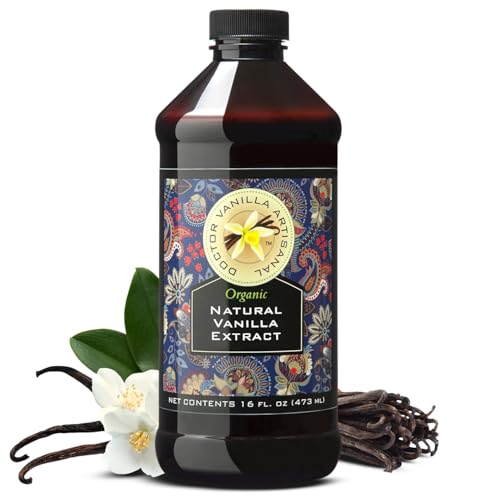
Best large bottle: Doctor Vanilla Organic Madagascar Bourbon Vanilla Extract, 16 fl oz
| Organic Integrity Score | 84 / 100 |
| Size | 16 fl oz |
| Beans | Hand-pollinated, sun-cured Madagascar Bourbon pods |
| Process | Cool infusion rather than heat extraction |
| Best for | Heavy bakers who want the extraction method named |
The largest bottle here, and the only one that describes how the extract was actually made.
Cool infusion is the claim to notice. Vanilla extract is normally produced by percolating alcohol through beans, and heat speeds that up at the cost of the delicate aromatic compounds. A cool process takes longer and keeps more of them, which is a real trade-off rather than a marketing line.
The bean description is unusually specific too: hand-pollinated and sun-cured. Vanilla orchids outside their native Mexico have no natural pollinator, so every commercial vanilla bean in Madagascar is pollinated by hand, one flower at a time. Saying so is accurate and explains why real vanilla costs what it does.
What is missing is certification detail. Organic appears in the product name with no certifier and no USDA phrasing in the body, and there is no bean-per-gallon figure.
What we liked: Names its extraction method, describes hand-pollination and sun-curing accurately, and is the largest bottle here.
Keep in mind: No certifier, no regulated organic phrasing in the body, and no bean ratio. The most expensive bottle in the comparison.
What the listing discloses: DOCTOR VANILLA ARTISANAL leaves the basics open, including whether the USDA seal applies and where it was grown or made.
Best value: Vanilla Bean Kings Organic Vanilla Extract, 4 fl oz
| Organic Integrity Score | 82 / 100 |
| Size | 4 fl oz |
| Beans | Stated as over 13.35 ounces of vanilla beans per gallon |
| Origin | Bourbon Madagascar vanilla beans |
| Best for | Buyers who want a bean ratio published at all |
The only vanilla listing in this comparison to publish a bean ratio, which is the single specification that determines how strong an extract is.
It needs a caveat though, and it is a real one. The listing says it contains “over 13.35 ounces of vanilla beans per gallon, which means our extract is more potent compared to the industry standard single-fold.” In fact 13.35 ounces per gallon is exactly the single-fold standard — it is the minimum the FDA requires for something to be called pure vanilla extract. So “over 13.35” means at or slightly above the legal baseline rather than above the industry norm.
We still credit it. A number you can check beats no number at all, and no competitor here gives one. It simply does not mean what the sentence implies.
The beans are named as Bourbon Madagascar, which is the variety most baking recipes assume.
What we liked: Publishes a bean-per-gallon figure, which nothing else here does, and names the bean variety and origin.
Keep in mind: The potency comparison misstates the standard: 13.35 oz per gallon is single-fold, not above it. No certifier is named.
What the listing discloses: Vanilla Bean Kings commits to a single-ingredient formula but stops short of whether the USDA seal applies and where it was grown or made.
Common questions about organic vanilla extract
What legally counts as pure vanilla extract?
The FDA standard of identity requires a minimum of 13.35 ounces of vanilla beans per gallon, measured at 25 percent moisture, and at least 35 percent alcohol by volume, with all flavor derived from the beans themselves. No added vanillin, natural or artificial, is permitted. A product missing any of these cannot be labeled pure vanilla extract.
What is the difference between extract and vanilla flavoring?
Vanilla flavoring is made from real vanilla beans but does not meet the 35 percent alcohol threshold, which is typically the case for glycerin-based and alcohol-free products. It is a legitimate product with a legitimate use; it simply cannot be called extract under the standard.
Is imitation vanilla bad for you?
It is safe to eat. Imitation vanilla is built on synthetic vanillin, usually derived from wood pulp byproducts or petrochemical feedstocks, and it is regulated as a food ingredient. The objection is flavor rather than safety: vanillin is a single compound where real vanilla contains hundreds, which is why imitation tastes flat in anything where vanilla leads.
Does organic certification change the extract standard?
No. The bean ratio and alcohol percentage are fixed by the standard of identity regardless of certification. Organic certification adds requirements about how the vanilla was grown and handled, and means the extraction alcohol is organic too. The two operate on different aspects of the product.
Why is vanilla so expensive?
Because outside its native range every flower must be hand-pollinated within a single day of opening, the pods take months to mature and months more to cure, and it is about three years from planting to first harvest. It is among the most labor-intensive crops grown, which is also why fair trade certification is unusually meaningful here.
Which origin should I buy?
Madagascar Bourbon if you are buying one bottle. It is the creamy, rounded profile most recipes are written around. Tahitian is more floral and fruity and shines in custards and fruit desserts but is largely wasted in a long hot bake. Mexican is spicier and less common.
Does vanilla extract go bad?
It does not spoil, thanks to the alcohol, but it slowly loses aromatic intensity over years. Keep it in dark glass, sealed, away from heat, and buy a size you will finish within a couple of years rather than a large bottle that sits fading in a warm cupboard.
Can I substitute imitation vanilla in baking?
In a heavily flavored bake where vanilla is a background note, most people cannot reliably tell. In ice cream, custard, panna cotta, buttercream or anything gently cooked or uncooked, the difference is obvious. Long hot baking drives off some delicate aromatics regardless, which is exactly why the gap narrows there.
- Organic Food and Pantry hub
- Fair Trade vs organic: what each guarantees
- Best Organic Ceylon Cinnamon
- our organic food product database — compare brands across every pantry guide
Price and availability as of October 15, 2026 1:10 pm EDT. Product prices and availability are accurate as of the date/time indicated and are subject to change. Any price and availability information displayed on Amazon.com at the time of purchase will apply to the purchase of this product.
Looking for other organic products?
We have checked more than 800 products across food, household goods, gardening, personal care and pet, every one against its stated certification. Browse all reviews.
Organic Connection is reader-supported. When you buy through links on this page we may earn a commission, at no extra cost to you. As an Amazon Associate we earn from qualifying purchases. We are not paid to feature or rank any product. How we research and rate.