Last updated: September 30, 2026
We may earn a commission when you buy through links on this page, at no extra cost to you. How we research and rate.
The short version
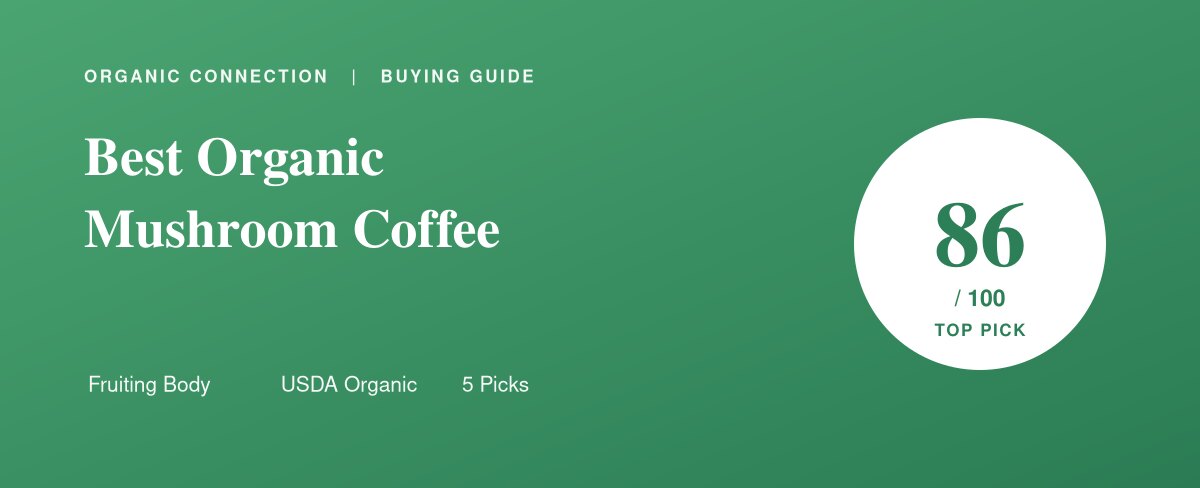
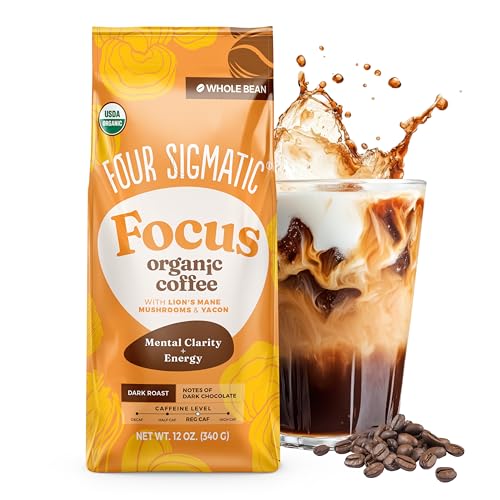
After working through the beta-glucan analyses and the human trial evidence, our top pick is Four Sigmatic Organic Focus Mushroom Ground Coffee. It is certified organic, it uses fruiting body extract rather than grain-grown mycelium, and it is sold as ordinary ground coffee you brew normally, which is why it earned our highest Organic Integrity Score of 86 out of 100.
We have scored this whole category lower than most on this site, and deliberately. Mushroom coffee is not a bad product, but the gap between what the marketing implies and what the human evidence supports is wider here than in almost anything else we cover.
Best organic mushroom coffee compared
| Best Choice | Best Value | ||||
 |  |  |  |  | |
| Product | Four Sigmatic Organic | Four Sigmatic Dark Roast | Four Sigmatic Focus | Four Sigmatic Organic Cold | Four Sigmatic Mushroom |
| Organic Integrity Score | 86/ 100 | 85/ 100 | 83/ 100 | 82/ 100 | 78/ 100 |
| Our rating | 4.3 | 4.3 | 4.2 | 4.1 | 3.9 |
| Format | Ground, 12 oz | Whole bean, 12 oz | Instant, 10 packets | Coarse ground, 12 oz | — |
| Mushrooms | Lion’s mane, chaga | Lion’s mane, chaga | Lion’s mane, chaga, rhodiola | Lion’s mane, chaga | — |
| Mushroom part | Fruiting body | Fruiting body | Fruiting body | Fruiting body | — |
| Best for | Everyday brewing | Grinding fresh | Travel and office | Cold brew | — |
| Certification | Fair Trade, Organic | Fair Trade, Organic | Fair Trade, Organic | — | Gluten-free, Vegan, Organic |
| Price | $18.38$1.53 / ounce View on Amazon | $18.85 $19.99 −6%$1.57 / ounce View on Amazon | Currently unavailable See buying options | $12.55$1.05 / ounce View on Amazon | $14.95$7.05 / ounce View on Amazon |
Scores are ours, based on independent research of mushroom sourcing, extract transparency, coffee quality, certification and value, using the same 10-criteria method we apply to every product.
The organic mushroom coffee certifications, and the question each one leaves open
The labels on these products are not interchangeable, and several of them cover things that have nothing to do with each other. Here is what each one actually buys you.
| Certification | Covers | Key exclusion |
| USDA Organic | Farming and handling: no synthetic pesticides or fertilizers, no GMOs, no sewage sludge or irradiation, audited yearly by an accredited certifier | Three different tiers share the one seal, and it makes no claim about worker pay, food miles, or nutrition |
| GOTS | Organic fiber from farm to finished textile, plus dyeing, finishing, wastewater and labor criteria | Has a weaker second tier, “made with organic”, that needs only 70% organic fiber and carries the same name |
GOTS has a second tier that shares its name. The organic grade requires at least 95% certified organic fiber; the “made with organic” grade requires 70%, and both are labeled GOTS. It remains the strongest textile standard in the field, because it follows the fiber through dyeing, finishing, wastewater and working conditions rather than stopping at the farm. The percentage is on the label for a reason, and it is worth reading.
Mycelium on grain versus fruiting body
This single distinction decides whether you are buying mushroom or buying grain, and it is invisible unless you know the phrasing to look for.
A mushroom has two parts. The fruiting body is the mushroom you would recognize, and it is what traditional use and the overwhelming majority of clinical research have studied. The mycelium is the root-like network the fungus grows through its substrate. Growing mycelium on sterilized grain is far faster and cheaper than cultivating fruiting bodies, and the finished powder is the mycelium and the grain it grew on, because the two cannot practically be separated.
The compositional gap is not subtle. Across dozens of species, fruiting bodies carry roughly five to fifteen times more immune-active beta-glucans than grain-grown mycelium. Analyses of myceliated grain products have found beta-glucan as low as 1 to 5 percent with starch at 35 to 40 percent, which is close to the nutritional profile of the substrate itself.
The label tell is specific. “Mushroom mycelium (grown on grain)”, “myceliated brown rice”, or a supplement facts panel listing “mycelial biomass” all point the same way. “Fruiting body extract”, ideally with a stated beta-glucan percentage, points the other. A brand doing the expensive thing will tell you, because it is the reason their product costs more.
What the human evidence actually supports
Being straightforward here matters more than being encouraging.
Lion’s mane has the best case of the functional mushrooms, with moderate evidence in mild cognitive impairment and a 2024 analysis finding benefit for cognition and energy in older adults. The important caveat is dose: the studied doses are substantially higher than a serving of mushroom coffee delivers. A cup with a few hundred milligrams of extract is not the intervention that was trialled.
Chaga is rich in beta-glucans and shows antioxidant activity, but that evidence ceiling is cell-culture and animal work rather than human trials. It is a reasonable ingredient with an unreasonable amount of marketing attached.
Overall, human evidence for mushroom coffee specifically remains limited, and the more dramatic claims rest on in vitro and animal studies. What you can say honestly is that these are foods with plausible bioactive compounds, that lion’s mane has the most support, and that a coffee-sized serving is a fraction of any studied dose.
There is also a simpler reason people report feeling better on mushroom coffee: most blends contain less caffeine than a standard cup. If jitteriness was your problem, a lower-caffeine coffee solves it regardless of what else is in the bag. Our lion’s mane guide covers the supplement side, where doses are closer to the research.
Does organic certification help here?
It helps with the coffee and it helps with the growing, but it does not address the question that matters most in this category.
USDA organic certification covers how the coffee and the mushrooms were grown and handled. It does not distinguish fruiting body from mycelium-on-grain, and it sets no minimum for beta-glucan content. A certified organic mushroom coffee can be organic myceliated grain. Certification and potency are separate questions, and only one of them is on the front of the bag.
Key things to look for in an organic mushroom coffee
1. “Fruiting body” stated explicitly
The single most important line on the package. If it says mycelium grown on grain, you are largely buying starch.
2. A stated extract amount
Milligrams of mushroom extract per serving, ideally with a beta-glucan percentage. “Contains lion’s mane” without a quantity is not a claim you can evaluate.
3. Caffeine content per serving
Blends vary widely, and many are deliberately lower than regular coffee. If that is what you want, check the number rather than assuming.
4. The coffee itself should be decent
Some mushroom coffees use instant coffee of no particular quality and rely on the mushrooms for the story. A product built on properly roasted organic beans is a better daily drink.
5. Format that fits your routine
Ground and whole bean brew like normal coffee. Instant sachets travel. Latte mixes add coconut milk powder and sweetness. The best one is the one you will keep making.
Who should buy organic mushroom coffee
Buy it if you want a lower-caffeine coffee that still tastes like coffee and you are curious about functional mushrooms with realistic expectations. Buy it if you have tried lion’s mane and liked how you felt, and want it in a format you will keep up daily. Buy the fruiting body products, because the alternative is paying a premium for rice flour.
Do not buy it expecting the cognitive effects described in the trials, since a coffee serving is well below those doses. If lion’s mane specifically is what you want, a proper extract supplement gets you closer to the studied amounts for less money. And if you take medication or have an autoimmune condition, functional mushrooms are worth raising with your doctor rather than assuming food-like means consequence-free.
How to choose an organic mushroom coffee
Find the words “fruiting body” first; if they are absent, move on. Then look for a stated extract quantity. Then pick your format based on how you actually make coffee in the morning. Then check caffeine if that is part of why you are here. Certification is worth having but, as above, it does not answer the potency question. Finally, judge it as coffee, because a functional ingredient you dislike drinking does nothing at all.
Best overall: Four Sigmatic Organic Focus Mushroom Ground Coffee, 12 oz
| Organic Integrity Score | 86 / 100 |
| Format | Ground coffee, 12 oz, dark roast |
| Certification | Fair Trade, Organic |
| Best for | Everyday brewing in a normal coffee maker |
It gets the fundamental right. Four Sigmatic use fruiting bodies rather than grain-grown mycelium, which is the difference between buying mushroom and buying rice flour, and they build it on organic dark roast coffee you brew in whatever you already own. No sachets, no ritual, no separate purchase.
The trade-off is that the mushroom extract in a cup of coffee is nowhere near the doses used in the lion’s mane trials, and no reformulation changes that. Treat it as good organic coffee with a plausible bonus rather than a cognitive intervention, and it is easy to recommend. Treat it as a nootropic and it will disappoint.
What we liked: Fruiting body extract, stated plainly. Brews like ordinary coffee so it survives contact with a real morning. Organic certification on both coffee and mushrooms. Dark roast carries the earthy mushroom note better than a light roast would.
Keep in mind: Extract per serving is well below trialled doses. Costs considerably more than good organic coffee without mushrooms.
What the listing discloses: You are told Fair Trade for Four Sigmatic; you are not told whether the USDA seal applies and where it was grown or made.
Best whole bean: Four Sigmatic Dark Roast Organic Whole Bean Coffee, 12 oz
| Organic Integrity Score | 85 / 100 |
| Format | Whole bean, 12 oz, dark roast |
| Certification | Fair Trade, Organic |
| Best for | Anyone who grinds fresh |
The same lion’s mane and chaga proposition in whole bean, which matters because grinding immediately before brewing is the single biggest improvement most people can make to a cup of coffee. If you already own a grinder this is the version to buy.
Worth understanding how these work: the mushroom extract is applied to the beans rather than existing inside them, so grind and brew as you would any coffee. The mushroom note is earthy and subtle, and the dark roast is chosen to carry it.
What we liked: Whole bean stays fresher than pre-ground for far longer. Fruiting body extract. Genuinely enjoyable dark roast in its own right.
Keep in mind: Needs a grinder. Same dose caveat as every product here.
What the listing discloses: Four Sigmatic commits to Fair Trade but stops short of whether the USDA seal applies and where it was grown or made.
Best for travel: Four Sigmatic Focus Organic Mushroom Coffee, 10 Packets
| Organic Integrity Score | 83 / 100 |
| Format | Instant, 10 single-serve packets |
| Certification | Fair Trade, Organic |
| Best for | Travel, office desks and hotel kettles |
Single-serve packets that need only hot water, with rhodiola added alongside the lion’s mane and chaga. Rhodiola is an adaptogen with its own modest evidence base for fatigue, and it is a reasonable inclusion rather than a filler.
Instant coffee is a compromise on flavor regardless of what is added to it, and this is no exception. Where it wins is portability: a packet in a bag means you are not at the mercy of hotel coffee, and it is the easiest way to try the category before committing to a bag.
What we liked: Genuinely convenient, fruiting body extract maintained in the instant format, and rhodiola is a defensible addition.
Keep in mind: Instant coffee tastes like instant coffee. Cost per serving is high compared with the ground bag.
What the listing discloses: Four Sigmatic lists Fair Trade. The gap is whether the USDA seal applies and where it was grown or made.
Best for cold brew: Four Sigmatic Organic Cold Brew Coffee Grounds, 12 oz
| Organic Integrity Score | 82 / 100 |
| Format | Coarse ground, 12 oz, dark roast |
| Certification | — |
| Best for | Cold brew, ground correctly out of the bag |
Ground coarse specifically for cold brew, which is a genuinely useful thing to buy pre-ground because coarse is the one grind most home grinders struggle to produce evenly. Twelve to eighteen hours steeping and you have a concentrate.
Cold brew’s lower acidity suits people who find hot coffee harsh, and the long steep extracts the mushroom note gently. The obvious limitation is that this grind is wrong for anything else, so it is a single-purpose bag.
What we liked: Correct coarse grind out of the bag, which is harder to achieve at home than people expect. Fruiting body extract. Lower acidity than hot brewing.
Keep in mind: Only good for cold brew. Cold brew concentrate is stronger than it tastes, so dilute properly.
What the listing discloses: Four Sigmatic is thin on detail, and does not say whether the USDA seal applies and where it was grown or made.
Best latte style: Four Sigmatic Mushroom Coffee Latte, 10 Packets
| Organic Integrity Score | 78 / 100 |
| Format | Instant latte mix, 10 packets |
| Certification | Gluten-free, Vegan, Organic |
| Best for | People who want a creamy cup without dairy |
Coconut milk powder blended in for a creamy dairy-free cup from hot water alone. It is the most approachable version of mushroom coffee and the one most likely to convert someone who finds black coffee unpleasant.
It scores lowest of our picks because it is the most processed, with the coconut milk powder and other additions moving it furthest from simply being coffee. That is a fair trade if creaminess is what gets you drinking it, and worth knowing if you are trying to keep ingredients minimal.
What we liked: Genuinely creamy without dairy. Convenient. Keto friendly. Easiest entry point for people who dislike black coffee.
Keep in mind: Most processed option here, with the longest ingredient list. Highest cost per serving.
What the listing discloses: Sparse documentation from Four Sigmatic — nothing on whether the USDA seal applies and where it was grown or made.
Lower caffeine, and a claim built on the wrong dose
Mushroom coffee is marketed on a combination of reduced caffeine and functional mushroom benefits, and the two parts deserve separate treatment.
The caffeine reduction is real and straightforward. Mushroom coffee blends dilute ground coffee with mushroom extract powder, so a cup typically carries around half the caffeine of ordinary coffee. For anyone sensitive to caffeine or drinking it later in the day, that is a genuine and useful property, and it is probably the best reason to buy the product.
The functional claims are where the dose problem appears. The mushrooms used, typically lion’s mane, chaga, cordyceps or reishi, have research literatures of varying quality, and the human trials that exist generally use one to three grams of extract daily. A serving of mushroom coffee frequently contains a few hundred milligrams, spread across several species, which is well below the doses studied for any of them.
Blending several mushrooms makes this worse rather than better, since the total is divided further. A blend of five mushrooms at a gram total delivers 200 mg of each, against studies using several times that of one.
On weight there is no evidence for mushroom coffee, and the reduced caffeine means slightly less of the small thermogenic effect ordinary coffee provides.
Our lion’s mane guide covers the extract-versus-substrate question, which applies here too: mycelium grown on grain and sold as mushroom powder is a large part of this market.
Honest summary: a genuine caffeine reduction, functional doses well below what the research used, and no weight effect. Buy it if half-caffeine coffee is what you want.
Common questions about organic mushroom coffee
Does mushroom coffee actually work?
Partly, with important limits. Lion’s mane has the best evidence, including moderate support in mild cognitive impairment and a 2024 analysis finding benefit for cognition and energy in older adults, but the studied doses are much higher than a serving of mushroom coffee provides. Human evidence for mushroom coffee specifically is limited, and many claims rest on cell and animal studies. Many people also feel better simply because these blends contain less caffeine.
What is the difference between mycelium and fruiting body?
The fruiting body is the mushroom itself, which traditional use and most research have studied. Mycelium is the root-like network, and when grown on grain it cannot be separated from that grain. Fruiting bodies carry roughly five to fifteen times more beta-glucans, while myceliated grain products have tested as low as 1 to 5 percent beta-glucan with 35 to 40 percent starch.
How do I tell which one I am buying?
Read the ingredient panel. “Mushroom mycelium (grown on grain)”, “myceliated brown rice” or “mycelial biomass” all indicate the grain-grown product. “Fruiting body extract”, especially with a stated beta-glucan percentage, indicates the real thing. Brands using fruiting bodies say so, because it is why they cost more.
Does organic certification guarantee fruiting body?
No. Certification covers how the coffee and mushrooms were grown and handled. It does not distinguish fruiting body from mycelium-on-grain and sets no beta-glucan minimum, so a certified organic mushroom coffee can be organic myceliated grain.
Does mushroom coffee have less caffeine?
Usually, though it varies by product, and it is often why people report feeling calmer on it. If lower caffeine is what you want, check the stated figure rather than assuming, and note that a lower-caffeine ordinary coffee would achieve the same thing more cheaply.
Does mushroom coffee taste like mushrooms?
Mildly. The note is earthy rather than savory, and dark roasts are generally chosen to carry it, which is why most blends are dark. Most people find it tastes like slightly earthy coffee rather than anything obviously fungal.
Is mushroom coffee safe with medication?
Worth checking. Functional mushrooms are foods, but some have effects on immune signalling and blood sugar, and reishi in particular has been discussed in relation to anticoagulants. If you take regular medication or have an autoimmune condition, raise it with your doctor rather than assuming food-like means consequence-free.
Is it better to take a lion’s mane supplement instead?
If lion’s mane is specifically why you are interested, yes. A dedicated extract supplement gets far closer to the doses used in research, usually for less money than mushroom coffee. Buy mushroom coffee because you want the coffee, and buy a supplement because you want the dose.
- Organic Supplements and Wellness hub
- Best Organic Lion’s Mane
- Best Organic Coffee
- every product we have reviewed — filter by USDA Organic, GOTS, Fair Trade and more
Price and availability as of October 16, 2026 7:10 pm EDT. Product prices and availability are accurate as of the date/time indicated and are subject to change. Any price and availability information displayed on Amazon.com at the time of purchase will apply to the purchase of this product.
Looking for other organic products?
We have checked more than 800 products across food, household goods, gardening, personal care and pet, every one against its stated certification. Browse all reviews.
Organic Connection is reader-supported. When you buy through links on this page we may earn a commission, at no extra cost to you. As an Amazon Associate we earn from qualifying purchases. We are not paid to feature or rank any product. How we research and rate.