Last updated: September 30, 2026
We may earn a commission when you buy through links on this page, at no extra cost to you. How we research and rate.
The short version
After researching the certifications, drying methods and cuts of the organic yerba mate you can actually buy right now, our top pick is ECOTEAS Organic Traditional Cut. Its listing names USDA Organic, kosher and non-GMO outright, it is the best-selling mate in its category, and it is among the cheapest per pound, which earned it our highest Organic Integrity Score of 93 out of 100. If you want to avoid smoke-dried leaf, BALIBETOV says unsmoked on the label and adds Fair Trade, and Obviously Love is the cheapest unsmoked option.
With yerba mate, the two things that separate a good bag from a mediocre one are whether the leaf was smoke-dried and whether it was grown in shade or full sun. We flag each product’s certification and processing.
Best organic yerba mate compared
| Best Choice | Best Value | ||||
 |  |  |  | ||
| Product | ECOTEAS | BALIBETOV | U.S. Wellness | Obviously Love | La Obereña |
| Organic Integrity Score | 93/ 100 | 90/ 100 | 88/ 100 | 87/ 100 | 78/ 100 |
| Our rating | 4.7 | 4.5 | 4.4 | 4.4 | 3.9 |
| Format | Loose leaf, 1 lb | Loose leaf, 2.2 lb | Loose leaf, 1 lb | Loose leaf | Loose leaf |
| Best for | Best overall | Unsmoked | Strongest cup | Best value | Traditional Argentine |
| Certification | USDA Organic, kosher, non-GMO | USDA Organic, Fair Trade | USDA Organic | Certified organic | — |
| Drying | Not stated | Unsmoked | Not stated | Unsmoked | Not stated |
| Price | View on Amazon | $21.99$0.62 / ounce View on Amazon | $18.99 $22.99 −17%$1.19 / ounce View on Amazon | $12.99 View on Amazon | $29.99$0.86 / ounce View on Amazon |
Price and availability as of October 11, 2026 7:10 pm EDT. Product prices and availability are accurate as of the date/time indicated and are subject to change. Any price and availability information displayed on Amazon.com at the time of purchase will apply to the purchase of this product.
Scores are ours, based on independent research of certification, drying and growing method, sourcing ethics, format, and value, using the same 10-criteria method we apply to every product. See how we research and rate.
What each certification on an organic yerba mate label actually covers
The labels on these products are not interchangeable, and several of them cover things that have nothing to do with each other. Here is what each one actually buys you.
| Certification | Covers | Key exclusion |
| USDA Organic | Farming and handling: no synthetic pesticides or fertilizers, no GMOs, no sewage sludge or irradiation, audited yearly by an accredited certifier | Three different tiers share the one seal, and it makes no claim about worker pay, food miles, or nutrition |
| Kosher | Ingredients and production comply with Jewish dietary law, verified by a rabbinic agency that inspects the facility | A dietary-law standard: it makes no claim about pesticides, GMOs or farming practice |
Kosher and organic answer entirely different questions. A kosher mark, OU, OK, Star-K and others, confirms that ingredients and production follow Jewish dietary law, verified by an agency that inspects the facility. It is a rigorous supply-chain audit and it says nothing about pesticides, GMOs or farming. The two seals appear together often precisely because neither substitutes for the other.
Key things to look for in organic yerba mate
Great yerba mate is about certification, drying method, growing conditions, and cut. Here is what matters.
1. USDA organic certification
It verifies leaf grown without synthetic pesticides, which matters on a crop you steep and drink directly without washing.
2. Unsmoked or air-dried
Smoke drying deposits PAHs on the leaf. Unsmoked mate has a cleaner, greener, more herbal flavor and avoids them.
3. Shade-grown under native canopy
Shade-grown mate preserves rainforest and produces a smoother leaf. Sun-grown plantation mate replaces native forest.
4. Fair trade sourcing
Mate is harvested in Argentina, Paraguay, and Brazil by workers whose conditions have historically been poor. Fair trade certification addresses this.
Loose leaf or tea bags, and how to brew it
Traditional mate is drunk from a hollow gourd through a metal straw called a bombilla, using loose leaf that includes stems and powder. The gourd is packed with leaf at an angle, hot water is added to the low side, and the same leaf is refilled many times over an hour or more, which is what makes mate a social ritual rather than a single cup. That method extracts the most from the leaf and is by far the cheapest way to drink it, since one packing serves many refills.
Tea bags are the practical compromise. They are dramatically more convenient, work in any mug, and produce a milder, more consistent brew, at the cost of some flavor depth and considerably higher price per serving. There is no wrong answer here: the traditional method rewards the effort, but a tea bag you actually drink beats loose leaf sitting unused in a cupboard. Either way the critical rule is water temperature. Mate should be brewed at roughly 150 to 170 °F, not boiling. Boiling water scorches the leaf, producing a harsh, bitter brew, and drinking any beverage at very high temperatures is itself associated with esophageal irritation. Let a kettle sit for three or four minutes off the boil before pouring. Steep loose leaf for three to five minutes, or refill a gourd continuously; a tea bag needs three to five minutes and can usually take a second infusion.
How to choose organic yerba mate
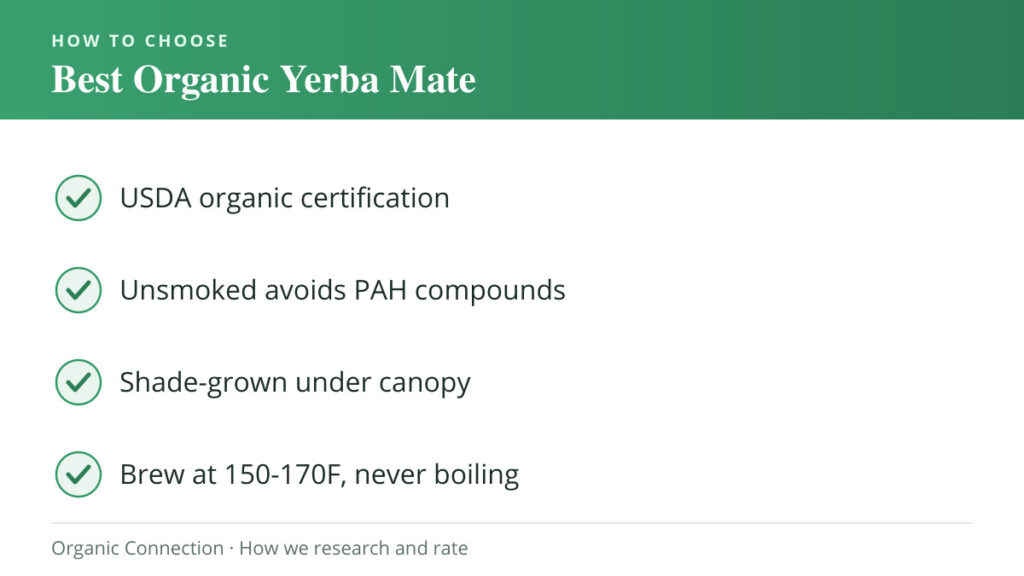
- Confirm USDA organic. The leaf is steeped unwashed, so pesticide certification matters here.
- Look for “unsmoked” or “air-dried.” Smoke drying deposits PAH compounds on the leaf.
- Prefer shade-grown. Better for rainforest and generally a smoother, less bitter leaf.
- Check for fair trade. Mate harvesting has a documented history of poor labor conditions.
- Brew below boiling. Around 150 to 170 °F; boiling water makes mate bitter and harsh.
Who should buy organic yerba mate
The right mate depends on how you drink it. If you want the best-sourced loose leaf for a gourd or a French press, our top pick fits. If you want the convenience of tea bags, the best value in bulk loose leaf, a smaller loose-leaf bag to try, or a compact tin for travel, we have a pick for each.
Best overall: ECOTEAS Organic Yerba Mate Loose Tea, Traditional Cut
| Organic Integrity Score | 93 / 100 |
| Certification | USDA Organic, kosher, non-GMO, gluten-free, all named on the listing |
| Format | Loose leaf, 1 lb bag |
| Cut | Traditional: leaf, stem and a little dust, the way it is drunk in Argentina |
| Best for | The best-documented mate in the category, at a fair price |
ECOTEAS is the best-selling yerba mate in its category and the one whose listing does the most to earn that. USDA Organic, kosher, non-GMO and gluten-free are all stated outright rather than implied by a logo.
The traditional cut includes stems and some powder, which is how mate is actually drunk in Argentina and Uruguay. It brews stronger and cloudier than a pure-leaf cut, and it is what a gourd and bombilla are designed for.
At around fifteen dollars a pound it is also the second cheapest here, which is unusual for the best-documented product in any category.
What we liked: A full certification set named in the listing, the top seller in its category, traditional cut, and a sensible price per pound.
Keep in mind: The listing does not say whether the leaf is smoke-dried, which matters if you are avoiding PAHs. If that is your reason for buying, the two unsmoked picks below say so explicitly.
Best unsmoked: BALIBETOV Organic Yerba Mate, Unsmoked Pure Leaf
| Organic Integrity Score | 90 / 100 |
| Certification | USDA Organic and Fair Trade, plus gluten-free and vegan, named on the listing |
| Format | Loose leaf, 2.2 lb |
| Drying | Unsmoked |
| Best for | Avoiding the smoke-drying question entirely |
Traditional mate is dried over wood smoke, and that process deposits polycyclic aromatic hydrocarbons on the leaf — the same class of compound that makes charred meat a concern. It is the single most substantive health question in this category, and most listings simply do not address it.
This one says unsmoked in the title. It also carries Fair Trade alongside USDA Organic, which is the only pick here to name a labor standard as well as a farming one.
It is a pure-leaf cut rather than traditional, so it brews cleaner and less bitter, and there is over two pounds in the bag.
What we liked: Unsmoked and says so, USDA Organic plus Fair Trade, a large bag, and a smoother pure-leaf cut.
Keep in mind: Pure leaf tastes milder than the traditional cut. If you want the strong, dusty, classic gourd experience, our top pick is closer to it.
Best for a strong cup: U.S. Wellness Naturals Super-Green Yerba Mate
| Organic Integrity Score | 88 / 100 |
| Certification | USDA Organic, named on the listing |
| Format | Loose leaf, 1 lb |
| Cut | Green cut, screened for dust and stems |
| Best for | Getting the most caffeine per gram |
Screened to remove dust and stem, which is the opposite choice from the traditional cut: less sediment in the gourd, more leaf per scoop, and a stronger cup for the same volume.
It scores below the two above it because USDA Organic is the only certification its listing names, and because it costs about half again what our top pick does per pound.
What we liked: A clean green cut with no dust, USDA Organic, and a noticeably stronger brew.
Keep in mind: No mention of smoked or unsmoked drying, and one certification where others name three or four.
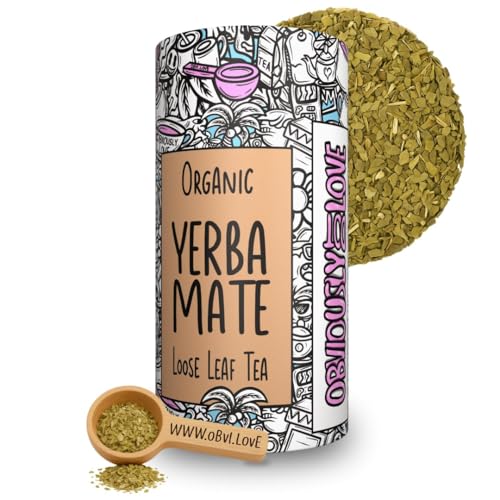
Best value: Obviously Love Organic Yerba Mate, Unsmoked Brazilian
| Organic Integrity Score | 87 / 100 |
| Certification | Certified organic, stated on the listing |
| Format | Loose leaf |
| Drying | Unsmoked |
| Best for | The cheapest way to drink unsmoked mate |
The cheapest mate on this page, and it is unsmoked. Those two things do not usually travel together, since avoiding wood-smoke drying normally costs more.
Brazilian mate is generally milder and greener than Argentine, which suits people who find traditional mate harsh. Its listing says certified organic without naming the certifying body, and it is much the slowest seller of the five, which is what keeps it out of the top three.
What we liked: Unsmoked, certified organic, sustainably grown, and the lowest price here.
Keep in mind: No certifier is named, and a thin sales record means less real-world feedback than the brands above.
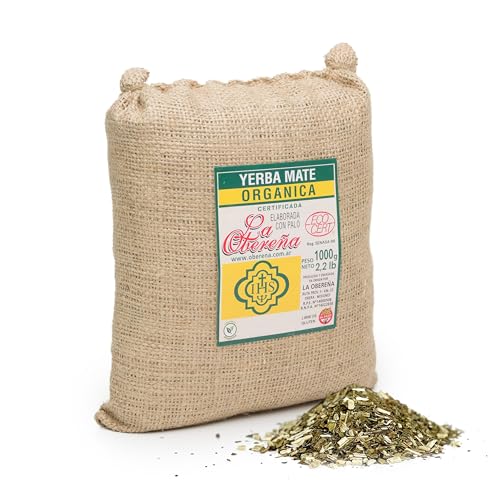
Best traditional Argentine: La Obereñan Organic Yerba Mate
| Organic Integrity Score | 78 / 100 |
| Certification | Organic, gluten-free and vegan claimed; no certifying body named |
| Format | Loose leaf |
| Cut | Traditional South American |
| Best for | An authentic Argentine profile |
A traditional Argentine mate for people who want the real thing rather than a Westernised version of it, with the stem content and strength that implies.
It scores lowest here for the reasons this site always scores lowest. Its listing claims organic without naming who certified it, says nothing about smoked or unsmoked drying, and it is the most expensive product on the page.
What we liked: A genuinely traditional Argentine cut, gluten-free and vegan, from a producer in the growing region.
Keep in mind: No certifier named, no drying method stated, and the highest price here.
Caffeine, and drinking mate sensibly
Yerba mate contains roughly 40 to 80 mg of caffeine per 8 oz serving, putting it between black tea and coffee, alongside theobromine, the compound in chocolate. Many drinkers describe the effect as steadier and less jittery than coffee, which is plausible given the theobromine and the slower drinking pattern of a refilled gourd, though the underlying caffeine chemistry is the same. Treat it as a caffeinated drink: keep it out of the late afternoon if you are caffeine sensitive, and be aware that a gourd refilled ten times delivers far more than a single mug.
Two practical cautions worth taking seriously. First, temperature: brew and drink mate warm rather than scalding. The association between mate and esophageal cancer in South American studies appears to be driven substantially by the very high temperatures at which it is traditionally consumed, and the same association exists for any very hot beverage. Second, smoked leaf: choosing unsmoked mate avoids the PAH exposure that traditional wood-fire drying adds. Both are easy to control, and both are why every pick in this guide is unsmoked and why we keep repeating the 150 to 170 °F guidance. If you are pregnant, managing a heart condition, or on medication affected by caffeine, check with your doctor first.
The cancer question, and what IARC actually changed in 2016
Yerba mate carries a cancer association that gets reported badly in both directions — either ignored entirely by sellers or presented as a reason never to touch it. The actual finding is more specific and more useful than either version, and it changes how you should drink it rather than whether you should.
In 1991, an IARC working group classified drinking hot mate as probably carcinogenic to humans (Group 2A), while mate without further specification was not classifiable (Group 3). In 2016, IARC re-evaluated the evidence in Monographs volume 116 and reached a different conclusion:
- Drinking very hot beverages above 65°C is probably carcinogenic to humans (Group 2A) — any beverage, not mate specifically. Positive associations were observed with squamous cell carcinoma of the esophagus.
- Drinking mate that is not very hot is not classifiable (Group 3), with inadequate evidence in experimental animals for mate as a drinking fluid.
In other words, the risk that earlier studies picked up in South America — and in tea-drinking populations in China, Iran and Turkey, where beverages are traditionally taken at around 70°C — appears to be about thermal injury to the esophagus, not about the plant. Mate was implicated because it is traditionally drunk extremely hot, not because of anything in the leaf.
Keep in mind: this is genuinely actionable. Brewing mate at 70–80°C rather than boiling, and letting it drop below 65°C before drinking, addresses the identified risk directly — and it happens to be exactly what traditional preparation calls for anyway, because boiling water scorches mate and makes it harsh and bitter. The correct brewing temperature and the safer one are the same temperature. That is a rare and convenient alignment, and it is the single most useful thing on this page.
Preparing mate properly
Mate is prepared differently from any other leaf infusion, and the technique is what separates a pleasant drink from a bitter, silty one.
- Fill the gourd about two-thirds with yerba, not to the brim.
- Cover the opening with your hand, invert and shake gently. This brings the fine powder to the top so it can be tipped away — it is the step that prevents a silty first sip.
- Tilt the gourd so the yerba sits at an angle, leaving a hollow on the low side.
- Wet that hollow with cool or lukewarm water first and let it absorb for a minute. This protects the leaf from thermal shock and preserves flavor across many refills.
- Insert the bombilla into the wet hollow and — this matters — do not stir it afterwards. Moving the bombilla clogs the filter with fines and ends the session.
- Top up with water at 70–80°C, always pouring into the same hollow. A good gourd gives ten to fifteen refills before the leaf is spent.
- Drink each refill completely before topping up.
For a teapot or French press instead, use about a tablespoon per cup at the same temperature, steep 3–5 minutes, and expect a cleaner but less complex result. Tea bags are the least interesting format and the most convenient.
Types, cuts and origin
| Style | Character |
| Argentine | The most common. Aged 12–24 months, balanced, dusty-green, often with stems. |
| Paraguayan | Frequently unaged and coarser, sometimes with herbs (yuyos). Stronger, greener. |
| Brazilian (erva-mate / chimarrão) | Finely ground, bright green, unaged. Very fresh and grassy; used for chimarrão. |
| Con palo (with stems) | Milder, smoother, lasts longer through refills. The usual starting point. |
| Sin palo (pure leaf) | Stronger, more bitter, more caffeine per gram. Clogs the bombilla more readily. |
| Despalada / barbacuá | Traditionally smoke-dried over wood, giving a distinctly smoky flavor |
If you are new to mate, an aged Argentine con palo is the forgiving choice — milder, less bitter and less likely to clog. Aging in cedar for a year or more rounds off the sharp edges of fresh leaf, which is why unaged Brazilian mate tastes startlingly green to people used to Argentine brands.
Caffeine, and the “mateine” myth
Worth stating plainly: there is no such thing as mateine. The stimulant in yerba mate is caffeine, chemically identical to the caffeine in coffee and tea. The term was coined in the nineteenth century when chemists believed each plant’s stimulant was distinct, and it survives purely as marketing. Any product claiming mate contains a gentler “natural” alternative to caffeine is telling you something untrue.
- Roughly 80 mg of caffeine per cup, sitting between tea and coffee — though a shared gourd over an hour delivers considerably more in total than a single cup.
- Mate also contains theobromine, the compound that dominates in cocoa, which is a milder and longer-acting stimulant. That combination is a plausible explanation for the smoother, more sustained effect people describe — it is not evidence of a different molecule.
- It has real polyphenol content, including chlorogenic acids similar to those in coffee, plus saponins that give mate its characteristic foam and slight bitterness.
Who should be careful
- Pregnancy and breastfeeding — standard advice caps caffeine at around 200 mg daily, and a shared gourd makes intake hard to track. Count it as coffee.
- Anxiety, palpitations or insomnia — the effect is longer-lasting than coffee, so an afternoon gourd can affect sleep more than an afternoon espresso.
- MAOI antidepressants — combining with caffeine-containing stimulants requires medical advice.
- Blood pressure medication and stimulant medication — additive effects.
- Iron deficiency — like tea, mate contains tannins that inhibit non-haem iron absorption. Drink it between meals rather than with them.
- Smoking — the esophageal cancer studies in South America found risk concentrated in people who also smoked and drank alcohol, and the combination is considerably worse than any element alone.
- Sharing a gourd passes saliva between people. Traditional and sociable, and worth thinking about during any infectious illness.
Storage
- Airtight, opaque, cool and dry. Mate is more stable than green tea but still loses aroma with light and air.
- Around 1–2 years sealed, and 6–12 months once opened before the flavor flattens noticeably.
- Keep it away from strong odors — the fine cut has a lot of surface area and absorbs neighboring smells quickly.
- Do not refrigerate. Condensation clumps the leaf and dulls the flavor.
- Clean the bombilla thoroughly after every use, ideally with boiling water through it. Trapped fines ferment and will ruin subsequent sessions.
- Cure a new calabash gourd before first use — scrape out the soft interior, fill with spent yerba and hot water, and leave for a day or two, repeating a few times. Skipping this makes the gourd mold.
How we researched this guide
We are a research-based review site. We compared each product against its certification (USDA organic, and where present Fair Trade), drying method (smoked versus unsmoked), growing conditions, format and cost per serving, and the weight of aggregated customer feedback on flavor and smoothness, then scored each with our 10-criteria Organic Integrity Score. No brand paid to be included or ranked. Nothing here is medical advice. Read the full method on our How We Research and Rate page.
Mateine does not exist, and other things worth knowing
Yerba mate is marketed with a distinctive set of claims and one persistent myth that is worth clearing up before the weight question.
The myth is mateine. Marketing frequently describes yerba mate as containing a gentler stimulant called mateine rather than caffeine. There is no such compound. The stimulant in yerba mate is caffeine, chemically identical to the caffeine in coffee and tea. Any difference in how it feels is attributable to dose, to the presence of theobromine, and to the way mate is traditionally drunk in repeated small servings rather than one large cup.
Caffeine content is genuine and moderate, roughly 80 mg per cup depending on preparation, which is comparable to coffee. So the same small acute thermogenic effect applies, with the same tolerance caveat, and the same caveat about what happens if it becomes a sweetened bottled drink.
The mate-specific research is mostly preclinical. Studies in cell culture and rodents have reported effects on fat cell formation and on satiety signalling, and a small number of human trials have looked at mate with exercise. The human evidence is thin and the effect sizes modest.
There is one caution worth stating plainly. Long-term consumption of mate at very high temperatures has been associated in epidemiological studies with increased risk of oesophageal cancer, and the evidence points to the heat rather than the plant. Drinking it hot rather than scalding is a sensible precaution.
Honest summary: real caffeine under a fictional name, a small preclinical literature on weight, and a temperature caution that matters more than either.
Common questions about organic yerba mate
What is the best organic yerba mate?
Our overall pick is Guayakí Organic Traditional Loose Leaf, because it is USDA certified organic and Fair Trade, unsmoked so it avoids the PAH compounds from wood-fire drying, and shade-grown under native rainforest canopy. For convenience, Guayakí tea bags are our pick, and for the best value in loose leaf, Kiss Me Organics.
Why does unsmoked yerba mate matter?
Traditional mate is dried over open wood fires, which imparts a smoky flavor and also deposits polycyclic aromatic hydrocarbons on the leaf, the same class of compounds found in barbecue smoke. Unsmoked or air-dried mate avoids them entirely and has a cleaner, greener flavor. Every pick in this guide is unsmoked.
What temperature should I brew yerba mate at?
Around 150 to 170 °F, well below boiling. Boiling water scorches the leaf and produces a harsh, bitter brew, and drinking any beverage at very high temperatures is associated with esophageal irritation. Let a kettle stand three or four minutes off the boil before pouring.
Do I need a gourd to drink yerba mate?
No. A gourd and bombilla is the traditional method and extracts the most from the leaf across many refills, but a French press works very well, and a fine tea infuser is adequate. Tea bags need no equipment at all, at the cost of some depth and a higher price per serving.
Does yerba mate cause cancer?
The evidence points at temperature rather than the plant. IARC classified drinking hot mate as probably carcinogenic (Group 2A) in 1991, but re-evaluated in 2016 and concluded that drinking very hot beverages above 65°C — any beverage — is Group 2A, while drinking mate that is not very hot is Group 3, not classifiable. The associations found in South America and in very-hot-tea-drinking populations in China, Iran and Turkey appear to reflect thermal injury to the esophagus. Brew at 70 to 80°C and let it cool below 65°C, which is also how mate is meant to be prepared.
What temperature should you brew yerba mate at?
70 to 80°C, never boiling. Boiling water scorches the leaf and makes mate harsh and bitter, and it is also the temperature range implicated in esophageal risk. The correct brewing temperature and the safer one happen to be the same, which makes this an easy thing to get right.
Is mateine different from caffeine?
No — there is no such thing. The stimulant in yerba mate is caffeine, chemically identical to that in coffee and tea. “Mateine” was coined in the nineteenth century when chemists believed each plant’s stimulant was distinct, and it survives only as marketing. Any product claiming mate contains a gentler natural alternative to caffeine is telling you something untrue.
How much caffeine is in yerba mate?
Roughly 80 mg per cup, between tea and coffee — though a shared gourd drunk over an hour delivers considerably more in total. Mate also contains theobromine, the milder longer-acting stimulant that dominates in cocoa, which plausibly explains the smoother sustained effect people describe.
How do you prepare mate in a gourd?
Fill about two-thirds with yerba, cover the opening, invert and shake gently to bring fines to the top, then tip them away. Tilt the gourd so a hollow forms on the low side, wet that hollow with cool water first and let it absorb for a minute, then insert the bombilla — and do not stir it afterwards, because moving it clogs the filter and ends the session. Top up at 70 to 80°C into the same hollow; a good gourd gives ten to fifteen refills.
What is the difference between con palo and sin palo?
Stems. Con palo includes stems and is milder, smoother and longer-lasting through refills — the sensible starting point. Sin palo is pure leaf: stronger, more bitter, more caffeine per gram, and more likely to clog the bombilla. Aged Argentine con palo is the most forgiving option for anyone new to mate.
Who should avoid yerba mate?
Anyone limiting caffeine — pregnancy guidance caps intake around 200 mg daily and a shared gourd makes that hard to track. Also people with anxiety, palpitations or insomnia, since the effect lasts longer than coffee; anyone on MAOI antidepressants, blood pressure or stimulant medication; and people with iron deficiency, since mate’s tannins inhibit non-haem iron absorption. Note too that the esophageal cancer studies found risk concentrated in people who also smoked and drank alcohol.
How do you look after a mate gourd and bombilla?
Cure a new calabash gourd before first use — scrape out the soft interior, fill with spent yerba and hot water, leave a day or two, and repeat a few times, or it will mold. Clean the bombilla thoroughly after every session, ideally by running boiling water through it, since trapped fines ferment and ruin later sessions. Store yerba airtight, opaque and dry, and never in the fridge.
- Organic Food & Pantry hub
- Best Organic Green Tea
- Best Organic Loose Leaf Tea
- Organic Coffee and Tea: A Cleaner Daily Cup
- Organic Product Database — search every product we have reviewed, by certification
- Best Organic Energy Drinks
Price and availability as of October 11, 2026 7:10 pm EDT. Product prices and availability are accurate as of the date/time indicated and are subject to change. Any price and availability information displayed on Amazon.com at the time of purchase will apply to the purchase of this product.
Looking for other organic products?
We have checked more than 800 products across food, household goods, gardening, personal care and pet, every one against its stated certification. Browse all reviews.
Organic Connection is reader-supported. When you buy through links on this page we may earn a commission, at no extra cost to you. As an Amazon Associate we earn from qualifying purchases. We are not paid to feature or rank any product. This page is informational and is not medical advice. How we research and rate.