Last updated: September 30, 2026
We may earn a commission when you buy through links on this page, at no extra cost to you. How we research and rate.
The short version
After researching the certifications, protein content, and sourcing of the most popular organic bone broths, our top pick is Pacific Foods Organic Unsalted Chicken Bone Broth. It is USDA certified organic and Non-GMO Project Verified, slow-simmered to deliver around 19 grams of protein per serving, and made from bones of organically raised chickens with a clean ingredient list, which is why it earned our highest Organic Integrity Score of 94 out of 100. For the best value, Pacific Foods Organic Unsalted Chicken Bone Broth is our pick, and for the richest beef option, Pacific Foods Organic Beef Bone Broth is the best choice.
The number that separates real bone broth from seasoned stock in a carton is protein per serving. We flag each product’s certification and protein.
Best organic bone broth compared
| Best Choice | Best Value | ||||
 |  |  |  |  | |
| Product | Pacific Foods Chicken | Pacific Foods Beef | Kettle & Fire Chicken | Bare Bones Chicken | Kettle & Fire Low Sodium |
| Organic Integrity Score | 94/ 100 | 90/ 100 | 82/ 100 | 80/ 100 | 79/ 100 |
| Our rating | 4.7 | 4.5 | 4.1 | 4.0 | 4.0 |
| Protein | Moderate | Moderate | ~19 g | High | ~17 g |
| Best for | Best overall | Richest flavor | Sipping | Small format | Low sodium |
| Certification | USDA Organic, Non-GMO | USDA Organic, Non-GMO, Gluten-free | Non-GMO, Gluten-free, Organic | Gluten-free, Organic | Gluten-free, Organic |
| Price | $5.53$0.17 / fluid ounce View on Amazon | $75.48$0.20 / fluid ounce View on Amazon | $40.01$0.39 / fluid ounce View on Amazon | $7.81 $8.39 −7%$0.49 / fluid ounce View on Amazon | $39.99$6.67 / fluid ounce View on Amazon |
Price and availability as of October 12, 2026 1:10 am EDT. Product prices and availability are accurate as of the date/time indicated and are subject to change. Any price and availability information displayed on Amazon.com at the time of purchase will apply to the purchase of this product.
Scores are ours, based on independent research of certification, protein content, sodium, ingredient purity, and value, using the same 10-criteria method we apply to every product. See how we research and rate.
The organic bone broth certifications, and the question each one leaves open
Certification names are easy to confuse and easy to trade on. Below is what each of these marks covers, and the part of the picture it says nothing about.
| Certification | Covers | Key exclusion |
| USDA Organic | Farming and handling: no synthetic pesticides or fertilizers, no GMOs, no sewage sludge or irradiation, audited yearly by an accredited certifier | Three different tiers share the one seal, and it makes no claim about worker pay, food miles, or nutrition |
| Non-GMO Project | Testing and supply-chain traceability showing the ingredients are not genetically engineered | Sets no limit on synthetic pesticides or fertilizers, so it is not an organic claim |
The mark most often mistaken for an organic claim is Non-GMO Project Verified. It is a real standard with real testing, and it verifies exactly one thing: that the ingredients are not genetically engineered. It sets no limit on synthetic pesticides, synthetic fertilizers, or anything else about how the crop was grown. USDA Organic already prohibits GMOs outright, so on a certified organic product the butterfly adds independent verification rather than a new promise. On a product carrying only the butterfly, the pesticide question has not been asked.
Key things to look for in organic bone broth
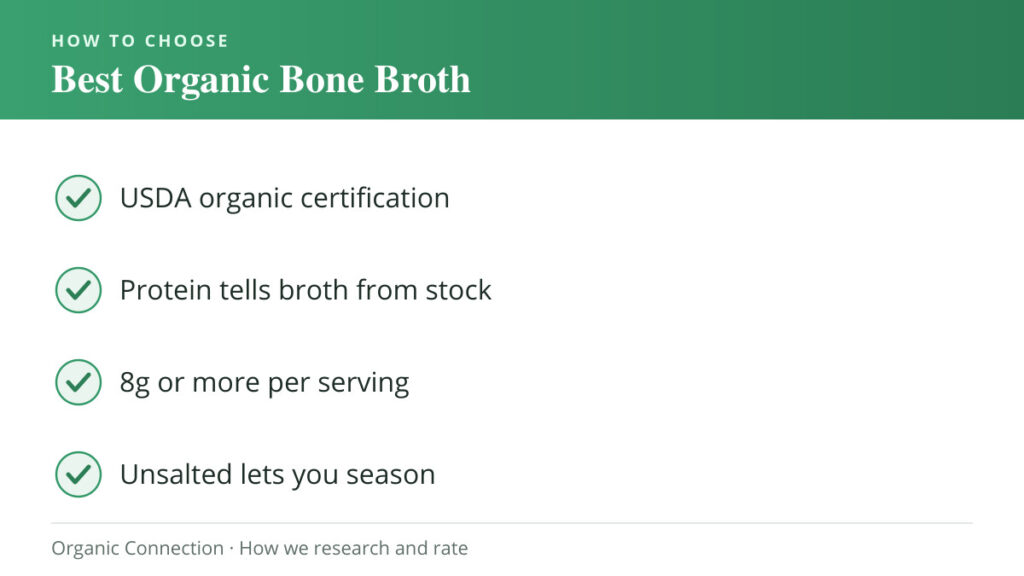
Great bone broth is about certification, protein, sodium, and a short ingredient list. Here is what matters.
1. USDA organic certification
It covers the animals’ feed, the absence of routine antibiotics and added hormones, and the organic status of the vegetables and herbs.
2. Meaningful protein per serving
Eight grams or more signals genuine long simmering. Two or three grams means you are buying stock.
3. Sodium you can control
Unsalted and low-sodium versions let you season to taste. Some cartons carry 500 mg or more per cup.
4. A short, recognizable ingredient list
Bones, water, vegetables, herbs, vinegar. “Natural flavors” and yeast extract are used to fake body that long simmering would have produced.
What bone broth does and does not do
Bone broth is genuinely good food and a genuinely oversold supplement, and it is worth separating the two.
What it reliably is: a low-calorie, high-protein, savory liquid that makes an excellent base for soups, risottos, grains, and braises, and a warm, filling drink on its own. The protein is real, the minerals are modest but present, and if you are replacing a commercial stock cube with a genuine organic bone broth, your cooking will improve noticeably. As a warm low-calorie snack it is far better than most alternatives.
What the marketing claims and the evidence does not support: that drinking collagen rebuilds your own collagen. Dietary collagen is digested into amino acids like any other protein, and your body then builds whatever it needs from that amino acid pool. It does not travel intact to your skin or joints. There is some research on hydrolysed collagen peptide supplements at specific doses showing modest effects on skin and joint measures, but bone broth is not a standardized peptide supplement and the amounts vary enormously. Claims about “healing leaky gut” are not supported by good human evidence. The glycine content is real and glycine has legitimate roles, but that is a long way from the transformation the category advertises.
One genuine caution: because bones can accumulate heavy metals, particularly lead, there has been some concern about long-simmered broths. The measured levels in commercial broths are generally low and organic sourcing does not specifically address this, but it is a reason to treat bone broth as a food you enjoy rather than something to drink in extreme quantities daily.
How to choose organic bone broth
- Confirm USDA organic. It covers feed, antibiotics, and hormones for the animals the bones came from.
- Read the protein figure first. Eight grams or more per serving means genuine long simmering.
- Choose unsalted or low-sodium so you can season the dish rather than inherit someone else’s seasoning.
- Check the ingredient list is short. Yeast extract and “natural flavors” substitute for real extraction.
- Treat it as food, not therapy. The collagen claims run well ahead of the evidence.
Who should buy organic bone broth
The right broth depends on how you use it. If you want the highest-protein certified organic broth for sipping or cooking, our top pick fits. If you want the best value in bulk, a rich beef version, a small-format chicken broth, or a reduced-sodium option, we have a pick for each.
Best overall: Pacific Foods Organic Unsalted Chicken Bone Broth, 32 oz
| Organic Integrity Score | 94 / 100 |
| Protein | Moderate |
| Certification | USDA Organic, Non-GMO |
| Best for | Cooking, where you control the salt |
Pacific Foods is the sensible everyday choice, and the unsalted version is the one to buy. Being unsalted is a genuine advantage for cooking: you season the finished dish rather than inheriting a fixed sodium level, which matters enormously when you reduce a broth or use it in a risotto where the liquid concentrates. It is USDA certified organic, widely stocked, and priced well below the premium sipping brands, with a 32 oz carton that covers a family soup.
The trade-off is protein. Pacific’s broths sit below Kettle & Fire on the panel, which means less collagen extraction and a thinner body, and they do not gel the way a long-simmered broth does. As a cooking liquid that is largely irrelevant; as a sipping broth it is noticeably less satisfying.
What we liked: USDA organic and unsalted so you control seasoning, widely available, and much better value than the premium brands.
Keep in mind: Lower protein and thinner body than the top pick; it does not gel.
What the listing discloses: Pacific Foods is explicit about USDA organic certification, and silent on where it was grown or made.
Richest flavor: Pacific Foods Organic Beef Bone Broth, 32 oz, 12-Pack
| Organic Integrity Score | 90 / 100 |
| Protein | Moderate |
| Certification | USDA Organic, Non-GMO, Gluten-free |
| Best for | Braises, stews, French onion soup, and pho |
Beef bone broth is a different ingredient from chicken, deeper and more savory, and it is what you want for braises, stews, French onion soup, and beef pho where chicken broth would taste thin. This is USDA certified organic beef bone broth in a twelve-carton case, which brings the cost per carton down substantially if beef broth is a staple in your cooking.
The trade-off is that twelve 32 oz cartons is a genuine commitment in both money and cupboard space, and beef broth is a narrower ingredient than chicken, which works in almost anything. Protein sits at Pacific’s usual moderate level rather than premium.
What we liked: USDA organic beef bone broth with real depth for braising, at a good per-carton price in the case format.
Keep in mind: Twelve large cartons needs real storage, and beef broth is less versatile than chicken.
What the listing discloses: Pacific Foods is explicit about a USDA organic claim, and silent on where it was grown or made.
Sipping, and as a genuinely: Kettle & Fire Organic Chicken Bone Broth, 6-Pack
| Organic Integrity Score | 82 / 100 |
| Protein | Approximately 19 g per serving |
| Certification | Non-GMO, Gluten-free, Organic |
| Best for | Sipping, and as a genuinely rich cooking base |
Kettle & Fire earns its place here because the protein figure backs up the label. At around 19 grams per serving it is at the top of the category, which is direct evidence of genuine long simmering rather than a quick stock dressed up as broth, and you can see it in the texture: it gels properly when chilled. It is USDA certified organic and Non-GMO Project Verified, made from bones of organically raised chickens, with a short recognizable ingredient list and no yeast extract or “natural flavors” propping up the body. Shelf-stable cartons mean no freezer space required.
The trade-off is price, which is the highest here by a clear margin, and sodium, which is moderate rather than low in the standard version. If you are cooking with it rather than sipping it, that sodium reduces your seasoning headroom.
What we liked: Around 19 g protein per serving, USDA organic and Non-GMO verified, genuinely gels, clean short ingredient list, and shelf stable.
Keep in mind: The most expensive option here, and standard sodium limits seasoning headroom in cooking.
What the listing discloses: On the Kettle & Fire label: Whole30 approval. Not stated: whether the USDA seal applies and where it was grown or made.
Best small format: Bare Bones Organic Classic Chicken Bone Broth, 16 oz
| Organic Integrity Score | 80 / 100 |
| Protein | High |
| Certification | Gluten-free, Organic |
| Best for | Sipping a cup without opening a large carton |
Bare Bones built its brand around sipping broth, and the 16 oz format is designed for exactly that: roughly two cups, so you can drink one and refrigerate the rest without a half-empty 32 oz carton lingering. It is USDA certified organic, slow-simmered with good protein content, and the flavor is seasoned for drinking rather than for cooking, which is a real distinction.
It scores lower here on economics: small formats always cost more per ounce, and the price per cup is well above the large cartons. It also means more packaging per serving. Buy it if sipping is your primary use, not if you mainly cook with broth.
What we liked: USDA organic with high protein, sized and seasoned specifically for sipping rather than cooking.
Keep in mind: Highest cost per ounce here, and more packaging per serving.
What the listing discloses: Bare Bones leaves the basics open, including whether the USDA seal applies and where it was grown or made.
Best low sodium: Kettle & Fire Reduced Sodium Organic Chicken Bone Broth
| Organic Integrity Score | 79 / 100 |
| Protein | Approximately 17 g per serving |
| Certification | Gluten-free, Organic |
| Best for | People managing sodium intake who still want high protein |
This is the answer for anyone who wants Kettle & Fire’s protein content while watching sodium, whether for blood pressure reasons or simply to have more seasoning control when reducing a sauce. It keeps around 17 grams of protein per serving and the USDA organic certification, with the salt substantially cut.
It scores lowest here for two honest reasons. Salt carries flavor, so a reduced-sodium broth tastes noticeably flatter drunk on its own and needs seasoning if you are sipping it, and it carries the same premium price as the standard version despite being a narrower product. If sodium is not a concern for you, Pacific’s unsalted version gives you the same control for considerably less money.
What we liked: High protein and USDA organic certification with sodium substantially reduced, useful for medical and culinary reasons alike.
Keep in mind: Noticeably flatter flavor when sipped plain, at the same premium price as the standard version.
What the listing discloses: Kettle & Fire is explicit about Whole30 approval, and silent on whether the USDA seal applies and where it was grown or made.
Cooking with it, and making your own
Bone broth is a straight upgrade over a stock cube anywhere liquid carries flavor: risotto, grain pilafs, braises, pan sauces, and any soup. Reduce it slightly before using it in a sauce and the gelatin gives you body without cream or flour, which is the single most useful thing it does in a kitchen. For sipping, warm it with a strip of lemon zest, a crushed garlic clove, or a slice of ginger, and a pinch of salt if you bought unsalted. Once opened, a carton keeps three to four days refrigerated, or freeze it in an ice cube tray for pan sauces later.
Making your own is cheaper and better, and worth mentioning honestly on a page selling cartons. Save chicken carcasses in the freezer until you have two or three, cover with water, add a tablespoon of vinegar to help extraction, a halved onion, a carrot, and a couple of bay leaves, and simmer very gently for six to twelve hours. Do not boil it hard, which emulsifies fat and clouds the broth. Strain, cool, and lift off the fat cap. Properly made, it sets to a firm jelly in the fridge, which is the visual proof of collagen extraction that no label can give you. Cartons are for convenience; the homemade version costs almost nothing and is better than anything in this guide.
The lead question, in proportion
Bones store lead. That is their function in mammalian physiology — the skeleton is where lead accumulates over a lifetime — and simmering bones for many hours is a reasonable way to extract what is in them. This has been measured.
A small 2013 pilot study published in Medical Hypotheses tested chicken bone broth, chicken meat without bones, and skin-and-cartilage broth, using the same tap water, utensils and cooking time for each, with boiled tap water as a control. The results:
| Preparation | Lead concentration |
| Skin and cartilage broth | 9.5 μg/L |
| Chicken bone broth | 7.01 μg/L |
| Chicken meat, no bones | 2.3 μg/L |
| Control (boiled tap water) | 0.89 μg/L |
Keep in mind: this was a single small pilot study using organic chickens from one source, and subsequent work on essential and toxic metals in animal bone broths has produced a mixed picture rather than confirming a consistent hazard. For an adult drinking a mug occasionally, these levels are not a cause for alarm — for context, the US drinking water action level is 15 μg/L. The reasons to take it seriously are narrower and specific: daily high-volume consumption, and young children and pregnant women, for whom no lead exposure is considered beneficial and who are more susceptible by body weight. Bone broth is also recommended within some therapeutic diets aimed precisely at children, which is what prompted the original study.
What reduces the concern: use broth as a food rather than a daily protocol, vary the animal and source, prefer broths made from bones of younger animals, and note that organic certification does not address lead — it is accumulated from the animal’s environment over its life, not applied as a spray. This is the same limitation we flag on cocoa, rice, tea and supplement powders.
Does the collagen actually reach your joints and skin?
The central claim for bone broth is collagen, and the honest answer is more nuanced than either the marketing or the debunking suggests.
Collagen is a protein. Like any protein, it is broken down in digestion — it does not travel intact to your knees. That part of the skeptical case is correct. However, collagen is unusual in being rich in glycine, proline and hydroxyproline, and research has found that certain small collagen-derived peptides, particularly hydroxyproline-containing di- and tripeptides, do appear in the bloodstream after ingestion. That is a plausible mechanism, and it is why hydrolysed collagen supplements have a modest but real evidence base for joint comfort and skin measures.
Where bone broth differs from those supplements:
- Dose. Collagen trials typically use 2.5–15 g of hydrolysed collagen daily. A cup of commercial bone broth often supplies 5–10 g of total protein, only some of which is collagen, and many supermarket products supply less.
- Consistency. Supplement doses are standardized; broth varies enormously by recipe, bones, ratio and simmering time.
- Hydrolysis. Supplements are enzymatically hydrolysed into the peptide sizes studied. Simmering does some of this and not all of it.
The fair summary: bone broth is a genuinely good source of glycine and a pleasant, nourishing food. If your goal is a studied collagen dose, a hydrolysed collagen supplement delivers it more reliably and more cheaply. If you want a warm savory drink that is better for you than most warm savory drinks, broth is excellent.
Two claims that do not survive scrutiny
- “Bone broth is rich in minerals.” It is not, particularly. Measured calcium and magnesium in broth are modest — bone mineral is locked in a matrix that does not readily dissolve into water even over long simmering. A cup of broth is not a meaningful calcium source, and no amount of extra hours changes that.
- “Add vinegar to draw out the minerals.” A splash of acid is traditional and does slightly help break down connective tissue, but the notion that it meaningfully leaches calcium into your stock is not supported. Add it for flavor and texture if you like; do not add it expecting mineral extraction.
Broth, stock and bone broth
| Product | Made from | Simmer | Character |
| Broth | Mostly meat, some bone | 1–2 hours | Thin, savory, seasoned. Drinkable as is. |
| Stock | Bones with some meat, often roasted | 4–6 hours | Body from gelatin; usually unseasoned, a cooking base |
| Bone broth | Bones, joints, feet, cartilage | 12–24 hours+ | Highest gelatin; sets solid when chilled |
The gel test is the quality check. Chill a cup of bone broth overnight — a good one sets to a wobbling jelly, because that is dissolved collagen turning to gelatin. Liquid broth straight from the fridge means low collagen content, whatever the label says. This is the single most useful way to compare products, and it works on homemade too.
For homemade, the parts that gel are the ones people leave out: chicken feet, wings, necks and backs, or beef knuckle and marrow bones. A pot of plain leg bones will not set.
Sodium, histamine and other practicalities
- Check sodium. Commercial broths range from around 100 mg to over 500 mg per cup. If you drink several cups a day, that adds up quickly — unsalted versions let you season to taste.
- Compare protein per cup, which is the most honest single indicator. 9–10 g is good; 5 g or less means a thin product.
- Histamine. Long-simmered, aged and slow-cooked foods are high in histamine, and bone broth is among the higher ones. People with histamine intolerance or mast cell activation issues frequently react to it — headache, flushing, itching, digestive upset — and it is a common and under-recognized reason someone feels worse rather than better on a broth protocol. Shorter-cooked broth is lower.
- Glutamate. Long simmering also produces free glutamate, which is what makes broth taste savory. A small number of people find that unpleasant.
- Storage: refrigerate 4–5 days once opened, or freeze up to 6 months. Freeze in ice cube trays for cooking-sized portions.
- The fat cap is a preservative on homemade broth — leave it in place while it is stored, and lift it off before use.
- Discard any broth that smells sour or fizzes. Low-acid, protein-rich liquids are exactly the conditions where spoilage matters.
How we researched this guide
We are a research-based review site. We compared each product against its certification (USDA organic, and where present Non-GMO Project Verified), protein content as evidence of genuine extraction, sodium, ingredient purity, and the weight of aggregated customer feedback on flavor and body, then scored each with our 10-criteria Organic Integrity Score. No brand paid to be included or ranked. Nothing here is medical advice. Read the full method on our How We Research and Rate page.
Protein, volume, and the collagen question again
Bone broth is marketed with a broad set of claims, and the one relevant here is more modest and more defensible than most of them.
A cup of a decent bone broth carries roughly 40 to 50 calories with 9 to 10 grams of protein. That combination is genuinely useful: a hot, savory, high-volume, low-calorie drink with real protein in it. As a mid-afternoon or pre-dinner option it occupies the same behavioral space as tea while contributing something nutritionally, and warm liquids have a modest satiating effect of their own.
That is the honest case, and it is a reasonable one. It is also entirely about volume and protein rather than about anything specific to bones.
The collagen claims need the same treatment they get elsewhere. The protein in bone broth is largely collagen, which is an incomplete protein low in tryptophan and several other essential amino acids. It is not equivalent gram for gram to whey, soy or a pea and rice blend for supporting lean mass, and our organic protein powder guide covers products that do that job properly.
Protein content also varies enormously between products. Some commercial bone broths are closer to seasoned stock, carrying 1 to 2 grams a cup, and the label is the only way to tell. This is the single most important thing to check when buying.
The gut-healing and joint claims are more commonly asserted than tested, and the human evidence specific to bone broth is thin.
Honest summary: a genuinely useful low-calorie savory drink with real protein when the product is a good one, no special properties beyond that, and a category where checking the protein figure separates the real from the seasoned water.
Common questions about organic bone broth
What is the best organic bone broth?
Our overall pick is Pacific Foods Organic Unsalted Chicken Bone Broth, which scores highest here at 94, because its listing names USDA organic certification and leaves the salt to you. For sipping, Kettle & Fire is our pick, and for a small format, Bare Bones.
What is the difference between bone broth and stock?
Simmering time. Bone broth is simmered for many hours, extracting collagen that converts to gelatin and sets the broth to a jelly when chilled. Stock is simmered briefly and extracts far less. The protein figure on the panel is the honest tell: genuine bone broth typically shows 8 to 20 grams per serving, stock shows 2 or 3.
Does drinking bone broth improve skin or joints?
The evidence does not support the strong claims. Dietary collagen is digested into amino acids like any other protein and does not travel intact to your skin or joints. Some research on standardized hydrolysed collagen peptide supplements shows modest effects, but bone broth is not a standardized supplement and its content varies widely.
Why does good bone broth turn to jelly in the fridge?
Because collagen extracted from bones and connective tissue during long simmering converts to gelatin, which sets when cold. It is the clearest visual sign that a broth was genuinely simmered long enough. A “bone broth” that stays liquid when thoroughly chilled has extracted very little collagen.
Is homemade bone broth better than store-bought?
Usually yes, and far cheaper. Simmering saved chicken carcasses gently for six to twelve hours with a splash of vinegar and some aromatics produces a broth that gels firmly and costs almost nothing. Cartons are for convenience and shelf stability rather than superiority.
Does bone broth contain lead?
It can, because bones are where lead accumulates in the body. A 2013 pilot study measured 7.01 μg/L in chicken bone broth and 9.5 μg/L in skin-and-cartilage broth, against 0.89 μg/L in the boiled tap water control. For context the US drinking water action level is 15 μg/L, so an occasional mug is not a cause for alarm. The narrower concerns are daily high-volume consumption, and young children and pregnant women, who are more susceptible by body weight. Organic certification does not address it, since lead accumulates from the animal’s environment rather than being sprayed.
Does the collagen in bone broth reach your joints?
Not intact — collagen is a protein and is broken down in digestion. But research has found that certain small collagen-derived peptides, particularly hydroxyproline-containing di- and tripeptides, do appear in the bloodstream, which is the plausible mechanism behind hydrolysed collagen supplements. The gap is dose: trials typically use 2.5 to 15 g of hydrolysed collagen daily, while a cup of commercial broth often supplies 5 to 10 g of total protein, only some of it collagen.
Is bone broth a good source of minerals?
No, and this is one of the most repeated claims about it. Measured calcium and magnesium in broth are modest, because bone mineral is locked in a matrix that does not readily dissolve into water even over long simmering. A cup of broth is not a meaningful calcium source, and longer cooking does not change that.
Should you add vinegar to bone broth?
For flavor and texture if you like, but not for mineral extraction. A splash of acid does slightly help break down connective tissue, but the idea that it meaningfully leaches calcium into your stock is not supported by measurement.
What is the difference between broth, stock and bone broth?
Simmering time and what goes in. Broth is mostly meat, simmered 1 to 2 hours, thin and drinkable. Stock is bones with some meat, often roasted, simmered 4 to 6 hours, with body from gelatin and usually unseasoned. Bone broth uses bones, joints, feet and cartilage simmered 12 to 24 hours or more, and has the highest gelatin content.
How do you tell if bone broth is good quality?
The gel test. Chill a cup overnight — a good bone broth sets to a wobbling jelly, because dissolved collagen becomes gelatin. Broth that stays liquid straight from the fridge is low in collagen whatever the label says. It works on homemade too, and the parts that make it gel are the ones people leave out: chicken feet, wings, necks and backs, or beef knuckle and marrow bones.
Why does bone broth make some people feel worse?
Often histamine. Long-simmered and slow-cooked foods are high in histamine, and bone broth is among the higher ones, so people with histamine intolerance or mast cell activation frequently react with headache, flushing, itching or digestive upset. It is a common and under-recognized reason a broth protocol backfires. Shorter-cooked broth is lower in histamine.
How long does bone broth keep?
4 to 5 days refrigerated once opened, or up to 6 months frozen — ice cube trays give useful cooking-sized portions. On homemade broth, leave the fat cap in place while it is stored, since it acts as a seal, and lift it off before use. Discard any broth that smells sour or fizzes.
- Organic Food & Pantry hub
- Best Organic Ghee
- Best Organic Ramen Noodles
- How we research and rate products
- our searchable product database — compare all 800+ picks side by side
- Best Organic Soup
Price and availability as of October 12, 2026 1:10 am EDT. Product prices and availability are accurate as of the date/time indicated and are subject to change. Any price and availability information displayed on Amazon.com at the time of purchase will apply to the purchase of this product.
Looking for other organic products?
We have checked more than 800 products across food, household goods, gardening, personal care and pet, every one against its stated certification. Browse all reviews.
Organic Connection is reader-supported. When you buy through links on this page we may earn a commission, at no extra cost to you. As an Amazon Associate we earn from qualifying purchases. We are not paid to feature or rank any product. This page is informational and is not medical advice. How we research and rate.