Last updated: September 30, 2026
We may earn a commission when you buy through links on this page, at no extra cost to you. How we research and rate.
The short version
We read the label copy on every organic chicken broth carton we could buy today, and the result was not what we expected. Three of our five picks use the word organic without naming who certified it. Only two name a certifying standard outright, and exactly one names a second certification on top of it. That carton — Imagine Organic Free-Range Chicken Broth — is our top pick, at 92 out of 100 on our Organic Integrity Score.
The other thing worth knowing before you buy is that sodium, not certification, is the number that will actually change your diet. And the two do not line up: the best-certified carton on this page is not the lowest in sodium, and the lowest-sodium cartons name no certifier at all. You are choosing between them, which is why both kinds are on this list.
Best organic chicken broth compared
| Best Choice | Best Value | ||||
 |  |  |  |  | |
| Product | Imagine Free-Range | Kitchen Basics Stock | Swanson Low Sodium | Pacific Foods | 365 Whole Foods |
| Organic Integrity Score | 92/ 100 | 88/ 100 | 85/ 100 | 82/ 100 | 76/ 100 |
| Our rating | 4.6 | 4.4 | 4.3 | 4.1 | 3.8 |
| Certifier named on the listing | USDA Certified Organic, plus Animal Welfare Certified | USDA Certified Organic | None — says organic only | None — says organic only | None — says organic only |
| Sodium claim | Not labeled low sodium; sea salt stated | Not labeled low sodium | Labeled low sodium | Not labeled low sodium; sea salt stated | Labeled low sodium |
| Bird raising claim | Free range, and welfare certified | Free range, uncertified | Farm-raised — no range claim | Free range, uncertified | None stated |
| Type and body | Broth — light, for cooking and sipping | Stock — full-bodied, for sauces | Broth — light | Broth — light | Broth — light |
| Other label claims | Shelf stable, resealable carton | Gluten free, resealable | Gluten free, no preservatives, no added MSG | Fat free, gluten free, twist-open | Easy-open cap, carrots and onions stated |
| Contents | 32 fl oz carton | 32 oz carton | 32 oz carton | 32 oz carton | 32 fl oz carton |
| Price | $5.29$0.17 / fluid ounce View on Amazon | $4.73 $5.69 −17%$0.01 / fluid ounce View on Amazon | $3.89 View on Amazon | $3.43$0.11 / fluid ounce View on Amazon | $1.99$0.06 / fluid ounce View on Amazon |
Scores are ours, based on independent research of certification wording, sodium labeling, ingredient integrity, body, format and value, using the same 10-criteria method we apply to every product.
What each claim on a broth carton covers
| Claim | Covers | Key exclusion |
| USDA Certified Organic | Organic feed, no routine antibiotics, outdoor access, audited yearly by an accredited agent | Says nothing about sodium, space per bird, or slaughter practice |
| Organic, standing alone | Legally the same requirement — the term is regulated | Gives you nothing to check it against; three of five listings here |
| Animal Welfare Certified | A separate welfare audit covering density, enrichment and handling | Names no scheme; tiers differ enormously, and one carton here uses it |
| Free range | The birds had access to the outdoors | No guarantee of space, duration, or that they used it |
| Farm-raised | Nothing. Every chicken is raised on a farm | Appears where a free-range claim would sit, and replaces it |
| Low sodium | An FDA-defined threshold: 140 mg or less per serving | A real, checkable number — the strongest defined claim on this page |
| No added MSG | No monosodium glutamate added as an ingredient | Yeast extract and hydrolyzed protein carry free glutamate and stay permitted |
| Gluten free | Under 20 ppm gluten, an FDA-defined threshold | A floor nearly every broth clears; not a differentiator |
| Fat free | Under 0.5 g fat per serving | True of most broth by nature; says nothing about quality |
Two rows there deserve a second look, because they mislead most often.
Low sodium is the best claim in the table, and the only one with a number behind it you can hold a manufacturer to. It is federally defined at 140 mg or less per serving. Reduced sodium is a different and much weaker claim — it means 25% less than the reference product, so a reduced-sodium version of an 870 mg broth can still land above 600 mg. If sodium is why you are here, the words you want are low sodium: not reduced, not less, not lightly salted.
No added MSG is the claim doing the most quiet work. It is technically true wherever it appears and frequently beside the point, because the savory intensity in a thin broth has to come from somewhere. Yeast extract, autolyzed yeast and hydrolyzed vegetable protein all deliver free glutamate, all are permitted under a no-added-MSG claim, and all are common in this aisle. This is not a safety issue; the evidence against glutamate as a general hazard is weak. It is a transparency issue, because the claim is engineered to answer a question the ingredient list answers better.
Three of five cartons say organic without naming a certifier
This is the finding that reordered our picks, and it is invisible unless you read the label copy word by word.
Two cartons name the standard outright. Imagine states USDA Certified Organic. Kitchen Basics states it is USDA Certified Organic and gluten-free. That phrasing points at a specific federal program with a public rulebook, an accredited certifying agent behind it, and an inspection regime you can look up.
The other three simply say organic. Swanson describes an organic, gluten free broth with no preservatives and no added MSG. Pacific Foods describes a combination of organic free range chicken, sea salt and seasonings. 365 by Whole Foods Market says it is made from slow-simmered organic chicken with carrots and onions. Not one of them names USDA, an agent, or any standard.
Here is the honest part, and it matters: in the United States, organic on a food package is a regulated term. Unlike the unregulated words that fill this category — natural, wholesome, farm-fresh — a product cannot legally be labeled organic without certification. So all five of these almost certainly are certified, and the seal is on the physical carton even where the listing copy omits it.
What the omission tells you is narrower but still useful: it measures how much the brand will put in writing where you are actually shopping. A listing that names its standard is a listing you can check. A listing that gestures at organic and then spends four bullets on flavor is asking you to take the most important claim on trust while it argues hard for the least important one. Across every category we audit, that gap reliably predicts what else the listing leaves out.
It is not hypothetical here. Two of the three unattributed cartons also drop the free-range claim, and one drops any statement about how the birds were raised at all — which is the single thing organic certification changes most in poultry.
The one carton that names a second certification
Imagine goes further than anything else on this page, and the wording is worth quoting exactly: USDA Certified Organic chicken broth made with Animal Welfare Certified free range chicken and sea salt.
That is two certification claims in one sentence, and the second is rare. Welfare certification is a separate audit from organic, run by separate bodies, against standards covering stocking density, enrichment, outdoor access and handling — things USDA organic touches only lightly. Almost nothing in the packaged broth aisle carries one.
Now the caveat, because it is the same caveat as everywhere else on this page. Animal Welfare Certified does not name its certifier either. Several distinct schemes use similar language and they are not equivalent: some are tiered programs whose lowest tier sits close to conventional practice, others are single-tier standards that are genuinely demanding. Without the certifier named you cannot tell which you are buying, and the gap between them is large.
So we scored it as what it is: a real second audit, more than any competitor offers, stated without enough specificity to verify the level. That is still the strongest certification stack in the category, and it is still four words short of what the carton could have told you.
Broth, stock and bone broth are not clearly defined
Three words are used on these cartons and the boundaries between them are far blurrier than the packaging implies.
Traditionally, broth is made by simmering meat, is lighter bodied, and is seasoned to be drinkable on its own. Stock is made from bones and connective tissue, simmered much longer, is usually unseasoned, and sets to a jelly when cold because of the gelatin it extracts. That gelling is the practical test: it is what gives sauces body and mouthfeel, and it is why chefs care about stock.
Bone broth is the recent one, and it is essentially stock rebranded for the wellness market — bones simmered a long time, sometimes with vinegar to help extract minerals, sold as a drink rather than a cooking ingredient. We keep it out of this guide deliberately and cover it separately in our organic bone broth guide, because it is bought for different reasons and priced in a different bracket.
The complication is that none of these terms is legally defined in a way that separates them, so manufacturers use them loosely and interchangeably. A carton labeled broth may behave like stock, and a bone broth may be thinner than a good homemade stock. Judge by two things instead of the word on the front: whether it gels in the fridge, which tells you about gelatin, and the sodium figure, which tells you what you are committing to.
That is why exactly one product on this page is a stock rather than a broth. Kitchen Basics is the option to buy if you want body, and it sits here rather than in the bone broth guide because it is priced and sold as a cooking ingredient, not as a drink.
What organic certification actually changes in poultry
This is one of the categories where the seal carries real, specific weight, and it is worth knowing exactly what it covers.
Certified organic poultry cannot be given routine antibiotics. That is the most substantive point, and it matters beyond the individual bird: routine antibiotic use in livestock is a recognized contributor to antimicrobial resistance, which is a public health problem rather than a personal purity question. Organic birds must also be fed certified organic feed, which means no GM grain and no crops grown with the prohibited pesticides, and must have outdoor access.
Where honesty is needed is the phrase free range, which appears on three of these cartons. It is a weaker term than most shoppers assume: the standards behind it specify access to the outdoors without guaranteeing much about how much space, for how long, or whether the birds meaningfully use it. It is better than nothing and it is not the pastoral scene the words suggest. The organic certification alongside it is doing more of the work — and the welfare certification on our top pick, whatever its tier, is doing more still.
Note also what is absent. Swanson does not make a range claim at all, describing the birds only as farm-raised, which is a phrase with no content: there is no other kind of chicken. It is not a deception so much as a placeholder occupying the spot where a real claim would go, and once you notice the pattern you see it across the aisle.
Key things to look for in organic chicken broth
1. Sodium per cup, before anything else
This is the number that changes your diet. Under 140 mg per cup meets the federal low sodium definition, around 500 is what reduced sodium usually delivers, and 800 or more is standard and worth avoiding as a base. Read the panel rather than the front of the carton, because the front is where the vaguer words live.
2. Who certified it, in writing
Organic is regulated, so an organic label is meaningful regardless. But a brand willing to write USDA Certified Organic in its own listing copy is a brand you can check, and in our reading that willingness travels with the rest of the disclosure. Two of five here do it.
3. A short, recognizable ingredient list
Chicken, water, vegetables and herbs is what you want. Yeast extract and natural flavors are legitimate ingredients but are also how manufacturers add savory intensity that thin broth would otherwise lack, and they are the reason a no-added-MSG claim can be true and unhelpful at the same time.
4. Whether it gels when cold
Gelling means real gelatin from bones and connective tissue, which gives sauces body. It is the single best indicator of whether a carton behaves like proper stock, and it is the one thing a light broth cannot do at any price.
5. Carton size versus how you cook
A 32 oz carton must be used within a few days of opening. If you use broth a cup at a time, freezing the remainder in an ice cube tray costs nothing and wastes nothing, which is a better answer than paying a premium for small cartons.
Who should buy organic chicken broth
Buy it if you cook with broth regularly, because it is one of the few packaged foods where the difference between a good and a poor version is immediately obvious in the finished dish. Buy organic specifically if avoiding routine antibiotic use in poultry matters to you, since that is the clearest thing certification delivers here.
Buy low sodium almost regardless of anything else, because you can always add salt and you cannot remove it. Buy a stock rather than a broth if you make pan sauces, risotto or gravy, since body is the one quality you cannot add later. And if you roast chickens, consider that the carcass makes better stock than anything in a carton, for free.
How to choose organic chicken broth
Look at the sodium figure first and treat everything else as secondary, because it has the largest effect on your diet. Then read the ingredient list and prefer the shortest one that still tastes of chicken. Decide whether you want body — if you are making sauces or risotto, a stock that gels is worth paying for; if you are thinning a soup, it is not.
Then check whether the listing names its certifier, which costs you ten seconds and tells you how the brand behaves when nobody is forcing it to be specific. Finally, ignore the words broth, stock and bone broth as quality signals, because they do not reliably mean what they suggest.
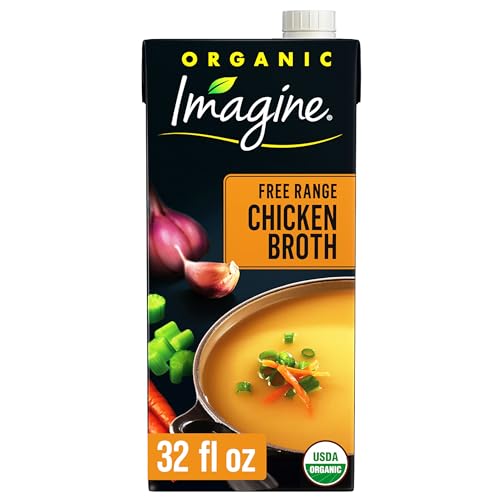
Best overall: Imagine Organic Broth, Free-Range Chicken, 32 oz
| Organic Integrity Score | 92 / 100 |
| Certifier named | USDA Certified Organic, plus Animal Welfare Certified |
| Bird raising claim | Free range, and welfare certified — the only one here |
| Sodium | Not labeled low sodium; sea salt stated as an ingredient |
| Contents | 32 fl oz shelf-stable resealable carton |
| Best for | Anyone who wants the most verifiable carton on the shelf |
It wins on the one axis this site exists to measure. Of five cartons, this is the only listing that names a certifying standard and stacks a second, independent audit on top of it. Everything else in the category either names USDA alone or names nothing at all.
The practical product behind that is a straightforward, well-made free-range chicken broth in a shelf-stable resealable carton. It is seasoned with sea salt and it tastes of chicken rather than of salt, which is a lower bar than it sounds — a great deal of broth tastes primarily of its own sodium. As a base for soup, grains, braises and gravy it does what a base should: carry flavor without deciding the seasoning for you.
Three honest limitations, and the first is the important one. This is not a low sodium product. If you came to this page because of the number in the box near the top, this is not the carton that solves it, and the Swanson below is. Second, Animal Welfare Certified does not name its scheme, so you cannot verify the tier — it is more than anyone else offers and less than full disclosure. Third, it is a broth rather than a stock, so it is light bodied and will not gel or give a pan sauce real mouthfeel.
What we liked: The only listing naming two certifications. USDA stated explicitly. Free range and welfare certified. Tastes of chicken, not salt. Shelf stable and resealable.
Keep in mind: Not low sodium. The welfare scheme is unnamed, so the tier is unverifiable. Light bodied — it will not gel.
What the listing discloses: Imagine lists USDA organic certification. The gap is where it was grown or made.
Best for sauces and body: Kitchen Basics Organic Free Range Chicken Stock, 32 oz
| Organic Integrity Score | 88 / 100 |
| Certifier named | USDA Certified Organic, stated in the listing |
| Bird raising claim | Free range, no welfare certification stated |
| Type | Stock — slow-simmered for a fuller body |
| Contents | 32 oz resealable carton |
| Best for | Pan sauces, risotto, gravy and anything needing mouthfeel |
The second of only two cartons here that names USDA Certified Organic outright, and the only one sold as a stock rather than a broth. Those two facts together are why it sits this high.
Body is the quality you cannot add at the stove. A light broth thins a pan sauce and a good stock builds it, and no amount of reduction or butter fully substitutes for the gelatin that long simmering pulls out of bones and connective tissue. If you make risotto, gravy, or any sauce you expect to coat the back of a spoon, this is the carton on this page to buy, and the price difference against ordinary broth is small enough to be irrelevant next to the difference in the finished dish.
The listing is also refreshingly plain. It describes slow simmering with organic ingredients, states the certification and the gluten-free status, and then talks about soups and gravies. There is no wellness framing and no health claim, which in this aisle counts as a virtue.
What to weigh. It is not labeled low sodium, and stocks are frequently saltier than the broths beside them, so check the panel if that is your priority. The free-range claim carries no welfare certification behind it, which is where the top pick pulls ahead. And a stock is slightly wrong for some jobs — if you are thinning a thin soup or poaching, the extra body is not doing anything for you.
What we liked: Names USDA Certified Organic explicitly. Genuine stock body for sauces. Plain, claim-free listing. Modest price for what it does.
Keep in mind: Not labeled low sodium. Free range with no welfare certification. Body is wasted on simple thinning jobs.
What the listing discloses: You are told USDA organic certification for Kitchen Basics; you are not told where it was grown or made.
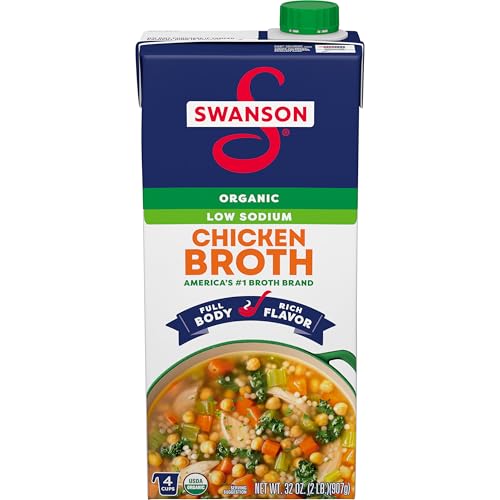
Best low sodium: Swanson Low Sodium Organic Chicken Broth, 32 oz
| Organic Integrity Score | 85 / 100 |
| Certifier named | None — the listing says organic without naming a standard |
| Bird raising claim | Farm-raised only — no free-range claim made |
| Sodium | Labeled low sodium — the FDA threshold is 140 mg per serving |
| Contents | 32 oz carton |
| Best for | Anyone for whom sodium is a medical or dietary priority |
This is the carton that solves the problem in the statistic near the top of this page, and it does so at the lowest price of any full-size option here.
Low sodium is a defined federal claim, not a marketing adjective, and it is the strongest single thing any product on this page states about itself. If someone in your household is managing blood pressure, or if you cook with broth several times a week, the difference between this and a standard 870 mg carton compounds faster than any other choice in the guide. You can salt the finished dish to taste; you cannot unsalt it.
The rest of the listing is decent and unremarkable. No preservatives and no added MSG are both true and both weaker than they read — free glutamate can still arrive through yeast extract, and broth is not a category with a preservative problem to begin with. Gluten free is a floor rather than a feature.
Two real deductions, and they are why this sits third rather than first. The listing never names a certifier, so you are relying on the regulated status of the word organic rather than on anything the brand has told you. And where the other cartons claim free range, this one says farm-raised, which is not a claim at all. It is a placeholder in the slot where the welfare information belongs, and on a page about certification integrity that costs it real points.
What we liked: Meets a defined low sodium threshold. Cheapest full-size carton here. No preservatives, gluten free. Widely stocked and easy to reorder.
Keep in mind: No certifier named. Farm-raised is not a range claim. No added MSG does not rule out yeast extract.
What the listing discloses: SWANSON S is thin on detail, and does not say whether the USDA seal applies and where it was grown or made.
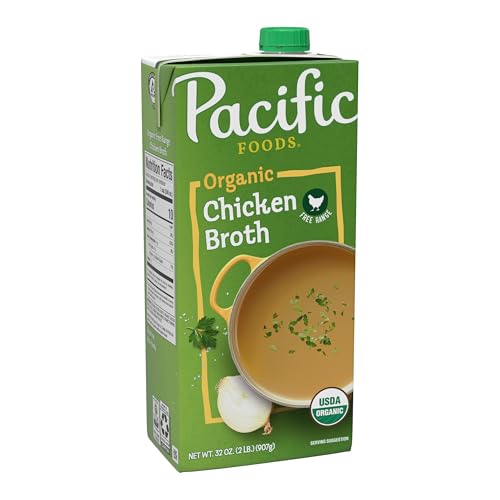
Best everyday staple: Pacific Foods Organic Chicken Broth, 32 oz
| Organic Integrity Score | 82 / 100 |
| Certifier named | None — the listing says organic without naming a standard |
| Bird raising claim | Free range, no welfare certification stated |
| Sodium | Not labeled low sodium; sea salt stated as an ingredient |
| Contents | 32 oz resealable twist-open carton |
| Best for | The default carton to keep on the shelf |
The most widely available organic broth in the category, and the one most people will already recognize. It earns its place on availability and consistency rather than on any single standout claim.
The formulation is deliberately plain: organic free range chicken, sea salt, seasonings. The twist-open resealable carton is genuinely better than the pull-tab designs it replaced, which matters more than it should when you are pouring one cup and refrigerating the rest. As a general-purpose pantry staple that will be in stock whenever you reorder, it is a sound default.
The deductions are all about what the listing does not say. There is no named certifier. There is no welfare certification behind the free-range claim. It is not labeled low sodium, and sea salt is stated as an ingredient, so if you use it as a base you are building on top of a salt load rather than starting from zero. Fat free is listed as a feature, which is true of essentially all broth and tells you nothing.
None of that makes it a poor product. It makes it an ordinary one, well distributed, in a category where two competitors chose to disclose more.
What we liked: Free range stated. Reliably in stock and easy to reorder. Good resealable carton. Short, plain formulation.
Keep in mind: No certifier named. Not low sodium. Fat free is a non-claim. Light bodied — it will not gel.
What the listing discloses: Pacific Foods is thin on detail, and does not say whether the USDA seal applies and where it was grown or made.
Best value: 365 by Whole Foods Market Organic Low Sodium Chicken Broth, 32 oz
| Organic Integrity Score | 76 / 100 |
| Certifier named | None — the listing says organic without naming a standard |
| Bird raising claim | None stated — no free-range or welfare claim at all |
| Sodium | Labeled low sodium |
| Contents | 32 fl oz resealable carton, easy-open cap |
| Best for | Cooking in volume, where price per carton decides |
By a wide margin the cheapest carton here, and it is low sodium as well, which is an unusual combination. If you make soup in quantity or cook grains in broth as a matter of routine, the arithmetic is hard to argue with.
The listing tells you it is made from slow-simmered organic chicken with carrots and onions, which is a real and specific description of a real and specific recipe. The easy-open cap is called out and, having handled a lot of these cartons, we can confirm the pull-tab designs it replaces deserve their reputation.
It scores lowest here for one reason: it says the least. No certifier is named. No free-range claim is made. Nothing at all is stated about how the birds were raised, which on a page about organic certification is the most consequential silence available. That is not evidence of a problem — the organic label is regulated and this is a Whole Foods private label with a supply chain behind it — but our scoring rewards what a seller is willing to put in writing, and this listing puts the least in writing.
Buy it as what it is: a low sodium organic broth at a price that makes the choice easy, from a listing that asks you to take more on trust than the four cartons above it.
What we liked: Lowest price on this page by a distance. Labeled low sodium. Specific about the actual recipe. Genuinely better cap design.
Keep in mind: No certifier named. No claim of any kind about how the birds were raised. Light bodied. Least disclosed listing here.
What the listing discloses: Beyond the organic claim itself, 365 by Whole Foods Market does not say whether the USDA seal applies and where it was grown or made.
Volume eating, and where broth genuinely helps
Chicken broth is one of the few products in the pantry with a straightforward, evidence-supported connection to eating less, and the mechanism has nothing to do with the chicken.
The relevant research is on energy density and preloads. Studies have repeatedly found that starting a meal with a low-calorie soup reduces total intake at that meal, typically by around 20%, even accounting for the calories in the soup. Broth-based soups do this; cream-based ones largely do not, because the effect depends on high volume for few calories.
A cup of chicken broth is around 10 to 15 calories. As a base for a vegetable soup, it converts a bowl of vegetables into a hot, savory, filling meal for very little energy, which is about as favorable a ratio as cooking offers.
Why liquid works here when it does not in a smoothie is worth understanding. The soup preload effect appears to depend on the food being eaten as soup, deliberately, with a spoon, at the start of a meal. Blended calories consumed quickly as a drink do not show the same compensation. Form and context are doing real work.
Sodium is the practical caveat, and it is why two of our five picks are low sodium cartons. Commercial broths frequently carry 800 to 1,000 mg per cup, and a bowl of soup made with two cups approaches a substantial share of a day of sensible intake. If you are using broth as a volume-eating tool several times a week, the low sodium version is not optional.
Honest summary: a genuinely useful ingredient for high-volume, low-calorie cooking with real evidence behind the soup preload effect, with sodium the thing to watch rather than calories.
Common questions about organic chicken broth
What is the difference between broth, stock and bone broth?
Traditionally broth is simmered from meat and is lighter and seasoned, stock is simmered from bones and gels when cold, and bone broth is essentially stock sold as a drink. In practice none of these terms is legally defined in a way that separates them, so manufacturers use them loosely. Judge by whether it gels and by the sodium figure rather than by the word on the carton.
Does organic have to be certified if the carton does not say USDA?
Yes. Organic is a regulated term on food packaging in the United States, so a product cannot legally be labeled organic without certification, whether or not the online listing mentions USDA. What the omission changes is what you can verify while shopping. Three of the five cartons here say organic without naming a standard, and we score that lower because our method rewards what a seller states in writing.
How much sodium is in chicken broth?
Standard chicken broth commonly carries 800 to 900 mg per cup, which is roughly a third of the usual daily guidance in a single cup of something you use as a base and then season further. Cartons labeled low sodium must meet a federal threshold of 140 mg or less per serving. If you change one thing after reading this guide, change that.
Is low sodium the same as reduced sodium?
No, and the difference is large. Low sodium is defined as 140 mg or less per serving. Reduced sodium only means 25% less than the reference product, so a reduced-sodium version of an 870 mg broth can still exceed 600 mg per cup. Look for the words low sodium specifically.
Does organic chicken broth mean no antibiotics?
Yes. Certified organic poultry cannot be given routine antibiotics, and must be fed certified organic feed with outdoor access. The antibiotic point is the most substantive thing the seal delivers here, and it matters beyond the individual bird because routine livestock antibiotic use contributes to antimicrobial resistance.
What does free range mean on a broth carton?
Less than most shoppers assume. It indicates the birds had access to the outdoors without guaranteeing how much space, for how long, or whether they used it. It is a genuine step above conventional confinement and it is not the picture the phrase paints. The organic certification alongside it is doing more work, and a welfare certification alongside that does more still.
Does no added MSG mean no glutamate?
No. It means monosodium glutamate was not added as an ingredient. Yeast extract, autolyzed yeast and hydrolyzed vegetable protein all contribute free glutamate and are all permitted under a no-added-MSG claim. This is not a safety concern, since the evidence against glutamate as a general hazard is weak, but it does mean the claim answers a narrower question than it appears to.
Should broth gel in the fridge?
If it is a stock, yes. Gelling means real gelatin extracted from bones and connective tissue, and it is the best single indicator of body. A light broth will not gel, which is not a fault but does mean it will not give sauces the same mouthfeel. Only one product on this page is sold as a stock.
How long does broth keep once opened?
About three to five days refrigerated. It freezes well, and freezing it in an ice cube tray is the simplest way to avoid waste, since most recipes that call for a splash of broth need far less than a carton. Aseptic cartons keep for months unopened.
- Organic Food and Pantry hub
- Best Organic Bone Broth
- Best Organic Collagen Peptides
- our organic food product database — compare brands across every pantry guide
Price and availability as of October 15, 2026 1:10 pm EDT. Product prices and availability are accurate as of the date/time indicated and are subject to change. Any price and availability information displayed on Amazon.com at the time of purchase will apply to the purchase of this product.
Looking for other organic products?
We have checked more than 800 products across food, household goods, gardening, personal care and pet, every one against its stated certification. Browse all reviews.
Organic Connection is reader-supported. When you buy through links on this page we may earn a commission, at no extra cost to you. As an Amazon Associate we earn from qualifying purchases. We are not paid to feature or rank any product. How we research and rate.