Last updated: September 30, 2026
We may earn a commission when you buy through links on this page, at no extra cost to you. How we research and rate.
The short version
After working through genetically modified soy, gums and emulsifiers, the isoflavone question and the fortification gap that nobody mentions, our top pick is Silk Shelf-Stable Organic Soy Milk, Unsweetened. It is made from whole organic soybeans grown by American family farms, contains nothing but soybeans and water, and has been made the same way since 1983. It earned our highest Organic Integrity Score of 90 out of 100.
There is a trade-off in this category that no carton mentions. The cleanest soy milks are usually the least nutritionally complete, and which of those matters depends entirely on what you are using it for.
Best organic soy milk compared
| Best Choice | Best Value | ||||
 |  |  |  | 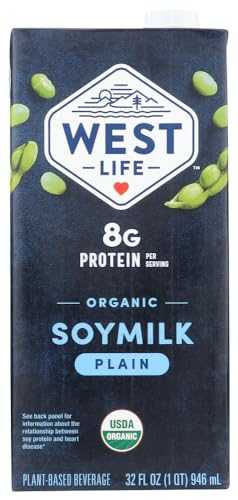 | |
| Product | Silk Shelf-Stable Organic Soy Milk | WestSoy Organic | Silk Unsweetened x6 | WestSoy Organic | WestSoy Organic Soy Milk |
| Organic Integrity Score | 90/ 100 | 89/ 100 | 86/ 100 | 85/ 100 | 81/ 100 |
| Our rating | 4.5 | 4.5 | 4.3 | 4.3 | 4.1 |
| Ingredients | — | Soybeans, water | Soybeans, water | Soybeans, water, vanilla | Soybeans, water, sweetener |
| Added sugar | — | None | None | None | Yes |
| Fortified | — | No | No | No | No |
| Best for | — | Daily drinkers, value | Purists, cooking | Flavor without sugar | Coffee, cereal, baking |
| Certification | Non-GMO, Vegan, Organic | Gluten-free, Organic | Non-GMO Project Verified, Certified Organic, Vegan | — | — |
| Contents | Whole organic soybeans and filtered water, 32 oz x 6, shelf stable | Organic soybeans and filtered water, 32 oz x 12, shelf stable | — | Organic soybeans, water and vanilla, unsweetened, 32 oz | Organic soy milk, original sweetened, 32 oz x 2 |
| Price | $35.95$0.19 / fluid ounce View on Amazon | Currently unavailable See buying options | $15.79$0.08 / fluid ounce View on Amazon | Currently unavailable See buying options | Currently unavailable See buying options |
Scores are ours, based on independent research of ingredient integrity, sourcing, processing, added sugar, fortification and value, using the same 10-criteria method we apply to every product.
The organic soy milk certifications, and the question each one leaves open
The labels on these products are not interchangeable, and several of them cover things that have nothing to do with each other. Here is what each one actually buys you.
| Certification | Covers | Key exclusion |
| USDA Organic | Farming and handling: no synthetic pesticides or fertilizers, no GMOs, no sewage sludge or irradiation, audited yearly by an accredited certifier | Three different tiers share the one seal, and it makes no claim about worker pay, food miles, or nutrition |
| Non-GMO Project | Testing and supply-chain traceability showing the ingredients are not genetically engineered | Sets no limit on synthetic pesticides or fertilizers, so it is not an organic claim |
| Kosher | Ingredients and production comply with Jewish dietary law, verified by a rabbinic agency that inspects the facility | A dietary-law standard: it makes no claim about pesticides, GMOs or farming practice |
Non-GMO and organic are not two grades of the same thing. The butterfly certifies an absence of genetic engineering and stops there; the USDA seal prohibits genetic engineering as one clause among many, alongside synthetic pesticides, synthetic fertilizers, sewage sludge and irradiation. That makes organic the broader claim by some distance. Where both appear together, the butterfly is adding batch testing on top of a standard that had already banned GMOs.
Why organic matters more in soy than almost anywhere else
If you buy one thing organic on a limited budget, soy has a stronger claim than most.
The overwhelming majority of soybeans grown in the United States are genetically modified, and the dominant trait is herbicide tolerance — the plant is engineered to survive being sprayed with glyphosate, so weeds can be controlled after the crop is up. That is the entire agronomic point of the technology, and it means conventional soy is grown in a system built around repeated herbicide application.
Organic certification prohibits genetically modified seed outright and prohibits glyphosate. So in soy, the organic seal is not a marginal upgrade or a matter of taste. It changes the crop, the seed and the spray program together. In categories like spices or salt the seal delivers relatively little; here it delivers about as much as it is capable of delivering anywhere.
It is worth being clear about what this does not settle. Whether glyphosate residues at dietary levels harm people is a genuinely contested scientific question, and we have written about what the evidence does and does not show rather than pretending it is settled either way. The point here is narrower: if avoiding GM crops and herbicide-tolerant systems is something you care about, soy is where that choice has the most leverage.
The ingredient list is the whole review
Plant milks are one of the few grocery categories where reading the ingredients tells you almost everything.
Soy milk in its traditional form is soybeans and water. That is the entire recipe, and two of the products in this guide contain exactly that. Most commercial plant milk contains considerably more: sunflower or canola oil for richness, gellan gum or locust bean gum to keep it from separating, calcium carbonate, added vitamins, salt, and frequently sugar under one of its many names.
Not all of that is objectionable. Gums are used in tiny quantities and are broadly regarded as safe; carrageenan, which drew the most criticism, has largely been removed from these products anyway, and the evidence against it at dietary levels was never as strong as the campaigning suggested. Oil and gums exist because they make plant milk behave more like dairy, which is a legitimate thing to want.
But there is a genuine difference between a drink that is beans and water and a drink that is beans, water, oil, gum, sugar and a vitamin premix. The first is a food; the second is a formulation. Both have their place. You should just know which one you are buying, and the ingredient list is where that is decided.
Soy milk is the only plant milk that competes on protein
This is the strongest practical argument for choosing soy over the alternatives, and it is not close.
A cup of soy milk carries roughly 7 to 9 grams of protein, which puts it within reach of dairy milk’s 8 grams. Almond milk typically contains around 1 gram. Oat milk sits around 2 to 3, and rice milk lower still. If you are using plant milk as a genuine substitute rather than a coffee whitener, this difference matters more than any other nutritional line on the carton.
Soy protein is also a complete protein, containing all the essential amino acids in usable proportions, which is unusual among plant sources. For anyone eating little or no animal protein, soy milk is doing real work in a way almond milk simply is not. We cover the alternatives in our organic oat milk guide, but on protein alone soy wins clearly.
The isoflavone question, answered honestly
Soy attracts more anxiety than any other food in this aisle, so it deserves a direct answer rather than reassurance.
Soybeans contain isoflavones, plant compounds that can bind weakly to estrogen receptors. This is the origin of the concern that soy might disrupt hormones, feminize men, or affect breast cancer risk. The concern is not manufactured from nothing — the mechanism is real.
What the human evidence shows is considerably less dramatic than the mechanism suggests. Isoflavones bind preferentially to a different receptor subtype than the body’s own estrogen and produce much weaker effects. Reviews of human studies have not found that dietary soy intake reduces testosterone or feminizes men, and the widely circulated cases involved extraordinary intakes far beyond anything a carton of soy milk represents. For breast cancer, the observational evidence in populations with lifelong soy consumption points, if anything, in a protective direction rather than a harmful one, and major cancer organizations do not advise avoiding it.
Two real caveats remain. Much of the alarming early work was done in rodents, which metabolize isoflavones very differently from people, so those findings do not transfer. And soy is a genuine allergen — one of the major ones — which is a straightforward reason for some people to avoid it that has nothing to do with hormones. If you have thyroid disease and take levothyroxine, separate soy from your medication by a few hours, since it can interfere with absorption. Beyond that, ordinary dietary soy is not the risk it is often presented as.
Key things to look for in organic soy milk
1. How short the ingredient list is
Soybeans and water is the benchmark. Anything beyond that should be there for a reason you actually want, whether that is fortification, sweetness or texture.
2. Unsweetened, and check what unsweetened means
Plain soy milk is often not unsweetened. Look for zero added sugars on the panel rather than words like original or plain on the front, which have no fixed meaning.
3. Whether it is fortified, and whether you need it to be
The minimalist brands are not fortified. That is fine if soy milk supplements your diet, and a real gap if it replaces dairy, particularly for children or anyone relying on it for calcium.
4. Whole beans versus soy protein isolate
Milk made by grinding whole soybeans is a different product from milk reconstituted from isolated soy protein. The whole bean versions taste beanier and carry more of the original food.
5. Shelf stable or refrigerated
Aseptic cartons keep unopened for months and are far more practical to buy in bulk online. Refrigerated cartons taste slightly fresher and are harder to ship sensibly.
Who should buy organic soy milk
Buy it if you want a plant milk that genuinely replaces dairy protein, since no other common option comes close. Buy organic specifically, because soy is where the seal does the most work of any crop in your kitchen. Buy the two-ingredient versions if you want food rather than formulation, and if your diet covers calcium and vitamin D elsewhere.
Buy a fortified version instead if soy milk is doing the job dairy used to do, especially for a child, since calcium, vitamin D and B12 are not optional. Avoid soy entirely if you are allergic, and keep it away from thyroid medication by a few hours if you take it. Do not avoid it because of the hormone claims, which the human evidence does not support.
How to choose organic soy milk
Start by deciding whether this is a replacement or an addition. If it is replacing dairy in a meaningful way, prioritize fortification over ingredient minimalism, because a short ingredient list is no comfort if you are short on calcium. If it is going in coffee, on cereal or into cooking, buy the plainest one you can find and enjoy the fact that it is just beans and water.
Then check added sugars on the nutrition panel rather than trusting the front of the carton, pick shelf-stable cartons if you are buying in bulk online, and expect unsweetened soy milk to separate. Shake it properly, and give it a taste before deciding you dislike it in coffee, because plain soy behaves differently from the barista formulations most people have tried.
Best overall: Silk Shelf-Stable Organic Soy Milk Organic Soymilk, 32 oz (Pack of 6)
| Organic Integrity Score | 90 / 100 |
| Contents | Whole organic soybeans and filtered water, 32 oz x 6, shelf stable |
| Certification | Non-GMO, Vegan, Organic |
| Best for | Committing to the best soy milk without a case of twelve |
Six cartons is the sensible middle ground: our top pick at a better price per ounce, without the cupboard commitment of a full case. For a household that drinks soy milk several times a week rather than daily, this is the right quantity.
Everything that earned Edensoy the top score applies unchanged — whole American-grown organic soybeans, water, nothing else — and the aseptic cartons keep for months unopened, so there is no rush.
The pack-size economics are the only real consideration. It costs more per ounce than the twelve-pack and less than buying singles, which is exactly what you would expect. And it is still unfortified, so the calcium point stands.
What we liked: Our top pick at better value. Sensible quantity for most households. Long unopened shelf life.
Keep in mind: Still not fortified. More expensive per ounce than a full case. Beany flavor is not for everyone.
What the listing discloses: Beyond the organic claim itself, the listing does not say whether the USDA seal applies and where it was grown or made.
Best value: WestSoy Organic Unsweetened Soymilk, 32 oz (Pack of 12)
| Organic Integrity Score | 89 / 100 |
| Contents | Organic soybeans and filtered water, 32 oz x 12, shelf stable |
| Certification | Gluten-free, Organic |
| Best for | Households drinking soy milk daily |
WestSoy’s unsweetened line is the other genuinely minimalist option, and buying it by the case is the cheapest way to drink two-ingredient organic soy milk regularly. Shelf-stable aseptic cartons make a twelve-pack practical in a way refrigerated cartons never are: they live in a cupboard until opened.
Slightly milder and thinner than Edensoy, which many people prefer, particularly in tea and coffee where the fuller Eden flavor can dominate. Same essential honesty of formulation, with no added sugar, oil or gums.
The caveats are storage and, again, fortification. Twelve quart cartons take real cupboard space, and once opened each needs refrigerating and using within about a week — so this is only good value if soy milk is a genuine habit. It is also unfortified.
What we liked: Two-ingredient formulation at the best price per ounce here. Shelf-stable cartons store easily. Milder flavor works better in hot drinks.
Keep in mind: Not fortified. Twelve cartons needs cupboard space. Wasteful unless soy milk is a regular habit.
What the listing discloses: Sparse documentation from Westbrae Natural — nothing on whether the USDA seal applies and where it was grown or made.
Reliable unsweetened carton: Silk Shelf-Stable Organic Soy Milk, Unsweetened, 32 oz x 6
| Organic Integrity Score | 86 / 100 |
| Size | 32 fl oz x 6, shelf stable |
| Certification | Non-GMO Project Verified, Certified Organic, Vegan |
| Sweetening | Unsweetened |
| Best for | A reliable unsweetened carton that keeps in the cupboard |
Soy is one of the most heavily genetically engineered crops grown in North America, which makes organic certification do unusually concrete work here — it prohibits engineered seed outright. This carton carries both certified organic and Non-GMO Project Verified, the second being belt-and-braces on an organic product but pointed at the right issue in this particular crop.
Unsweetened is the important word on a soy milk carton. Sweetened versions can carry a surprising amount of added sugar, and unsweetened is the version that works in coffee and cooking without changing the dish.
Shelf stable matters practically: these keep in a cupboard until opened, so a six-pack does not need fridge space until you start it.
The listing itself is thin — a single bullet describing serving occasions rather than the product — and no certifying agency is named.
What we liked: Certified organic and Non-GMO Project Verified together, genuinely unsweetened, and shelf stable in a six-pack.
Keep in mind: One bullet, no certifier named, and no ingredient or nutrition detail at all.
What the listing discloses: Silk documents Non-GMO Project Verified, and leaves whether the USDA seal applies and where it was grown or made unsaid.
Best flavored: WestSoy Organic Unsweetened Vanilla Soymilk, 32 oz
| Organic Integrity Score | 85 / 100 |
| Contents | Organic soybeans, water and vanilla, unsweetened, 32 oz |
| Certification | — |
| Best for | Making plain soy milk more approachable without sugar |
This is a genuinely clever product and an underrated one. Vanilla makes soy milk taste sweeter without any sugar being present, because aroma strongly influences perceived sweetness. If you find unsweetened soy milk austere but do not want the sugar of a sweetened version, this closes most of the gap for free.
It works particularly well on cereal and in smoothies, where the vanilla reads as a flavor rather than an oddity, and it is a useful bridge for someone moving off sweetened plant milks who does not want to jump straight to plain.
Vanilla is not neutral, though, and that limits it. In savory cooking it is wrong, and in coffee it is a matter of taste that plenty of people get wrong once and regret. Buy the plain version for anything where you do not want to taste vanilla. Not fortified, like the rest of the range.
What we liked: Tastes sweeter with no added sugar at all. Excellent transition product off sweetened plant milks. Same clean organic base.
Keep in mind: Useless in savory cooking. Divisive in coffee. Not fortified.
What the listing discloses: Westsoy is thin on detail, and does not say whether the USDA seal applies and where it was grown or made.
Best for coffee and baking: WestSoy Organic Soy Milk Original, 32 oz (Pack of 2)
| Organic Integrity Score | 81 / 100 |
| Contents | Organic soy milk, original sweetened, 32 oz x 2 |
| Certification | — |
| Best for | Coffee, cereal and baking where a little sweetness helps |
The original sweetened version exists because a lot of people genuinely prefer it, and pretending otherwise would be dishonest. In coffee it behaves more like the plant milks most people are used to, on cereal it needs nothing added, and in baking the slight sweetness is usually welcome rather than a problem.
It is still certified organic soy from the same producer, so the GM and herbicide argument that opens this guide applies in full. The two-carton pack is a sensible trial quantity.
It scores lowest here for one reason: it contains added sugar, and this guide is built around the view that soy milk does not need any. That is a preference rather than a fault, and if a small amount of sugar is the difference between drinking it and not, that is a reasonable trade. Just buy it knowingly rather than because the carton says original.
What we liked: Familiar, approachable taste in coffee and on cereal. Certified organic soy. Sensible two-carton quantity.
Keep in mind: Contains added sugar, unlike everything else here. Not fortified either. Original does not mean unsweetened.
What the listing discloses: Sparse documentation from this listing — nothing on whether the USDA seal applies and where it was grown or made.
The protein milk, and the phytoestrogen question
Soy milk is nutritionally the closest plant milk to dairy, and it carries one recurring question that deserves a direct answer.
On composition it is the strongest of the plant milks for this purpose. A cup of unsweetened soy milk supplies around 80 calories with 7 to 8 grams of complete protein, against roughly 3 for oat and 1 for almond. Protein is the most satiating macronutrient, so soy is the plant milk most likely to contribute to fullness rather than simply to liquid volume.
That makes it the sensible default if you are reducing dairy but want the nutritional contribution milk was making, particularly for anyone with a protein target.
The phytoestrogen concern comes up constantly and the evidence does not support it. Soy isoflavones are structurally similar to estrogen and bind weakly to estrogen receptors, which is the basis of the worry. Human research, including meta-analyses of hormone levels in men, has not found meaningful effects on testosterone or estrogen at ordinary dietary intakes. Large reviews of breast cancer outcomes have generally found soy consumption neutral or modestly favorable rather than harmful.
On weight specifically there is no special mechanism. Soy milk is a food with a good protein-to-calorie ratio, and that is the whole of its advantage.
As with every milk in this aisle, sweetened and vanilla versions add 5 to 10 grams of sugar a cup, which undoes a fair share of the benefit. Unsweetened is the version that does what the nutritional argument claims.
Honest summary: the highest-protein plant milk and the best like-for-like dairy substitute, with the hormonal concern unsupported at dietary intakes, and unsweetened the only version worth buying for these reasons.
Common questions about organic soy milk
Is organic soy milk worth it compared with regular?
In soy, more than almost any other crop. The great majority of American soybeans are genetically modified for herbicide tolerance, so conventional soy is grown in a system built around glyphosate application. Organic certification prohibits both the modified seed and the herbicide, which makes the seal do more work here than in categories where it changes relatively little.
Does soy milk affect hormones in men?
Human studies do not support this. Soy isoflavones bind weakly and preferentially to a different estrogen receptor subtype than the body’s own estrogen, and reviews of human trials have not found that dietary soy reduces testosterone or feminizes men. The alarming early findings came largely from rodents, which metabolize isoflavones very differently, and the widely shared case reports involved extreme intakes far beyond normal consumption.
Why is my soy milk separating?
Because it contains no gums or emulsifiers. Products made only from soybeans and water will settle, which is a sign of a short ingredient list rather than a fault. Shake the carton before pouring. Milks that never separate contain gellan gum or something similar to prevent it.
Is unfortified soy milk a problem?
It depends entirely on what it is replacing. As an addition to a varied diet it is fine. If it is genuinely standing in for dairy — particularly for a child, or for anyone relying on it for calcium — the absence of added calcium, vitamin D and B12 is a real gap that must be covered from elsewhere. The cleanest ingredient list and the most complete nutrition are not the same product.
How much protein is in soy milk?
Around 7 to 9 grams per cup, which is close to dairy milk’s 8 grams and far ahead of every other common plant milk. Almond milk carries about 1 gram and oat milk about 2 to 3. Soy protein is also complete, containing all essential amino acids, which is unusual among plant sources.
Can I have soy milk with thyroid medication?
Separate them by a few hours. Soy can interfere with the absorption of levothyroxine, so taking them together may reduce how much medication you absorb. This is a timing issue rather than a reason to avoid soy, and it is worth raising with whoever manages your prescription.
Is carrageenan still in soy milk?
Mostly not. It was widely removed after sustained consumer pressure, and none of the products in this guide contain it. It is worth noting that the evidence against it at dietary levels was weaker than the campaign against it implied, drawing heavily on cell and animal studies using a degraded form not used in food.
Does soy milk work in coffee?
It can, but plain soy milk sometimes curdles in hot acidic coffee. Warming it slightly first, and pouring coffee into the milk rather than the reverse, both help considerably. Barista formulations avoid this with added stabilizers, which is the trade-off: they behave better and have longer ingredient lists.
- Organic Food and Pantry hub
- Best Organic Oat Milk
- Organic milk versus regular milk
- browse all our reviewed products — scores and certifications for 800+ products
Price and availability as of October 15, 2026 1:10 pm EDT. Product prices and availability are accurate as of the date/time indicated and are subject to change. Any price and availability information displayed on Amazon.com at the time of purchase will apply to the purchase of this product.
Looking for other organic products?
We have checked more than 800 products across food, household goods, gardening, personal care and pet, every one against its stated certification. Browse all reviews.
Organic Connection is reader-supported. When you buy through links on this page we may earn a commission, at no extra cost to you. As an Amazon Associate we earn from qualifying purchases. We are not paid to feature or rank any product. How we research and rate.