Last updated: September 30, 2026
We may earn a commission when you buy through links on this page, at no extra cost to you. How we research and rate.
The short version
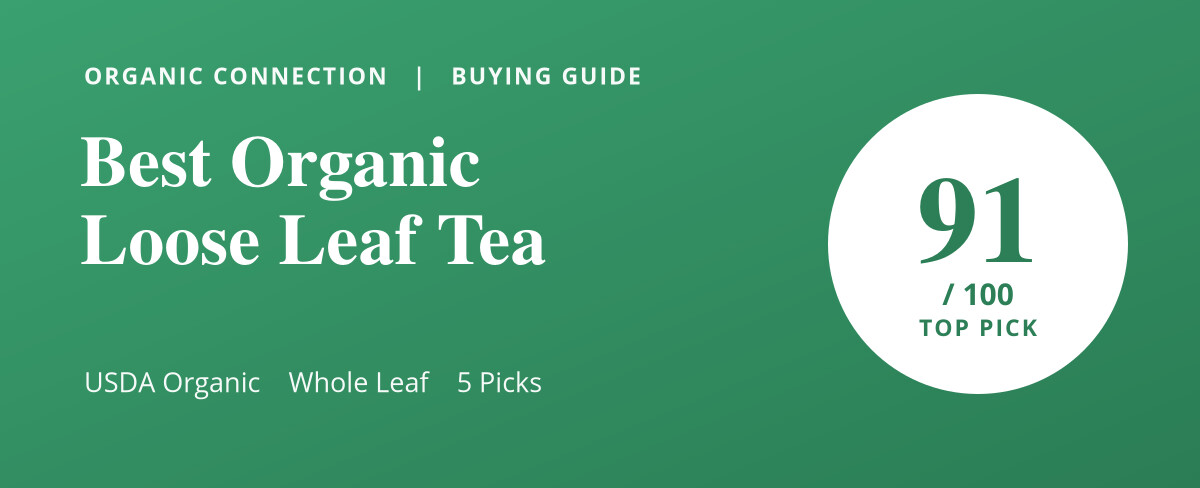
Reading what each listing will actually stand behind, our top pick is Davidson's Organics Loose Leaf Tea. Its listing names USDA Certified Organic, which earned it our highest Organic Integrity Score of 94 out of 100. Rishi Tea Organic English Breakfast is our pick for also considered, and Rishi Tea Organic Jasmine Green for floral.
Loose leaf tea is generally higher quality than bagged tea, because it uses whole leaves rather than the broken “dust and fannings” in many tea bags, and it avoids the microplastics some bags shed. We flag each pick’s type and certification.
Best organic loose leaf tea compared
| Best Choice | Best Value | ||||
 |  |  |  |  | |
| Product | Davidson’s Organics | Rishi English Breakfast | Rishi Jasmine Green | Numi Golden Chai | Numi Gunpowder Green |
| Organic Integrity Score | 94/ 100 | 90/ 100 | 87/ 100 | 85/ 100 | 81/ 100 |
| Our rating | 4.7 | 4.5 | 4.4 | 4.3 | 4.1 |
| Best for | Best overall | Everyday organic tea | Floral / jasmine | Chai | Green tea |
| Type | Black / many types | Black | Scented green | Spiced black chai | Green |
| Certification | USDA Organic, Non-GMO | USDA Organic, Non-GMO, Gluten-free | USDA Organic, Non-GMO, Kosher | Fair Trade, Certified Organic | — |
| Price | $19.12 $27.21 −30%$1.20 / ounce View on Amazon | $50.00$3.13 / ounce View on Amazon | $58.00$3.63 / fluid ounce View on Amazon | Currently unavailable See buying options | $43.74$2.73 / ounce View on Amazon |
Price and availability as of October 11, 2026 7:10 pm EDT. Product prices and availability are accurate as of the date/time indicated and are subject to change. Any price and availability information displayed on Amazon.com at the time of purchase will apply to the purchase of this product.
Scores are ours, based on independent research of certification, sourcing, leaf quality, and value, using the same 10-criteria method we apply to every product. See how we research and rate.
What each certification on an organic loose leaf tea label actually covers
Most shoppers read a certification as a general signal of quality. Every one of them is narrower than that, and the gaps between them are where the marketing lives.
| Certification | Covers | Key exclusion |
| USDA Organic | Farming and handling: no synthetic pesticides or fertilizers, no GMOs, no sewage sludge or irradiation, audited yearly by an accredited certifier | Three different tiers share the one seal, and it makes no claim about worker pay, food miles, or nutrition |
| Kosher | Ingredients and production comply with Jewish dietary law, verified by a rabbinic agency that inspects the facility | A dietary-law standard: it makes no claim about pesticides, GMOs or farming practice |
Kosher and organic answer entirely different questions. A kosher mark, OU, OK, Star-K and others, confirms that ingredients and production follow Jewish dietary law, verified by an agency that inspects the facility. It is a rigorous supply-chain audit and it says nothing about pesticides, GMOs or farming. The two seals appear together often precisely because neither substitutes for the other.
Key things to look for in organic loose leaf tea
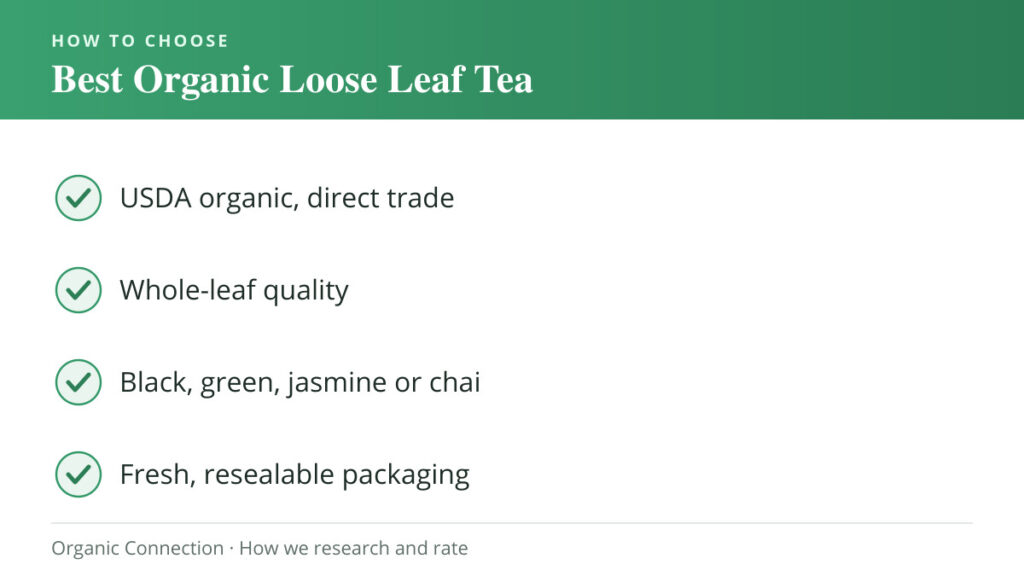
Good organic loose leaf tea is about leaf quality and clean sourcing. Here is what matters.
1. USDA organic and clean sourcing
Organic certification confirms no synthetic pesticides, and the best brands add direct-trade or transparent sourcing relationships with growers.
2. Whole-leaf quality
Full, unbroken leaves brew a smoother, more flavorful cup and can be steeped more than once, unlike the broken leaf in cheap bags.
3. The type you enjoy
Black for bold and everyday, green for fresh and grassy, jasmine and other scented teas for aroma, and chai for spice.
4. Freshness and packaging
Tea fades with light and air, so resealable pouches or tins and a brand that turns over stock keep the leaves fresh.
Is organic loose leaf tea worth it?
Tea is one of the more sprayed crops, and you drink it daily and never wash the leaves, so organic certification is a genuinely worthwhile choice for a cup you enjoy every morning. Loose leaf adds a quality upgrade on top: whole leaves brew a fuller, smoother flavor, can be re-steeped, and skip the tea bag, avoiding the microplastics that some sealed bags shed when steeped in hot water. A little loose tea and a simple infuser or teapot is all it takes.
Our scoring rewards genuine organic certification, clean and direct-trade sourcing, whole-leaf quality, and value, so you get tea that is both certified organic and genuinely better in the cup, not just a premium label.
Brewing green tea for catechins, not bitterness
How you brew green tea changes both how it tastes and how much of the compounds you are drinking it for actually end up in the cup. The variables are simple and most people get at least one wrong.
| Variable | What to do | Why |
| Water temperature | 175 to 185°F (80 to 85°C) | Hotter water rapidly releases astringent compounds and can degrade catechins |
| Steep time | 3 to 5 minutes | EGCG extraction rises up to around 5 minutes, then bitterness outpaces any gain |
| Water quality | Filtered or low-mineral water | Calcium and magnesium in hard water inhibit catechin release; soft water can roughly double EGCG extracted |
| Leaf format | Loose leaf over bags | Studies find loose leaf yields more catechins; some bags deliver around half |
The water hardness finding is the underrated one. If you live in a hard water area and brew with straight tap water, you may be extracting substantially less EGCG than someone using filtered water with identical leaf. That is a bigger variable than most brand choices, and a water filter is cheaper than upgrading your tea.
Boiling water is the most common mistake. Green tea is not black tea. Water straight off a rolling boil scalds the leaf, producing immediate bitterness and astringency, and it is why people who dislike green tea often dislike it for a reason that is entirely fixable. Let the kettle stand for two or three minutes after boiling before pouring.
On leaving catechins behind. Steeped tea discards the leaf, and with it a meaningful share of its catechins, commonly estimated at 30% to 60%. This is the structural reason matcha delivers more EGCG per gram: you consume the whole powdered leaf rather than an infusion of it. It is also why matcha carries more of anything else the leaf absorbed, which cuts both ways.
Re-steeping. Good loose leaf green tea takes two or three infusions, and the second is often the best. Catechin content falls with each steep, so if you are drinking it for EGCG rather than pleasure, the first infusion is the one that counts.
How to choose an organic loose leaf tea
- Look for USDA organic and direct trade. Clean growing plus transparent grower relationships signal quality.
- Favor whole-leaf tea. Full leaves brew smoother and can be re-steeped.
- Pick the type you drink. Black, green, jasmine, chai, choose for your taste and time of day.
- Check freshness and packaging. Resealable pouches or tins keep leaves fresh; buy sizes you will finish.
- Get a simple infuser. A basket infuser or teapot makes loose leaf as easy as a bag.
Who should buy organic loose leaf tea
Taste settles this one. For organic black loose leaf, our top pick is where to begin. If you want a vibrant green, a fragrant jasmine, a spiced chai, or the best everyday value, we have a pick for each.
Best overall: Davidson’s Organics Loose Leaf Tea
| Organic Integrity Score | 94 / 100 |
| Type | Black (and many other varieties) |
| Certification | USDA Organic, Non-GMO |
| Best for | Everyday value in bulk |
Davidson’s is our top pick. As the first purveyor of fine organic teas (since 1976) and a vertically integrated grower and blender, it offers USDA-organic loose leaf in generous 16-ounce bulk bags at a low cost per cup, across a huge range of types from English Breakfast to herbal blends, ideal if you drink a lot of tea.
It takes first place on documentation: its listing names USDA Certified Organic, where most of this category asks to be taken on trust.
What we liked: USDA organic, a huge range of types, generous bulk bags, and a low cost per cup from a pioneering organic-tea grower.
Keep in mind: It is an affordable everyday tea rather than a premium single-origin, so connoisseurs may want a specialist lot.
What the listing discloses: Davidson’s commits to USDA organic certification but stops short of where it was grown or made.
Everyday organic tea: Rishi Tea Organic English Breakfast
| Organic Integrity Score | 90 / 100 |
| Type | Full-leaf black tea |
| Certification | USDA Organic, Non-GMO, Gluten-free |
| Best for | An all-around everyday organic tea |
Rishi remains a sound option because it combines premium leaf quality with genuinely clean, transparent sourcing. This USDA-organic, full-leaf English Breakfast is a robust, malty black tea, and Rishi is known for its direct-trade relationships, traveling to origin each season to work with growers, plus organic and non-GMO certification, giving a smooth, bold everyday cup you can re-steep.
The trade-off is that premium loose leaf costs more than supermarket bags. For a genuinely organic, high-quality everyday tea from a trusted specialist, it does the job well, and Rishi offers many other varieties too.
What we liked: USDA organic, full-leaf quality, direct-trade sourcing, a bold malty flavor, and a large re-steepable pouch.
Keep in mind: It is priced as a premium loose leaf, and you will want an infuser or teapot to brew it.
What the listing discloses: Rishi Tea states a USDA organic claim, and does not say where it was grown or made.
Best floral: Rishi Tea Organic Jasmine Green
| Organic Integrity Score | 87 / 100 |
| Type | Jasmine-scented green tea |
| Certification | USDA Organic, Non-GMO, Kosher |
| Best for | A fragrant, floral green cup |
Rishi Jasmine Green is our pick for a floral cup. This USDA-organic green tea is traditionally scented with real jasmine blossoms for a delicate floral aroma and smooth, lightly sweet taste, full-leaf and re-steepable, an elegant, calming everyday tea from the same trusted direct-trade specialist as our top pick.
It scores in the middle only because it is a scented specialty rather than a plain everyday base, but for fragrant jasmine tea done right, organically, it is excellent.
What we liked: USDA organic, real jasmine-blossom scenting, a smooth floral flavor, full-leaf quality, and trusted sourcing.
Keep in mind: The jasmine aroma is a distinctive flavor profile, so it is more of a special cup than a plain daily base for some.
What the listing discloses: Rishi Tea documents USDA organic certification and kosher certification, and leaves where it was grown or made unsaid.
Best chai: Numi Organic Golden Chai
| Organic Integrity Score | 85 / 100 |
| Type | Spiced black chai |
| Certification | Fair Trade, Certified Organic |
| Best for | A rich, spiced chai latte |
Numi Golden Chai is our pick for chai. It blends organic Assam black tea with real organic cinnamon, cardamom, and ginger for a rich, warming, spicy cup that makes an excellent chai latte with steamed milk, USDA organic and Fair Trade, with around 200 cups per pound.
It scores in the value range because it is a flavored spice blend rather than a pure single tea, but for an authentic, organic spiced chai, it delivers.
What we liked: USDA organic and Fair Trade, real whole spices, a rich warming flavor, and great value per cup.
Keep in mind: It is a spiced blend, so it is a specific flavor rather than a plain black tea, and it shines most as a latte.
What the listing discloses: Numi lists Fair Trade. The gap is whether the USDA seal applies and where it was grown or made.
Best green: Numi Gunpowder Green Tea
| Organic Integrity Score | 81 / 100 |
| Type | Green tea (rolled gunpowder) |
| Certification | — |
| Best for | A fresh, vibrant green cup |
Numi is our pick for green tea. Its organic Gunpowder Green is made from whole leaves hand-rolled into pellets that unfurl as they steep, giving a vibrant, grassy, slightly smoky cup, and it is USDA organic and Fair Trade from a brand built on real fruits, flowers, and spices with no artificial anything. A pound brews around 200 cups.
For a fresh, authentic organic green loose leaf at great value per cup, it is a standout.
What we liked: USDA organic and Fair Trade, hand-rolled whole leaves, a vibrant grassy flavor, and around 200 cups per pound.
Keep in mind: Green tea is best brewed with cooler, not boiling, water to avoid bitterness.
What the listing discloses: Numi lists a single-ingredient formula. The gap is whether the USDA seal applies and where it was grown or made.
How to brew loose leaf tea
Use about one teaspoon of loose leaf per cup in a basket infuser, teapot, or strainer. Match the water temperature to the tea: near-boiling (around 200 to 212°F) for black and chai, cooler (around 160 to 180°F) for green and jasmine to avoid bitterness. Steep black tea 3 to 5 minutes and green tea 2 to 3 minutes, adjusting to taste. Good loose leaf can be re-steeped a second or third time. Store tea in an airtight, opaque container away from light, heat, and moisture, and use it within a few months for the best flavor.
Loose leaf versus bags: the honest comparison
Loose leaf is usually framed as the premium option, which makes people assume it is the expensive one. On cost per cup it is frequently the opposite.
| Loose leaf | Tea bags | |
| Leaf grade | Whole leaf and tips | Fannings and dust — the small fragments left after grading |
| Room to expand | Full, if the vessel allows | Constrained by the bag |
| Re-steeps | 2–3 infusions typical | One, weakly |
| Cost per cup | Often lower, once re-steeps count | Higher than it looks per box |
| Packaging | No bag material at all | May contain plastic — see below |
| Convenience | Needs an infuser and 30 seconds more | Unbeatable |
The arithmetic: a 100 g pouch at 2.5 g per cup gives 40 cups, and if you re-steep once — which good whole leaf easily supports — that is 80 cups. Against a box of 40 bags at a comparable price, loose leaf comes out ahead on both cost and quality. The real cost of loose leaf is thirty seconds and a rinsed infuser, not money.
Keep in mind: there is also a materials question. Many “silken” pyramid teabags are nylon or PET, and a 2019 McGill University study published in Environmental Science & Technology found that steeping a single plastic teabag at 95°C releases roughly 11.6 billion microplastic and 3.1 billion nanoplastic particles into one cup. The health effects are not established — genuinely unknown rather than known to be safe. Many paper bags are also heat-sealed with polypropylene, which is why an ordinary teabag will not fully compost. Loose leaf removes the question entirely, and it is one thing the organic seal does not cover: certification governs the leaf, not the bag it is packed in.
Brewing equipment, and why the tea ball is the wrong tool
Whole leaf needs to unfurl. Cramming it into a small perforated ball prevents exactly that, which is why loose leaf brewed in a tea ball often tastes weaker than the bag it replaced — and then people conclude loose leaf is not worth it.
| Vessel | Verdict |
| Large basket infuser | The default recommendation. Fine mesh, wide enough for full expansion, fits most mugs and pots. |
| Teapot with built-in strainer | Excellent, provided the strainer occupies most of the pot rather than a small cylinder |
| Gaiwan | Traditional Chinese lidded bowl. Best control, ideal for short repeated infusions of good leaf. |
| Grandpa style (leaf loose in the mug) | Genuinely works for green and white tea. Top up with hot water; the leaf settles. |
| French press | Workable, though the plunger crushes leaf and the tea keeps brewing. Decant it. |
| Tea ball / squeeze tongs | Avoid. No room to expand, and the mesh is usually too coarse for small leaf. |
| Disposable paper filter bags | A reasonable compromise for the office. Fill loosely, not tightly. |
Brewing parameters for every tea type
This is the one reference table worth keeping. The most common error across all of them is boiling water on delicate leaf.
| Type | Water | Time | Leaf per 250 ml | Re-steeps |
| White | 75–85°C | 2–4 min | 2–3 g | 2–3 |
| Green (Japanese) | 70–80°C | 60–90 sec | 3 g | 2–3 |
| Green (Chinese) | 75–85°C | 2–3 min | 2–3 g | 2 |
| Oolong (light) | 85–90°C | 2–3 min | 3–4 g | 4–6 |
| Oolong (dark/roasted) | 90–95°C | 3 min | 3–4 g | 4–6 |
| Black | 95–100°C | 3–5 min | 2–3 g | 1–2 |
| Pu-erh | Full boil | Rinse, then 20–30 sec | 4–5 g | 6+ |
| Herbal / rooibos | Full boil | 5–7 min | 2–3 g | 1 |
- Add 15–30 seconds per subsequent steep. The second infusion of a good oolong is frequently the best one.
- Rinse pu-erh and compressed teas — a five-second pour-off of the first water removes dust and wakes the leaf. Discard it.
- Cover the vessel while steeping. Aromatics leave with the steam.
- Filtered water makes an audible difference in loose leaf, more than in bagged tea, because you are tasting the leaf rather than the tannin hit of dust.
How to judge quality before you brew
- Look at the dry leaf. Whole, intact leaves with visible shape are what you are paying for. A pouch that looks like coarse dust is bagged tea sold loose.
- Smell it dry. It should be distinctly aromatic. Faint or cardboard-like means old stock.
- Inspect the wet leaf after brewing — this is the professional’s tell. Good tea opens into recognizable whole leaves, often with the bud attached. Poor tea stays as fragments.
- Color uniformity matters more than any particular shade. Wildly mixed leaf suggests blending of different grades.
- Stalks are not automatically bad — kukicha is made deliberately from stems — but unintended stalk in a leaf grade indicates careless sorting.
- Be skeptical of heavy flavoring. Strong artificial-smelling scent in the pouch often masks mediocre base leaf. Real jasmine is scented with blossom; real Earl Grey uses bergamot oil.
Storage, by type
- Airtight, opaque, cool, dry and odor-free applies to everything. Tea absorbs neighboring smells faster than almost anything in a kitchen, so keep it away from coffee and spices.
- Green and white tea: 6–12 months. Unoxidized, so they keep oxidizing in the packet. Buy small quantities often.
- Oolong: 1–2 years, with roasted oolongs keeping longer than green ones.
- Black tea: about 2 years, fading rather than spoiling.
- Pu-erh is the exception — it is meant to age, and wants some airflow and stable humidity rather than an airtight seal. Do not vacuum-pack it.
- Matcha: refrigerate sealed, use within 1–2 months of opening. Jade turning olive means oxidation.
- Never store tea in the fridge or freezer unless it is sealed and unopened, and always bring it to room temperature before opening — condensation ruins leaf.
- Nitrogen-flushed or vacuum-sealed packaging is a genuine quality signal for green tea specifically.
How we researched this guide
We are a research-based review site. We compared each tea against its certification, sourcing and direct-trade transparency, leaf quality, and the weight of aggregated customer feedback on flavor, then scored each with our 10-criteria Organic Integrity Score. No brand paid to be included or ranked. Read the full method on our How We Research and Rate page.
Why loose leaf changes the dose, if not the conclusion
Loose leaf versus bagged is mostly a quality and flavor question, and it has one genuine implication for anything the tea’s compounds might do.
Tea bags typically contain fannings and dust, the small broken particles left after grading whole leaf. Smaller particles have more surface area, so they infuse faster, which is why bagged tea brews quickly and strongly. But the smaller grades are also lower quality leaf, and they release tannins fast, which is why bagged tea turns bitter if left too long.
Whole leaf infuses more slowly and more completely, and it can be steeped multiple times. Analytical comparisons generally find whole leaf tea yields a higher and better-sustained concentration of catechins and other polyphenols across a proper infusion than a quickly dunked bag, though a strongly brewed bag can close much of the gap.
What this does not change is the conclusion. Even a well-brewed cup of high-quality loose leaf green tea delivers a fraction of the EGCG used in the trials that produced the modest weight findings. Better leaf means a better cup and somewhat more of the active compounds; it does not move brewed tea into the dose range the research used.
Where loose leaf genuinely matters for anything weight-adjacent is behavioral. A tea you enjoy enough to brew properly is a tea you will drink instead of something sweetened, and that substitution is the mechanism that actually works.
Honest summary: a real improvement in extraction and quality, a marginal increase in active compounds, and no change to the underlying position that brewed tea is a good drink rather than an intervention.
Common questions about organic loose leaf tea
What is the best organic loose leaf tea?
Our overall pick is Davidson’s Organics Loose Leaf Tea, which scores highest here at 94, because its listing names USDA organic certification. For green tea, Numi Gunpowder Green is our pick, and for a floral cup, Rishi Jasmine Green.
Is loose leaf tea better than tea bags?
Generally yes. Loose leaf uses whole leaves that brew a fuller, smoother flavor and can be re-steeped, while many tea bags contain broken leaf. Loose leaf also skips the bag, avoiding the microplastics some plastic or heat-sealed bags can release into hot water.
Why choose organic tea?
Tea is one of the more sprayed crops and the leaves are never washed before brewing, so USDA-organic certification, which confirms no synthetic pesticides were used, is a worthwhile choice for a drink you have daily.
How do I brew loose leaf tea without a special teapot?
A simple basket or ball infuser in a mug works fine: add about a teaspoon of leaves, pour hot water at the right temperature, steep, then remove the infuser. You can also steep in a mug and pour through a small strainer.
Can I re-steep loose leaf tea?
Yes. Quality whole-leaf teas can usually be steeped two or three times, with each infusion revealing slightly different flavors, which also improves the value per cup compared with a single-use tea bag.
Is loose leaf tea cheaper than tea bags?
Usually, once re-steeps are counted. A 100 g pouch at 2.5 g per cup gives 40 cups, and good whole leaf easily supports a second infusion, which makes 80. Against a box of 40 bags at a similar price, loose leaf wins on both cost and quality. The real cost is thirty seconds and a rinsed infuser, not money.
Why does my loose leaf tea taste weak?
Most often the infuser. Whole leaf needs room to unfurl, and a small perforated tea ball prevents exactly that — which is why loose leaf brewed in one often tastes weaker than the bag it replaced. Use a large basket infuser, a teapot with a full-width strainer, or simply put the leaf loose in the mug. Under-dosing is the other cause: 2 to 3 g per 250 ml is the working amount.
Do tea bags contain plastic?
Many do. Pyramid “silken” bags are usually nylon or PET, and a 2019 McGill University study found that steeping one at 95°C releases roughly 11.6 billion microplastic and 3.1 billion nanoplastic particles into a single cup. The health effects are not established. Many paper bags are also heat-sealed with polypropylene, which is why they do not fully compost. Loose leaf avoids the question, and it is something the organic seal does not cover — certification governs the leaf, not the bag.
What temperature should each tea be brewed at?
White 75 to 85°C, Japanese green 70 to 80°C, Chinese green 75 to 85°C, light oolong 85 to 90°C, roasted oolong 90 to 95°C, black 95 to 100°C, pu-erh at a full boil after a brief rinse, and herbal infusions at a full boil for 5 to 7 minutes. The most common mistake across all of them is boiling water on delicate leaf, which extracts bitterness rather than flavor.
How many times can you re-steep loose leaf tea?
Oolong and pu-erh give the most — four to six for oolong and six or more for pu-erh. Green and white teas give two or three, black tea one or two, and herbal infusions generally one. Add 15 to 30 seconds per subsequent steep. The second infusion of a good oolong is frequently better than the first.
Should you rinse tea before brewing?
For pu-erh and compressed teas, yes — a five-second pour-off removes dust and opens the compressed leaf. Discard that water. For loose green, black and oolong it is unnecessary, and rinsing green tea to reduce caffeine does not work; you lose flavor and only a fraction of the caffeine.
How can you tell if loose leaf tea is good quality?
Look at the wet leaf after brewing — the professional’s tell. Good tea opens into recognizable whole leaves, often with the bud attached, while poor tea stays as fragments. Dry leaf should be visibly intact and distinctly aromatic; faint or cardboard-like smell means old stock. Be skeptical of heavy artificial scent in the pouch, which often masks mediocre base leaf.
How long does loose leaf tea keep?
Green and white 6 to 12 months, oolong 1 to 2 years, black about 2 years, all airtight, opaque and away from odors. Pu-erh is the exception — it is meant to age and wants stable humidity and some airflow rather than a vacuum seal. Matcha should be refrigerated sealed and used within 1 to 2 months of opening. Never open cold tea before it reaches room temperature, or condensation will ruin it.
- Organic Food and Pantry hub
- Best Organic Green Tea
- Best Organic Matcha
- How we research and rate products
- our organic food product database — compare brands across every pantry guide
- Best Stainless Steel Tea Kettles
- Organic coffee and tea, explained
Price and availability as of October 11, 2026 7:10 pm EDT. Product prices and availability are accurate as of the date/time indicated and are subject to change. Any price and availability information displayed on Amazon.com at the time of purchase will apply to the purchase of this product.
Looking for other organic products?
We have checked more than 800 products across food, household goods, gardening, personal care and pet, every one against its stated certification. Browse all reviews.
Organic Connection is reader-supported. When you buy through links on this page we may earn a commission, at no extra cost to you. As an Amazon Associate we earn from qualifying purchases. We are not paid to feature or rank any product. How we research and rate.