Last updated: September 30, 2026
We may earn a commission when you buy through links on this page, at no extra cost to you. How we research and rate.
The short version
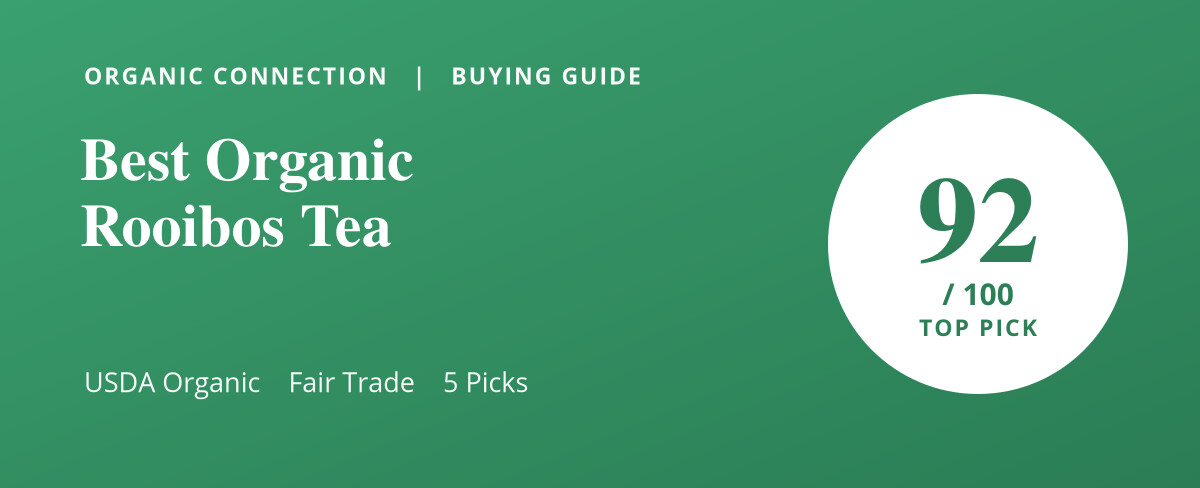
After researching the certifications, sourcing, and grade of the most popular organic rooibos teas, our top pick is Numi Organic Rooibos. It is USDA certified organic and Fair Trade sourced from the same small-scale South African growers Numi has worked with since 1999, in microplastic-free bags, which is why it earned our highest Organic Integrity Score of 92 out of 100. For the best value, Davidson’s Organics South African Rooibos is our pick, and for loose leaf, Rooibos Rocks 16 oz is the best choice.
Rooibos is the easiest herbal tea to drink and one of the easiest to buy badly, because the difference between graded long-cut leaf and the dust swept off the sorting floor is enormous. We flag each product’s certification, format, and cut.
Best organic rooibos tea compared
| Best Choice | Best Value | ||||
 |  |  |  |  | |
| Product | Numi Rooibos 54 ct | Cederberg 30 ct | Davidson’s 100 ct | Rooibos Rocks 16 oz | Rishi Blueberry Rooibos |
| Organic Integrity Score | 92/ 100 | 90/ 100 | 89/ 100 | 87/ 100 | 81/ 100 |
| Our rating | 4.6 | 4.5 | 4.5 | 4.4 | 4.1 |
| Format | Tea bags | Tea bags | Tea bags | Loose leaf | Loose leaf |
| Best for | Best overall | Trying it first | Best value | Best loose leaf | Best flavored |
| Certification | USDA Organic | USDA Organic, Non-GMO | USDA Organic, Fair Trade | Certified Organic, Non-GMO | USDA Organic, Non-GMO, Kosher |
| Ingredients | Organic rooibos | — | Organic rooibos | Organic red rooibos, loose leaf | Organic rooibos with blueberry and botanicals |
| Price | $18.09 $21.99 −18%$0.34 / count View on Amazon | $9.99$0.33 / count View on Amazon | $15.76$0.16 / count View on Amazon | $17.99$1.12 / ounce View on Amazon | Currently unavailable See buying options |
Price and availability as of October 15, 2026 1:10 pm EDT. Product prices and availability are accurate as of the date/time indicated and are subject to change. Any price and availability information displayed on Amazon.com at the time of purchase will apply to the purchase of this product.
Scores are ours, based on independent research of certification, Fair Trade sourcing, leaf grade, packaging materials, format, and value, using the same 10-criteria method we apply to every product. See how we research and rate.
The certification map for organic rooibos tea, and what each one actually excludes
A seal is a specific promise about a specific thing. These are the promises behind the marks on this page, in plain terms, along with the question each one leaves unanswered.
| Certification | Covers | Key exclusion |
| USDA Organic | Farming and handling: no synthetic pesticides or fertilizers, no GMOs, no sewage sludge or irradiation, audited yearly by an accredited certifier | Three different tiers share the one seal, and it makes no claim about worker pay, food miles, or nutrition |
| Kosher | Ingredients and production comply with Jewish dietary law, verified by a rabbinic agency that inspects the facility | A dietary-law standard: it makes no claim about pesticides, GMOs or farming practice |
Kosher and organic answer entirely different questions. A kosher mark, OU, OK, Star-K and others, confirms that ingredients and production follow Jewish dietary law, verified by an agency that inspects the facility. It is a rigorous supply-chain audit and it says nothing about pesticides, GMOs or farming. The two seals appear together often precisely because neither substitutes for the other.
Key things to look for in organic rooibos tea
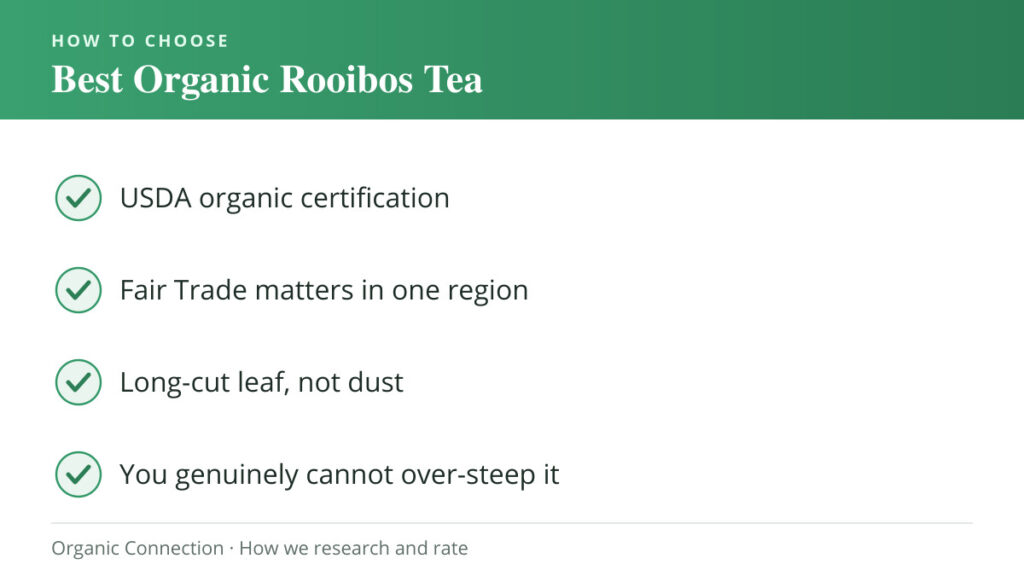
Great rooibos comes down to certification, cut, oxidation, and packaging. Here is what matters.
1. USDA organic certification
You steep the leaf and drink it without rinsing, so pesticide certification matters more here than on a washed food crop.
2. Fair Trade sourcing
Rooibos comes from one region with a long history of labor inequity. Fair Trade certification is unusually meaningful here.
3. Long-cut leaf, not dust
Good rooibos is visibly needle-like, deep red-brown, and aromatic. Fine dark powder is the low grade left after sorting.
4. Plastic-free bags
Many tea bags are heat-sealed with polypropylene. Unbleached paper or microplastic-free bags avoid steeping plastic in near-boiling water.
Red versus green rooibos, and what the health claims are worth
Rooibos is marketed on antioxidants, and the picture is more interesting and more modest than the packaging suggests.
Red versus green. Standard red rooibos is oxidized after cutting, which develops the sweet, woody, vanilla-ish flavor most people know. Green rooibos is the same plant dried without oxidation, which keeps it grassy and much lighter in flavor, closer to a green tea. Green rooibos is significantly higher in aspalathin, the flagship antioxidant, because oxidation degrades it. It is also more expensive and harder to find, and most people prefer the taste of the red.
The antioxidant claims. Rooibos genuinely contains aspalathin and nothofagin, two flavonoids found in almost no other plant, and laboratory work on them is legitimately interesting. Human trials have found that drinking rooibos does raise circulating antioxidant levels, with an important caveat that rarely makes it into marketing: the increases are small and wear off quickly. Systematic reviews covering the last two decades conclude there are potential benefits, particularly around cardiometabolic markers, alongside limited studies and mixed results, and that the evidence is not yet sufficient to support the claims definitively.
Blood sugar, the more interesting thread. Aspalathin has been shown to suppress the vascular inflammation that follows high blood glucose, and one human crossover study found that drinking a rooibos beverage alongside a standardized fatty meal lowered blood glucose at both two and six hours after eating. Most of the stronger work here uses green rooibos or concentrated aspalathin-rich extracts rather than ordinary red rooibos tea, and much of it is in animal models, so treat this as a promising research direction rather than a reason to buy.
The iron finding worth knowing. A frequent concern with any tea is that tannins impair iron absorption. A 2013 study specifically tested this and found that drinking six cups of rooibos daily for six weeks did not negatively affect participants’ iron status. That is a genuinely useful result: it means rooibos is a reasonable everyday drink for people managing low iron, unlike strong black tea.
The honest summary is that rooibos is a pleasant, naturally caffeine-free, very low-tannin drink with some promising early research behind it, and it is not a functional medicine.
Where it genuinely wins. The practical advantage that is real and often overlooked is that rooibos is naturally caffeine-free rather than decaffeinated. No chemical or water process has been applied to strip caffeine out, because there was never any there, which matters if you are avoiding caffeine in pregnancy, in the evening, or entirely. Its very low tannin content is the other: it will not turn bitter however long you leave it, which makes it close to impossible to brew badly.
One caution. There are isolated case reports of liver enzyme elevation associated with very heavy rooibos consumption, and it may have mild estrogenic activity in laboratory settings. At normal drinking levels this is not a practical concern, but it is worth mentioning to your doctor if you drink very large quantities or have liver disease. Nothing here is medical advice.
How to choose organic rooibos tea
- Confirm USDA organic, and prefer Fair Trade given the region’s labor history.
- Look for long-cut leaf rather than fine dark dust, especially when buying loose.
- Decide red or green on flavor: red is sweet and woody, green is grassy and higher in aspalathin.
- Check the bags are plastic-free, or buy loose and use a stainless infuser.
- Buy pure rooibos first, then try flavored blends once you know you like the base.
Who should buy organic rooibos tea
The right rooibos depends on how you drink it. If you want the best-sourced everyday bagged tea, our top pick fits. If you want the best price per cup, loose leaf for a pot, a smaller box to try, or a flavored blend, we have a pick for each.
Best overall: Numi Organic Rooibos, 54 Tea Bags
| Organic Integrity Score | 92 / 100 |
| Ingredients | Organic rooibos |
| Certification | USDA Organic |
| Best for | An everyday caffeine-free cup with traceable sourcing |
Numi is our top pick because of the depth of its sourcing relationship. The company has bought from the same small-scale organic rooibos farmers in South Africa since 1999, which is a genuinely unusual continuity in a category where most brands buy from brokers on price. The tea is USDA organic and Fair Trade, the bags are microplastic-free, and the leaf grade is visibly good: long, needle-like, deep red-brown. In the cup it is sweet, woody, and faintly vanilla, with none of the dusty flatness of supermarket rooibos.
The trade-off is price. Numi sits above most rooibos on a per-bag basis, and the 54-count box is a mid-size rather than a bulk buy. The flavor is also on the gentle side; if you want a robust, almost malty rooibos, a longer steep or a loose-leaf option will suit you better.
What we liked: USDA organic and Fair Trade with a two-decade grower relationship, microplastic-free bags, and visibly good long-cut leaf.
Keep in mind: Priced above most rooibos, and the flavor is gentle rather than robust.
What the listing discloses: You are told USDA organic certification, a B Corp certification and a single-ingredient formula for Numi; you are not told where it was grown or made.
Best plastic-free bags: Cederberg Tea Company Organic Rooibos, 30 Tea Bags
| Organic Integrity Score | 90 / 100 |
| Size | 30 tea bags |
| Fill weight | 2.5 grams per bag, published |
| Origin | Farms in the Western Cape, South Africa |
| Leaf | Top fine-cut rooibos needles, no stems |
| Bags | Plastic-free, PLA, fully compostable |
| Best for | Anyone who wants the bag itself accounted for |
The only rooibos here that publishes a fill weight, and it is the number that decides how strong your cup is. 2.5 grams per bag is a full-strength fill; plenty of supermarket teabags carry closer to 1.5 g, and no other listing on this page tells you either way.
The leaf grade is stated too: top fine-cut rooibos needles with no stems. Stem content is the usual way cheap rooibos is padded, so excluding it is a genuine quality claim rather than a decorative one.
Origin is named properly. Rooibos grows in one place on earth, the Western Cape of South Africa, and this brand takes its name from the Cederberg mountains where it is cultivated.
Then the packaging, which nobody else addresses. The bags are plastic-free, made from PLA and fully compostable. Most teabags contain polypropylene to seal them, so a compostable bag is a real difference, and the listing goes further with a 70 percent packaging waste reduction and a facility on hydro-electric power.
What we liked: A published fill weight, no stems, the growing region named, and genuinely plastic-free compostable bags.
Keep in mind: Only 30 bags per pouch, so the price per cup is higher than the big boxes here. “Rich in antioxidants” is unquantified.
What the listing discloses: Cederberg Tea Company lists a USDA organic claim. The gap is where it was grown or made.
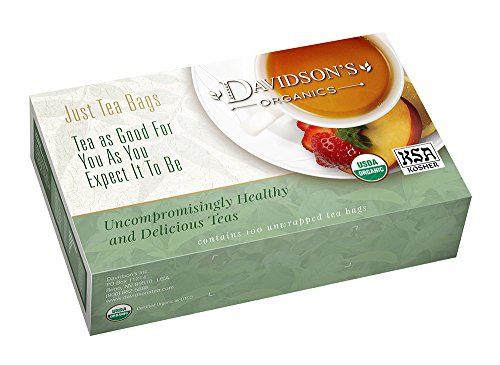
Best value: Davidson’s Organics South African Rooibos, 100 Tea Bags
| Organic Integrity Score | 89 / 100 |
| Ingredients | Organic rooibos |
| Certification | USDA Organic, Fair Trade |
| Best for | Households drinking rooibos daily |
A hundred unwrapped bags at a price that makes rooibos an everyday drink rather than an occasional one. Davidson’s is a third-generation organic tea company that grows, imports, blends, and packs its own product, which is unusual vertical integration in a broker-dominated category. The rooibos is USDA organic, sourced from the Cape Province, and has the proper sweet woody character. Leaving the bags unwrapped also cuts a lot of packaging waste compared with individually enveloped teas.
The trade-off is that unwrapped bags in a single box lose aroma faster once opened, because there is nothing protecting each bag from air. Davidson’s also does not carry Fair Trade certification here, so you have less assurance on labor conditions than with our top pick. Decant into an airtight tin if you are not going to get through them quickly.
What we liked: USDA organic from a vertically integrated grower, excellent price per cup, and far less packaging waste.
Keep in mind: Unwrapped bags lose aroma once opened, and no Fair Trade certification.
What the listing discloses: Davidson’s states USDA organic certification and Fair Trade, and does not say where it was grown or made.
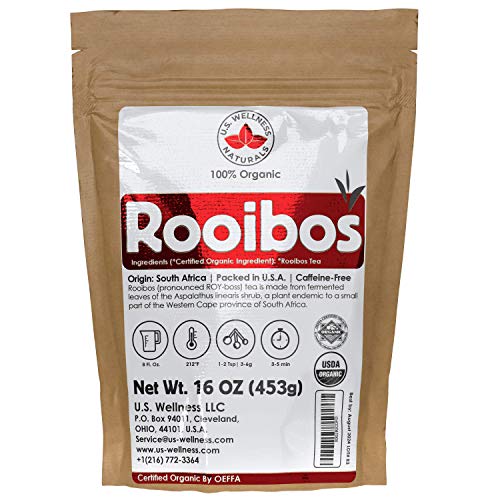
Best loose leaf: Rooibos Rocks Organic Rooibos, 16 oz
| Organic Integrity Score | 87 / 100 |
| Ingredients | Organic red rooibos, loose leaf |
| Certification | Certified Organic, Non-GMO |
| Best for | Pots, iced tea, and home blending |
A pound of loose South African red rooibos, grown without synthetic pesticides and USDA certified, working out to over two hundred cups. Loose leaf is where rooibos genuinely improves: you can see the grade you are getting, the long needles have room to expand, and you control the strength precisely. It is also the format for making rooibos by the pot, for iced rooibos in summer, and for blending your own with vanilla, cinnamon, or orange peel.
The trade-off is that you need an infuser or a strainer, and rooibos needles are fine enough to slip through a coarse mesh, leaving sediment in the cup. A pound is also a lot to work through before the aroma starts to fade, though rooibos holds up better over time than most herbal teas because it is already oxidized.
What we liked: Visibly good long-cut leaf, USDA organic, outstanding value per cup, and full control over strength.
Keep in mind: Needs a fine infuser, and a pound is a large commitment for occasional drinkers.
What the listing discloses: U.S. Wellness Naturals documents USDA organic certification, and leaves where it was grown or made unsaid.
Best flavored: Rishi Tea Organic Blueberry Rooibos, 16 oz
| Organic Integrity Score | 81 / 100 |
| Ingredients | Organic rooibos with blueberry and botanicals |
| Certification | USDA Organic, Non-GMO, Kosher |
| Best for | Iced tea and people who find plain rooibos dull |
Rooibos takes flavoring unusually well, because its natural sweetness and total lack of bitterness give fruit something to sit on rather than fight against. Rishi is a serious organic tea company with strong direct sourcing, and this blueberry rooibos is genuinely well balanced rather than the artificial candy-sweetness that afflicts most flavored herbals. It is exceptional iced, and it is the blend to reach for if plain rooibos leaves you cold.
It scores lowest here because our scoring rewards single-ingredient purity, and this is a blend. Flavored teas also make it harder to judge the quality of the underlying rooibos, since fruit notes cover a multitude of sins in the base leaf. Buy plain rooibos first to learn what good base tea tastes like, then come to this.
What we liked: A genuinely well-balanced organic blend from a serious tea company, and outstanding served iced.
Keep in mind: It is a blend rather than pure rooibos, and flavoring masks the quality of the base leaf.
What the listing discloses: Rishi Tea documents USDA organic certification and kosher certification, and leaves where it was grown or made unsaid.
How to brew rooibos, and why you cannot get it wrong
Rooibos is the most forgiving tea there is. It is very low in tannins, so it does not develop the bitterness that punishes an over-steeped black or green tea. That means you can use water at a full rolling boil and leave it as long as you like: five minutes for a standard cup, ten or more for something deeper and more full-bodied, and it will simply get stronger rather than harsher. If you have ever forgotten a mug of tea and come back to something undrinkable, rooibos is the answer to that problem.
Use a heaped teaspoon per cup if you are brewing loose, in an infuser with room for the needles to expand. Rooibos takes milk well, which most herbal teas do not, and a rooibos latte made with steamed milk and a little honey is genuinely good and completely caffeine-free. It also pairs naturally with vanilla, cinnamon, cardamom, orange peel, and ginger, which is why so many chai-style blends use it as a base.
Iced rooibos is underrated. Brew it double strength, cool it, and serve over ice with lemon and a little honey; because there is no tannin, it will not go cloudy in the fridge the way iced black tea does. Store loose leaf and opened boxes airtight, cool, and dark. Rooibos keeps its character longer than most herbal teas because it is already oxidized, but aroma still fades, so aim to use it within a year.
How we researched this guide
We are a research-based review site. We compared each product against its certification (USDA organic and, where present, Fair Trade and kosher), sourcing transparency and grower relationships, leaf grade and cut, packaging materials including tea bag composition, format, and the weight of aggregated customer feedback on aroma and flavor, then scored each with our 10-criteria Organic Integrity Score. No brand paid to be included or ranked. Nothing here is medical advice. Read the full method on our How We Research and Rate page.
Caffeine-free, aspalathin, and where the evidence sits
Rooibos is worth covering because its main practical advantage is one it does not usually advertise, and its research is at an early stage.
The advantage is simple: rooibos is naturally caffeine-free. That removes the entire caffeine-and-thermogenesis argument that applies to green, black and oolong teas, and it makes rooibos a genuine evening option and suitable for people who cannot tolerate caffeine at all.
The research interest centers on aspalathin, a flavonoid that occurs in appreciable quantities essentially only in rooibos. Laboratory and animal studies have examined aspalathin in relation to glucose uptake and fat cell formation, with some promising results in cell culture and rodent models.
Human evidence on rooibos and body weight is close to absent. There is some small-scale human work on lipid profiles and oxidative stress markers, with mixed results. Nothing supports a weight claim, and the gap between a rodent given a concentrated extract and a person drinking a cup of tea is the same gap that recurs throughout this category.
Green rooibos, the unfermented version, contains substantially more aspalathin than the familiar red variety, since fermentation degrades it. If the compound is what interests you, that distinction matters more than anything else on the packet.
Where rooibos earns its place is as a naturally sweet, caffeine-free, essentially calorie-free drink that many people find satisfying without sugar. Replacing an evening sweetened drink with it is a real change.
Honest summary: no human weight evidence, an interesting compound at an early research stage, and a genuinely useful caffeine-free option where the practical benefit is substitution.
Common questions about organic rooibos tea
What is the best organic rooibos tea?
Our overall pick is Numi Organic Rooibos, because it is USDA certified organic and Fair Trade, sourced from the same small-scale South African growers since 1999, and packed in microplastic-free bags with visibly good long-cut leaf. For the best value, Davidson’s Organics South African Rooibos is our pick, and for loose leaf, Rooibos Rocks.
Is rooibos tea really caffeine-free?
Yes, and naturally so. Rooibos contains no caffeine at any point, unlike decaffeinated black or green tea, which has caffeine removed through a process and usually retains a small residual amount. That makes rooibos a genuine option for evenings, for pregnancy, and for anyone avoiding caffeine entirely.
What is the difference between red and green rooibos?
They are the same plant processed differently. Red rooibos is oxidized after cutting, which develops the sweet, woody, vanilla-like flavor most people know. Green rooibos is dried without oxidation, so it stays grassy and lighter, closer to green tea, and retains significantly more aspalathin, its flagship antioxidant. Green is rarer and more expensive.
Can you over-steep rooibos?
Not really, which is one of its best features. Rooibos is very low in tannins, so unlike black or green tea it does not turn bitter or astringent when left too long. A longer steep simply produces a stronger, deeper cup. You can use fully boiling water and leave it ten minutes without spoiling it.
Does rooibos affect iron absorption?
Much less than regular tea. The tannins in black and green tea bind iron and can meaningfully reduce absorption from a meal, which is why people with low iron are often told to drink tea between meals. Rooibos is very low in tannins, so it is a considerably better choice if iron status matters to you.
- Organic Food & Pantry hub
- Best Organic Loose Leaf Tea
- Best Organic Black Tea
- Organic Coffee and Tea: A Cleaner Daily Cup
- Organic Product Database — search every product we have reviewed, by certification
Price and availability as of October 15, 2026 1:10 pm EDT. Product prices and availability are accurate as of the date/time indicated and are subject to change. Any price and availability information displayed on Amazon.com at the time of purchase will apply to the purchase of this product.
Looking for other organic products?
We have checked more than 800 products across food, household goods, gardening, personal care and pet, every one against its stated certification. Browse all reviews.
Organic Connection is reader-supported. When you buy through links on this page we may earn a commission, at no extra cost to you. As an Amazon Associate we earn from qualifying purchases. We are not paid to feature or rank any product. This page is informational and is not medical advice. How we research and rate.