Last updated: September 30, 2026
We may earn a commission when you buy through links on this page, at no extra cost to you. How we research and rate.
The short version
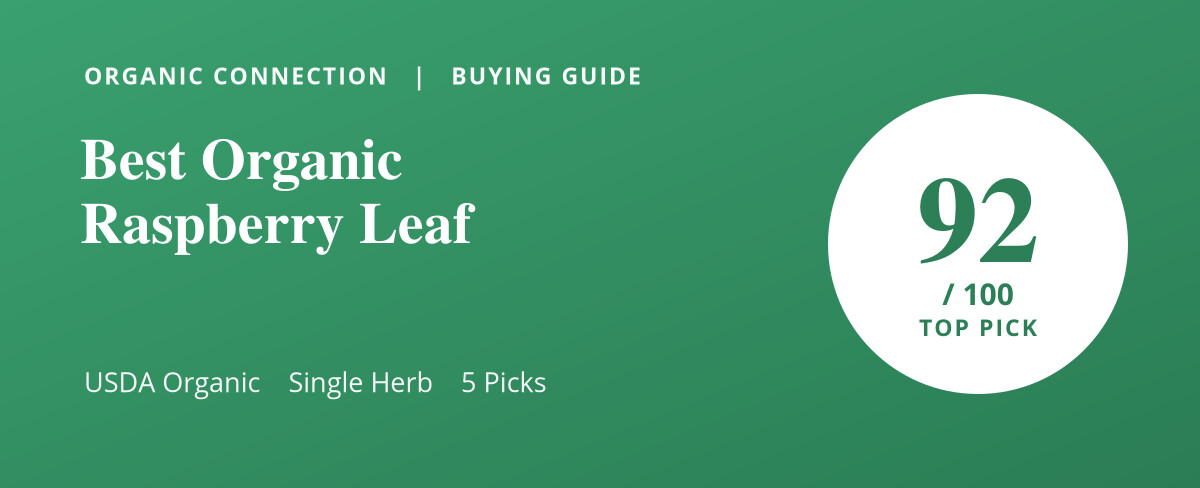
After researching the certifications, sourcing, and formulation of the most popular organic raspberry leaf teas, our top pick is Traditional Medicinals Organic Raspberry Leaf Tea. It is USDA certified organic and Non-GMO Project Verified, made from a single ingredient with pharmacopoeial-grade herb sourcing, which is why it earned our highest Organic Integrity Score of 92 out of 100. For a pregnancy-focused brand, Earth Mama Organic Red Raspberry Leaf Tea is our pick, and for the best value, the Traditional Medicinals 96-bag pack is the best choice.
Raspberry leaf tea is most often bought for pregnancy or menstrual support, and both uses come with real caveats we cover below. We flag each product’s certification and format.
Best organic raspberry leaf tea compared
| Best Choice | Best Value | ||||
 |  |  |  | ||
| Product | Traditional Medicinals 16 ct | Earth Mama 16 ct | Traditional Medicinals 96 ct | Earth Mama 48 ct | Earth Mama 96 ct |
| Organic Integrity Score | 92/ 100 | 89/ 100 | 86/ 100 | 82/ 100 | 78/ 100 |
| Our rating | 4.6 | 4.5 | 4.3 | 4.1 | 3.9 |
| Best for | Best overall | Pregnancy-focused brand | Best value | Mid-size supply | Largest supply |
| Certification | USDA Organic, Non-GMO Project Verified, Kosher, caffeine-free | USDA Organic, Non-GMO Project Verified, Oregon Tilth | Certified Organic, Non-GMO, Kosher | USDA Organic, Non-GMO Project Verified, Oregon Tilth | USDA Organic, Non-GMO Project Verified, Oregon Tilth |
| Price | View on Amazon | Currently unavailable See buying options | $37.90$6.32 / count View on Amazon | $18.84$0.39 / count View on Amazon | $37.68$0.39 / count View on Amazon |
Price and availability as of October 11, 2026 7:10 pm EDT. Product prices and availability are accurate as of the date/time indicated and are subject to change. Any price and availability information displayed on Amazon.com at the time of purchase will apply to the purchase of this product.
Scores are ours, based on independent research of certification, ingredient purity, herb sourcing and testing, packaging, and value, using the same 10-criteria method we apply to every product. See how we research and rate.
Reading the seals on organic raspberry leaf tea: what each one does and does not cover
A seal is a specific promise about a specific thing. These are the promises behind the marks on this page, in plain terms, along with the question each one leaves unanswered.
| Certification | Covers | Key exclusion |
| USDA Organic | Farming and handling: no synthetic pesticides or fertilizers, no GMOs, no sewage sludge or irradiation, audited yearly by an accredited certifier | Three different tiers share the one seal, and it makes no claim about worker pay, food miles, or nutrition |
| Non-GMO Project | Testing and supply-chain traceability showing the ingredients are not genetically engineered | Sets no limit on synthetic pesticides or fertilizers, so it is not an organic claim |
| Kosher | Ingredients and production comply with Jewish dietary law, verified by a rabbinic agency that inspects the facility | A dietary-law standard: it makes no claim about pesticides, GMOs or farming practice |
The mark most often mistaken for an organic claim is Non-GMO Project Verified. It is a real standard with real testing, and it verifies exactly one thing: that the ingredients are not genetically engineered. It sets no limit on synthetic pesticides, synthetic fertilizers, or anything else about how the crop was grown. USDA Organic already prohibits GMOs outright, so on a certified organic product the butterfly adds independent verification rather than a new promise. On a product carrying only the butterfly, the pesticide question has not been asked.
Key things to look for in organic raspberry leaf tea
Great raspberry leaf tea is about certification, purity, herb quality, and packaging. Here is what matters.
1. USDA organic certification
You steep the leaf directly and drink it, so pesticide certification matters more here than on a washed food crop.
2. One ingredient
The list should read organic red raspberry leaf and nothing else. Blends dilute the herb with cheaper filler botanicals.
3. Verified herb quality
Brands that test to pharmacopoeial standards, or that publish sourcing, give you far more assurance than a generic private label.
4. Unbleached, plastic-free bags
Many tea bags contain polypropylene to heat-seal them. Unbleached paper or compostable bags avoid steeping plastic in near-boiling water.
What the evidence actually says
Because most people arrive at this tea for a specific reason, it is worth being straight about the state of the evidence rather than repeating marketing copy.
For late pregnancy and labor. Raspberry leaf has centuries of traditional use as a uterine tonic, typically started around 32 to 34 weeks and built up gradually. The clinical research is thin: a small number of studies have suggested a possible reduction in the length of the second stage of labor and in the use of forceps, but the trials are small, older, and not consistently replicated, and systematic reviews conclude the evidence is insufficient to make a firm recommendation. It is not advised in the first or second trimester, because of its traditional reputation for stimulating uterine activity. Anyone considering it should talk to their midwife or obstetrician first, particularly with a history of preterm labor, a planned caesarean, bleeding in pregnancy, or a multiple pregnancy.
For menstrual cramps. The traditional use is long-standing and many people report it helps, but controlled evidence is limited here too. It is a pleasant, caffeine-free, low-risk drink for most non-pregnant adults, and if it helps you, that is a reasonable basis to keep drinking it.
General cautions. Raspberry leaf is high in tannins, which can interfere with iron absorption if you drink large amounts with meals, a relevant point in pregnancy when iron status often matters. It may also affect blood sugar, so people managing diabetes should be careful. Nothing on this page is medical advice, and this is a category where asking a clinician genuinely matters more than reading a buying guide.
How to choose organic raspberry leaf tea
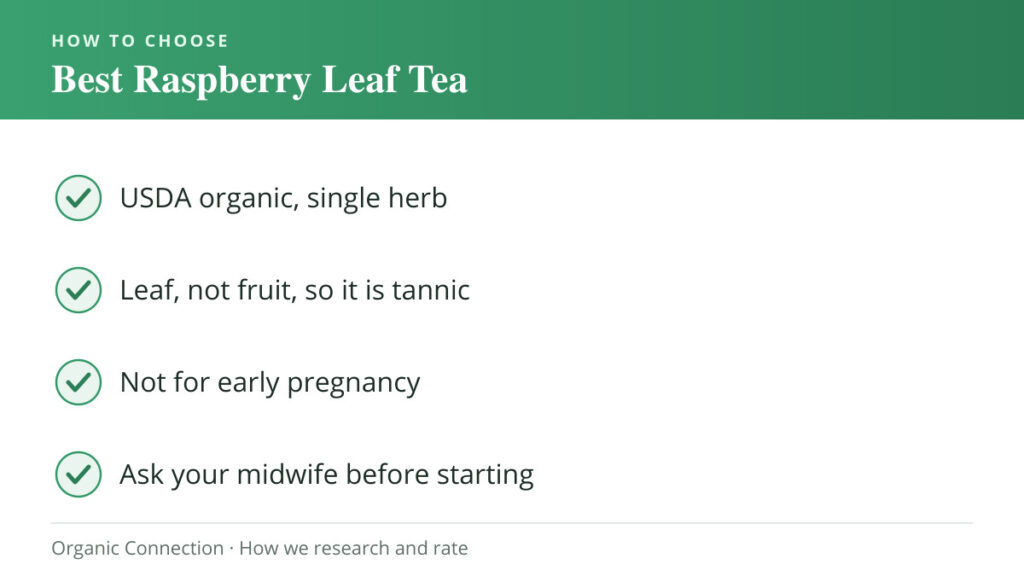
- Confirm USDA organic. You are drinking an unwashed steeped leaf.
- Check for a single ingredient. Pure raspberry leaf, not a blend padded with filler herbs.
- Prefer brands that test their herbs. Pharmacopoeial-grade sourcing beats an unnamed supplier.
- Look for plastic-free bags, or buy loose leaf and use a stainless infuser.
- Talk to your midwife or doctor first if you are pregnant, and do not start in early pregnancy.
Who should buy organic raspberry leaf tea
The right tea depends on why you are drinking it. If you want the best-sourced single-ingredient organic raspberry leaf, our top pick fits. If you want a pregnancy-focused brand, the best value in bulk, a smaller box to try, or a large supply for daily use, we have a pick for each.
Best overall: Traditional Medicinals Organic Raspberry Leaf Tea, 16 Bags
| Organic Integrity Score | 92 / 100 |
| Ingredients | Organic red raspberry leaf |
| Certification | USDA Organic, Non-GMO Project Verified, Kosher, caffeine-free |
| Best for | Menstrual support and late-pregnancy use under guidance |
Traditional Medicinals is our top pick because it is a herbalist-founded company that treats tea as a herbal product rather than a beverage. The herb is USDA certified organic and Non-GMO Project Verified, it is a single ingredient, and the company tests its botanicals to pharmacopoeial-grade standards, which is a meaningfully higher bar than a private-label tea sourced from an unnamed broker. The tea bags are compostable and the wrappers unbleached. The flavor is clean, green, and tannic, closer to a light black tea than anything fruity.
The trade-off is box size and price. Sixteen bags does not last long if you are drinking two or three cups a day, and the per-bag cost is above supermarket herbal teas. The taste is also genuinely plain, which surprises people expecting raspberry.
What we liked: USDA organic and Non-GMO verified, single ingredient, pharmacopoeial-grade herb testing, compostable bags, and a clean honest flavor.
Keep in mind: Only 16 bags per box, priced above supermarket herbals, and it tastes nothing like raspberries.
What buyers say: Buyers consistently rate the herb quality and note the flavor is earthy rather than fruity; box size is the main practical complaint.
Best pregnancy-focused brand: Earth Mama Organic Red Raspberry Leaf Tea, 16 Bags
| Organic Integrity Score | 89 / 100 |
| Ingredients | Organic red raspberry leaf |
| Certification | USDA Organic, Non-GMO Project Verified, Oregon Tilth |
| Best for | Third-trimester and postpartum use under professional guidance |
Earth Mama built its business around pregnancy and postpartum products, and that focus shows in the labeling: the packaging is clear about when in pregnancy the tea is traditionally used, which is genuinely useful given how much confusion exists around timing. It is USDA certified organic, non-GMO, caffeine-free, and a single herb. For anyone buying this specifically for labor preparation, a brand that specializes in the category is a reasonable preference.
The trade-off is that specialization carries a price premium over a general herbal tea brand, and the 16-bag box is small relative to the several-cups-a-day regimen typically described. Being a pregnancy brand does not change the underlying evidence, which remains limited.
What we liked: USDA organic single-herb tea from a pregnancy specialist, with unusually clear guidance on the packaging.
Keep in mind: Priced at a premium, small box, and the specialism does not strengthen the underlying evidence.
What buyers say: Expecting parents rate the brand’s clarity and trust highly; several note the taste takes acclimatizing to.
Best value: Traditional Medicinals Organic Raspberry Leaf, 96 Bags
| Organic Integrity Score | 86 / 100 |
| Ingredients | Organic red raspberry leaf |
| Certification | Certified Organic, Non-GMO, Kosher |
| Best for | Daily drinkers and multi-week regimens |
Six boxes, ninety-six bags, same herb quality as our top pick, and a substantially lower cost per cup. If you are drinking this daily, whether for menstrual support across months or in a structured late-pregnancy build-up, buying in this format is simply the sensible economics. Each box stays sealed until opened, so the herb keeps its aroma.
The trade-off is committing upfront to a tea you may not enjoy. Buy a single box first and confirm you can drink it daily, because raspberry leaf’s tannic, green flavor is polarizing and ninety-six bags of something you dislike is a waste.
What we liked: Best cost per cup for pharmacopoeial-grade organic raspberry leaf, with individually sealed boxes preserving freshness.
Keep in mind: A large commitment to a polarizing flavor; try a single box first.
What buyers say: Regular drinkers buy this format for the value and note the consistency across boxes.
Best mid-size: Earth Mama Organic Raspberry Leaf Tea, 48 Teabags
| Organic Integrity Score | 82 / 100 |
| Ingredients | Organic red raspberry leaf |
| Certification | USDA Organic, Non-GMO Project Verified, Oregon Tilth |
| Best for | A four-to-six week supply |
Forty-eight bags is a practical quantity for a defined period, roughly six weeks at one cup a day, which maps neatly onto a third-trimester regimen or a couple of menstrual cycles. It is the same USDA organic single-herb Earth Mama tea as the 16-count box, at a better rate per bag, without committing to a very large multipack.
The trade-off is that per-bag pricing still sits above Traditional Medicinals in bulk, so if cost per cup is your priority rather than the brand, the 96-bag pack above is better value.
What we liked: A sensible defined-period supply from a pregnancy specialist, better value than the small box.
Keep in mind: Still more expensive per bag than the Traditional Medicinals bulk pack.
What buyers say: Buyers on a defined regimen find the count matches their needs well.
Largest supply: Earth Mama Organic Red Raspberry Leaf Tea, 96 Teabags
| Organic Integrity Score | 78 / 100 |
| Ingredients | Organic red raspberry leaf |
| Certification | USDA Organic, Non-GMO Project Verified, Oregon Tilth |
| Best for | Heavy daily use across a long period |
Ninety-six bags of Earth Mama’s organic raspberry leaf, for anyone drinking two or three cups a day through a long regimen and committed to this brand. Everything good about the smaller boxes applies, in the quantity a genuine daily habit consumes.
It scores lowest here on economics rather than quality: it is the most expensive way to buy ninety-six bags in this guide, since Traditional Medicinals’ equivalent count costs meaningfully less. Herbal tea also loses aroma over many months once a box is opened, so a very large supply should be stored sealed and used within a year.
What we liked: A genuinely large supply of USDA organic single-herb tea from a pregnancy-focused brand.
Keep in mind: The priciest 96-bag option here, and aroma fades over many months once opened.
What buyers say: Committed daily drinkers of this brand buy it for convenience; price-focused buyers switch to the alternative.
How to brew and build up safely
Raspberry leaf is a leaf infusion rather than a delicate green tea, so it wants near-boiling water and a long steep: pour water just off the boil, cover the cup, and leave it ten to fifteen minutes. Covering matters, since it keeps the volatile compounds in the cup rather than in the steam. Squeeze the bag before removing it. The result is tannic and astringent; a little honey or a slice of lemon rounds it off, and it is very good iced, brewed double strength and poured over ice.
If you are using it in late pregnancy, the conventional traditional approach is to start around 32 to 34 weeks with one cup a day and build gradually to two or three over several weeks, rather than starting at full strength. Do this in consultation with your midwife or doctor, and stop if you notice strong or unusual cramping. Avoid it in the first and second trimesters. Because the tannins can interfere with iron absorption, drink it between meals rather than alongside them, which matters if you are taking an iron supplement or managing low iron. Store the box sealed, cool, and dark, and use within a year of opening.
The two studies everyone cites, and what they actually found
Raspberry leaf is one of the most widely recommended herbs in late pregnancy, and the research base behind it is two small Australian studies. Both are worth knowing in detail, because the summaries circulating online routinely overstate them.
Parsons and colleagues (1999) — a retrospective observational study at Westmead Hospital comparing 57 mothers who used raspberry leaf products against 51 who did not. It described some shortening of labor and less mechanical assistance with forceps or vacuum, but no statistically significant differences were found. Being retrospective and observational, it also cannot separate the herb from the kind of person who chooses to take it.
Simpson and colleagues (2001) — a double-blind randomized controlled trial in Sydney with 192 low-risk first-time mothers, taking raspberry leaf tablets or placebo from 32 weeks until labor began. This is the better study by design. Its clearest conclusion was on safety: no adverse effects were observed in mothers or babies. Efficacy findings were modest, and the trial did not establish that raspberry leaf meaningfully shortens labor.
Keep in mind: the honest summary is that raspberry leaf appears safe in late pregnancy in these studies, and that evidence it works is weak. Reviews consistently conclude that the evidence on both safety and active ingredients is limited and that more research is needed before healthcare professionals should be recommending it. That is a very different message from “clinically proven to shorten labor”, which is how it is often sold.
None of this means you should not drink it. It means you should drink it because you like it and it is a pleasant part of preparing for birth, not because you are counting on a clinical effect — and you should tell your midwife or obstetrician that you are taking it.
It is a uterine tonic, not a labor inducer
This is the most common and most consequential misunderstanding in the category.
Raspberry leaf contains fragarine and a range of tannins, and the traditional claim is that it tones uterine muscle — helping it contract more efficiently once labor begins — rather than triggering contractions. It is not an induction agent, there is no evidence it starts labor, and drinking large amounts at 41 weeks in the hope of avoiding a medical induction is not supported by anything.
The practical implications:
- Start around 32 weeks, not earlier. Both studies and general guidance point to the last trimester, because of the possible effects on uterine muscle.
- Build up gradually — one cup daily for a week, then two, then up to three. Doses across studies varied enormously, from one to eight cups or tablets daily.
- It is a preparation, not an event. The traditional rationale depends on weeks of regular use, so a single large dose late on makes no sense even on its own terms.
- Stop and seek advice if you notice strong Braxton Hicks contractions, cramping or any bleeding after starting it.
Who should not drink it
Because raspberry leaf may act on uterine muscle, several groups are routinely advised to avoid it or to take medical advice first. This list is longer than most product packaging admits.
- Before the third trimester. Standard guidance is to avoid it in the first and second trimesters.
- Previous caesarean section or any uterine surgery.
- Any planned caesarean.
- History of precipitate labor — a labor under three hours — where stronger contractions are not desirable.
- Bleeding in pregnancy, placenta praevia, or any placental complication.
- Pre-eclampsia or high blood pressure in pregnancy.
- Multiple pregnancy, breech presentation or a baby in an unstable lie.
- Preterm labor history, or currently at risk of it.
- Gestational diabetes — some sources advise caution, and it is worth raising.
- Existing medication, particularly anything affecting blood sugar or blood pressure.
The rule that covers all of it: raspberry leaf is a herb with a plausible physiological action being taken during pregnancy, so it belongs in the conversation with your midwife or doctor rather than being treated as ordinary tea because it is sold in a tea bag.
Raspberry leaf is not raspberry
Worth stating plainly, because the packaging often shows fruit. Raspberry leaf tea is made from the leaves of Rubus idaeus and tastes nothing like raspberries — it is green, grassy and mildly astringent, closer to a black tea without the caffeine than to a fruit infusion.
- “Raspberry tea” or “raspberry flavor” is a different product entirely, usually a fruit infusion with flavoring and none of the leaf. Check the ingredients say raspberry leaf.
- Red raspberry leaf and raspberry leaf are the same thing — the “red” refers to the plant variety, not a different herb.
- It is naturally caffeine-free.
- The astringency is tannins, the same class of compound that makes strong black tea drying in the mouth. Some people find it unpleasant; lemon, honey or blending with peppermint or nettle helps considerably.
- Outside pregnancy, those same tannins underpin its traditional use as an astringent — as a mouth rinse or gargle, and for mild diarrhea. Those uses are also weakly evidenced but low risk.
Brewing and storage
- Leaves, not roots, so infuse rather than simmer. Freshly boiled water, 10–15 minutes covered — considerably longer than black tea, and covering matters because the volatiles escape with the steam.
- Loose leaf: one to two teaspoons per cup. Loose leaf generally gives a stronger infusion than bags, which are filled with cut and sifted material.
- Cold brew works well and is much less astringent — a tablespoon of loose leaf in a liter of cold water overnight in the fridge. Useful in late pregnancy in warm weather, and easier to drink in quantity.
- Do not over-steep to make it “stronger.” Past about fifteen minutes you extract more tannin and no more of anything useful.
- Storage: airtight, opaque, cool and dry. Dried leaf keeps about a year before the color fades from green toward brown and the flavor flattens.
- Buy smaller quantities. If you are drinking it only in the last eight weeks of pregnancy, a large tin will go stale before you finish it.
How we researched this guide
We are a research-based review site. We compared each product against its certification (USDA organic, and where present Non-GMO Project Verified), ingredient purity, herb sourcing and testing standards, packaging materials, and the weight of aggregated customer feedback on flavor and quality, then scored each with our 10-criteria Organic Integrity Score. No brand paid to be included or ranked. Nothing here is medical advice, and pregnancy-related use should be discussed with a midwife or doctor. Read the full method on our How We Research and Rate page.
Common questions about organic raspberry leaf tea
What is the best organic raspberry leaf tea?
Our overall pick is Traditional Medicinals Organic Raspberry Leaf Tea, because it is USDA certified organic and Non-GMO Project Verified, a single ingredient, and the company tests its botanicals to pharmacopoeial-grade standards. For a pregnancy-focused brand, Earth Mama is our pick, and for the best value, the Traditional Medicinals 96-bag pack.
When should you start drinking raspberry leaf tea in pregnancy?
Traditionally around 32 to 34 weeks, starting with one cup a day and building gradually. It is not recommended in the first or second trimester because of its traditional reputation for stimulating uterine activity. Discuss it with your midwife or obstetrician before starting, particularly with a history of preterm labor, a planned caesarean, or a multiple pregnancy.
Can you drink raspberry leaf tea when not pregnant?
Yes. It is a caffeine-free herbal tea traditionally used for menstrual cramps, and it is low-risk for most non-pregnant adults. Be aware it is high in tannins, which can interfere with iron absorption, so drink it between meals rather than with them if your iron status matters.
Does raspberry leaf tea actually shorten labor?
The evidence is weak. The two studies usually cited are Parsons (1999), a retrospective observational comparison of 57 users against 51 non-users that found some shortening and less mechanical assistance but no statistically significant differences, and Simpson (2001), a double-blind randomized trial of 192 low-risk first-time mothers taking tablets from 32 weeks. Simpson’s clearest finding was on safety — no adverse effects in mothers or babies — while efficacy findings were modest. Reviews consistently say more research is needed before healthcare professionals recommend it.
Does raspberry leaf tea induce labor?
No, and this is the most consequential misunderstanding about it. The traditional claim is that it tones uterine muscle so it contracts more efficiently once labor starts — not that it triggers contractions. There is no evidence it starts labor, so drinking large amounts at 41 weeks hoping to avoid a medical induction is not supported by anything. It is a preparation over weeks, not an event.
When should you start drinking raspberry leaf tea?
Around 32 weeks, which is when the randomized trial started participants, and standard guidance is to avoid it in the first and second trimesters. Build up gradually — one cup daily for a week, then two, then up to three. Stop and seek advice if you notice strong Braxton Hicks contractions, cramping or any bleeding after starting.
Who should not drink raspberry leaf tea?
Anyone before the third trimester; anyone with a previous caesarean or uterine surgery, or a planned caesarean; a history of precipitate labor under three hours; bleeding in pregnancy, placenta praevia or placental complications; pre-eclampsia or high blood pressure; multiple pregnancy, breech or unstable lie; history of or risk of preterm labor. Gestational diabetes warrants caution too. Raise it with your midwife or doctor rather than treating it as ordinary tea because it comes in a tea bag.
Does raspberry leaf tea taste like raspberries?
Not at all. It is made from the leaves of Rubus idaeus and tastes green, grassy and mildly astringent — closer to a caffeine-free black tea than a fruit infusion. “Raspberry tea” or “raspberry flavor” is a different product, usually a fruit infusion with flavoring and no leaf at all, so check the ingredients say raspberry leaf. Red raspberry leaf and raspberry leaf are the same thing.
How do you brew raspberry leaf tea properly?
Freshly boiled water, 10 to 15 minutes covered — considerably longer than black tea, and covering matters because volatiles escape with the steam. Use one to two teaspoons of loose leaf per cup; loose leaf gives a stronger infusion than bags. Do not steep beyond about fifteen minutes, since past that you extract more tannin and nothing more useful.
Can you cold brew raspberry leaf tea?
Yes, and it is much less astringent that way — a tablespoon of loose leaf in a liter of cold water overnight in the fridge. That makes it considerably easier to drink in quantity, which is useful in late pregnancy and in warm weather.
Is raspberry leaf tea useful outside pregnancy?
Traditionally, as an astringent — as a mouth rinse or gargle, and for mild diarrhea — on the basis of its tannin content, the same compounds that make it drying in the mouth. Those uses are also weakly evidenced, though low risk. It is naturally caffeine-free, which makes it a reasonable everyday herbal tea regardless.
- Organic Food & Pantry hub
- Best Organic Loose Leaf Tea
- Best Organic Prenatal Vitamins
- Switching to Organic for Babies and Families
- our full product index — search by brand, product or certification
Price and availability as of October 11, 2026 7:10 pm EDT. Product prices and availability are accurate as of the date/time indicated and are subject to change. Any price and availability information displayed on Amazon.com at the time of purchase will apply to the purchase of this product.
Looking for other organic products?
We have checked more than 800 products across food, household goods, gardening, personal care and pet, every one against its stated certification. Browse all reviews.
Organic Connection is reader-supported. When you buy through links on this page we may earn a commission, at no extra cost to you. As an Amazon Associate we earn from qualifying purchases. We are not paid to feature or rank any product. This page is informational and is not medical advice. How we research and rate.