
Last updated: September 21, 2026
Some links in this guide point to our product reviews, which may earn us a commission at no extra cost to you. How we research and rate.
New parents quickly discover that babies come with a mountain of products, and that many of them sit against delicate skin or surround a sleeping infant for hours a day. Because babies have thinner skin, developing systems, and spend so much time in contact with bedding and clothing, choosing cleaner, organic options for the highest-contact items is a sensible, high-value priority. This practical guide walks room by room through where organic genuinely matters for babies and families, what certifications to look for, and how to make the switch without buying everything at once.
Why organic matters more for babies
Babies are not just small adults. Their skin is thinner and more permeable, their organs and immune systems are still developing, and pound for pound they eat, drink, and breathe more than adults do, so their relative exposure to any residue or emission is higher. They also spend enormous amounts of time in direct, prolonged contact with a few specific products: the mattress they sleep on 14 to 16 hours a day as newborns, the diapers against their skin around the clock, and the clothing and bedding that wrap them constantly. That combination, more vulnerability plus more contact, is exactly why the high-contact baby items are among the best places to prioritize organic and low-chemical options.
The goal is not anxiety or buying everything labeled “natural.” It is a calm, prioritized approach: focus on the items with the most skin contact and the longest exposure, choose genuine certifications over marketing, and expand as budget allows. That is the same evidence-and-priority mindset we bring to every review.
The nursery: start with safe, clean sleep
Your baby will spend more time in the crib than anywhere else, so the nursery is the top priority, and here safety comes first. A crib mattress must be firm and fit the crib snugly (no more than about two fingers’ gap), with only a fitted sheet and nothing else in the crib, following safe-sleep guidance, because a soft or ill-fitting mattress is a suffocation risk. That rule holds regardless of materials.
Once safety is met, materials matter because of how many hours your baby breathes and rests against the mattress. The best organic crib mattresses use GOTS organic cotton, avoid vinyl (PVC) and added flame-retardant chemicals, and carry certifications like GREENGUARD Gold (for low chemical emissions) and MADE SAFE. As our crib mattress guide explains, some are fully organic while others pair an organic cotton cover with a certified low-emission foam core, and both keep the cleanest layer against your baby. Pair the mattress with GOTS organic cotton crib sheets, and the nursery’s highest-contact surfaces are covered. For the bedding principles behind this, see our guide to organic cotton and textiles.
Diapering: constant contact, so worth prioritizing
Diapers are in continuous contact with some of your baby’s most sensitive skin, and you go through thousands of them, so this is a natural place to choose cleaner options. Organic and natural diapers use materials free of chlorine bleaching, fragrances, lotions, and many of the additives in conventional diapers, which can help sensitive skin and reduce exposure to unnecessary chemicals against the skin. Look for brands transparent about their materials and free of added fragrance and chlorine. Whether you choose disposable natural diapers or cloth, the priority is a clean material against the skin and, for many families, fewer reactions and less diaper rash. Pair them with fragrance-free, gentle wipes and a simple, clean diaper cream.
Baby clothing and bedding: clean fabric on delicate skin
Everything your baby wears touches their skin directly, often for the whole day and night, which makes organic cotton clothing and bedding a high-value choice. The certification to look for is GOTS, which verifies both the organic fiber and clean, low-toxicity dyeing and finishing, so there are no harsh dye residues or formaldehyde finishes against your baby’s skin. Prioritize the pieces in longest contact: sleepwear, onesies, and anything worn next to the skin. The same logic that makes organic cotton worthwhile for adults, covered in our textiles guide, applies even more strongly to babies. You do not need an entirely organic wardrobe; start with sleepwear and base layers, where contact is greatest, and build from there. Choosing durable pieces also lets you hand them down, which is both economical and sustainable.
Bath and skincare for little ones
A baby’s skin barrier is still developing, so gentle, clean bath and skincare products help avoid unnecessary irritants. Keep it simple: a mild, fragrance-free wash and a clean moisturizer are enough for most babies, and simpler is generally better than a cabinet full of scented products. The label-reading skills from our organic skincare guide apply directly here, scan the ingredient list, favor short lists of recognizable ingredients, and be cautious with added synthetic fragrance, which is a common irritant for sensitive skin. Many single-ingredient organic oils are gentle, versatile options for baby massage or moisture, though you should always patch test first and check with your pediatrician about anything new on a baby’s skin.
Feeding: from pregnancy through solids
Clean nutrition for a growing family starts before the baby arrives. During pregnancy, an organic prenatal vitamin, ideally a whole-food formula, supports both parent and baby with cleanly sourced nutrients (always chosen with your doctor’s guidance). Once your baby starts solids, the produce-prioritization logic of the Dirty Dozen is especially relevant, since babies eat a lot of fruit and vegetable purees relative to their size; choosing organic for high-residue produce like berries, apples, and leafy greens is a sensible priority. Building clean family meals from an organic pantry extends the same care to everyone at the table. And for family wellness through cold season, options like organic elderberry syrup are popular, used according to label and pediatric guidance for children.
A room-by-room priority plan
You cannot and need not convert everything at once. Here is a sensible order of priority for a growing family:
- Safe sleep first. A firm, well-fitting crib mattress (ideally GOTS organic and GREENGUARD Gold) with organic cotton sheets, following safe-sleep rules.
- Diapers and wipes. Clean, fragrance-free, chlorine-free materials against the skin, used around the clock.
- Sleepwear and base layers. GOTS organic cotton for the clothing in longest skin contact.
- Bath and skincare. A simple, fragrance-free wash and moisturizer; fewer, cleaner products.
- Feeding. Organic prenatal during pregnancy, organic high-residue produce for early solids, and a clean family pantry.
- Everything else, gradually. Expand into other clothing, toys, and household items as budget and replacement cycles allow.
This order concentrates your effort and money where the contact and vulnerability are highest, which is exactly where organic delivers the most value for your baby.
A word on balance
It is easy for new parents to feel pressure to buy everything organic and to worry that anything less is a failure. That is neither necessary nor realistic. The sensible approach is to prioritize the high-contact essentials, safe organic sleep, clean diapers, organic base layers, choose genuine certifications over marketing words, and let everything else follow over time. Safety always comes first, especially for infant sleep, and no organic label changes the basic safe-sleep rules. Beyond that, every clean swap you make reduces your baby’s exposure a little more, and doing it gradually is completely fine. Progress, not perfection, is the right standard.
Where organic matters most for babies
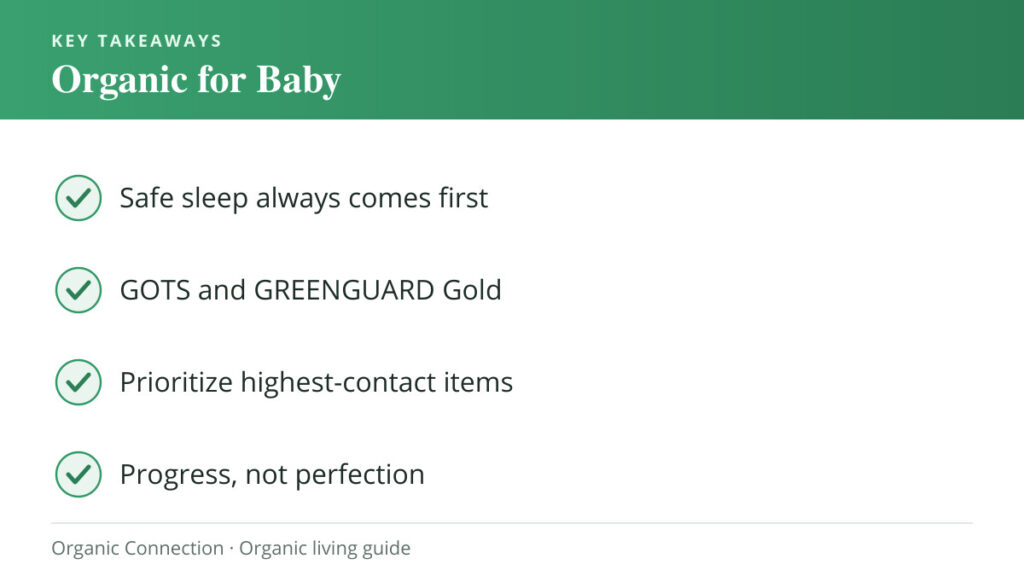
Babies are more vulnerable and spend more time in direct contact with a few key products, which is why the crib mattress, diapers, sleepwear, and base layers are the highest-value places to choose organic and low-emission options. Lead with safety, especially for sleep, then choose genuine certifications like GOTS and GREENGUARD Gold, and prioritize room by room rather than all at once. Extend the same care to feeding through an organic prenatal, high-residue organic produce, and a clean pantry. For our specific picks, follow the links above, and see how we evaluate every product in our rating method. This article is general information, not medical advice; follow current safe-sleep guidance and consult your pediatrician.
The rule that explains why organic pajamas are always snug
Parents notice this within a week of buying the first pair: certified organic cotton sleepwear is nearly always tight-fitting, and the roomy fleece pajamas are usually polyester. That is not a fashion preference. It is a federal safety standard.
Under the children’s sleepwear flammability standard at 16 CFR 1615.1, “children’s sleepwear” covers “any product of wearing apparel up to and including size 6X, such as nightgowns, pajamas, or similar or related items, such as robes, intended to be worn primarily for sleeping.” Such garments must be flame resistant — which for most fabrics means either a synthetic that melts rather than burns, or a chemical flame-retardant treatment.
There are two exits from that requirement, and organic cotton takes one of them.
- Tight-fitting garments are exempt, provided they meet maximum measurements for chest, waist, seat, upper arm, thigh, wrist and ankle at each size — a size 2 chest may not exceed 52.1 centimeters, or 20½ inches — with sleeves and legs that taper, and minimal trim standing more than 6 mm from the garment.
- Infant garments in sizes nine months and smaller are exempt where they meet length limits, comply with the general clothing textile flammability requirements, and carry a label giving the age in months, such as “0 to 3 mos.”
The logic is physical rather than bureaucratic: loose fabric traps air and can catch fire; a snug garment has no billowing fabric to ignite and no gap between cloth and skin. So the exemption is not a loophole, it is a different route to the same objective.
This is the single most useful thing a parent can know in this category. If a pajama is roomy and not flame resistant, it should not be sold as sleepwear. If it is snug and made of untreated organic cotton, it is complying with the standard by design. Our guide to organic baby sleepwear works through the yellow hang tag that states which route a garment took, and our organic cotton pajamas and sleep sack guides record what each listing says about fit and treatment.
What GOTS adds on top of the safety rule
The flammability standard is about fire. It says nothing about what was sprayed on the cotton or what chemistry went into dyeing it, which is where certification does its work.
GOTS carries two label grades, and the difference is a number worth checking: the “organic” grade requires at least 95% certified organic fiber, while “made with organic” covers 70% to 95%. Every company in the production chain must be certified, with annual on-site audits and transaction certificates — so the claim follows the garment rather than resting on the brand’s word. Our explainer on what GOTS certification actually means goes through both grades and how they differ from OEKO-TEX, which tests the finished fabric for harmful substances but says nothing about farming.
For a nursery, the practical division is straightforward:
| Question | What answers it |
| Will this burn? | The sleepwear flammability standard, and the yellow hang tag |
| How was the cotton grown and dyed? | GOTS, at one of its two grades |
| What is left in the finished fabric? | OEKO-TEX STANDARD 100, Class 1 for baby items |
| What is in the food? | Organic certification, plus published heavy metals testing |
Diapering: what the bleaching words mean
Diapers are the highest-contact product in the whole nursery, worn against skin around the clock for roughly two and a half years, so it is worth knowing what the marketing vocabulary refers to.
The pulp in a disposable diaper has to be whitened, and the method is where the terms come from. Elemental chlorine free means chlorine dioxide was used rather than elemental chlorine gas. Totally chlorine free means no chlorine compounds at all, usually oxygen or ozone bleaching instead. Unbleached pulp skips the question and is visibly brown.
The distinction matters because elemental chlorine bleaching of pulp was historically associated with dioxin formation. The industry largely moved away from it decades ago, which means “elemental chlorine free” describes what nearly everyone already does and reads as a stronger claim than it is. Totally chlorine free is the meaningfully stricter version.
What no diaper label tells you is the absorbent core chemistry. Superabsorbent polymer is what makes a modern diaper work, it is a synthetic material in every mainstream product including the ones marketed as natural, and the quantity is never stated. A diaper marketed as “plant-based” is usually describing the top sheet or the backsheet, not the core. Our guides to natural diapers and organic baby wipes record exactly which component each listing is talking about, because the difference between “plant-based materials” and “plant-based top sheet” is the whole claim.
For wipes, the question is simpler and more useful: the cloth matters less than the solution it carries. A wipe is mostly water plus a preservative system and often a mild surfactant, so the ingredient list is the product. Cloth material decides how it feels and how it disposes; the liquid decides what touches the skin.
Bath and skin: less is genuinely more
Infant skin is thinner than adult skin and has a higher surface area relative to body weight, which is the physiological reason to use fewer products rather than gentler versions of many products.
- Bathing two or three times a week is enough for most babies before they are mobile. Daily bathing with cleanser strips the skin barrier faster than it rebuilds.
- Fragrance-free beats naturally fragranced on infant skin. Essential oils are natural and are also among the most common sensitizers, so a product that smells of nothing is usually the safer starting point.
- Short ingredient lists are easier to troubleshoot. If a rash appears, a five-ingredient product tells you far more than a thirty-ingredient one.
- Patch test anything new on a small area for a couple of days before general use, particularly with anything botanical.
Our guides to organic baby shampoo, baby washcloths and hooded towels apply the same reading, and our explainer on skincare ingredients worth avoiding covers the adult version of the question.
A spending order that matches the exposure
If the budget is finite, which it always is, the useful principle is to spend where contact time is longest and skin is thinnest.
- Diapers and wipes. Around the clock contact for years, and a recurring cost where a small per-unit difference compounds.
- Sleepwear and crib sheets. Ten to fourteen hours a day of direct skin contact, and the category where the flammability standard and GOTS interact in the way described above.
- Food, once solids start. This is where published testing matters more than any seal, for the reasons in the feeding section.
- Bath products. Brief contact, rinsed off, so fragrance-free and simple beats certified and complicated.
- Toys, furniture and decor. Worth attention for safety standards and finishes, but far down the list on skin exposure.
That ordering is deliberately unglamorous, and it is the opposite of how baby marketing is arranged: the highest-margin products tend to be the ones with the least skin contact.
Feeding: the two numbers that matter most
The food side of a baby’s first years has firmer regulation than the clothing side, and two figures are worth carrying in your head.
Lead in baby food. The FDA finalized action levels in January 2025: 10 parts per billion for most processed baby foods, and 20 ppb for single-ingredient root vegetables. These are enforcement thresholds rather than safety guarantees, and the agency’s position remains that there is no known safe level of lead exposure.
Inorganic arsenic in infant rice cereal has an action level of 100 ppb, finalized in 2020. Rice takes up arsenic from soil and water more readily than other grains, which is the reason to vary the grains a baby eats rather than to avoid rice.
Alongside those, California’s AB 899 requires baby food makers to test each finished product monthly for arsenic, cadmium, lead and mercury and to publish results behind a QR code on the package — the most useful single development for parents in this category, and the subject of our explainer on heavy metals in organic food. Our guides to organic baby food pouches, organic baby formula and baby cereal record which brands publish anything at all.
What organic certification does and does not do here is worth stating plainly: it governs how the crop was grown, and it requires no testing of the finished food for metals. For a baby, both questions matter, and only one of them is answered by the seal.
Common questions about organic baby products
Why does organic matter more for babies?
Babies have thinner, more permeable skin and developing systems, and pound for pound they eat, drink, and breathe more than adults, so their relative exposure is higher. They also spend enormous time in direct contact with a few products, the crib mattress, diapers, and clothing, which makes those high-contact items the best places to prioritize organic.
What should I look for in an organic crib mattress?
Safety first: it must be firm and fit the crib snugly, regardless of materials. For clean materials, look for GOTS organic cotton, no vinyl or added flame-retardant chemicals, and certifications like GREENGUARD Gold (low emissions) and MADE SAFE. Some mattresses are fully organic; others pair an organic cotton cover with a certified low-emission core.
Are organic or natural diapers worth it?
For many families, yes. Natural and organic diapers use materials free of chlorine bleaching, fragrances, and many additives found in conventional diapers, which can help sensitive skin and reduce chemical contact. Because diapers are in constant contact with sensitive skin around the clock, they are a sensible place to prioritize cleaner materials.
Do I need to buy everything organic for my baby?
No. The sensible approach is to prioritize the high-contact essentials, safe organic sleep, clean diapers, and organic sleepwear and base layers, then expand gradually as budget allows. Safety always comes first, especially for infant sleep, and progress rather than perfection is the right standard.
What certifications should I look for in baby products?
For textiles and clothing, look for GOTS, which verifies organic fiber and clean processing. For mattresses, look for GOTS plus GREENGUARD Gold (low emissions) and MADE SAFE. For food and supplements, USDA Organic. These independent certifications are more reliable than marketing words like “natural” on baby products.
Keep reading
- The Complete Guide to Organic Cotton and Natural Textiles
- Organic Skincare 101: Reading Labels and Building a Routine
- The Dirty Dozen and Clean Fifteen: Where Buying Organic Matters Most
- How we research and rate products
- Organic Product Database — search every product we have reviewed, by certification
- Organic Baby Essentials hub
- our organic product database — compare brands across every guide
Organic Connection is reader-supported. When you buy through links in our reviews we may earn a commission, at no extra cost to you. As an Amazon Associate we earn from qualifying purchases. We are not paid to feature or rank any product. This article is general information, not medical advice; always follow current safe-sleep guidance and consult your pediatrician. How we research and rate.