Last updated: September 30, 2026
We may earn a commission when you buy through links on this page, at no extra cost to you. How we research and rate.
Safety note: For safe infant sleep, always use a firm, flat mattress that fits the crib snugly (no more than two fingers’ gap), with a fitted sheet and nothing else in the crib, no pillows, bumpers, or loose bedding. Place babies on their back to sleep. A soft or ill-fitting mattress increases the risk of suffocation and SIDS. Follow the AAP safe-sleep guidelines.
The short version
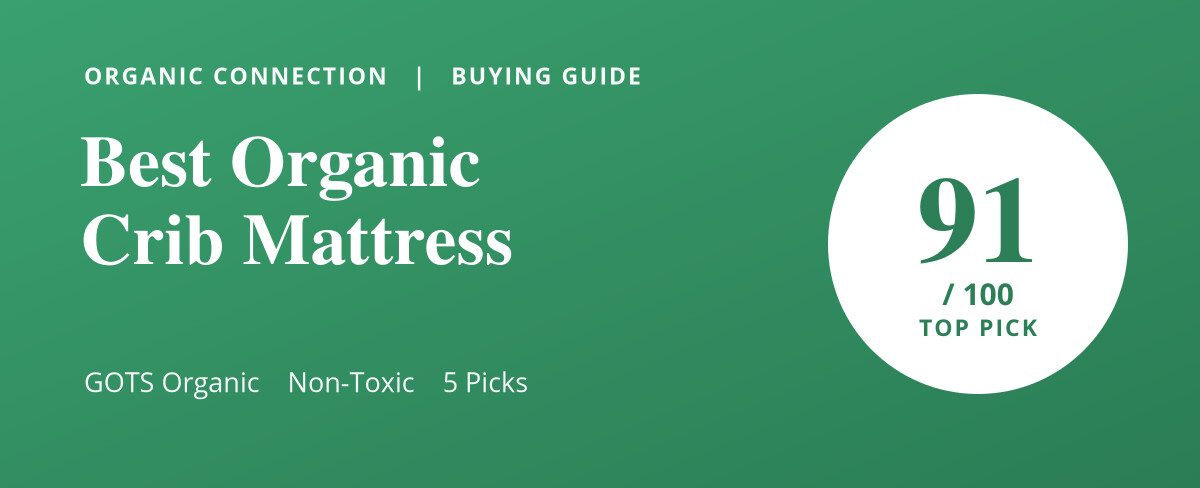
After researching the certifications, materials, and safety of the most popular organic crib mattresses, our top pick is the Delta Children CleanEarth Certified Organic Crib and Toddler Mattress. It is GOTS organic certified, GREENGUARD Gold and MADE SAFE certified, firm, and truly waterproof with a food-safe sugarcane coating instead of vinyl, which is why it earned our highest Organic Integrity Score of 92 out of 100. For a value dual-firmness pick, Colgate EcoClassica III is our choice, and for an all-organic innerspring, Naturepedic is the best.
For a crib mattress, the priorities are a firm, well-fitting surface, non-toxic materials with no added flame-retardant chemicals or vinyl, and trustworthy certifications. We flag each pick’s certifications and construction, noting which are fully organic versus organic-cotton-cover over a certified foam core.
Best organic crib mattress compared
| Best Choice | Best Value | ||||
 |  |  |  |  | |
| Product | Delta CleanEarth | Naturepedic Classic Coil | Babyletto x Avocado | KATU Latex + Coconut | Modera 2-Sided |
| Organic Integrity Score | 92/ 100 | 90/ 100 | 89/ 100 | 87/ 100 | 84/ 100 |
| Our rating | 4.6 | 4.5 | 4.5 | 4.4 | 4.2 |
| Best for | Best overall | All-organic innerspring | Most certified | Organic latex | Cheapest |
| Construction | GOTS cotton, waterproof | GOTS cotton & wool, coils | Coconut coir, wool, organic cotton | Organic latex over coconut, no foam | Foam core, organic cotton cover |
| Certification | GOTS, Certified Organic | Certified Organic | GREENGUARD Gold, GOTS, GOLS | GOLS and GOTS materials | CertiPUR-US foam, not organic |
| Price | $169.99 $229.99 −26% View on Amazon | $279.00 View on Amazon | $359.00 View on Amazon | $329.99 View on Amazon | $129.99 View on Amazon |
Price and availability as of October 11, 2026 7:10 pm EDT. Product prices and availability are accurate as of the date/time indicated and are subject to change. Any price and availability information displayed on Amazon.com at the time of purchase will apply to the purchase of this product.
Scores are ours, based on independent research of firmness and fit, certification, materials, and value, using the same 10-criteria method we apply to every product. See how we research and rate.
The certification map for bedding, and what each one actually excludes
Bedding carries more competing seals than almost any category, and they cover genuinely different things. Here is what each one buys you.
| Certification | Covers | Key exclusion |
| GOTS | Organic fiber from farm to finished textile, plus labor criteria | Bans polyurethane foam and chemical flame retardants; requires wool as the fire barrier |
| GOLS | Latex specifically, at least 95% organic | Bans chemical flame retardants and polyurethane |
| OEKO-TEX Standard 100 | Tests finished product for 1,000+ harmful substances | Says nothing about whether fiber was organically grown |
| GREENGUARD Gold | Chemical emissions and VOC off-gassing | Stricter limits set for sensitive spaces such as nurseries |
| CertiPUR-US | Polyurethane foam only | Covers just the foam, not the rest of the product |
The one most misread is CertiPUR-US. It is a genuine certification and it applies only to the polyurethane foam in a product. It confirms that foam was made without formaldehyde, phthalates, ozone depleters, heavy metals, and TCEP flame retardants, and sets a VOC emission limit of 0.5 parts per million. What it does not do is tell you anything about the cover fabric, the fill, or the rest of the construction, and it certainly does not mean a product is organic. A CertiPUR-US mattress is still a polyurethane foam mattress.
Key things to look for in an organic crib mattress
A safe organic crib mattress is about firmness, clean materials, and certifications. Here is what matters.
1. Firm and well-fitting
Infant sleep surfaces must be firm and fit the crib snugly; softness is a safety risk, not a comfort feature, for babies.
2. Non-toxic materials and certifications
Look for GOTS organic cotton, GREENGUARD Gold (low emissions), and MADE SAFE, with no vinyl or added flame-retardant chemicals.
3. Waterproofing without vinyl
A waterproof surface is practical, but the best brands use food-safe plant-based coatings instead of PVC.
4. Fully organic vs organic-cotton cover
Some mattresses are fully organic (cotton and wool over coils); others use a GOTS organic cotton cover over a certified foam core.
Fully organic vs organic cotton cover
Crib mattresses labeled “organic” fall into two groups. Fully organic mattresses, like Delta CleanEarth and Naturepedic, use GOTS organic cotton and often organic wool over an organic-cotton-wrapped coil or batting core, the purest option. The more affordable group, like Colgate and Milliard, pairs a certified organic cotton cover (the surface closest to baby) with a certified foam core (often GREENGUARD Gold and CertiPUR-US, made without added flame retardants). Both keep the cleanest layer against your baby and avoid the worst materials; the difference is how deep the organic content goes.
Neither is unsafe; it is a purity-versus-price trade-off. Our scoring rewards firmness and fit, GOTS organic cotton, GREENGUARD Gold and MADE SAFE certification, vinyl-free waterproofing, and honest labeling, and we flag exactly what each mattress is so you can choose.
Flame retardants: the reason certification matters here
This is the substantive issue in bedding and the strongest argument for paying more.
Mattresses and some bedding must meet flammability standards, and manufacturers have two broad ways to do it: add chemical flame retardants, or use a material that resists fire on its own. Wool is naturally flame resistant and is the standard approach in certified organic bedding, which is why GOTS-certified mattresses use a wool fire barrier rather than a chemical treatment. Both GOTS and GOLS explicitly prohibit chemical flame retardants.
Since you spend roughly a third of your life in direct, prolonged, warm contact with a mattress, and since children spend considerably more, this is a more defensible reason to buy certified than most organic purchasing decisions. It is not about pesticide residue in fiber; it is about what was deliberately added to the product to make it pass a burn test.
On off-gassing. The chemical smell from new bedding is volatile organic compounds vaporizing at room temperature. It is most pronounced with polyurethane foam and diminishes over days to weeks. If VOC emissions are your concern specifically, GREENGUARD Gold is the certification that tests for it, and it is the one worth prioritizing for a nursery, where the emission limits are set lower precisely because of who is sleeping there.
For a crib specifically, the sensible combination is GREENGUARD Gold for emissions plus GOTS or GOLS for materials. One without the other leaves a gap: organic materials that still off-gas, or low emissions from conventional materials.
How to choose an organic crib mattress
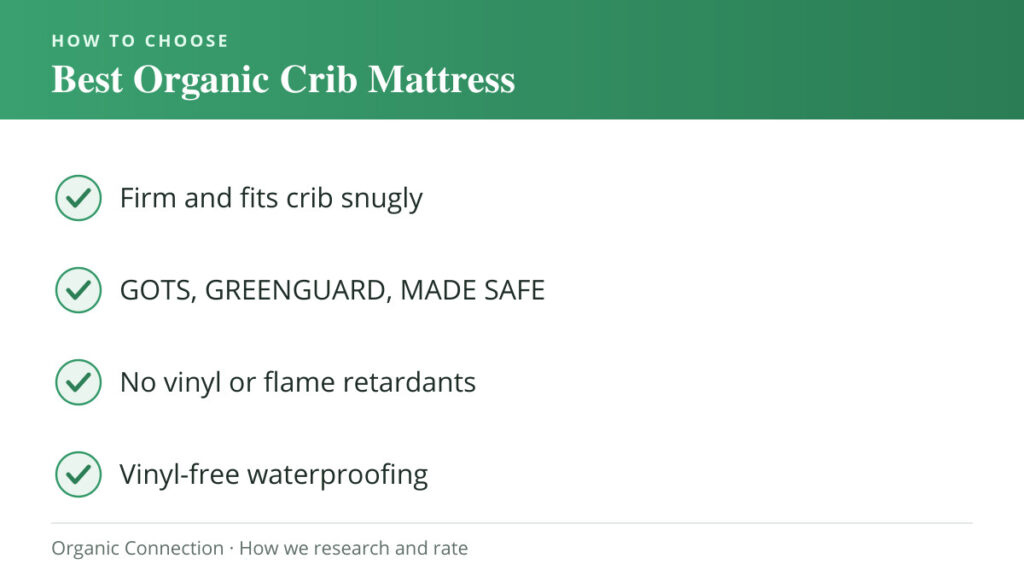
- Confirm it is firm and fits snugly. The most important safety feature for infant sleep.
- Look for GOTS, GREENGUARD Gold, and MADE SAFE. These verify organic cotton and low chemical emissions.
- Avoid vinyl and added flame retardants. Favor food-safe, plant-based waterproofing.
- Decide fully-organic or organic-cover. Fully organic for purity, organic-cover-over-certified-foam for value.
- Consider dual firmness. A firm infant side that flips to a slightly softer toddler side extends its life.
Who should buy organic crib mattress
Priorities differ sharply here, and budget usually leads. Our top pick is the one to beat. If you want a value dual-firmness pick, an all-organic innerspring, the best budget option, or a breathable washable mattress, we have a pick for each.
Best overall: Delta Children CleanEarth Certified Organic Crib and Toddler Mattress
| Organic Integrity Score | 92 / 100 |
| Construction | GOTS organic cotton, firm, waterproof surface |
| Certification | GOTS, Certified Organic |
| Best for | An all-around safe, organic crib mattress |
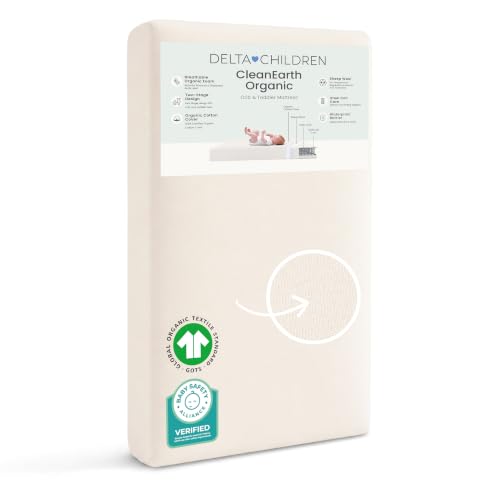
Delta CleanEarth is our top pick because it is the benchmark for safe, organic baby sleep. It is certified to the GOTS organic standard plus GREENGUARD Gold (low emissions) and MADE SAFE, uses organic cotton and no vinyl, polyurethane foam, or added flame-retardant chemicals, and waterproofs with a food-safe, plant-based (sugarcane) coating that wipes clean, all in a firm, lightweight, well-fitting mattress with heat-sealed waterproof seams.
The trade-off is a premium price. For the safest, cleanest, most thoroughly certified organic crib mattress, it is our first choice, and 2-stage and breathable versions are available.
What we liked: GOTS, GREENGUARD Gold, and MADE SAFE certified, no vinyl or flame retardants, food-safe waterproofing, and a firm, well-fitting design.
Keep in mind: It is a premium-priced mattress, reflecting the full organic construction and certifications.
What the listing discloses: Delta Children states GOTS, and does not say whether the USDA seal applies and where it was grown or made.
Best all-organic innerspring: Naturepedic Organic Classic Coil Crib Mattress
| Organic Integrity Score | 90 / 100 |
| Construction | Certified organic cotton throughout, coil innerspring, edge support |
| Certification | Certified Organic |
| Best for | A fully organic coil mattress |
Naturepedic is our pick for parents who want coils rather than foam. It puts certified organic cotton throughout, over a coil core with edge support, and pairs it with a firm waterproof surface that wipes clean, which is the practical half of a crib mattress most organic options handle badly. It is a 2-stage design, firmer on the infant side and softer for the toddler years.
One inconsistency worth noticing before you buy: the product title says 144 coils and the listing body says 150 coils. It is a small discrepancy and it is the kind of thing we flag, because a coil count is the specification this mattress is sold on. It scores in the middle mainly on price and on intermittent stock rather than on quality, which is high.
What we liked: Certified organic cotton throughout, a coil core with edge support, a genuinely wipeable waterproof surface, and a 2-stage firmness design.
Keep in mind: Premium-priced, heavier than foam, stock is intermittent, and the listing disagrees with itself on the coil count.
What the listing discloses: You are told GOTS, EWG Verified and an origin of the USA for Naturepedic; you are not told whether the USDA seal applies.
Most certified: Babyletto x Avocado Organic Crib Mattress
| Organic Integrity Score | 89 / 100 |
| Construction | Coconut coir core, wool batting, organic cotton cover |
| Certification | GREENGUARD Gold (UL Environment), GOTS textile, GOLS latex |
| Best for | Parents who want every layer accounted for |
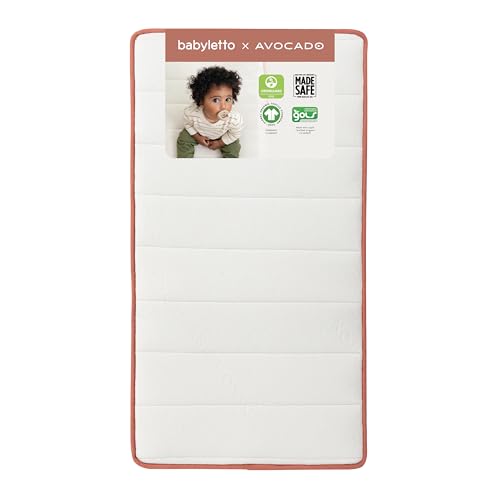
This is the most completely certified mattress we found in stock, and the three marks it holds do genuinely different jobs. GOTS covers the organic cotton. GOLS — the Global Organic Latex Standard — covers the latex, which GOTS cannot, because latex is not a textile. GREENGUARD Gold is different again: tested by UL Environment for chemical emissions into the air of the room, which is the thing you cannot see or smell and the thing a sleeping infant is exposed to for twelve hours a day.
Underneath, it is a coconut coir core with wool batting, firm on the infant side and softer on the toddler side. Coir is naturally breathable and springy without foam, which is why it appears in most genuinely organic mattresses in this category.
It costs more than the picks above it, and a mattress protector is a separate purchase — worth budgeting for, because the thing that ends most crib mattresses is a leak, not wear.
What we liked: Three certifications covering three genuinely different questions — textile, latex and airborne emissions — over a foam-free coconut coir core in a 2-stage design.
Keep in mind: Among the most expensive here, and no waterproof protector is included.
What the listing discloses: Babyletto names GREENGUARD Gold with the testing body (UL Environment), GOTS for the cover and GOLS for the latex — the most specific certification disclosure on this page.
Best organic latex: KATU Organic Latex and Coconut 2-Stage
| Organic Integrity Score | 87 / 100 |
| Construction | Organic latex over coconut fiber, no foam, no plastic |
| Certification | GOLS and GOTS certified materials |
| Best for | Avoiding plastic and polyurethane entirely |
KATU takes the most direct aim at the thing most crib mattresses are actually made of. Its listing opens by pointing out that many mainstream crib mattresses are, in its words, glorified plastic, and that research has found they emit volatile organic compounds. Its answer is a build with no polyurethane foam and no plastic layer at all: organic latex over coconut fiber, hand-assembled.
The materials are sourced to GOLS and GOTS certification, and it carries a lifetime guarantee, which is unusual in a product a child outgrows in three years.
Two practical notes. Latex and coir make a genuinely firm mattress, which is what infant sleep guidance calls for but can surprise parents expecting give. And as with the pick above, the mattress protector is sold separately — on a mattress with no plastic layer, that matters more, not less.
What we liked: GOLS and GOTS certified materials in a genuinely foam-free, plastic-free build, with a lifetime guarantee and an argument it is willing to state plainly.
Keep in mind: The most expensive pick here, very firm, and no protector included on a mattress that has no built-in waterproof layer.
What the listing discloses: KATU names GOLS and GOTS for its materials and states what it excludes — foam and plastic. It does not name a GREENGUARD or emissions certification.
Cheapest, and the organic part is the cover: Modera 2-Sided Crib Mattress
| Organic Integrity Score | 84 / 100 |
| Construction | Memory foam and high-density foam core, organic cotton cover |
| Certification | CertiPUR-US for the foam. No organic certification for the mattress |
| Best for | A firm, cheap 2-sided mattress with an organic cotton surface |
This is the price point most parents actually shop at, and it is here with a clear label on it. Modera is a dual-sided mattress — high-density firm foam for the infant side, memory foam for the toddler side — with an organic cotton cover on top.
The organic part is the cover. That is the single most useful sentence in this guide for anyone shopping under $200, because almost every mattress marketed as organic in this price band is built the same way: a polyurethane foam core with an organic cotton fabric over it. The cotton against your baby’s face is genuinely organic. The material doing the supporting is foam.
Its certification is CertiPUR-US, and that mark is worth understanding rather than dismissing. It is a foam certification: it tests polyurethane foam for emissions, for restricted substances such as certain flame retardants and heavy metals, and for durability. That is a real and useful thing to hold. It is not an organic certification, it says nothing about how anything was farmed, and it is not interchangeable with GOTS, GOLS or GREENGUARD Gold.
Whether that trade is right is a budget question rather than a safety one — CertiPUR-US foam is tested foam. But buy it knowing which half of the mattress the word organic applies to.
What we liked: A genuinely firm infant side at a third the price of the certified mattresses, with a real organic cotton cover and CertiPUR-US tested foam beneath it.
Keep in mind: The mattress is not organic — the cover is. CertiPUR-US is a foam emissions and content standard, not an organic certification, and there is no GOTS, GOLS or GREENGUARD Gold claim here.
What the listing discloses: Modera names CertiPUR-US for its foam and describes the cover as organic cotton. It claims no organic certification for the mattress itself, which is the honest way to sell this construction.
Setting up safe organic sleep
Choose a firm mattress that fits your crib with no more than about two fingers of gap on any side, and use only a fitted sheet, no pillows, blankets, bumpers, or toys, with baby placed on their back. Wipe waterproof surfaces clean with mild soap and water, and machine-wash removable organic covers per the label. Air out new mattresses briefly, though certified GREENGUARD Gold mattresses are already low-emission. As your child grows, flip dual-firmness mattresses to the toddler side. Always follow current AAP safe-sleep guidance.
The federal safety standard, and what it now tests
Crib mattresses in the US are covered by a specific federal standard — 16 CFR Part 1241, finalized in 2022 — which applies to full-size crib mattresses, non-full-size crib mattresses, and after-market mattresses for play yards and non-full-size cribs. It is worth knowing what it actually tests, because it covers the hazards that matter most and it is not something an organic certification substitutes for.
| Hazard | What the standard does |
| Suffocation from soft surfaces | Adds a firmness test, based on the AS/NZS 8811.1 method for testing infant sleep surfaces, to address overly soft mattresses |
| Gap entrapment | Dimensional conformity testing and corner-gap measurement performed with a cotton sheet installed and washed twice — because a shrunken sheet changes the fit |
| Laceration | A cyclic impact test for coils and springs breaking through the surface |
| Information | Improved labeling and instructions on SIDS, suffocation, infant positioning, soft bedding and gap entrapment |
The standard has since been updated: the CPSC issued a direct final rule in February 2026, with compliance to ASTM F2933-25 required from 3 May 2026. A mattress currently on sale in the US should meet the applicable version, and reputable manufacturers state which.
Keep in mind: organic certification and this safety standard cover completely different things. GOTS and GOLS govern the fibers and the chemistry; 16 CFR 1241 governs firmness, fit and structural safety. You want both, and a mattress that leads with organic credentials while saying nothing about the federal standard deserves a direct question. This is also why an “organic” mattress bought from overseas or through a marketplace reseller may not have been tested to the US standard at all.
Firmness is a safety feature, not a comfort preference
Adult intuition is exactly wrong here, and it is the most important thing on this page.
Pediatric safe-sleep guidance is consistent: infants should sleep on a firm, flat, non-inclined surface, on their back, with nothing loose in the sleep space. A soft mattress that conforms around a baby’s face is a suffocation risk, and it is precisely why the federal standard added a firmness test.
- The press test: push down firmly in the center and at the edges. It should not conform to your hand, and it should spring back immediately without leaving an impression. If it feels comfortable to an adult hand, it is probably too soft.
- Flat, always. Inclined sleep surfaces have been the subject of recalls and regulatory action, and no incline should be used for infant sleep, including for reflux, unless a doctor has specifically directed it.
- Two-stage mattresses — firm infant side, softer toddler side — are a sensible design. Make sure the infant side faces up, and label it if that is not obvious.
- Nothing on top. No mattress topper, no padding, no sheepskin, no quilt beneath the sheet. Adding softness defeats the entire design.
- A fitted sheet only, sized for that mattress, tight enough not to lift at the corners.
The fit test that catches most problems
Gap entrapment is the hazard the standard now tests with a washed sheet in place, and it is easy to check at home.
- The two-finger rule: with the mattress pushed to one side, you should not be able to fit more than two fingers between the mattress and the crib frame at any point.
- Check all four corners and both long sides. Corners are where gaps appear first, and where a limb or head can become trapped.
- Re-check after washing sheets. A sheet that shrinks pulls the mattress in and can open a gap — which is exactly why the federal test washes the sheet twice before measuring.
- Standard full-size US crib mattresses are approximately 27¼ × 51⅝ inches and no more than 6 inches thick. Cribs and mattresses are standardized so they fit; problems mostly arise with non-standard, antique or imported cribs.
- Never use an after-market mattress in a play yard unless it is specifically made and sold for that model.
Off-gassing, and what to do about it
New mattresses of all kinds release volatile organic compounds, and the concern with crib mattresses is that a baby sleeps with their face close to the surface for twelve or more hours a day.
- Unwrap and air a new mattress for several days in a well-ventilated room before use, ideally longer. This is the single most effective step and it costs nothing.
- GREENGUARD Gold certifies low chemical emissions and is tested against limits set with children and sensitive individuals in mind — the most directly relevant mark for this concern.
- CertiPUR-US applies to polyurethane foam, restricting certain flame retardants, heavy metals, phthalates and formaldehyde, and setting a VOC limit. Useful, but note it certifies foam rather than the whole product.
- Natural latex, coir, wool and cotton constructions generally emit less than polyurethane foam, which is a genuine argument for the organic constructions in this guide beyond the farming question.
- Waterproofing matters as much as the core. Look for food-grade polyethylene rather than PVC or vinyl, which can carry phthalate plasticizers. Many organic mattresses use exactly this, and it is worth checking rather than assuming.
- Warmth increases emission. A mattress in a hot room off-gasses faster, which argues for airing it somewhere warm before the baby uses it rather than after.
How organic mattresses meet flammability rules without chemicals
Mattresses sold in the US must meet federal flammability standards. Conventional manufacturers usually achieve this with chemical flame retardants or treated barrier fabrics, which is exactly what parents buying organic are trying to avoid.
The organic route is a physical barrier rather than a chemical one — most commonly wool, which is naturally flame resistant and can allow a mattress to pass without added chemistry. Some manufacturers use hydrated silica or other inert barriers instead. Both are legitimate compliance routes, and GOTS prohibits chemical flame retardants outright.
If wool is a concern — allergy, or a vegan household — silica-barrier and other non-wool constructions exist, and it is worth asking manufacturers directly, since this detail is often buried in specifications rather than stated on the product page.
Hygiene and lifespan
- Waterproof the surface, not with a soft pad. A fitted waterproof protector that does not add loft is fine; a padded mattress protector adds softness and works against the firmness requirement.
- Clean spills promptly and dry completely. Moisture inside a mattress is how mold develops, and it is invisible until it is a problem.
- Do not use a second-hand crib mattress where you do not know the history. Compression, hygiene and unknown storage conditions all matter, and older mattresses may predate the current standard entirely.
- Reusing between siblings is generally considered acceptable if the mattress is firm, undamaged, has been kept clean and dry, and still meets the fit test — but inspect the surface, corners and seams first.
- Replace it if the surface is torn, coils are audible or palpable, there is any sagging or permanent indentation, or there is any sign of mold or persistent odor.
This guide summarizes published safety standards and guidance and is not medical advice. For questions about your baby’s sleep, speak to your pediatrician.
How we researched this guide
We are a research-based review site. We compared each mattress against firmness and fit, certifications (GOTS, GREENGUARD Gold, MADE SAFE), materials and waterproofing, and the weight of aggregated parent feedback, then scored each with our 10-criteria Organic Integrity Score. No brand paid to be included or ranked. Read the full method on our How We Research and Rate page.
Common questions about organic crib mattress
What is the best organic crib mattress?
Our overall pick is the Delta Children CleanEarth Certified Organic Crib and Toddler Mattress, because it is GOTS organic, GREENGUARD Gold, and MADE SAFE certified, firm, and waterproof without vinyl. For value dual-firmness, Colgate EcoClassica III is our pick, and for an all-organic innerspring, Naturepedic.
Should a crib mattress be firm?
Yes. Infant sleep surfaces must be firm and fit the crib snugly, because a soft or loose mattress increases the risk of suffocation and SIDS. Firmness is a safety requirement for babies, not a comfort preference.
What certifications should an organic crib mattress have?
Look for GOTS (organic cotton), GREENGUARD Gold (low chemical emissions), and ideally MADE SAFE. These verify organic content and that the mattress meets strict low-emission and non-toxic standards.
Is an organic cotton cover enough, or do I need a fully organic mattress?
An organic cotton cover keeps the cleanest layer against baby and, paired with a GREENGUARD Gold certified core with no added flame retardants, is a safe, affordable choice. A fully organic mattress (organic cotton and wool over coils) goes further on materials for a higher price.
Do organic crib mattresses avoid flame retardants?
Yes. The best organic crib mattresses meet flammability requirements without added flame-retardant chemicals, often using organic wool as a natural flame barrier or compliant designs, which is a key reason parents choose them.
What safety standard should a crib mattress meet?
16 CFR Part 1241, the federal standard finalized in 2022, covering full-size and non-full-size crib mattresses and after-market play yard mattresses. It adds a firmness test based on the AS/NZS 8811.1 method, dimensional and corner-gap testing performed with a cotton sheet installed and washed twice, and a cyclic impact test for coils breaking through. The CPSC issued an update in February 2026 requiring compliance with ASTM F2933-25 from 3 May 2026.
Does organic certification cover crib mattress safety?
No — they cover different things entirely. GOTS and GOLS govern fibers and chemistry; 16 CFR 1241 governs firmness, fit and structural safety. You want both, and a mattress leading with organic credentials while saying nothing about the federal standard deserves a direct question. This is also why an organic mattress bought from overseas or a marketplace reseller may never have been tested to the US standard.
How firm should a crib mattress be?
Firmer than adult intuition suggests. Press down firmly in the center and at the edges — it should not conform to your hand and should spring back immediately without leaving an impression. If it feels comfortable to an adult hand, it is probably too soft. Pediatric safe-sleep guidance calls for a firm, flat, non-inclined surface, and a soft mattress that conforms around a baby’s face is a suffocation risk.
How do you check a crib mattress fits properly?
The two-finger rule: push the mattress to one side, and you should not fit more than two fingers between mattress and crib frame anywhere. Check all four corners and both long sides, since corners are where gaps appear first. Re-check after washing sheets — a shrunken sheet pulls the mattress in and can open a gap, which is exactly why the federal test washes the sheet twice before measuring.
Can you put a topper on a crib mattress?
No. No topper, padding, sheepskin or quilt beneath the sheet — adding softness defeats the firmness the mattress is designed to provide. Use a fitted sheet sized for that mattress, tight enough not to lift at the corners. A thin non-padded waterproof protector is fine; a padded one is not.
How long should you air out a new crib mattress?
Several days in a well-ventilated room, and longer if you can. It is the single most effective step against off-gassing and costs nothing. Warmth increases emission, so airing it somewhere warm before the baby uses it is better than after. GREENGUARD Gold certifies low chemical emissions against limits set with children in mind, which is the most directly relevant mark here.
How do organic mattresses pass flammability rules without flame retardants?
With a physical barrier rather than a chemical one — most often wool, which is naturally flame resistant and can allow a mattress to pass without added chemistry. Some manufacturers use hydrated silica or other inert barriers instead. GOTS prohibits chemical flame retardants outright. If wool is a concern for allergy or a vegan household, non-wool constructions exist but you may need to ask the manufacturer directly.
Can you reuse a crib mattress for a second baby?
Generally yes if it is firm, undamaged, has been kept clean and dry, and still passes the fit test — but inspect the surface, corners and seams first. Do not use a second-hand mattress whose history you do not know: compression, hygiene and storage conditions all matter, and older mattresses may predate the current standard. Replace any mattress that is torn, sagging, has audible coils, or shows mold or persistent odor.
- Organic Household hub
- Best Organic Cotton Sheets
- Best Natural Diapers
- How we research and rate products
- every product we have reviewed — filter by USDA Organic, GOTS, Fair Trade and more
Price and availability as of October 11, 2026 7:10 pm EDT. Product prices and availability are accurate as of the date/time indicated and are subject to change. Any price and availability information displayed on Amazon.com at the time of purchase will apply to the purchase of this product.
Looking for other organic products?
We have checked more than 800 products across food, household goods, gardening, personal care and pet, every one against its stated certification. Browse all reviews.
Organic Connection is reader-supported. When you buy through links on this page we may earn a commission, at no extra cost to you. As an Amazon Associate we earn from qualifying purchases. We are not paid to feature or rank any product. How we research and rate.