
Last updated: September 30, 2026
We may earn a commission when you buy through links on this page, at no extra cost to you. How we research and rate.
Health note: This guide is general information, not medical advice. Apple cider vinegar is a food, not a treatment, and the evidence for many health claims is limited. Always dilute it, and talk to your doctor before using it regularly if you take medication (including diabetes or heart medicine), or have digestive or kidney concerns.
The short version
After researching the sourcing, processing, and quality of the most popular organic apple cider vinegars, our top pick is Bragg Organic Apple Cider Vinegar. It is raw, unfiltered, USDA Organic, and contains “the mother,” the cloudy strands of beneficial bacteria and enzymes that mark a minimally processed vinegar, which is why it earned our highest Organic Integrity Score of 94 out of 100. For a premium small-batch option, Fairchild’s is our pick, and for a convenient (if less potent) format, Goli ACV Gummies are the easiest to take.
The signs of a quality ACV are simple: raw and unfiltered, USDA Organic, and “with the mother.” We flag which products have those, and we are honest that gummies and pills are more processed and usually much weaker than the liquid.
Best organic apple cider vinegar compared
| Best Choice | Best Value | ||||
 |  |  |  |  | |
| Product | Bragg Organic | Mantova 68 oz | Goli Gummies | Mother Earth | Dynamic Health |
| Organic Integrity Score | 94/ 100 | 85/ 100 | 82/ 100 | 80/ 100 | 79/ 100 |
| Our rating | 4.7 | 4.3 | 4.1 | 4.0 | 4.0 |
| Best for | Best overall | Value liquid | Easy gummy | Premium barrel-aged | Budget |
| Type | Raw, with mother | Raw, with mother | Gummy | Raw, with mother | Raw, with mother |
| Certification | USDA Organic, Non-GMO Project Verified, Kosher | 100% USDA Certified Organic | Non-GMO, Gluten-free, Vegan | Certified organic, Non-GMO Project Verified, Kosher (OU) | — |
| Price | Currently unavailable See buying options | $19.99$0.29 / ounce View on Amazon | $14.59$0.24 / count View on Amazon | $14.99$0.94 / fluid ounce View on Amazon | $7.09$0.44 / ounce View on Amazon |
Price and availability as of October 17, 2026 7:10 pm EDT. Product prices and availability are accurate as of the date/time indicated and are subject to change. Any price and availability information displayed on Amazon.com at the time of purchase will apply to the purchase of this product.
Scores are ours, based on independent research of sourcing, processing, and quality, and deliberately not on unproven health claims.
What each claim on an apple cider vinegar label actually covers
Apple cider vinegar carries more folk claims than almost anything in the pantry, and the label terms divide neatly into three groups: audited certifications, accurate descriptions of processing, and words that sound technical but are not defined at all.
| Claim | Covers | Key exclusion |
| USDA Organic | The apples were grown and the vinegar handled under the National Organic Program | Says nothing about acidity, whether the mother is present, or whether it was pasteurized |
| “Organic” with no seal named | An assertion, usually accurate | Not attributable. Two picks here name USDA outright; others leave it at the word |
| “With the mother” | The cloudy strands of cellulose and acetic acid bacteria are still in the bottle | It describes what was not removed. Every vinegar starts with the mother; filtering, distilling or pasteurizing takes it out. It is not an added ingredient |
| Raw / unpasteurized | Not heat-treated, so the bacterial culture survives | No standard defines raw for vinegar, and it is not a sterility or safety claim |
| Unfiltered | Sediment and the mother were left in | Often used interchangeably with raw, though they are different steps |
| Non-GMO Project Verified | Independent verification of non-GMO sourcing | There are no commercial GM apples in this supply chain, so it confirms a non-issue |
| Kosher (OU) | Ritual production standards, verified by a named agency | Unrelated to organic status, acidity or the mother |
| “5% acidity” or a stated percentage | The concentration of acetic acid, which is the one number that predicts how it behaves | Almost nobody prints it. Not one pick on this page states an acidity figure, which is the single biggest documentation gap in the category |
| Gluten-free, vegan | That no gluten-containing grain and no animal-derived ingredient was added to the bottle | True of apple cider vinegar generally. Neither distinguishes one bottle from another |
| Health claims on the bottle | Nothing verified | Dietary supplement wording is not pre-approved. Read the evidence section above rather than the label |
What makes a good apple cider vinegar
Apple cider vinegar is made by fermenting apples twice, first to cider, then to vinegar. The quality differences are easy to see once you know what to look for.
1. Raw and unfiltered
Raw, unfiltered vinegar skips the heat pasteurization and fine filtering that strip out beneficial compounds, so it keeps more of the original ferment.
2. “The mother”
The cloudy, cobweb-like strands called the mother are colonies of beneficial bacteria and enzymes, and their presence is a sign of a minimally processed vinegar.
3. Organic apples
USDA-organic ACV is made from apples grown without synthetic pesticides, which many people prefer for a daily-use product.
4. Acetic acid, sensibly used
Acetic acid is what gives vinegar its bite and most of its studied effects, and also why it must be diluted to protect your teeth and throat.
What the science does and does not say
It is worth being clear-eyed. Some small studies suggest vinegar may modestly blunt the rise in blood sugar after a carb-heavy meal, and it is a low-calorie way to add flavor. But the evidence is limited and short-term, and ACV is not a proven treatment for weight loss, diabetes, or any disease. Marketing often runs far ahead of the research.
What we can assess reliably is quality: raw versus pasteurized, organic versus conventional, with or without the mother. As Harvard Health notes, ACV is fine as a diluted culinary habit but should not replace medical care. Our scoring weights sourcing and processing quality, not health claims, and we always flag the need to dilute.
Acidity: the number nobody prints, and why it matters
Taste-test roundups rank apple cider vinegar on flavor and almost none of them mention acidity, which is the one specification that determines what the product actually does.
The standard is 5% acetic acid. That is the conventional strength for culinary vinegar and what essentially all the research uses. Some products are diluted below it, and some artisanal vinegars run higher. Acetic acid is the active compound behind every effect ACV is credited with, so a vinegar at 4% is doing roughly four-fifths the work of one at 5% per spoonful. If a bottle does not state its acidity, you cannot compare it meaningfully.
What “the mother” is, precisely. The cloudy sediment is a colony of cellulose and acetic acid bacteria left over from fermentation. Raw, unfiltered, unpasteurized vinegar retains it; filtered and pasteurized vinegar does not. It is worth knowing that the acetic acid, which is what the blood sugar research measures, is present either way. The mother adds trace enzymes and bacteria and is not the source of the main effect. Buy raw and unfiltered by preference; do not assume filtered vinegar is inert.
What the blood sugar evidence actually shows
This is the best-supported claim, and the doses are specific enough to be worth copying.
A GRADE-assessed systematic review and dose-response meta-analysis pooling seven controlled trials in people with type 2 diabetes found apple cider vinegar significantly reduced fasting blood sugar. Individual trials have used around 30 ml a day, roughly two tablespoons. One frequently cited trial had participants take two tablespoons at bedtime alongside a standardized meal plan and found morning fasting glucose significantly lower than without it.
| Protocol | Detail |
| Typical trial dose | 15 to 30 ml daily, one to two tablespoons |
| Timing that showed fasting glucose effects | At bedtime |
| Timing for post-meal glucose | Shortly before a carbohydrate-containing meal |
| Always diluted in | About 240 ml of water |
| What it does not do | Replace diabetes medication, or produce meaningful weight loss on its own |
Effect sizes are modest and the trials are small. This is a reasonable adjunct to a diet that already manages carbohydrate sensibly, not a treatment.
Your teeth: the part that gets glossed over
Apple cider vinegar sits at a pH of roughly 2.5 to 3.0. Tooth enamel begins to demineralize below pH 5.5. That gap is the whole problem, and enamel does not grow back.
The uncomfortable detail. Diluting one tablespoon of 5% ACV into 240 ml of water raises the pH of what is in the glass to roughly 3.8 to 4.2. That is a large reduction in acid concentration, and it is still below the 5.5 threshold. Dilution reduces the damage substantially; it does not eliminate it. Anyone drinking ACV daily for years should know that.
How to actually protect your teeth:
- Always dilute, one tablespoon in a large glass of water, and never drink it neat.
- Use a straw so the liquid bypasses your front teeth.
- Drink it in one go rather than sipping. Sipping keeps the mouth acidic for far longer.
- Rinse with plain water afterwards.
- Do not brush for 30 to 60 minutes. Brushing acid-softened enamel abrades it, so brushing straight after does more harm than waiting.
Gummies are worse for teeth, not better. This surprises people who choose them to avoid the acid. ACV gummies still contain acetic acid, they are sticky so they cling to tooth surfaces far longer than a liquid that saliva washes away, and most contain added sugar that feeds acid-producing oral bacteria. They also typically deliver considerably less acetic acid than a tablespoon of liquid, so you get less of the effect and more of the dental risk. Convenience is a fair reason to choose them; dental protection is not.
Who should be careful
Apple cider vinegar is food, and at habitual doses it has real interactions worth raising with a doctor.
- Low potassium. Long-term use has been associated with reduced potassium levels, which matters more if you are already at risk.
- Insulin and diabetes medication. ACV lowers blood glucose, so combining it with glucose-lowering drugs can push blood sugar or potassium dangerously low. This is the most important interaction on the list.
- Diuretics. Both deplete potassium, so the effect compounds.
- Laxatives and some blood pressure medicines can also interact.
- Reflux, gastritis, or gastroparesis. Acid on an irritated stomach is a poor idea, and vinegar can slow gastric emptying, which is unhelpful in gastroparesis specifically.
Nothing here is medical advice. If you take any regular medication, mention a daily vinegar habit to your doctor rather than assuming a kitchen ingredient cannot matter.
How to choose an apple cider vinegar
- Look for “raw,” “unfiltered,” and “with the mother.” These three phrases signal a minimally processed vinegar.
- Choose USDA Organic. For a product you use daily, organic apples avoid synthetic pesticide residues.
- Prefer glass bottles. Glass avoids any concern about acidic liquid sitting in plastic, and protects flavor.
- Be realistic about gummies. They are convenient but contain far less acetic acid than a tablespoon of liquid, and often add sugar.
- Mind the acidity. Standard ACV is about 5% acidity; always dilute, and rinse your mouth with water after.
Who should buy organic apple cider vinegar
Drinking it and cooking with it are not the same purchase. One bottle covers both, and that is our top pick. If you want a premium small-batch vinegar, an everyday value bottle, or an easy gummy, we have a pick for each. Dilute it, and check with your doctor if you take medication.
Best overall: Bragg Organic Apple Cider Vinegar
| Organic Integrity Score | 94 / 100 |
| Certification | USDA Organic, Non-GMO Project Verified, Kosher |
| Type | Raw, unfiltered, with the mother |
| Best for | An all-around daily organic ACV |
Bragg is our top pick because it is the benchmark other apple cider vinegars are measured against. It is USDA Organic, raw, unfiltered, and clearly shows the mother, from a brand that has made ACV for decades. It is widely available, fairly priced, and versatile for dressings, drinks, and cooking.
The only real caveats are universal to ACV: it must be diluted, and it comes in both glass and plastic, so choose glass if that matters to you. For a reliable, genuinely organic everyday vinegar, it is our first choice.
What we liked: USDA Organic, raw and unfiltered with a visible mother, widely available, versatile, and fairly priced.
Keep in mind: Like all ACV it must be diluted to protect your teeth, and it is sold in both glass and plastic, so pick glass if you prefer.
What the listing discloses: Bragg commits to a USDA organic claim, Non-GMO Project Verified, kosher certification and a B Corp certification but stops short of where it was grown or made.
Best value liquid: Mantova Organic Apple Cider Vinegar With The Mother
| Organic Integrity Score | 85 / 100 |
| Type | Raw, unfiltered, with the mother |
| Certification | 100% USDA Certified Organic, stated outright |
| Best for | Anyone using ACV daily who does not want to keep reordering |
At 68 ounces for around seventeen dollars, this works out near 25 cents an ounce — the cheapest way to keep raw apple cider vinegar in the house, by a clear margin. If you take it daily, or cook with it, or clean with it, the bottle size is the point.
It is also the only listing on this page that states 100% USDA Certified Organic in plain words rather than leaving it at “organic”, and it confirms raw and unfiltered with the mother intact, with no artificial additives or preservatives.
The trade-off is the format. A 68 ounce jug is heavy to pour and takes months to finish, and once opened, the mother continues to develop — harmless and in fact the sign you bought the right thing, but it means sediment and a cloudier bottle over time. Shake before use and do not judge it by clarity.
What we liked: The clearest organic certification wording here, raw and unfiltered with the mother, at roughly a quarter a fluid ounce.
Keep in mind: A 68 ounce jug is awkward to handle and slow to get through, and the mother will keep settling as it sits.
What the listing discloses: Mantova names 100% USDA Certified Organic, raw and unfiltered, and that the mother is present. It states no acidity percentage.
Easiest to take: Goli ACV Gummies
| Organic Integrity Score | 82 / 100 |
| Type | Chewable gummies |
| Note | Convenient; far less acetic acid than liquid |
| Best for | People who cannot stand the taste of liquid ACV |
Goli gummies are our pick for the easiest experience. They deliver apple cider vinegar in a pleasant gummy with no vinegar taste and no risk to tooth enamel from sipping acid, which helps people stay consistent, plus added B vitamins.
It scores in the value range because gummies are far more processed and contain much less acetic acid than a tablespoon of liquid (so any vinegar effect is minimal), and they contain some added sugar. If you want the actual properties of ACV, the liquid is stronger; if taste is the barrier, gummies win.
What we liked: No vinegar taste, gentle on tooth enamel, convenient, and easy to take consistently, with added B vitamins.
Keep in mind: Gummies contain far less acetic acid than liquid ACV and add some sugar, so they are more about convenience than potency.
What the listing discloses: Goli carries no organic claim, certified or otherwise.
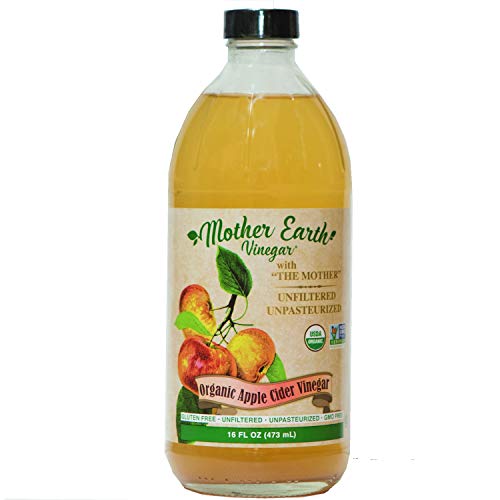
Best premium: Mother Earth Organic Apple Cider Vinegar with The Mother
| Organic Integrity Score | 80 / 100 |
| Type | Raw, unpasteurized, unfiltered, with the mother |
| Certification | Certified organic, Non-GMO Project Verified, Kosher (OU) |
| Best for | Anyone who cares what it tastes like, not only what it does |
Mother Earth is the pick for flavor, and it is the only one here that explains why it has any. The vinegar is aged for three months in redwood barrels using a century-old slow-fermentation process, which is long by modern standards and produces a rounder, honey-golden vinegar rather than the flat sharpness of industrially made ACV.
Its certification stack is the second deepest on the page: certified organic, Non-GMO Project Verified, and Kosher under OU, alongside unpasteurized, unfiltered and preservative-free. It also makes the most useful point in this whole category in its own bullets — that every vinegar begins with the mother, and that most producers filter, distil or pasteurize it out. That is exactly right, and it reframes “with the mother” from a feature into a description of what was not removed.
It costs more per ounce than the value pick and comes in a smaller bottle, which is the honest trade for the barrel aging.
What we liked: Three-month redwood barrel aging with a genuinely smoother result, certified organic with Non-GMO Project and OU Kosher verification, and the clearest explanation of what the mother actually is.
Keep in mind: Materially more per ounce than the value pick, in a smaller bottle, and it states no acidity percentage either.
What the listing discloses: Mother Earth names certified organic, Non-GMO Project Verified and Kosher (OU), and describes its fermentation and aging. No acidity figure is given.
Best budget: Dynamic Health Organic Apple Cider Vinegar with Mother, 16 oz
| Organic Integrity Score | 79 / 100 |
| Certification | — |
| Type | Raw, with the mother |
| Best for | Stocking up cheaply for cooking and cleaning |
Dynamic Health is our budget pick. It is USDA Organic, raw, and with the mother, usually sold in a larger bottle at a low cost per ounce, which makes it practical if you go through a lot of ACV for dressings, marinades, or even natural cleaning.
It scores at the value end on flavor refinement and brand pedigree rather than integrity, but for a certified organic vinegar to use generously without worrying about cost, it is a dependable choice.
What we liked: USDA Organic, raw, with the mother, at a low cost per ounce, great for heavy everyday use.
Keep in mind: It is a value product rather than a premium-flavor vinegar, and, like all ACV, must be diluted for drinking.
What the listing discloses: Sparse documentation from Dynamic Health — nothing on whether the USDA seal applies and where it was grown or made.
How to use apple cider vinegar well
Always dilute: mix about a tablespoon into a large glass of water, and drink it with or after a meal rather than on an empty stomach. Use a straw if you drink it often, and rinse your mouth with plain water afterward to protect tooth enamel. ACV also shines in the kitchen, in vinaigrettes, marinades, and pickles, which is a pleasant, low-risk way to use it. Do not treat it as a substitute for medical care, and check with your doctor if you take diabetes, heart, or diuretic medication, since vinegar can interact.
How we researched this guide
We are a research-based review site. We did not lab-test these vinegars ourselves, and we do not endorse unproven health claims. We compared each against its certification, processing (raw, unfiltered, with the mother), packaging, and the weight of aggregated customer feedback, then scored each with our 10-criteria Organic Integrity Score. No brand paid to be included or ranked. Read the full method on our How We Research and Rate page.
Common questions about organic apple cider vinegar
What is the best organic apple cider vinegar?
Our overall pick is Bragg Organic Apple Cider Vinegar, because it is USDA Organic, raw, unfiltered, and clearly contains the mother, from a long-trusted brand at a fair price. For a premium small-batch option, Fairchild’s is our pick.
What is “the mother” in apple cider vinegar?
The mother is the cloudy, cobweb-like strands of beneficial bacteria and enzymes formed during fermentation. Its presence indicates a raw, minimally processed vinegar, which is why quality ACV is labeled “with the mother.”
How much apple cider vinegar should I drink?
A common amount is about one tablespoon diluted in a large glass of water, once or twice a day with meals. Always dilute it, since undiluted vinegar can erode tooth enamel and irritate the throat, and check with your doctor if you take medication.
Do apple cider vinegar gummies work as well as liquid?
Not really, in terms of acetic acid. Gummies are convenient and taste better, but contain far less acetic acid than a tablespoon of liquid, and add some sugar. Choose them for consistency and taste, and the liquid for potency.
Can apple cider vinegar help with weight loss or blood sugar?
The evidence is limited. Some small studies suggest vinegar may modestly reduce the blood sugar spike after a carb-heavy meal, but ACV is not a proven treatment for weight loss or diabetes. Treat it as a wellness habit and rely on your doctor for medical care.
- Organic Supplements and Wellness hub
- Best Organic Turmeric
- Best Organic Honey
- every organic supplement we have reviewed — searchable by certification and testing
Price and availability as of October 17, 2026 7:10 pm EDT. Product prices and availability are accurate as of the date/time indicated and are subject to change. Any price and availability information displayed on Amazon.com at the time of purchase will apply to the purchase of this product.
Looking for other organic products?
We have checked more than 800 products across food, household goods, gardening, personal care and pet, every one against its stated certification. Browse all reviews.
Organic Connection is reader-supported. When you buy through links on this page we may earn a commission, at no extra cost to you. As an Amazon Associate we earn from qualifying purchases. We are not paid to feature or rank any product. How we research and rate.