Last updated: September 30, 2026
We may earn a commission when you buy through links on this page, at no extra cost to you. How we research and rate.
The short version
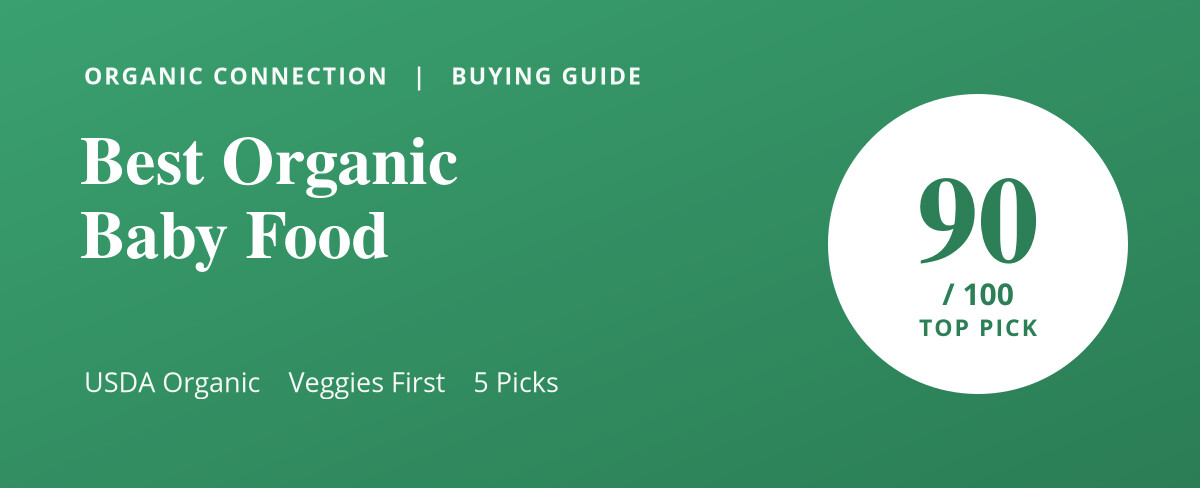
After researching the certifications, ingredient decks, and sugar profiles of the most popular organic baby food pouches, our top pick is Happy Baby Organics Clearly Crafted Stage 1. It is USDA certified organic, single-ingredient at Stage 1, and Happy Baby publishes the origin of the ingredients in each pouch, which is why it earned our highest Organic Integrity Score of 90 out of 100. For a variety pack, Plum Organics 6+ Months is our pick, and for cold-pressed rather than heat-treated purée, Once Upon a Farm is the best choice.
Pouches are convenient and genuinely useful, and they also have two real drawbacks worth understanding before you stock up. We flag each product’s certification and stage.
Best organic baby food pouches compared
| Best Choice | Best Value | ||||
 |  |  |  |  | |
| Product | Happy Baby Clearly Crafted | Plum Organics Variety 18pk | Plum Organics Just Prunes | Once Upon a Farm Trial | Once Upon a Farm Sampler |
| Organic Integrity Score | 90/ 100 | 86/ 100 | 83/ 100 | 80/ 100 | 76/ 100 |
| Our rating | 4.5 | 4.3 | 4.2 | 4.0 | 3.8 |
| Stage | Stage 1 | 6+ months | 4+ months | Varied | Varied |
| Best for | Best overall | Best value variety | First foods | Cold-pressed | Broad sampler |
| Certification | USDA Organic, Non-GMO | USDA Organic, Non-GMO, Kosher | Non-GMO Project Verified, Certified Organic, Kosher | Non-GMO Project Verified, Organic | Non-GMO Project Verified, Organic |
| Ingredients | Single organic ingredient, Stage 1 | Organic fruit and vegetable blends, three flavors | Organic prunes only | Organic fruit, vegetable, and whole-food blends | Organic blends across six flavors |
| Price | $26.32$0.47 / ounce View on Amazon | $27.99$0.39 / ounce View on Amazon | $16.15$0.38 / ounce View on Amazon | Currently unavailable See buying options | Currently unavailable See buying options |
Price and availability as of October 11, 2026 7:10 pm EDT. Product prices and availability are accurate as of the date/time indicated and are subject to change. Any price and availability information displayed on Amazon.com at the time of purchase will apply to the purchase of this product.
Scores are ours, based on independent research of certification, ingredient order and purity, testing transparency, stage suitability, and value, using the same 10-criteria method we apply to every product. See how we research and rate.
The organic baby food pouches certifications, and the question each one leaves open
Seals accumulate on a package faster than meaning does. This is what each of the marks you will see here certifies, and what it leaves out.
| Certification | Covers | Key exclusion |
| USDA Organic | Farming and handling: no synthetic pesticides or fertilizers, no GMOs, no sewage sludge or irradiation, audited yearly by an accredited certifier | Three different tiers share the one seal, and it makes no claim about worker pay, food miles, or nutrition |
| Non-GMO Project | Testing and supply-chain traceability showing the ingredients are not genetically engineered | Sets no limit on synthetic pesticides or fertilizers, so it is not an organic claim |
| Kosher | Ingredients and production comply with Jewish dietary law, verified by a rabbinic agency that inspects the facility | A dietary-law standard: it makes no claim about pesticides, GMOs or farming practice |
Non-GMO and organic are not two grades of the same thing. The butterfly certifies an absence of genetic engineering and stops there; the USDA seal prohibits genetic engineering as one clause among many, alongside synthetic pesticides, synthetic fertilizers, sewage sludge and irradiation. That makes organic the broader claim by some distance. Where both appear together, the butterfly is adding batch testing on top of a standard that had already banned GMOs.
Key things to look for in organic baby food pouches
Great pouches are about certification, ingredient order, testing, and stage-appropriate simplicity. Here is what matters.
1. USDA organic certification
Babies eat far more per kilogram of body weight than adults, which makes the pesticide question proportionally larger.
2. Vegetables first, fruit later
If apple or pear leads the list, it is a fruit purée. Look for blends where the named vegetable actually comes first.
3. Heavy metal testing
Rice, sweet potato, and carrots take up arsenic, lead, and cadmium from soil. Brands publishing testing are ahead of the category.
4. Simple, stage-appropriate ingredients
Stage 1 should be one ingredient. Long ingredient lists in early stages make it harder to identify a reaction.
The two real drawbacks of pouches
Pouches are a genuinely useful tool and we are not going to pretend otherwise: they are sterile, they travel, they need no refrigeration until opened, they reduce waste versus a jar a baby half-finishes, and for a parent on a train or in a waiting room they solve a real problem. Used sensibly, they are a fine part of feeding a baby. But two criticisms come up consistently from pediatric feeding specialists and both are worth taking seriously.
Sucking instead of chewing. Babies learn to eat by managing texture: moving food around the mouth, chewing, and coordinating a swallow. Sucking a smooth purée from a spout skips all of that. A baby fed largely from pouches gets less practice with the oral-motor skills they need for solid food, and specialists link heavy pouch use to slower acceptance of textures. The fix is simple and does not require abandoning pouches: squeeze the contents onto a spoon or into a bowl rather than letting the baby suck directly, and make sure the majority of meals involve real texture, whether that is mashed, lumpy, or finger food.
Sugar and flavor training. Because fruit purée is cheap and universally accepted, many blends are fruit-led, and even genuinely vegetable-forward pouches are smooth and sweet compared with actual cooked vegetables. Infants have an innate preference for sweetness and learn to accept bitter and sour flavors through repeated exposure. A diet dominated by sweet purées gives less of that exposure. Again the fix is proportion rather than prohibition: use pouches as a convenience item alongside varied home-cooked food rather than as the main event.
One further point worth knowing: independent testing over recent years has repeatedly found heavy metals, particularly inorganic arsenic in rice-based products and lead and cadmium in root vegetables, across the baby food category including organic brands. Organic certification does not address this, because it concerns applied chemicals rather than what a plant takes up from soil. Rotating ingredients rather than feeding the same purée daily, and limiting rice-based products specifically, is the practical response.
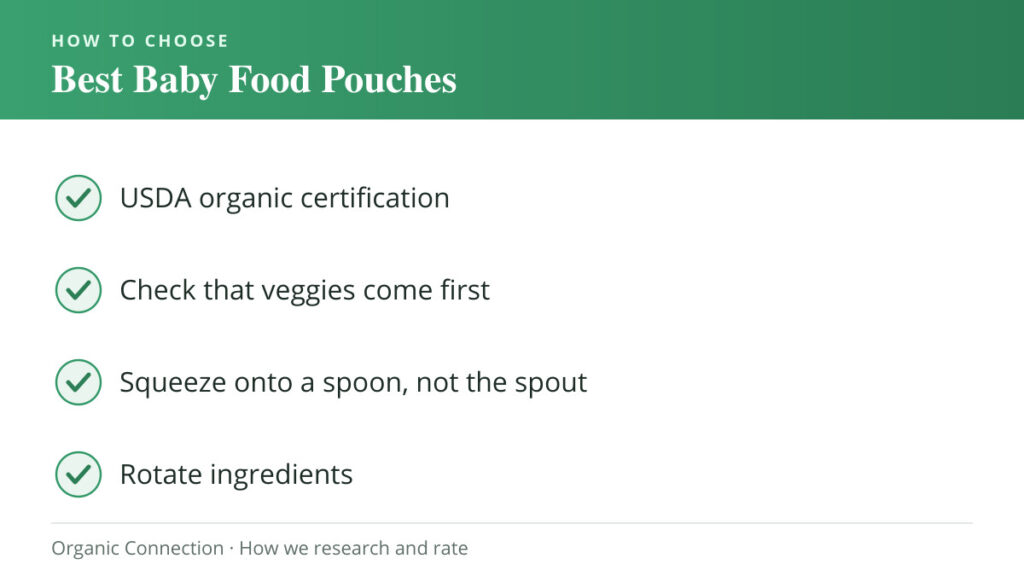
How to choose organic baby food pouches
- Confirm USDA organic. The exposure question is proportionally larger for infants.
- Read the ingredient order. Vegetables first, not apple or pear.
- Match the stage. Single ingredients at Stage 1 make reactions easy to identify.
- Squeeze onto a spoon. It preserves the oral-motor practice that sucking skips.
- Rotate ingredients and limit rice-based products, because of heavy metal accumulation.
Who should buy organic baby food pouches
The right pouch depends on age and use. If you want the cleanest single-ingredient Stage 1 pouch, our top pick fits. If you want a variety pack, a first-foods prune option, cold-pressed purées, or a broad sampler, we have a pick for each.
Best overall: Happy Baby Organics Clearly Crafted Stage 1
| Organic Integrity Score | 90 / 100 |
| Ingredients | Single organic ingredient, Stage 1 |
| Certification | USDA Organic, Non-GMO |
| Best for | First foods and identifying reactions |
Clearly Crafted is our top pick because it gets the Stage 1 job exactly right and shows its work. Single ingredient means you can introduce one food at a time and know immediately what caused a reaction, which is the whole point of early weaning purées and is surprisingly rare in a category full of five-fruit blends. It is USDA certified organic, and Happy Baby publishes ingredient origin information on the pack, which is more transparency than almost any competitor offers. Prunes specifically are also useful for the constipation that commonly accompanies starting solids.
The trade-off is that single-ingredient purées are, by design, plain, so a baby used to sweet blends may push back. Pouches also cost considerably more per ounce than home-cooked purée, and Happy Baby, like most of the category, has been named in heavy metal testing reports, which is a reason to rotate ingredients rather than rely on any one.
What we liked: USDA organic single-ingredient purée ideal for introducing foods one at a time, with published ingredient origins.
Keep in mind: Plain by design, expensive versus homemade, and rotate ingredients given category-wide heavy metal findings.
What the listing discloses: You are told USDA organic certification for Happy Baby; you are not told where it was grown or made.
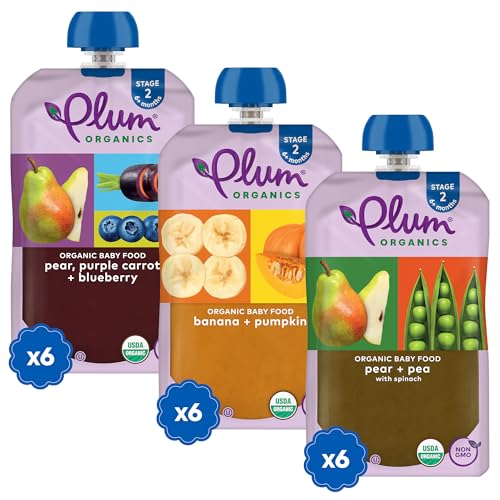
Best value variety: Plum Organics 6+ Months Variety Pack, 18 Pouches
| Organic Integrity Score | 86 / 100 |
| Ingredients | Organic fruit and vegetable blends, three flavors |
| Certification | USDA Organic, Non-GMO, Kosher |
| Best for | Everyday convenience once solids are established |
Eighteen pouches across three flavors at the best cost per pouch here makes this the practical everyday choice once a baby is past first foods and eating blends. Plum Organics is USDA certified organic and Non-GMO, the pouches are quality tested, and the variety means you are rotating ingredients rather than feeding the same purée daily, which is genuinely good practice given heavy metal accumulation.
The trade-off is the fruit-first issue this guide opened with: several Plum blends lead with apple or pear, so read the specific flavors in the pack rather than assuming a “veggie” name means vegetables dominate. Blends also make it harder to identify what caused a reaction, so they belong after single ingredients have been introduced.
What we liked: USDA organic and Non-GMO at the best cost per pouch, with three flavors that encourage ingredient rotation.
Keep in mind: Several blends lead with apple or pear, and blends make reactions harder to attribute.
What the listing discloses: Plum Organics lists a USDA organic claim and kosher certification. The gap is where it was grown or made.
Best first food: Plum Organics Just Prunes, 4+ Months, 12-Pack
| Organic Integrity Score | 83 / 100 |
| Ingredients | Organic prunes only |
| Certification | Non-GMO Project Verified, Certified Organic, Kosher |
| Best for | Very first purées and constipation when starting solids |
A single-ingredient organic prune purée, which is one of the genuinely useful specific products in this category. Constipation is extremely common when babies transition from milk to solids, and prunes are the standard first-line food response. Being single-ingredient and USDA organic, it also works as a straightforward early introduction food.
It scores below the picks above for a specific reason worth flagging: the 4+ months labeling. Current guidance from major pediatric bodies is that solids generally begin around six months, and 4-month labeling on the shelf leads some parents to start earlier than advised. Talk to your pediatrician about timing rather than taking the box as guidance. Prunes are also, unsurprisingly, effective, so start with a small amount.
What we liked: USDA organic single-ingredient prune purée, genuinely useful for the constipation that accompanies starting solids.
Keep in mind: The 4+ month labeling runs ahead of standard guidance to start solids around six months; ask your pediatrician.
What the listing discloses: Plum Organics lists Non-GMO Project Verified and kosher certification. The gap is whether the USDA seal applies and where it was grown or made.
Best cold-pressed: Once Upon a Farm Organic Baby Food Trial Pack, 16 Count
| Organic Integrity Score | 80 / 100 |
| Ingredients | Organic fruit, vegetable, and whole-food blends |
| Certification | Non-GMO Project Verified, Organic |
| Best for | Fresher-tasting purées closer to home-cooked |
Once Upon a Farm uses high-pressure processing rather than heat retorting, which is the meaningful difference here: shelf-stable pouches are heated substantially to sterilize them, which flattens flavor and degrades some nutrients, while cold-pressed purées taste noticeably fresher and closer to food you would make at home. That better flavor also means less need for sweet fruit to carry the blend, which addresses one of the category’s real problems.
The trade-off is that cold-pressed means refrigerated or frozen, so these need cold storage and do not go in a changing bag for a day out, which removes much of the convenience that makes pouches appealing in the first place. They are also the most expensive per pouch here by a clear margin.
What we liked: Cold-pressed rather than heat-retorted, so flavor is fresher and blends rely less on sweet fruit to be palatable.
Keep in mind: Requires refrigeration or freezing, so it loses the shelf-stable convenience, and it is the priciest option.
What the listing discloses: You are told Non-GMO Project Verified for Once Upon a Farm; you are not told whether the USDA seal applies and where it was grown or made.
Best broad sampler: Once Upon a Farm Organic Baby Food Sampler, 24 Count
| Organic Integrity Score | 76 / 100 |
| Ingredients | Organic blends across six flavors |
| Certification | Non-GMO Project Verified, Organic |
| Best for | Exposing a baby to the widest range of flavors |
Twenty-four pouches across six flavors gives the broadest flavor exposure of anything here, which matters more than it sounds: repeated exposure to varied flavors, including less sweet ones, is how infants learn to accept a wide diet, and variety also rotates ingredients away from over-relying on any single crop.
It scores lowest here on practicality rather than quality. Twenty-four frozen or refrigerated pouches is a serious freezer commitment, the cost is the highest in the guide, and a sampler by definition includes flavors your baby may reject, so waste is more likely than with a pack of known favorites. Excellent for the exploration phase, expensive as a staple.
What we liked: The widest flavor exposure here in USDA organic cold-pressed form, which supports accepting a varied diet.
Keep in mind: Significant freezer space, the highest cost here, and samplers inevitably include flavors that get rejected.
What the listing discloses: Once Upon a Farm states Non-GMO Project Verified, and does not say whether the USDA seal applies and where it was grown or made.
Using pouches well
Three habits make pouches a good part of feeding rather than a problem. First, squeeze the contents onto a spoon or into a bowl instead of letting the baby suck from the spout. This single change preserves the oral-motor practice that sucking bypasses and is the main thing pediatric feeding specialists ask for. Second, keep pouches as a minority of meals, alongside mashed, lumpy, and finger foods that give real texture experience. Third, rotate ingredients rather than repeating the same purée daily, which spreads any heavy metal exposure and broadens flavor learning at the same time.
Practical handling: check the cap is intact before buying or using, since a loose cap means the seal may be broken. Never feed directly from a pouch that has been open more than a couple of hours at room temperature, and refrigerate an opened pouch and use it within 24 hours. Do not heat pouches in the microwave in the pouch; squeeze into a bowl first, since uneven heating creates hot spots. Watch the small cap around crawling babies, as it is a choking hazard. And remember homemade purée is far cheaper and easy: steam and blend whatever vegetable you are already cooking, freeze in an ice cube tray, and you have portioned baby food for pennies. Pouches are for when that is not practical, which is often enough to make them worth keeping in the bag. More on the wider picture in our guide to going organic for babies and families.
Heavy metals: the problem organic certification does not solve
Keep in mind: in February 2021 a US House Oversight subcommittee staff report found that baby foods from leading brands contained significant levels of toxic heavy metals — arsenic, lead, cadmium and mercury. The finding that matters most for this guide is that this included products labeled organic, across jars, pouches, puffs, rice cereal and juice. Reported test results ran dramatically above EPA/FDA standards for drinking water: up to 91 times the arsenic level, 177 times the lead level, 69 times the cadmium level and 5 times the mercury level. A follow-up report in September 2021 added further findings. Exposure at this age is linked to lower IQ, behavioral problems and attention difficulties, and the damage to brain development can be irreversible.
The reason organic does not help is the same one we flag across this site, and it is starkest here: heavy metals are soil and water contaminants, not sprays. Organic certification governs what was applied to the crop. It has nothing to say about lead or cadmium the plant drew up from the ground, or arsenic taken up by rice. An organic sweet potato purée and a conventional one face the same problem.
The investigation prompted the FDA’s “Closer to Zero” action plan, which is setting action levels for heavy metals in food intended for babies and young children. That work is ongoing and has produced levels for some categories.
What actually reduces exposure
This is where a parent has real leverage, and it is more about which foods than which brand.
| Higher risk | Why | Lower-risk swap |
| Rice cereal, rice puffs, brown rice syrup | Rice takes up inorganic arsenic from soil more than most crops | Oat, barley or multigrain cereal |
| Sweet potato and carrot purées | Root vegetables concentrate lead and cadmium from soil | Rotate rather than repeat daily |
| Fruit juice | Concentrates whatever was in the fruit; low nutritional value | Whole fruit; juice is not recommended under 12 months |
| Any single food eaten daily | Repetition concentrates whatever that crop accumulates | Variety is the strongest single protection |
- Rotate foods and grains. The most effective and least stressful step. No single purée should be a daily fixture for months.
- Rice cereal is no longer the default first food. Pediatric guidance has moved away from it, and oat or barley cereal is a straightforward substitute.
- If you cook rice for a baby, boil it in excess water and drain, which reduces inorganic arsenic substantially compared with the absorption method.
- Buy from brands that publish heavy metal testing per batch. Several now do, and it is far more informative than the organic seal on this specific question.
- Make some food at home where practical — not because homemade is automatically lower, but because it lets you vary ingredients cheaply.
Perspective matters too. This is a reason to vary the diet and prefer tested brands, not a reason for panic or for avoiding commercial baby food entirely. A varied diet including some pouches is not a hazardous one.
The sugar in fruit-forward pouches
Read the ingredient order rather than the picture on the front. A pouch showing spinach and kale prominently is frequently apple or pear purée first, with the green vegetables well down the list — fruit is cheap, sweet and shelf-stable, and it is doing most of the work.
- “No added sugar” is accurate and beside the point. Concentrated fruit purée carries substantial free sugars whether or not anything was added.
- Check the order. If you want a vegetable pouch, the vegetable should be first.
- Watch fruit juice concentrate in the list, which is a sweetener however it is described.
- The taste-preference argument is the real one. Sweet purées are readily accepted, and consistently offering them makes bitter vegetables a harder sell later. Single-vegetable pouches and actual vegetables at the table are worth persisting with.
- Typical pouches run 8–12 g of sugar, most of it from fruit. That is not alarming occasionally and adds up as a daily habit.
How pouches are used matters as much as what is in them
Our section above covers the main drawbacks. Three practical points worth being specific about:
- Squeeze into a bowl and spoon-feed where you can. Sucking purée straight from the spout bypasses the chewing and tongue movement that develop oral motor skills, and it removes the sensory experience of texture, color and smell that helps babies learn to accept food.
- Do not let a baby carry a pouch around and graze. Prolonged sipping bathes the teeth in fruit sugars and acids for extended periods, which is the pattern dentists associate with early childhood caries. It is the same mechanism as a bottle at bedtime.
- The cap is a choking hazard. Screw caps are small, hard and exactly the size that causes problems. Keep them out of reach while feeding and dispose of them immediately.
- Pouches are a supplement, not a system. Babies need to see, touch and chew food to learn to eat. Use pouches for travel, nursery and awkward days, and offer real textures at home.
- Check the spout for damage before each use, and never let an older baby bite the spout, which can detach pieces.
Handling and storage
- Never feed directly from a pouch you intend to save. Saliva introduces bacteria and the contents will spoil quickly. Squeeze the portion you need into a bowl and refrigerate the rest.
- Once opened, refrigerate and use within 24 hours, or follow the manufacturer’s shorter guidance.
- Do not warm a pouch in the microwave. It heats unevenly and creates scalding pockets. Stand it in warm water instead, and stir after decanting.
- Discard any pouch that is swollen, leaking or hisses on opening, or where the contents smell fermented. These are low-acid sealed foods and spoilage is not something to take chances with.
- Check dates carefully. Pouches are often bought in bulk multipacks and stored at the back of a cupboard for months.
- Store unopened at room temperature unless the product is a chilled cold-pressed line, which must stay refrigerated throughout.
This guide summarizes published findings and general guidance and is not medical advice. For questions about your baby’s diet, speak to your pediatrician or health visitor.
How we researched this guide
We are a research-based review site. We compared each product against its certification (USDA organic), ingredient order and purity, processing method, testing and sourcing transparency, stage suitability, and the weight of aggregated parent feedback, then scored each with our 10-criteria Organic Integrity Score. No brand paid to be included or ranked. Nothing here is medical advice, and decisions about when and what to feed your baby belong with your pediatrician. Read the full method on our How We Research and Rate page.
Common questions about organic baby food pouches
What are the best organic baby food pouches?
Our overall pick is Happy Baby Organics Clearly Crafted Stage 1, because it is USDA certified organic, single-ingredient so reactions are easy to identify, and Happy Baby publishes ingredient origins. For a value variety pack, Plum Organics 6+ Months is our pick, and for cold-pressed purées, Once Upon a Farm.
Are baby food pouches bad for babies?
Not inherently, but two criticisms are well founded. Sucking a smooth purée from a spout skips the chewing and texture management babies need to learn, and many blends are fruit-led and sweeter than real vegetables. Both are solved by squeezing the contents onto a spoon and keeping pouches as a minority of meals alongside textured food.
Why do so many vegetable pouches list apple first?
Because apple and pear purée is cheap, sweet, and reliably accepted by babies, so it is used as a base to carry vegetables that would otherwise be rejected. Read the ingredient order: if apple or pear comes first, you are feeding a fruit purée with vegetables in it rather than a vegetable purée.
Do organic baby foods contain heavy metals?
They can, and organic certification does not address it. Rice, sweet potato, and carrots take up arsenic, lead, and cadmium from soil, and independent testing has found detectable levels across the category including organic brands, because certification concerns applied chemicals rather than soil uptake. Rotating ingredients and limiting rice-based products is the practical response.
When should babies start solid food?
Major pediatric bodies generally advise starting solids around six months, though some products on the shelf are labeled 4+ months. Take the timing question to your pediatrician rather than the packaging, since readiness depends on the individual baby’s development rather than a date on a box.
Does organic baby food contain heavy metals?
It can, and the 2021 US House Oversight subcommittee report found significant levels of arsenic, lead, cadmium and mercury in baby foods including products labeled organic, across jars, pouches, puffs, rice cereal and juice. Reported results ran far above EPA/FDA drinking water standards. Organic certification does not help here because heavy metals are soil and water contaminants rather than sprays — the seal governs what was applied to the crop, not what the plant drew up from the ground.
How do you reduce heavy metal exposure in baby food?
Variety is the strongest single protection — no purée should be a daily fixture for months. Limit rice-based products, since rice takes up inorganic arsenic more than most crops, and use oat or barley cereal instead. Rotate root vegetables like sweet potato and carrot rather than repeating them daily. Skip fruit juice, which is not recommended under 12 months anyway. And buy from brands publishing per-batch heavy metal testing, which is more informative than the organic seal on this question.
Is rice cereal still recommended as a first food?
No. Pediatric guidance has moved away from rice cereal as the default first food because of inorganic arsenic, and oat or barley cereal is a straightforward substitute. If you cook rice for a baby at home, boil it in excess water and drain, which reduces arsenic substantially compared with the absorption method.
How much sugar is in baby food pouches?
Typically 8 to 12 g, most of it from concentrated fruit purée. “No added sugar” is accurate and beside the point — fruit purée carries substantial free sugars regardless. Read the ingredient order rather than the picture: a pouch showing spinach and kale is frequently apple or pear first, with the greens well down the list, because fruit is cheap, sweet and shelf-stable.
Should babies eat straight from the pouch?
Better to squeeze it into a bowl and spoon-feed. Sucking purée from the spout bypasses the chewing and tongue movement that develop oral motor skills, and removes the sensory experience of texture, color and smell that helps babies learn to accept food. Pouches work well for travel and nursery; real textures at home are what build eating skills.
Are pouches bad for babies’ teeth?
Grazing from one is. Prolonged sipping bathes teeth in fruit sugars and acids for extended periods, which is the pattern dentists associate with early childhood caries — the same mechanism as a bottle at bedtime. Do not let a baby carry a pouch around and sip at it over an hour.
Are pouch caps a choking hazard?
Yes. Screw caps are small, hard and exactly the size that causes problems. Keep them out of reach during feeding and dispose of them immediately. Check the spout for damage before each use too, and do not let an older baby bite it, since pieces can detach.
How long does an opened baby food pouch last?
24 hours refrigerated, or less if the manufacturer says so — and only if you have not fed directly from it. Saliva introduces bacteria and the contents will spoil quickly, so squeeze out the portion you need and refrigerate the rest. Do not microwave a pouch, since it heats unevenly and creates scalding pockets. Discard any pouch that is swollen, leaking, hisses on opening or smells fermented.
- Organic Food & Pantry hub
- Best Organic Baby Formula
- Best Natural Diapers
- Switching to Organic for Babies and Families
- our searchable product database — compare all 800+ picks side by side
- Best Organic Applesauce
- Lead in cinnamon and ground spices
Price and availability as of October 11, 2026 7:10 pm EDT. Product prices and availability are accurate as of the date/time indicated and are subject to change. Any price and availability information displayed on Amazon.com at the time of purchase will apply to the purchase of this product.
Looking for other organic products?
We have checked more than 800 products across food, household goods, gardening, personal care and pet, every one against its stated certification. Browse all reviews.
Organic Connection is reader-supported. When you buy through links on this page we may earn a commission, at no extra cost to you. As an Amazon Associate we earn from qualifying purchases. We are not paid to feature or rank any product. This page is informational and is not medical advice. How we research and rate.