Last updated: September 30, 2026
We may earn a commission when you buy through links on this page, at no extra cost to you. How we research and rate.
The short version
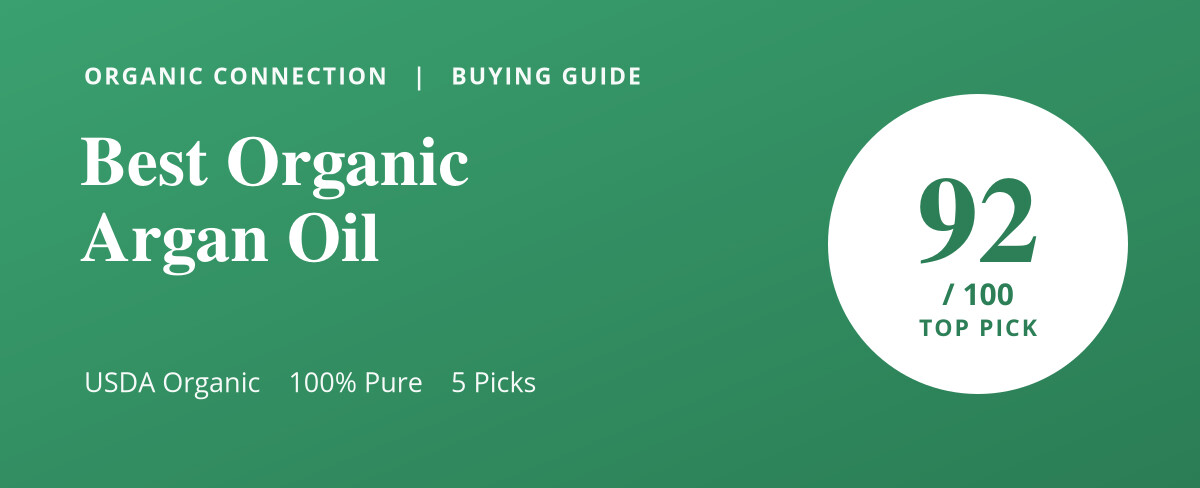
After researching the certifications, extraction, and purity of the most popular organic argan oils, our top pick is Cliganic Organic Argan Oil. It is USDA certified organic, 100 percent pure single-ingredient cold-pressed Moroccan argan with no synthetic additives or carrier oils, which is why it earned our highest Organic Integrity Score of 92 out of 100. For a larger bottle with the same certification, PURA D’OR Organic Moroccan Argan Oil, 4 oz is our pick, and for dual USDA and Ecocert certification, 100% Pure Organic Argan Oil, 8 fl oz is the best choice.
With argan oil, the two things that matter most are whether the organic claim is actually certified and whether the bottle is pure argan or a diluted blend. We flag each product’s certification and purity.
Best organic argan oil compared
| Best Choice | Best Value | ||||
 |  | |  |  | |
| Product | Cliganic Organic Argan | PURA D’OR 4 oz | 100% Pure Organic 8 oz | Kate Blanc 4 oz Light | US Organic Moroccan 2 oz |
| Organic Integrity Score | 92/ 100 | 89/ 100 | 85/ 100 | 80/ 100 | 76/ 100 |
| Our rating | 4.6 | 4.5 | 4.3 | 4.0 | 3.8 |
| Purity | 100% pure, one ingredient | 100% pure | 100% pure | 100% pure | 100% pure, unrefined |
| Best for | Best overall | Hair, face, and skin | Best value per ounce | Lighter texture | Amber glass, travel |
| Certification | USDA Organic, Non-GMO Project Verified, Certified Vegan | USDA Organic | USDA Organic, Ecocert | Certified Organic | USDA Organic, Leaping Bunny |
| Price | $9.98 $11.99 −17%$4.99 / fluid ounce View on Amazon | $16.99$4.25 / fluid ounce View on Amazon | $21.99 $25.99 −15%$2.75 / fluid ounce View on Amazon | $25.99$6.50 / fluid ounce View on Amazon | $21.99$11.00 / fluid ounce View on Amazon |
Price and availability as of October 11, 2026 7:10 pm EDT. Product prices and availability are accurate as of the date/time indicated and are subject to change. Any price and availability information displayed on Amazon.com at the time of purchase will apply to the purchase of this product.
Scores are ours, based on independent research of certification, purity, extraction method, packaging, and value, using the same 10-criteria method we apply to every product. See how we research and rate.
What each certification on an organic argan oil label actually covers
Seals accumulate on a package faster than meaning does. This is what each of the marks you will see here certifies, and what it leaves out.
| Certification | Covers | Key exclusion |
| USDA Organic | Farming and handling: no synthetic pesticides or fertilizers, no GMOs, no sewage sludge or irradiation, audited yearly by an accredited certifier | Three different tiers share the one seal, and it makes no claim about worker pay, food miles, or nutrition |
| GOTS | Organic fiber from farm to finished textile, plus dyeing, finishing, wastewater and labor criteria | Has a weaker second tier, “made with organic”, that needs only 70% organic fiber and carries the same name |
| COSMOS Organic | Cosmetics: organic content thresholds, permitted processes and ingredients, and packaging rules | Its sister grade, COSMOS Natural, carries the same name and requires no minimum organic content at all |
COSMOS is two standards with one name, and the weaker one is easy to miss. COSMOS Organic requires at least 95% of the plant ingredients to be organic. COSMOS Natural, printed in the same typeface by the same body, requires no minimum organic content whatsoever: it governs which ingredients and processes are permitted, not how much of the product is organic. If the word after COSMOS is “Natural”, the organic question is still open.
Key things to look for in organic argan oil
Great argan oil is about certification, purity, extraction, and packaging. Here is what matters.
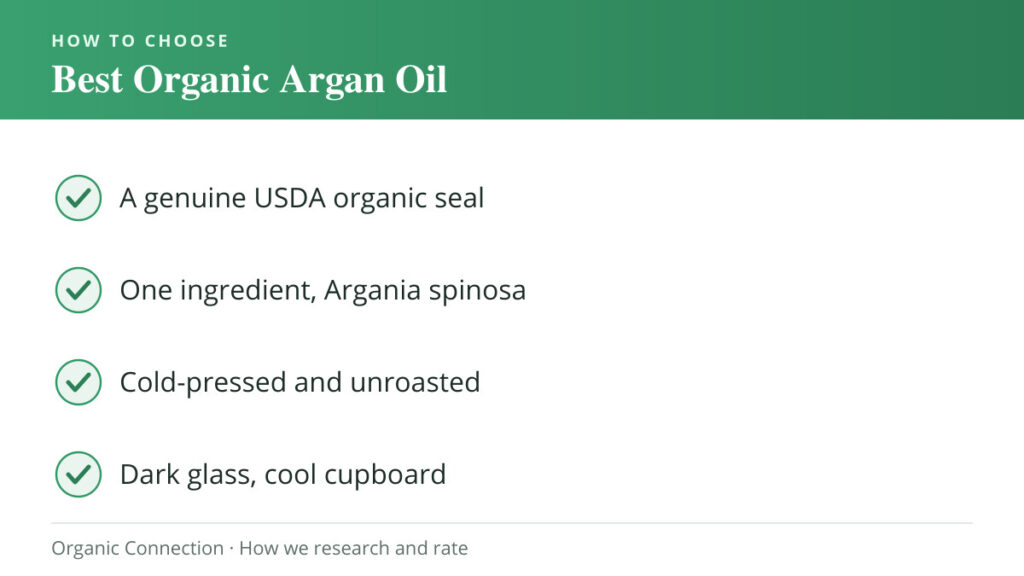
1. A genuine USDA organic seal
Cosmetics labeling is lightly regulated, so “organic” on the front means nothing on its own. Look for the certification mark.
2. 100 percent pure argan, one ingredient
The ingredient list should read Argania spinosa kernel oil and stop. Anything else means you are buying a blend.
3. Cold-pressed and unroasted
Cold pressing preserves the vitamin E and fatty acids. Roasted kernels make culinary argan oil, which smells strongly nutty.
4. Dark glass packaging
Light oxidizes argan oil. Amber or cobalt glass protects it; clear plastic does not.
Cosmetic versus culinary, and how to spot dilution
There are two genuinely different argan oils and they are not interchangeable. Cosmetic argan oil is pressed from raw, unroasted kernels; it is pale gold, has a light nutty smell that fades within minutes of application, and is what you want for skin and hair. Culinary argan oil is pressed from kernels that have been roasted first, which gives it a deep amber color and a strong, persistent nutty aroma closer to toasted sesame oil. Culinary oil is delicious drizzled on food and smells far too strong to wear. If a bottle smells intensely nutty hours after you applied it, you probably bought the culinary grade.
Dilution is the more common problem. Genuine pure argan oil is expensive, so a suspiciously cheap large bottle is the clearest warning sign there is. Read the ingredient list rather than the marketing: if you see Simmondsia chinensis (jojoba), Prunus amygdalus dulcis (sweet almond), cyclopentasiloxane or dimethicone (silicones), or paraffinum liquidum (mineral oil), you have a blend, which may still be a perfectly nice product but is not what you are paying argan prices for. Genuine oil is pale gold rather than water-clear or dark brown, absorbs within a couple of minutes rather than sitting greasy on the surface, and has a faint nutty note. Also worth knowing: argan oil oxidizes, and rancid oil smells sharp and crayon-like rather than nutty. That is why dark glass, a cool cupboard, and finishing a bottle within a year of opening all matter more than they do for a shelf-stable cosmetic.
Cosmetic versus culinary argan, and why the kernels differ
Argan oil is sold in two genuinely different forms, and buying the wrong one is a common and avoidable mistake.
The difference is roasting. Both start from the kernels inside the argan nut. For cosmetic oil the kernels are left unroasted, producing a pale golden oil with a faint, mild nutty smell. For culinary oil the kernels are roasted first, which produces a darker oil with a pronounced toasted, almost hazelnut aroma and a much stronger flavor. Culinary argan is excellent drizzled over food and on bread with honey, and it is not what you want on your face, where the roasted aroma is strong and the roasting has altered the composition.
If a bottle smells strongly nutty and toasted, it is culinary. Cosmetic argan should smell faint and slightly nutty at most, and completely odorless argan has usually been deodorized, which strips some of what you paid for.
What is actually in it. Argan oil is an unusually good source of tocopherols, the vitamin E family, at roughly 600 to 900 mg per kilogram of oil. What makes it distinctive is the form: around 69% of its tocopherol content is gamma-tocopherol rather than the alpha-tocopherol that dominates most oils. Gamma-tocopherol is more effective than alpha at neutralizing reactive nitrogen species, which is a meaningful and under-advertised point of difference. Alongside that sit phenolic compounds including caffeic acid, oleuropein, vanillic acid, tyrosol, and catechol.
The co-operative question. Argan grows commercially only in southwestern Morocco, largely within the Arganeraie Biosphere Reserve, and the nuts are traditionally collected and hand-processed by rural women. Women’s co-operatives were established specifically so that income from a globally valuable oil reaches the households doing the labor, and buying from brands that source through certified co-operatives is one of the more direct ways a purchase decision affects producers. It is worth checking whether a brand names its co-operative or simply says “Moroccan”.
How to choose organic argan oil
- Look for the USDA organic seal. The word “organic” alone on a cosmetic label is unregulated.
- Check the ingredient list. One ingredient: Argania spinosa kernel oil.
- Choose cold-pressed and unroasted for skin and hair; roasted is the culinary grade.
- Prefer dark glass. Light degrades the oil, and clear plastic offers no protection.
- Be suspicious of cheap large bottles. Real argan oil is expensive to produce.
Who should buy organic argan oil
The right bottle depends on how much you use and where. If you want the cleanest certified single-ingredient argan oil, our top pick fits. If you want a larger bottle, dual certification, an amber glass bottle for a bathroom shelf, or a small size to try, we have a pick for each.
Best overall: Cliganic Organic Argan Oil
| Organic Integrity Score | 92 / 100 |
| Purity | 100% Argania spinosa kernel oil, no additives |
| Certification | USDA Organic, Non-GMO Project Verified, Certified Vegan |
| Best for | Face, hair ends, cuticles, and dry patches |
Cliganic is our top pick because it clears the two bars this category is built on. It carries a genuine USDA organic certification rather than an unregulated “organic” claim, and it is a single-ingredient product: cold-pressed Moroccan argan oil with no carrier oils, no silicones, no fragrance, and no preservatives. Cliganic is a carrier-oil specialist rather than a general beauty brand, which shows in the consistency between batches, and the oil absorbs cleanly with only a faint nutty note that fades in a couple of minutes.
The trade-off is that a pure oil is a single-purpose product without the pleasant fragrance or fast-slip feel of a formulated serum, so some people find it plain. Bottles are also on the smaller side, and pure argan oil is expensive by the ounce compared with the blended “argan” products it sits next to on a shelf.
What we liked: Genuine USDA organic certification, one single ingredient, cold pressed, consistent batch to batch, and it absorbs cleanly.
Keep in mind: Plain by design, small bottles, and expensive per ounce next to blended products.
What the listing discloses: You are told USDA organic certification, Non-GMO Project Verified and a single-ingredient formula for Cliganic; you are not told where it was grown or made.
Best for hair and skin: PURA D’OR Organic Moroccan Argan Oil, 4 oz
| Organic Integrity Score | 89 / 100 |
| Purity | 100% pure Moroccan argan oil, single ingredient, unrefined |
| Certification | USDA Organic, stated on the listing |
| Processing | Cold-pressed, virgin, hexane-free |
| Best for | Hair first, then face, skin and nails |
PURA D’OR states the four things that matter on an argan oil and does not pad them out: USDA Organic, cold-pressed, virgin and unrefined, and a single ingredient. Hexane-free is stated too, which is worth having in writing, because hexane extraction is the cheap alternative to cold pressing and it is rarely mentioned by the listings that use it.
The brand is primarily a haircare company, and that suits this slot. Argan oil earns its keep fastest on hair, where a few drops tame frizz and coarse ends, and hair gets through a bottle far quicker than a face does. At 4 oz this is a sensible size for someone using it head to nails rather than only as a facial oil.
The usual caution for any unrefined oil applies. It oxidises once opened, so a 4 oz bottle used only on your face may go past its best before you reach the bottom. Keep it cool and dark, and buy this size only if hair is part of the plan.
What we liked: USDA Organic, cold-pressed, virgin, unrefined and single-ingredient, with hexane-free stated rather than implied. A practical 4 oz size for hair and skin.
Keep in mind: Four ounces is a lot to finish before an unrefined oil oxidises, if you use it only on your face. The listing sprawls across a dozen use cases, which buries the specification.
What the listing discloses: PURA D’OR documents a USDA organic claim and a single-ingredient formula, and leaves where it was grown or made unsaid.
Best value: 100% Pure Organic Argan Oil, 8 fl oz
| Organic Integrity Score | 85 / 100 |
| Purity | 100% pure, cold pressed from Morocco |
| Certification | USDA Organic, Ecocert |
| Best for | Heavy users, hair treatments, and full-body use |
Dual certification is what earns this a place: certified organic by both the USDA and Ecocert, the French body whose cosmetic organic standard is widely used across Europe. Two independent certifications on the same bottle is a stronger signal than one, and at 8 fl oz the cost per ounce is the lowest here by a clear margin, which makes full-body or regular hair-mask use affordable rather than extravagant.
The trade-off is the size itself. Eight ounces of an oxidation-prone oil is a large commitment, and unless you are using it liberally on hair and body you will not finish it within a year. Decant a small working amount into a dark dropper bottle and keep the main bottle sealed, cool, and dark.
What we liked: Dual USDA and Ecocert certification, cold pressed from Morocco, and by far the best cost per ounce here.
Keep in mind: Eight ounces will oxidize before a light user finishes it; decant and store the rest sealed.
What the listing discloses: You are told USDA organic certification, Non-GMO Project Verified and a single-ingredient formula for Cliganic; you are not told where it was grown or made.
Best lighter texture: Kate Blanc Cosmetics Argan Oil, Light
| Organic Integrity Score | 80 / 100 |
| Purity | 100% pure Moroccan argan oil |
| Certification | Certified Organic |
| Best for | Oily or combination skin and fine hair |
The lighter variant is aimed at people who find pure argan too rich, particularly those with oily or combination skin and fine hair that goes limp under a heavier oil. It is the same USDA certified organic, cold-pressed, 100 percent pure argan; the difference is in the sensory feel and how quickly it sinks in, which for fine hair is the difference between glossy and greasy.
It scores below the standard version because “light” is a formulation and sensory distinction rather than a certification or purity one, and for very dry skin the standard oil simply performs better. Choose by your skin and hair type rather than by the score.
What we liked: Same certification and purity in a texture that suits fine hair and oilier skin.
Keep in mind: Less effective on very dry skin than the standard oil; the difference is sensory, not certification.
What the listing discloses: Kate Blanc Cosmetics lists a single-ingredient formula. The gap is whether the USDA seal applies and where it was grown or made.
Best small bottle: US Organic Moroccan Argan Oil, 2 oz Amber Glass
| Organic Integrity Score | 76 / 100 |
| Purity | 100% pure, cold-pressed virgin, unrefined |
| Certification | USDA Organic, Leaping Bunny |
| Best for | Trying argan oil, travel, and cuticle or nail care |
Amber glass is the correct packaging for an oxidation-prone oil, and this 2 oz bottle is the only one here that leads with it. It is USDA certified organic, cold-pressed virgin, unrefined argan sourced from Morocco, and the small size means you will finish it while it is still fresh, which for a light user is genuinely better than a large bottle going off in a cupboard.
It scores lowest on economics: 2 oz is the highest cost per ounce here by some distance, and small-bottle argan oil is always an expensive way to buy it. It is the right choice for a first purchase, for travel, or for someone who only uses a few drops on nails and cuticles.
What we liked: Proper amber glass packaging, USDA certified unrefined virgin oil, and a size that stays fresh for light users.
Keep in mind: The highest cost per ounce in this guide.
What the listing discloses: US Organic documents itself unusually well, stating USDA organic certification, a Leaping Bunny mark, an origin of the USA and Morocco and a single-ingredient formula.
How to actually use argan oil
The most common mistake is using far too much. Argan oil is potent and a little goes a long way: two or three drops is enough for a whole face, and four or five for mid-lengths and ends of hair. Warm it between your palms first, then press it into damp skin rather than rubbing it into dry skin; applying to damp skin traps water underneath and is the difference between a moisturized feel and an oily film. On the face it works as the last step of an evening routine, after any water-based serum, and it is comparatively low on the comedogenic scale, which makes it one of the better facial oils for skin that is dry but breakout-prone.
On hair, keep it to the mid-lengths and ends and stay well away from the roots, where it will simply look greasy. A few drops on damp hair before drying tames frizz; a more generous application left on for an hour before washing works as a pre-shampoo treatment for dry or chemically treated hair. It is also excellent on cuticles, elbows, and the dry patches nothing else fixes. Patch test on your inner forearm for 24 hours before first use, particularly if you have a tree nut allergy, since argan is a tree kernel oil. Store it in a cool, dark cupboard rather than a sunny bathroom windowsill, keep the cap on tight, and replace it if it ever smells sharp or crayon-like rather than faintly nutty, which is the sign it has oxidized. Most bottles are best used within a year of opening.
The authenticity checklist
Argan is expensive, which makes it worth adulterating, and dilution with cheaper oils is the most common form. There is no home test that proves purity, but there are several signals that together tell you a lot.
| Check | Genuine cosmetic argan | Warning sign |
| Ingredient list | Argania spinosa kernel oil, and nothing else | Any additional oil, fragrance, preservative or filler |
| Color | Golden yellow to light amber | Colorless, or very dark (that is culinary oil) |
| Clarity | Slightly cloudy; a little sediment at the bottom is normal and indicates unfiltered oil | Perfectly clear and water-thin |
| Smell | Mild, nutty, faintly earthy — and it fades within minutes on skin | No smell at all usually means deodorized; a strong perfume smell means added fragrance |
| Texture | Light and silky, absorbs quickly without greasy residue | Watery, or heavy and slow to absorb |
| Packaging | Dark glass | Clear plastic |
| Price | Genuinely expensive | Suspiciously cheap for the volume |
Keep in mind: the smell test cuts both ways and is widely misreported. Pure cosmetic argan has a mild nutty scent that dissipates — so a bottle with no scent whatsoever has most likely been deodorized, a high-temperature process that strips the odor along with some of the minor constituents. Deodorized argan is not fake and it is not bad; many people prefer it, particularly for hair, and it is what most salon products use. But it is a processed product, and if you are paying a premium for unrefined cold-pressed oil, an absence of smell means you did not get it.
Cosmetic and culinary are made from different kernels
Our sections above cover this. The short version worth having in one place: cosmetic argan is pressed from unroasted kernels; culinary argan from roasted ones. Cosmetic oil is golden yellow with a mild scent. Culinary oil is darker amber with a pronounced toasted, nutty aroma, and is used on couscous, salads and in amlou.
They are not interchangeable. Culinary argan on your face will smell strongly of roasted nuts and its composition has been altered by roasting; cosmetic argan on food tastes flat and, if deodorized, has been processed in ways not intended for eating. If a seller offers one bottle “for both”, that is a reason to look elsewhere.
The cooperative story, honestly told
Argan is sold on a genuinely appealing narrative: Berber women in Morocco’s Souss valley hand-cracking nuts from thorny trees, organized into cooperatives, with the traditional knowledge inscribed on UNESCO’s Representative List of the Intangible Cultural Heritage of Humanity in 2014. All of that is true.
The part usually left out is what happened next. The global argan industry is now worth well over $700 million, and reporting on the sector has found that the women’s cooperatives are being pushed to the margins of it — with profits from the cosmetic boom rarely finding their way back to the people doing the labor-intensive work at source. Growth in the market has not translated into proportionate gains for the producers whose image sells it.
What that means practically:
- “Made by a women’s cooperative” on a label is not audited. It is a marketing claim like any other unless backed by something verifiable.
- Fair trade certification, or a brand that names the specific cooperative and publishes what it pays, is worth considerably more than the story on the bottle.
- Buying direct from Moroccan cooperatives is possible and is the most reliable route if this matters to you.
- Organic certification does not address any of this — it covers the trees, not the terms of trade. The two claims answer different questions and neither substitutes for the other.
What argan is actually good at
- Comedogenic rating 0 — it does not block pores, which puts it among the safest facial oils for acne-prone skin, alongside jojoba.
- High in vitamin E and oleic and linoleic acids, giving a light, fast-absorbing feel that suits faces better than heavier butters and oils.
- Hair: excellent on lengths and ends as a leave-in serum. Two or three drops warmed between palms is plenty; more makes hair greasy and is the most common mistake.
- Nails and cuticles, where its absorbency is an advantage.
- Not sunscreen, and not a treatment for any condition — it is an emollient.
- Nut allergy note: argan is a tree fruit kernel rather than a true nut, and reactions are rare, but anyone with a significant tree nut allergy should patch test and check with their allergist first.
Storage
- 1–2 years from pressing, less once opened. Argan is more stable than rosehip but nothing like jojoba.
- Dark glass, cool cupboard — never a sunny windowsill or a hot bathroom shelf.
- Keep the cap tight. Oxidation is the main failure mode.
- Rancid argan smells sharp, waxy or like old crayons, quite unlike the mild nuttiness of fresh oil. Discard it — oxidized oils are more irritating on skin, not merely less effective.
- Buy small bottles. A 2 oz bottle finished in three months beats an 8 oz bottle going off in your cupboard, whatever the unit price suggests.
How we researched this guide
We are a research-based review site. We compared each product against its certification (USDA organic, and where present Ecocert), purity and ingredient list, extraction method, packaging and light protection, and the weight of aggregated customer feedback on absorption, scent, and effectiveness, then scored each with our 10-criteria Organic Integrity Score. No brand paid to be included or ranked. Read the full method on our How We Research and Rate page.
Common questions about organic argan oil
What is the best organic argan oil?
Our overall pick is Cliganic Organic Argan Oil, because it carries a genuine USDA organic certification, is a single-ingredient cold-pressed Moroccan argan oil with no carrier oils or additives, and absorbs cleanly. For a larger bottle, PURA D’OR 4 oz is our pick, and for dual USDA and Ecocert certification, the 100% Pure Organic Argan Oil 8 fl oz.
How can I tell if argan oil is pure?
Read the ingredient list: it should say Argania spinosa kernel oil and nothing else. Jojoba, sweet almond, silicones like dimethicone, or mineral oil mean it is a blend. Genuine cosmetic argan oil is pale gold rather than clear or dark brown, absorbs within a couple of minutes, and has a faint nutty smell that fades quickly.
Will argan oil clog my pores?
It is comparatively low on the comedogenic scale, which makes it one of the better facial oils for skin that is dry but prone to breakouts. Use two or three drops on damp skin as the final step of an evening routine, and if you have oily or combination skin, try a lighter variant or keep it to dry areas only.
How should I store argan oil?
In a cool, dark cupboard with the cap tight, not on a sunny bathroom windowsill, since light and heat oxidize it. Dark glass packaging helps. Use it within about a year of opening, and replace it if the smell turns sharp or crayon-like rather than faintly nutty, which means it has gone rancid.
How do you tell if argan oil is real?
No single home test proves it, but several signals together tell you a lot. The ingredient list should read Argania spinosa kernel oil and nothing else. Genuine cosmetic argan is golden yellow to light amber, slightly cloudy, and a little sediment at the bottom is normal for unfiltered oil. It should feel light and silky and absorb quickly. Dark glass packaging, and a price that reflects a genuinely expensive product.
Should argan oil have a smell?
Yes — a mild, nutty, faintly earthy scent that fades within minutes on skin. This is widely misreported. A bottle with no smell at all has most likely been deodorized, a high-temperature process that strips odor along with some minor constituents. Deodorized argan is not fake and many people prefer it, especially for hair — but if you are paying a premium for unrefined cold-pressed oil, no smell means you did not get it. A strong perfume smell means added fragrance.
What is the difference between cosmetic and culinary argan oil?
The kernels. Cosmetic argan is pressed from unroasted kernels and is golden yellow with a mild scent; culinary argan comes from roasted kernels and is darker amber with a pronounced toasted aroma, used on couscous, salads and in amlou. They are not interchangeable — culinary oil on your face smells strongly of roasted nuts, and cosmetic oil on food tastes flat. A seller offering one bottle “for both” is a reason to look elsewhere.
Is the women’s cooperative story true?
The tradition is real — the knowledge and practices around the argan tree were inscribed on UNESCO’s Representative List of Intangible Cultural Heritage in 2014. What is usually left out is that the industry is now worth well over $700 million and reporting has found the women’s cooperatives being pushed to the margins, with profits rarely reaching source. “Made by a women’s cooperative” is not an audited claim; fair trade certification, or a brand naming the specific cooperative and what it pays, is worth far more.
Does organic certification cover fair treatment of argan producers?
No. Organic certification covers the trees and what was applied to them, not the terms of trade. The two claims answer different questions and neither substitutes for the other, which is worth knowing when a bottle leads with both.
Is argan oil good for acne-prone skin?
It is one of the better options. Argan has a comedogenic rating of 0, meaning it does not block pores, which places it alongside jojoba among the safest facial oils for acne-prone skin. It is high in vitamin E and oleic and linoleic acids, giving a light, fast-absorbing feel. It is an emollient, not a treatment for acne.
How much argan oil should you use on hair?
Two or three drops warmed between the palms, applied to lengths and ends. Using more is the single most common mistake and it is what makes hair look greasy rather than glossy. Keep it off the roots unless your scalp is genuinely dry.
How long does argan oil last?
1 to 2 years from pressing and less once opened — more stable than rosehip, nowhere near as stable as jojoba. Store in dark glass in a cool cupboard, never a sunny windowsill or hot bathroom shelf, and keep the cap tight since oxidation is the main failure mode. Rancid argan smells sharp and waxy rather than mildly nutty, and oxidized oils are more irritating on skin rather than merely less effective.
- Organic Skincare & Beauty hub
- Best Organic Jojoba Oil
- Best Organic Shea Butter
- Organic Skincare 101
- every product we have reviewed — filter by USDA Organic, GOTS, Fair Trade and more
Price and availability as of October 11, 2026 7:10 pm EDT. Product prices and availability are accurate as of the date/time indicated and are subject to change. Any price and availability information displayed on Amazon.com at the time of purchase will apply to the purchase of this product.
Looking for other organic products?
We have checked more than 800 products across food, household goods, gardening, personal care and pet, every one against its stated certification. Browse all reviews.
Organic Connection is reader-supported. When you buy through links on this page we may earn a commission, at no extra cost to you. As an Amazon Associate we earn from qualifying purchases. We are not paid to feature or rank any product. How we research and rate.