
Last updated: September 12, 2026
Some links in this guide point to our product reviews, which may earn us a commission at no extra cost to you. How we research and rate.
“Regenerative” is the fastest-growing word in food marketing, and it is being used two very different ways. One is a genuine certification with published standards, annual audits, and a defined relationship to USDA organic. The other is a vague adjective any brand can print on a bag. This guide explains what Regenerative Organic Certified actually requires, how it differs from organic, where the criticisms land, and how to tell a certified product from a marketing claim wearing the same word.
What USDA organic already covers, and what it does not
To understand what regenerative adds, it helps to be precise about what organic already does. USDA organic certification prohibits synthetic pesticides and fertilizers, genetically modified seed, sewage sludge, and irradiation. It requires organic feed for livestock, prohibits routine antibiotics and added growth hormones, and mandates outdoor access for animals. It requires a three-year transition period before land qualifies, annual inspection by an accredited certifier, and detailed record keeping. That is a substantial, legally enforceable standard, and the criticisms of it are usually overstated.
What it does less well falls into three gaps. First, soil: organic requires crop rotation and soil-building practices in general terms, but it does not mandate specific outcomes like reduced tillage, cover cropping, or measured increases in soil organic matter. A certified organic farm can still till heavily and deplete its soil. Second, animal welfare: “outdoor access” is famously elastic, and organic sets no requirements on stocking density, grass-fed status, or pasture time beyond broad rules. Third, labor: organic says essentially nothing about who works the farm, what they are paid, or under what conditions, which is a striking omission given the labor intensity of organic production. Regenerative Organic Certification exists to close exactly these three gaps.
What Regenerative Organic Certified actually requires
ROC is administered by the Regenerative Organic Alliance and organized around three pillars, each audited, with tiered levels (Bronze, Silver, Gold) that farms progress through over time.
Soil health
This is the pillar the name refers to. Requirements include cover cropping, crop rotation, minimizing tillage, keeping soil covered rather than bare, and reducing or eliminating external inputs over time. Farms must monitor soil organic matter and demonstrate it is stable or improving. The underlying idea is that agriculture should build soil carbon and biology rather than deplete it, which matters both for long-term productivity and because soil is a very large carbon store.
Animal welfare
Requirements go substantially beyond organic’s outdoor access rule: grass-fed and pasture-raised standards, limits on stocking density, prohibitions on the physical alterations common in conventional livestock production, and restrictions on transport and slaughter conditions. Where organic asks whether animals can go outside, ROC asks how they actually live.
Farmworker fairness
This is the pillar most often overlooked and arguably the most distinctive. It requires fair payment, freedom of association, safe working conditions, and protection against forced and child labor, verified through worker interviews rather than only paperwork. For crops with documented labor problems, cocoa and coffee among the worst, this is doing real work that no organic seal addresses.
Where you will actually encounter it
ROC is still a small certification, which is worth saying plainly: it launched in 2018 and the certified acreage is a fraction of organic’s. In practice you meet it most often in a handful of categories where the supply chain problems it addresses are most acute.
Cocoa and chocolate is the clearest case, since cocoa’s labor record is genuinely bad and the farmworker pillar directly addresses it. Coffee is similar. Personal care brands built on tropical oils, notably Dr. Bronner’s, whose soaps appear in our bar soap guide, use ROC coconut and olive oil and were instrumental in creating the standard. You will also see it on some grains, cotton, and a growing number of pantry staples. If you are looking for it, the mark is a circular logo with the words “Regenerative Organic Certified” and often a tier level.
Expect to pay more. ROC products carry a premium above organic, which reflects both genuine production costs and the fact that certification adds audit expense on top of organic certification a farm is already paying for. Whether that premium is worth it depends on how much you value the three pillars, and on the category: on cocoa, where the labor pillar addresses a real and documented harm, the case is strong. On a crop with no particular labor or welfare issue, the marginal benefit over organic is mostly the soil requirements.
The criticisms, fairly stated
A guide that only praised a certification would not be useful, so here are the substantive objections.
It is small and hard to find. A certification most shoppers cannot buy has limited practical impact, and ROC’s footprint remains modest. This is a chicken-and-egg problem that may resolve with time, but it is a real limitation today.
Certification cost is a barrier for small farms. Layering ROC on top of organic certification means paying twice, which is hardest on exactly the small diversified farms most likely to already be farming regeneratively. Some excellent farms will never certify because the arithmetic does not work, which is the same critique long made of organic certification itself.
The carbon claims can be overstated. Soil carbon sequestration is real but its magnitude, permanence, and measurability are genuinely debated among soil scientists. Carbon stored in soil can be released again by a change in management or a drought, and measuring it accurately at farm scale is difficult. Regenerative practices are well supported for soil health, water retention, and biodiversity; treating them as a straightforward climate solution runs ahead of the evidence.
Yields and land use. Like organic, regenerative practices often produce lower yields per acre than conventional intensive agriculture, which means more land for the same output. That is a genuine environmental cost that has to sit alongside the soil benefits rather than being waved away.
None of this makes the certification worthless. It makes it a standard with a defined scope and real trade-offs, which is how any certification should be understood.
Regenerative as a word versus regenerative as a certification
Here is the practical part. Because “regenerative” is not a legally protected term, any company can use it. Large conventional agriculture companies have adopted the language enthusiastically, describing programs that involve cover cropping or reduced tillage while continuing to use synthetic pesticides and genetically modified seed. Those practices may genuinely help soil, and calling that regenerative is not straightforwardly dishonest, but it is a very different proposition from a certified product, and shoppers reasonably read the word as implying more than it delivers.
Several other certifications also use the term or overlap with it. “Regenerative Organic Certified” is the one built on USDA organic with the three pillars described above. “Certified Regenerative by A Greener World” and various company-specific programs have their own standards of varying rigor. Some are substantive; some are self-administered. The test is the same one we apply throughout our greenwashing guide: is there an independent body with published standards and audits, and can you look it up?
The practical rule: if a package says “regenerative” without a certification mark, treat it as a description of intent rather than a verified claim. If it carries the ROC logo, the product is organic first and has passed audits on soil, animals, and labor on top of that. That distinction is the entire content of this article, and it takes two seconds to check on a shelf.
Should you pay more for it?
Our honest position, consistent with how we treat cost across the site in Is Organic Worth It?: certified organic remains the highest-value certification for most shoppers in most categories, because it is legally enforced, widely available, and addresses the pesticide and GMO questions most people are actually asking about. Regenerative Organic Certified is a genuine upgrade on top of that, and it is worth seeking out specifically where its extra pillars address a known problem.
That means: prioritize ROC on cocoa, chocolate, and coffee, where the farmworker pillar addresses documented labor abuses that organic certification does not touch. Consider it on animal products, where the welfare standards go meaningfully beyond organic’s outdoor-access rule. On everything else, treat it as a nice-to-have that you buy when the price gap is small, and do not feel you are compromising by buying certified organic instead. Spending an extra premium on ROC rice while buying conventional chocolate would be exactly the wrong allocation.
The broader point is that certifications are tools with defined scopes, not moral rankings. USDA organic answers “how was this grown?” GOTS answers “how was this fabric processed?” Fair Trade answers “how were the workers paid?” ROC bundles several of those questions into one mark for the categories where they all matter at once. Knowing which question a seal answers is more useful than knowing which seal is “best.”
What regenerative certification is worth
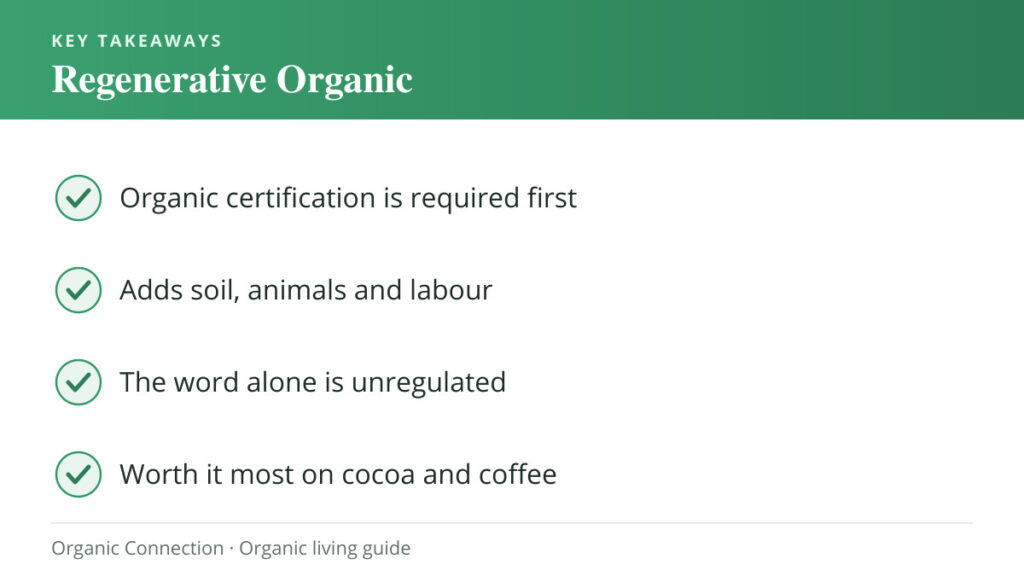
Regenerative Organic Certified is organic plus three things organic leaves loose: measured soil health, substantive animal welfare, and audited farmworker fairness. It is real, it is audited, and it is small. The word “regenerative” without that certification mark is unregulated and increasingly used by conventional agriculture, so the logo is the whole difference. Buy it where the extra pillars solve a real problem, chocolate and coffee above all, treat certified organic as the reliable everyday standard, and check for the mark rather than the adjective.
Common questions about regenerative organic
What does regenerative organic mean?
Regenerative Organic Certified is a certification built on top of USDA organic, adding audited requirements in three areas organic does not fully cover: soil health including cover cropping and reduced tillage, animal welfare including pasture and stocking density, and farmworker fairness including fair pay and safe conditions. A product must already be certified organic to qualify.
Is regenerative better than organic?
It is organic plus more, not an alternative. USDA organic remains the highest-value certification for most shoppers because it is legally enforced and widely available. Regenerative Organic Certified adds soil, animal welfare, and labor requirements on top, which matters most in categories with documented labor problems such as cocoa and coffee.
Can a non-organic farm be regenerative?
It can use the word, because “regenerative” is not legally protected. Conventional operations describe cover cropping and reduced tillage programs as regenerative while still using synthetic pesticides and GMO seed. Those practices may genuinely benefit soil, but it is a very different claim from Regenerative Organic Certified, which requires organic certification first.
Does regenerative farming fight climate change?
The soil health, water retention, and biodiversity benefits are well supported. The carbon sequestration claims are more contested: soil carbon is real but its magnitude, permanence, and measurability at farm scale are genuinely debated, and stored carbon can be released again by a change in management. Treat it as good for soil rather than as a settled climate solution.
How do I know if a product is Regenerative Organic Certified?
Look for the circular Regenerative Organic Certified logo, often with a tier level of Bronze, Silver, or Gold. If a package uses the word “regenerative” without that mark, it is a description of practices rather than a verified certification, and there is no independent audit behind it.
Keep reading
- What “Organic” Really Means: A Complete Guide to Certifications
- Greenwashing: 12 Label Tricks and How to Spot Fake Claims
- Organic vs Natural vs Non-GMO
- Is Organic Worth It? An Honest Cost Breakdown
- our organic food product database — compare brands across every pantry guide
Organic Connection is reader-supported. When you buy through links in our reviews we may earn a commission, at no extra cost to you. As an Amazon Associate we earn from qualifying purchases. We are not paid to feature or rank any product. How we research and rate.