Last updated: September 30, 2026
We may earn a commission when you buy through links on this page, at no extra cost to you. How we research and rate.
The short version
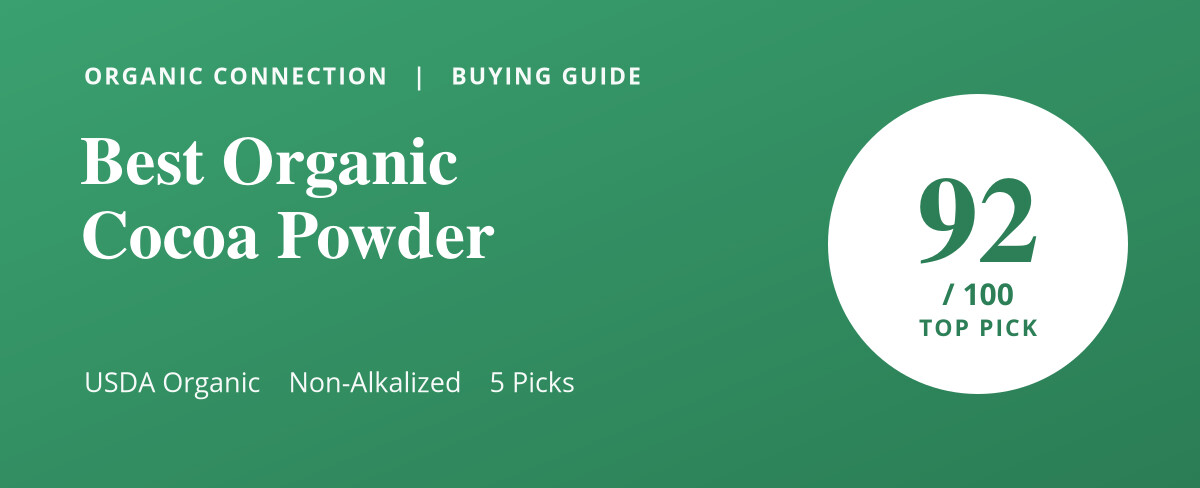
After researching the certifications, processing, and sourcing of the most popular organic cocoa and cacao powders, our top pick is NOW Foods Organic Raw Cacao Powder. It is USDA certified organic and Regenerative Organic Certified, Fairtrade, and non-alkalized, so it keeps the flavanols that alkalizing strips out, which is why it earned our highest Organic Integrity Score of 92 out of 100. For the best value, Viva Naturals Organic Cacao Powder, 1 lb is our pick, and for bulk baking, the Yupik Organic Raw Unsweetened Cacao bag is the best choice.
With cocoa powder, the two things that matter most are the organic seal and whether the powder has been Dutch-processed, because alkalizing changes both flavor and nutrition. We flag each product’s certification and processing.
Best organic cocoa powder compared
| Best Choice | Best Value | ||||
 |  |  |  |  | |
| Product | NOW Foods 12 oz | Viva Naturals 1 lb | Antler Farms 200 g | Yupik 2.2 lb | Navitas 16 oz 2-Pack |
| Organic Integrity Score | 92/ 100 | 87/ 100 | 86/ 100 | 82/ 100 | 80/ 100 |
| Our rating | 4.6 | 4.4 | 4.3 | 4.1 | 4.0 |
| Best for | Best overall | Best value | Small size | Bulk baking | Stocking up |
| Certification | USDA Organic, Non-GMO Project Verified, Fair Trade | USDA Organic, Non-GMO Project Verified, Kosher | USDA Organic, Non-GMO, Gluten-free | USDA Organic, Non-GMO, Kosher | USDA Organic, Fair Trade, Non-GMO |
| Price | $12.99 $13.64 −5%$1.08 / ounce View on Amazon | $18.42$1.15 / ounce View on Amazon | $16.99$2.41 / ounce View on Amazon | $26.99$0.76 / ounce View on Amazon | $40.00$1.25 / ounce View on Amazon |
Price and availability as of October 12, 2026 1:10 am EDT. Product prices and availability are accurate as of the date/time indicated and are subject to change. Any price and availability information displayed on Amazon.com at the time of purchase will apply to the purchase of this product.
Scores are ours, based on independent research of certification, processing, purity, sourcing ethics, and value, using the same 10-criteria method we apply to every product. See how we research and rate.
The organic cocoa powder certifications, and the question each one leaves open
A seal is a specific promise about a specific thing. These are the promises behind the marks on this page, in plain terms, along with the question each one leaves unanswered.
| Certification | Covers | Key exclusion |
| USDA Organic | Farming and handling: no synthetic pesticides or fertilizers, no GMOs, no sewage sludge or irradiation, audited yearly by an accredited certifier | Three different tiers share the one seal, and it makes no claim about worker pay, food miles, or nutrition |
| Non-GMO Project | Testing and supply-chain traceability showing the ingredients are not genetically engineered | Sets no limit on synthetic pesticides or fertilizers, so it is not an organic claim |
| Fair Trade Certified | A price floor for producers, a community premium, and labor standards on the farms and in the facilities | An economic and labor standard; it is not an organic or pesticide claim |
| Regenerative Organic | Soil health, animal welfare and farmworker fairness, built on top of an existing organic certification | Requires organic certification as its baseline, so it is an addition to the USDA seal and never a replacement for it |
| COSMOS Organic | Cosmetics: organic content thresholds, permitted processes and ingredients, and packaging rules | Its sister grade, COSMOS Natural, carries the same name and requires no minimum organic content at all |
| Kosher | Ingredients and production comply with Jewish dietary law, verified by a rabbinic agency that inspects the facility | A dietary-law standard: it makes no claim about pesticides, GMOs or farming practice |
COSMOS is two standards with one name, and the weaker one is easy to miss. COSMOS Organic requires at least 95% of the plant ingredients to be organic. COSMOS Natural, printed in the same typeface by the same body, requires no minimum organic content whatsoever: it governs which ingredients and processes are permitted, not how much of the product is organic. If the word after COSMOS is “Natural”, the organic question is still open.
Key things to look for in organic cocoa powder
Great organic cocoa is about certification, processing, purity, and sourcing ethics. Here is what matters.
1. USDA organic certification
Cacao is grown in the tropics with heavy conventional pesticide and fungicide use. The organic seal verifies none of that, plus no GMOs.
2. Non-alkalized (natural) processing
Non-alkalized powder retains far more flavanols and a brighter, fruitier chocolate flavor. Dutched powder trades those for a darker, milder cup.
3. 100% cocoa, nothing added
The ingredient list should read “organic cacao powder” and stop. No sugar, no milk solids, no anti-caking agents, no artificial flavor.
4. Fairtrade or regenerative sourcing
Cocoa has well-documented labor issues. Fairtrade and Regenerative Organic Certified add wage, labor, and soil-health standards on top of organic.
Cacao or cocoa? And raw versus roasted
The two words describe the same plant, and the labeling is more marketing convention than regulation. In common usage, “cacao powder” implies minimally processed, unroasted or lightly roasted, non-alkalized powder, while “cocoa powder” often implies a roasted and sometimes Dutched product intended for baking. Because the terms are not legally defined, you cannot rely on the name alone: read the ingredient panel and look for the word “alkalized” or “processed with alkali,” which is what actually tells you how the powder was made.
The practical difference for cooking is acidity. Natural, non-alkalized powder is acidic, so it reacts with baking soda to leaven a batter. Dutched powder is neutral and pairs with baking powder instead. Swapping one for the other in a recipe without adjusting the leavening is the most common reason a chocolate cake comes out flat or dense. For smoothies, hot chocolate, and anything unbaked, use non-alkalized freely: you get the fuller flavanol content and a brighter, fruitier chocolate note that alkalizing sands away.
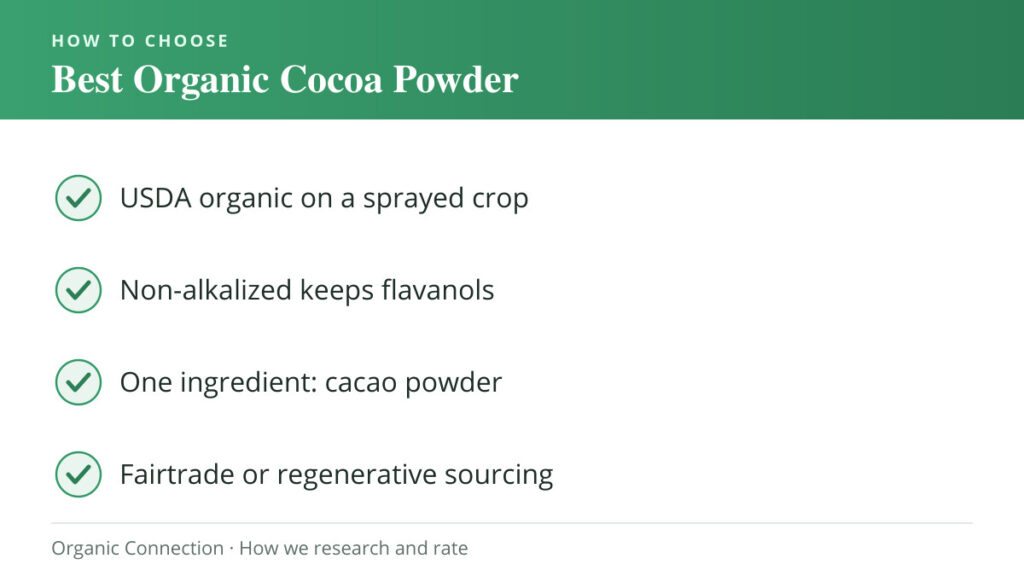
How to choose organic cocoa powder
- Confirm USDA organic. Cacao is a heavily sprayed conventional crop, so the seal matters more here than in most categories.
- Prefer non-alkalized. More flavanols, brighter flavor, and it works with baking soda in recipes.
- Read the ingredient list. One ingredient is the target: organic cacao powder.
- Look for Fairtrade or Regenerative Organic. Cocoa’s labor record makes third-party social certification worth paying for.
- Buy the size you will finish. Cocoa keeps well but slowly loses aroma once opened, so match the bag to your actual use.
Who should buy organic cocoa powder
Application decides it. For the strongest certifications on an organic cacao powder, begin with our top pick. If you want the best value per pound, a bulk bag for regular baking, a small bag to try first, or a widely available everyday option, we have a pick for each.
Best overall: NOW Foods Organic Raw Cacao Powder, 12 oz
| Organic Integrity Score | 92 / 100 |
| Size | 12 oz |
| Processing | Slowly fermented, then sun-dried rather than roasted |
| Origin | Peru |
| Certification | USDA Organic, Non-GMO Project Verified, Fair Trade |
| Best for | Anyone who wants the processing and the certifier both named |
The only cacao listing here that describes its processing in full, and the distinction it draws is the one that matters. “Sun-dried, instead of roasted, to retain all of their valuable nutrients.”
That is the actual line between cacao and cocoa. Raw cacao is fermented and dried at low temperature; cocoa is roasted. Roasting changes the flavor and reduces the flavanol content, which is the compound most of the research interest attaches to. A listing that says sun-dried rather than roasted is telling you which product you are buying.
It also names its origin, Peru, and its fermentation step, and it is the only product on this page to name its kosher certifying agency — Triangle K — rather than writing the word kosher and stopping. Non-GMO Project Verified is named as a program too.
One claim we would not lean on. The bullet headed “naturally occurring polyphenols and flavonols” then talks about the fair trade program rather than the compounds, so the heading and the sentence underneath it are about different things.
What we liked: Sun-dried rather than roasted, stated plainly; origin named; the kosher agency named; Non-GMO Project named as a program.
Keep in mind: No flavanol figure to go with the polyphenol claim, and the smallest bag in this comparison at 12 oz.
What the listing discloses: NOW documents itself unusually well, stating a USDA organic claim, Non-GMO Project Verified, Fair Trade and kosher certification.
Best value: Viva Naturals Organic Cacao Powder, 1 lb
| Organic Integrity Score | 87 / 100 |
| Processing | Non-alkalized |
| Certification | USDA Organic, Non-GMO Project Verified, Kosher |
| Best for | Everyday baking and smoothies without the premium price |
Viva Naturals hits the sweet spot for most kitchens. It is USDA certified organic, non-alkalized, and a single-ingredient powder with no sugar, fillers, or anti-caking agents, at a price meaningfully below the premium brands. The flavor is a straightforward rich dark chocolate, and it performs well in baking, smoothies, and hot chocolate alike. The 1 lb bag is the size most households will actually finish while it is still aromatic.
The trade-off is that it carries the organic seal but not Fairtrade or regenerative certification, so you get the agricultural assurance without the social and soil layer. If sourcing ethics is your priority rather than price, our top pick is the better fit.
What we liked: USDA organic and non-alkalized at a clearly lower price, one clean ingredient, and a versatile rich flavor.
Keep in mind: No Fairtrade or regenerative certification, so sourcing transparency is thinner than the top pick.
What the listing discloses: On the Viva Naturals label: USDA organic certification, Non-GMO Project Verified, kosher certification and a single-ingredient formula. Not stated: where it was grown or made.
Best small size: Antler Farms 100% Pure Organic Raw Cacao Powder, 200 g
| Organic Integrity Score | 86 / 100 |
| Size | 200 g, stated as 40 servings |
| Origin | Amazon basin of Peru, grown outdoors |
| Certification | USDA Organic, Non-GMO, Gluten-free |
| Excludes | Added colors, flavors, sweeteners, fillers, preservatives |
| Best for | Trying good cacao without committing to a large bag |
The smallest bag here, and the only one that tells you how many servings are in it. 200 g stated as 40 servings is a more useful number than a weight alone, because it lets you work out cost per use rather than cost per gram.
The sourcing is the most specific in the comparison: grown outdoors in the Amazon basin of Peru, with a note that cacao has been cultivated there by indigenous communities for over 3,000 years. Outdoors is doing quiet work in that sentence, since it distinguishes traditional shade-grown cultivation from intensive production.
The exclusions are enumerated rather than summarized — no added colors, flavors, sweeteners, fillers or preservatives — and separately no herbicides, pesticides, artificial fertilizers or GMOs.
It also names theobromine, the mild stimulant in cacao that is responsible for most of its effect and is almost never mentioned on a label.
What we liked: Servings as well as weight, the most specific origin here, five named exclusions, and theobromine named honestly as a stimulant.
Keep in mind: “Harvested at the peak of potency” is unmeasurable, and there is no figure for the antioxidants it claims.
What the listing discloses: Everything we check for is on the Antler Farms listing: USDA organic certification, an origin of Peru and a single-ingredient formula.
Best for bulk baking: Yupik Organic Raw Unsweetened Cacao Powder, 2.2 lb
| Organic Integrity Score | 82 / 100 |
| Size | 2.2 lb |
| Certification | USDA Organic, Non-GMO, Kosher |
| Additives | None, and no added sugar, both stated |
| Best for | Baking in quantity |
The bulk option, at more than two pounds, and the whole listing is a single line of certifications: “USDA Organic, Kosher certified, Non-GMO, gluten-free, dairy-free, and vegan. No additives, no added sugar.”
It is thin, and it is well chosen. Six certifications plus two explicit exclusions is more useful in eight words than most listings manage in five bullets, and on a single-ingredient powder the exclusions are the part that matters.
What it does not tell you is anything about processing. Raw and unsweetened appear in the product name, and nothing explains how the beans were dried, which is the distinction our top pick is built on. No origin either.
What we liked: Six certifications and two exclusions stated compactly, kosher stated as certified, and a genuine bulk size.
Keep in mind: Nothing about drying or fermentation, no origin, and no certifying agency named.
What the listing discloses: Yupik states a USDA organic claim, kosher certification and a single-ingredient formula, and does not say where it was grown or made.
Best for stocking up: Navitas Organics Cacao Powder, 16 oz, 2-Pack
| Organic Integrity Score | 80 / 100 |
| Processing | Non-alkalized |
| Certification | USDA Organic, Fair Trade, Non-GMO |
| Best for | Buying ahead without losing freshness |
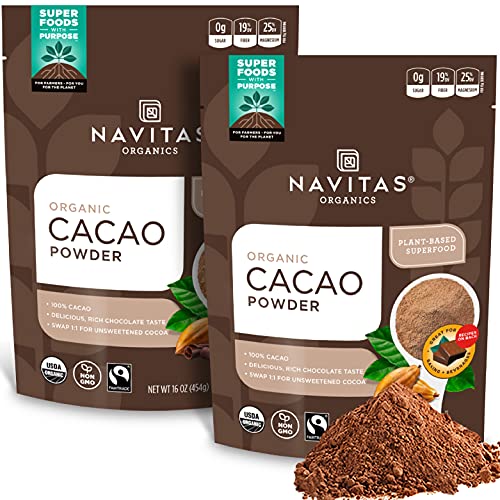
Two sealed 16 oz bags solve the problem the 2 lb single bag creates: you get bulk pricing while the second bag stays factory-sealed and fully aromatic until you open it. It is Navitas quality with USDA organic and Fairtrade certification, non-alkalized, and it is a sensible way to stock a pantry if you go through cocoa steadily but not fast.
The trade-off is that per-ounce pricing on multipacks fluctuates, and it is not always cheaper than buying the 24 oz bag outright. It is worth comparing the unit price at the time you buy rather than assuming the two-pack wins.
What we liked: Fairtrade and USDA organic with two separately sealed bags, so freshness holds until you open the second.
Keep in mind: Multipack pricing moves around; check the per-ounce cost against the single large bag.
What the listing discloses: Navitas Organics is explicit about a USDA organic claim, Fair Trade and kosher certification, and silent on where it was grown or made.
Baking and drinking with cocoa powder
Match the powder to the leavening. Natural, non-alkalized cocoa is acidic and reacts with baking soda, which is what most American chocolate cake and brownie recipes assume; Dutched cocoa is neutral and belongs in recipes calling for baking powder. If you substitute one for the other without adjusting, expect a flatter, denser result. For hot chocolate, bloom the powder first: whisk it into a small amount of hot liquid to a smooth paste before adding the rest, which prevents lumps and releases far more aroma than dumping it into a full mug. In smoothies, cocoa pairs naturally with banana, nut butter, and dates, and a tablespoon is usually plenty. Store the bag airtight, away from heat, light, and strong smells; cocoa readily absorbs odors from a pantry, and that is the fastest way to ruin an otherwise good powder.
Natural versus Dutch-process: the choice that changes everything
This is the most consequential distinction in cocoa powder and the one supermarket labeling handles worst. Natural cocoa is simply roasted, ground and defatted beans — acidic, at roughly pH 5–6, light reddish-brown, sharp and fruity. Dutch-process cocoa has been treated with an alkali to raise pH toward neutral, which darkens the color, mellows the flavor and improves solubility.
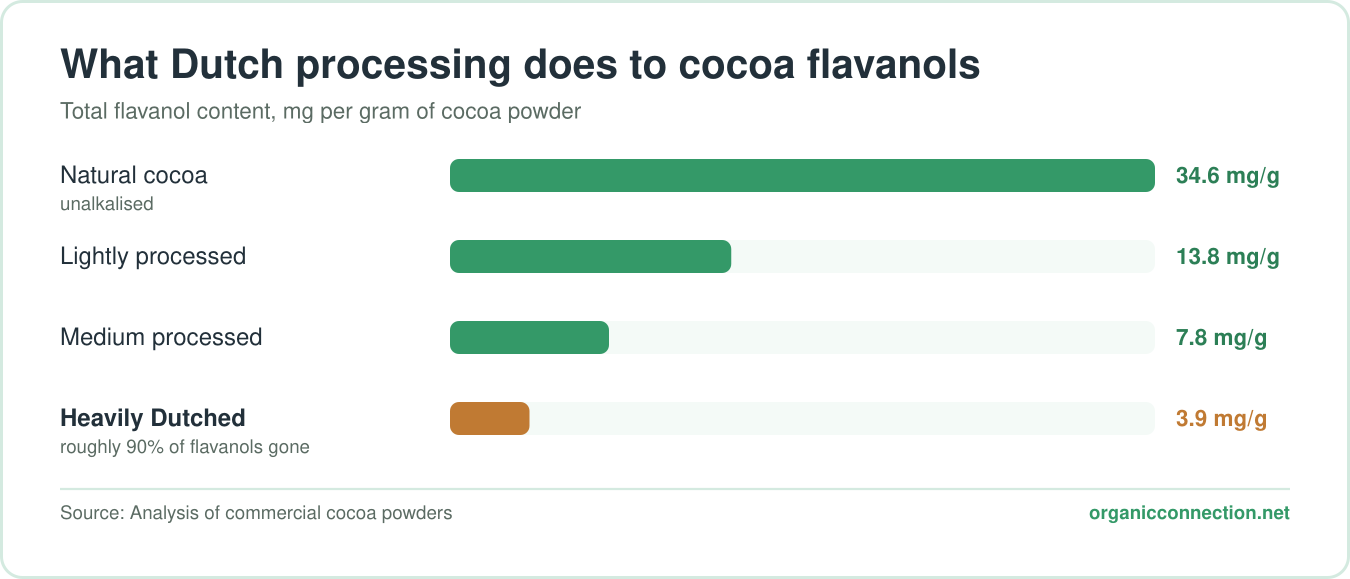
The cost of that treatment is measurable. Research analyzing commercial cocoa powders found average total flavanol content of 34.6 mg/g in natural cocoa, falling to 13.8 mg/g in lightly processed, 7.8 mg/g in medium processed, and 3.9 mg/g in heavily processed powders. Heavy Dutching removes roughly nine-tenths of the flavanols — the compounds most of cocoa’s health interest rests on.
| Natural cocoa | Dutch-process | |
| pH | ~5–6, acidic | ~7–8, neutral to alkaline |
| Color | Light reddish-brown | Dark brown to near-black |
| Flavor | Sharp, fruity, bitter | Smooth, mellow, “chocolatey” |
| Flavanols | Highest | Up to ~90% lower |
| Leavening partner | Baking soda — the acid reacts with it | Baking powder — brings its own acid |
| Dissolves in milk | Poorly, clumps | Readily — why drinking chocolate is Dutched |
Keep in mind: the leavening point is not optional chemistry. A recipe calling for baking soda relies on natural cocoa’s acidity to produce lift; substitute Dutch-process and it will be flat and soapy-tasting. A recipe calling for baking powder is built for Dutch cocoa, and natural cocoa will make it sharp and dense. If a recipe specifies one, use it. If it specifies both leaveners, either cocoa will work.
Most powders labeled “cacao” rather than “cocoa” are unalkalized and therefore natural — including the picks in this guide — which is why they taste sharper than a supermarket baking cocoa and behave differently in a cake.
Cadmium: the contaminant organic certification does not address
Cacao trees take up cadmium from soil, and in parts of Latin America — where much of the world’s fine-flavor and organic cacao grows — soil cadmium is naturally elevated by geology and volcanic activity. The metal ends up in the bean regardless of farming method, which means a certified organic cocoa powder can carry more cadmium than a conventional one from a different origin.
The regulatory picture: EU Regulation 2023/915 sets a maximum of 0.60 mg/kg cadmium in cocoa powder sold to the final consumer or used in drinking chocolate. The US has no equivalent federal limit, and California Proposition 65 has driven most of the disclosure and reformulation that has happened there. Consumer Reports testing found roughly a third of chocolate products it examined were high in heavy metals.
Two details worth carrying into a purchase decision:
- Alkalization can raise heavy-metal concentration per gram of cocoa solids, so heavily Dutched powder is doubly disadvantaged — fewer flavanols, potentially more metal per serving.
- Origin matters more than certification. West African cacao generally tests lower for cadmium than Peruvian, Ecuadorian or Dominican. That is an awkward finding, because West African cacao carries the heaviest child labor burden — the two concerns pull in opposite directions and there is no origin that resolves both.
What actually helps: buy from brands that publish batch-level heavy metal testing, keep daily intake moderate rather than heroic, and be particularly careful with high-dose cacao habits — a scoop in a smoothie every day is a different exposure from a cake once a month. Children are more susceptible to heavy metal exposure by body weight, which is worth remembering before making cacao a daily fixture for a small child.
What the flavanol research actually found
Cocoa’s health reputation rests largely on flavanols, and there is now a large trial rather than only mechanistic studies.
The COSMOS trial — COcoa Supplement and Multivitamin Outcomes Study — was a randomized, double-blind, placebo-controlled trial in 21,442 participants (12,666 women aged 65 and over, 8,776 men aged 60 and over), testing a cocoa extract supplement providing 500 mg/day of flavanols over a median 3.6 years. The cocoa flavanol group showed a statistically significant 15% reduction in total cardiovascular events and a 39% reduction in cardiovascular deaths.
Three caveats that matter for how you read that:
- It tested a concentrated extract supplement, not cocoa powder. Getting 500 mg of flavanols from natural cocoa powder at 34.6 mg/g means roughly 14 g daily — achievable, but from heavily Dutched powder at 3.9 mg/g you would need well over 100 g, which is not.
- The primary endpoint result was not statistically significant in the trial’s pre-specified primary analysis; the 15% and 39% figures come from secondary and total-event analyses. That is a meaningful distinction and it is often dropped in reporting.
- The trial was supported by Mars, which manufactures the supplement tested. That does not invalidate a well-conducted randomized trial, but it belongs in the disclosure.
The reasonable conclusion: unalkalized cocoa is a genuinely flavanol-rich food and the evidence for cardiovascular benefit is better than for most things sold in a health food aisle — while noting that hot chocolate made with Dutched powder and sugar is not what was tested.
Fat content, and why two powders behave differently
Cocoa powder is sold at two fat levels and packaging rarely says which.
- Standard, 10–12% cocoa butter. The default. Fine for most baking and drinks.
- High-fat or “extra brute”, 22–24%. Richer mouthfeel, deeper color, better in ganache, ice cream and anything where fat carries flavor. Also more expensive and more calorific.
If a cocoa powder tastes unexpectedly thin in hot chocolate, low fat content is the usual reason rather than poor bean quality. Bloom it in a little hot liquid or melted butter first — cocoa’s flavor compounds are fat-soluble and blooming makes a noticeable difference in any recipe.
Substituting and baking with cocoa
- Cocoa powder for baking chocolate: 3 tbsp cocoa plus 1 tbsp fat replaces 1 oz (28 g) unsweetened chocolate.
- Natural for Dutch: use the same weight of Dutch cocoa and replace each ½ tsp of baking soda with 2 tsp of baking powder.
- Dutch for natural: use the same weight of natural cocoa and add ⅛ tsp baking soda per 3 tbsp of cocoa to neutralize the acidity.
- Bloom it. Whisking cocoa into hot liquid before adding it to a batter deepens flavor more than any brand change will.
- Sift. Cocoa clumps stubbornly and unsifted lumps do not disperse during mixing.
- A pinch of salt and a little espresso powder amplify cocoa flavor without making anything taste salty or of coffee.
Storage
- Airtight, cool, dark and dry. Cocoa keeps 2–3 years and loses aroma gradually rather than spoiling.
- Never refrigerate. Cocoa absorbs odors aggressively and condensation causes permanent clumping.
- Gray-white surface bloom on cocoa powder is fat migration, harmless, and disappears in baking.
- Keep it away from spices and coffee. Cocoa picks up neighboring aromas faster than almost anything else in a cupboard.
- If it smells of cardboard rather than chocolate, the volatile compounds have gone. It is safe but flat, and worth relegating to recipes with strong competing flavors.
How we researched this guide
We are a research-based review site. We compared each product against its certification (USDA organic, and where present Fairtrade and Regenerative Organic Certified), processing (alkalized versus natural), ingredient purity, sourcing transparency, and the weight of aggregated customer feedback on flavor and consistency, then scored each with our 10-criteria Organic Integrity Score. No brand paid to be included or ranked. Read the full method on our How We Research and Rate page.
What cocoa gives you once the sugar is gone
Cocoa powder is worth separating from chocolate, because most of what makes chocolate calorific is absent here.
A tablespoon of unsweetened cocoa powder carries around 12 calories, with roughly 2 grams of fiber and a meaningful amount of iron and magnesium. It is one of the more concentrated sources of flavanols in the diet, and it is essentially free of sugar. That combination makes it a genuinely useful way to get chocolate flavor into food without the accompanying energy.
The flavanol research is the same body of work discussed for dark chocolate: small but measurable effects on blood pressure and endothelial function in meta-analyses, using cocoa preparations rather than confectionery. Cocoa powder is closer to what those studies used than a chocolate bar is.
Processing is the variable that decides how much of that survives. Dutch-processed or alkalised cocoa is treated to reduce acidity, darken color and mellow flavor, and the process destroys a large proportion of the flavanols. Natural cocoa retains considerably more. If the research is why you are buying, natural rather than Dutched is the choice that matters, and it is covered above.
None of this is a weight mechanism. What cocoa offers is flavor intensity at almost no caloric cost, which makes it useful for satisfying a chocolate craving in yogurt, porridge or a hot drink for a fraction of what a bar would cost.
The caution that applies to all cocoa applies here: cadmium and lead occur naturally in cocoa and concentrate in powder, which is worth knowing at daily high intakes.
Honest summary: high flavor and flavanols for very few calories, no metabolic effect, and natural rather than Dutched if the research matters to you.
Common questions about organic cocoa powder
What is the best organic cocoa powder?
Our overall pick is NOW Foods Organic Raw Cacao Powder, which scores highest here at 92, because its listing names USDA organic certification, Non-GMO Project verification, kosher certification and Fair Trade certification. For the best value, Viva Naturals Organic Cacao Powder is our pick, and for bulk baking, the Yupik Organic Raw Unsweetened Cacao bag.
What is the difference between cacao powder and cocoa powder?
They come from the same bean, and the terms are not legally defined. In practice, “cacao” usually signals a minimally processed, non-alkalized powder, while “cocoa” often means roasted and sometimes Dutch-processed. Because the labels are marketing rather than regulation, read the ingredient panel for the words “alkalized” or “processed with alkali” to know what you are actually buying.
Is Dutch-processed cocoa less healthy?
Alkalizing neutralizes cocoa’s natural acidity, which darkens and mellows it, but it also destroys a large share of the flavanols that give cocoa its nutritional interest. Dutched cocoa is not harmful, it is simply lower in those compounds, which is why we favor non-alkalized powder when you have the choice.
Can I substitute cacao powder for cocoa powder in baking?
Usually yes, one for one by weight, but watch the leavening. Non-alkalized powder is acidic and works with baking soda; Dutched powder is neutral and works with baking powder. Swapping without adjusting the leavening is the usual cause of a flat or dense result.
How should I store cocoa powder?
Keep it in an airtight container in a cool, dark, dry place, away from strong-smelling foods. Cocoa does not spoil quickly, but it absorbs odors readily and loses aroma over time once opened, so buy a size you will finish within a few months.
What is the difference between natural and Dutch-process cocoa?
Natural cocoa is acidic at around pH 5–6, light reddish-brown and sharp-tasting. Dutch-process has been treated with alkali to raise pH toward neutral, which darkens it, mellows the flavor and improves solubility in milk. The cost is flavanols: research found 34.6 mg/g in natural cocoa, falling to 3.9 mg/g in heavily processed powder — a loss of roughly nine-tenths. Most powders labeled “cacao” are unalkalized and therefore natural.
Can I substitute Dutch cocoa for natural cocoa in baking?
Only with a leavening adjustment, because this is chemistry rather than preference. A recipe using baking soda relies on natural cocoa’s acidity to react; substitute Dutch and it will be flat and soapy. To swap Dutch in, replace each half teaspoon of baking soda with 2 teaspoons of baking powder. To swap natural into a Dutch recipe, add an eighth of a teaspoon of baking soda per 3 tablespoons of cocoa.
Does cocoa powder contain cadmium?
Often, yes. Cacao trees take up cadmium from soil, and it is naturally elevated by geology in parts of Latin America where much organic cacao grows — so a certified organic powder can carry more cadmium than a conventional one from elsewhere. EU Regulation 2023/915 sets a maximum of 0.60 mg/kg in cocoa powder sold to consumers; the US has no federal equivalent. Consumer Reports testing found about a third of chocolate products it examined high in heavy metals. Organic certification does not address this, because cadmium is a soil contaminant rather than something sprayed.
Which cocoa origin is lowest in heavy metals?
West African cacao generally tests lower for cadmium than Peruvian, Ecuadorian or Dominican. That is an uncomfortable finding, because West African cacao carries the heaviest documented child labor burden — the two concerns pull in opposite directions and no origin resolves both. Brands publishing batch-level heavy metal testing are more useful than any origin rule of thumb.
What did the COSMOS trial find about cocoa flavanols?
COSMOS randomized 21,442 older adults to a cocoa extract supplying 500 mg/day of flavanols or placebo over a median 3.6 years, and reported a 15% reduction in total cardiovascular events and a 39% reduction in cardiovascular deaths. Three caveats: it tested a concentrated extract rather than cocoa powder, those figures come from secondary and total-event analyses rather than the pre-specified primary endpoint, and the trial was supported by Mars, which makes the supplement tested.
How much cocoa powder gives 500 mg of flavanols?
Roughly 14 g of natural unalkalized cocoa at 34.6 mg/g. From heavily Dutched powder at 3.9 mg/g you would need well over 100 g, which is not a realistic serving. This is the practical reason to choose unalkalized cacao if flavanols are why you are buying it.
What is high-fat cocoa powder?
Cocoa is sold at two fat levels that packaging rarely states. Standard powder holds 10 to 12% cocoa butter; high-fat or “extra brute” holds 22 to 24%, giving a richer mouthfeel and deeper color for ganache and ice cream. If a cocoa tastes thin in hot chocolate, low fat content is usually the reason. Blooming cocoa in hot liquid or melted butter first helps either type, since its flavor compounds are fat-soluble.
How should you store cocoa powder?
Airtight, cool, dark and dry, where it keeps 2 to 3 years and fades rather than spoils. Never refrigerate it — cocoa absorbs odors aggressively and condensation causes permanent clumping. Keep it away from spices and coffee for the same reason. Gray-white surface bloom is fat migration, harmless and invisible after baking. If it smells of cardboard rather than chocolate, the aromatics have gone.
- Organic Food & Pantry hub
- Best Organic Candy
- Best Organic Bread Flour
- How we research and rate products
- our organic food product database — compare brands across every pantry guide
- Heavy metals in organic food, explained
Price and availability as of October 12, 2026 1:10 am EDT. Product prices and availability are accurate as of the date/time indicated and are subject to change. Any price and availability information displayed on Amazon.com at the time of purchase will apply to the purchase of this product.
Looking for other organic products?
We have checked more than 800 products across food, household goods, gardening, personal care and pet, every one against its stated certification. Browse all reviews.
Organic Connection is reader-supported. When you buy through links on this page we may earn a commission, at no extra cost to you. As an Amazon Associate we earn from qualifying purchases. We are not paid to feature or rank any product. How we research and rate.