Last updated: September 30, 2026
We may earn a commission when you buy through links on this page, at no extra cost to you. How we research and rate.
The short version
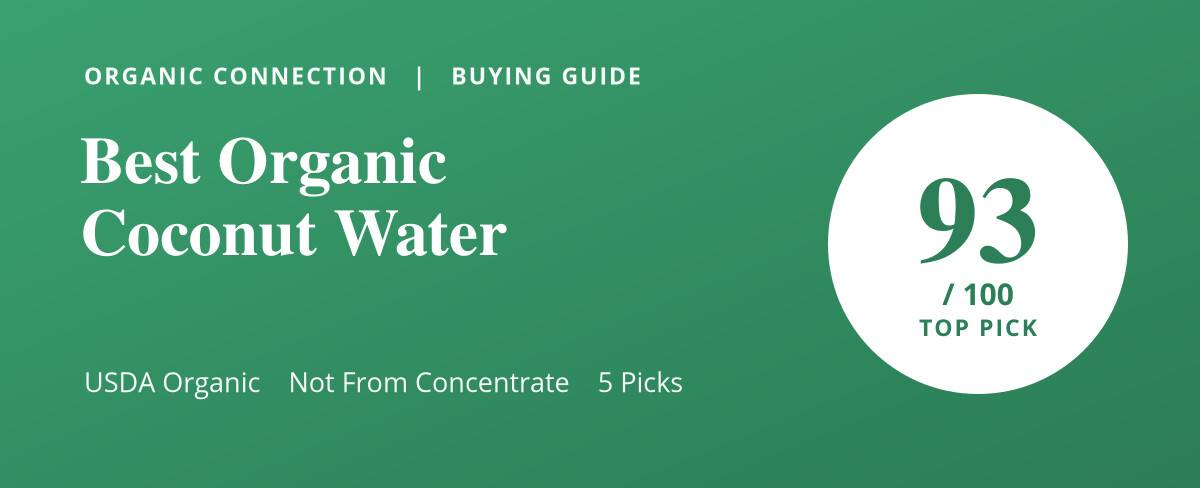
After researching the certifications, processing methods, and ingredient lists of the most popular organic coconut waters, our top pick is Harmless Harvest Organic Coconut Water. It is USDA certified organic and Fair for Life certified, it is never made from concentrate, and it uses micro-filtration instead of heat pasteurization, which is why it earned our highest Organic Integrity Score of 89 out of 100. For the best value per ounce, the Harmless Harvest 32 oz multipack is our pick, and for a coconut water with pulp, Amy & Brian Pure Coconut Water with Pulp is the best choice.
With coconut water, the things that separate a good bottle from a bad one are whether it came from concentrate, whether sugar was added, and how it was preserved. We flag each product’s certification and processing.
Best organic coconut water compared
| Best Choice | Best Value | ||||
 |  |  |  |  | |
| Product | Harmless Harvest 32 oz | Real Coco 6 x 1 L | CocoGoodsCo 16.9 oz x12 | Harmless Harvest Sparkling | Amy & Brian with Pulp |
| Organic Integrity Score | 89/ 100 | 88/ 100 | 86/ 100 | 78/ 100 | 72/ 100 |
| Our rating | 4.5 | 4.4 | 4.3 | 3.9 | 3.6 |
| Best for | Best overall | Household volume | Grab and go | Sparkling | Coconut water with pulp |
| Certification | USDA Organic, Non-GMO | USDA Organic, Non-GMO, Kosher | Non-GMO, Kosher, Gluten-free | — | Non-GMO |
| Processing | Micro-filtered, never from concentrate | Bottled within hours of the coconut being cracked; never from concentrate | — | Carbonated organic coconut water | Not from concentrate, canned with coconut pulp |
| Price | $61.44$0.32 / fluid ounce View on Amazon | $29.99$0.15 / fluid ounce View on Amazon | $29.99$0.15 / fluid ounce View on Amazon | Currently unavailable See buying options | $32.99$0.16 / fluid ounce View on Amazon |
Price and availability as of October 11, 2026 7:10 pm EDT. Product prices and availability are accurate as of the date/time indicated and are subject to change. Any price and availability information displayed on Amazon.com at the time of purchase will apply to the purchase of this product.
Scores are ours, based on independent research of certification, sourcing, processing, ingredient purity, and value, using the same 10-criteria method we apply to every product. See how we research and rate.
The certification map for organic coconut water, and what each one actually excludes
The labels on these products are not interchangeable, and several of them cover things that have nothing to do with each other. Here is what each one actually buys you.
| Certification | Covers | Key exclusion |
| USDA Organic | Farming and handling: no synthetic pesticides or fertilizers, no GMOs, no sewage sludge or irradiation, audited yearly by an accredited certifier | Three different tiers share the one seal, and it makes no claim about worker pay, food miles, or nutrition |
| Non-GMO Project | Testing and supply-chain traceability showing the ingredients are not genetically engineered | Sets no limit on synthetic pesticides or fertilizers, so it is not an organic claim |
| Fair Trade Certified | A price floor for producers, a community premium, and labor standards on the farms and in the facilities | An economic and labor standard; it is not an organic or pesticide claim |
| Kosher | Ingredients and production comply with Jewish dietary law, verified by a rabbinic agency that inspects the facility | A dietary-law standard: it makes no claim about pesticides, GMOs or farming practice |
Non-GMO and organic are not two grades of the same thing. The butterfly certifies an absence of genetic engineering and stops there; the USDA seal prohibits genetic engineering as one clause among many, alongside synthetic pesticides, synthetic fertilizers, sewage sludge and irradiation. That makes organic the broader claim by some distance. Where both appear together, the butterfly is adding batch testing on top of a standard that had already banned GMOs.
Key things to look for in organic coconut water
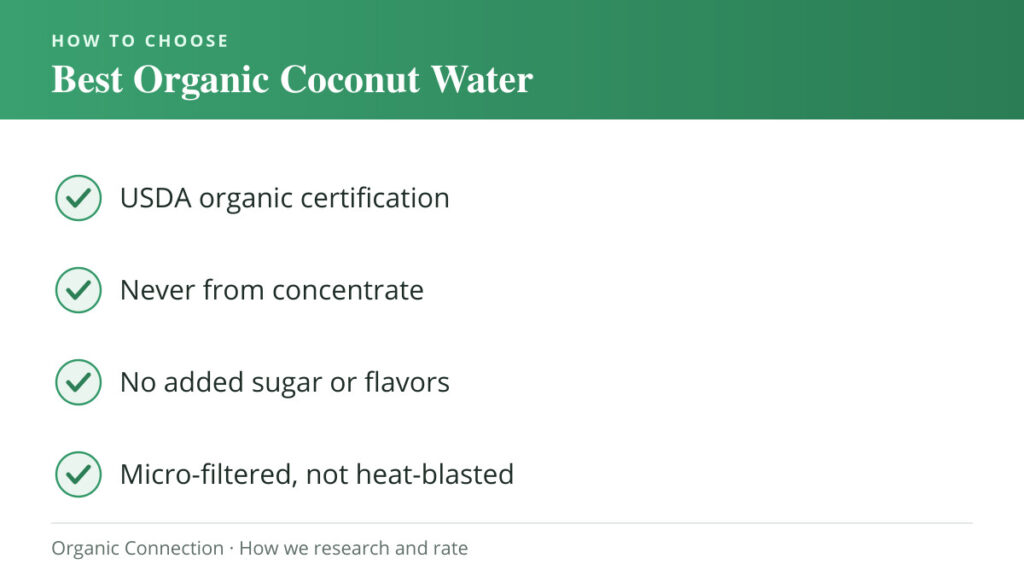
Great coconut water is about certification, sourcing, processing, and a very short ingredient list. Here is what matters.
1. USDA organic certification
It verifies coconuts grown without synthetic pesticides or fertilizers, and rules out non-organic additives in the finished bottle.
2. Not from concentrate
Reconstituted coconut water tastes flat and cooked. “Never from concentrate” on the label is the single best flavor predictor.
3. No added sugar or flavor
The ingredient list should be coconut water, and nothing else. Added sugar, “natural flavors,” and fruit juice concentrate are all red flags.
4. Gentle preservation
Micro-filtration and high-pressure processing preserve the fresh taste far better than aggressive heat pasteurization.
Bottled, boxed, or from concentrate?
Most coconut water sold in the US falls into three groups. Reconstituted-from-concentrate products are the cheapest and the most compromised: heating to concentrate drives off the delicate aromatics, and what comes back after adding water is a thin, faintly cooked drink that brands often prop up with added sugar or fruit juice. Shelf-stable boxed coconut water is a step up, made from single-strength liquid but heat-pasteurized to survive on a pantry shelf, which mutes flavor while keeping the minerals intact. Chilled, gently processed coconut water sits at the top: bottled from single-strength liquid, preserved by micro-filtration or high pressure rather than heat, and sold refrigerated.
The mineral content does not change dramatically between these categories, so if you are drinking coconut water strictly for potassium after a workout, the boxed shelf-stable versions are a perfectly reasonable and cheaper choice. What changes is taste. Gently processed coconut water is sweeter, brighter, and noticeably more coconut-forward, and it develops a natural pink tint over time as antioxidants in the water react to light, which is a sign of minimal processing rather than a defect. Once you have had it, the reconstituted stuff is hard to go back to.
How to choose organic coconut water
- Confirm USDA organic. It rules out synthetic pesticides on the coconuts and non-organic additives in the bottle.
- Look for “not from concentrate.” It is the clearest single predictor of good flavor.
- Read the ingredient list. One ingredient. Any added sugar, juice concentrate, or “natural flavors” means you are drinking a beverage, not coconut water.
- Prefer gentle processing. Micro-filtered or high-pressure processed beats heavily heat-treated for taste.
- Match the size to the use. Small bottles for portability and portion control, large bottles for household economy.
Who should buy organic coconut water
The right coconut water depends on how you drink it. If you want the cleanest, best-tasting organic option, our top pick fits. If you want the lowest cost per ounce, a grab-and-go size, a sparkling version, or a traditional coconut water with pulp, we have a pick for each.
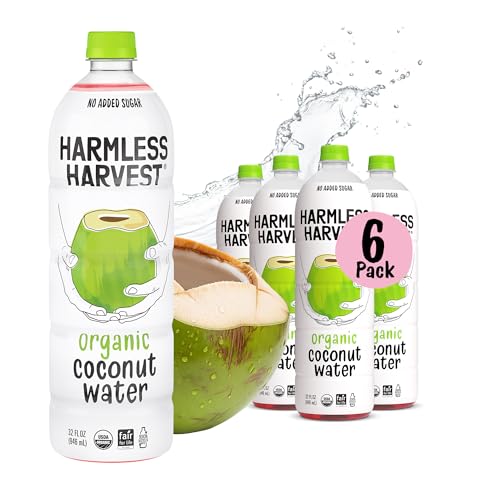
Best overall: Harmless Harvest Organic Coconut Water, 32 oz, 6-Pack
| Organic Integrity Score | 89 / 100 |
| Processing | Micro-filtered, never from concentrate |
| Certification | USDA Organic, Non-GMO |
| Best for | Households that drink coconut water regularly |
Same water, bigger bottle, better arithmetic. The 32 oz format brings the cost per ounce down substantially versus single-serve bottles while keeping the USDA organic and Fair for Life certifications and the micro-filtered, never-from-concentrate production. If coconut water is a household staple rather than an occasional treat, this is the format that makes it affordable.
The trade-off is the open-bottle clock. Without heat pasteurization, an opened bottle needs to be refrigerated and finished within a few days, and 32 oz is a lot for one person to get through. It also takes real space in a fridge, and six of them take a shelf.
What we liked: The best per-ounce price for genuinely premium organic coconut water, with all the certifications intact.
Keep in mind: Once opened it needs refrigeration and prompt use, and six large bottles take real fridge space.
What the listing discloses: On the Harmless Harvest label: USDA organic certification. Not stated: where it was grown or made.
Household volume: Real Coco Organic Pure Coconut Water, 6 x 1 L
| Organic Integrity Score | 88 / 100 |
| Size | 6 x 1 liter |
| Processing | Bottled within hours of the coconut being cracked; never from concentrate |
| Certification | USDA Organic, Non-GMO, Kosher |
| Excludes | Added sugar, dairy, soy, gluten, trans fat |
| Best for | Household volume with the freshness question answered |
Coconut water has one quality variable above all others, and it is time. The water starts changing the moment the nut is opened, which is why so much of what is sold is reconstituted from concentrate and tastes nothing like the fresh article.
This listing answers it directly: “bottled within hours of the coconut being cracked” and “never from concentrate.” Those two phrases together are the whole quality argument in this category, and most competitors make neither.
The certification is stated as USDA Organic, and the free-from list is unusually long: non-GMO, non-dairy, vegan, gluten-free, trans-fat free, soy-free, kosher.
Two things in that list are not claims at all. “Non-artificial”, “non-pesticidal” and “non-hormonal” are not defined terms, and coconut water containing hormones was never a possibility. They sit oddly beside two genuinely strong process statements.
What we liked: Names the bottling window and rules out concentrate, which together are the only quality claims that matter here.
Keep in mind: Several invented free-from terms padding the list, and no origin for the coconuts.
What the listing discloses: Life Refreshed states a USDA organic claim and kosher certification, and does not say where it was grown or made.
Best grab and go: CocoGoodsCo Single-Origin Organic Coconut Water, 12 x 16.9 fl oz
| Organic Integrity Score | 86 / 100 |
| Size | 12 x 16.9 fl oz |
| Origin | Single origin: Ben Tre, Vietnam |
| Ingredients | One |
| Certification | Non-GMO, Kosher, Gluten-free |
| Best for | Buyers who want to know which region the coconuts came from |
The only coconut water here that names a single origin, and it names it precisely: Ben Tre, Vietnam, in the Mekong Delta, which is one of the main coconut-growing provinces in the world.
Single origin means something concrete in this category. Most coconut water is blended from whatever is available across several countries; sourcing from one region is a supply chain decision that costs money and makes the product consistent from pack to pack.
It also states one ingredient and never from concentrate, which between them close the two questions worth asking, and describes its chain as from-tree-to-table.
The listing is otherwise sparse. One bullet, no certifying body, and no processing detail beyond the origin claim.
What we liked: A genuinely single-origin claim naming the province, one ingredient, and never from concentrate.
Keep in mind: A single bullet with no certifier named, and “100% organic” rather than the regulated USDA phrasing.
What the listing discloses: COCOGOODSCO is explicit about kosher certification and a single-ingredient formula, and silent on whether the USDA seal applies and where it was grown or made.
Best sparkling: Harmless Harvest Organic Sparkling Coconut Water, 16 oz
| Organic Integrity Score | 78 / 100 |
| Processing | Carbonated organic coconut water |
| Certification | — |
| Best for | A soda replacement with no added sugar |
This is the pick for people trying to leave soda behind. It is organic coconut water with carbonation and no added sugar, so you get the fizz and a naturally sweet drink without the sugar load of a soft drink. In a can or bottle at a barbecue, it does the job a sparkling water cannot quite manage, and it mixes well as a low-sugar cocktail base.
The trade-off is that carbonation is a processing step away from the pure product, and the added fizz slightly masks the delicate coconut flavor that makes the still version special. It scores lower here for that reason: it is a very good beverage, but it is less purely coconut water than the picks above it.
What we liked: USDA organic with no added sugar, a genuinely useful soda alternative, and good as a mixer.
Keep in mind: Carbonation mutes the delicate coconut flavor, and it is a more processed product than the still versions.
What the listing discloses: Beyond the organic claim itself, Harmless Harvest does not say whether the USDA seal applies and where it was grown or made.
Best with pulp: Amy & Brian Pure Coconut Water with Pulp
| Organic Integrity Score | 72 / 100 |
| Processing | Not from concentrate, canned with coconut pulp |
| Certification | Non-GMO |
| Best for | The traditional coconut-stand experience |
We include this one because it delivers something none of the others do: actual pieces of young coconut meat suspended in the water, which is how coconut water is drunk in the places it comes from. It is never from concentrate, has no added sugar, and comes from young Thai coconuts, and the pulp gives it a texture and a satisfying quality that filtered coconut water lacks entirely.
We are being straightforward about why it scores lowest: it is Non-GMO Project Verified but it is not USDA certified organic, so it does not meet the certification bar the rest of this guide is built on. If organic certification is non-negotiable for you, choose one of the picks above. If you want the traditional pulp experience and non-GMO sourcing is enough, this is the one.
What we liked: Real coconut pulp, never from concentrate, no added sugar, and a shelf-stable can that travels well.
Keep in mind: Non-GMO Project Verified but not USDA certified organic, which is why it ranks last here.
What the listing discloses: Amy & Brian makes no organic claim anywhere, so the case rests on the other claims it does make.
Getting the most from coconut water
Coconut water is a genuinely useful hydration drink, with meaningful potassium and magnesium and roughly 45 to 60 calories per cup from naturally occurring sugar. That makes it a reasonable post-workout choice, though it is comparatively low in sodium, the electrolyte you actually lose most in sweat, so for long or very hot sessions a pinch of salt or a proper electrolyte drink does more. It is not a weight-loss drink and it is not sugar-free; treat it as a light beverage rather than as water. Serve it cold, since warm coconut water tastes noticeably flatter, and use it in smoothies where it thins the blend without the dairy or the added sugar of juice. Once opened, refrigerate and finish within two to three days, and if a bottle smells sour or tastes sharp, discard it. A pink tint in minimally processed coconut water is normal; a sour smell is not.
The electrolyte reality: coconut water is not a sports drink
Coconut water is marketed almost universally as “nature’s sports drink”, and the electrolyte profile does not actually support that. This is the most useful correction in the category.
| Per 8 oz (240 ml) | Coconut water | Typical sports drink |
| Potassium | ~540–600 mg | ~30–50 mg |
| Sodium | ~40–65 mg | ~110–160 mg |
| Sugar | ~9–11 g (naturally occurring) | ~14 g (added) |
Sodium is the electrolyte you lose most in sweat, and coconut water is low in it while being unusually high in potassium — the reverse of what heavy sweating depletes. Research comparing coconut water with a carbohydrate-electrolyte sports drink in trained men found it better than plain water for recovery but not superior to a sports drink, which is a fair summary of where it sits.
Keep in mind: for ordinary daily drinking, and for mild dehydration after a hot day or a moderate workout, coconut water is genuinely good — it hydrates, it supplies potassium most people fall short on, and its sugar is naturally occurring rather than added. For prolonged endurance exercise, heavy sweating or working in heat, it is the wrong tool: you need sodium, and coconut water does not have much. A pinch of salt in a bottle of coconut water fixes this entirely and costs nothing, which is a more useful piece of advice than any brand recommendation.
From concentrate, not from concentrate, and why it matters
A large share of the coconut water on shelves is reconstituted — water removed at origin for cheaper shipping, then added back before bottling. It is not deceptive, and it is stated on the pack, but it changes the product.
- “Not from concentrate” means the water went from coconut to bottle without a concentration step. Better flavor, more of the delicate aromatics, more expensive.
- “From concentrate” means it was reduced and rebuilt. Cheaper, more consistent, and flatter in taste — the coconut character is thinner and often slightly cooked.
- Watch for added sugar, “natural flavor” and added sodium in concentrate-based products. These are used to rebuild what processing removed, and a coconut water with added sugar has lost most of its point.
- Check the ingredient list is one ingredient. The best products list coconut water and nothing else.
Why some coconut water turns pink — and why that is a good sign
People frequently return or discard pink coconut water assuming it has spoiled. In most cases it is the opposite.
Coconut water naturally contains polyphenols along with two enzymes, polyphenol oxidase (PPO) and peroxidase (POD). When those enzymes remain active, they oxidize the polyphenols over time and the liquid develops a pink or rosy tint — the same class of reaction that browns a cut apple.
The processing method decides whether this happens:
- Heat pasteurization (HTST) denatures the enzymes thoroughly. Research has found no pink development in either HTST- or standard HPP-treated coconut water during storage, because the enzymes were inactivated. Heat also flattens the flavor.
- High pressure processing (HPP) uses intense pressure instead of heat to kill microbes, which preserves fresh taste and heat-sensitive nutrients far better. Under some conditions PPO and POD survive it and remain active, which is why certain HPP products pink up during refrigerated storage.
So a pink tint generally indicates minimally processed, non-heat-treated coconut water in which natural enzymes are still present. It is a flavor and freshness signal rather than a spoilage one. Genuine spoilage smells sour or fermented and often fizzes — that is the thing to act on, not the color.
Who should be careful: the potassium question
The high potassium content that makes coconut water useful is also the reason a specific group of people should not drink it freely, and it is almost never mentioned on packaging.
- Chronic kidney disease. Impaired kidneys cannot clear potassium efficiently. Coconut water at 540–600 mg per cup is a substantial load, and hyperkalaemia can cause dangerous heart rhythm disturbances. Anyone on a potassium-restricted renal diet should treat coconut water as a high-potassium food, not a health drink.
- ACE inhibitors and ARBs — ramipril, lisinopril, losartan and similar all raise serum potassium. Adding a daily liter of coconut water is a real interaction rather than a theoretical one.
- Potassium-sparing diuretics such as spironolactone and amiloride — same mechanism, same caution.
- Before surgery — coconut water can affect blood pressure and potassium; most surgical teams ask you to stop unusual dietary supplements beforehand.
- Diabetes — 9 to 11 g of sugar per cup is modest but real, and it is absorbed quickly. Count it as a drink with sugar in it.
For everyone with normal kidney function and no relevant medication, the potassium is a benefit rather than a risk — most people fall well short of the recommended intake.
Reading the label and storing it
- One ingredient. Coconut water, full stop. Anything else is a compromise.
- Check for “not from concentrate” if flavor matters to you.
- HPP or cold-pressed on the label signals non-thermal processing and better taste; shelf-stable cartons are almost always heat-treated.
- Refrigerated products are usually better than ambient ones, for the same reason.
- Young green coconuts produce the sweet, delicate water sold for drinking; mature brown coconuts produce a less pleasant liquid used mainly in cooking. Products worth buying use young coconut.
- Once opened, refrigerate and drink within 24–48 hours. Coconut water ferments quickly — it is essentially a sugar solution — and it goes off much faster than most juices.
- Unopened shelf-stable cartons keep 9–12 months; refrigerated HPP bottles typically 30–60 days.
- Discard if it fizzes, smells sour or tastes sharp. Fermentation is the failure mode here, not mold. A pink tint on its own is not spoilage.
How we researched this guide
We are a research-based review site. We compared each product against its certification (USDA organic, and where present Fair for Life), sourcing, processing method, whether it was reconstituted from concentrate, ingredient purity, and the weight of aggregated customer feedback on flavor and consistency, then scored each with our 10-criteria Organic Integrity Score. No brand paid to be included or ranked. Read the full method on our How We Research and Rate page.
The natural sports drink framing, and the sugar it obscures
Coconut water is positioned as nature’s answer to sports drinks, and the comparison is fair in one respect and misleading in another.
The potassium claim holds. A cup of coconut water carries around 400 to 600 mg of potassium, which is genuinely high and more than most sports drinks provide. For rehydration after moderate sweating, that is a real advantage.
Sodium is where it falls short of the framing. Sweat loses considerably more sodium than potassium, and coconut water is low in sodium, which makes it a less complete rehydration solution after heavy or prolonged exercise than the products it is compared with. For ordinary daily hydration none of this matters.
The part relevant here is that coconut water is a sweet drink. A cup carries roughly 45 to 60 calories and 9 to 12 grams of naturally occurring sugar. That is considerably less than fruit juice and considerably more than water, and it is easy to miss because the product reads as hydration rather than as a beverage with calories.
Drunk instead of a soft drink, it is a clear improvement. Drunk in addition to normal fluid intake, as a daily habit, a large bottle is a few hundred calories that register as nothing at all.
Flavored and “from concentrate” versions frequently add sugar on top, which removes the main thing the product had going for it.
Honest summary: genuinely good potassium, incomplete as a sports drink, and a mildly caloric beverage that people tend to file mentally as water. Useful as a replacement, not as an addition.
Common questions about organic coconut water
What is the best organic coconut water?
Our overall pick is Harmless Harvest Organic Coconut Water, because it is USDA certified organic and Fair for Life certified, never made from concentrate, and micro-filtered rather than heat-pasteurized, which preserves its fresh flavor. For the best value, the 32 oz multipack is our pick, and for coconut water with pulp, Amy & Brian.
Why does my coconut water turn pink?
A natural pink tint develops in minimally processed coconut water when antioxidants in the liquid react to light and air. It is a normal consequence of not heat-treating the product and is not a sign of spoilage. Heat-pasteurized coconut water stays clear because that reaction has been cooked out along with much of the fresh flavor.
Is coconut water good for hydration?
It is a decent hydration drink, containing meaningful potassium and magnesium plus natural sugars, which makes it a reasonable choice after moderate exercise. It is relatively low in sodium, the electrolyte you lose most in sweat, so for long or very hot sessions plain water with a proper electrolyte source does more.
Does coconut water have added sugar?
Good coconut water has none; the sugar on the label is what the coconut naturally contains, roughly 45 to 60 calories per cup. Cheaper products, especially those reconstituted from concentrate, sometimes add sugar or fruit juice concentrate to compensate for lost flavor. Check that the ingredient list says coconut water and nothing else.
Is coconut water from concentrate worse?
Nutritionally it is broadly similar, but the flavor is much worse. Concentrating requires heating off the water, which destroys the delicate aromatics, and reconstituted coconut water tends to taste thin and slightly cooked. Look for “never from concentrate” on the label if flavor matters to you.
Is coconut water good for rehydration after exercise?
For moderate exercise yes, for heavy sweating no. Coconut water supplies around 540 to 600 mg of potassium per cup but only about 40 to 65 mg of sodium, against 110 to 160 mg in a typical sports drink — and sodium is the electrolyte you lose most in sweat. Research comparing it with a carbohydrate-electrolyte sports drink in trained men found it better than plain water but not superior to the sports drink. A pinch of salt added to the bottle fixes the gap entirely.
Why is my coconut water pink?
Usually because it is minimally processed, which is a good sign rather than a bad one. Coconut water contains polyphenols plus the enzymes polyphenol oxidase and peroxidase; when those enzymes stay active they oxidize the polyphenols and the liquid turns rosy — the same class of reaction that browns a cut apple. Heat pasteurization destroys the enzymes and prevents pinking, but also flattens flavor. Genuine spoilage smells sour or fermented and often fizzes; act on that, not on color.
Is “from concentrate” coconut water worse?
Flatter, yes. Water is removed at origin for cheaper shipping and added back before bottling, which loses delicate aromatics and often tastes slightly cooked. It is cheaper and more consistent. The bigger issue is that concentrate-based products more often add sugar, “natural flavor” or sodium to rebuild what processing removed — and coconut water with added sugar has lost most of its point. Look for a single-ingredient list.
Who should avoid coconut water?
Anyone with chronic kidney disease or on a potassium-restricted diet, since impaired kidneys cannot clear potassium efficiently and 540 to 600 mg per cup is a substantial load — hyperkalaemia can cause dangerous heart rhythm disturbances. Also anyone taking ACE inhibitors, ARBs such as losartan, or potassium-sparing diuretics like spironolactone, all of which raise serum potassium themselves. Stop it before surgery if asked to pause supplements.
How much sugar is in coconut water?
About 9 to 11 g per cup, naturally occurring rather than added — slightly less than a typical sports drink’s 14 g of added sugar. It is modest but real and absorbs quickly, so people managing blood glucose should count it as a drink with sugar in it rather than as water.
What does HPP mean on coconut water?
High pressure processing — using intense pressure instead of heat to kill microbes, which preserves fresh taste and heat-sensitive nutrients far better than pasteurization. HPP products are refrigerated rather than shelf-stable, and they are the ones that sometimes turn pink, because the natural enzymes can survive the process. Shelf-stable cartons are almost always heat-treated.
How long does coconut water last after opening?
24 to 48 hours refrigerated, which is shorter than most juices — it is essentially a sugar solution and ferments quickly. Unopened shelf-stable cartons keep 9 to 12 months; refrigerated HPP bottles typically 30 to 60 days. Discard if it fizzes, smells sour or tastes sharp, since fermentation rather than mold is the failure mode here.
Should coconut water come from young or mature coconuts?
Young green coconuts, which produce the sweet, delicate water sold for drinking. Mature brown coconuts yield a less pleasant liquid used mainly in cooking. Any product worth buying uses young coconut, though few state it explicitly — taste is the reliable indicator.
- Organic Food & Pantry hub
- Best Organic Coconut Oil
- Best Organic Apple Juice
- How we research and rate products
- browse all our reviewed products — scores and certifications for 800+ products
Price and availability as of October 11, 2026 7:10 pm EDT. Product prices and availability are accurate as of the date/time indicated and are subject to change. Any price and availability information displayed on Amazon.com at the time of purchase will apply to the purchase of this product.
Looking for other organic products?
We have checked more than 800 products across food, household goods, gardening, personal care and pet, every one against its stated certification. Browse all reviews.
Organic Connection is reader-supported. When you buy through links on this page we may earn a commission, at no extra cost to you. As an Amazon Associate we earn from qualifying purchases. We are not paid to feature or rank any product. How we research and rate.