Last updated: September 30, 2026
We may earn a commission when you buy through links on this page, at no extra cost to you. How we research and rate.
The short version
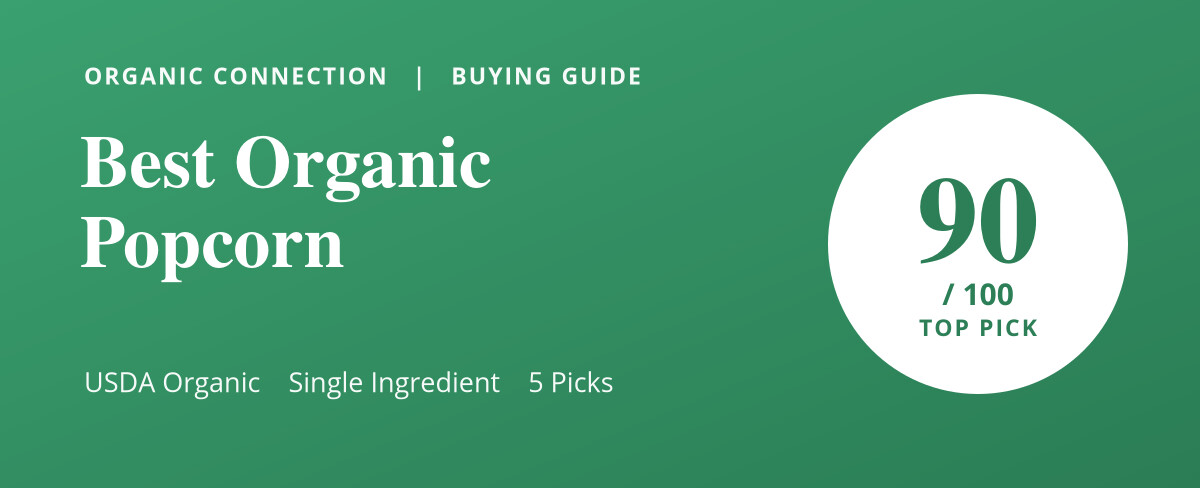
After researching the certifications, sourcing, and packaging of the most popular organic popcorn kernels, our top pick is Anthony’s Organic Yellow Popcorn Kernels, 3 lb. It is USDA certified organic, which on a corn crop means genuinely non-GMO rather than merely “non-GMO claimed,” and it is a single-ingredient whole grain with nothing added, which is why it earned our highest Organic Integrity Score of 90 out of 100. For the deepest certification, NOW Foods Organic Popcorn names four separate marks on its listing. For tender small flakes and a rare published residue test, Doudlah Farms Organic White is the best choice, and for the lowest price, 365 Organic Yellow Kernels costs about 14 cents an ounce.
With popcorn, the two things that matter most are whether the corn is certified organic and whether you are buying plain kernels or a pre-packaged microwave bag, because the bag is where most of the problems live. We flag each product’s certification and kernel type.
Best organic popcorn compared
| Best Choice | Best Value | ||||
 |  |  |  |  | |
| Product | Anthony's 3 lb | NOW Foods 24 oz | Doudlah Farms White 3 lb | Preferred 28 oz x4 | 365 Organic 28 oz |
| Organic Integrity Score | 90/ 100 | 85/ 100 | 83/ 100 | 79/ 100 | 76/ 100 |
| Our rating | 4.5 | 4.3 | 4.2 | 4.0 | 3.8 |
| Kernel | Yellow | Not stated | White | Yellow | Yellow |
| Best for | Best overall | Deepest certification | Tender white flakes | Bulk multipack | Best value |
| Certification | USDA Organic, Non-GMO, Gluten-free | USDA Organic, Non-GMO Project Verified, Kosher, TerraCycle | Organic, residue tested for 220 chemicals | Certified organic — agent not named | Organic — agent not named |
| Format | 3 lb bag | 24 oz bag | 3 lb bag | 4 x 28 oz bags | 28 oz bag |
| Price | $18.19$0.38 / ounce View on Amazon | $5.27$0.22 / ounce View on Amazon | $21.99$0.46 / ounce View on Amazon | $22.99$0.21 / ounce View on Amazon | $3.99$0.14 / ounce View on Amazon |
Price and availability as of October 11, 2026 7:10 pm EDT. Product prices and availability are accurate as of the date/time indicated and are subject to change. Any price and availability information displayed on Amazon.com at the time of purchase will apply to the purchase of this product.
Scores are ours, based on independent research of certification, ingredient purity, kernel quality, packaging, and value, using the same 10-criteria method we apply to every product. See how we research and rate.
What each claim on a popcorn bag actually covers
Popcorn is a single ingredient, which ought to make its labels simple. Instead the bags carry a stack of claims that are variously audited, self-asserted, or true of literally every kernel on the shelf. Here is what each one commits the seller to.
| Claim | Covers | Key exclusion |
| USDA Organic | The corn was grown without synthetic pesticides and from non-GM seed, under audited conditions | Nothing requires the harvested crop to be tested for residues afterwards |
| “Non-GMO” as a bare claim | The producer’s own assertion about seed genetics | Nobody audits it, and USDA organic already prohibits GM seed, so on an organic bag it adds nothing |
| Non-GMO Project Verified | Independent testing and supply-chain traceability to non-GMO sources | On a product already certified organic it largely duplicates a requirement organic imposes anyway |
| “Tested free of 220 chemicals” | A measurement of the finished crop, which can catch pesticide drift from neighboring conventional fields that certification alone would not | Not a certification: the company chooses the laboratory and which chemicals are on the panel |
| “Whole grain” | Accurate — the whole kernel is intact | True of every popcorn kernel ever sold, organic or not; it distinguishes nothing |
| Gluten free | Corn contains no gluten | Describes the crop rather than the facility, unless the bag carries a separate gluten-free certification |
| Kosher | Ritual production standards, verified by a named agency | Unrelated to pesticides, organic status, or kernel quality |
| “Sodium-free”, “low fat”, “air-popper ready” | Accurate for plain kernels | Describes what has not been added yet; everything here is bare corn until you cook it |
| White or yellow kernel | A real difference: white pops smaller and more tender with thinner hulls, yellow pops bigger and sturdier | A flavor and texture choice, not a quality grade — and several listings never state it |
| “Grown in the USA” | Country of origin, and sometimes a named farm or region | Says nothing about organic status, spraying, or residue levels on its own |
Key things to look for in organic popcorn
Great organic popcorn is about certification, kernel type, freshness, and format. Here is what matters.
1. USDA organic certification
Corn is a majority-GMO crop in the US and is commonly treated with glyphosate. The organic seal rules out both, which a “non-GMO” claim alone does not fully do.
2. One ingredient
Plain kernels should list popcorn and nothing else. No oil, no flavoring, no preservatives, no anti-caking agents.
3. Yellow versus white kernels
Yellow pops large and sturdy with a classic buttery flavor; white pops smaller, more tender, and slightly sweeter.
4. Resealable, moisture-tight packaging
Popcorn pops because of the water sealed inside the kernel. Packaging that lets that moisture escape gives you unpopped kernels.
Kernels versus microwave bags versus ready-to-eat
Plain kernels are the clear winner on cost, control, and cleanliness. A pound of organic kernels makes an enormous quantity of popcorn for a few dollars, you decide what fat and how much salt goes on it, and there is no bag lining, no flavoring, and no packaging chemistry to think about. Popping takes about four minutes in a heavy pot with a lid, or three in an air popper, which is not meaningfully slower than a microwave cycle.
Microwave bags buy convenience at a real cost. The grease-resistant coatings that keep the bag from soaking through have historically been PFAS-based, and while many manufacturers have moved away from the worst of these compounds, the category still carries the baggage. Butter-flavored varieties add flavoring compounds and a lot of sodium. Organic microwave popcorn exists and is a genuine improvement on the conventional kind, but it is still four to five times the price per serving of kernels. Ready-to-eat bagged popcorn is the most expensive of all and often carries the most added oil, salt, and sugar, though it has a place when you want something you can throw in a bag and go. If you eat popcorn regularly, kernels are the choice that wins on every axis except the thirty seconds it takes to get a pot out.
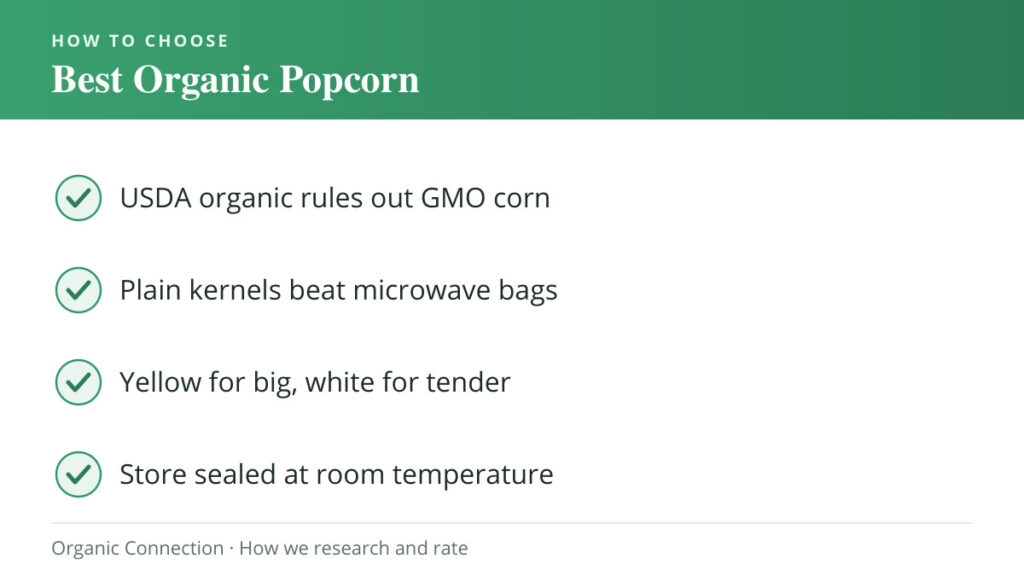
How to choose organic popcorn
- Confirm USDA organic. On corn, this is what actually rules out GMO seed and glyphosate.
- Buy plain kernels, not bags. Cheaper per serving, no bag lining chemistry, and you control the fat and salt.
- Pick your kernel. Yellow for big, sturdy, classic flakes; white for smaller and more tender.
- Check the ingredient list. It should say popcorn, full stop.
- Store it sealed. Kernels need their internal moisture to pop, so an airtight container at room temperature is essential.
Who should buy organic popcorn
Two things decide it: how much you eat, and whether you like a tender flake or a sturdy one. For a kernel that suits most people, go with our top pick. If you want bulk value, tender white kernels, a mid-size multipack, or a widely stocked non-GMO option at the lowest price, we have a pick for each.
Best overall: Anthony’s Organic Yellow Popcorn Kernels, 3 lb
| Organic Integrity Score | 90 / 100 |
| Size | 3 lb, unpopped kernels |
| Certification | USDA Organic, Non-GMO, Gluten-free |
| Method | Stovetop, electric popper or air popper |
| Best for | Everyday popping from a single large bag |
Popcorn is the simplest product on this site: one ingredient, and the only questions are whether the corn is certified and what it costs per pound. This bag answers both.
The certification uses the regulated phrasing — USDA Certified Organic — applied to the kernels, with gluten free and non-GMO in the product name. On a single-ingredient whole grain that is the entire certification story.
It also states what most kernel listings leave out: that it works on a stovetop, an electric popper or an air popper. Kernels are not all equal here — some are sold specifically for hot-air machines — so confirming all three saves a wasted bag.
Worth knowing generally: organic certification is doing real work in corn. The overwhelming majority of the US corn crop is genetically engineered, so certified organic corn is one of the few reliable routes to non-GE kernels, in the same way it is for canola.
The listing is two bullets and nothing more: no origin, no certifier, no moisture content, which is the variable that actually determines how well kernels pop.
What we liked: Regulated certification wording, a genuine 3 lb bag, and the popping methods spelled out.
Keep in mind: Two bullets, no certifier and no origin. Store kernels sealed; dried-out corn pops badly and leaves more unpopped.
What the listing discloses: Everything we check for is on the Anthony’s listing: USDA organic certification and an origin of the USA.
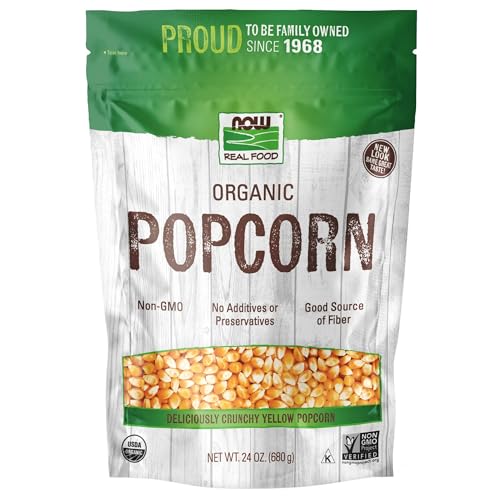
Deepest certification: NOW Foods Organic Popcorn, 24 oz
| Organic Integrity Score | 85 / 100 |
| Kernel | Not stated on the listing |
| Certification | USDA Organic, Non-GMO Project Verified, Kosher (Triangle K), TerraCycle |
| Ingredients | Popcorn kernels only — no additives or preservatives |
| Best for | Buyers who want the paperwork as well as the popcorn |
NOW Foods carries the deepest certification stack on this page and it is not close: USDA Organic, Non-GMO Project Verified, kosher under Triangle K, and TerraCycle packaging participation, all four named explicitly on the listing. On a page where two picks say only “organic” and leave you to guess who certified it, that matters.
It is also genuinely good value at about 21 cents an ounce, second cheapest here, from a family-owned company packaging in the USA since 1968. The kernels are a single ingredient with no additives or preservatives.
Two honest gaps. The listing never states the kernel color, which for popcorn is a real omission — yellow and white pop differently and taste different, as the section below explains. And 24 oz is a modest bag if you pop several times a week.
What we liked: Four named certifications including independent Non-GMO Project verification, single-ingredient kernels, strong cost per ounce, and a long-established family company.
Keep in mind: The kernel color is not stated on the listing, and the bag is smaller than the bulk options here.
What the listing discloses: NOW covers the ground, naming a USDA organic claim, Non-GMO Project Verified, kosher certification and an origin of the USA.
Best white kernel: Doudlah Farms Organic White Popcorn Kernels, 3 lb
| Organic Integrity Score | 83 / 100 |
| Kernel | White — smaller, more tender flakes |
| Certification | Organic; independently tested free of 220 chemicals including glyphosate |
| Farming | Regenerative and biodynamic, Wisconsin family farm |
| Best for | Tender flakes, thin hulls, and residue testing beyond organic |
White popcorn is the quieter sibling of yellow and worth knowing about. The flakes come out smaller and noticeably more tender, with thinner hulls and a lighter, slightly sweeter corn flavor rather than the robust buttery note of yellow. If you find standard popcorn tough, or the hulls annoying, white kernels are the fix.
What lifts this one above other white kernels is a claim we rarely get to report: Doudlah Farms states the corn is tested free of 220 chemicals, including glyphosate and its breakdown product AMPA. That is a meaningfully different thing from organic certification. Organic certification governs what a farmer is permitted to apply; it does not require anyone to test the finished crop for residues, and drift from neighboring conventional fields is a real phenomenon in the Midwest corn belt. A residue test measures the outcome rather than the process. It is the difference between a rule and a measurement, and almost nothing in this aisle offers the second.
The farm also describes its practice as regenerative and biodynamic and is a sixth-generation Wisconsin family operation. The trade-off is price and expansion: at about 46 cents an ounce it costs more than double the bulk picks, and white kernels expand less than yellow, so a given weight yields less popcorn.
What we liked: A published residue-testing claim covering glyphosate, genuinely tender white flakes with thin hulls, and regenerative farming on a named family farm.
Keep in mind: More than double the cost per ounce of the bulk picks, and white kernels yield less popped volume per pound than yellow.
What the listing discloses: Doudlah Farms commits to an origin of Wisconsin but stops short of whether the USDA seal applies.
Best bulk multipack: Preferred Popcorn Organic Popcorn, 28 oz, Pack of 4
| Organic Integrity Score | 79 / 100 |
| Kernel | Yellow — pops into large, durable flakes |
| Certification | Certified organic |
| Format | Four 28 oz bags, about 120 cups popped per bag |
| Best for | Families and households that pop weekly |
Seven pounds of certified organic kernels for around 20 cents an ounce, grown in the United States by farmers the company names as certified organic growers. Preferred Popcorn says each 28 oz bag pops up to 120 cups, which works out to well under five cents a cup — popcorn remains one of the genuinely cheap organic staples, and at this quantity that is obvious.
The kernels are selected to pop into large, durable flakes that hold up to seasoning rather than shattering, which is the practical difference between a bowl you can toss with butter and one that turns to crumbs.
The trade-offs are storage and disclosure. Four 28 oz bags need a pantry shelf, and while dry kernels keep well over a year sealed, they gradually lose the internal moisture that makes them pop, so old kernels give more duds. The listing also says “certified organic” without naming the certifying agent, where our second pick names four separate certifications outright.
What we liked: Excellent cost per ounce, US-grown certified organic corn, and kernels chosen for large sturdy flakes that take seasoning well.
Keep in mind: Seven pounds needs real storage, kernels dry out over time and pop less well, and no certifying agent is named.
What the listing discloses: Preferred Popcorn commits to an origin of the USA but stops short of whether the USDA seal applies.
Best budget: 365 Organic Yellow Popcorn Kernels, 28 oz
| Organic Integrity Score | 76 / 100 |
| Kernel | Yellow |
| Certification | Organic — no certifier named on the listing |
| Format | Single 28 oz bag |
| Best for | The cheapest way into organic popcorn |
This is the cheapest organic popcorn on the page by a wide margin, at roughly 14 cents an ounce — about a third of the white-kernel pick and cheaper per ounce than even the four-bag bulk case. For a single 28 oz bag of organic yellow kernels, it is very hard to argue with, and it is low-fat and sodium-free because it is simply corn.
It scores lowest for one reason, and it is a disclosure reason rather than a quality one. The listing says “organic yellow popcorn kernels” and stops. No certifying agent is named, there is no Non-GMO Project verification alongside it, and no growing region is given — where our second pick names four certifications and our white pick publishes residue testing. On a crop as heavily sprayed as conventional corn, organic certification is the claim doing the real work here, so we would rather see it attributed.
None of that makes it a bad bag. If the choice is this or conventional microwave popcorn, this is better corn, without the bag lining or the added flavoring, at a price that removes the excuse.
What we liked: The lowest price per ounce here by some distance, organic certification, single-ingredient kernels, and a size most households will actually finish.
Keep in mind: The listing names no certifying agent, adds no independent non-GMO verification, and states no growing region.
What the listing discloses: Beyond the organic claim itself, 365 by Whole Foods Market does not say whether the USDA seal applies and where it was grown or made.
How to pop it well
The stovetop method is the most reliable. Use a heavy pot with a lid, add enough high-smoke-point oil to coat the bottom (avocado or refined coconut oil work well), drop in three kernels, and cover. When those three pop, the oil is at temperature: add a single layer of kernels, cover, shake gently, and crack the lid slightly to let steam escape, which is what keeps popcorn crisp rather than chewy. Pull it off the heat when pops slow to a couple of seconds apart. An air popper gets you there with no oil at all and is the lowest-calorie route, though the flakes take seasoning less well without a little fat to hold it. If you want microwave convenience without the bag chemistry, put a quarter cup of kernels in a plain brown paper lunch bag, fold the top twice, and microwave for two to three minutes. Season after popping, not before, and use fine salt so it clings. Store kernels in an airtight jar at room temperature; refrigerating them dries them out and gives you more unpopped duds.
The microwave bag problem, honestly assessed
Microwave popcorn bags have attracted two genuine chemical concerns, and both have improved substantially — which is worth stating fairly rather than alarming people about a problem that has largely been addressed.
Diacetyl. The artificial butter flavoring diacetyl was linked to bronchiolitis obliterans, an irreversible lung disease that became known as “popcorn lung”, initially in workers at microwave popcorn plants exposed to it in vapor form. Most major manufacturers voluntarily removed diacetyl from their products by 2007. Consumer exposure was always far lower than occupational exposure, and the ingredient is now largely gone from the category.
PFAS. Per- and polyfluoroalkyl substances were used to create the grease-proof lining inside microwave popcorn bags, stopping oil soaking through. A 2019 study found people who regularly ate microwave popcorn had higher blood PFAS levels than those who did not. In February 2024, the FDA announced that manufacturers had voluntarily ended the sale of these PFAS for US food packaging.
Keep in mind: “voluntarily ended” is not the same as banned, and much of the industry moved to short-chain PFAS alternatives that are considered safer than the earlier generation but whose long-term effects are still being studied. If you want to be certain rather than reassured, popping loose kernels removes the packaging question entirely — which is the strongest practical argument for buying kernels rather than bags, and a better one than the usual cost comparison.
The other reason to skip bags is simpler: the oil. Microwave bags typically use palm or partially refined oils plus salt and flavoring, which is where most of the calories and sodium come from. Loose kernels let you choose both.
Popping methods compared
| Method | How | Notes |
| Stovetop | Heavy pan, 2 tbsp oil to ½ cup kernels, medium-high, lid slightly ajar | Best flavor and control. The three-kernel test below is the trick. |
| Air popper | No oil, hot air | Lowest calorie; drier and blander, and needs oil or butter added after to hold seasoning |
| Microwave, bowl method | ¼ cup kernels in a glass bowl with a plate on top, 2–4 min | Free, no bag, no coating. Works better than people expect. |
| Microwave, paper bag | Plain brown lunch bag, folded twice | Cheap and effective; use an unprinted, uncoated bag |
| Commercial microwave bag | Prepackaged | Convenient; carries the packaging and oil questions above |
Stovetop technique that actually works:
- Heat the oil with three kernels in the pan and the lid on. When all three pop, the oil is at temperature — add the rest, count to thirty off the heat so they all reach popping temperature together, then return to the heat.
- Leave the lid slightly ajar. Trapped steam is what makes popcorn chewy rather than crisp.
- Shake the pan occasionally to stop the bottom layer scorching.
- Pull it off the heat when popping slows to two seconds between pops, not when it stops entirely. Waiting for silence burns the batch.
- Oil choice matters — popping happens around 200°C, so use something with a high smoke point: refined coconut oil is traditional and gives the cinema flavor, avocado oil is neutral and stable, and extra virgin olive oil will smoke and turn bitter.
- Salt fine, salt early. Coarse salt slides off; fine salt or a quick blitz in a grinder sticks, especially tossed while the popcorn is still hot and slightly oily.
Kernel types: butterfly, mushroom and color
| Type | Shape | Best for |
| Butterfly / snowflake | Irregular with wings | Home and cinema popcorn. Wings catch butter and seasoning. |
| Mushroom | Dense round balls | Caramel and coated popcorn — survives tumbling without shattering |
| Yellow kernels | Larger, sturdier pops | The default. Classic buttery flavor and good volume. |
| White kernels | Smaller, more tender, more delicate | Lighter texture; often preferred plain |
| Red, blue and purple | Small, crunchy, nuttier | Novelty and flavor. They all pop white — the color is in the hull. |
If you have ever wondered why coated caramel corn from a shop holds its shape while your homemade version turns to crumbs, mushroom kernels are the answer. They are sold separately and are worth seeking out for anything you plan to coat.
Why kernels fail to pop, and how to fix it
Popping works because each kernel contains a small amount of water sealed inside a hard hull. Heat turns it to steam at high pressure until the hull ruptures and the starch expands. That mechanism depends entirely on moisture content, which needs to be around 13.5–14%.
- Too dry and they will not pop — this is what has happened to an old bag producing a bowl of unpopped “old maids”.
- You can rehydrate them. Add a tablespoon of water per cup of kernels to a sealed jar, shake, and leave for two to three days, shaking occasionally. It genuinely works.
- Never refrigerate or freeze kernels. This is the most common storage mistake and it dries them out, which is the opposite of what people assume they are doing.
- Store airtight at room temperature, away from heat. Kernels keep one to two years this way.
- Cracked or damaged hulls will not pop, because the steam escapes rather than building pressure.
Nutrition, and the things worth knowing
- Popcorn is a whole grain, and one of the few snack foods that genuinely is. Three cups air-popped supplies roughly 3.5–4 g of fiber for around 90 calories.
- It is also high in polyphenols, concentrated in the hull — the part people find annoying.
- What ruins it is what goes on it. Cinema and heavily buttered popcorn can carry many times the calories of the plain version, and ready-to-eat bagged popcorn is often high in sodium and sugar.
- Organic matters here mainly for the corn itself. Popcorn is a distinct variety of maize and is not currently grown from GM seed commercially, so “non-GMO popcorn” is technically true and tells you nothing. Organic certification does mean no synthetic pesticides on the crop and no synthetic additives in flavored products, which is the real difference.
- Choking hazard. Popcorn is on the standard list of foods not recommended for children under four, because the light, irregular pieces are easily inhaled.
- Hulls and dental work — hull fragments lodge readily under gums and around braces and crowns. Not dangerous, genuinely irritating, and the main reason some people prefer white or “hulless” small-kernel varieties, which still have hulls but finer ones.
How we researched this guide
We are a research-based review site. We compared each product against its certification (USDA organic), ingredient purity, kernel type and yield, packaging and moisture retention, and the weight of aggregated customer feedback on pop rate and flavor, then scored each with our 10-criteria Organic Integrity Score. No brand paid to be included or ranked. Read the full method on our How We Research and Rate page.
Volume, density, and the one snack that genuinely wins
Popcorn is the rare case on this site where the honest answer to the weight question is straightforwardly positive, and the reason is physics rather than nutrition.
Air-popped popcorn runs about 31 calories a cup. Three cups, which is a generous bowl that takes real time to eat, comes to under 100 calories with around 3.5 grams of fiber. Almost nothing else in the snack aisle offers that ratio of bulk to energy.
The relevant concept is energy density: calories per gram of food. People tend to eat a fairly consistent weight of food rather than a consistent number of calories, so foods that carry fewer calories in the same volume produce the same fullness for less. Popcorn is mostly air and fiber, which puts it near the bottom of the density scale for a dry snack. Controlled comparisons have found popcorn more satiating than an equal-calorie serving of crisps, by a wide margin.
Everything depends on what happens after popping. Microwave butter popcorn can run three to four times the calories of air-popped, and cinema popcorn with topping is in a different category entirely. Kettle corn adds sugar. The advantage is real and it belongs to plain popcorn, which is a strong argument for buying kernels rather than bags.
Whole grain status is a genuine bonus. Popcorn is a whole grain, and most people eating it are not thinking of it as one, which makes it an unusually painless way to add fiber.
Honest summary: a genuinely good high-volume snack, provided you pop it yourself and season it lightly. It is one of the few foods where the health framing survives contact with the evidence.
Common questions about organic popcorn
What is the best organic popcorn?
Our overall pick is Anthony’s Organic Yellow Popcorn Kernels, which scores highest here at 90, because it is USDA certified organic, a single-ingredient whole grain, and it pops large, sturdy flakes with very few duds. For the deepest certification, NOW Foods Organic Popcorn names four marks outright. For tender small flakes, Doudlah Farms Organic White is tested free of 220 chemicals including glyphosate, and for the lowest price, 365 Organic Yellow Kernels.
Is organic popcorn worth buying?
On corn, yes, more than in most categories. The overwhelming majority of US field corn is genetically modified and commonly treated with glyphosate, and USDA organic certification rules out both. Popcorn is also one of the cheapest organic staples you can buy, so the price gap over conventional kernels is small in absolute terms.
Is microwave popcorn bad for you?
The concern is mostly the bag rather than the corn. Grease-resistant bag linings have historically used PFAS compounds, and butter-flavored varieties add flavorings and a lot of sodium. Many manufacturers have reformulated, but plain kernels popped in a pot, air popper, or plain paper bag avoid the question entirely and cost far less per serving.
What is the difference between yellow and white popcorn?
Yellow kernels pop larger, sturdier flakes with a classic robust corn flavor, and they hold up to heavy toppings. White kernels pop smaller, more tender flakes with thinner hulls and a lighter, slightly sweeter taste, which suits people who find standard popcorn tough or dislike hulls. Yellow also yields more popcorn per ounce.
Why do my kernels not pop?
Popcorn pops because of moisture sealed inside the kernel turning to steam, so kernels that have dried out will not pop. Store them in an airtight container at room temperature rather than the fridge, which dries them further, and use older bags first. Oil that is not hot enough before the kernels go in also causes duds.
Is microwave popcorn safe now?
Much safer than it was, though not entirely settled. Diacetyl, the butter flavoring linked to bronchiolitis obliterans or “popcorn lung”, was voluntarily removed by most major manufacturers by 2007. PFAS grease-proof bag linings — which a 2019 study associated with higher blood PFAS levels in regular eaters — were voluntarily withdrawn from US food packaging as the FDA announced in February 2024. Much of the industry moved to short-chain PFAS alternatives considered safer but still under study. Popping loose kernels removes the question entirely.
What is the best way to pop popcorn?
Stovetop, for flavor and control. Heat two tablespoons of high smoke point oil with three kernels in the pan and the lid on; when all three pop, add half a cup of kernels, count to thirty off the heat so they reach temperature together, then return to the heat with the lid slightly ajar so steam escapes. Pull it off when popping slows to two seconds between pops rather than waiting for silence.
Which oil is best for popping popcorn?
Something with a high smoke point, since popping happens around 200°C. Refined coconut oil is traditional and gives the cinema flavor, avocado oil is neutral and stable. Extra virgin olive oil will smoke and turn the batch bitter. For an air popper, add oil or melted butter afterwards — otherwise seasoning slides straight off.
Why won’t my popcorn kernels pop?
They have dried out. Popping depends on moisture sealed inside the hull turning to steam, and kernels need to be around 13.5 to 14% moisture. You can rehydrate them: add a tablespoon of water per cup of kernels to a sealed jar, shake, and leave two to three days, shaking occasionally. Never refrigerate or freeze kernels — it dries them out, which is the opposite of what most people assume.
What is the difference between butterfly and mushroom popcorn?
Shape and durability. Butterfly or snowflake kernels pop irregular with wings that catch butter and seasoning, and are what you want for home and cinema-style popcorn. Mushroom kernels pop into dense round balls that survive tumbling in caramel or coating without shattering — which is why shop-bought caramel corn holds together and homemade often does not.
Is popcorn actually healthy?
Plain popcorn genuinely is — it is a whole grain, and three cups air-popped gives roughly 3.5 to 4 g of fiber for around 90 calories, plus polyphenols concentrated in the hull. What ruins it is what goes on top: cinema and heavily buttered popcorn carry many times the calories, and ready-to-eat bagged versions are often high in sodium and sugar.
Is non-GMO popcorn a meaningful claim?
No. Popcorn is a distinct variety of maize and is not grown commercially from GM seed, so “non-GMO popcorn” is technically true and tells you nothing. What organic certification does mean here is no synthetic pesticides on the crop and no synthetic additives in flavored products.
At what age can children eat popcorn?
Generally not under four. Popcorn appears on standard lists of choking hazards because the light, irregular pieces are easily inhaled. Separately, hull fragments lodge readily under gums and around braces and crowns — irritating rather than dangerous, and the main reason some people prefer smaller white kernels.
- Organic Food & Pantry hub
- Best Organic Candy
- Best Organic Nuts
- How we research and rate products
- our searchable product database — compare all 800+ picks side by side
Price and availability as of October 11, 2026 7:10 pm EDT. Product prices and availability are accurate as of the date/time indicated and are subject to change. Any price and availability information displayed on Amazon.com at the time of purchase will apply to the purchase of this product.
Looking for other organic products?
We have checked more than 800 products across food, household goods, gardening, personal care and pet, every one against its stated certification. Browse all reviews.
Organic Connection is reader-supported. When you buy through links on this page we may earn a commission, at no extra cost to you. As an Amazon Associate we earn from qualifying purchases. We are not paid to feature or rank any product. How we research and rate.