Last updated: September 30, 2026
We may earn a commission when you buy through links on this page, at no extra cost to you. How we research and rate.
The short version
After researching the ingredients and certifications of the most popular organic candies, our top pick is YumEarth Organic Lollipops. They are USDA organic, allergy-friendly, colored with real fruit and vegetable juice, and free of high-fructose corn syrup and artificial dyes, which is why they earned our highest Organic Integrity Score of 93 out of 100. For gummies, YumEarth Organic Gummy Bears are our pick, and for grown-up hard candy, Torie & Howard is the best choice.
Organic candy is still candy, so it has sugar, but the good stuff swaps artificial dyes, high-fructose corn syrup, and synthetic flavors for organic sugar and real fruit and vegetable coloring. We flag each pick’s type and certification.
Best organic candy compared
| Best Choice | Best Value | ||||
 |  |  |  |  | |
| Product | YumEarth Pops (40ct) | YumEarth Lollipops | Torie & Howard Hard | YumEarth Gummy Bears | Torie & Howard Tin |
| Organic Integrity Score | 93/ 100 | 90/ 100 | 86/ 100 | 78/ 100 | 77/ 100 |
| Our rating | 4.7 | 4.5 | 4.3 | 3.9 | 3.9 |
| Best for | Best overall | Clean organic treat | Hard candy | Gummies | Gift tin |
| Type | Lollipops (bulk) | Lollipops | Hard candy | Gummy bears | Hard candy tin |
| Certification | USDA Organic, Non-GMO, Gluten-free | USDA Organic, Non-GMO, Kosher | USDA Organic, Non-GMO, Kosher | Not stated on the listing | — |
| Price | $11.95$3.41 / ounce View on Amazon | Currently unavailable See buying options | $20.95$1.31 / ounce View on Amazon | $8.82$1.26 / ounce View on Amazon | $12.38$3.10 / ounce View on Amazon |
Price and availability as of October 11, 2026 7:10 pm EDT. Product prices and availability are accurate as of the date/time indicated and are subject to change. Any price and availability information displayed on Amazon.com at the time of purchase will apply to the purchase of this product.
Scores are ours, based on independent research of certification, ingredient cleanliness, allergy-friendliness, and taste, using the same 10-criteria method we apply to every product. See how we research and rate.
Reading the seals on organic candy: what each one does and does not cover
The labels on these products are not interchangeable, and several of them cover things that have nothing to do with each other. Here is what each one actually buys you.
| Certification | Covers | Key exclusion |
| USDA Organic | Farming and handling: no synthetic pesticides or fertilizers, no GMOs, no sewage sludge or irradiation, audited yearly by an accredited certifier | Three different tiers share the one seal, and it makes no claim about worker pay, food miles, or nutrition |
| Fair Trade Certified | A price floor for producers, a community premium, and labor standards on the farms and in the facilities | An economic and labor standard; it is not an organic or pesticide claim |
| Rainforest Alliance | Farm-level criteria for deforestation, biodiversity, water and working conditions | Permits a defined list of synthetic pesticides that organic certification prohibits outright |
| Kosher | Ingredients and production comply with Jewish dietary law, verified by a rabbinic agency that inspects the facility | A dietary-law standard: it makes no claim about pesticides, GMOs or farming practice |
Rainforest Alliance is not an organic label, and the frog is regularly read as one. Its criteria are genuinely strong on deforestation, biodiversity and farm working conditions, and it permits a defined list of synthetic pesticides that organic certification prohibits outright. The two standards overlap and plenty of good farms hold both. But a frog on its own has not answered the pesticide question.
Key things to look for in organic candy
Good organic candy is about clean ingredients and honest treats. Here is what matters.
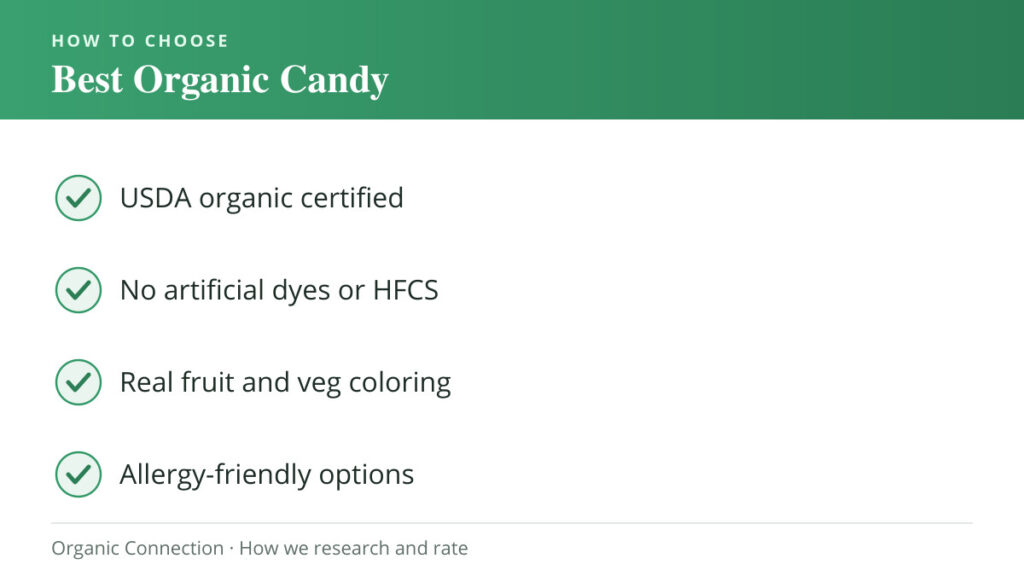
1. USDA organic certification
It confirms organic sugar and ingredients grown without synthetic pesticides, and no artificial additives.
2. No artificial dyes or HFCS
Look for coloring from real fruit and vegetable juices and no high-fructose corn syrup.
3. Allergy-friendly, if needed
Many organic candies are free of the top allergens, gluten, and gelatin (or use it clearly), which is great for kids and parties.
4. The right format
Lollipops and hard candy last longer, gummies are chewy and kid-friendly, and tins make nice gifts.
Is organic candy really better?
Let’s be honest: candy is a treat, and organic candy still contains sugar, so it is not a health food. What organic certification changes is what’s not in it: no artificial dyes like Red 40, no high-fructose corn syrup, and no synthetic flavors, with organic sugar and real fruit and vegetable juice for color instead. For parents who want to avoid artificial dyes (which some children are sensitive to), and for anyone who prefers cleaner ingredients in their occasional sweet, that is a meaningful difference.
Our scoring rewards genuine USDA certification, clean ingredients (no artificial dyes or HFCS), allergy-friendliness, and taste, so you get candy that is a cleaner treat, while remembering it is still a treat to enjoy in moderation.
How to choose an organic candy
- Look for the USDA Organic seal. It confirms organic sugar and no artificial additives.
- Check for no artificial dyes or HFCS. Real fruit and vegetable juice coloring is the sign of clean candy.
- Consider allergies. Many organic candies are top-allergen-free; gummies may or may not contain gelatin.
- Pick the format. Lollipops and hard candy for slow treats, gummies for kids, tins for gifts.
- Enjoy in moderation. It is still sugar, so treat it as an occasional sweet.
Who should buy organic candy
The occasion decides this more than the product does. For organic lollipops, our top pick is the one. If you want chewy gummies, grown-up hard candy, a value party size, or a gift tin, we have a pick for each.
Best overall: YumEarth Organic Pops (40 Count)
| Organic Integrity Score | 93 / 100 |
| Type | Lollipops, 40-count value pack |
| Certification | USDA Organic, Non-GMO, Gluten-free |
| Best for | Parties, favors, and stocking up |
YumEarth Pops in the 40-count size is our top pick. It is the same clean, USDA-organic, dye-free lollipops as our top pick in a party-size bag, giving a lower cost per pop, ideal for birthday favors, classroom treats, Halloween, and keeping the candy dish stocked without buying premium tins.
It takes first place on documentation: its listing names USDA Organic, where most of this category asks to be taken on trust.
For clean organic candy at the best price per piece, it is the smart buy.
What we liked: Same clean USDA-organic lollipops in a party-size bag, at a low cost per pop, and vegan.
Keep in mind: It is the same product as our top pick, just in bulk, so choose based on quantity.
What the listing discloses: YumEarth lists a USDA organic claim. The gap is where it was grown or made.
Clean organic treat: YumEarth Organic Lollipops
| Organic Integrity Score | 90 / 100 |
| Type | Lollipops, 8 fruit flavors |
| Certification | USDA Organic, Non-GMO, Kosher |
| Best for | An all-around clean organic treat |
YumEarth Lollipops are our top pick because they set the standard for clean candy. From the #1 organic candy brand, they are USDA organic, free of the top allergens, non-GMO, gluten-free, and vegan, colored with real fruit and vegetable juice with no high-fructose corn syrup or artificial dyes, in eight fruity flavors, individually wrapped for lunchboxes, parties, and the candy dish.
The trade-off is that they are still sugar, so they are a treat, not a snack. For a clean, allergy-friendly, crowd-pleasing organic candy, they are a dependable option.
What we liked: USDA organic, top-allergen-free, no artificial dyes or HFCS, real fruit flavors, and individually wrapped.
Keep in mind: Organic candy still contains sugar, so it is an occasional treat.
What the listing discloses: You are told a USDA organic claim and kosher certification for YumEarth; you are not told where it was grown or made.
Best hard candy: Torie & Howard Organic Hard Candy
| Organic Integrity Score | 86 / 100 |
| Type | Hard candy assortment, individually wrapped |
| Certification | USDA Organic, Non-GMO, Kosher |
| Best for | A grown-up, sophisticated treat |
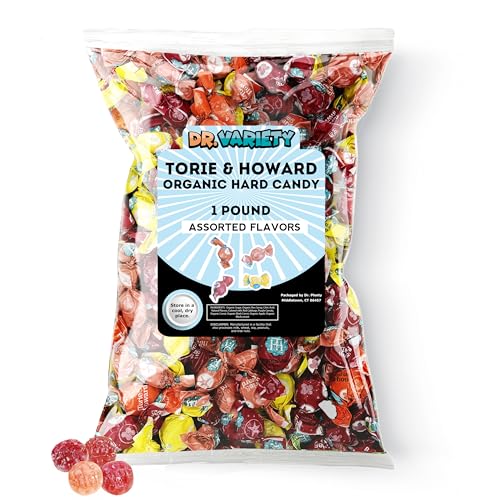
Torie & Howard is our pick for hard candy. This USDA-organic, kosher, non-GMO assortment features sophisticated dual-fruit flavor combinations like Blood Orange & Honey and Pink Grapefruit & Honey, with no corn syrup, artificial colors, or flavors, colored naturally with fruit and vegetable extracts, individually wrapped, and free of gluten, nuts, dairy, and soy.
It scores in the middle because it is a more premium, grown-up hard candy rather than a kid-focused treat, but for a clean, elegant organic hard candy, it is a standout.
What we liked: USDA organic and kosher, sophisticated dual-fruit flavors, no corn syrup or artificial colors, and allergy-friendly.
Keep in mind: It is a premium, grown-up hard candy, so it costs more than basic candy and is less kid-oriented.
What the listing discloses: Doctor Plenty commits to USDA organic certification and kosher certification but stops short of where it was grown or made.
Best gummies: YumEarth Organic Gummy Bears
| Organic Integrity Score | 78 / 100 |
| Type | Gummy bears, snack packs |
| Certification | Not stated on the listing |
| Best for | Chewy, kid-friendly gummies |
YumEarth Gummy Bears are our pick for gummies. These USDA-organic, non-GMO, top-allergen-free gummy bears are made with real fruit juices and colored with fruit and vegetable extracts, no high-fructose corn syrup or artificial dyes, in individually portioned snack packs that are perfect for lunchboxes and on the go.
What we liked: USDA organic, real fruit juice, no artificial dyes or HFCS, top-allergen-free, and convenient snack packs.
Keep in mind: They contain gelatin, so they are not vegan, and gummies are sticky and sugary like any chewy candy.
What the listing discloses: YumEarth carries no organic claim, certified or otherwise.
Best gift: Torie & Howard Organic Hard Candy Tin
| Organic Integrity Score | 77 / 100 |
| Type | Hard candy in a reusable tin |
| Certification | — |
| Best for | Gifting and a pretty desk treat |
The Torie & Howard tin is our gift pick. It brings the same clean, USDA-organic, no-corn-syrup hard candy as our hard-candy pick in a pretty, reusable tin, in flavors like Blood Orange & Honey, making it an easy, thoughtful gift or a tidy treat for a desk, bag, or nightstand.
It scores at the value end because you pay a little more for the tin and get a smaller quantity, but for a clean organic candy that also makes a nice gift, it is a lovely choice.
What we liked: USDA organic, clean ingredients, appealing flavors, and a pretty reusable tin that gifts well.
Keep in mind: You pay for the tin and get a smaller amount, so it is more gift than bulk value.
What the listing discloses: Torie & Howard is thin on detail, and does not say whether the USDA seal applies and where it was grown or made.
What the artificial dye rules actually say now
Most organic candy guides tell you organic means “no artificial dyes” and stop there. That is true, but the rules around conventional candy have changed enough since 2025 that the gap between the two shelves is narrowing, and it is worth knowing where things actually stand before you pay a premium.
On 15 January 2025 the FDA revoked the authorization for FD&C Red No. 3 in food and ingested drugs, acting under the Delaney Clause after petitioners submitted data showing the additive causes cancer in male rats. Food and beverage manufacturers have until 15 January 2027 to comply; makers of ingested drugs have until 18 January 2028. In April 2025 HHS and the FDA went further and asked companies to phase out petroleum-based synthetic dyes generally, and to drop Red 3 ahead of the 2027 deadline rather than run stock down to the wire.
Two things follow from that. First, conventional candy is losing Red 3 whether or not you buy organic, so “no Red 3” is not a reason to pay more for much longer. Second, the phase-out does not cover Red 40, Yellow 5, Yellow 6, Blue 1 or Blue 2, which are the dyes that actually do most of the coloring in mainstream candy and which the FDA has only asked companies to move away from voluntarily. Organic certification still prohibits all of them outright, and that is the durable difference.
| Color | Conventional candy uses | Certified organic candy uses |
|---|---|---|
| Red / pink | Red 40, Red 3 (until 2027) | Black carrot, beet, radish, purple sweet potato |
| Yellow / orange | Yellow 5, Yellow 6 | Turmeric, annatto, carrot, paprika extract |
| Blue / purple | Blue 1, Blue 2 | Spirulina extract, huito, red cabbage |
| Green | Blue 1 + Yellow 5 | Spirulina + turmeric, or safflower |
| Brown / black | Caramel color class III/IV | Cocoa, caramelized sugar, vegetable carbon |
The practical consequence is cosmetic and worth expecting: plant-based colors are less saturated, they shift with pH, and they fade in sunlight. Organic gummies look muted next to conventional ones and a bag left on a car dashboard will go pale. That is the coloring behaving normally, not the candy spoiling.
The sweeteners in organic candy, and the one worth knowing about
None of the top-ranking organic candy roundups break down what is actually doing the sweetening, which matters more than the color question for anyone buying this for a small child.
| Sweetener | Common in | What to know |
|---|---|---|
| Organic cane sugar | Hard candy, lollipops, chocolate | The default. Nutritionally identical to conventional sugar. |
| Organic tapioca syrup | Gummies, chews, caramels | Neutral flavor, good chew, no known contaminant issue. |
| Organic brown rice syrup | Gummies, chews, cereal-bar style candy | Carries an arsenic caveat — see below. |
| Organic coconut sugar | Chocolate, caramels | Slightly lower glycaemic index, but still sugar. Adds a molasses note. |
| Organic glucose syrup (corn) | Hard candy | Not high-fructose corn syrup. Organic rules prohibit HFCS. |
| Dates / fruit concentrate | “Fruit chew” style candy | Brings fiber and potassium, but sugar content is comparable. |
Keep in mind: organic brown rice syrup is a documented source of inorganic arsenic. A 2012 Dartmouth study led by Brian Jackson, published in Environmental Health Perspectives, tested 17 toddler formulas, 29 cereal bars and 3 energy shots and found that products using organic brown rice syrup as a primary ingredient carried inorganic arsenic averaging 8.6 ppb in a dairy-based formula and 21.4 ppb in a soy one — comparable to or above the 10 ppb US drinking water limit, and more than twenty times the levels in formulas without it. Rice draws arsenic out of soil more readily than most crops, and organic certification does nothing to change that, because arsenic is a soil contaminant rather than something sprayed on. There is still no US regulatory limit for arsenic in food. This is not a reason to avoid an occasional lollipop, but if you are buying organic candy specifically because of a toddler, tapioca-syrup and cane-sugar sweetened products are the more conservative choice.
Organic is not fair trade, and for chocolate that matters
The two labels get used interchangeably in candy roundups and they cover completely different things. USDA organic governs what was applied to the crop. It says nothing at all about who harvested it or under what conditions.
For cocoa that distinction is substantial. NORC at the University of Chicago, in its assessment of child labor in cocoa-growing areas of Côte d’Ivoire and Ghana, found roughly 1.56 million children engaged in child labor in cocoa — about 790,000 in Côte d’Ivoire and 770,000 in Ghana — with around 1.48 million of them exposed to at least one hazardous condition, including sharp tools, land clearing, night work and agrochemical exposure. A certified organic chocolate bar sourced from those regions is not exempt from that picture.
If the labor question matters to you, look for a second mark alongside the USDA seal: Fairtrade International, Fair Trade USA, Rainforest Alliance, or a brand that publishes direct-trade sourcing with named cooperatives and prices paid. Several small chocolate makers do the latter and it is generally more informative than any seal. For non-chocolate candy — lollipops, hard candy, fruit chews — the issue is far less acute, because cane sugar supply chains carry their own labor concerns but not on the same documented scale.
More organic candy brands worth knowing
Our picks above are the ones we tested and rated, but the organic candy shelf is wider than any five products, and if you are shopping a specific format it helps to know who makes what.
| Brand | Best known for | Worth knowing |
|---|---|---|
| YumEarth | Lollipops, gummies, candy corn, chewies | The broadest organic range; free of the top allergens, no gelatin in most lines. |
| Torie & Howard | Hard candy, tins | Flavor pairings aimed at adults; strong gifting presentation. |
| Surf Sweets | Jelly beans, gummy worms, sour bears | Made in a peanut- and tree-nut-free facility; some lines use organic tapioca rather than gelatin. |
| Cocomels | Coconut-milk caramels | Dairy-free and vegan by formulation, not just by substitution. |
| Theo Chocolate | Chocolate bars | Organic plus published fair-trade sourcing — the combination discussed above. |
| Alter Eco | Truffles, chocolate bars | Organic and fair trade, with compostable truffle wrappers. |
| St. Claire’s | Organic licorice, mints, tarts | Allergen-free formulation; licorice is anise- and fennel-flavored rather than dyed. |
| Lovely Candy Co. | Chews, licorice, fruit bites | Gluten-free and non-GMO across the range; some lines organic rather than all. |
Keep in mind: not every product from an “organic brand” is certified. Several of these companies run both certified-organic and merely non-GMO lines under the same logo and packaging family, and the difference is only visible in the seal on the back. Check the individual bag rather than trusting the brand name.
How to read an organic candy label
Three tiers appear on candy packaging and they are not equivalent:
- “100% Organic” — every ingredient is certified organic, excluding salt and water. Rare in candy, because most formulations need at least one non-organic processing aid.
- “Organic” (with the USDA seal) — at least 95% of ingredients by weight are certified organic. This is what almost all organic candy carries, and it is the tier worth buying.
- “Made with organic ingredients” — at least 70% organic. This cannot carry the USDA seal, and the remaining 30% can include ingredients organic rules would otherwise prohibit. It is the tier that trips people up, because the wording looks reassuring on a front-of-pack flash.
Below 70% organic content, a product can only name organic ingredients individually in the ingredient list — “organic cane sugar” — and cannot use the word organic anywhere on the front of the package. If the front says organic and there is no USDA seal, read the fine print before assuming.
Enjoying organic candy sensibly
Organic candy is a cleaner treat, no artificial dyes, high-fructose corn syrup, or synthetic flavors, but it still contains sugar, so it is best enjoyed in moderation rather than as a snack. For kids, individually wrapped lollipops and gummy snack packs make portion control easy and are handy for lunchboxes and parties. Store candy in a cool, dry place so hard candy does not get sticky and gummies do not dry out. If you are avoiding gelatin, check the label, since some gummies use gelatin and others use pectin.
How we researched this guide
We are a research-based review site. We compared each candy against its certification, ingredient cleanliness (no artificial dyes or HFCS), allergy-friendliness, and the weight of aggregated customer feedback on taste, then scored each with our 10-criteria Organic Integrity Score. No brand paid to be included or ranked. Read the full method on our How We Research and Rate page.
Organic candy is candy
This section exists because the question gets asked, and because the honest answer is short enough that padding it would be dishonest in itself.
Organic certification on confectionery governs how the sugar cane or beet was farmed, which colorings and flavorings may be used, and the absence of certain synthetic additives. Those are real differences and they are covered above. None of them changes what sugar does once eaten.
Organic cane sugar and conventional cane sugar are the same molecule, digested identically, at the same roughly four calories per gram. A piece of organic candy and a conventional one of equal size are nutritionally equivalent in every way that affects body weight.
Where organic certification does something worth having is in the additives. Synthetic dyes such as Red 40, Yellow 5 and Yellow 6 are prohibited, as are several artificial flavorings. For families concerned about those specifically, particularly in relation to children, that is a legitimate reason to pay more, and it has nothing to do with weight.
The risk worth naming is the health halo. A product labeled organic tends to be perceived as lighter, healthier and more permissible, and there is reasonable research showing people eat more of foods they perceive that way. Organic candy is one of the clearest cases where that perception is unearned.
If sweets are part of your week, the useful levers are the ordinary ones: buy a small bag rather than a large one, keep it out of sight rather than on the desk, and eat it as something you chose rather than something within reach.
Honest summary: a genuine improvement in additives and provenance, no nutritional or caloric difference of any kind, and a label that makes overconsumption slightly more likely rather than less.
Common questions about organic candy
What is the best organic candy?
Our overall pick is YumEarth Organic Lollipops, because they are USDA organic, allergy-friendly, and colored with real fruit and vegetable juice with no artificial dyes or HFCS. For gummies, YumEarth Organic Gummy Bears are our pick, and for hard candy, Torie & Howard.
Is organic candy healthier than regular candy?
It is a cleaner treat, not a health food. Organic candy avoids artificial dyes, high-fructose corn syrup, and synthetic flavors, using organic sugar and real fruit and vegetable coloring, but it still contains sugar, so enjoy it in moderation.
Is organic candy free of artificial dyes?
Yes. USDA-organic candy cannot use synthetic dyes like Red 40 or Yellow 5, and instead colors with real fruit and vegetable juices, which is a key reason parents choose it for kids sensitive to artificial colors.
Is organic candy vegan?
Some are and some are not. Lollipops and many hard candies are vegan, while gummies often contain gelatin. Check the label, and look for pectin-based gummies if you want a vegan option.
Does organic candy have less sugar?
Not necessarily; organic candy uses organic sugar but is not automatically lower in sugar than conventional candy. The difference is the absence of artificial dyes, HFCS, and synthetic flavors, so treat it as an occasional sweet.
Why does organic candy look duller than regular candy?
Because the color comes from plants rather than petroleum. Black carrot, beet, spirulina, turmeric and annatto produce softer, less saturated shades than Red 40 or Blue 1, and they shift with pH and fade in sunlight. A bag that has gone pale on a windowsill has faded, not spoiled.
Is organic candy safe for a child sensitive to artificial colors?
It removes the specific trigger, since USDA-organic rules prohibit all synthetic dyes including Red 40, Yellow 5 and Yellow 6. Whether removing them changes behavior is a separate and genuinely contested question — the evidence linking dyes to hyperactivity is mixed, and the FDA’s position is that most children show no effect while a subset may be sensitive. If you have observed a reaction in your own child, organic candy is a straightforward way to eliminate the variable.
Does organic candy contain arsenic?
Some does, depending on the sweetener. Candy sweetened with organic brown rice syrup can carry inorganic arsenic, because rice takes up arsenic from soil and organic certification does not address soil contaminants. A 2012 Dartmouth study found brown-rice-syrup-sweetened products with inorganic arsenic at or above the 10 ppb drinking water limit. Cane sugar and tapioca syrup sweetened candy does not have this issue.
Is organic candy fair trade?
Not unless it separately says so. USDA organic covers farming inputs, not labor conditions. For chocolate this gap is significant — NORC research found around 1.56 million children in child labor in cocoa growing areas of Côte d’Ivoire and Ghana. Look for a Fairtrade, Fair Trade USA or Rainforest Alliance mark alongside the organic seal, or a brand that publishes its sourcing.
What does “made with organic ingredients” mean on candy?
It means at least 70% of ingredients are organic, and it is a weaker claim than it sounds. Products at this tier cannot display the USDA organic seal, and the remaining 30% may include ingredients that full organic certification would prohibit. Look for the seal itself rather than the wording on the front of the bag.
Does organic candy go bad faster?
It can, in the sense that shelf life is shorter and texture changes sooner. Organic candy avoids several synthetic preservatives and humectants that keep conventional candy stable, so hard candy becomes sticky and gummies dry out faster once opened. Keep it sealed, cool and out of direct light, and buy smaller bags rather than bulk if you go through it slowly.
- Organic Food and Pantry hub
- Best Organic Honey
- Best Organic Chia Seeds
- How we research and rate products
- Organic Product Database — search every product we have reviewed, by certification
Price and availability as of October 11, 2026 7:10 pm EDT. Product prices and availability are accurate as of the date/time indicated and are subject to change. Any price and availability information displayed on Amazon.com at the time of purchase will apply to the purchase of this product.
Looking for other organic products?
We have checked more than 800 products across food, household goods, gardening, personal care and pet, every one against its stated certification. Browse all reviews.
Organic Connection is reader-supported. When you buy through links on this page we may earn a commission, at no extra cost to you. As an Amazon Associate we earn from qualifying purchases. We are not paid to feature or rank any product. How we research and rate.